Introduction
The construction of reservoirs in alluvial channels changes the balance of a river, leading to a series of changes in the features and fluvial processes. This results in problems of management in both the flooded area and the stretch downstream from the dam (Crispim & Stevaux, Reference Crispim and Stevaux2002). After the dam's construction, physical, limnological and biotic changes have been reported in the area upstream of the studied stretch. Roberto et al. (Reference Roberto, Santana and Thomaz2009) reported the occurrence of limnological changes following the closure of the Porto Primavera dam and this has resulted in an increase in Secchi disc values in the main channel of the Paraná River over the past 20 years. The increase in water transparency can explain several biotic changes observed in the floodplain, such as changes in the predation of piscivorous species (Abujanra, Reference Abujanra2007).
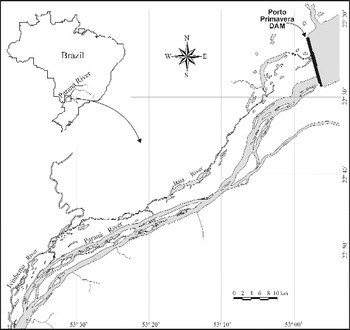
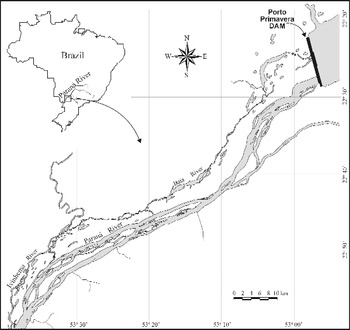
The Hydroelectric Power Plant Engenheiro Sérgio Motta, also known as Porto Primavera Hydroelectric Plant, is located on the Paraná River, 28 km upstream of the confluence with the Paranapanema River. Its dam, the longest in Brazil, is 10,186.20 m long and its reservoir has a surface area of 2250 km2 (CESP, 2011).
In 1999, after the construction of the Porto Primavera reservoir, the floodplain of the Paraná River was reduced to a short lotic stretch of about 200 km, which extends to the Itaipu dam (Galvão & Stevaux, Reference Galvão and Stevaux2010).
The introduction of exotic species is another important factor that has caused modifications in the area. Among the introduced species that settled in the floodplain of the upper Paraná River are the bivalves Limnoperna fortunei and Corbicula fluminea. The latter species has been documented in the area since 1990 (Takeda et al., Reference Takeda, Fujita, Fontes, Agostinho, Rodrigues, Gomes, Thomaz and Miranda2004) and the populations of L. fortunei have shown exponential growth since the end of 2002 (Takeda et al., Reference Takeda, Fujita and Fontes2002). Studies have recorded the use of these organisms as food sources for fish species (Cantanhêde et al., Reference Cantanhêde, Hahn, Gubiani and Fugi2008), also they compete with native species, causing changes in diversity and abundance of macroinvertebrates, mainly bivalves and gastropods (Takeda et al., Reference Takeda, Fujita, Fontes, Agostinho, Rodrigues, Gomes, Thomaz and Miranda2004). Thus, the introduction of these species has caused changes in the structure of aquatic food webs by causing changes in the diet of native species.
Changes in community structure and, consequently, in food webs may reflect changes in helminth parasite infracommunities, since most of the internal parasites come into contact with the host through food. There are few studies that relate the modifications of the helminth fauna of fish with environmental impacts such as those caused by dam construction (Morley, Reference Morley2007; Morley & Lewis, Reference Morley and Lewis2010).
Salminus brasiliensis (Cuvier 1816), also known as ‘Dourado’, is a piscivorous fish that migrates extensively in the basin of the upper Paraná River for reproductive purposes (Agostinho et al., Reference Agostinho, Gomes and Pelicice2007). This ecologically important fish species, as a top predator, can interfere with the qualitative and quantitative composition of prey species (Persson et al., Reference Persson, Anderson, Wahlstron and Eklov1996). ‘Dourado’ is also a very popular fish in game-fishing, with a high price in trade due to the excellent quality of its meat (Zaniboni-Filho & Schulz, Reference Zaniboni-Filho, Schulz, Carolsfeld, Harvey, Ross and Baer2003).
Thus, the present study investigated possible changes in the structure of the helminth parasite infracommunities of S. brasiliensis after construction of the Porto Primavera dam, as well as identification of the type of changes that occurred, and offers suggestions for future studies on the use of helminth parasites as indicators of the quality of aquatic ecosystems. Data were collected both before and after the construction of the dam.
Materials and methods
Study area
The upper Paraná River floodplain is located between two reservoirs, immediately downstream from the Porto Primavera dam and about 200 km upstream from the beginning of the Itaipu reservoir. This area is the last stretch of the Paraná River inside Brazilian territory with running waters (Souza-Filho & Stevaux, Reference Souza-Filho, Stevaux, Thomaz, Agostinho and Hahn2004) and is located near the municipality of Porto Rico, Paraná State (22°43′S and 53°10′W) (fig. 1).
The floodplain of the upper Paraná River and Porto Primavera Hydroelectric Plant.
Collection and examination of fish for parasites
Between 1992 and 1995, the period prior to the dam's construction, 126 specimens were collected (then identified as S. maxillosus Valenciennes 1849). Then, between 2009 and 2010, after the construction of the dam, 56 specimens of S. brasiliensis were collected. To minimize the possible effect of time of year, the samples were acquired quarterly, both before and after construction, in March, June, September and December.
Fish were collected using a rod and reel as well as nets of different mesh sizes, which were placed for 24 h at each sampling point. The nets were checked every 8 h. Following the collection period, the fish were taken to the laboratory and immediately killed by deep anaesthesia with 3 g of benzocaine dissolved in 10 ml of ethanol to 30 litres of water (Lizama et al., Reference Lizama, de Los, Takemoto, Ranzani-Paiva, Ayroza and Pavanelli2007). All fish caught by nets were analysed to ensure sampling of the different sizes of fish.
After taxonomic identification and biometric data of the hosts had been obtained, a longitudinal incision was made on the ventral surface of the individual and all organs were removed and separated. The visceral cavity and each organ were examined under a stereomicroscope to collect helminth parasites. Sampling, fixation, conservation and preparation of the helminth parasites followed the methodology of Eiras et al. (Reference Eiras, Takemoto and Pavanelli2006).
Data analysis
The Brillouin diversity index (HB) was used to determine the diversity of parasite infracommunities before and after the construction of the Porto Primavera dam. The Mann–Whitney U test was used to establish whether the differences were significant. The Simpson index was used to determine the concentration of dominance (C), based on the proportion of infected fish, with dominance being assumed for values greater than or equal to 0.25 (Stone & Pence, Reference Stone and Pence1978).
The relative condition factor (K n) was calculated for each host, which corresponds to the ratio between the observed weight (W o) and the theoretically expected weight (W e) for a given length, i.e. K n= W o/W e (Le Cren, Reference Le Cren1951). The constants a and b of the length–weight relationship were used to estimate the theoretically expected values of body weight (W e) by the formula a.L sW e= b, where L s is the length standard.
Results
Before dam construction
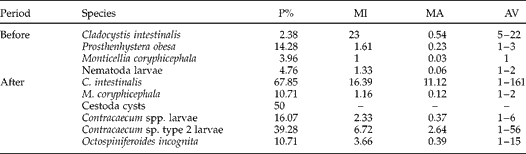
Each specimen of S. brasiliensis was measured, with a (mean ± standard deviation) body length of 32.08 ± 10.33 cm (range 12–63.2 cm). Two Digenea (Prosthenhystera obesa and Cladocystis intestinalis), one Cestoda (Monticellia coryphicephala) and one nematode larva (not identified) were reported (table 1). The most prevalent species was P. obesa (14.28%) and the least prevalent was C. intestinalis (2.38%).
Helminth parasites of Salminus brasiliensis before and after the construction of the Porto Primavera Hydroelectric Plant.
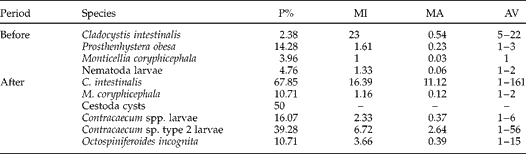
P%, prevalence; MI, mean intensity; MA, mean abundance; AV, range of abundance variation.
After dam construction
Fish were measured prior to post-mortem examination for helminths. The length of the fish varied between 18.3 and 68.5 (mean ± standard deviation 39.4 ± 12.82 cm). The following parasites were found: C. intestinalis, M. coryphicephala, Octospiniferoides incognita, Contracaecum spp. larvae and Contracaecum sp. type 2 larvae Moravec, Kohn & Fernandes Reference Moravec, Kohn and Fernandes1993 (table 1). The most prevalent species was C. intestinalis (67.85%) and least prevalent were M. coryphicephala and O. incognita with 10.71%.
Diversity differed between the pre- and post-dam periods (mean HB = 0.069 and HB = 0.2, respectively), significantly different according to the Mann–Whitney test (Z (U) = 1.97; P= 0.0479). The parasite community of S. brasiliensis before the construction of the dam showed dominance of P. obesa (C = 0.38) and after the dam's construction there was no concentration of dominance of any species of parasite (C = 0.22). The digenean C. intestinalis also stood out for presenting the lowest prevalence of infection before the construction of the dam and the highest prevalence after the event. Besides the increase in prevalence, the mean abundance of parasites after the construction of the dam also rose, from 0.54 to 11.12 individuals. In the pre-Porto Primavera dam period the K n of fish was 1.0 while after the dam's construction it was 0.93, significantly different according to the Mann–Whitney test (Z (U) = 4.1257; P < 0.0001).
Discussion
The fish studied (S. brasiliensis) in the present investigation were mainly piscivorous, feeding on a great variety of fish species (Almeida et al., Reference Almeida, Hahn and Vazzoler1997). The feeding habit of the examined species may have great influence on the composition and abundance of its helminth parasite species, since they come in contact with the host primarily through food. This fact led us to the hypothesis that the environmental changes caused by the dam (that results in changes in the trophic structure of the whole community) affected the composition and structure of the helminth fauna of S. brasiliensis.
According to the results obtained after the formation of the Porto Primavera Reservoir, there was a great change in the structure of the helminth fauna of S. brasiliensis, showing changes in the richness and abundance of parasites. The most important change was the disappearance of digenean P. obesa, which was the species with the highest prevalence of infection before the dam was built.
According to a previous study, the prevalence of P. obesa is not correlated with the standard length of the host, and there is no influence of the sex of the host on its prevalence and infection intensity (Isaac et al., Reference Isaac, Guidelli and Pavanelli2000). This information eliminates the possibility that the differences before and after the dam's construction had been due to the influence of ontogenetic development or the percentage of males and females in the sample.
In Brazil, the oldest known record of P. obesa parasitizing S. maxillosus dates from 1918, in specimens caught in São Paulo State. In the Paraná River basin, P. obesa was recorded from specimens of S. maxillosus collected in the localities of Guaíra in 1985 and Foz do Iguaçu in 1991 (Kohn et al., Reference Kohn, Fernandes and Baptista-Farias1997). To date, P. obesa has been recorded parasitizing about 26 species of fish collected in the São Francisco, Paraná and Paraguay basins (Thatcher, Reference Thatcher1993; Kohn et al., Reference Kohn, Fernandes and Baptista-Farias1997, Reference Kohn, Moravec, Cohen, Canzi, Takemoto and Fernandes2011; Brasil-Sato & Pavanelli 2004).
According to recent checklists of fish hosts and their parasites from the Paraná River basin, P. obesa was recorded in three hosts: Pimelodus maculatus and S. brasiliensis in the upper Paraná River floodplain (Takemoto et al., Reference Takemoto, Pavanelli, Lizama, Lacerda, Yamada, Moreira, Ceschini and Bellay2009), and Cynopotamus kincaidi and S. brasiliensis in the middle Paraná River (Kohn et al., Reference Kohn, Moravec, Cohen, Canzi, Takemoto and Fernandes2011). However, these checklists are based on studies that report results from several expeditions, including years prior to the construction of the major dams of the river; they do not specify the last time that P. obesa was recorded in these hosts. The most recent study that records the occurrence of this parasite in this area is that of Brasil-Sato & Pavanelli (Reference Brasil-Sato and Pavanelli2004) in specimens of P. maculatus collected between 1995 and 1997. For S. brasiliensis, the last record was in specimens collected between 1992 and 1995 (Isaac et al., Reference Isaac, Guidelli and Pavanelli2000). Both studies by Brasil-Sato & Pavanelli (Reference Brasil-Sato and Pavanelli2004) and Isaac et al. (Reference Isaac, Guidelli and Pavanelli2000) were prior to the construction of the Porto Primavera Reservoir.
Adult worms of the digenean P. obesa occur in the gall bladder of several species of freshwater fish. This parasite can be considered large compared with the size of the organ, where it settles and probably harms the host by reducing the storage capacity of the gall bladder (Isaac et al., Reference Isaac, Guidelli and Pavanelli2000). The Digenea are Platyhelminthes that always have a vertebrate as the definitive host. The life cycle of these parasites is complex, involving two hosts, with asexual reproduction in the first intermediate host, which, with rare exceptions, is a clam (Eiras et al., Reference Eiras, Takemoto and Pavanelli2010). The characteristics of the floodplain of the upper Paraná River ensure the maintenance of life cycles of digenetic species by presenting a diversity of aquatic habitats, including ponds of various shapes and sizes, and diversity of fish, birds and aquatic plants (Souza-Filho et al., Reference Souza-Filho, Rocha, Comunello, Stevaux, Thomaz, Agostinho and Hahn2004).
The absence of P. obesa after the closure of Porto Primavera was probably due to the change of the flood pulse or the arrival of invasive molluscs after dam construction, which may have caused high mortality of intermediate hosts, thereby preventing the completion of the digenean life cycle. This study records the disappearance of P. obesa, and suggests that there has been local extinction of this parasite; however, we emphasize that it is necessary to monitor the parasitic fauna to prove this hypothesis.
The occurrence and abundance of mussels (L. fortunei) showed a visible increase in the study area, to the detriment of native species (Takeda et al., Reference Takeda, Fujita, Fontes, Agostinho, Rodrigues, Gomes, Thomaz and Miranda2004). The monitoring of species has shown that their proliferation in the floodplain of the upper Paraná River, coupled with changes resulting from the construction of dams just above the plain, resulted in marked changes in native benthic communities (Takeda et al., Reference Takeda, Fujita and Fontes2002). These changes can influence the life cycle of digenetic species of parasites and the parasitic fauna composition of fish and birds in the region. According to Abdul-Salam & Al-Khedery (Reference Abdul-Salam and Al-Khedery1992), populations of shellfish may determine which digenetic species are present in the fish and birds in a region. Thus, any disturbance in this environment influences parasite life cycles. The present results indicate an enhancement of the life cycle of C. intestinalis and some disruption of that of P. obesa.
Cladocystis intestinalis occurs in the intestine of both Salminus hilarii and S. maxillosus (Kohn et al., Reference Kohn, Fernandes, Macedo and Abramson1985; Kohn & Fernandes, Reference Kohn and Fernandes1987), although Takemoto et al. (Reference Takemoto, Pavanelli, Lizama, Lacerda, Yamada, Moreira, Ceschini and Bellay2009) reported this species in S. brasiliensis from the upper Paraná River foodplain as Neocladocystis intestinalis (Vaz, 1932). Cladocystis intestinalis occurs only in the fish host genus Salminus, suggesting that this digenean is host genus-specific or at least shows a preference for this genus. Interestingly, the increase in the prevalence of infection and in the variations of the abundance of C. intestinalis coincided with the disappearance of P. obesa. Since C. intestinalis occurs in the intestine, a negative correlation with other parasite species occupying this niche is expected. However, we observed an increase in the prevalence of infection and the variations of the abundance of M. coryphicephala and O. incognita.
Unlike P. obesa, the acanthocephalan O. incognita has only been recorded in S. brasiliensis after the formation of the Porto Primavera Reservoir. The acanthocephalans are exclusive parasites of the digestive tract of vertebrates (Taraschewski, Reference Taraschewski2008) with complex life cycles involving two hosts (fish and invertebrates) (Eiras et al., Reference Eiras, Takemoto and Pavanelli2010). The intensity of infection in the definitive host is dependent on its diet and accessibility of intermediate hosts, but the transfer of adult parasites among hosts may also occur (Hnath, 1969; Amin & Burrows, Reference Amin and Burrows1977). In our later samplings (2009), O. incognita had a prevalence greater than 10%, supporting the changes in the trophic network hypothesis, caused by changes in ecosystem structure.
The condition factor is an index widely used to study the biology of fish, because it provides important information about the physiological status of these animals, the assumption being that individuals with greater mass in a given length are in better condition (Lima-Junior & Goitein, Reference Lima-Junior and Goitein2006). According to Vazzoler (Reference Vazzoler1996), the condition factor is an important indicator of the degree of health of an individual and its value reflects recent nutritional conditions and/or expenses of the stocks in cyclical activities, and it can be related to the environmental and behavioural aspects of the species.
An important tool for the study of host–parasite interactions is the relationship between the K n of fish and their levels of parasitism (Lizama et al., Reference Lizama, de los, Takemoto and Pavanelli2006). Condition factor variations among individuals and populations can be used to show effects of different factors such as environmental quality and food resources (Bolger & Connolly, Reference Bolger and Connolly1989) and also the effect of species of parasites on their hosts in natural environments (Ranzani-Paiva et al., Reference Ranzani-Paiva, Silva-Souza, Pavanelli and Takemoto2000). The K n takes into account the expected and observed weight. Variations that are influenced by the environment, the lack of food or even parasites cause changes in value, and in normal conditions the optimal value is 1.
Before construction of the Porto Primavera dam, the average condition factor of S. brasiliensis was 1, i.e. the optimal value. After the construction of the dam, the value dropped to 0.93, showing the human influence on natural systems by interfering directly or indirectly on fish welfare and health. Another hypothesis for this result is the presence of the Acanthocephala group, not present before the closure of the Porto Primavera dam, which may be more pathogenic to the hosts, with a higher prevalence of other groups such as Cestoda and Nematoda. Analysing Prochilodus lineatus from the Volta Grande Reservoir, Minas Gerais State, Martins et al. (2001) observed important host responses in fish parasitized by the Acantocephalan Neoechinorhynchus curemai; desquamation, hyperplasia and hypertrophia of the goblet cells in the intestinal epithelium were observed.
As carnivorous fish feed on a large number of fishes, we expected that S. brasiliensis would have a great diversity of helminth parasites acquired from their prey, as reported by Machado et al. (Reference Machado, Pavanelli and Takemoto1996), who found ten species of helminths (five Nematoda, five Cestoda) in the guts of Pseudoplatystoma corruscans from the Paraná River basin. However, S. brasiliensis presented only four species of helminth fauna before the construction of the dam (one in a larval stage) and five in the post-dam period (two in a larval stage).
Through the results obtained, we conclude that after the construction of the Porto Primavera dam and the introduction of exotic species, helminth fauna and the condition factor of S. brasiliensis were modified. This study shows that changes in aquatic environments influence the diversity of parasites and nutritional conditions of fish. Thus, it emphasizes the need for studies to determine specifically what is causing these changes.
Acknowledgements
The authors wish to thank Nupélia/UEM, Núcleo de Pesquisas em Limnologia, Ictiologia e Aquicultura, and to Project A Planície Alagável do Rio Paraná: Estrutura e Processos Ambientais – PELD/CNPq for logistic and financial support. A.I. and I.P.A. were supported by a research fellowship from CAPES (Coordenação de Aperfeiçoamento de Pessoal de Ensino Superior). L.C.K, R.M.T. and G.C.P. were supported by a research fellowship from CNPq (Conselho Nacional de Desenvolvimento Científico e Tecnológico). We are also very grateful to Dr Katherine Cameron and the anonymous reviewers for their valuable suggestions.