Introduction
Increasingly, the modern food system is characterized as a complex socio-ecological system resulting from interactions between biophysical and social factors (Jordan et al., Reference Jordan, Grossman, Lawrence, Harmon, Dyer, Maxwell, Cadieux, Galt, Rojas, Byker, Ahmed, Bass, Kebreab, Signh, Michaels and Tzenis2014; iPES-FOOD, 2015). Challenges emerging from the inherent complexity of modern food systems are typically ill-structured or of a ‘wicked’ sort, meaning that they are multi-faceted, uncertain and unpredictable, and marked by disputes about causes and solutions (King and Kitchener, Reference King and Kitchener1994; Hamm, Reference Hamm2009). Global food security is a prime example of such a problem. Although consensus exists that society ought to ensure an adequate diet for a growing global population while simultaneously addressing the detrimental social and ecological effects of our current food system, disagreement exists over how to achieve this objective (Mooney and Hunt, Reference Mooney and Hunt2009; Fraser et al., Reference Fraser, Legwegoh, KC, CoDyre, Dias, Hazen, Johnson, Martin, Ohberg, Sethuratnam, Sneyd, Smithers, Van Acker, Vansteenkiste, Wittman and Yada2016).
Individuals and organizations involved in food-related careers are increasingly required to address such problems in food systems as a regular element of their professional work. Actors in all food system sectors—including agricultural production, food distribution, retail, nutrition (consumption) and disposal—now address complex food systems issues of ecological sustainability, food safety and security and food sovereignty, in addition to other considerations such as profitability and livelihoods. For example, governments and even many private-sector firms are concerned with providing ‘positive social impact,’ in addition to economic growth or profitability. Increasingly, therefore, future professionals in the food system will need to carry out complex organizational missions in global and local food environments in which interdependency and engagement in large-scale emergent structures are routine aspects of work (Institute for the Future, 2011; Liu et al., Reference Liu, Mooney, Hull, Davis, Gaskell, Hertel, Lubchenco, Seto, Gleick, Kremen and Li2015). These dynamics will require new capacities for collective intelligence and integrated action, requiring in turn new kinds of knowledge, skills and dispositions. Ultimately, food systems professionals will need to demonstrate individual and collective agency to advance workplace and societal missions that encompass economic, environmental and social aspects of sustainability in food and agriculture. We emphasize that we interpret social sustainability broadly, to encompass complex issues such as food security, food sovereignty and food justice (Loos et al., Reference Loos, Abson, Chappell, Hanspach, Mikulcak, Tichit and Fischer2014).
Institutes of higher education have a crucial role to play in the development of new professionals whose work will directly shape the food system, including agronomists, nutritionists, crop breeders, civil servants and industry leaders. These actors, as professionals, require the capacity to make judgments under conditions of complexity and uncertainty through particular forms of thinking, performance and action with integrity (Shulman, Reference Shulman2005). Complex challenges within modern food systems also demand attention to relationships among system elements spanning production, consumption, waste and to balancing social, economic and environmental aspects of sustainability (McIntyre et al., Reference McIntyre, Herren, Wakhungu and Watson2009; EU SCAR, 2013). However, in many current educational programs, future professionals are trained in narrowly defined disciplines, such as food science, nutrition, agronomy, plant science and animal biology. Traditional agriculture and food-related curricula often follow linear, cause-and-effect rationalities that focus on a limited range of objectives (e.g., agricultural yield, micronutrient intake, or return on investment) (Jordan et al., Reference Jordan, Grossman, Lawrence, Harmon, Dyer, Maxwell, Cadieux, Galt, Rojas, Byker, Ahmed, Bass, Kebreab, Signh, Michaels and Tzenis2014). Graduates are thus often ill-prepared to deal with complexity in food systems or interact effectively with knowledge and practical domains outside of their specialization.
In response, there has been rapid growth in North American sustainable agriculture and food systems degree programs, specializations and certificates (Jacobsen et al., Reference Jacobsen, Niewolny, Schroeder-Moreno, Van Horn, Harmon, Chen Fanslow, Williams and Parr2012; Self et al., Reference Self, Handforth, Hartman, McAuliffe, Noznesky, Schwei, Whitaker, Wyatt and Webb Girard2012; Jordan et al., Reference Jordan, Grossman, Lawrence, Harmon, Dyer, Maxwell, Cadieux, Galt, Rojas, Byker, Ahmed, Bass, Kebreab, Signh, Michaels and Tzenis2014), which we characterize under the umbrella term of Sustainable Food Systems Education (SFSE). These developments create an opportunity to analyze emergent themes across the programs to articulate a signature pedagogy (SP) for SFSE. SPs are systemic models of the educational process in a particular discipline or field of study (Shulman, Reference Shulman2005); such models reveal the characteristic forms of teaching and learning through which ‘future practitioners are educated for their new professions’ (Shulman, Reference Shulman2005, p. 52).
In this paper, we apply a SP framework to the field of undergraduate SFSE, aiming to spur critical and creative dialogue about the theory and practice of SFSE. As educators in flagship SFSE programs at four universities in North America, we identify commonalities in our pedagogical approaches to SFSE in conversation with themes in the broader SFSE literature. Our aim is to provide a common structure and lexicon for elucidating and comparing program objectives, curricular activities and assessment strategies across SFSE programs. This, in turn, can enable further pedagogical innovation within the SFSE field.
What is a SP?
Shulman (Reference Shulman2005, p. 52) defines a SP as the ‘types of teaching that organize the fundamental ways in which future practitioners are educated for their new profession.’ SPs orient both teachers and learners to the ontological, epistemic and axiological foundations of a profession, as well as to the accepted methodological approaches to developing essential professional capacities. SPs implicitly define what counts as knowledge in a field and how things become known. They define how knowledge is analyzed, criticized, accepted, or discarded. They define the functions of expertise in a field, the locus of authority and the privileges of rank and standing (Shulman, Reference Shulman2005, p. 54).
A SP for a particular profession is typically used across the range of institutions engaged in education for that field. Use of the SP creates strong alignment among programs in terms of philosophies of education, teaching practices and learning outcomes while developing the ‘three fundamental dimensions of professional work: to think, to perform and to act with integrity’ (Shulman, Reference Shulman2005, p. 54).
In Shulman's framework, SPs have structure and associated functions at three nested levels. First, the surface structure reflects the visible operational acts of teaching and learning, including the learning contexts and roles of participants in the learning environment. The second level, deep structure, is ‘a set of assumptions about how best to impart a certain body of knowledge and know-how’ that together constitutes essential theories, concepts, and capacities for professional practice (Shulman, Reference Shulman2005, pp. 54–55). The third level, implicit structure, consists of ‘a moral dimension that comprises a set of premises and commitments about professional attitudes, values, and dispositions’ (Shulman, Reference Shulman2005, p. 55). This third level is also termed the ‘hidden curriculum’, i.e., content, process and behavior of teachers and students during learning activities that constitute, in effect, instruction in professional attitudes, values and dispositions (Shulman, Reference Shulman2005, p. 55).
Below, we identify common themes in SFSE programs (our own and those reported in the SFSE literature) and present them within a SP framework. We discuss the potential opportunities connected to developing a common pedagogical pattern within the field as well as challenges associated with the implementation of an SFSE SP, including critical examples from our own programs. We conclude with a call for further research on evaluating specific outcomes and components to enhance the quality of teaching and learning in SFSE programs.
Identifying Common Themes in SFSE Programs
To determine common themes in SFSE programs, we conducted a thematic content analysis of our respective SFSE programs’ learning objectives and guiding principles. Concurrently, we identified themes articulated in scholarly literature on pedagogical innovation in the domains of sustainable agriculture, nutrition and agroecology, as well as empirical investigations of academic programs and other perspectives from scholars and practitioners within the field. Below, we describe our SFSE programs, the process of analyzing learning outcomes and guiding principles and the frequency of occurrence of each theme. We then define four central themes (collective action, systems thinking, experiential learning and interdisciplinarity), describe how they are put into practice with specific examples from our undergraduate programs and discuss how these emergent themes relate to dominant themes within the SFSE literature.
Four undergraduate SFSE programs
We first present an overview of our four undergraduate sustainable food systems programs: (1) the Land, Food and Community series curriculum at University of British Columbia (UBC), (2) the Sustainable Food and Bioenergy Systems major at Montana State University (MSU), (3) the University of Minnesota (UMN) Food Systems major and (4) the Sustainable Agriculture and Food Systems major at the University of California, Davis (UC Davis).
The Faculty of Land and Food Systems instituted a SFSE program at the University of British Columbia in Vancouver, Canada in 2000 as a 4-yr ‘Land, Food and Community’ (LFC) core series of courses required for all undergraduate students in degree programs offered by this faculty (Applied Biology, Food, Nutrition and Heath, and Global Resource Systems). The LFC series aims to enable students to use systems approaches to analyze issues related to building healthy, sustainable and just food systems, including a focus on how to evaluate interdisciplinary evidence and work on community-based projects in multi-stakeholder teams.
Montana State University initiated the interdisciplinary Sustainable Food and Bioenergy Systems (SFBS) major 2009 with a set of core courses and four program options (Sustainable Food Systems, Sustainable Crop Production, Agroecology and Sustainable Livestock Production) housed between four departments in two colleges (Colleges of Agriculture and Education, Health and Human Development). Core courses in the SFBS major provide systems thinking training through experiential learning projects with the goal to build student capacity on promoting sustainable production, distribution and consumption of food and bioenergy, while courses for specific program options allow for enriching disciplinary expertise.
The University of California, Davis launched its interdisciplinary Sustainable Agriculture and Food Systems major in 2011, centered on core classes with heavy emphases on experiential learning and systems thinking, and with three tracks (Agriculture and Ecology, Food and Society and Economics and Policy). The program is overseen by eight departments within the College of Agricultural and Environmental Sciences, and focuses on seven learning outcomes: systems thinking, experimentation and inquiry, interpersonal communication, understanding values, strategic management, civic engagement and personal development.
The University of Minnesota has offered its Food Systems major since 2014. Like the other programs, the major is organized around a core of four courses that impart holistic perspectives on food and agriculture, with particular emphasis on systems thinking across multiple scales and in engagement with non-academic expertise. Currently, students can complement the core curriculum with three focused tracks (Organic and Local Food Production, Agroecology and Consumers and Markets) or an individualized track. Presently offered by faculty who work in agricultural science and economics, the intent is to further integrate both faculty and students that work on food and agriculture from other disciplinary perspectives.
Thematic analysis of learning outcomes and guiding principles
We compiled evidence (syllabi, curriculum descriptions and program documents) of learning outcomes and guiding principles from each of our undergraduate SFSE programs. From these documents, we conducted a curriculum review to identify key pedagogical themes (Creswell, Reference Creswell2013). We grouped the language on learning outcomes and guiding principles into meaning units (Saldana, Reference Saldana2013) and coded and categorized each of the meaning units to identify themes. We tabulated the frequency of meaning units as a percentage of total meaning units of all themes. Meaning units were placed under multiple themes where applicable.
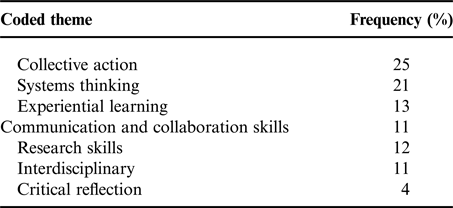
We identified seven themes that occurred in all four SFSE programs (Table 1) from the 75 meaning units derived from the thematic analysis. These themes were collective action, systems thinking, experiential learning, communication and collaboration skills, research skills, interdisciplinarity and critical reflection. Table 1 lists the frequency of occurrence of each theme as a percentage of all meaning units.
Frequency of themes from coded learning outcomes and guiding principles.

In what follows, we define the emergent themes from our curriculum analysis, provide curricular examples from our programs and discuss the congruence of these themes with the broader SFSE literature.
Collective action
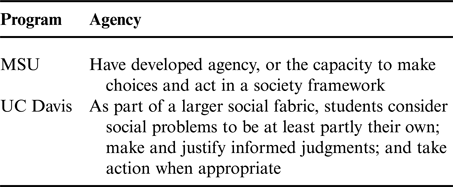
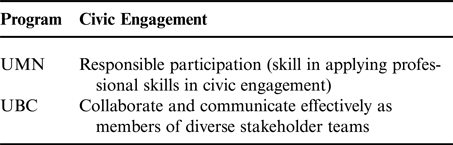
In our analysis of our program learning objectives and guiding principles, we combined two sub themes, development of agency (19%) and civic engagement (9%), into one theme: collective action (see Tables 2 and 3 for examples) (due to overlap of two meaning units within the sub-themes, the final percentage is 25%). We define agency as the reflexive product of action, which allows an individual to understand who she is, what she is doing and why (Gubrium and Holstein, Reference Gubrium and Holstein1995). We define civic engagement as a partnership between university and external stakeholders to collaboratively identify and address issues of mutual interest, supporting both course learning outcomes and stakeholder needs (McNall et al., Reference McNall, Reed, Brown and Allen2008). External stakeholders are broadly defined as individuals, organizations, or networks that are attempting to address public or civic problems in the food system, such as farmers, health professionals, non-profit organizations, K-12 schools, branches of government and industry partners. Combining these two terms, we define collective action as a theme demonstrated when students are empowered and motivated to act together to achieve a common objective, address critical societal issues and contribute to the public good (Gilbert, Reference Gilbert2006; McNall et al., Reference McNall, Reed, Brown and Allen2008).
Examples of program learning outcomes or guiding principles related to agency.

Examples of program learning outcomes or guiding principles related to civic engagement.

SFSE students at each of our four institutions engage in collective action projects, situated in various community settings (Jordan et al., Reference Jordan, Grossman, Lawrence, Harmon, Dyer, Maxwell, Cadieux, Galt, Rojas, Byker, Ahmed, Bass, Kebreab, Signh, Michaels and Tzenis2014), that seek a ‘socially constructed definition [of sustainable food systems] that evolves as individuals and groups learn to negotiate meanings, power inequalities, and conflicting worldviews’ (Parr et al., Reference Parr, Trexler, Khanna and Battisti2007, p. 530). For example, over the course of an academic year, 12 groups of third-year students at UBC (72 students in total) conducted community kitchen asset inventories across all 21 neighborhoods in the city of Vancouver. Municipal staff and academics at UBC created a survey and questionnaire for student groups to collect observational data and conduct interviews. Each student group was assigned one or two neighborhoods of the city and contacted community kitchens to determine interest in participating in the study. The activity provided an opportunity for students to collaborate with professionals and community members working on food security related initiatives while developing research-related skills. Students were exposed to policymaker and community member perspectives and practices to tangible food system issues with respect to differences in neighborhood demographics. The logistical scope of the city-wide inventory would have been otherwise beyond the capacity of municipal staff. However, the results of students’ data collection and analysis will be used to inform funding allocation to develop food assets in the city. Similar pedagogical activities occur in the food systems major capstone courses at UC Davis, UMN and MSU (Grossman et al., Reference Grossman, Sherard, Prohn, Bradley, Goodell and Andrew2012; Jordan et al., Reference Jordan, Grossman, Lawrence, Harmon, Dyer, Maxwell, Cadieux, Galt, Rojas, Byker, Ahmed, Bass, Kebreab, Signh, Michaels and Tzenis2014).
In the SFSE literature, Niewolny et al. (Reference Niewolny, Grossman, Byker, Helms, Clark, Cotton and Jacobsen2012, p. 28) articulate the pedagogical importance of civic engagement through community-campus partnerships in new food system programs and identify the various forms these opportunities may take, including ‘agriculture-orientated [sic] internships, off-campus service-learning opportunities, cooperative learning experiences with the agriculture industry, student-led seminars, and self-directed practicums.’ Clark et al. (Reference Clark, Byker, Niewolny and Helms2013) scaffold service-learning throughout Virginia Tech's food system minor, culminating in capstone experiences that mutually benefit students, community partners and faculty. Similarly, Hilimire et al. (Reference Hilimire, Gillon, McLaughlin, Dowd-Uribe and Monsen2014) discuss scenario-based case studies that begin with a practitioner developed problem related to their position within the food system.
Systems thinking
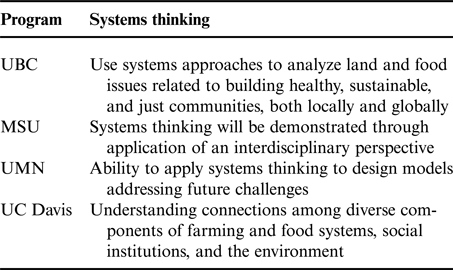
Developing systems thinking competencies emerged as the second most prevalent theme within the analysis (see Table 4 for examples of learning outcomes and guiding principles). At the core of systems thinking, or adopting a systems perspective, are the principles of holism and pluralism. Holism is defined as a shift in one's attention to the relationships and interactions between the component parts of a system to understand the whole and to be aware of the contextual factors that surround an issue; and, pluralism is defined as the explicit engagement and valuing of multiple perspectives in defining systems objectives, boundaries, interventions and evaluations (Reynolds and Holwell, Reference Reynolds and Holwell2010; Williams and Hummelbrunner, Reference Williams and Hummelbrunner2010).
Examples of program learning outcomes or guiding principles related to systems thinking.

One approach to develop systems thinking from the Faculty of Land and Food Systems at UBC begins by having students practice thinking about systems (Cabrera et al., Reference Cabrera, Colosi and Lobdell2008); that is, representing systems (such as the dairy sector in BC) through diagrams and creating models to identify components, boundaries, nested levels, inputs, and outputs and then relate them to processes of emergence, energy and material flow, and feedback loops (Meadows, Reference Meadows2008). In this way, interactions amongst components and processes inform an understanding of relationships and leverage points for understanding a system as a whole. After demonstrating understanding of systems concepts and behaviors, students begin to identify stakeholders and their interactions in the system, examining how their worldviews and values influence the goals and objectives of the system (Checkland, Reference Checkland1981). Central to this process is identifying structural inequalities, and through discussion and feedback, recognizing those perspectives that are absent from the conception of the system model (Ulrich and Reynolds, Reference Ulrich, Reynolds, Reynolds and Holwell2010). Another introductory approach to systems thinking conducted at UC Davis begins with an object (such as a food commodity) or a place (such as a garbage dump) or an interaction (such as buying a pack of gum) and asks the question: what conditions and causes have to be in place for this to exist here, in this form? In peeling back the layers, many components of different biophysical and social systems are implicated.
Developing systems thinking is a prominent theme in the broader SFSE literature (Jordan et al., Reference Jordan, Bawden and Bergmann2008, Reference Jordan, Grossman, Lawrence, Harmon, Dyer, Maxwell, Cadieux, Galt, Rojas, Byker, Ahmed, Bass, Kebreab, Signh, Michaels and Tzenis2014; Rojas, Reference Rojas, Allen-Gil, Stelljes and Borysova2009; Bawden, Reference Bawden and Blackmore2010; Jacobsen et al., Reference Jacobsen, Niewolny, Schroeder-Moreno, Van Horn, Harmon, Chen Fanslow, Williams and Parr2012; Rojas et al., Reference Rojas, Sipos and Valley2012; Clark et al., Reference Clark, Byker, Niewolny and Helms2013; Hilimire et al., Reference Hilimire, Gillon, McLaughlin, Dowd-Uribe and Monsen2014). Students are taught to recognize connectedness for a particular purpose as a key stage in being able to use holistic thinking to address particular food system challenges (Jordan et al., Reference Jordan, Grossman, Lawrence, Harmon, Dyer, Maxwell, Cadieux, Galt, Rojas, Byker, Ahmed, Bass, Kebreab, Signh, Michaels and Tzenis2014). With a similar emphasis on adopting a systems perspective, nutritionists and other health professionals are calling ‘for a ‘new paradigm’ of nutritional science and food systems that integrates the biophysical aspects of nutritional health with social and environmental antecedents and outcomes’ (Harmon et al., Reference Harmon, Lapp, Blair and Hauck-Lawson2011, p. 115).
Experiential learning
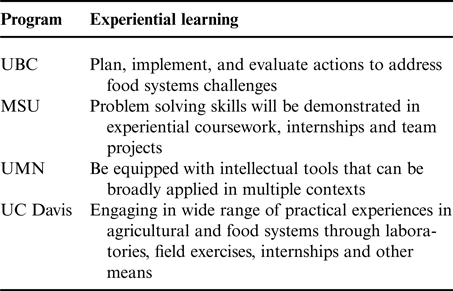
Experiential learning is a third common pedagogical strategy across our programs (see Table 5 for examples of learning outcomes and guiding principles). Inspired by educational theories of Dewey (Reference Dewey1966), Freire (Reference Freire1970), Kolb (Reference Kolb1984) and Mezirow (Reference Mezirow1991), our programs aim to provide experiences that integrate cognitive, psychomotor and affective learning into curricula. Such threefold engagement is essential to the notion of professionalism as capacities for thought, performance and action with integrity (Shulman, Reference Shulman2005). Incorporating critical reflection on cognitive and practical experience is integral to experiential learning, and has been found useful for unveiling worldviews and frames of reference (Mezirow, Reference Mezirow1991; Galt et al., Reference Galt, Parr, Kim, Beckett, Lickter and Ballard2013).
Examples of program learning outcomes or guiding principles related to experiential learning.

As an example of experiential learning activities, students at UC Davis participate in farm production and go behind the scenes in processing, distribution and marketing activities as well as working with community food system organizations. All four programs place strong emphasis on helping students identify and reflect upon their taken-for-granted meaning perspectives through experiential learning and associated reflection (Rojas, Reference Rojas, Allen-Gil, Stelljes and Borysova2009; Galt et al., Reference Galt, Clark and Parr2012, Reference Galt, Parr, Kim, Beckett, Lickter and Ballard2013; Jordan et al., Reference Jordan, Grossman, Lawrence, Harmon, Dyer, Maxwell, Cadieux, Galt, Rojas, Byker, Ahmed, Bass, Kebreab, Signh, Michaels and Tzenis2014).
In the literature, SFSE programs report incorporating experiential learning and critical reflection into their curricula in different ways. For example, a Critical Learning System theory emerged from experiences at the Hawkesbury School of Agriculture, characterized as a critically self-reflective subsystem based on Kolb's (Kolb, Reference Kolb1984) experiential learning cycle, through which learners integrate theory and action through reflection (Bawden, Reference Bawden2005; Jordan et al., Reference Jordan, Bawden and Bergmann2008). Lieblein and Francis (Reference Lieblein and Francis2007, p. 87), in describing their SFSE graduate program at the Norwegian University of Life Sciences also cite Kolb's experiential learning cycle and further conceptualize ‘a learning ladder metaphor that integrates a personal dimension including values, attitudes, and emotions into the learning landscape, in addition to cognitive elements.’ Students involved in these two programs typically carried out traditional agricultural extension activities, such as meeting with farmers and other actors in the food system to apply current research on production, processing, distribution and market strategies. Hilimire et al. (Reference Hilimire, Gillon, McLaughlin, Dowd-Uribe and Monsen2014) ascribe the importance of experiential learning to providing students with deeper understanding of theoretical concepts, opportunities to engage with food system practitioners and acquisition of research or job-related skills.
Interdisciplinarity
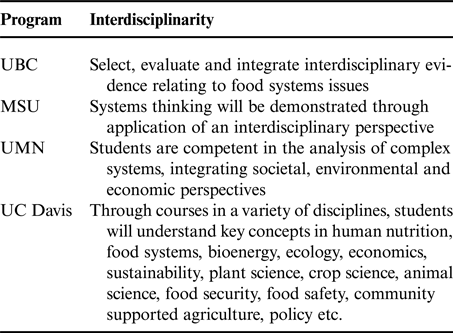
From our analysis of program objectives, interdisciplinary learning emerged as a significant theme (see Table 6 for examples). Consistent with pluralism as fundamental to a systems approach, our SFSE programs incorporate multiple academic and non-academic ways of knowing into pedagogical activities. Francis et al. (Reference Francis, Jordan, Porter, Breland, Lieblein, Salomonsson, Sriskandarajah, Wiedenhoeft, DeHaan, Braden and Langer2011, p. 228) make a useful distinction between multi-, inter- and trans- disciplinary approaches: a multidisciplinary approach ‘brings together multiple disciplines, but does not guarantee an integration of perspectives or research methods, nor any emergent value of the process’; interdisciplinary approaches address problems single academic disciplines are incapable of managing by allowing for a blending or modifying of approaches to better suit the problem at hand; and transdisciplinary strategies incorporate non-academic ways of knowing into knowledge generation activities, acknowledging that certain research problems or objectives require engagement beyond narrowly defined expert knowledge.
Examples of program learning outcomes or guiding principles related to interdisciplinarity.

Our programs frame curricula in a manner that intentionally integrates the natural and social science dimensions of the food system to inform the study of production, distribution and consumption. However, the SFSE programs examined here intentionally build on the experiential learning components of their curriculum to push inter- and multi-disciplinary strategies further to a transdisciplinary approach, incorporating humanistic and non-academic ways of knowing into course curriculum. This requires an intentional inclusion of perspectives at all levels in the food system, including those who work directly in the food system—on farms and as distributors and processors—to those who receive its end products—consumers—and those who shape it—citizens, politicians and educators.
For example, in a second-year course at UBC, students from all degree programs in the faculty learn about the provincial dairy system through separate guest lectures by an economist, sociologist, nutritional scientist, food scientist and animal welfare expert. Students are expected to draw on each perspective to develop an understanding of the sustainability of the system. Additionally, the class of 300 students is split into two groups, with half visiting a conventional dairy farm, and the other half visiting a certified organic dairy farm. One of the objectives of the tour is to provide students direct access to the knowledge of the farm operators and staff. Course discussion and assignments prompt students to compare their own experiences on the farms and from their respective disciplines with other academic and practitioner perspectives when making claims about the sustainability of the dairy system.
Explicitly designing curricular opportunities for students to interact with diverse stakeholders is a fundamental tenet in numerous SFSE programs (Bawden and Packham, Reference Bawden and Packham1993; Harmon et al., Reference Harmon, Lapp, Blair and Hauck-Lawson2011; Jacobsen et al., Reference Jacobsen, Niewolny, Schroeder-Moreno, Van Horn, Harmon, Chen Fanslow, Williams and Parr2012; Hilimire et al., Reference Hilimire, Gillon, McLaughlin, Dowd-Uribe and Monsen2014). Lieblein and Francis (Reference Lieblein and Francis2007, p. 85) state that inclusivity of perspectives is necessary to ‘determine a set of goals that will lead to an improved future food system, using social, ecological and economic indicators of sustainability’. Through this structuring of curricula, SFSE programs aim to bring the voice of the community into the classroom, or bring the classroom to the community, in a manner that frames the interaction as collaborative and reciprocal (Hilimire et al., Reference Hilimire, Gillon, McLaughlin, Dowd-Uribe and Monsen2014).
Applying a SP Framework to SFSE
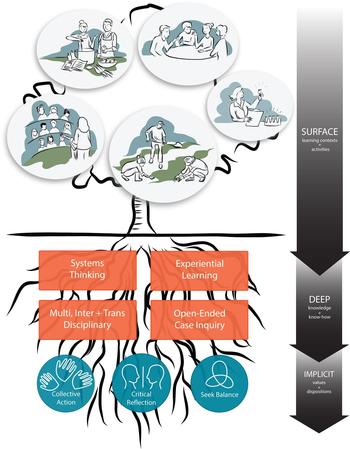
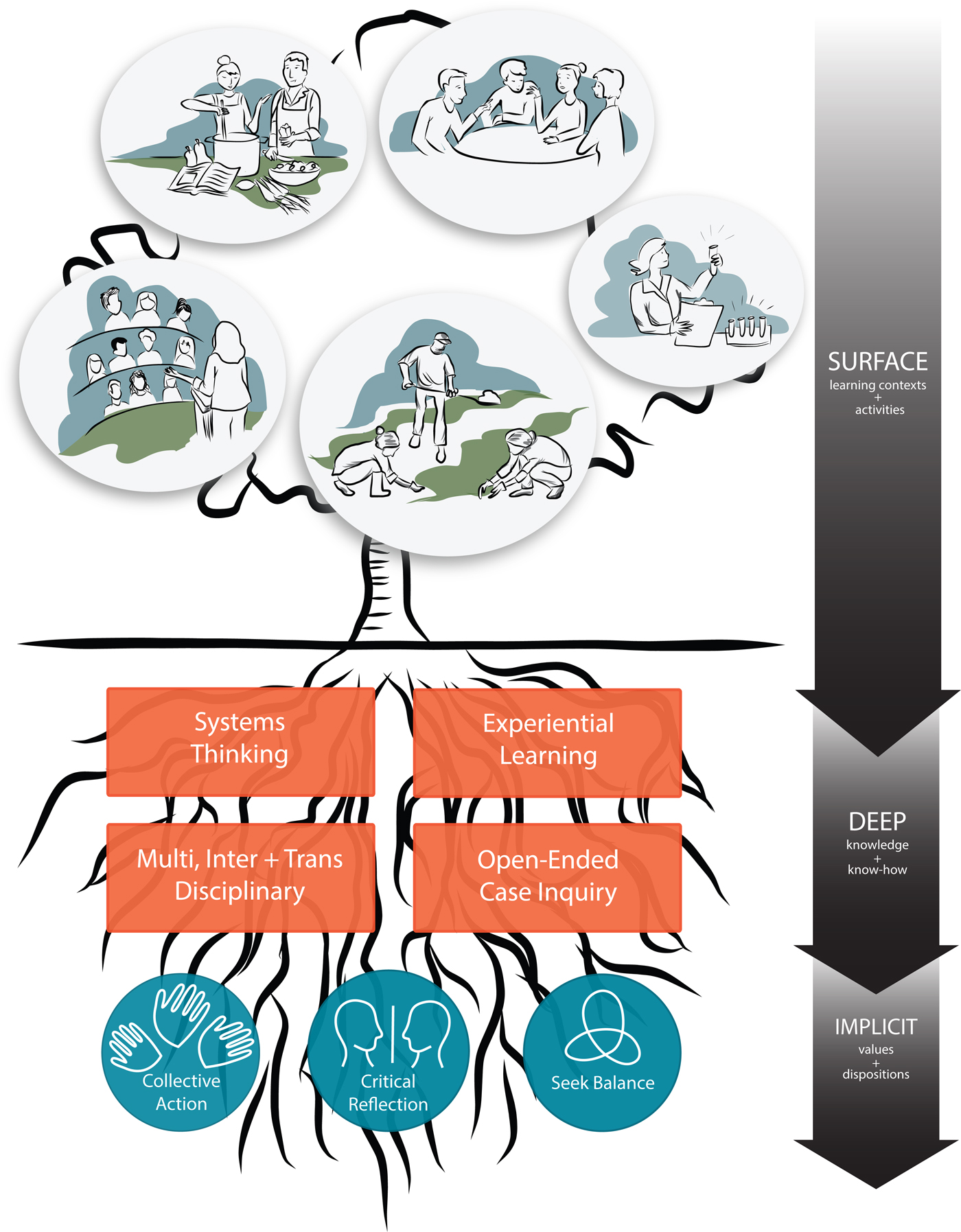
Here, we draw upon the analysis of our institutional learning outcomes and guiding principles, our teaching experiences, and SFSE literature to propose the central components of an emerging SFSE SP. Figure 1 (below) depicts the components of SFSE programs through the surface, deep and implicit levels of Shulman's (Reference Shulman2005) SP framework. The placement of each component within the three levels of the framework corresponds to the categorical differences within Shulman's conceptualization of a SP, which we describe in further detail below.
Components of the surface, deep and implicit structure of an emerging SFSE signature pedagogy.
Surface structure
The surface structure reflects the learning settings and configurations that facilitate the deep and implicit structures of the pedagogy. The surface structure of SFSE programs we examined—both our own and within the broader literature—contains the following characteristics: multiple learning contexts, individual and group learning opportunities and diverse assessment strategies (Rojas et al., Reference Rojas, Sipos and Valley2012; Francis et al., Reference Francis, Breland, Østergaard, Lieblein and Morse2013; Galt et al., Reference Galt, Parr, Kim, Beckett, Lickter and Ballard2013; Jordan et al., Reference Jordan, Grossman, Lawrence, Harmon, Dyer, Maxwell, Cadieux, Galt, Rojas, Byker, Ahmed, Bass, Kebreab, Signh, Michaels and Tzenis2014).
Multiple learning contexts in SFSE programs include lecture halls, small classrooms, laboratories, field placements, field trips, community placements and internships. Diverse contexts provide opportunities for students to adapt to learning in different settings and gain context-specific knowledge and skills. Small classrooms are conducive to activities that require active, spontaneous interactions with other learners. Field trips embed students in-place, providing opportunity to learn and integrate knowledge within diverse socio-ecological contexts. Labs, community-placements and internships require students to develop specific skills and competencies, from the technical to socio-cultural, through experiential learning activities.
To develop professionals capable of engaging with and producing multi-, inter- and trans-disciplinary knowledge, SFSE curricula place significant emphasis on collaborative and community-based group work activities. Group work in academic and community settings provides opportunities for students to interact with individuals in other disciplines and social actors beyond the university. Engaging with individuals with diverse worldviews, values and experiences prepares students for situations they will be encountering as professionals in the food system.
Being required to perform in multiple learning contexts as individuals and as part of collaborative groups, students in SFSE programs complete a variety of assessment tasks. Students demonstrate achievement of program learning objectives through traditional evaluations like multiple choice tests, short answer questions and essays. However, students also participate in group and self-assessments (Galt et al., Reference Galt, Parr, Kim, Beckett, Lickter and Ballard2013), individual and group presentations, discussion facilitation, system models development and writing proposals, reports, blog posts and reflective journals. This diversity models how professionals in the food system demonstrate their expertise and produce reliable knowledge.
Deep structure
The deep structure of a SP conveys how to think like a professional through explicitly acknowledging what may otherwise be a tacit set of assumptions about subject knowledge and know-how (Shulman, Reference Shulman2005). Essentially, the deep structure reveals the ontological and epistemic beliefs of a knowledge domain and the educational conditions for acquiring them. Examining the characteristics of the deep structure of SFSE SP helps address the following question: how can students conceptualize knowledge and knowing to effectively create healthy, sustainable and just food systems?
To think and act professionally in the food system requires developing competencies in systems thinking and effective multi-, inter- and trans-disciplinary collaboration (Bawden, Reference Bawden2007; Rojas et al., Reference Rojas, Sipos and Valley2012; Jordan et al., Reference Jordan, Grossman, Lawrence, Harmon, Dyer, Maxwell, Cadieux, Galt, Rojas, Byker, Ahmed, Bass, Kebreab, Signh, Michaels and Tzenis2014). Know-how in SFSE requires engaging cognitive, psychomotor and affective learning domains through experiential learning activities and open-ended case inquiry (Sipos, Reference Sipos, Allen-Gil, Stelljes and Borysova2009; Francis et al., Reference Francis, Jordan, Porter, Breland, Lieblein, Salomonsson, Sriskandarajah, Wiedenhoeft, DeHaan, Braden and Langer2011; Galt et al., Reference Galt, Parr, Kim, Beckett, Lickter and Ballard2013). These four elements of the deep structure of SFSE programs emerge from recognizing knowledge in the domain of food systems as complex, conjectural and socially constructed. Know-how requires the ability to integrate, apply, collaborate, reflect and perform in contexts of uncertainty.
Systems thinking
The ability to understand and apply the principles of holism and pluralism requires an ontological commitment to a relational, interdependent view of reality and an epistemological shift towards knowledge as socially constructed, residing in and evaluated from, different perspectives and approaches. Food systems are complex due to the socio-ecological context of the domain and the interactions between different sources of knowledge and values that exist within the system: scientific, local, practitioner and indigenous ways of knowing (iPES-FOOD, 2015). Systems thinking, or adopting a systems perspective, helps avoid committing the reductive bias: the oversimplification of complex material resulting in conceptual errors (Spiro et al., Reference Spiro, Coulson, Feltovich and Anderson1988). For example, food security first appeared in global political discussions in a post WWII context concerned about overpopulation and environmental conditions, such as drought, floods or soil erosion (Sage, Reference Sage2012). However, Sen (Reference Sen1981) demonstrated that food insecurity was not an inevitable consequence related to the availability of food but rather was a function of entitlements to access food, raising awareness of the complexity of hunger and starvation with respect to other issues such as labor, distribution, access to land and other social assets. Considering food security as an ‘arithmetic of food supply and population’ (Sage, Reference Sage2012, p. 213) is an example of a reductive bias.
Spiro et al. (Reference Spiro, Coulson, Feltovich and Anderson1988, p. 548) state that the ‘remedy [to committing the reductive bias] is to take pains to highlight component interactions, to clearly demonstrate the intricate patterns of conceptual combination’. This is analogous to the concepts of interconnectedness and emergent properties central to systems theory, invoking the well-known systems aphorism, ‘the whole is greater than the sum of its parts’ (Flood, Reference Flood2010, p. 269). Recognizing and making use of interconnected pathways amongst components, nested levels and perspectives are critical competencies of systems thinking.
Multi-, inter- and trans-disciplinarity
In SFSE programs, students develop disciplinary knowledge similar to traditional degree programs and group work is a significant element of the surface structure. Accordingly, our programs frame curricula in a manner that intentionally integrates domain specific knowledge and methodologies from natural and social science dimensions of the food system to inform the study of production, distribution and consumption (Rojas et al., Reference Rojas, Sipos and Valley2012; Jordan et al., Reference Jordan, Grossman, Lawrence, Harmon, Dyer, Maxwell, Cadieux, Galt, Rojas, Byker, Ahmed, Bass, Kebreab, Signh, Michaels and Tzenis2014). Additionally, ways of knowing and practicing from a wide range of social actors are brought into SFSE curricula (Galt et al., Reference Galt, Clark and Parr2012). Importantly, such inclusivity creates opportunities for students to practice the performance of food system professionalism, in the course of interactions with a wide range of food system actors. Thus, facilitating pluralism in curricula creates experiences that require paying attention to how groups of individuals with different values, interests and backgrounds work together, which demonstrates the situated and socially constructed nature of knowledge in food systems.
Know-how in multi-, inter- and trans-disciplinary contexts requires effective collaboration skills (Lang et al., Reference Lang, Wiek, Bergmann, Stauffacher, Martens, Moll, Swilling and Thomas2012). Curricula in our SFSE programs provide students with opportunities to develop interpersonal skills that facilitate knowledge and skill acquisition that cannot be reached when individuals act on their own. The components of this collaboration match closely with Bronstein's (Reference Bronstein2003) model for interdisciplinary collaboration, which focuses on developing interdependence, creation of shared activities, flexibility, collective ownership of goals and reflection on process. Effective collaboration skills facilitate learning in social settings and provide opportunities for positive interactions within communities of practice, giving novices access to the situated cultural norms and behaviors of experts in the food system.
Experiential learning
Drawing on the work of John Dewey, Cook and Brown (Reference Cook and Brown1999) state that knowing is about interaction between the knower and the world, and consequently, being accomplished in a profession requires practice. Our SFSE programs attempt to complement abstract knowledge acquisition with knowledge-in-use activities. Experiential learning, as a knowledge-in-use strategy, demonstrates that theoretical concepts must be tailored to specific contexts, enhanced by accepting diverse perspectives as part of the knowledge generation and application process. Our SFSE programs frame problem resolution in a food system context as being contextual and socially constructed amongst diverse stakeholders. Further, personal experience is integrated as a valid and useful source of knowledge, to be compared with and evaluated amongst knowledge from authoritative sources, like university lectures, textbooks and scientific articles. In this way, students are exposed to multiple sources of knowledge and assisted in navigating the challenging process of evaluating evidence to support decision-making under uncertainty.
SFSE programs integrate experiential learning opportunities into curriculum through field trips, laboratory activities, community placements and internships that ‘embed learning in activity and make deliberate use of the social and physical context’ (Brown et al., Reference Brown, Collins and Duguid1989, p. 39). The complexity and uncertainty that exists in these settings cannot be replicated in the classroom. A robust understanding of the challenges and opportunities of the modern food system requires directly engaging with the diverse, non-academic stakeholders that participate in it on a daily basis. Moreover, experiential learning activities allow students to encounter, appreciate and critique non-academic ways of knowing as legitimate and valuable sources of knowledge. With multiple opportunities to engage with food-related stakeholders and organizations, students are exposed to diverse professional cultures in action, demonstrating the expectations and standards of conduct in the field or community setting. Thus experiential learning promotes and enriches multi-, inter- and trans-disciplinary learning.
Open-ended case inquiry
The domain of sustainable food systems is characterized by a high degree of uncertainty due to the dynamic and conjectural nature of food systems and food system knowledge: ‘‘to the best of our knowledge at the present time…’ becomes the critical qualifier for research and practice on sustainable food systems’ (Hinrichs, Reference Hinrichs and Blay-Palmer2010, p. 24). As Shulman (Reference Shulman2005, p. 57) states, ‘learning to deal with uncertainty in the classroom models one of the most crucial aspects of professionalism, namely, the ability to make judgments under uncertainty’. Students in SFSE programs need to be given the opportunity to perform in contexts of uncertainty and receive feedback on their judgments and action in order to prepare them for professional practice.
To this end, open-ended, inquiry-based food system case studies are a fundamental element of SFSE curricula (Francis et al., Reference Francis, Jordan, Porter, Breland, Lieblein, Salomonsson, Sriskandarajah, Wiedenhoeft, DeHaan, Braden and Langer2011; Rojas et al., Reference Rojas, Sipos and Valley2012; Hilimire et al., Reference Hilimire, Gillon, McLaughlin, Dowd-Uribe and Monsen2014). Francis et al. (Reference Francis, Jordan, Porter, Breland, Lieblein, Salomonsson, Sriskandarajah, Wiedenhoeft, DeHaan, Braden and Langer2011) make a distinction between closed- and open-ended case formats, preferring the latter for developing competencies for dealing with the complex situations. Closed-ended cases are designed in a manner that allows the student to discover the ‘correct’ solution, which is already known by the instructor. Open-ended cases, such as a case study of problems faced by a working farm, model the uncertainty of professional work and are suited for developing processes of collaboration amongst instructor, community or industry stakeholder, and student, acknowledging that ‘neither the relevant questions nor the answers have yet been identified’ (Francis et al., Reference Francis, Jordan, Porter, Breland, Lieblein, Salomonsson, Sriskandarajah, Wiedenhoeft, DeHaan, Braden and Langer2011, p. 230). Inquiry of this nature provides opportunities to apply previous skills, such as the ability to incorporate contextual knowledge when framing questions, identify leverage points within a system and effectively collaborate with diverse stakeholders. These skills are essential to developing cognitive flexibility to address uncertainty (Spiro et al., Reference Spiro, Coulson, Feltovich and Anderson1988).
Implicit structure
Analysis of the implicit structure (or hidden curriculum) of a SP reveals ‘a moral dimension that comprises a set of beliefs about professional attitudes, values, and dispositions’ (Shulman, Reference Shulman2005, pp. 54–55). The choice of content, process and behavior within a classroom (and other learning environments) models to the learner what to be concerned with and how to interact in a professional context (Shulman, Reference Shulman2005). The implicit structure of SFSE SP contains the core elements of collective action, critical reflection and seeking balance, as critical ethical commitments for food systems professionals. In order to think systemically and work collaboratively towards creating healthy, sustainable and just food systems, professionals graduating from SFSE programs recognize the importance of collective action to address complex issues, critically reflect on practices of engagement between unequal communities and seek to address imbalance amongst competing perspectives and objectives within the food system.
Collective action
SFSE curricula emphasize the importance of collective action in efforts to make lasting improvements in complex food system problems (Niewolny et al., Reference Niewolny, Grossman, Byker, Helms, Clark, Cotton and Jacobsen2012; Jordan et al., Reference Jordan, Grossman, Lawrence, Harmon, Dyer, Maxwell, Cadieux, Galt, Rojas, Byker, Ahmed, Bass, Kebreab, Signh, Michaels and Tzenis2014; Meek and Tarlau, Reference Meek and Tarlau2015). Current efforts to develop healthy, sustainable and just food systems are taking shape through collaborative networks (Levkoe, Reference Levkoe2014; Blay-Palmer et al., Reference Blay-Palmer, Sonnino and Custot2016; Levkoe et al., Reference Levkoe, Andrée, Bhatt, Brynne, Davison, Kneen and Nelson2016). Graduates of SFSE programs are taught to recognize the limitations of single-disciplinary perspectives in addressing complexity as well as the necessity for collaboration amongst the many social, civic and private institutions involved in the food system. SFSE programs ‘walk-the-talk’ by engaging with community and industry stakeholders through collective action at the program level. Including a collaboration component as part of SFSE instructional design demonstrates the value of collaboration as part of food system professionalism and has the potential to directly contribute to resolving regional food system challenges. Having students participate in a collective response to global pressures models the growing nature of professional culture in the food system (McIntyre et al., Reference McIntyre, Herren, Wakhungu and Watson2009; iPES-FOOD, 2015).
Critical reflection
SFSE programs teach students in an ethos of reflective civic professionalism, which acknowledges the dual responsibility in professional life to organizational missions and to the common good. We recognize that most organizations have levels of self-interest that potentially diverge from the common good, regardless of their missions and that food system professionals will need to develop an ability to manage this tension with integrity. We recognize that such management is no simple matter and relies on an awareness of patterns of hegemony, ethnocentrism, ahistoricism, depoliticization, salvationism, uncomplicated solutions and paternalism (de Oliveira, Reference de Oliveira2012) that permeate the food system and society broadly (Allen et al., Reference Allen, FitzSimmons, Goodman and Warner2003; Born and Purcell, Reference Born and Purcell2006; Levkoe, Reference Levkoe2011). It is important for students to be critically aware of how they are framing issues and solutions as well as the potentially problematic positionality and social location of experts and professionals. As demonstrated in critical analyses of alternative food movements, there is much potential to perpetuate structural inequalities through well-intentioned fixes to food problems (Slocum, Reference Slocum2007; Allen, Reference Allen2008; Guthman, Reference Guthman, Alkon and Agyeman2011).
Developing student ability to critically reflect is an essential component of developing professional dispositions in SFSE programs. Students in our programs are asked to begin their reflective practice by identifying personal beliefs, values and attitudes built from prior experiences. Students are then asked to recognize these patterns in others. Further, common ways of seeing and knowing are discussed to reveal the social, cultural and historical influences on food system knowledge. This results in continual questioning of processes and outcomes in food system development to determine if efforts are perpetuating, contributing to, or addressing issues of power and inequality (Andreotti, Reference Andreotti2014; Meek and Tarlau, Reference Meek and Tarlau2015; Yamashita and Robinson, Reference Yamashita and Robinson2016).
Seeking balance
SFSE programs demonstrate a commitment to holistic and pluralistic understanding of food systems, and an awareness that addressing food-related issues is a complex challenge for humanity and the biosphere. The implication of this view is that food systems will always be in need of improvement, and ongoing effort to improve them is essential to food system professionalism. In this way, professionals graduating from SFSE programs learn to address conflict amongst many variables, objectives, perspectives, and needs within the modern food system to achieve food security and sustainability goals. SFSE programs are increasingly shifting from teaching about maximizing agricultural output (or any other variable) to balancing benefits across many environmental, social and economic issues (Francis et al., Reference Francis, Lieblein, Gliessman, Breland, Creamer, Harwood, Salomonsson, Helenius, Rickerl, Salvador, Wiedenhoeft, Simmons, Allen, Altieri, Flora and Poincelot2003; Jacobsen et al., Reference Jacobsen, Niewolny, Schroeder-Moreno, Van Horn, Harmon, Chen Fanslow, Williams and Parr2012). This approach requires multi, inter- and trans-disciplinary collaboration, since single disciplines are limited for understanding and improving socio-ecological systems (Hinrichs, Reference Hinrichs and Blay-Palmer2010; iPES-FOOD, 2015). In order to advance social, economic and environmental sustainability, professionals that seek to address competing interests and attributes within food system will rely on dialogue and collaboration amongst stakeholders with diverse worldviews in a manner that can further collective understanding of the multifunctionality of food systems as a whole (McIntyre et al., Reference McIntyre, Herren, Wakhungu and Watson2009). Having students practice working in interdisciplinary teams in collaboration with other social actors in the food system demonstrates the necessity of engaging with diverse perspectives and the challenging but necessary process of meeting multiple objectives.
Discussion
Applying the concept of a SP to SFSE programs provides a framework for considering the components of educational programs that seek to develop professionals for transitioning our current food system towards one that is more healthy, just and sustainable. SP theory allows scholars to share a common language to identify strengths, limitations and opportunities for change in order to address shared program objectives. Our purpose of applying a SP framework is to demonstrate the pedagogical and curricular unity amongst SFSE programs, rather than suggest or impose a universal model.
Our analysis of learning outcomes and guiding principles of our four programs correspond to the themes reported in the SFSE literature. Our attempt to further define and position commonly reported components of SFSE programs underlines the similarities and differences amongst them. The SP framework distinguishes between what is taught, where, why and how. In this way, the relationships and connections amongst components can be more clearly articulated. For example, the development of systems thinking competencies, based on the principles of holism and pluralism, requires engagement with other disciplinary ways of knowing and the knowledge and expertise of social actors outside of academia. This in turn creates an opportunity for instructors to become involved with stakeholders and issues beyond campus, laying the groundwork for collective action. Further, if students are being asked to interact with individuals and organizations beyond the university, curricular time needs to be devoted to preparing them for the challenges and opportunities of these experiences.
In order to facilitate greater adoption and support for SFSE programs, more examples of pedagogical transformations need to be made available for others to identify successful practices and overcome potential challenges that may arise in the different contexts that exist across the spectrum of higher education programs. Self et al. (Reference Self, Handforth, Hartman, McAuliffe, Noznesky, Schwei, Whitaker, Wyatt and Webb Girard2012) note that despite an increase in SFSE program offerings, there is little critical analysis about approaches to designing and teaching SFSE programs. Similarly, the NRC (2009) states that there is a need for those who have implemented change to report and act as models for those who are interested in attempting similar levels of transformation. In the domain of social work education, SP theory has allowed scholars to share, critique and adapt philosophical perspectives, teaching strategies and contextual issues relevant to the development of future social work professionals (Wayne et al., Reference Wayne, Raskin and Bogo2010).
Based upon our experiences in developing and teaching SFSE programs, we have identified a number of issues in need of further discussion by scholars and practitioners of the emerging SFSE SP. We frame this through reflection and discussion of challenges that have arisen in our own programs, and identify the following four areas that require development in order to create better learning experiences for our students and more reciprocal partnerships with external stakeholders: supporting students’ reflection processes, creating safe spaces for dialogues about positionality and social location, preparing students for non-hierarchical views of knowledge and promoting discordant pluralism.
The central themes and objectives of SFSE programs are disruptive of common beliefs and practices about knowledge and learning, which often lead to discomfort and frustration experienced in the learning process. From having integrated collective action approaches into SFSE programs, we recognize the new set of challenges that result from integrating students in community settings. Such learning experiences often disrupt students’ taken-for-granted assumptions, beliefs and values (Galt et al., Reference Galt, Parr, Kim, Beckett, Lickter and Ballard2013), creating discomfort and tension. To make the most of these experiences, critical reflection is needed on habits of mind, resulting behaviors and one's position relative to the system of interest (Williams and Hummelbrunner, Reference Williams and Hummelbrunner2010). Students will need to be prepared for and supported in such reflection.
Similarly, SFSE pedagogy requires students to question how knowing occurs, where knowledge resides, how it is constructed and how it is evaluated. The critical nature of SFSE programs asks students to engage with historical and current injustices within the food system, often connected to privilege and oppression arising from unequal positions in social hierarchies related to class, gender, race/ethnicity, sexual orientation, dis/ability and nationality. Involving students in critical learning contexts may place students, especially from privileged backgrounds, in positions where they witness power, authority, privilege and oppression in the food system play out in the daily lives of others. Such activities can create unsettling experiences, where previously-held assumptions about reality, truth and knowledge are no longer adequate.
SFSE programs will need to develop pedagogical strategies to cultivate culturally-aware students who enter transdisciplinary collaborations with a realistic sense of their abilities, and who are open to critiquing and seeing both the potential and the limitations of academic ways of knowing (Stoecker, Reference Stoecker2008). Reflecting on the power relations between local and scientific ways of knowing, Shiva (Reference Shiva1993, p. 62) states that the former is often made to disappear through the latter, ‘denying it the status of a systematic knowledge, and assigning it the adjectives of primitive and unscientific.’ Community-university partnerships can be problematic when current conventions of knowledge generation preserve the power of the academy to maintain control over knowledge production (Stoecker, Reference Stoecker2008; Bradley and Herrera, Reference Bradley and Herrera2016). Preparing students to overcome these often-unspoken assumptions about sources of knowledge and the resultant behavior needs to be an explicit part of SFSE curricula.
Efforts to promote student adoption of a pluralist perspective are futile if individuals become entrenched in fundamentalist positions, in which food system issues such as economic development, social justice, environmental health and racial or gender-base inequity are framed as incommensurable ‘either/or’ positions. Gregory (Reference Gregory, Flood and Romm1996, p. 54) proposes discordant pluralism, which promotes a habit of ‘critical appreciation’, whereby issues are reframed ‘in a way that recognizes the legitimacy of each position’ allowing further discussion to take place. Gregory's (Reference Gregory, Flood and Romm1996, p. 54) reframing permits discourse to continue ‘in the face of unresolvable differences’, bringing issues closer to a ‘both/and’ solution. A discordant pluralist perspective and practice seeks to understand similarities and differences amongst perspectives without attempting to reach consensus and relies on listening and using one's critical faculties to come to an appreciation of divergent views. This perspective allows discordant theoretical approaches to challenge and supplement each other without reducing the other to the same (Gregory, Reference Gregory, Flood and Romm1996; Jordan et al., Reference Jordan, Grossman, Lawrence, Harmon, Dyer, Maxwell, Cadieux, Galt, Rojas, Byker, Ahmed, Bass, Kebreab, Signh, Michaels and Tzenis2014).
In addition to program development, there are also important questions about evaluating the outcomes of individual programs and SFSE programs as a whole. To be successful contributors to the resolution of contemporary and future global food and agricultural crises, professionals working in the food system will need to be competent in making decisions to address wicked and ill-structured problems by using systems approaches and engaging with diverse stakeholders. The SP of SFSE is clearly structured to create and facilitate these outcomes. Yet, to date there has been little systematic assessment of the effectiveness of these programs in terms of the learning outcomes for their students and their students’ performances in their working and civic environments once graduated. We believe it is worth SFSE programs asking a number of evaluative questions of their work. To what extent have they prepared their graduates to make decisions and take action within the contexts of complexity and uncertainty, exposed their graduates to multi-, inter- and trans- disciplinary collaborations and cultivated in their students appropriate values, attitudes and dispositions towards diverse ways of seeing and knowing? Asking these questions of individual courses and SFSE programs as a whole can begin the iterative cycle of program improvement. We hope that the analysis presented here will help spur and facilitate discussions amongst SFSE educators and the production of more scholarly literature on SFSE program development.
Acknowledgments
Many thanks to our colleagues who provided valuable feedback on earlier iterations of the article, in particular: Alejandro Rojas, Mary Brakke, Valentine Cadieux, and Tom Michaels. And thank you to the three anonymous reviewers for their thoughtful and critical suggestions for ways to add clarity and coherence to the manuscript.