INTRODUCTION
Tanaidaceans are mostly marine crustaceans, but they can also be found in brackish and freshwater environments. The more than 900 species occupy a wide variety of habitats that range from the intertidal zone to the deep sea, from polar to tropical seas (Sieg, Reference Sieg1986). These small crustaceans live on sandy or muddy bottoms, and they may or may not be associated with algae, hydroids, empty shells, polychaete tubes and sponges (Gardiner, Reference Gardiner1975; Johnson & Attramadal, Reference Johnson and Attramadal1982; Lana & Guiss, Reference Lana and Guiss1991; Toniollo & Masunari, Reference Toniollo and Masunari2007). More recently, an epibiont tanaid species was recorded from the Mexican manatee Trichechus manatus manatus (Linnaeus, 1758) (Moráles-Vela et al., Reference Moráles-Vela, Suarez-Morales, Padilla-Saldívar and Heard2008).
Sinelobus cf. stanfordi (Richardson, 1901) is a tube-building tanaid. According to Sieg (Reference Sieg1986), it is largely distributed in temperate and tropical shallow waters around the globe. This species is sensitive to changes in its environment; therefore, it is not found in areas highly affected by pollutants (Ocon et al., Reference Ocon, Rodrigues Capítulo and Paggi2008).
In Brazil, Santos (Reference Santos2000) studied the seasonal abundance and the occurrence patterns of S. stanfordi in the Tramandaí estuary, RS. Additionally, the post-embryonic development of this species reared in the laboratory has been described by Toniollo & Masunari (Reference Toniollo and Masunari2007); the early stages were obtained from ovigerous females collected in brackish water in Paranaguá Bay, PR, Brazil. Males undergo four non-reproductive stages and four copulatory stages, while females undergo five non-reproductive stages, two preparatory stages and two copulatory stages. However, these individuals may suffer more ecdises because in nature, larger individuals than those reared in the laboratory have been recorded. These authors highlighted the strong secondary sexual dimorphism in cheliped size, that is quite large in reproductive males.
The present study aimed to describe the population structure of S. cf. stanfordi from mangrove muddy substrates at Guaratuba Bay, Paraná State, Brazil.
MATERIALS AND METHODS
Data on the monthly average air temperature for the municipality of Guaratuba were obtained from the Paraná State Meteorological System (SIMEPAR).
Sinelobus cf. stanfordi individuals were collected from the surface of galleries (interconnected burrow complex) constructed by the mangrove crab Ucides cordatus (Linnaeus, 1763) at Rio Pinheiros mangrove, Guaratuba Bay, Paraná State, Brazil. Samples were collected bimonthly from June 2007 to April 2008 during low spring tide. Fifteen samples of muddy soil (12 cm × 12 cm × 10 cm) were obtained during each sampling month. These mud samples were diluted in fresh water and filtered through 0.60-mm mesh, packed into plastic bags and frozen for temporary preservation. Tanaids were sorted from these samples under a stereoscope microscope and preserved in 75% alcohol.
The developmental stages and the sex of S. cf. stanfordi have been classified according to the morphology of the antennae and chelipeds according to Toniollo & Masunari (Reference Toniollo and Masunari2007). Tanaids were classified into four demographic categories: adult males (M) bearing well-developed chelipeds, ovigerous females (OV) bearing eggs or embryos, preparatory females (PREP) bearing oostegites and non-reproductive individuals (NREP). NREP was composed of males with no apparent sexual dimorphism, immature females, mature females without oostegites, juveniles and manca stages (first developmental stage) due to the difficulty in discriminating males from females in juvenile stages. Based on Mendoza (Reference Mendoza1982), any tanaid smaller than 0.32 mm carapace length (CL) was considered juvenile stage because the smallest preparatory female of S. cf. stanfordi had this CL value.
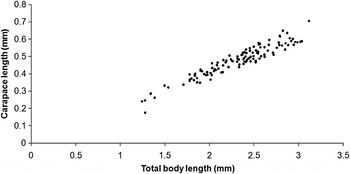
Photographs of all tanaids were obtained under a stereoscopic microscope using a digital camera, and the images were later analysed using the Image Tool program. A correlation study was performed between total body length (TL – from the frontal margin of the cephalothorax to the distal margin of the pleotelson) and carapace length (CL – distance between frontal and distal margins of cephalothorax) in 121 individuals. The positive correlation with a high correlation coefficient observed between CL and TL (R = 0.95; Figure 1) allowed us to perform all morphometric analyses based on CL measurement in this population of S. cf. stanfordi. This procedure prevented the need to straighten the curled body of all collected tanaids.
Sinelobus cf. stanfordi. Correlation between CL and TL.

All individuals were distributed into 12 CL classes according to Sturges’ rule (Sturges, Reference Sturges1926) (k = 1 + 3.3 * log10n, where ‘k’ is the number of classes and ‘n’ is the number of individuals).
Statistical analyses
The normality of the data was analysed using the Shapiro–Wilk test, while the Kruskal–Wallis test was used to compare the density of S. cf. stanfordi between sampling months. The G test was used to verify the deviation of the sexual proportion from the expected 1:1. This proportion was calculated only for individuals with a CL longer than 0.39 mm. An ANOVA and a Scheffé test for paired comparisons were performed to verify size differences between M, females (PREP + OV) and NREP. The size difference between OV and PREP was compared using Student's t-test. The OV proportion was calculated by dividing the number of OV by the total number of mature females (ovigerous, preparatory and without oostegites). Spearman's correlation analysis was used to determine the relationship between the oscillations of ovigerous female proportions and mean monthly air temperature. A significance level of 0.05 was set for all analyses.
RESULTS
A total of 714 S. cf. stanfordi individuals were obtained: 112 M, 191 reproductive females (OV + PREP) and 411 NREP. From the NREP category, 279 were females (CL longer than 0.39 mm), 100 were sexually immature males or females without oostegites (CL between 0.32 and 0.39 mm), 30 were juveniles (CL less than 0.32 mm) and two were manca stage.
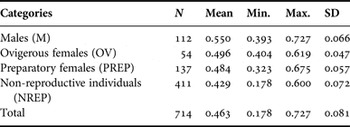
Carapace length ranged from 0.24 to 0.73 mm, with a mean value of 0.46 with a standard deviation of ±0.08 mm (Table 1). Males, females (PREP + OV) and NREP differed in CL (ANOVA, F = 161.33; G.L. = 2; P < 0.001). NREP were smaller (0.43 ± 0.07 mm) than the reproductive individuals (0.51 ± 0.06 mm) (Scheffé, P < 0.001). M were larger (0.55 ± 0.06 mm) than females (0.49 ± 0.05 mm) (Scheffé, P < 0.001), and among the females, OV (0.49 ± 0.04 mm) did not differ from PREP (0.48 ± 0.5 mm) (t = 1.30; df = 189; P = 0.19).
Sinelobus cf. stanfordi. Statistics of carapace length (CL) of the demographic categories.

N, absolute frequency; SD, standard deviation.
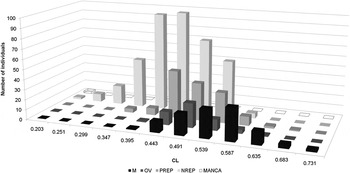
The population was distributed into 12 CL classes. Of these classes, the 0.443 mm class had the highest frequency and constituted the mode class. The individuals from 0.203 to 0.299 mm CL were exclusively composed of NREP. In classes above 0.395 mm, all demographic categories were recorded, with high frequencies of M in the higher CL classes (Figure 2).
Sinelobus cf. stanfordi. Distribution of the absolute frequency of the demographic categories into classes of CL. M, males; OV, ovigerous females; PREP, preparatory females; NREP, non-reproductive individuals; MANCA, manca stage.

Females dominated in the S. cf. stanfordi population, with a sex ratio of 1:4.2 (M:F), which showed a statistical difference from the expected 1:1 (G = 470.79).
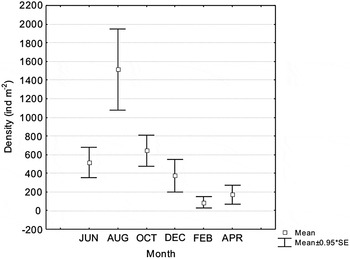
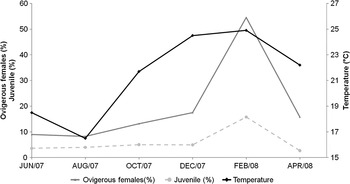
The S. cf. stanfordi population showed a strong fluctuation in density during the months sampled, with the highest value in August 2007 (1513.89 ± 455.99 individuals m−2) and the lowest in February 2008 (87.90 ± 64.10 individuals/m2) (H = 26.554; P < 0.0001). The mean monthly air temperature oscillated from 16.5°C in August 2007 (winter month) to 24.9°C in February 2008 (summer month) during this period. All demographic categories were recorded in all months sampled, with a dominance of NREP in all collection months (Figure 3).
Sinelobus cf. stanfordi. Annual fluctuation in density during the sampling period.

The percentages of OV and juvenile recruits showed higher values in February (summer month in the southern hemisphere), during which two mancas were also observed. However, the lowest percentage for OV was recorded in August (winter month). These results show that reproductive events can occur year round, with the highest intensity in warmer months (Figure 4). Spearman's correlation test showed a positive correlation between the annual fluctuation of mean monthly temperatures and ovigerous female percentage (Spearman = 1.00; P < 0.05); however, no correlation between the annual fluctuation in the number of juvenile recruits and air temperature was recorded (Spearman = 0.486; P > 0.05).
Sinelobus cf. stanfordi. Annual fluctuation in the relative frequency of OV and juveniles. The annual fluctuation in the mean monthly air temperature is also presented.

DISCUSSION
The low frequency of manca stage individuals recorded in the present study (only two) is probably related to sample handling. Because their CL is approximately 0.20 mm (and therefore 1.25 mm TL – see Figure 1), they could have escaped through the mesh (0.6 mm) in a head-to-tail direction. This escape was effective, considering that in the absence of disturbance, these tiny juveniles remain near their mother's tube until the next moult (Toniollo & Masunari, Reference Toniollo and Masunari2007). Therefore, the mesh size used was effective in collecting only tanaids larger than 0.20 mm in CL.
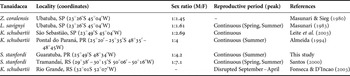
The sexual proportion showing female predominance in the present study seems to be common among tanaidacean species, at least for those whose population biology has been studied (Table 2). This female predominance could be related to the protogyny observed in some species. For example, Leptochelia dubia (Kroyer, 1842) females can change their sex after the reproductive period to compensate for the absence or rarity of males. However, as observed by Toniollo & Masunari (Reference Toniollo and Masunari2007), S. cf. stanfordi is a gonochoristic species, and the female predominance in all size classes may have a different explanation.
Sinelobus cf. stanfordi. The sexual proportion and reproductive period of Brazilian tanaids for which population biology is known. The localities are ordered by latitude in the southern hemisphere.

The habit of male S. cf. stanfordi in visiting female tubes for mating purposes observed by Toniollo & Masunari (Reference Toniollo and Masunari2007) may be an explanation for the sex ratio observed. This habit makes males more susceptible to predation than females, lowering their number in the population and significantly influencing the sex ratio. This male behaviour is known for tubiculous peracarids (Borowsky, Reference Borowsky1983) and for the tanaidacean L. dubia, whose males are more frequently seen on the surface of the substrate than females under laboratory conditions (Mendoza, Reference Mendoza1982).
Hamilton (Reference Hamilton1967) and Heimpel (Reference Heimpel1997) have pointed out several possible reasons for biased sex-ratio on arthropods, mainly Hexapoda. However, we do not have enough data on S. cf. stanfordi to explain the sex-ratio observed on this species.
The sexual dimorphism in CL is not a rule among tanaidacean species. While no differences have been reported between male and female CL in Hargeria rapax (Harger, 1879) (Kneib, Reference Kneib1992), in Kalliapseudes schubartii Mañe-Garzon, 1949, males are smaller than females, and ovigerous females are significantly larger than preparatory females (Leite et al., Reference Leite, Turra and Souza2003). In the present paper, sexual dimorphism was recorded in both CL and cheliped size: male CL was larger than female CL, and cheliped size was much bigger in males, at least in adult specimens.
Similar seasonal density fluctuations observed for S. cf. stanfordi in the present study have also been reported for other tanaidacean species: Kneib (Reference Kneib1992) described higher densities of H. rapax living in muddy substrates in the winter and lower densities in the summer, and the same pattern was observed for L. dubia in sandy substrates (Mendoza, Reference Mendoza1982). Additionally, Masunari (Reference Masunari1983) reported higher values for Leptodactyla savignyi (Kroyer, 1842) in the winter and lower values in the autumn. This pattern could be a consequence of decreased predation pressure by large organisms such as fishes and decapods that reduce their metabolic rate due to low temperatures during the winter, as stated by Lana & Guiss (Reference Lana and Guiss1991). The mangrove ecosystem is a nursery ground for several species of fishes and other aquatic organisms that reproduce more intensively in warmer months. In this context, tanaids would constitute a rich food for their offspring.
Other species show different patterns of temporal distribution of abundance. Almeida (Reference Almeida1994) reported higher densities in the spring and summer and lower densities in the winter for K. schubartii from Paraná State. However, Santos (Reference Santos2000) observed higher values of S. stanfordi from the estuarine region of Rio Grande do Sul State in summer months but lower values in the freshwater lakes of this state. The author has associated the latter result with the hatching season of insect larvae that could act as predators of tanaids in summer months. Fonseca & D'Incao (Reference Fonseca and D'Incao2006) reported that the mortality rates of K. schubartii did not differ between sampled seasons at Patos Lagoon. However they agree that this tanaid species might be heavily preyed by juvenile fishes and decapods; and that the expected higher mortality in summer/spring might not apply to unvegetated soft bottom estuaries.
Except for the K. schubartii population in the southern region of Brazil (Fonseca & D'Incao, Reference Fonseca and D'Incao2003), ovigerous females are continuously present year round, although reproductive peaks occur (Table 2). It is likely that the effect of temperature oscillation is decreased in the subsurface layer of substrates, allowing tanaidaceans to maintain a regular metabolic rate. However, in the previously cited population of K. schubartii in which ovigerous females occur only in the spring and the beginning of the autumn, the low temperatures were cold enough to interrupt reproductive activities. The absence of ovigerous females seems to be influenced by low temperatures only in habitats south of 29°S.
The density peaks of ovigerous females recorded in the populations with continuous reproductive periods show an influence of temperature. In the present work, a higher percentage of ovigerous females was observed in February 2008 (summer month, see Figure 4), the month with the highest mean temperature (24.9°C). In the same way, a lower proportion of ovigerous females was recorded in August 2007, the month with the lowest mean temperature (16.5°C). Almeida (Reference Almeida1994) reported a higher proportion of ovigerous females of K. schubartii in Paraná State in the spring and summer and considered the reproductive period for that species as continuous, with high seasonal influence. Masunari (Reference Masunari1983) reported higher proportions of ovigerous females of L. savignyi in Ubatuba, SP, in the spring and summer. Similarly, Santos (Reference Santos2000) reported reproductive peaks for S. stanfordi at Tramandaí, RS, in the spring and summer and highlighted the importance of temperature seasonality for this species' population growth. Modlin & Harris (Reference Modlin and Harris1989) reported a higher proportion of ovigerous females in Alabama, USA, in the summer months.
Contrary to the previously cited populations, Leite et al. (Reference Leite, Turra and Souza2003) reported four peaks of ovigerous females (one in each season) in a population of K. schubartii in São Sebastião, SP. Although no data on annual temperature oscillation were available in this article, it is probable that the temperature did not oscillate significantly in the period of study, and temperatures low enough to diminish the reproductive activities of K. schubartii did not occur.
The present work highlights the necessity of conservation of the mangrove ecosystem, especially the burrow complex of the mangrove crabs that shelters not only their juveniles (Kassuga & Masunari, Reference Kassuga and Masunari2015) but an abundant population of tanaids, which, in turn, constitutes the base of the mangrove trophic web.
ACKNOWLEDGEMENTS
We are grateful to the Director of Meteorological System of Paraná State – SIMEPAR – for the data of monthly air temperatures. We are also grateful to M.Sc. Sara Regina Sampaio, M.Sc. Daniel Luís Lepka and the biologist Jefferson Keiti Nagata for helping us with fieldwork. All biological sample collections of the present study were in compliance with the current Brazilian Federal Government laws. These collections were conducted with the authorization of the Brazilian Institute of Environment and Renewable Natural Resources – IBAMA – of Paraná State (Authorisation # 12852-1 – DIFAP/IBAMA). Elsevier Language Editing revised the English text. This is Contribution No. 1822 of the Department of Zoology, Federal University of Paraná.
FINANCIAL SUPPORT
We are grateful to CAPES for the scholarship granted to the first author (A.D.K.) during the development of the present work.