Grill (Reference Grill2023) proposes, as a “contender in contemporary population axiology,” the sum of averages view (SAV), according to which the value of a population is given by

where the t are discrete time periods and ūt is the average lifetime welfare of people born in period t. Time periods are discretized by SAV as “periods of substantial length, for example one year” (p. 108), and periods in which no one is born have zero value.Footnote 1 Because SAV both sums and takes averages, it inherits some of the well-known implications of both total and average utilitarianism. Like total utilitarianism, SAV would consider it a great loss if a long, prosperous future were replaced with an empty future. But like average utilitarianism, SAV would be indifferent between the actual intertemporal population and an alternative in which each life is replaced with two identical lives, lived concurrently.
Although Grill is (to our knowledge) the first to explicitly defend SAV as the correct population axiology, it is closely related to social welfare functions that are commonly used for policy evaluation (and, to that extent, implicitly treated as correct) in economics. Macroeconomists and climate economists in particular often examine time-period-specific average utilities or time-period-specific average levels of consumption as a stand-in for welfare (sometimes, but not always, weighted by time discounting).Footnote 2 Scovronick et al. (Reference Scovronick, Budolfson, Dennig, Fleurbaey, Siebert, Socolow, Spears and Wagner2017) is a prominent recent example in climate macroeconomics that explicitly refers to population ethics and considers a (weighted) sum of per-period averages for calculating social welfare.Footnote 3 The use of SAV-like views in economics is motivated at least in part by both computational convenience and tradition rather than axiological conviction. Still it is all the more important, in light of these influential applications, to evaluate the plausibility of SAV as a population axiology.Footnote 4
Grill defends SAV as an improvement on standard average utilitarianism that can preserve its attractive features while avoiding its drawbacks. Chief among the drawbacks that Grill aims to avoid is the “Egyptology” objection: the counterintuitive implication that, in Grill's words, “whether or not it is good that a life starts depends on the quality of lives at other times, including the distant past (such as ancient Egypt)” (p. 104).Footnote 5 Since SAV averages an individual's lifetime welfare only with her contemporaries (other individuals born at roughly the same time), whether her life contributes positively or negatively to the relevant average does not depend on lives that began in the distant past. So SAV escapes at least a narrow version of the Egyptology objection.
In this comment, however, we argue that SAV does not escape the substance of Egyptology – it is vulnerable to slightly modified but similarly weighty versions of the same objection. We also identify a further, decisive problem for SAV that is not shared with either average or total utilitarianism.
Beginning with Egyptology: broadly speaking, an axiology is vulnerable to Egyptology-like objections insofar as it is non-separable. Non-separability means that which of two additions to a population is better (e.g., in the simplest case, adding a single person at a particular welfare level or adding no one) can depend on facts about the pre-existing population. Any view that averages over individuals in a population whose size can vary (such as all the individuals born in a certain period) is non-separable in this sense. The simplest way to avoid all Egyptology-like objections is to embrace full separability, between all pairs of individuals. Given other plausible assumptions (anonymity, completeness, Pareto, and continuity), this yields an additive view in the “critical-level generalized utilitarian” family that includes total utilitarianism, critical-level utilitarianism, and prioritarianism (Blackorby and Donaldson Reference Blackorby and Donaldson1984; Blackorby et al. Reference Blackorby, Bossert and Donaldson2005; Thomas Reference Thomas, Arrhenius, Bykvist, Campbell and Finneron-Burns2022).
But not all violations of separability beget equally compelling Egyptology-style objections, and we do not wish to claim that anyone who finds the original Egyptology objection troubling is thereby committed to full separability.Footnote 6 For instance, consider a “relational egalitarian” view that penalizes inequality between individuals who stand in certain morally significant relationships (e.g., engaging in economic transactions with one another or belonging to the same political community). This view is non-separable, and will sometimes imply that facts about unaffected individuals are morally relevant to your choices. For instance, perhaps you ought not create a person with a slightly positive life if they will be much worse off than others in their community. But whether one finds this claim plausible or implausible, it is not implausible in the same way as Egyptology. The welfare of ancient Egyptians seems obviously irrelevant to the decision whether to have a baby; the welfare of the people to whom that baby would stand in morally significant relations does not.
Whether SAV successfully avoids the force of the Egyptology objection, then, depends on whether membership in the same birth cohort – i.e., being born at approximately the same time – is enough to make one life intuitively relevant to another. We contend that it is not. Consider, for instance, an ancient Mesoamerican deciding whether to have a child. Are facts about the ancient Egyptians (her unreachable contemporaries across the Atlantic) any more relevant to her procreative decisions than to ours? Would it be reasonable for her to conclude, as SAV implies, that it would be bad to have a child if its welfare, though positive, would be below-average for its birth cohort given the prosperity of those distant Egyptians? (Of course, she would have no way of making such an evaluation in her time – before transatlantic travel or radio communication.) Similarly, consider contemporaries of different species. Does the value of having a child today depend on the size and welfare of, say, present-day fish populations? (Would it be reasonable to delay conception in order to avoid a year when periodical cicadas are hatching, so that your well-off child will be part of a smaller birth cohort and therefore have a larger impact on the average?) Finally, consider individuals in distant galaxies, far enough apart that it is physically impossible even to communicate with them in a human lifetime. Are these distant, unreachable aliens any more relevant to our procreative choices than the ancient Egyptians? It seems to us that all of these implications are as implausible as the original Egyptology counterexample to average utilitarianism.Footnote 7
The possibility of very large spatial distances between populations highlights a second problem for SAV, which Grill does not consider: special relativity tells us that the time-ordering of events that are spacelike-separated (outside each other's past/future light cones) is not an objective matter, but depends on a choice of reference frame – observers moving at different speeds will disagree. The same is true of the duration (temporal distance) between timelike-separated events. But SAV is sensitive to these facts about time-order and duration, and its ranking of populations can therefore depend on one's choice of reference frame. SAV must therefore claim either that axiological facts are velocity-relative, or that there is an axiologically privileged reference frame. Neither of these options is appealing.Footnote 8
Third and finally, SAV has a decisive problem which it does not share with either average or total utilitarianism: it can evaluate a same-people change as an improvement, even though the change makes every person strictly worse off and has no effect on who is born.
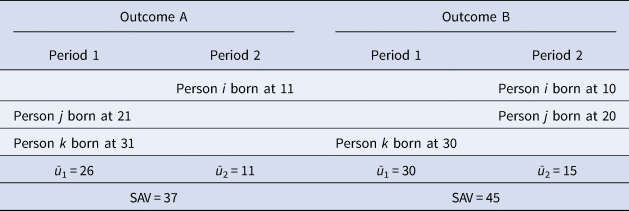
Consider the choice between outcome A and outcome B in Table 1. Choosing B delays the birth of person j to period 2 and reduces every person's wellbeing by 1. Despite harming each person, this change has the effect of increasing average welfare in both periods. (This is an example of what statisticians call the “Okie paradox,” named for Will Rogers' joke that “When the Okies left Oklahoma and moved to California, they raised the average intelligence level in both states.”Footnote 9) As a result, SAV implies that outcome B is better than outcome A. This is a verdict rejected by both average and total utilitarianism, and one that seems utterly implausible.Footnote 10 It violates even an extremely weak version of the Pareto principle: if exactly the same individuals exist in two outcomes, and one outcome makes each individual strictly worse off, then that outcome is not strictly better.Footnote 11 More fundamentally, it violates the idea that persons/welfare subjects are the basic loci of value and of moral concern. SAV instead treats birth cohorts as basic units of concern. But birth cohorts simply are not fundamental loci of value. It is not plausible to value their “interests” independent of, and at the expense of, the interests of the individuals who compose them.Footnote 12
Same-person change that makes every person worse off, but that SAV evaluates as an improvement

Grill's view is just one of a family of possible views that involve summing over subpopulation averages. Indeed, standard average and total utilitarianism are limiting cases of this family: averagism groups all individuals into the same subpopulation (and takes the trivial sum of a single subpopulation average), while totalism treats each individual as their own subpopulation (and sums the trivial welfare averages in these singleton subpopulations). Any view in this family that, like Grill's, is intermediate between averagism and totalism will inherit many of the weaknesses of both limiting views. Like totalism, as Grill acknowledges, it will be vulnerable to the Repugnant Conclusion (at least insofar as the number of subpopulations is potentially unbounded).Footnote 13 Like averagism, it will be vulnerable to Egyptology-style objections and to the Sadistic Conclusion.Footnote 14 Moreover, unlike either limiting view, it will sometimes endorse changes that make everyone worse off (at least insofar as it is possible for the same individual to belong to different subpopulations in different outcomes). We therefore believe that all intermediate views in this family will be implausible – there is no viable halfway point, at least on this spectrum, between averagism on the one hand and totalism on the other.
Financial support
Although this paper received no specific funding, the underlying research received support from the Eunice Kennedy Shriver National Institute of Child Health and Human Development (grant K01HD098313 and P2CHD042849) and from the Musk Foundation, awarded to the Population Research Center at The University of Texas at Austin. The content is solely the responsibility of the authors and does not necessarily represent the official views of the funders, who did not review this research.
Competing interests
None.