


Introduction
What makes people support or oppose a carbon tax? While environmental protection enjoys broad public backing as a valence issue, this backing tends to erode when policies impose concrete costs on individuals (Kallbekken and Sælen Reference Kallbekken and Sælen2011; Stadelmann-Steffen and Dermont Reference Stadelmann-Steffen and Dermont2018). Low support for fossil fuel taxation exemplifies this tension. On one side, taxing carbon-intensive activities can support the post-carbon transition by giving producers and consumers reasons to choose lower-carbon options, while also generating revenue for green investment (Genschel et al. Reference Genschel, Limberg and Seelkopf2025). On the other, like all consumption taxes, carbon taxes tend to be regressive, falling harder on low-income households, and they can hurt the employment prospects of workers in high-emission industries, which can in turn produce political backlash (Driscoll Reference Driscoll2023). Support for, or opposition to, carbon tax policy thus runs along a fault line between ecological and socio-economic concerns.
Our study adds to a growing body of research examining how perceptions of the economic risks associated with environmental protection shape support for carbon taxation and how existing social policy institutions condition these relationships. Previous research on the socio-economic drivers of green backlash has focused mainly on the link between income and opposition to carbon taxes (Beiser-McGrath and Busemeyer Reference Beiser-McGrath and Busemeyer2024; Fairbrother et al. Reference Fairbrother, Sevä and Kulin2019; Schaffer Reference Schaffer2021 Reference Schaffer2024). A second strand of scholarship highlights that carbon taxes can also produce new groups of “losers,” such as workers in high-emission industries who face heightened risks of job displacement (González-Rostani et al. Reference González-Rostani, Beiser-McGrath and Aklin2026; Heddesheimer et al. Reference Heddesheimer, Hilbig and Voeten2025), who are also likely to oppose carbon taxation. Finally, a growing literature has also examined how social protection institutions shape perceptions of exposure to the economic consequences of the carbon transition (Baute Reference Baute2025; Büchs et al. Reference Büchs, Bastianelli and Schnepf2024; Nordbrandt et al. Reference Nordbrandt, Peterson, Mårtensson and Palme2025; Parth and Vlandas Reference Parth and Vlandas2022). Existing evidence suggests that individuals evaluate climate policies not only in light of their own economic circumstances but also through expectations about the extent to which national institutions will protect them against potential losses.
Building on these insights, we argue that confidence in the protective capacity of existing social policy institutions not only increases support for carbon taxation but also conditions how income difficulties and perceived employment vulnerability shape carbon tax preferences. Drawing on policy feedback theory (Larsen Reference Larsen2019; Moynihan and Soss Reference Moynihan and Soss2014; Pierson Reference Pierson1993), we argue that satisfaction with current social policies reflects individuals’ confidence in the welfare state’s ability to protect individuals from economic disruptions, including those arising from the green transition. This differs from viewing social policy as a compensation mechanism for the “losers” of structural economic shifts (Rickard Reference Rickard2023), as the emphasis is on how past policy experiences and the institutional setting shape expectations about future protection (Fesenfeld et al. Reference Fesenfeld, Rudolph and Bernauer2022; Stadelmann-Steffen and Eder Reference Stadelmann-Steffen and Eder2021). We therefore expect individuals who perceive social policy institutions as effective and reliable to be more supportive of carbon taxation and less likely to translate concerns about income insecurity or employment-related risks into opposition to such measures. We test these assumptions using an original seven-country European survey (n = 10,968) fielded in December 2022.
Our study presents three key findings with implications. First, we confirm that income difficulty is a strong and consistent predictor of opposition to fossil fuel taxation, likely reflecting anxieties over the regressive impact of consumption taxes such as fuel price increases. Second, contrary to our expectations, perceived employment risk is positively associated with fossil fuel tax support. The association generalizes to other structural-transformation risks (automation and offshoring), suggesting that the active ingredient is awareness of structural economic change among respondents who already tend to support climate action, rather than narrow self-interest. Third, and most relevant for us, satisfaction with social policy not only directly predicts support for fossil fuel taxation but also positively moderates the relationship between employment risk and tax support, with respondents facing high employment risk becoming more supportive of carbon taxation as their satisfaction with the welfare state increases, consistent with policy feedback mechanisms. Taken together, public attitudes toward fossil fuel taxation are then shaped by both immediate economic concerns and perceptions of being protected by the welfare state. These findings suggest that strengthening (or at least bolstering confidence in) social protection systems can help build broader coalitions for climate policy.
The remainder of the paper is organized as follows. Section Understanding fossil fuel tax support reviews the literature on the economic determinants of fossil fuel tax support and develops our hypotheses on income difficulty, employment risk, and the moderating role of social policy satisfaction. Section Research design describes the survey data, the variables, and the estimation strategy. Section Results presents the main regression results, the comparison across different sources of employment risk, and a set of robustness checks. Section Discussion and conclusion discusses the findings, their implications for climate policy design, and limitations of the study.
Understanding fossil fuel tax support
Carbon taxes are widely regarded as among the most effective policy tools for addressing the climate crisis (Bürgisser et al. Reference Bürgisser, Stadelmann-Steffen and Armingeon2026; Genschel et al. Reference Genschel, Limberg and Seelkopf2025). International organizations, economists, and policy experts treat them as efficient instruments for reducing emissions, as they provide stable, long-term incentives for green innovation and sustainable behavior, and the resulting revenue can be reinvested in climate action (Carattini et al. Reference Carattini2017; Cullenward and Victor Reference Cullenward and Victor2020; OECD 2021). Despite these compelling reasons to support carbon taxation, most public opinion studies find a persistent gap: while people generally express support for environmental protection as an abstract goal, they tend to oppose environmental taxes as the means to achieve it (Kallbekken and Sælen Reference Kallbekken and Sælen2011; Stadelmann-Steffen and Dermont Reference Stadelmann-Steffen and Dermont2018).
The literature offers several explanations for this gap between general environmental concern and specific policy support. For instance, there is a widespread suspicion that carbon taxes serve primarily as a covert way to raise state revenue rather than to reduce emissions (Fairbrother et al. Reference Fairbrother, Sevä and Kulin2019), as well as limited public understanding of the short- and long-term benefits of such policies (Beiser-McGrath and Bernauer Reference Beiser-McGrath and Bernauer2019; Beiser-McGrath and Busemeyer Reference Beiser-McGrath and Bernauer2024; Bürgisser et al. Reference Bürgisser, Stadelmann-Steffen and Armingeon2026). In addition, the long horizon of climate change tends to push citizens toward more immediate concerns, especially during external shocks such as wars, economic downturns, or health crises, the so-called “policy distraction” effect (Genschel et al. Reference Genschel, Limberg and Seelkopf2025). Political factors, including party cues and the broader international politicization of climate policy, also matter (Beiser-McGrath and Bernauer Reference Beiser-McGrath and Bernauer2022; Bürgisser et al. Reference Bürgisser, Stadelmann-Steffen and Armingeon2026; Coffé et al. Reference Coffé, Crawley and Givens2026).
A recurring theme across almost all of these explanations is the distributive implications of carbon taxation, since the perceived socio-economic consequences of these taxes translate into lower public support (Beiser-McGrath and Bernauer Reference Beiser-McGrath and Bernauer2024; Beiser-McGrath and Busemeyer Reference Beiser-McGrath and Busemeyer2024; Schaffer Reference Schaffer2021; Stadelmann-Steffen and Dermont Reference Stadelmann-Steffen and Dermont2018). Some scholars emphasize the regressive nature of consumption-based carbon taxes, which fall disproportionately on lower-income households and fuel public skepticism (Bremer and Bürgisser Reference Bremer and Bürgisser2023; Fairbrother et al. Reference Fairbrother, Sevä and Kulin2019). Others stress employment risks, noting that workers in high-emission sectors are generally less supportive of carbon taxes and of climate policies more broadly (Cavallotti et al. Reference Cavallotti, Colantone, Stanig and Vona2025; Heddesheimer et al. Reference Heddesheimer, Hilbig and Voeten2025; Ronchi et al. Reference Ronchi, Natili and Molteni2023). A more recent strand of work points to the welfare state, arguing that robust social protection systems can dampen perceptions of risk and unfairness in the post-carbon transition and so make carbon taxation more acceptable (Nordbrandt et al. Reference Nordbrandt, Peterson, Mårtensson and Palme2025; Parth and Vlandas Reference Parth and Vlandas2022). What is still missing is a clear account of how these factors interrelate. The following analysis aims to disentangle their respective contributions and examine how they interact.
Economic risks to post-carbon transition
Income difficulty
Studies have illustrated a trade-off between economic interests and support for pro-environmental policies. They have demonstrated that economic insecurity and perceptions of unfairness in environmental policies are key determinants of public opposition to carbon taxes and, more broadly, to the green transition (Beiser-McGrath and Bernauer Reference Beiser-McGrath and Bernauer2024; Beiser-McGrath and Busemeyer Reference Beiser-McGrath and Busemeyer2024; Büchs et al. Reference Büchs, Bastianelli and Schnepf2024; Im Reference Im2024; Schaffer Reference Schaffer2021). Individuals experiencing economic hardship and uncertainty about their future economic prospects are more likely to oppose carbon taxes. This opposition is pronounced in rural, less prosperous regions and countries heavily reliant on fossil fuels (Hope et al. Reference Hope, Limberg and Steinebach2026; Lübke Reference Lübke2022).
In other words, it is the fear of economic loss from the transition to a post-carbon economy that drives resistance against green taxes. Similarly, scholars have shown that lower-income groups are less likely to support green transition policy packages that include higher taxes on fossil fuels, as these policies may impose additional financial burdens through higher household energy costs (Carley and Konisky Reference Carley and Konisky2020).
Following a similar logic, Tatham and Peters (Reference Tatham and Peters2023) argue that redistribution to low-income households from the revenue can moderate the opposition to carbon tax measures. Consistently, Natili et al. (Reference Natili, Pellegata and Visconti2026) show that support for a carbon tax increase significantly when it is combined in a policy package that includes investment in green infrastructure and social benefits designed to compensate those who are negatively affected by the transition.
To sum up, the opposition to carbon taxes reflects broader concerns about economic inequality and unfairness in the post-carbon transition process. Economic hardship creates conditions under which individuals may oppose carbon taxes because they perceive these measures as imposing additional financial costs. In accordance with the egocentric rationale of maximizing self-interest and minimizing risk, people with low household income would be skeptical about introducing the carbon tax measure. This leads to our first hypothesis concerning the relationship between income difficulty and fossil fuel tax support.
• H1: Individuals experiencing household income difficulties are less likely to support fossil fuel tax.
Employment risk
One strand of research on the economic underpinnings of green backlash has focused on current income difficulties and consumption-side dynamics, the angle developed above. A parallel strand turns to future economic difficulties on the production side of the economy, asking how concerns over job displacement from decarbonization shape public attitudes toward fossil fuel taxation.
The post-carbon transition is a structural transformation akin to automation and offshoring. It produces winners and losers, sharpens political divisions over who bears the costs (Otto and Gugushvili Reference Otto and Gugushvili2020; Ronchi et al. Reference Ronchi, Natili and Molteni2023), and creates direct displacement risks for workers in carbon-intensive sectors. Closures of coal mines or coal-fired plants can lead to layoffs (Rud et al. Reference Rud, Simmons, Toews and Aragon2024; Rueda Cantuche et al. Reference Rueda Cantuche2025), and the shutdown of high-emission industries can also affect adjacent jobs and businesses, including local services that depend on these industries’ workers (Graham and Knittel Reference Graham and Knittel2024; Mark et al. Reference Mark, Rafaty and Schwarz2024). Workers and regions facing these prospects have reason to view fossil fuel taxation as a threat to their economic basis.
Empirical work at multiple levels is consistent with this. At the micro level, workers in fossil fuel-dependent sectors and in countries heavily reliant on fossil fuels tend to view climate mitigation as a threat (Knight Reference Knight2018; Lübke Reference Lübke2022), and low skill transferability and the “brownness” of jobs further weaken support for the transition and consequently carbon taxation (Doorn and Vliet Reference Doorn and van Vliet2024; Heddesheimer et al. Reference Heddesheimer, Hilbig and Voeten2025). Beyond fossil fuel sectors, González-Rostani et al. (Reference González-Rostani, Beiser-McGrath and Aklin2026) show that individuals exposed to labor-market risk from automation also hold weaker environmental concerns and are less supportive of carbon taxes.
In line with this reasoning, we posit that people with high employment risk due to pro-environmental policies, such as individuals highly dependent on the fossil fuel industry, may perceive a fossil fuel tax as an economic threat that undermines their basis of economic prosperity. These theoretical expectations lead to our hypothesis concerning the employment-related determinants of public support for fossil fuel tax policy.
• H2: Individuals who perceive employment risk due to environmental protection are less likely to support fossil fuel tax.
Role of social policy satisfaction
The consumption-side and employment-side accounts above treat economic risk largely as an individual-level attribute and ask how it shapes support for fossil fuel taxation. However, the extent to which individuals translate economic risk into specific policy preferences is itself conditioned by the institutional context in which such risks are managed. In particular, social protection arrangements influence who is protected from the economic costs of structural change and under what conditions. We therefore turn to the literature on the role of social policy in shaping public support for green taxation.
A useful starting point is that citizens appear to evaluate carbon tax proposals within the broader social policy environment in which they are embedded, rather than primarily against compensation features attached to the tax itself. Consistent with this argument, Mildenberger et al. (Reference Mildenberger, Lachapelle, Harrison and Stadelmann-Steffen2022) find that carbon tax rebate programs have only limited impacts on public support for carbon pricing even when rebates are designed to be highly visible and progressive. Similarly, Fremstad et al. (Reference Fremstad, Mildenberger, Paul and Stadelmann-Steffen2022) find that while personalized information about progressive rebate design can raise support for carbon taxes, this effect is dampened or eliminated once carbon pricing becomes politicized. It indicates that tax-specific compensation features alone may be a fragile basis for sustaining public support. These findings suggest that the relevant institutional signal comes from citizens’ standing relationship with the welfare state (whether existing social policy has, in their experience, reliably cushioned economic shocks) rather than from features bolted onto a specific tax instrument.
Policy feedback theory offers a frame for this argument. Policy feedback approaches suggest that citizens’ experiences with current policies shape their expectations about future government action and their willingness to accept policy change (Larsen Reference Larsen2019; Moynihan and Soss Reference Moynihan and Soss2014; Pierson Reference Pierson1993). This is distinct from a direct-compensation framing of social policy. Compensation approaches focus on offsetting the specific costs that an environmental policy imposes, whereas policy feedback turns on how prior policy experience shapes general perceptions of government protection and trustworthiness. Satisfaction with social policies thus reflects a broader sense of being protected by the welfare state (De Blok and Kumlin Reference De Blok and Kumlin2022; Kumlin and Haugsgjerd Reference Kumlin and Haugsgjerd2017), and citizens who are satisfied with existing social protections may be more willing to accept the economic uncertainties of carbon taxation because they expect similar protections to be available if they face hardship (Stadelmann-Steffen and Eder Reference Stadelmann-Steffen and Eder2021).
Social protection institutions moderate how individuals perceive the relationship between their economic risks and policy preferences (Brooks and Manza Reference Brooks and Manza2008). Institutional protection can offset fears of job loss due to structural transformations in the labor market. Indeed, several studies show that the way objective occupational risk to technological job loss predicts policy preference is conditioned by institutional context (Busemeyer and Tober Reference Busemeyer and Tober2023; Dekker et al. Reference Dekker, Salomons and van der Waal2017; Lee Reference Lee2024).
Recent research suggests that social policy institutions play an important role in shaping support for climate policies and responses to the green transition (Colantone et al. Reference Colantone, Lonardo, Margalit and Percoco2024; Parth and Vlandas Reference Parth and Vlandas2022). Nordbrandt et al. (Reference Nordbrandt, Peterson, Mårtensson and Palme2025) in particular reveal that welfare coverage significantly correlates with support for carbon taxes, although replacement rates and the duration of social insurance do not show such an association individually.
Building on these findings, we expect citizens who feel well-protected by existing social policies to be more supportive of fossil fuel taxation. Positive experiences with social policy can generate confidence that the welfare state is capable of absorbing the disruptions associated with the green transition (Malerba Reference Malerba2022). By contrast, citizens who are dissatisfied with social policies may have fewer reasons to believe that potential losses generated by the transition will be adequately compensated (Carattini et al. Reference Carattini, Carvalho and Fankhauser2018; Povitkina et al. Reference Povitkina, Jagers, Matti and Martinsson2021).
• H3: Individuals who are satisfied with national social policies are more likely to support a fossil fuel tax.
Further, we posit that satisfaction with social policies would positively moderate the relationship between economic risks and carbon tax support. Individuals who are confident in social protection may be more willing to support carbon taxation even when they perceive economic risks, because they trust that the welfare state will provide adequate support if needed. This leads to our moderation hypotheses:
• H4a: Public satisfaction with social policies would positively moderate the relationship between income difficulty and fossil fuel tax support.
• H4b: Public satisfaction with social policies would positively moderate the relationship between employment risk and fossil fuel tax support.
Research design
Data
This paper relies on a novel cross-national survey conducted in December 2022, with panels provided by the YouGov platform. The full sample contains 10,968 respondents across seven countries, with country-specific counts reported in Appendix A. The survey covers countries representing distinct welfare state configurations: Sweden (Nordic), France and Germany (Continental), Italy and Spain (Southern), Poland (Eastern), and the United Kingdom (Liberal) (Arts and Gelissen Reference Arts and Gelissen2002; Ferrera Reference Ferrera1996). This cross-regime variation motivates our pooled estimation strategy with country fixed effects, which absorb baseline cross-national differences in fossil fuel tax support while allowing individual-level mechanisms to be identified within countries.
Survey participants are a representative sample for each country in terms of gender, age, area of residence Nomenclature of Territorial Units for Statistics-level 1 (NUTS-1), and education level. The survey covers individual-level attitudes toward climate change, environmental policies, perceptions of socio-economic status, and social policy, allowing us to study how these dimensions interact in shaping eco-social policy preferences.
Variables
Dependent variable
Our key dependent variable is public support for implementing carbon tax. We ask respondents, “How much are you in favour or against each of the following policy proposals to fight climate change?” regarding various policy domains. Among these policy preferences, our main interest in this paper lies in to what extent people oppose or support “A national tax on fossil fuels, such as oil, gas and coal (increasing gasoline prices).” Respondents can choose answer from “Strongly against (0)” to “Strongly in favour (10).”
The question wording explicitly names both sides of the policy. A fossil fuel tax helps fight climate change but raises gasoline prices, which puts a heavier burden on individuals reliant on fossil fuel. Respondents are therefore informed of both the benefits and the costs when answering.
Explanatory variables
Income difficulty
First, we operationalize economic vulnerability regarding household income anxiety. The question asks, “Which of the descriptions below comes closest to how you feel about your household’s income nowadays?” The survey participants can choose from “Living comfortably on present income (1)” to “Finding it very difficult on present income (4).” Thus, in this four-Likert scale response, high score refers to heightened anxiety concerning household income.
Employment risk perception
Second, we examine one’s economic risk based on individual’s perception about likelihood of job loss. Specifically, we ask, “How likely do you think it is that you will lose your job or have to close down your activity in the next five years due to the following events?” which relates to “Your activity/company being seriously limited by policies for protecting the environment” This question asks one’s job loss possibility due to pro-environment policy efforts such as fossil fuel tax. Responses are measured from “Not at all likely (1)” to “Extremely likely (5),” meaning that high score refers to high level of economic anxiety.
This question was only asked of respondents currently employed or self-employed. Individuals outside the labor force (pensioners, students, homemakers, and the unemployed) could not respond. The result is roughly 35% missing data on employment risk, and the missingness is systematic rather than random, since non-respondents are overwhelmingly people outside the workforce. We address this sample composition issue by reporting sample sizes explicitly across models and running robustness checks on the H2-eligible subsample (Appendix D).
Social policy satisfaction
We measure respondents’ satisfaction on national social policies. The question asks, “Overall, how satisfied would you say you are with [NATIONALITY] social policies? With 11 Likert scale answers, ranging from “Completely dissatisfied (0)” to “Completely satisfied (10).”
This subjective satisfaction with social policies can be understood in two ways. First, it may reflect an individual’s satisfaction with the level of spending or the overall size of the welfare state. Second, it may capture perceptions of the moral dimensions of social policies, such as fairness or the deservingness of beneficiaries (Attewell Reference Attewell2020; Cavaillé and Trump Reference Cavaillé and Trump2015). Our measure cannot separate the two interpretations analytically, and both are worth keeping in mind when reading the results.
Covariates
Ecological risk perception
First, individuals’ perception and experience regarding ecological risk, as they may affect the ways in which individuals connect environmental and economic concerns (Franzen and Meyer Reference Franzen and Meyer2010). On the one hand, we measure whether survey participants have experienced pollution and extreme weather, which refers to climate change experience. To be specific, the survey asks, “Thinking about your neighbourhood, to what extent, if at all, was it affected by the following events over the last 12 months?” regarding air pollution, water pollution, and extreme weather (floods, droughts, wildfires, etc). Respondents can choose answer from “Not at all affected (1)” to “Extremely affected (5).”
On the other hand, the survey asks respondents to what extent they feel climate change as a serious threat. To be specific, it asks, “To what extent do you think that climate change represents a threat”? This subjective dimension both captures public fear regarding personal (“to you personally”) and society-wise (“to [country]”) consequences. Respondents can choose from “Not at all a threat (0) to Extremely serious threat (10) on this question. It examines subjective perceptions that is not reduced to one’s given (or objective) environmental conditions.
Because the two component indices are measured on different scales (1–5 vs. 0–10), we standardize each index (z-scores) prior to aggregation. Our final measure “Climate Change Vulnerability” is constructed as the average of the standardized threat perception and standardized experience indices.
Political orientation
Second, we control for individuals’ political orientation. Research indicates that political partisanship is a significant predictor of climate change denial in the United States and other Western Hemisphere countries. Overall, research show that people with left-wing views are more likely to be concerned about climate change (McCright et al. Reference McCright, Dunlap and Marquart-Pyatt2016; Poortinga et al. Reference Poortinga2019), while those who support nationalist and right-wing populist parties tend to be climate-skeptic (Lockwood Reference Lockwood2018) and to oppose climate change mitigation policies (Kulin et al. Reference Kulin, Johansson and Dunlap2021). As such, we measure respondents’ self-perceived political stance using the survey question: “In political matters, people sometimes talk of ‘left’ and ‘right’. How would you place your views on this scale, where 0 means ‘Left’ and 10 means ‘Right’?”
Occupational class
Third, we control for one’s actual position in the labor market, which complements the subjective employment-risk measure with an objective marker of economic interest. Occupational position is a standard predictor of political preferences (Kitschelt and Rehm Reference Kitschelt and Rehm2014), and social policy scholarship has largely documented that different occupational groups hold distinct preferences over redistribution and the role of the welfare state (Beramendi et al. Reference Beramendi, Häusermann, Kitschelt and Kriesi2015; Häusermann et al. Reference Häusermann, Pinggera, Ares and Enggist2022). Shifts in occupational structure have also shaped the politics of social policy reform (Garritzmann et al. Reference Garritzmann, Busemeyer and Neimanns2018; Gingrich and Häusermann Reference Gingrich and Häusermann2015).
Following Ronchi et al. (Reference Ronchi, Natili and Molteni2023), we group respondents into six occupational categories: small business owners, higher-grade service workers, clerical service workers, lower-grade service workers, production workers, and a residual group of respondents without occupational information.Footnote 1 Clerical service workers are the largest group (27.2%), followed by higher-grade service workers (24.9%); respondents without occupational information (“Not in work/Prefer not to say,” 17.3%) serve as the reference category. Production and lower-grade service workers are similar in size (13.1% each), and small business owners are the smallest group (4.3%).
Carbon emission intensity (CEI)
Finally, we use NUTS-1 level carbon emission intensity (CEI) from industrial sources for the European regions to capture “objective” employment risk to post-carbon transition. CEI is considered a proxy for analyzing the industrial sustainability transition pathways and is calculated as the ratio between CO2 equivalent emissions (CO2) and Gross Domestic Product (GDP) of the industrial sector (Mura et al. Reference Mura2021).
CEI provides information about the intensity of carbon emissions relative to economic activities (i.e., GDP), which subjective risk measures may not fully capture. For example, consider a restaurant owner. While this job might not be directly related to employment changes due to decarbonization, if the restaurant is located in a region undergoing a post-carbon transition (e.g., an area with coal mines), the business could be adversely affected. In our data, there are 57 unique values grouped by NUTS-1 region.
Other demographic attributes
Finally, we control for standard demographic attributes. Age enters as a continuous variable. Gender is a binary indicator, with female as the reference category. Education is measured in three ISCED categories (low, middle, high) with the high category as the reference. For descriptive statistics of all variables in the pooled sample, see Table A1.
Estimation
Based on the variables of our interest mentioned above, we estimate the associations between economic risks and support for the fossil fuel tax. Then, we investigate how public satisfaction with social policy moderates the relationship between the risks and the policy preference.
Formally, we test the following equation to estimate the role of economic risks in shaping fossil fuel tax policy preferences.
 $Suppor{t_i} = {\beta _0} + {\beta _1}{\rm{*}}Ris{k_i} + {\beta _2}{\rm{*}}Satisfactio{n_i} + {\beta _3}{\rm{*}}{Z_i} + {\varepsilon _i}$
Here, our key interest is estimating β1 and β2. According to H1 and H2, we expect that β1 is negative, meaning that economic vulnerability to the post-carbon transition leads to skepticism toward fossil fuel policy measures. Regarding H3, β2 is expected to be positive, which suggests that individuals highly satisfied with national social policies would be supportive of fossil fuel tax introduction.
Regarding the moderating effect of social policy satisfaction, we examine the following equation.
 $Suppor{t_i} = {\beta _0} + {\beta _1}{\rm{*}}Ris{k_i} + {\beta _2}{\rm{*}}Satisfactio{n_i} + {\beta _3}{\rm{*}}\left( {Ris{k_i}{\rm{*}}Satisfactio{n_i}} \right) + {\beta _4}{\rm{*}}{Z_i} + {\varepsilon _i}$
In this equation, our main interest is estimating β3, which refers to the moderation effect of social policy satisfaction. Following H4a and H4b, we expect β3 to be positive, which means that higher satisfaction with national social protection would positively moderate the relationship between economic risk and support for fossil fuel tax policy.
We estimate Ordinary Least Squares (OLS) regression models with country fixed effects to control for country-level variation not measured with the survey data. Standard errors are clustered at the NUTS-1 regional level to account for potential within-region correlation.
Results
Descriptive analysis
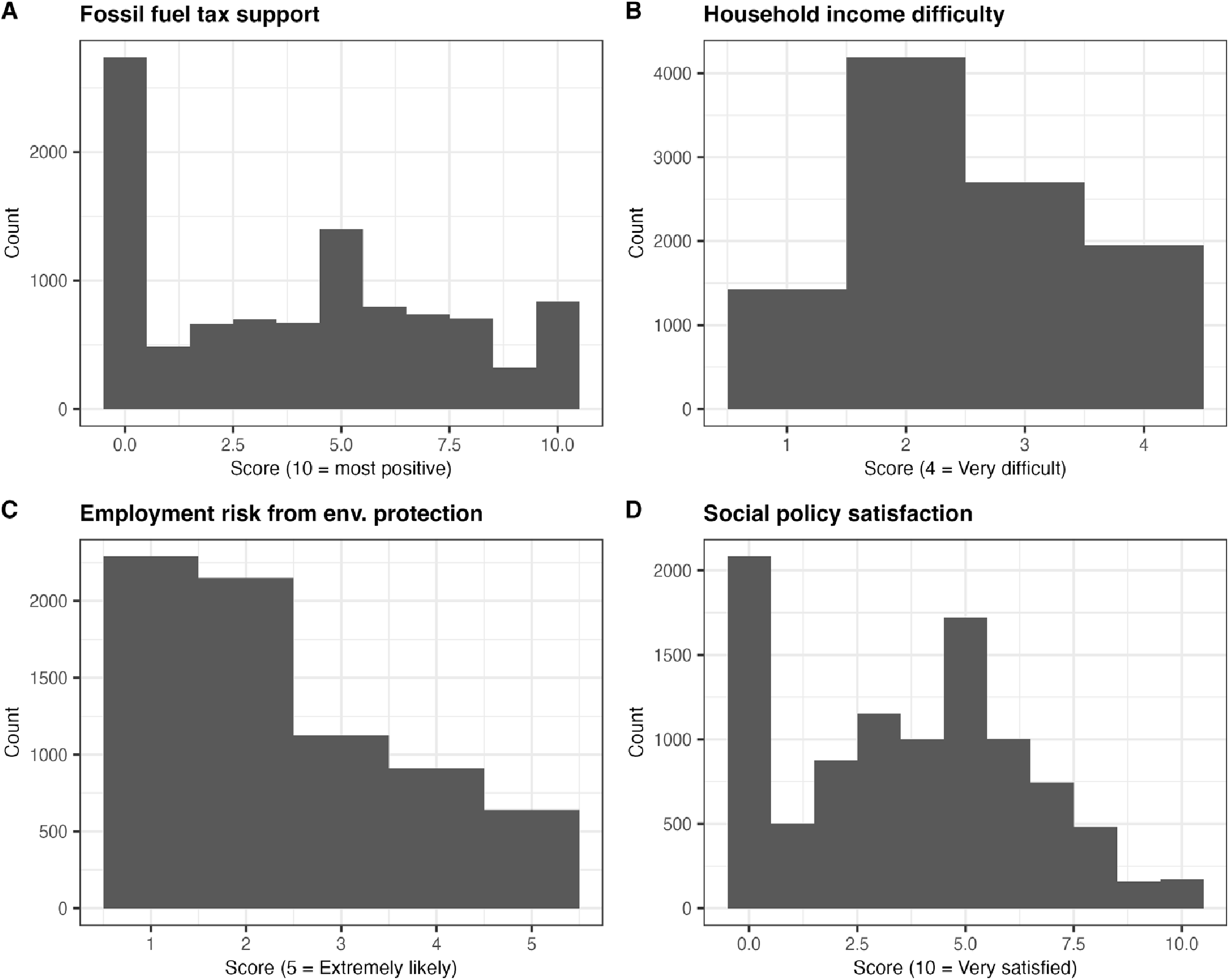
First, we present distributions of the dependent and explanatory variables. Figure 1 combines the four descriptive distributions used in the analysis: fossil fuel tax support, household income difficulty, employment risk from environmental protection, and satisfaction with national social policies. Panel A shows that public opinion toward the fossil fuel tax is highly polarized. A substantial portion (27%) of respondents are extremely skeptical (Score = 0) about imposing taxation on fossil fuel. Median support is 4, slightly below the midpoint (5). On the flip side, people sympathetic to the taxation (i.e., score higher than 6) are only 33.8% of the sample. Overall, the public mood toward the fossil fuel tax is skeptical.Footnote 2
Distributions of fossil fuel tax support, economic vulnerability, and social policy satisfaction.

Figure 1. Long description
Panel A: A histogram depicts the distribution of fossil fuel tax support. The x-axis is labeled Score (10 = most positive), and the y-axis is labeled Count. The histogram shows a high count at the lowest score, with smaller peaks around scores 5 and 10. Panel B: A histogram depicts the distribution of household income difficulty. The x-axis is labeled Score (4 = Very difficult), and the y-axis is labeled Count. The histogram shows a high count at score 2, with decreasing counts as the score increases. Panel C: A histogram depicts the distribution of employment risk from environmental protection. The x-axis is labeled Score (5 = Extremely likely), and the y-axis is labeled Count. The histogram shows a high count at score 1, with decreasing counts as the score increases. Panel D: A histogram depicts the distribution of social policy satisfaction. The x-axis is labeled Score (10 = Very satisfied), and the y-axis is labeled Count. The histogram shows a high count at the lowest score, with smaller peaks around scores 5 and 10.
Panels B and C present economic vulnerabilities concerning household income difficulty and job loss risk. On income, 45.3% of respondents reported finding it “difficult (3)” or “extremely difficult (4)” to manage on their present income. On job displacement risk, excluding 3,849 missing observations (due to non-employment status), 21.8% rated themselves “very likely (4)” or “extremely likely (5)” to be negatively affected by pro-environmental policy. A considerable share of people are therefore economically vulnerable to the post-carbon transition, whether through income difficulty or job loss risk.
Panel D shows the distribution of public perception about national social policies, suggesting that a majority of people are unsatisfied with their national social policies. The median score is 4 and the average satisfaction is 3.6, which suggests that people are generally unsatisfied. In particular, 21% of respondents are extremely (score 0) unsatisfied with social protection. Overall, there is substantial variation along all three dimensions, and the regression analyses below use that variation to test how these factors jointly shape climate policy attitudes.
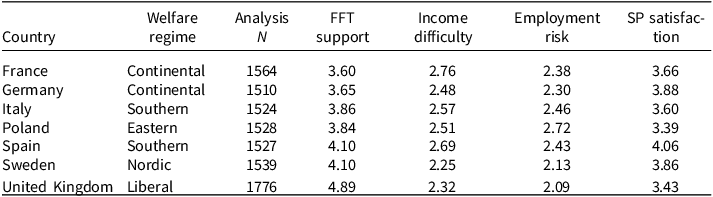
Finally, Table 1 illustrates cross-national variation in the key variables. Mean fossil fuel tax support is highest in the United Kingdom (4.89) and Spain and Sweden (both 4.10), and lowest in France (3.60) and Germany (3.65). Income difficulty is highest in France (2.76) and Italy (2.57) and lowest in Sweden (2.25). Poland shows the highest employment risk (2.72), contrast to the UK (2.09) and Sweden (2.13) exhibiting the lowest levels. Social policy satisfaction is highest in Spain (4.06) and Germany (3.88), while Poland (3.39) and the UK (3.43) report the lowest levels.
Cross-national means of key variables

Table 1. Long description
A table comparing welfare regimes and key variables across countries. The table has 8 rows and 7 columns. The columns are labeled Welfare regime, Analysis N, FFT support, Income difficulty, Employment risk, and SP satisfaction. The rows are labeled with country names: France, Germany, Italy, Poland, Spain, Sweden, and United Kingdom. Each row provides data for the respective country. Row 1: France, Continental, 1564, 3.60, 2.76, 2.38, 3.66. Row 2: Germany, Continental, 1510, 3.65, 2.48, 2.30, 3.88. Row 3: Italy, Southern, 1524, 3.86, 2.57, 2.46, 3.60. Row 4: Poland, Eastern, 1528, 3.84, 2.51, 2.72, 3.39. Row 5: Spain, Southern, 1527, 4.10, 2.69, 2.43, 4.06. Row 6: Sweden, Nordic, 1539, 4.10, 2.25, 2.13, 3.86. Row 7: United Kingdom, Liberal, 1776, 4.89, 2.32, 2.09, 3.43.
Note: Country means are unweighted and use all non-missing observations for each variable in the cleaned analysis file. FFT Support: 0–10; Income Difficulty: 1–4; Employment Risk: 1–5 (employed subsample only); Social Policy (SP) Satisfaction: 0–10.
Regression analysis
Economic risks, social policy satisfaction, and fossil fuel tax support
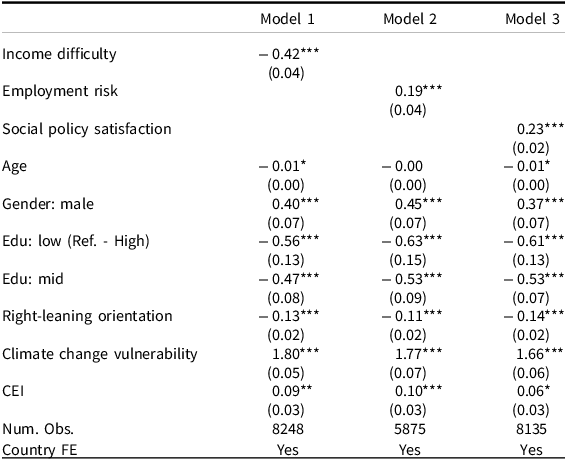
We begin our regression analysis by assessing how income difficulty and perceived employment risk shape support to fossil fuel taxation. The results are presented in Table 2, which shows fully specified models controlling for demographic, attitudinal, and contextual factors.
Economic risks and fossil fuel tax support
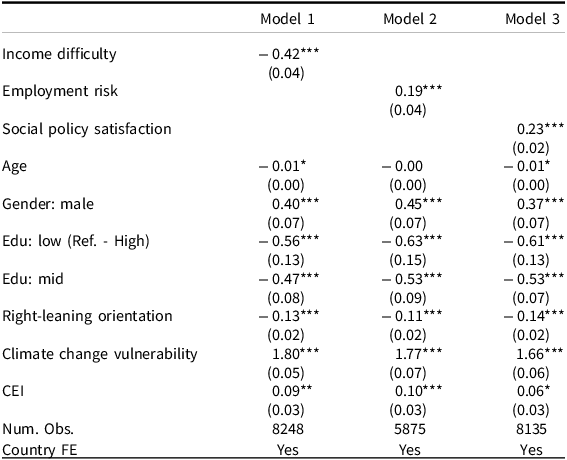
Table 2. Long description
A table showing regression analysis results on how income difficulty and perceived employment risk shape support for fossil fuel taxation. The table has 13 rows and 3 columns. The columns are labeled Model 1, Model 2, and Model 3. The rows are labeled with various factors such as Income difficulty, Employment risk, Social policy satisfaction, Age, Gender: male, Edu: low (Ref. - High), Edu: mid, Right-leaning orientation, Climate change vulnerability, CEI, Num. Obs., and Country FE. Each cell contains values representing the regression coefficients and standard errors for each factor in the three models. Row 1: Income difficulty, Model 1: -0.42***, (0.04), Model 2:, , Model 3:, . Row 2: Employment risk, Model 1:, , Model 2: 0.19***, (0.04), Model 3:, . Row 3: Social policy satisfaction, Model 1:, , Model 2:, , Model 3: 0.23***, (0.02). Row 4: Age, Model 1: -0.01*, (0.00), Model 2: -0.00, (0.00), Model 3: -0.01*, (0.00). Row 5: Gender: male, Model 1: 0.40***, (0.07), Model 2: 0.45***, (0.07), Model 3: 0.37***, (0.07). Row 6: Edu: low (Ref. - High), Model 1: -0.56***, (0.13), Model 2: -0.63***, (0.15), Model 3: -0.61***, (0.13). Row 7: Edu: mid, Model 1: -0.47***, (0.08), Model 2: -0.53***, (0.09), Model 3: -0.53***, (0.07). Row 8: Right-leaning orientation, Model 1: -0.13***, (0.02), Model 2: -0.11***, (0.02), Model 3: -0.14***, (0.02). Row 9: Climate change vulnerability, Model 1: 1.80***, (0.05), Model 2: 1.77***, (0.07), Model 3: 1.66***, (0.06). Row 10: CEI, Model 1: 0.09**, (0.03), Model 2: 0.10***, (0.03), Model 3: 0.06*, (0.03). Row 11: Num. Obs., Model 1: 8248, Model 2: 5875, Model 3: 8135. Row 12: Country FE, Model 1: Yes, Model 2: Yes, Model 3: Yes.
Note: Occupational class controlled but not shown. Standard errors clustered by NUTS-1 level in parentheses. * p < 0.05, ** p < 0.01, *** p < 0.001.
First, Model 1 shows that income difficulty is negatively associated with fossil fuel tax support, consistent with H1. Each unit increase in income difficulty (on a 1–4 scale) is associated with a 0.42-point decrease in fossil fuel tax support. Second, contrary to our expectations in H2, Model 2 indicates that employment risk perception is positively correlated with support for the fossil fuel tax (β = 0.19, p < 0.001). This unexpected finding suggests that individuals who perceive higher employment risks from environmental protection are actually more supportive of fossil fuel taxation. We return to this finding in detail in Section Understanding the unexpected finding: Comparing different structural sources of employment risk. Third, Model 3 shows that social policy satisfaction is positively associated with fossil fuel tax support (β = 0.23, p < 0.001), supporting H3.
To compare the three predictors on a common metric, we re-estimate the model with each standardized to zero mean and unit variance (Appendix B). A one-standard-deviation increase in social policy satisfaction is associated with a 0.62-point increase in fossil fuel tax support, compared with a 0.4-point decrease for a one-standard-deviation increase in income difficulty and a 0.25-point increase for employment risk. Social policy satisfaction thus carries the largest standardized association of the three. Its effect rivals or exceeds that of income difficulty, the predictor most studied in this literature, and is well above that of employment risk. This is consistent with the policy feedback mechanism we propose, in which positive experience with social protection raises confidence in institutional capacity and lowers the perceived cost of accepting climate policy uncertainty.
Among the covariates, climate change vulnerability is the strongest predictor of fossil fuel tax support across all models, suggesting that respondents who view climate change as threatening are substantially more supportive of carbon taxation. Lower education and right-leaning political ideology are consistently associated with weaker support, while being male is associated with stronger support. Regional CEI is modestly positive in Models 1 and 2 but loses significance in Model 3 once social policy satisfaction is included.
Interaction: social policy satisfaction
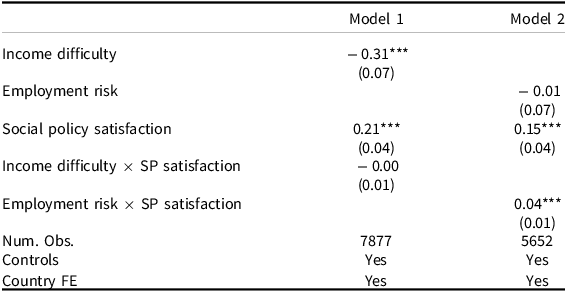
Table 3 examines interaction effects regarding the moderating role of social policy satisfaction on the relationship between economic risks and fossil fuel tax support.
Moderating role of social policy satisfaction
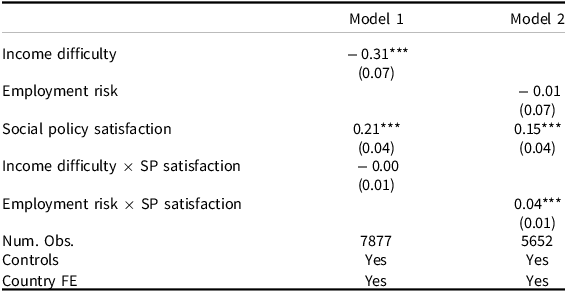
Table 3. Long description
A table with two models comparing the effects of social policy satisfaction on economic risks and support. The table has 8 rows and 4 columns. Column headers are Model 1 and Model 2. Row labels are Income difficulty, Employment risk, Social policy satisfaction, Income difficulty x SP satisfaction, Employment risk x SP satisfaction, Num. Obs., Controls, and Country FE. Row 1: Income difficulty, Model 1: -0.31***, (0.07), Model 2: empty. Row 2: Employment risk, Model 1: empty, Model 2: -0.01 (0.07). Row 3: Social policy satisfaction, Model 1: 0.21***, (0.04), Model 2: 0.15***, (0.04). Row 4: Income difficulty x SP satisfaction, Model 1: -0.00 (0.01), Model 2: empty. Row 5: Employment risk x SP satisfaction, Model 1: empty, Model 2: 0.04*** (0.01). Row 6: Num. Obs., Model 1: 78777, Model 2: 5652. Row 7: Controls, Model 1: Yes, Model 2: Yes. Row 8: Country FE, Model 1: Yes, Model 2: Yes.
Note: Controls include age, gender, education, occupational class, left-right scale, climate vulnerability, and CEI. Standard errors clustered by NUTS-1 level in parentheses. * p < 0.05, ** p < 0.01, *** p < 0.001.
Model 1 tests H4a by examining whether social policy satisfaction moderates the relationship between income difficulty and fossil fuel tax support. The interaction term is not statistically significant, indicating that the negative effect of income difficulty on tax support persists regardless of satisfaction with social policies. This suggests that income-related concerns about carbon taxation may be too immediate and concrete to be offset by general confidence in social protection.
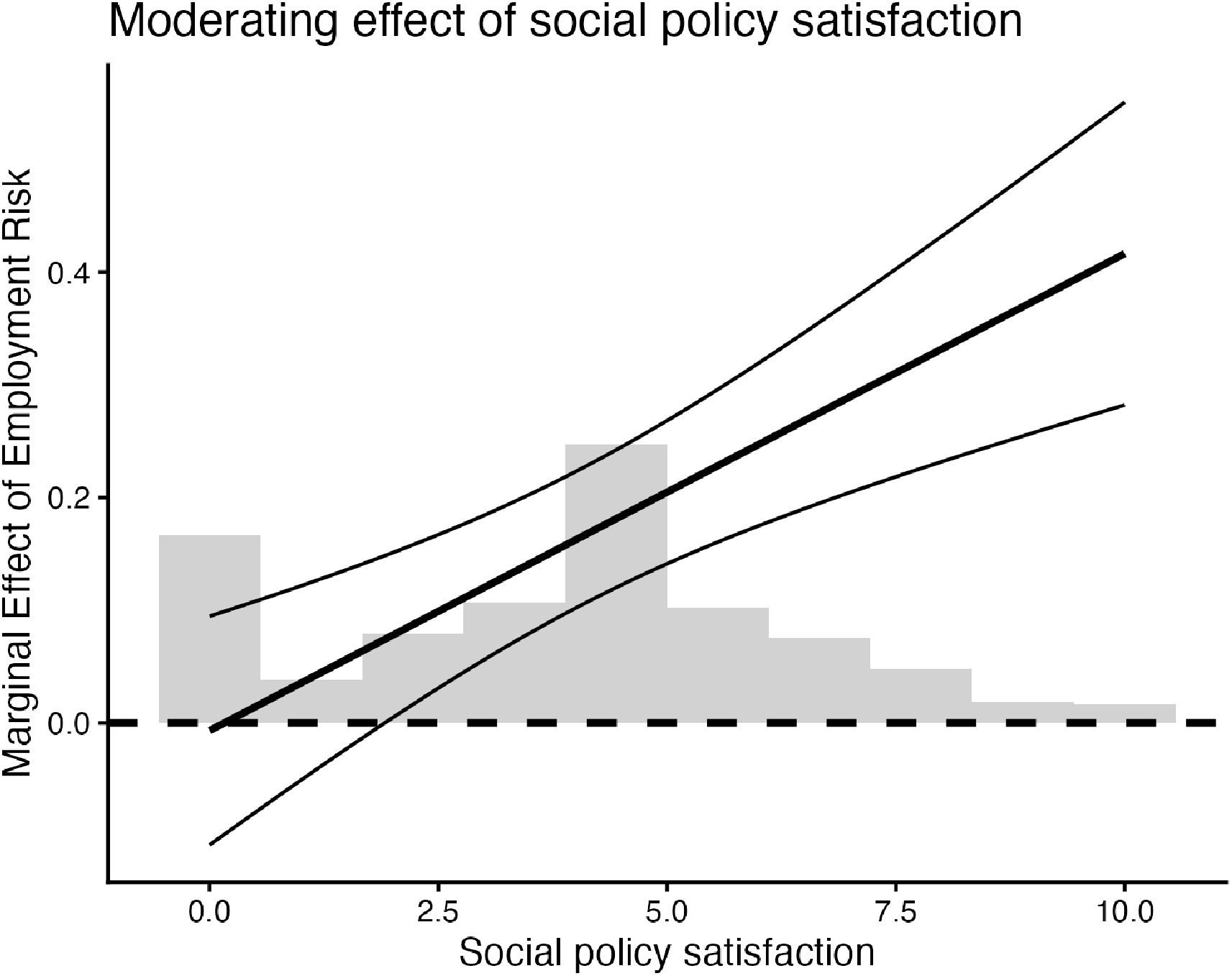
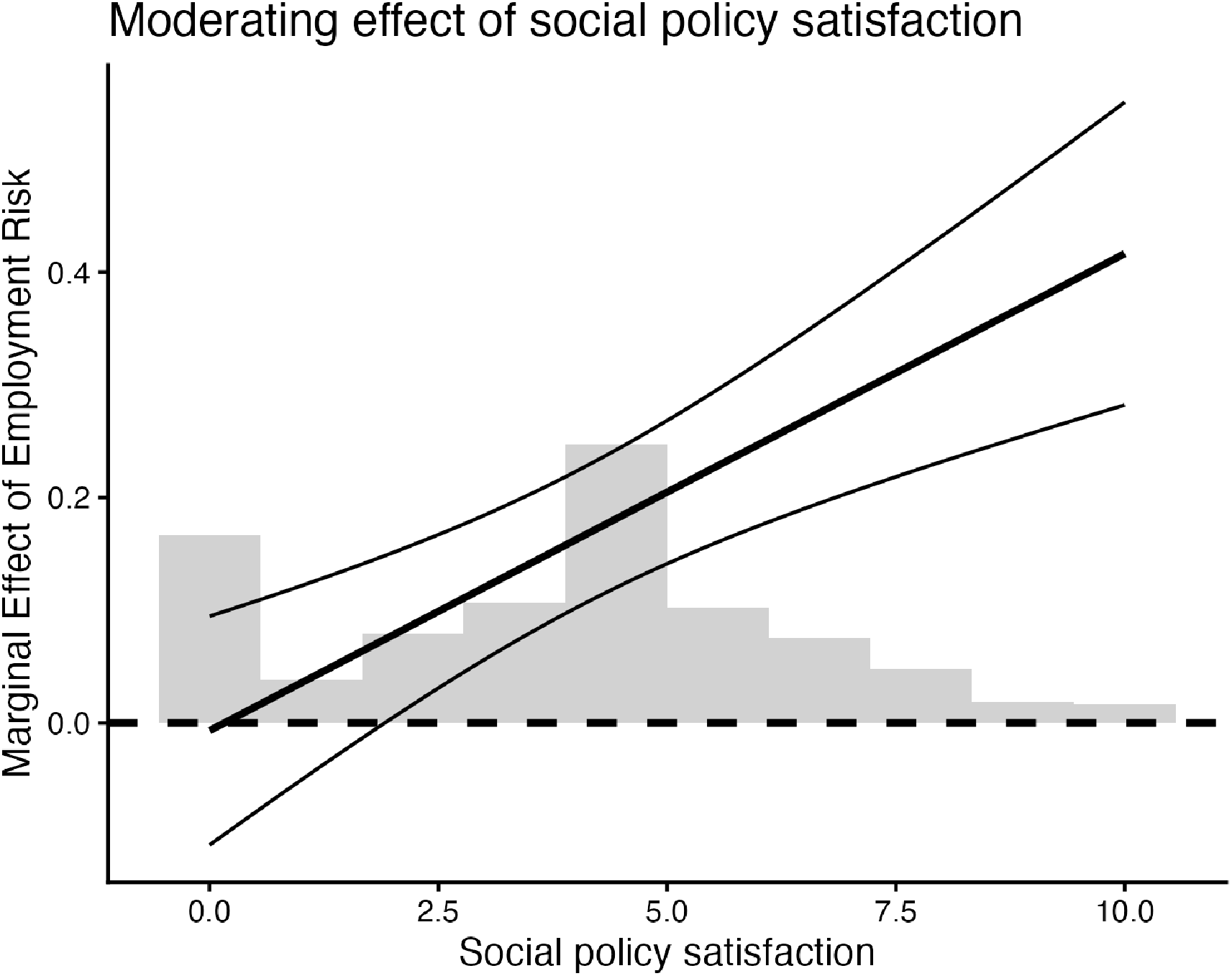
Model 2 tests H4b by examining whether social policy satisfaction moderates the relationship between employment risk and fossil fuel tax support. Here we find a significant positive interaction effect (β = 0.04, p < 0.001), consistent with H4b. This means that the relationship between employment risk and fossil fuel tax support varies depending on satisfaction with social policies. Figure 2 illustrates this interaction: among individuals with low social policy satisfaction, there is little relationship between employment risk and tax support, but among those with high satisfaction, greater employment risk is associated with substantially higher support for fossil fuel taxation.
Moderation effect of social policy satisfaction on employment risk.
Understanding the unexpected finding: comparing different structural sources of employment risk
The positive association between employment risk perception and fossil fuel tax support (contrary to H2) needs further scrutiny. One possibility is reverse-causality specific to environmental attitudes. Respondents who are highly concerned about climate change may support carbon taxation and perceive higher employment risks from the green transition not because they are genuinely vulnerable but because they are more attuned to climate-related disruptions. If that is the right reading, the positive association would be spurious, driven by environmental consciousness rather than by economic self-interest.
Alternatively, the pattern might reflect a broader phenomenon in which individuals attentive to structural economic change are generally more supportive of policy interventions. Under this interpretation, awareness of economic transformation is correlated with support for government action, regardless of its source.
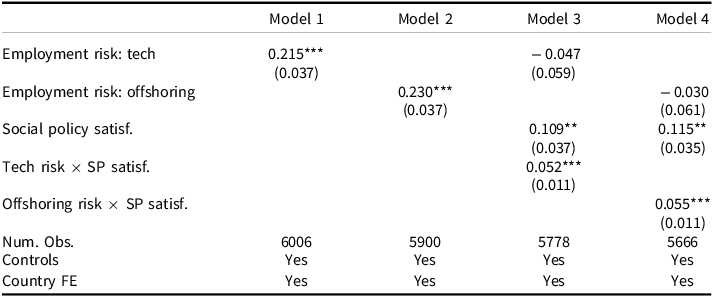
To distinguish between these readings, we use two additional employment risk perceptions concerning technology/automation and offshoring. If the positive association is unique to environment-related employment risk, that would support the reverse-causality reading, because only this risk type is directly tied to climate attitudes. If the pattern instead generalizes to automation and offshoring risks (which are not directly tied to environmental consciousness), it would point to a broader phenomenon of awareness of structural economic change. Table 4 presents these comparisons.
Comparing employment risk types and fossil fuel tax support
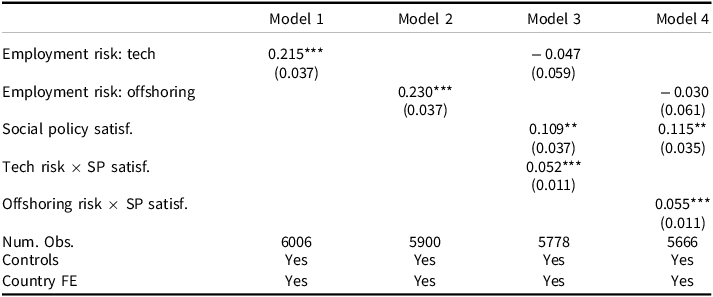
Table 4. Long description
A table comparing employment risk types and fossil fuel tax support across four models. The table has four rows and five columns. The columns are labeled Model 1, Model 2, Model 3, and Model 4. The row labels are Employment risk: tech, Employment risk: offshoring, Social policy satisf., Tech risk x SP satisf., Offshoring risk x SP satisf., Num. Obs., Controls, and Country FE. Row 1: Employment risk: tech, Model 1: 0.215***(0.037), Model 2:, Model 3: -0.047(0.059), Model 4: . Row 2: Employment risk: offshoring, Model 1:, Model 2: 0.230***(0.037), Model 3:, Model 4: -0.030(0.061). Row 3: Social policy satisf., Model 1:, Model 2:, Model 3: 0.109**(0.037), Model 4: 0.115**(0.035). Row 4: Tech risk x SP satisf., Model 1:, Model 2:, Model 3: 0.052***(0.011), Model 4: . Row 5: Offshoring risk x SP satisf., Model 1:, Model 2:, Model 3:, Model 4: 0.055***(0.011). Row 6: Num. Obs., Model 1: 6006, Model 2: 5900, Model 3: 5778, Model 4: 5666. Row 7: Controls, Model 1: Yes, Model 2: Yes, Model 3: Yes, Model 4: Yes. Row 8: Country FE, Model 1: Yes, Model 2: Yes, Model 3: Yes, Model 4: Yes.
Note: Models 1–2 include main effects only; Models 3–4 include interaction with social policy satisfaction. All models include full controls (age, gender, education, occupational class, CEI, left-right scale, climate vulnerability) and country FE. Standard errors clustered by NUTS-1. * p < 0.05, ** p < 0.01, *** p < 0.001.
The pattern is consistent across all four models. Models 1 and 2 show that both technology-related (β = 0.215, p < 0.001) and offshoring-related (β = 0.23, p < 0.001) employment risks are positively associated with fossil fuel tax support, similar in size to the environment-related employment-risk effect from our main analysis (Table 2, Model 2: β = 0.19). Models 3 and 4 then show that these positive associations are also moderated by social policy satisfaction: the interaction coefficients are positive and significant for both technology risk (β = 0.052, p < 0.001) and offshoring risk (β = 0.055, p < 0.001), again comparable in size to the corresponding environment-related interaction (Table 3, Model 2: β = 0.04).
Given that we observe the same pattern for risks unrelated to climate policy, the positive employment-risk coefficient is unlikely to be a reverse-causality artifact tied to environmental concern. It looks more like a general orientation among respondents who are attentive to structural economic change. They are more supportive of policy intervention across the board, and this support is amplified when they feel protected by the welfare state. We return to the broader implications of this reading in Section Discussion and conclusion.
Robustness checks
We subjected the findings to five robustness checks; full results are reported in the appendices. First, the results are robust to the multilevel structure of the data. Re-estimating the models with NUTS-1 random intercepts in place of country fixed effects leaves the negative income difficulty effect, the positive employment-risk effect, the positive satisfaction main effect, and the H4a/H4b asymmetry intact (Appendix C).
Second, the patterns are not artifacts of the differing analytic samples across models. Re-estimating Models 1, 3, and the income × SP interaction on the H2-eligible (employed) subsample leaves income difficulty (β ≈ −0.47) and social policy satisfaction (β ≈ 0.25) stable in sign and magnitude, and the income × SP interaction remains insignificant (Appendix D).
Third, the results are robust to alternative operationalizations of the dependent variable (Appendix E). Recoding fossil fuel tax support as a binary indicator (score > 5 = 1; 33.8% of sample) and re-estimating all models via Linear Probability Model (LPM) yields the same signs and the same H4a/H4b asymmetry as the OLS results (Appendix E1). Using support for “banning cheap, inefficient appliances” (a regulatory rather than fiscal instrument) as an alternative outcome, income difficulty remains negative (β = −0.21), social policy satisfaction remains positive (β = 0.09), and the employment-risk × satisfaction interaction remains positive (β = 0.03). The one exception is the employment-risk main effect, which is negative for the appliance ban (β = −0.15), suggesting that the unexpected positive association in our main models is specific to the fiscal instrument (Appendix E2).
Fourth, the satisfaction effect is not merely ideological sorting by “eco-social” respondents who combine pro-welfare and pro-environment attitudes (Fischer and Giuliani Reference Fischer and Amerigo Giuliani2025; Otto and Gugushvili Reference Otto and Gugushvili2020; Ronchi et al. Reference Ronchi, Natili and Molteni2023). Even after splitting the sample at the country-specific median of welfare state preferences, social policy satisfaction predicts support in both groups, while the employment risk × satisfaction interaction is stronger among the high-preference group (β = 0.04) than the low (β = 0.02, n.s.), consistent with a reinforcement reading of policy feedback (Appendix F).
Finally, estimates conducted separately for five welfare regime groups – Nordic, Continental, Southern, Eastern, and Liberal – and benchmarked against the pooled model (Figure G1) reveal a remarkably similar pattern. Income difficulty is negatively associated with support for carbon taxation in every regime group, while social policy satisfaction is positively associated with support in most cases. The results for perceived employment risk are more heterogeneous but nonetheless informative: its main effect is positive in most regime groups, and its interaction with social policy satisfaction is also generally positive. Given the limited number of observations within some regime-specific samples, we interpret these analyses as robustness checks rather than definitive tests of regime-level differences. Nevertheless, the findings suggest that the mechanisms identified in our analysis are not confined to any particular welfare state configuration but operate across a diverse range of institutional contexts (Appendix G).
Discussion and conclusion
This study investigated how socio-economic risks influence preferences for carbon taxes, with particular attention to the moderating role of satisfaction with national social policy institutions. Drawing on policy feedback theory, we argue that individuals’ confidence in existing social protections shapes their willingness to accept the economic risks associated with climate policy.
Our findings are threefold. Starting with the economic determinants of carbon tax support, we find that income difficulties and perceived employment vulnerability have contrasting effects. Consistent with H1, household income difficulty is negatively associated with fossil fuel tax support. This is consistent with a sizable literature documenting how immediate financial concerns, especially the regressive bite of consumption taxes, drive opposition to carbon pricing (Beiser-McGrath and Bernauer Reference Beiser-McGrath and Bernauer2024; Beiser-McGrath and Busemeyer Reference Beiser-McGrath and Busemeyer2024; Douenne and Fabre Reference Douenne and Fabre2022). For respondents already struggling with day-to-day expenses, the prospect of higher fuel prices is a concrete near-term cost that weighs against broader environmental benefits.
By contrast, and contrary to H2, perceived employment risk is positively associated with fossil fuel tax support, cutting against the straightforward self-interest expectations common in the political economy literature on occupational risk (Cusack et al. Reference Cusack, Iversen and Rehm2006; Kitschelt and Rehm Reference Kitschelt and Rehm2014). Because the same positive pattern holds for automation and offshoring risks (Table 4), we infer that what drives this association is not narrow self-interest but a broader “structural transformation salience” (Heddesheimer et al. Reference Heddesheimer, Hilbig and Voeten2025). Our interpretation is that respondents attentive to large-scale economic change are more supportive of coordinated policy responses and government intervention more generally, consistent with the view that individuals who perceive systemic risks are more supportive of systemic solutions (Pierson Reference Pierson1993; Stadelmann-Steffen and Eder Reference Stadelmann-Steffen and Eder2021). However, our cross-sectional data cannot establish causal direction here, and the interpretation would benefit from longitudinal or experimental follow-up.
The third, and most important, finding concerns the role of social policy institutions. Consistent with H3, satisfaction with national social policies is positively associated with fossil fuel tax support across all specifications. This is in line with recent cross-national evidence that welfare coverage correlates with carbon tax support (Nordbrandt et al. Reference Nordbrandt, Peterson, Mårtensson and Palme2025) and that welfare state generosity can increase pro-environmental behavior (Parth and Vlandas Reference Parth and Vlandas2022). What our results suggest is that perceived protection plays a role here, complementing the accounts that emphasize objective features of the welfare state.
Moreover, we find support for H4b. Social policy satisfaction positively moderates the relationship between employment risk and support (Figure 2), consistent with work showing that welfare context shapes fuel tax attitudes (Büchs et al. Reference Büchs, Bastianelli and Schnepf2024; Bürgisser et al. Reference Bürgisser, Stadelmann-Steffen and Armingeon2026). H4a, by contrast, is not supported, since income difficulty’s negative effect persists regardless of satisfaction.
The asymmetry between H4a and H4b was not what we initially expected. However, we see it as one of the paper’s main empirical contributions, as it suggests a potentially important distinction between immediate economic costs and anticipated economic risks, which future research should investigate more directly. Income difficulty is an immediate consumption cost. Higher fuel prices hit a stretched household budget directly, and general confidence in social protection does little to offset it. Employment risk is future-oriented and uncertain, and it is there that perceived institutional protection has most purchase. Respondents who feel the welfare state has protected them before are more willing to accept that it will again if the transition disrupts their job. Welfare state confidence thus works as a buffer against economic uncertainty rather than as compensation for immediate costs, a distinction that matters for using social protection to build climate policy coalitions.
Our analysis has several limitations. First, our measure of social policy satisfaction captures subjective perceptions, not the objective generosity of the welfare state. We argue perceptions are the right object for studying policy feedback, but future work should examine how objective welfare state characteristics interact with subjective satisfaction. Second, our regional measure (NUTS-1) is relatively coarse and does not capture fine-grained sectoral exposure to decarbonization. Finer sectoral data would help isolate the mechanisms through which employment concerns shape climate policy attitudes. Third, our cross-sectional data limit causal inference. The positive association between employment risk and carbon tax support could reflect reverse causality, common causes, or the awareness of structural change we propose, where attentiveness to structural economic change drives the association. Longitudinal or experimental designs would help adjudicate. Fourth, our sample is limited to seven European countries with relatively developed welfare states, so the relationships we observe may not generalize to contexts with weaker social protection.
Subject to these caveats, our results have practical implications for climate policy design. The strong negative effect of income difficulty on carbon tax support implies that distributional concerns cannot be set aside. But direct-compensation mechanisms alone are probably not enough, since even visible rebates have limited effects on public support (Mildenberger et al. Reference Mildenberger, Lachapelle, Harrison and Stadelmann-Steffen2022). Our results point to a complement, not a substitute. Broader confidence in social protection appears to be its own pathway for building climate policy coalitions.
The positive moderation effect of social policy satisfaction on the employment-risk channel suggests that strengthening welfare states can make it easier for the public to accept climate policies with uncertain economic consequences. That fits the “eco-social” policy integration approach in recent scholarship (Baute Reference Baute2025; Bergquist et al. Reference Bergquist, Mildenberger and Stokes2020; Fischer and Giuliani Reference Fischer and Amerigo Giuliani2025; Ronchi et al. Reference Ronchi, Natili and Molteni2023). The null finding for income difficulty is the other side of the same coin. General confidence in welfare state institutions does not address every source of opposition, and targeted measures aimed at immediate consumption impacts may also be needed (see also Natili et al. Reference Natili, Pellegata and Visconti2026).
Several lines of future research follow this. One question is which specific dimensions of social policy (unemployment insurance, active labor-market programs, minimum income guarantees) are most effective in building public support for climate policy. A second is why respondents who are attentive to structural economic change tend to support rather than oppose climate policy, since this runs against the standard self-interest reading. A third is how all of this plays out in different institutional contexts, particularly in countries with weaker social protection, where the moderating role of social policy satisfaction may be more pronounced.
Supplementary material
The supplementary material for this article can be found at https://doi.org/10.1017/S0143814X26101214.
Data availability statement
Replication materials are available in the Journal of Public Policy Dataverse at https://doi.org/10.7910/DVN/EWDWLV.
Competing interests
The author(s) declare none.


 Open access

