1. Introduction
The capacity to learn and use abstract concepts (ACs), such as “freedom”, is one of the most remarkable human abilities. ACs are ubiquitous, and they represent a great part of our speech (Lupyan & Winter, Reference Lupyan and Winter2018). In the following, we will use the working definition of ACs proposed by Borghi and Binkofski (Reference Borghi and Binkofski2014): compared to concrete concepts (CCs), ACs typically lack a single object as referent, they are more detached from sensory modalities (Barsalou, Reference Barsalou2003), and they refer to more complex situations in which multiple objects/entities are present (Pulvermüller, Reference Pulvermüller2018b). Notice that here we will focus on abstractness and not on abstraction (Borghi et al., in press), i.e., on “truly” ACs (e.g., “freedom”). We thus avoided using general concepts, such as superordinate ones (e.g., “animal”), because they have concrete denotations, i.e., refer to a variety of concrete exemplars (e.g., “lions”, “dogs”, “birds”). In our view, CCs and ACs are not dichotomously opposed: concepts typically have both abstract and concrete features, even if in different proportions (Wiemer-Hastings, Krug, & Xu, Reference Wiemer-Hastings, Krug and Xu2001).
Interest in the representation of ACs is growing in both psychology and cognitive and social neuroscience (see Bolognesi & Steen, Reference Bolognesi and Steen2018; Borghi, Barca, Binkofski, & Tummolini, Reference Borghi, Barca, Binkofski and Tummolini2018b). However, current literature is afflicted by two main limitations. The first is the tendency to consider ACs all together, without taking into account their distinctions; the second is that there is no uniformity in the criteria adopted to select them. We will address these two issues separately.
1.1. ACs are not a monolithic whole but many kinds of ACs exist
Traditional views both assumed the existence of a dichotomy between CCs and ACs, and also treated ACs as a monolithic whole. This is striking, especially in consideration of the long-lasting interest for sub-kinds of CCs. Since the seminal work of Warrington and Shallice (Reference Warrington and Shallice1984), many neuropsychological studies on CCs have been dedicated to investigating double dissociations, such as that between concepts of living and non-living entities (for a review, see Humphreys & Forde, Reference Humphreys and Forde2001).
Conversely, only recently behavioral and neuroscientific studies are starting to consider how different kinds of ACs are represented. On the behavioral side, results of a rating task showed that emotional, math-related, and mental states concepts differently engage the mouth and the hand effectors (Ghio, Vaghi, & Tettamanti, Reference Ghio, Vaghi and Tettamanti2013; see also Ghio, Haegert, Vaghi, & Tettamanti, Reference Ghio, Haegert, Vaghi and Tettamanti2018). Evidence with feature production tasks further pointed out the differences between ACs. For example, Setti and Caramelli (Reference Setti and Caramelli2005) highlighted the differences in the conceptual relations evoked by concepts of nominal kinds (e.g., “error”), states of the self (e.g., “worry”), cognitive processes (e.g., “memory”), and emotions (e.g., “fear”). A study by Roversi, Borghi, and Tummolini (Reference Roversi, Borghi and Tummolini2013) showed that the abstract–concrete distinction is more marked within social than institutional and artefact concepts. A cluster analysis (Harpaintner, Trumpp, & Kiefer, Reference Harpaintner, Trumpp and Kiefer2018) revealed different kinds of ACs, grouped on the basis of the dominance of the considered features. Finally, evidence was reported suggesting that emotion concepts are peculiar with respect both to CCs and to ACs: they are typically processed faster and recalled better than CCs but worse than ACs, they elicit different kinds of relations, and they are acquired earlier than ACs (Altarriba, Bauer, & Benvenuto, Reference Altarriba, Bauer and Benvenuto1999; Altarriba & Bauer, Reference Altarriba and Bauer2004; Barca, Mazzuca, & Borghi, Reference Barca, Mazzuca and Borghi2017; Mazzuca, Lugli, Benassi, Nicoletti, & Borghi, Reference Mazzuca, Lugli, Benassi, Nicoletti and Borghi2018; Ponari, Norbury, & Vigliocco, Reference Ponari, Norbury and Vigliocco2018).
As to the neural underpinnings of different ACs, fMRI evidence (Mellem, Jasmin, Peng, & Martin, Reference Mellem, Jasmin, Peng and Martin2016) showed that specific neural networks are engaged for social concepts processing, for number processing, and for abstract emotional words (Moseley, Carota, Hauk, Mohr, & Pulvermüller, Reference Moseley, Carota, Hauk, Mohr and Pulvermüller2011; Dreyer et al., Reference Dreyer, Frey, Arana, von Saldern, Picht, Vajkoczy and Pulvermüller2015). Desai, Reilly, and van Dam (Reference Desai, Reilly and van Dam2018) investigated the neural bases of number and emotional concepts, and of two higher-order concepts, i.e., morality judgments and theory of mind: they demonstrated that each of the four kinds of concepts engage overlapping but also unique areas. All together, these studies suggest that ACs can be quite different from one another.
Even though studies have started to explore ACs and their differences, so far no systematic attempt has been made to investigate the fine-grained distinctions between kinds of ACs. The first aim of our paper is to fill this gap in identifying how different kinds of ACs are represented. To this end, we systematically scrutinized a high number of Italian ACs, asking participants to rate them on many dimensions.
1.2. ACs cannot be identified solely on the basis of concreteness or of imageability ratings
The results of the numerous studies on ACs are sometimes difficult to compare, because of the different criteria adopted to identify them, and because many dimensions are correlated. Stimuli are often selected on the basis of abstractness and concreteness ratings, but in some databases these ratings are provided on a single scale (e.g., Paivio, Reference Paivio1990; Barca, Burani, & Arduino, Reference Barca, Burani and Arduino2002), in others on two different scales (e.g., Della Rosa, Catricalà, Vigliocco, & Cappa, Reference Della Rosa, Catricalà, Vigliocco and Cappa2010). Furthermore, sometimes concreteness and abstractness are not explained, sometimes defined in different ways: for example, Brysbaert, Warriner, and Kuperman (Reference Brysbaert, Warriner and Kuperman2014) defined abstract words as having “meanings that cannot be experienced directly but which we know because the meanings can be defined by other words” (p. 906), and concrete words as words that “refer to things or actions in reality, which you can experience directly through one of the five senses” (p. 906); in contrast, Juhasz and Yap (Reference Juhasz and Yap2013) operationalized this distinction in terms of “the extent to which a word evokes a sensory and/or perceptual experience” (p. 160); importantly the results obtained are only mildly correlated (r = .4) (Lupyan & Winter, Reference Lupyan and Winter2018). Furthermore, for some years stimuli were selected on the basis of imageability ratings, implicitly equating abstractness with low imageability. This choice was primarily due to the influence of the Dual Coding Theory proposed by Paivio (Reference Paivio1990), according to which abstractness was explained by low imageability. In reality, abstractness is highly correlated but not equivalent with imageability (Kousta, Vigliocco, Vinson, Andrews, & Del Campo, Reference Kousta, Vigliocco, Vinson, Andrews and Del Campo2011). To render things more complex, Connell and Lynott (Reference Connell and Lynott2012) have recently shown, with a sample of both concrete and abstract English words, that the concreteness effect is explained better by the perceptual strength of the each of the five senses separately, rather than by concreteness and imageability. In sum, ACs and CCs cannot be explained exclusively in terms of their difference in abstractness/concreteness and imageability. Rather, we are inclined to think that the best way to represent concreteness/abstractness is a multidimensional space, in which different concepts are distributed as a function of their similarity along a variety of dimensions (Crutch, Troche, Reilly, & Ridgway, Reference Crutch, Troche, Reilly and Ridgway2013; Troche, Crutch, & Reilly, Reference Troche, Crutch and Reilly2017).
To make a long story short, the distinction between CCs and ACs is far from being clear-cut, and deserves further scrutiny. Furthermore, we have seen that relying solely on abstractness/concreteness norms or alternatively on imageability norms has many limitations, and that previous studies are sometimes difficult to compare because of the different criteria adopted. Collecting norms in which different dimensions apart from concreteness–abstractness and imageability are introduced is thus pivotal, in order to investigate in depth the subtle nuances that might distinguish different kinds of ACs. Given the theoretical relevance of this challenge, our work offers both a methodological and a theoretical contribution. We will address them in sequence.
1.3. methodological contribution
Our study will assess how ACs are represented using ratings on many dimensions. Compared to previous work, our study (a) presents many more semantic dimensions, and (b) is exclusively focused on ACs.
(a) To our knowledge no database so far includes so many rated dimensions as the present one. As to Italian databases, the two most used in this area are those by Barca et al. (Reference Barca, Burani and Arduino2002) and by Della Rosa et al. (Reference Della Rosa, Catricalà, Vigliocco and Cappa2010). Barca et al. (Reference Barca, Burani and Arduino2002) provide norms and response times for 626 Italian concrete and abstract nouns. Their norms include many psycholinguistic variables (e.g., adult/child written frequencies, adult spoken frequency, length in syllables and letters, lexical stress), while the semantic variables which are more relevant to us, apart from familiarity, are concreteness/abstractness (computed on a single scale), imageability, and Age of Acquisition (AoA). Della Rosa et al. (Reference Della Rosa, Catricalà, Vigliocco and Cappa2010) provide norms on 417 Italian words, both concrete and abstract, on a number of semantic variables relevant to defining abstractness: apart from familiarity, they are concreteness and abstractness (separately computed), imageability, contextual availability, Age of Acquisition, and Modality of Acquisition (MoA). A third database, which is less directly relevant to our work, is by Montefinese, Ambrosini, Fairfield, and Mammarella (Reference Montefinese, Ambrosini, Fairfield and Mammarella2014), who provided affective norms for 1,121 Italian words, taken either from Affective Norms for English Words (ANEW; Bradley & Lang, Reference Bradley and Lang1999) or from Italian semantic norms (Montefinese, Ambrosini, Fairfield, & Mammarella, Reference Montefinese, Ambrosini, Fairfield and Mammarella2013).
(b) The present database differs from previous ones also because it is exclusively focused on ACs. We decided to use only ACs in order to capture even subtle differences among them, and to identify sub-kinds of ACs through cluster analysis. Hence, we took into account the evaluation of participants rather than principled, a-priori determined categories (for a study in which we verify how the rated dimensions fitted with a-priori determined categories, see Villani, Lugli, Liuzza, & Borghi, Reference Villani, Lugli, Liuzza and Borghi2019).
1.4. theoretical contribution
The major novelty of our work is theoretical. Apart from more traditional dimensions, the novel dimensions we introduced were selected based on the theoretical predictions of multiple representation theories on ACs. We believe that the most promising development in recent research on ACs has been the spread and success of these views (see review in Borghi, Binkofski, Castelfranchi, Cimatti, Scorolli, & Tummolini, Reference Borghi, Binkofski, Castelfranchi, Cimatti, Scorolli and Tummolini2017). According to them, ACs are grounded in the sensorimotor system, similarly to CCs (Cuccio & Gallese, Reference Cuccio and Gallese2018; Pulvermüller, Reference Pulvermüller2018a), but they also involve linguistic experience (Dove, Reference Dove2010, Reference Dove2014, Reference Dove2016, Reference Dove2018; Recchia & Jones, Reference Recchia and Jones2012; Borghi & Binkofski, Reference Borghi and Binkofski2014; Lupyan & Winter, Reference Lupyan and Winter2018), social experience (Borghi, Barca, Binkofski, & Tummolini, Reference Borghi, Barca, Binkofski and Tummolini2018a; Borghi et al., in press), emotional experience (Newcombe, Campbell, Siakaluk, & Pexman, Reference Newcombe, Campbell, Siakaluk and Pexman2012; Vigliocco, Kousta, Vinson, Andrews, & Del Campo, Reference Vigliocco, Kousta, Vinson, Andrews and Del Campo2013; Vigliocco et al., Reference Vigliocco, Kousta, Della Rosa, Vinson, Tettamanti, Devlin and Cappa2014), and other inner experiences (interoception, introspection, metacognition) (Barsalou & Wiemer-Hastings, Reference Barsalou, Wiemer-Hastings, Pecher and Zwaan2005; Dellantonio, Mulatti, Pastore, & Job, Reference Dellantonio, Mulatti, Pastore and Job2014).
The WAT (Words As social Tools) theory, a multiple representation view that we have recently proposed (Borghi & Binkofski, Reference Borghi and Binkofski2014; Borghi et al., Reference Borghi, Barca, Binkofski and Tummolini2018a; Borghi et al., in press), ascribes a major role to language and sociality. Specifically, it hypothesizes that more ACs are mainly linguistically acquired and induce in us a higher need to rely on others, because of their complexity and the feeling that our competences are inadequate (Shea, Reference Shea2018). We will detail below the main dimensions we asked participants to rate, and the theoretical reasons underlying our choice.
2. The dimensions we considered
In our study, we presented 425 Italian abstract words to 304 participants, and asked them to evaluate them on a 7-point scale on a variety of dimensions. Among the dimensions, first we included the most classic ones, that are typically used to select ACs: abstractness/concreteness, imageability (Paivio, Clark, & Khan, Reference Paivio, Clark and Khan1988; Paivio, Reference Paivio1990), and context availability (Schwanenflugel, Akin, & Luh, Reference Schwanenflugel, Akin and Luh1992). Notice that ratings on imageability and context availability were initially introduced to test the two more influential classic theories on ACs, i.e., the dual coding theory (DCT; Paivio, Reference Paivio1990) and the Context Availability Theory (CAT; Schwanenflugel et al., Reference Schwanenflugel, Akin and Luh1992). According to DCT, ACs are processed and recalled better than CCs because they are more imageable, while, according to CAT, ACs are characterized by a lower number of associated contexts than CCs. Beyond these usually tested dimensions, we introduced novel dimensions based on predictions of multiple representation views. Some of these dimensions (e.g., metacognition, social metacognition) have never been used to classify ACs. We will describe them below.
2.1. sensorimotor experience
To determine to what extent different kinds of ACs are grounded in sensorimotor experience, we asked participants to rate the perceptual strength of the five perceptual modalities and the extent to which each concept activates Body-Object-Interactions (BOI; Siakaluk, Pexman, Aguilera, Owen, & Sears, Reference Siakaluk, Pexman, Aguilera, Owen and Sears2008; Tillotson, Siakaluk, & Pexman, Reference Tillotson, Siakaluk and Pexman2008; Bennett, Burnett, Siakaluk, & Pexman, Reference Bennett, Burnett, Siakaluk and Pexman2011). For perceptual strength we used the formulation of Lynott and Connell (Reference Lynott and Connell2013), who obtained norms on 400 words on perceptual strength, and that of Connell and Lynott (Reference Connell and Lynott2012); while for Body-Object-Interaction we used the formulation of Bennett et al. (Reference Bennett, Burnett, Siakaluk and Pexman2011), who collected imageability and BOI ratings for 599 multisyllabic English nouns.
2.2. linguistic experience
We included two dimensions related to word acquisition, i.e, Age of Acquisition (Gilhooly & Logie, Reference Gilhooly and Logie1980) and Modality of Acquisition (Wauters, Tellings, Van Bon, & Van Haaften, Reference Wauters, Tellings, Van Bon and Van Haaften2003; Wauters, Van Bon, & Tellings, Reference Wauters, Van Bon and Tellings2006). These dimensions are critical for ACs, because we hypothesize that they are acquired later and more linguistically than CCs (Borghi & Binkofski, Reference Borghi and Binkofski2014).
2.3. inner experience
We included the dimensions of emotionality, interoception, and metacognition. Emotionality is crucial for two reasons: because according to a recent theory emotionality characterizes ACs more than CCs (Vigliocco, et al., Reference Vigliocco, Kousta, Vinson, Andrews and Del Campo2013; Vigliocco et al., Reference Vigliocco, Kousta, Della Rosa, Vinson, Tettamanti, Devlin and Cappa2014); and because we intend to test the hypothesis that emotionality is more crucial for some ACs, i.e., the emotional ones. We also asked participants to rate the role of interoception, i.e., awareness of inner body states (Connell, Lynott, & Banks, Reference Connell, Lynott and Banks2018) and of general metacognition, i.e., awareness of inner processes.
2.4. social experience
We included two dimensions that pertain to the social dimension: social valence (Barsalou & Wiemer-Hastings, Reference Barsalou, Wiemer-Hastings, Pecher and Zwaan2005; Barsalou, Dutriaux, & Scheepers, Reference Barsalou, Dutriaux and Scheepers2018) and social metacognition. Recently we distinguished between general and social metacognition – the first notion refers to the awareness of inner processes, the second to the need to rely on others in order to complement our knowledge because we are aware of the inadequacies of our concepts (Borghi et al., Reference Borghi, Barca, Binkofski and Tummolini2018b; Shea, Reference Shea2018).
2.5. hand and mouth effectors
We asked participants to rate to what extent concepts involve use of the hand and the mouth. Recent evidence has indeed shown that the processing of ACs overall, and particularly of very abstract ACs, such as mental states ones, involves the mouth motor system. Conversely, processing of CCs more involves the hand (Ghio et al., Reference Ghio, Vaghi and Tettamanti2013; Borghi & Zarcone, Reference Borghi and Zarcone2016; Barca, Mazzuca, & Borghi, Reference Barca, Mazzuca and Borghi2017; Dreyer & Pulvermüller, Reference Dreyer and Pulvermüller2018).
3. Hypotheses
We formulated two hypotheses. The first concerns the relationships between the considered dimensions, the second is exploratory and regards the way in which from our data clusters referring to different kinds of ACs are obtained.
3.1. relations between the rated dimensions
If ACs rely more than CCs on linguistic and social experience, then more ACs should be less related to sensorimotor and inner grounding (lower level of emotionality, Body-Object-Interaction, and perceptual modality strength), while they should be more related to linguistic and social experience. Specifically, we predict that more ACs would be acquired mostly linguistically (Modality of Acquisition) and, owing to their complexity, would rely to a larger extent on the competence of others (social metacognition). We also predict that, within ACs, the more concrete ones would evoke more bodily interactions with objects, while the more abstract ACs would elicit more inner processes, particularly less embodied inner processes (metacognition more than interoception).
3.2. kinds of ACs
We are interested in determining the latent variables underlying our data, and in identifying how ACs group into distinct clusters. We thus performed an exploratory factor analysis in order to reduce the number of weakly correlated dimensions, and further cluster analyses that allowed us to verify how different concepts group together. Given the exploratory character of the analyses, we formulated only very general predictions. We predict that the degree of embodiment influences organization in clusters: there might be more embodied ACs, such as emotional and physical concepts, and less embodied ones, like institutional or philosophical ACs. Within more embodied ACs, we are interested in determining if some concepts are more grounded than others in exteroceptive and interoceptive experience. Within less embodied ACs, we are especially interested in determining the role of linguistic and social dimensions (MoA, social metacognition) in influencing clustering of concepts.
4. Methods
4.1. participants
304 participants (191 females, M age = 28.38, SD age = 8.77) volunteered for the study. Participants were not younger than 18 and their had either a middle or high education level: 216 declared a degree, 88 a high school diploma. Every participant rated ACs only on one dimension. Every dimension was thus rated by at least 20 participants.
4.2. materials
We selected 425 Italian nouns. These included 286 words present in existing Italian databases on CCs and ACs, and 139 other words. We selected only abstract nouns, trying to include concepts belonging to different categories (e.g., social, temporal, spatial, institutional, emotional concepts). In determining whether a word was abstract or not we used the criterion of abstractness introduced at the beginning of this paper. As anticipated in the ‘Introduction’, to our knowledge two databases of Italian words are very relevant for us. From the Della Rosa et al. (Reference Della Rosa, Catricalà, Vigliocco and Cappa2010) database we considered 200 abstract words selected for their values of abstractness [mean: 486; SD: 75; from 212 (i.e., “family”) to 635 (i.e., “concept”) of threshold in a range from 100 (less abstract) to 700 (more abstract)]. From the Barca et al. (Reference Barca, Burani and Arduino2002) database we considered 86 words selected for their values of concreteness/abstractness [mean: 4.13; SD: 0.87; from 2.14 (i.e., “progress”) to 6.07 (i.e., “money”) of threshold in a range from 1 (highly abstract) to 7 (highly concrete)]. In selecting the remaining 139 words, we took care that all the three experimenters who evaluated them judged them as highly abstract. It is worth noting that the researchers’ evaluation will be supported by the participants’ rating: the mean values of abstractness was 3.99 (SD = 1.03), from 1.38 (i.e., “hole”) to 6.43 (i.e., “absolute”) of threshold in a range from 1 (less abstract) to 7 (highly abstract).
The sample we used might appear small, but it is larger than that of previous Italian databases, that included both CCs and ACs (Barca et al., Reference Barca, Burani and Arduino2002: 626 words; Della Rosa et al., Reference Della Rosa, Catricalà, Vigliocco and Cappa2010: 417 words), and similar to other English databases focusing only on ACs (e.g., Connell & Lynott, Reference Connell and Lynott2012; Lynott & Connell, Reference Lynott and Connell2013: 400 and 592 words, respectively) considering also that English vocabulary is much broader than Italian.
5. Procedure
Participants were submitted to an online form (Google Forms) and were presented with the 425 words in a randomized order. They had to evaluate on a 7-point Likert scale the following 15 dimensions: concreteness (CNR); abstractness (ABS); imageability (IMG); contextual availability (CAT); Age of Acquisition (AoA); Modality of Acquisition (MoA); Body-Object-Interaction (BOI); emotionality (EMO); perceptual strength in the five perceptual modalities (VISION; TOUCH; HEARING; SMELL; TASTE); interoception (INT); metacognition (META); social metacognition (MESO); social valence (SOCIAL); mouth involvement (MOUTH); hand involvement (HAND). We asked participants to provide evaluations of abstractness and concreteness without providing them with a definition of CCs and ACs in order to avoid biasing them and to get a sense of how they spontaneously represent these categories. As described below, the ratings provided were highly consistent with those of the two previously discussed databases. Notice that perceptual strength is considered as a single dimension, but it pertains to the five sensory modalities.
6. Statistical analysis
We analyzed our data using RStudio (version 1.1.453; RStudio Team, 2015) and R (R Core Team, 2018). Concepts represented our units of analysis and we thus computed the average rating for each concept on each dimension and standardized them.
In order to evaluate the level of agreement among the raters, we conducted an Intra Class Correlation analysis on the Concreteness and Abstractness ratings, which are the ones that we suspect might have been evaluated most idiosyncratically. We found that, having the goal of using the average rating, we observed good agreement on the Concreteness (ICC(2, K) = .73) ratings, and excellent agreement (ICC(2, K) = .84.) on the Abstractness ratings. Moreover, we assessed whether the ratings provided by our participants on the same target words for the same dimensions (Abstractness and Concreteness) converged with the ratings provided by the pool from Della Rosa et al. (Reference Della Rosa, Catricalà, Vigliocco and Cappa2010). We found a strong correlation in both dimensions (Pearson’s rs >= .7, ps < .001). We also found a milder (Pearson’s r = .31) but statistically significant (p = .01) correlation between the concreteness ratings provided by our pool and the ones provided by the pool from Barca et al. (Reference Barca, Burani and Arduino2002).
We conducted our analyses on the zero-order correlations by computing the Pearson’s r correlation coefficient for each bivariate correlation across the rated dimensions using the Hmsic R package (Harrell et al., Reference Harrell2018) and displayed them hierarchically clustered on a correlogram using the R package corrplot (Wei & Simko, Reference Wei and Simko2017).
The main aim of our study was to identify clusters of ACs based on their Euclidean distance on the dimensions assessed, an analytical strategy that echoes the one adopted by Harpaintner et al. (Reference Harpaintner, Trumpp and Kiefer2018). A high level of correlation across dimensions may hamper the cluster analysis because two or more conceptually similar dimensions may weight twice, whereas they may be reduced to a unique component score. Therefore, we first reduced the number of dimensions using a Principal Component Analysis (PCA) approach using the R package psych (Revelle, Reference Revelle2018). Since we did not assume components to be orthogonal, components were rotated using an oblimin procedure, and component scores for each component were computed using the regression method. The use of the oblimin rotation was motivated by the fact that psychological/psycholinguistic dimensions are often correlated, and therefore orthogonality is likely to be an unrealistic assumption. On top of that, cluster analysis (CA) requires only a lack of strong correlations, not a total lack of correlation, across variables.
Finally, because hierarchical procedures leave room for subjectivity, we chose to adopt a k-mean method, a partitioning method based on distance. We used Euclidean distances as a measure of distance because (a) it is suited to interval type variables such as component scores, and (b) its interpretation is quite straightforward and it is typically chosen as the standard measure of distance (Everitt, Landau, Leese, & Stahl, Reference Everitt, Landau, Leese and Stahl2001) in psycholinguistics (e.g., in Harpaintner et al., Reference Harpaintner, Trumpp and Kiefer2018).
In order to determine the optimal number of clusters, we used the R package NbClust (Charrad, Ghazzali, Boiteau, & Niknafs, Reference Charrad, Ghazzali, Boiteau and Niknafs2014), which provides 26 indices, such as the Calinski and Harabasz index and the Silhouette index. We set two as the minimum number of clusters and ten as the maximum number of clusters, and selected k-means as the clustering method.
7. Results
7.1. relations between the rated dimensions
In order to address the relations between the rated dimensions and how they account for the concreteness/abstractness of concepts, we will first discuss the correlations between abstractness, concreteness, and the other considered dimensions, then illustrate how PCA analysis led to the emergence of a 3-components solution.
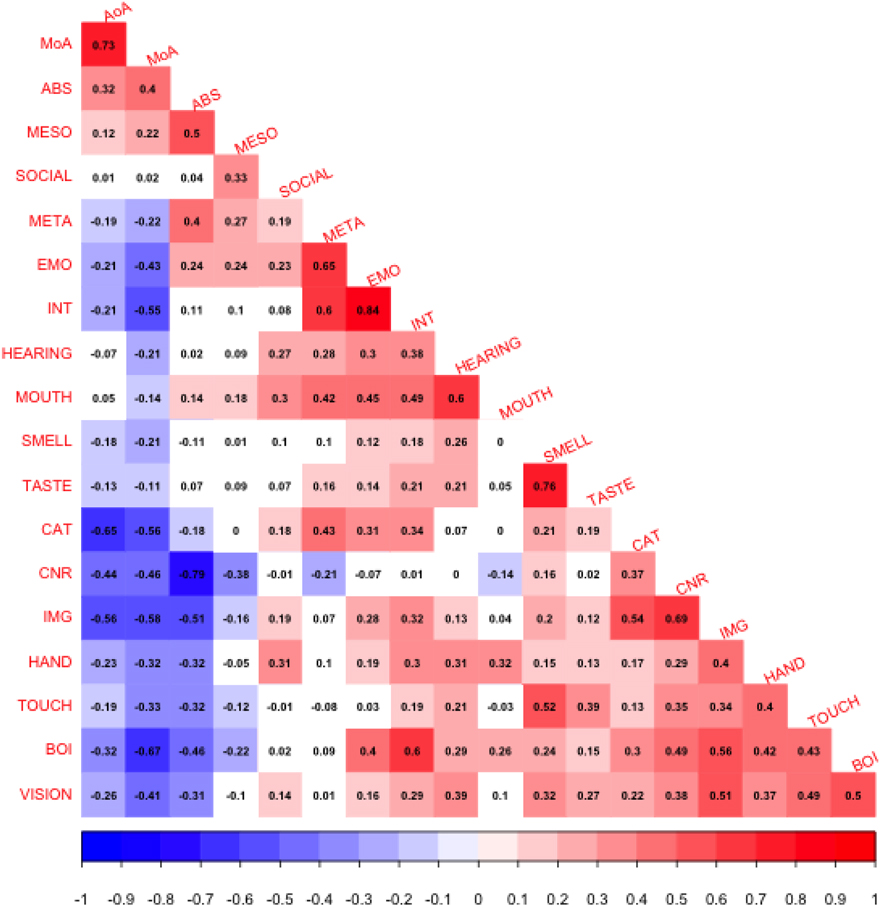
As can be seen from the correlogram (Figure 1), abstractness has a positive correlation with social metacognition (r = 0.5), MoA (r = 0.4) and metacognition (r = 0.4), emotionality (r = 0.24), and mouth (r = 0.14). This pattern confirms our predictions, derived by WAT: ACs are grounded in linguistic and social experience (MoA, social metacognition) and also evoke inner processes (metacognition and emotion, but interestingly not the more embodied interoception); finally, the activation of language may occur through inner talk (mouth). This analysis also confirms the role of emotionality for ACs, in line with the Affective Embodiment Account (AEA: Kousta et al., Reference Kousta, Vigliocco, Vinson, Andrews and Del Campo2011; Vigliocco et al., Reference Vigliocco, Kousta, Vinson, Andrews and Del Campo2013). As to negative correlations, abstractness is negatively correlated first with concreteness (r = –0.79), then with imageability (r = –0.51), BOI (r = –0.46), hand (r = –0.32), touch (r = –0.32), vision (r = –0.31), and CAT (r = –0.18).
Correlogram with the zero-order correlations across dimensions. Red tiles denote positive correlations, blue tiles denote negative ones. Color density is a function of the strength of the correlation. Pearson’s r correlation coefficients are reported at the center of each tile. Blank tiles represent non-significant correlations at an alpha level of .05 after correcting for multiple comparisons (Bonferroni correction). Abbreviations: concreteness (CNR); abstractness (ABS); imageability (IMG); contextual availability (CAT); Age of Acquisition (AoA); Modality of Acquisition (MoA); Body-Object Interaction (BOI); emotionality (EMO); perceptual strength in the five perceptual modalities (VISION; TOUCH; HEARING; SMELL; TASTE); interoception (INT); metacognition (META); social metacognition (MESO); social valence (SOCIAL); mouth involvement (MOUTH); hand involvement (HAND).

Concreteness is positively correlated with IMG (r = 0.69), BOI (r = 0.49), vision (r = 0.38), touch (r = 0.35), hand (r = 0.29), and smell (r = 0.16), while it is negatively correlated with abstractness (r = –0.79), then with MoA (r = –0.46), AoA (r = –0.44), social metacognition (r = –0.38), metacognition (r = –0.21), and mouth (r = –0.14).
Overall, from the analyses on correlations we can conclude that more ACs are mainly characterized in terms of linguistic, social, and inner experience (metacognition and emotion), and are considered as associated to the mouth effector. At the same time, they are characterized by the absence of exteroceptive experiences, such as visual and tactile/manual interactions with external objects. Conversely, less ACs elicit higher perceptual strength ratings in touch, vision, and also smell, are associated with the hand and not with the mouth, and have low levels of linguistic, social, and inner state properties. The results clearly confirm our predictions.
From a deeper reading of the correlogram displayed in Figure 1 through the corrplot R package (Wei & Simko, Reference Wei and Simko2017), it is apparent that some dimensions hold a significant degree of shared variance, hinting that there might be latent factors that may account for similarities/dissimilarities across dimensions. A further exploration of the factor structure underlying the way the words were rated on several dimensions may serve a two-fold purpose: (1) exploring whether dimensions belong to the same underlying factor may provide some clues on which are the relevant macro-dimensions that organize the semantic processing of abstract words (hypothesis 1); and (2) using the factor scores for each underlying factor may facilitate the identification of clusters of abstract words (hypothesis 2), as one of the requirements for conducting a cluster analysis is to use variables that are not highly correlated (Barbaranelli, Reference Barbaranelli2007).
In order to determine the appropriate number of components to extract, we ran a parallel analysis (PA) implemented in the psych package (Revelle, Reference Revelle2018) in R. PA “compares the screen of components of the observed data with that of a random data matrix of the same size as the original” (Revelle, Reference Revelle2018). PA based on PCA identified a three-component solution, which was further explored using an oblimin rotation, to improve the interpretability of the results.
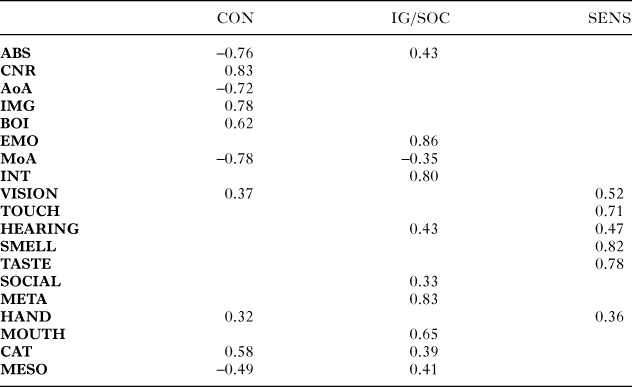
After exploring the dimensions that loaded > |.3|, which can be interpreted as a medium effect size (Cohen Reference Cohen1988), into each of the three components, we named the components as follows: ‘Concreteness/Abstractness’ (CON), ‘Inner Grounding and Social’ (IG/SOC), and ‘Sensorimotor’ (SENS) (see Table 1). These components, combined, explained 56% of the variance. The component ‘Concreteness/Abstractness’ included the dimensions more associated to the way participants evaluated a word as concrete or abstract (in our case the two ratings were separate, but a single component grouped them); the second ‘Inner grounding and Social’ mainly included dimensions referring to inner bodily and mental states – interoception, emotionality, metacognition, and mouth – together with sociality. The ‘Sensorimotor’ component included sensory modalities and the hand dimension. Interestingly, if we consider mouth and hand effectors, we notice that the mouth is included in the ‘Inner grounding and Social’ component, and the hand in the ‘Sensorimotor’ component, more related to external grounding.
The 3-components solution, with the dimensions that loaded > |.3| into each of the three components

Notes. Abbreviations dimensions: concreteness (CNR); abstractness (ABS); imageability (IMG); contextual availability (CAT); Age of Acquisition (AoA); Modality of Acquisition (MoA); Body-Object Interaction (BOI); emotionality (EMO); perceptual strength in the five perceptual modalities (VISION; TOUCH; HEARING; SMELL; TASTE); interoception (INT); metacognition (META); social metacognition (MESO); social valence (SOCIAL); mouth involvement (MOUTH); hand involvement (HAND). Abbreviations components: concreteness/abstractness (CON); inner grounding and social (IGSOC); sensorimotor (SENS).
Moving from this component solution, we computed its relative component scores using the regression method. The three factor scores displayed negligible (a correlation coefficient of r = 0.08 for the association between ‘Concreteness/Abstractness’ and ‘Inner Grounding and Social’) to small correlation coefficients (a correlation coefficient of r = 0.25 for the association between ‘Concreteness/Abstractness’ and ‘Sensorimotor’). We will then use these scores to conduct our cluster analysis to unveil the different kinds of ACs that can be inferred from our rating data.
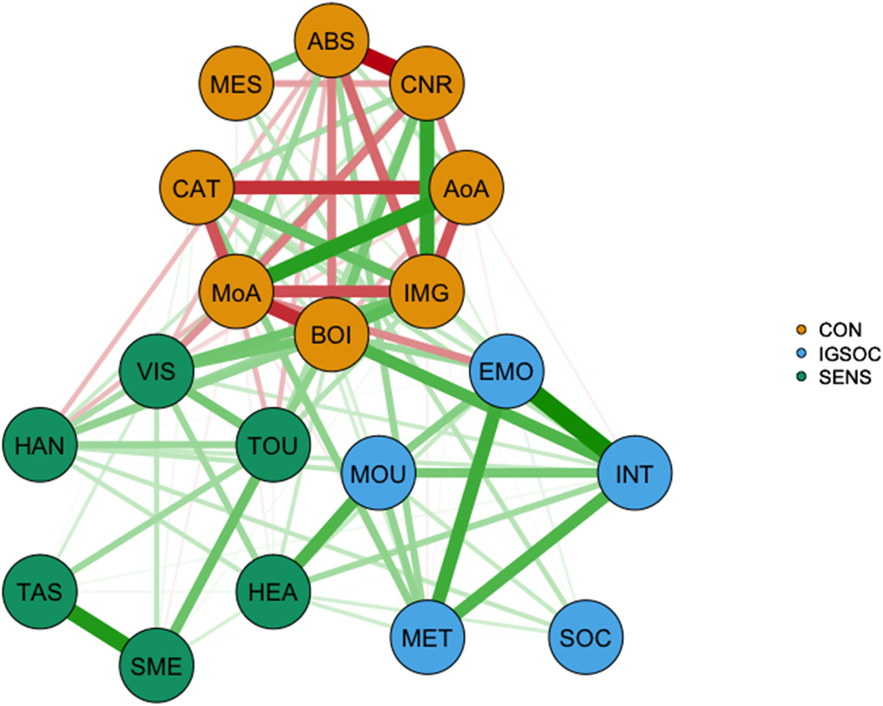
The following network graph displayed through the qgraph package in R (Epskamp, Cramer, Waldorp, Schmittmann, & Borsboom, Reference Epskamp, Cramer, Waldorp, Schmittmann and Borsboom2012) shows the relationship between dimensions between and within each component (Figure 2). Please note that, for visualization purposes, we ascribed some dimensions uniquely to the component where they loaded into most, although some of them almost equally loaded in more than one component. We are aware that, because of that, the PCA did not reach enough simplicity; however, we want to emphasize that the current PCA mainly serves the purpose of reducing dimensions, and compute component scores in order to explore the clustering of ACs through a cluster analysis (CA).
Network. The network graph on the relationship between dimensions between and within each component. Lines are displayed only for correlation coefficients that are statistically significant at p < .05 after correction for multiple comparisons (Bonferroni correction). Green lines denote positive correlations, red lines denote negative ones. Line thickness is a function of the strength of the correlation. Abbreviations dimensions: concreteness (CNR); abstractness (ABS); imageability (IMG); contextual availability (CAT); Age of Acquisition (AoA); Modality of Acquisition (MoA); Body-Object Interaction (BOI); emotionality (EMO); perceptual strength in the five perceptual modalities: vision (VIS); touch (TOU); hearing (HEA); smell (SME); taste (TAS); interoception (INT); metacognition (MET); social metacognition (MES); social valence (SOC); mouth involvement (MOU); hand involvement (HAN). Abbreviations components: concreteness/abstractness (CON); inner grounding and social (IGSOC); sensorimotor (SENS).

7.1.1. Concreteness/abstractness component
We found that concreteness is explained by the dimensions of Imageability, BOI, vision, and hand, while abstractness by social metacognition, MoA and AoA. The finding that Imageability and Context Availability predict abstractness is in line with the more influential classic theories on CCs/ACs, i.e., the Dual Coding Theory (Paivio, Reference Paivio1990) and the Context Availability Theory (Schwanenflugel et al., Reference Schwanenflugel, Akin and Luh1992). The role of Body-Object-Interaction in accounting for concreteness is instead completely new, and suggests that concreteness is more linked to an embodied dimension, but to an exteroceptive rather than to an interoceptive one (even if BOI is highly correlated with interoception; r = 0.60.). The BOI–interoception correlation holds across concepts, likely because also emotional concepts might activate both interoception and the tendency to act toward external stimuli. The differences between BOI and interoceptive ratings are higher for concepts referring to space, time, and math (e.g., ‘number’, ‘area’), characterized by higher BOI than interoceptive scores, and for concepts referring to the self (e.g., ‘infancy’, ‘maturity’, ‘destiny’) presenting the opposite pattern. Abstractness is instead linked to social metacognition, as predicted: the more abstract the concept is, the more we seem to need others to help us to understand its meaning (Borghi et al., Reference Borghi, Barca, Binkofski and Tummolini2018a). Furthermore, in keeping with our predictions, MoA and AoA are included in the concreteness/abstractness component, indicating that the more abstract concepts are, the more frequently they are linguistically acquired. Overall, the conjunct role of MoA, AoA, and MESO highlights the crucial role of language and social interaction for grounding ACs.
7.1.2. Sensorimotor component
This component includes all perceptual modalities, together with the hand dimension. Interestingly, the two sensory modalities linked to interoception, i.e., taste and smell, are very highly correlated (r = 0.76). While all sensory modalities are highly correlated (all correlations above |r| = 0.39), hand is more strongly correlated to touch (r = 0.49), vision (r = 0.37) and hearing (r = 0.31) than to more internal senses (smell r = 0.15; taste r = 0.13).
One could ask how much this sensorimotor component has to do with/predicts concreteness/abstractness. Connell and Lynott (Reference Connell and Lynott2012) have found that perceptual strength explains results on the concreteness effect (advantage in processing and recall of CCs over ACs) better than concreteness/abstractness, and that a special role was played by vision. The present results show that all sensory modalities are included in an independent cluster, even if both touch and vision are highly correlated to concreteness. Our results are thus in line with those obtained by Connell and Lynott, despite the difference in the considered language (English vs. Italian), and the fact that they used both CCs and ACs as stimuli. Furthermore, the fact that sensory modalities were not included in the concreteness/abstractness component confirms that ACs are rather detached from perceptual modalities (Barsalou, Reference Barsalou2003).
7.1.3. Inner grounding and social component
Within this component, the link between emotions, interoception, and general-metacognition (reliance on inner processes) confirms/suggests a strong linkage within dimensions pertaining to inner bodily, cognitive, and emotional processes/states. Interesting for us is the insertion within this component of the mouth (MOU) and social (SOC) dimensions. Social valence (SOC) is correlated to mouth (r = 0.30), emotionality (r = 0.23), and metacognition (r = 0.19) within this component (not to interoception, though), but it is also correlated both to hand (r = 0.31) and to hearing (r = 0.27) within the sensorimotor component. Finally, it is strongly correlated to social metacognition (MESO) of the concreteness/abstractness component (r = 0.33). The pattern of correlations that characterize SOC seem to refer to a sensorimotor circuit related to the use of language. This pattern is in keeping with the WAT’s view that a strict interrelation between linguistic and social experience exists, and with the specific prediction according to which the mouth activation can be due to a motor preparation derived from the metacognitive awareness that our concepts are not sufficient, and we need to ask information of others (Borghi et al., Reference Borghi, Barca, Binkofski, Castelfranchi, Pezzulo and Tummoliniin press a, Reference Borghi, Barca, Binkofski, Castelfranchi, Pezzulo and Tummoliniin press b). The strict relation between MOU and HEA also suggests a clear link to language activation, and the relation between MOU and HEA with dimensions concerning inner processes indicates that these processes may include either the mediation of inner speech or simulation of listening to someone else speaking.
One could ask how much inner grounding has to do with/predicts concreteness/abstractness. Emotionality, metacognition, and mouth are all correlated with abstractness. In agreement with theories according to which emotionality represents a peculiar trait of ACs (Kousta et al., Reference Kousta, Vigliocco, Vinson, Andrews and Del Campo2011; Vigliocco, et al., Reference Vigliocco, Kousta, Vinson, Andrews and Del Campo2013), there is a strict relationship between abstractness and inner grounding, but to our surprise no correlation between abstractness and interoception was present. By looking more closely at the data, the lower correlation between abstractness and interoception is due mainly to words referring to bodily states (e.g., “pain”, “cold”), characterized by high interoception and low abstractness scores, and by words referring to spiritual or institutional concepts (e.g., “immortality”, “republic”) which obtained high abstractness and low interoception scores. The difference with Connell et al. (Reference Connell, Lynott and Banks2018), who found instead that interoception and abstractness were highly correlated, could be due to the fact that they examined both CCs and ACs. More crucially, the link between the dimensions of metacognition, social metacognition (linked to sociality), mouth, and abstractness confirms the predictions of the WAT theory, according to which linguistic and social aspects are crucial for the representation of ACs, and determine an involvement of the mouth motor system.
Overall, the inspection of the network confirms that there exists neither an abstract/concrete dichotomy nor a linear relationship between concreteness/abstractness, but that a multidimensional space exists (Crutch et al., Reference Crutch, Troche, Reilly and Ridgway2013; Troche, Crutch, & Reilly, Reference Troche, Crutch and Reilly2014), in which many dimensions together determine whether a concept is concrete or abstract.
7.2. kinds of ACs
The relative majority of indices (8) indicated a 4-cluster solution. The same solution was achieved by plotting the curve of a within-cluster sum of square (WSS), according to the Elbow method. We therefore used a k-means clustering method to partition our 425 words into four clusters. The complete list of the 425 words distributed in the four clusters is available online at <https://osf.io/4bztv/>.
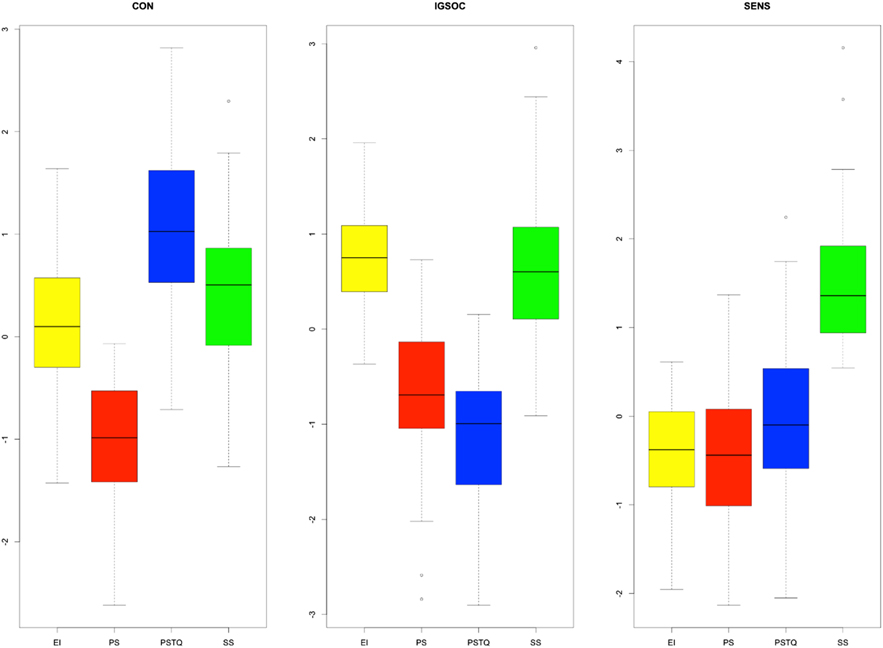
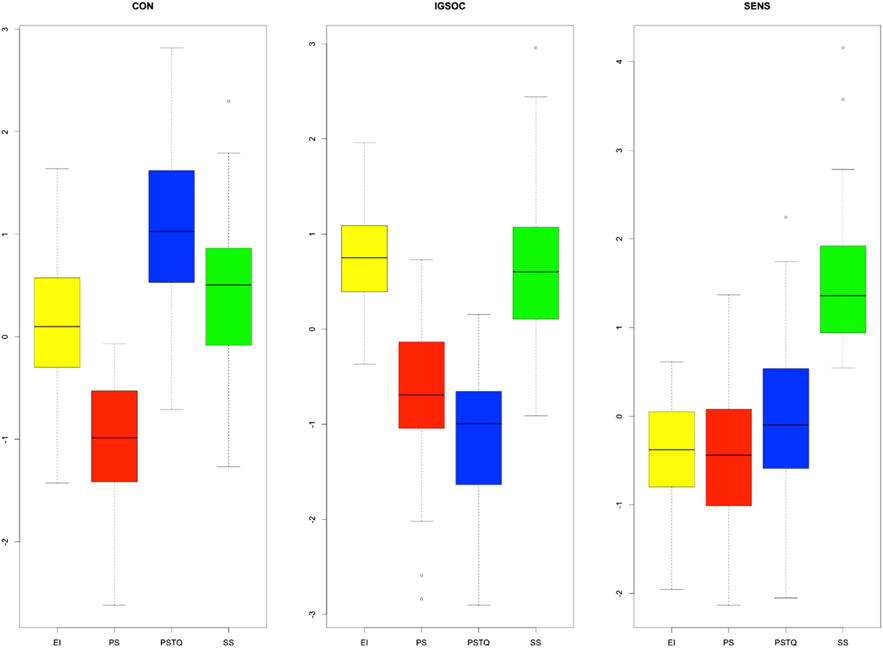
Figure 3 shows the boxplots for the component scores from each cluster, which were named after an inspection of the words that formed them, along with an evaluation of the component scores profile of each cluster.
Cluster plot. Each panel shows the boxplots for the component scores from each of the four clusters. Abbreviations component: concreteness/abstractness (CON); inner grounding and social (IG/SOC); sensorimotor (SENS). Abbreviation clusters: physical, spatio-temporal, and quantitative concepts (PSTQ); self and sociality concepts (SS); philosophical/spiritual concepts (PS); emotional and inner state concepts (EI).
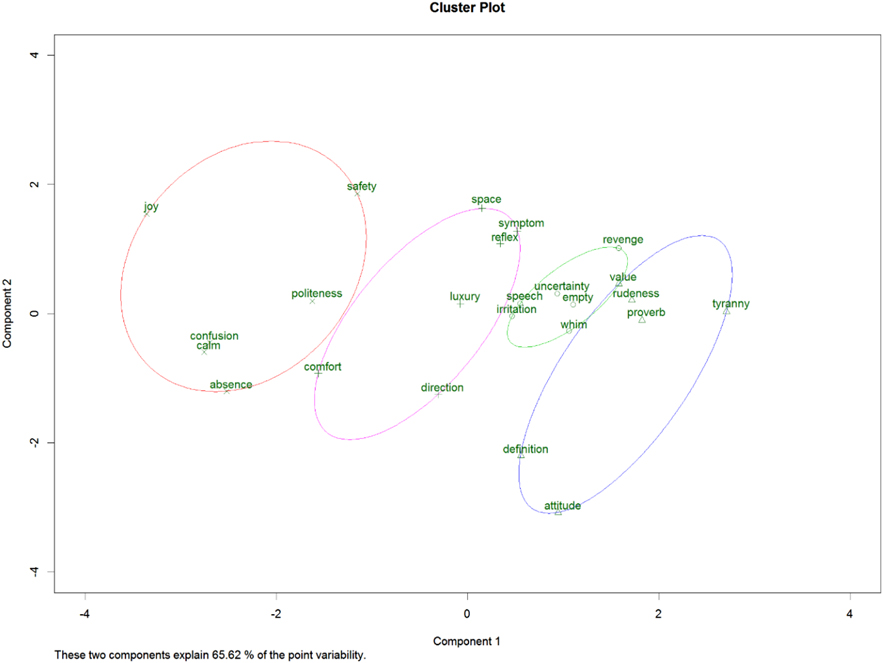
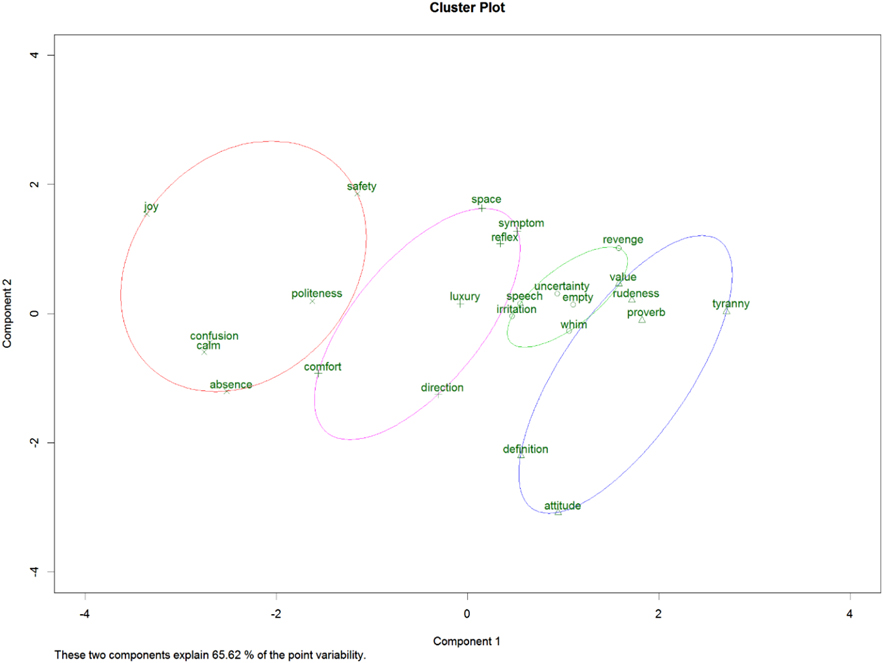
The cluster plot (Figure 4) displays a bivariate plot visualizing the clustering (shown through ellipses) of our data. For the sake of clarity, we selected the six most representative words for each cluster (i.e., the ones with the smallest distance from the centroid). All observations are represented by points in the plot, using principal components.
1. Physical, spatio-temporal, and quantitative concepts (73 concepts)
A bivariate plot that visualizes the clustering (shown through ellipses) of our data. The six most representative words for each cluster (i.e., the ones with the smallest distance from the centroid) are selected. PHYSICAL, SPATIO-TEMPORAL, AND QUANTITATIVE CONCEPTS (reflex, direction, comfort, symptom, space, luxury); PHILOSOPHICAL/SPIRITUAL CONCEPTS (definition, tyranny, attitude, proverb, rudeness, value); SELF AND SOCIALITY CONCEPTS (politeness, absence, calm, confusion, joy, safety); EMOTIONAL/INNER STATES CONCEPTS (revenge, speech, empty, uncertainty, irritation, whim).
This cluster (represented in blue in Figure 3) is characterized by higher scores in the concreteness/abstractness component, resulting from high ratings in concreteness, Body-Object-Interaction, imageability, and Context Availability. It includes concepts that refer to physical notions (e.g., reflex, image, mass, acceleration, shadow, gravity, matter, color), quantifiable bodily sensations (e.g., cold, shiver, vertigo, hot), quantities (e.g., liter, meter, dose, price, coin), numbers and operations (e.g., subtraction, sum, addition, number), quantifiable temporal concepts (e.g., beginning, day, end, season), and spatial concepts (e.g., space, place, destination, horizon, area).
2. Self and sociality concepts (81 concepts)
This cluster (represented in green in Figure 3) is characterized by higher scores in the inner grounding and social component: the words it includes were rated as activating inner bodily sensations, emotions and mental states, and social situations. It includes words related to psychological and physical characteristics of the self (e.g., charm, enthusiasm, ability, energy, curiosity, force, cheerfulness, elegance, beauty), mainly with a positive connotation, of social situations regulated by norms (e.g., politeness, kindness, hospitality, harmony, conflict, protest, seduction, game, safety), together with concepts related to social institutions (e.g., wedding, separation, family, civilization, culture, job, fashion), and to social situations characterized by the presence of more people (e.g., crowd, confusion, party).
3. Philosophical/spiritual concepts (125 concepts)
This cluster (represented in red in Figure 3) is characterized by low scores in the concreteness, inner grounding, and sensorimotor components. The words included here were evaluated as highly abstract, and refer to imagery entities (e.g., magic spell, mystery, utopia, enigma, luck, ghost, fate), religious words (e.g., religion, paradise, devotion, fervor, infinity, immortality, faith, salvation, absolution, idol, absolute), principles (e.g., value, purity, virtue, principle, belief), disciplines (e.g., history, philosophy, linguistics, logic, ethics), concepts linked to argumentation, reasoning, and decision-making (e.g., negation, affirmation, deduction, definition, reason, logic, implication, analysis, hesitation); finally it includes mainly negatively connoted words, related to characteristics of the self (e.g., greed, rudeness, dishonesty, inexperience).
4. Emotional/inner states concepts (146 concepts)
This cluster (represented in yellow in Figure 3) is characterized by high scores across the three components: the words included here were not rated as very abstract and imageable, and were considered to be mainly acquired early (AoA) and perceptually (low MoA). This cluster includes concepts referring to emotions, at different level of complexity (e.g., anger, wonder, sadness, horror, fury, terror, panic, anguish, shame, surprise, hate, unhappiness, despair, envy, pride, dread, guilt, hope, melancholy, shame, wrath), mental states (e.g., depression, boredom, distress, peace, satisfaction, impatience, unconcern, panic, exasperation, madness), emotionally connoted social situations (e.g., revenge, whim, deceit, deal, commitment, responsibility, disagreement, loyalty, irony, mourning, competition, pact, curse, oath, drama, deceit, discussion, craftiness, respect, justification, scandal, tragedy, tolerance, quarrel, criticism, resistance, freedom), and characteristics of the self with respect to others (e.g., sincerity, patience, bravery, originality).
In order to determine whether some kinds of ACs are considered by participants to be more “embodied” than others, we can observe how the different concepts are distributed in terms of the three components (Figure 3).
CONCRETENESS/ABSTRACTNESS component: we can notice a clear opposition between PHYSICAL, SPATIO-TEMPORAL, AND QUANTITATIVE concepts, characterized by high scores in concreteness, and the most ACs, i.e., PHILOSOPHICAL/SPIRITUAL concepts. The other two kinds of ACs are in the middle.
INNER GROUNDING & SOCIAL component: PHYSICAL, SPATIO-TEMPORAL, AND QUANTITATIVE concepts are characterized by low scores in inner grounding, followed by PHILOSOPHICAL/SPIRITUAL concepts. In contrast, both SELF AND SOCIALITY concepts and EMOTIONAL/INNER STATES score high on this component.
SENSORIMOTOR component: the role of sensorimotor experience and of perceptual strength is particularly marked for EMOTIONAL/INNER STATE concepts.
This different role of the three components for the four categories allows us to distinguish different forms of embodiment, one more linked to exteroceptive experience, one to interoceptive. Interestingly, EMOTIONAL/INNER STATES and PHYSICAL, SPATIO-TEMPORAL, AND QUANTITATIVE concepts can be considered more concrete and imageable than the other concepts, but the latter mainly rely on interactions with external objects/entities, while the first rely also on exteroception, but especially on inner grounding. In between, SELF AND SOCIALITY concepts rely on both external and inner grounding. Among the less embodied concepts, PHILOSOPHICAL/SPIRITUAL CONCEPTS rely more on inner than on external grounding.
8. Conclusion
In this study we report results of ratings on 425 Italian abstract words evaluated on 15 semantic dimensions, selected in order to test the major current views on ACs. To our knowledge, the present norms are the most extensive existent ones on ACs, in terms of the variety of considered dimensions.
Two general conclusions can be drawn from our results: the first is that defining concepts in terms of solely concreteness/abstractness is a simplification. The second is that different varieties of ACs exist, hence these should not be treated as a unitary domain. We will discuss these two issues in turn, together with their implications for current theories of ACs.
8.1. concreteness/abstractness is a simplification
Our cluster analysis allowed us to verify how the different rated dimensions characterize more abstract and more concrete ACs. Importantly, we found that the concreteness/abstractness component includes many dimensions. ACs are perceived as more concrete when they refer to interactions with objects, are highly imageable, and contextually situated. Instead, we conceive ACs as less concrete and more abstract, the more we feel that others are needed to give us information on the conceptual meaning, the later these concepts are acquired through language. Furthermore, abstractness is highly related to the inner grounding and sociality component, which includes the social dimension, dimensions involving inner states and processes (emotion, interoception, metacognition), and sensorimotor aspects linked to a possible (inner) language (mouth), while concreteness is more connected with the sensorimotor component, characterized by the different perceptual modality and by the hand effector. This pattern suggests that concreteness/abstractness is more plausibly conceived as grouping different components that can be represented in a multidimensional space, rather than a dichotomous single dimension.
8.2. implications for current theories on ACs
Our results confirm multiple representation theories, according to which ACs are not only grounded in a sensorimotor system, like CCs, but are grounded to a larger extent in social, linguistic, and inner experience. Within such theories, the high correlation between abstractness and the linguistic modality of acquisition is in keeping with the multiple representation views according to which linguistic experience plays a major role, such as the WAT view (Borghi & Cimatti, Reference Borghi, Cimatti, Taatgen and van Rijn2009; Borghi & Binkofski, Reference Borghi and Binkofski2014), and the view proposed by Dove (e.g., Dove, Reference Dove2010, Reference Dove2014, Reference Dove2016, Reference Dove2018). The high correlation between abstractness and social metacognition, and the insertion of social metacognition, age of acquisition, and modality of acquisition within the concreteness/abstractness component, fully confirms the predictions of the WAT view (Borghi et al., Reference Borghi, Barca, Binkofski and Tummolini2018a), and testifies that at the increase of the abstractness level we rely more on the competence of others (see also Prinz, Reference Prinz2004, Reference Prinz2014; Shea, Reference Shea2018), and that social and linguistic experience is crucial for the representation of ACs. Our results only partially confirm multiple representation views that propose an important role of emotions (Kousta et al., Reference Kousta, Vigliocco, Vinson, Andrews and Del Campo2011; Vigliocco et al., Reference Vigliocco, Kousta, Vinson, Andrews and Del Campo2013) and of other inner processes for ACs (introspection: Barsalou & Wiemer-Hastings, Reference Barsalou, Wiemer-Hastings, Pecher and Zwaan2005; general metacognition: Borghi et al., Reference Borghi, Barca, Binkofski and Tummolini2018a; see Zdrazilova & Pexman, Reference Zdrazilova and Pexman2013, for similar results): emotionality and general metacognition are correlated to abstractness, but the inner grounding component is separate from that of abstractness. With respect to standard embodied and grounded views, our results show that different kinds of ACs are characterized by a different level of embodiment, suggest that a higher level of abstractness is more related to inner grounding than to interactions with objects/entities in the environment, and indicate that perceptual strength of vision is critical to determine conceptual concreteness.
8.3. different varieties of ACs exist
Our results clearly indicate that ACs form different clusters, each differently characterized in terms of rated dimensions. Four different clusters were identified: PHILOSOPHICAL/SPIRITUAL concepts, EMOTIONAL/INNER STATES concepts, SELF AND SOCIALITY concepts, PHYSICAL, SPATIO-TEMPORAL, AND QUANTITATIVE concepts. Some of the clusters correspond to ACs already identified in the current literature, such as emotional concepts (Altarriba et al., Reference Altarriba, Bauer and Benvenuto1999; Altarriba & Bauer, Reference Altarriba and Bauer2004; Barca et al., Reference Barca, Mazzuca and Borghi2017; Ponari et al., Reference Ponari, Norbury and Vigliocco2018). The cluster of emotions includes the majority of “emotion-label” concepts, i.e., of words that directly refer to a specific affective state (e.g., “sadness”) (Pavlenko, Reference Pavlenko2008; Kazanas & Altarriba, Reference Kazanas and Altarriba2015, Reference Kazanas and Altarriba2016). “Emotion-laden” concepts, i.e., words related to emotions that do not refer to the specific emotions (e.g., “tears”), are spread across both the EMOTIONAL/INNER STATE cluster and the SELF AND SOCIALITY and PHILOSOPHICAL/SPIRITUAL clusters. In other cases ACs aggregated in novel ways: it is the case of PHILOSOPHICAL/SPIRITUAL ACs, that were grouped together, of numerical concepts, that clustered together with physical, temporal, and spatial quantitative concepts, of concepts related to the self and to sociality that were grouped together. As discussed, these concepts differ in degree of embodiment and in kind of embodiment (inner vs. external grounding), ranging from PHYSICAL, SPATIO-TEMPORAL, AND QUANTITATIVE concepts, grounded in experience with objects and entities, considered more concrete and imageable and evoking interactions with the environment, to EMOTIONAL/INNER STATES concepts, grounded primarily in inner experience. The finding that different kinds of ACs exist, that they are differently represented, and that they are characterized by different levels of embodiment, is likely to stimulate further studies in the field. Further research is needed to verify how these different concepts impact behavioral tasks and to investigate whether and how their neural representation differs (see Desai et al., Reference Desai, Reilly and van Dam2018), and differences between abstract nouns, adjectives, and verbs should be investigated.
What is certain, however, is that it is now clear that some old views do not hold any more: the view that CCs and ACs are dichotomously opposed, the view that concreteness/abstractness represents a continuum per se, without considering other aggregated dimensions related to language, sociality, inner processes, and the view that ACs represent a monolithic whole.