Role of education and training in improving dementia care
In the U.K. the status quo of dementia care is no longer acceptable. There is overwhelming concern about the inadequate quality of care provided to people with dementia and their families. It is now widely acknowledged that while there is a range of effective ways to care for and support people with dementia and their families from diagnosis to death, these have yet to become integral to practice. Thus our current health and social care response fails to meet the needs of people with dementia and their families (House of Commons Public Accounts Committee, 2008). There are economic as well as humanistic arguments for an improved response to people with dementia and their families. The costs of delayed diagnosis and iatrogenic care regimes can no longer be tolerated in the face of growing numbers of people with dementia (National Audit Office, 2007; Knapp et al., Reference Knapp2007). Service systems need to be part of the solution rather than compounding the problem.
The potential of an effective health and social care response to people with dementia has been well documented with the joint publication of the National Institute for Health and Clinical Excellence and the Social Care Institute for Excellence (2006) guidelines for supporting people with dementia and their families. These evidence-based guidelines point to the therapeutic potential of psychosocial interventions throughout the course of living with dementia, from diagnosis to death. It is now well established, however, that the provision of evidence alone, however necessary, is in and of itself insufficient to lead to practice or organizational change (Greenhalgh et al., Reference Greenhalgh, Robert, Bate, Macfarlane and Kyriakidou2005). (For further discussion of the transfer of research to practice, see Draper et al. this issue.)
In England, as in many other countries, the government is committed to ensuring optimal quality of life for people with dementia and their families (House of Commons Public Accounts Committee, 2008). The National Dementia Strategy (NDS) for England (Department of Health, 2009) calls for a “transformation” in the quality of care provided to people with dementia and their families. The NDS aims to transform the quality of care provided to people with dementia and their families by focusing on three key areas: (1) public and professional attitudes and practice; (2) early diagnosis and support; and (3) quality of care. The strategy recognizes that the workforce is ill equipped to care for people with dementia and that this is an issue that needs addressing in order to ensure the delivery of quality services and care.
Many professional and non-professional groups lack specialist expertise or even basic training. The need for education and training for general practitioners is a key area being highlighted by the NDS and is discussed elsewhere in this special issue (see Cherry et al. in this issue). It is important to acknowledge that primary care is not alone in its failure to address the needs of people with dementia and their families. At least in the U.K., primary care sits within a health care system which is making efforts to address institutional ageism (Department of Health, 2001) and dementism (Macdonald and Denning, Reference Macdonald and Denning2002; Banerjee et al., Reference Banerjee, Willis, Matthews, Contell, Chan and Murray2007). We know that nurses, despite the central role they play throughout the course of living with dementia, are poorly prepared for this role (Pulsford et al., Reference Pulsford, Hope and Thompson2007). Furthermore, some of the key skills required for good dementia care – emotional awareness and empathy – are not well addressed in nursing curricula (Smith, Reference Smith1992). Social workers also receive little by way of preparation for their role in working with people with dementia (Marshall and Tibbs, Reference Marshall and Tibbs2006). While there will continue to be a need for specialist secondary services such as old age psychiatry and geriatrics, the majority of people with dementia in the U.K. and elsewhere in Europe are supported by non-professional groups of staff, led by nurses or social workers who themselves have little specialist education in dementia. The level of preparation of care assistants is an international concern and is addressed elsewhere in this special issue (see the Guest Editorial by Colleen Doyle).
The idea that an informed and effective workforce lies at the heart of quality dementia care is not new (Kitwood, Reference Kitwood1997; Capstick and Kitwood, Reference Capstick and Kitwood1999; Kitwood and Capstick, Reference Kitwood and Capstick1999). Successive government reports have pointed to education and training as one key avenue to improving services. For example, in 2001 The Department of Health's National Service Framework for Older People, while paying relatively scant attention to people with dementia, recognized the need for workforce education and training to increase competence. This framework identified the need to address dementia-related gaps in knowledge as a key action area (Department of Health, 2001). What is new is that for the first time in England we are on the verge of having a national strategy for dementia and, at least in the document circulated for comment (Department of Health, 2008), there is some indication that resources will be made available to ensure an informed and effective workforce.
We now need an educational strategy that is appropriate to meet the challenge of ensuring an informed and effective workforce (Department of Health, 2009). The NDS makes a welcome distinction between basic training and continuous professional and vocational development. Basic training in dementia care is essential, but as Downie and McNaughton (Reference Downie and MacNaughton2000) have noted, training involves a focusing in and narrowing down on particular tasks. Education, on the other hand, involves broadening our perspectives and recognizing that there are many different ways of approaching the same situation or problem. Real changes in organizational culture can thus only emerge form programs of education that go beyond the development of skills (Baldwin and Capstick, Reference Baldwin and Capstick2007). It requires supervision, management and leadership, and an organizational culture which facilitates and rewards the transfer of such learning to everyday practice (for a recent review see Bowers, Reference Bowers, Downs and Bowers2008).
A number of studies have indicated that the impact of in-service training on quality of dementia care diminishes rapidly over time (Moniz-Cook et al., Reference Moniz-Cook1998). Thus an approach to workforce development which overly relies on training may not lead to sustainable change and risks wasting valuable resources. The NDS's aim of transforming the quality of care will require effective leadership and management of that change. Sustainable change requires investment in higher education to prepare role models, change agents, team leaders, supervisors and managers with an up-to-date knowledge of theory and evidence and advanced abilities in communication, critical reasoning, problem solving, decision-making and team working.
Higher education qualifications are intended to develop graduates with high-level analytical skills and a broad range of competences (see http://www.qaa.ac.uk/academicinfrastructure/FHEQ/EWNI08/default.asp). As such, awards in Higher Education are to be distinguished from training or solely the acquisition of higher level skills. Higher education has as its goal the development of critical thinking and informed action (Ford et al., Reference Ford, Johnston, Mitchell and Myles2004). Critical thinking and critical action skills are developed through a process of facilitating students to reflect critically on knowledge, on themselves, and on their actions. The development of such critical faculties is considered to be “transformatory” (Ford et al., Reference Ford, Johnston, Mitchell and Myles2004).
Higher education has a key role to play in meeting the goal of cultural transformation required in dementia care (Kitwood, Reference Kitwood1997; Kitwood and Capstick, Reference Kitwood and Capstick1999; Capstick and Kitwood, Reference Capstick and Kitwood1999; Downs and Capstick, 2004; Bartlett et al., Reference Bartlett, Downs and Grant2005a; Reference Bartlett, Downs and Grant2005b; Downs, Reference Downs2008). While there is still no professional body dictating the higher education requirement in dementia care, it is self evident that in order to transform dementia care, we need people who can think critically about what is currently provided and, drawing on the rapidly developing evidence base, envisage and implement what is needed in its place. By definition, practitioners and professionals need an understanding not only of what promotes quality of life for people with dementia and their families, but also what is needed to ensure such practices are integral to mainstream practice.
With growth in the number of people with dementia and a growing demand for excellence in dementia care (Downs and Bowers, Reference Downs and Bowers2008), education in dementia care will have to become integral to professional development programs. Everyone who comes into contact with older people will be required to have some knowledge of dementia and best practice in dementia care (Department of Health, 2008).
Bradford University's awards in dementia studies
Bradford Dementia Group, the Division of Dementia Studies at the University of Bradford, is dedicated to improving the quality of care provided to people with dementia and their families by practitioners and professionals. The University of Bradford's strap line is “Making knowledge work” and this goal permeates our graduate programs in dementia studies.
Our efforts in workforce development began with the provision of short courses in innovative ways of conceptualizing dementia and dementia care and in use of the practice development tool “Dementia Care Mapping” (Kitwood and Woods, Reference Kitwood and Woods1996; Kitwood, Reference Kitwood1997). Since 1992, we have been offering one- to four-day training courses in dementia care. Recognizing the need to complement a training approach to workforce development with accredited study, we began offering accredited modules in 1995. From 1998 to 2001 this work continued with partnership funding from the Alzheimer's Society and led to the introduction of an accredited Higher Education program consisting of three modules. Students who successfully complete these modules receive both a transcript of credit from Bradford University and a certificate from the Alzheimer's Society. This program provides a certificated exit point with half of the credits required for a full course of study. Many of these students subsequently go on to enroll for full award programs.
We offer a range of university awards in dementia studies informed by an active program of research and knowledge transfer, including short courses and consultancy. These include:
Certificate of Higher Education in Dementia Studies
Diploma of Higher Education in Dementia Studies
BSc (Hons) in Dementia Studies
MSc in Dementia Studies (incorporating specialized pathways in Training in Dementia Care and Dementia Care Mapping)
Postgraduate Certificate in Change Management and Leadership in Dementia Care
All our students work in some capacity with people with dementia. They are predominantly women in the 40–50 year age group working in the U.K. and Ireland. As mature students they fulfill the Higher Education Funding Council for England's strategic aim of increasing the number of non-traditional students in higher education (see http://www.hefce.ac.uk/widen/). While approximately two-thirds of our students are nurses, a range of other professional and educational backgrounds are also represented. They are working in a variety of roles and in a range of settings including hospitals, memory services, day care, care homes, hospices, and the inspectorate.
Their level of study is determined in part by the level of their previous qualifications, but it is also influenced by their academic ability and confidence. Inspired and sensitive practitioners are not necessarily accomplished academic writers, and many of our students know that they have difficulties with writing analytically and applying theory to practice. Often they choose to study at the level they feel they can cope with. Thus level of study is not necessarily related to experience and expertise in person-centered dementia care, or indeed responsibility at work. For this reason, and due to the lack of dementia education in previous courses, students at all levels of study need to consolidate and develop their knowledge in the same core areas of dementia studies. At every level, therefore, there are core modules on the principles of person-centered practice, promoting health and well-being and improving dementia practice. These modules are designed so that students who move through the levels can build on their knowledge at each stage without undue repetition.
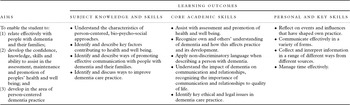
Certificate of Higher Education in Dementia Studies
The aims and learning outcomes for this level of study can be seen in Table 1.
Aims and learning outcomes of the Certificate of Higher Education in Dementia Studies

The core modules for this level of study include:
Person-centred dementia practice – encourages the student to understand dementia from a variety of perspectives and to reflect on how dementia is experienced both by individuals and within families.
Improving dementia practice – introduces the concepts of the reflective process and experiential learning; and enables the student to become a reflective practitioner.
Building a learning portfolio – enables the student to complete an assessed progress file commensurate with first-year undergraduate study and to develop personal transferable skills relevant to further study and career development.
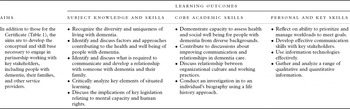
Diploma of Higher Education in Dementia Studies
The aims and learning outcomes for this level of study are shown in Table 2.
Aims and learning outcomes of the Diploma Higher Education in Dementia Studies

The core modules for this level of study include:
Person-centered dementia practice – enables the student to further develop bio-psychosocial approaches to dementia by understanding the interplay between personal biography and bio-psychosocial factors and to apply these concepts to their own practice.
Communication and relationships in dementia care – enables the student to develop a crucial understanding of the impact of dementia on communication and relationships within families and between the client, family and services. Students apply this understanding to a specific practice intervention.
Health and well-being in dementia care – introduces the concepts of health and well-being and encourages students to consider the factors which promote, or negatively affect, health and well-being in dementia. Students apply this knowledge to their own client groups in order to identify particular challenges in promoting health and well-being in people with dementia and develop skills in health promotion and awareness.
Improving dementia practice – enables the student to identify the basic elements of organizational culture that impact on the quality of service delivery and to encourage students to assess the impact of organizational culture on working practices in their own workplace.
Building a learning portfolio – enables students to complete an assessed progress file commensurate with second year undergraduate study and to develop personal transferable skills relevant to further study and career development.
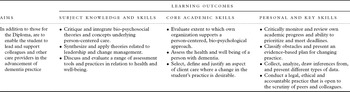
BSc (Hons) in Dementia Studies
The aims and learning outcomes for this level of study are shown in Table 3.
Aims and learning outcomes of the BSc (Hons) in Dementia Studies

The core modules for this level of study include:
Person-centred dementia practice – enables the student to evaluate the extent to which their organization supports a person-centered, bio-psychosocial understanding of dementia.
Health and well-being in dementia care – enables the student to review and evaluate critically the usefulness of bio-psychosocial approaches to health and well-being in dementia and to assess and promote well-being in dementia.
Partnership working in dementia care – enables the student to develop skills and knowledge in working with key stakeholders, colleagues, and or specific interest groups in order to identify areas of service need and plan appropriate interventions in dementia care.
Building a learning portfolio – enables the student to complete an assessed progress file commensurate with level 3 study and to develop personal transferable skills relevant to further study and career development.
Option modules available to undergraduate students include “Legal and ethical issues”; “Social context of dementia”; “Dementia, life history and care practice”; “Teaching and learning in dementia care”; “End of life care; facilitating activities”; and “Elective studies in dementia practice and research.”
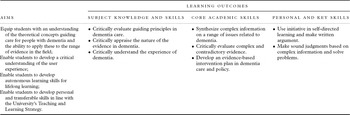
Postgraduate Certificate in Dementia Studies
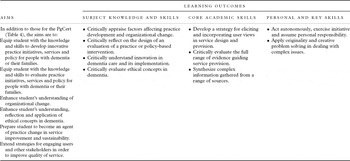
The aims and learning outcomes for this level of study are shown in Table 4.
Aims and learning outcomes of the Postgraduate Certificate in Dementia Studies

We also offer Postgraduate Certificates in Training in Dementia Care, Change Management and Leadership in Person-centered Dementia Care and Dementia Care Mapping. Details of these programs are on our web page (http://www.brad.ac.uk/health/dementia/).
The core modules for the Postgraduate Certificate in Dementia Studies include:
Guiding principles in dementia care – equips students with the knowledge to understand and appraise a range of bio-psychosocial approaches to dementia care and to develop reflective practice.
The experience of dementia – enables the student to develop an understanding of the range of experiences likely to occur when people have dementia and to engage with the lived experience of individuals.
Postgraduate Diploma in Dementia Studies
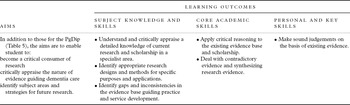
The aims and learning outcomes for this level of study are shown in Table 5.
Aims and learning outcomes of the Postgraduate Diploma in Dementia Studies

We also offer Postgraduate Diplomas in Training in Dementia Care and Dementia Care Mapping. Details of these programs are on our web page.
The core modules for the postgraduate diploma in dementia studies include:
Practice development and organizational change – enables the student to identify ways to improve the care of people with dementia and to contribute effectively to dementia services development.
Research literacy and design – enables the student to develop a critical understating of the nature and generation of evidence in dementia care.
Option modules available to postgraduate students include “Brain and behavior: implications for dementia care practice”; “Teaching, training and learning in dementia care”; “Dementia and society”; “Ethical and legal issues”; “Evidence-based dementia care”; and “Elective studies in dementia practice and research.”
MSc in Dementia Studies
The aims and learning outcomes for this level of study are shown in Table 6.
Aims and learning outcomes of the MSc in Dementia Studies

We also offer a Masters program in Training in Dementia Care and Dementia Care Mapping. Details of these programs are on our web page.
The one core module for the MSc in Dementia Studies is the dissertation. Students develop a detailed plan for a practice intervention in their own area of work on a topic of their own choice. This work is carried out under individual supervision by a member of the academic team with a specific interest in the student's chosen subject area.
MPhil/PhD study
In recent years we have developed an MPhil/PhD program by distance learning, for those wishing to take this level of study.
Course delivery
Our accredited courses are taught by distance learning using print-based learning materials and e-learning technologies. We draw on humanistic and constructivist theories of adult learning including self-directed learning (Knowles, Reference Knowles1984), experiential learning (Kolb, Reference Kolb1984), reflective practice (Schön, Reference Schön1984) and life-long learning. Such approaches belong to a model of adult, life-long learning and have been shown to be effective in the related field of palliative care (Yates et al., Reference Yates, Clinton and Hart1996).
Course materials are developed and delivered by a multidisciplinary, research active team with backgrounds in nursing (general and mental health), psychology (clinical, community, general, and neuro-psychology), occupational therapy, social work, sociology, and social policy. Our course management team includes a range of stakeholders including people with dementia and family carers (Thompson et al., Reference Thompson, Capstick, Heyward, Pulsford and Hope2007) and practitioners and professionals from the range of care sectors.
Print-based materials
The Study Guide, written by members of the course team, supports learning through a range of conceptual, practical and interactive activities and exercises including guided reading, reflection and discussion. The Guide helps students prepare for, and write, their assignments. A Resource Pack accompanies the Study Guide and contains all the required readings.
E-learning
There is a wide variation in computer literacy and access to computer facilities among our student cohort. All students are encouraged to engage with electronic resources, and in some modules there is a compulsory on-line element, but there is scope for students to choose a balance of paper-based and electronic activities that suits their needs.
The virtual learning environment provides:
1. facilities for online discussion, blogs, wikis and a virtual classroom;
2. a quick link to library services and other online resources and facilities;
3. an electronic notice board for information and guidance;
4. an electronic file cabinet for course documents.
Online learning allows:
• discussion of contemporary concerns and material
• easy access to additional resources
• forum for dialogue and debate with fellow students
• engagement with online experts including people with dementia who otherwise may have difficulty engaging with students studying at a distance
• communities of learning and practice
• sharing reflective practice through use of blogs
• a range of modes of presenting material, including audio and video
• innovative approaches to collaborative assessment
In addition we offer individualized support using email, telephone, web cams, skype, and, where feasible, face-to-face contact. We have a student newsletter with information about University services, events taking place within the Bradford Dementia Group, new publications and other news. Increasingly students are contributing stories about their experience of studying with us. New students are encouraged to identify mentors in the workplace who can provide them with informal support during their course.
Assessment
A range of assessment strategies are used on the courses, including: essays, case studies, life history projects, reports, group work, work setting analysis, practice audit and contribution to online discussion. All assignments are practice-based projects which require the student to engage in their workplace thus assisting them in improving the quality of care.
Conclusion
The quality of dementia care to which we aspire makes it essential that practitioners and professionals have the knowledge, skills and attitudes to improve their own and their colleagues' practice. We need practitioners and professionals who can adopt a critical perspective on existing service systems and care practices and who can act as role models and change agents. We need confident practitioners and professionals who demonstrate compassion, empathic communication, creative problem solving, critical thinking, reflection and partnership working. These attributes might be collectively described as emotional intelligence (Goleman, Reference Goleman1995) and require a particular kind of learning experience, one which draws on principles of adult learning and which is adapted to support those in full or part time work. The graduate courses at the University of Bradford aim to meet these requirements through a process of continuous evaluation and review.
Future directions
There are five key areas in which we will be developing our provision over the coming years. These include: (1) working with our colleagues in professional development programs (such as nursing, social work and rehabilitation studies) to identify where dementia care will best fit within their programs; (2) taking full advantage of developing information technologies to facilitate interactive and collaborative learning; (3) maximizing input from experts by experience – both people with dementia and their families as well as practitioners and professionals in all phases of development, delivery, assessment and evaluation; (4) developing an evidence base for effective higher education in dementia care; and (5) maximizing the potential of arts-based approaches to teaching and learning in dementia care.
Conflict of interest
None.
Description of authors' roles
All authors assisted with conceptualizing the various programs of study and drafting specific sections of the paper. M. Downs produced a first draft of the paper, P.C. Baldwin, C. Surr, A. Capstick and E. Bruce assisted with drafting the sections on course delivery, and A. Capstick assisted with drafting the section on the role of education and training in improving dementia care.