Introduction
The contemporary concern over sustainable supply chain management (Wichaisri and Sopadang, Reference Wichaisri and Sopadang2018), along with the consumers' (Bonnedahl and Caramujo, Reference Bonnedahl and Caramujo2019) and other stakeholders' intent to support alternative food distribution initiatives (Aubry and Kebir, Reference Aubry and Kebir2013), have led to a rising interest over short food supply chains (SFSCs). SFSCs represent alternative food marketing arrangements, which instead of focusing on profit maximization give prominence to the production of value through the re-establishment of a mutually beneficial relationship between food producers and consumers. To define these marketing schemes scholars use both quantitative/manifest characteristics (e.g., number of actors involved in the chain) and qualitative/latent properties (e.g., the quality of relationships within the scheme). In a SFSC, farmers sell their products to consumers without the intervention of intermediaries, or with the intervention of only an extra node between farmers and consumers (Chiffoleau, Reference Chiffoleau and Maréchal2008). According to Renting et al. (Reference Renting, Marsden and Banks2003), the most striking feature of a SFSC is the development of transparent institutional structures that facilitate the communication of the food products' attributes. By combining these two viewpoints, SFSCs can be conceptualized as marketing networks in which the number of agents interceding between farmers and consumers is minimal or zero, and the institutions developed within the network facilitate the flow of information from farmers to consumers and vice versa (Charatsari et al., Reference Charatsari, Kitsios, Stafyla, Aidonis and Lioutas2018a).
Schemes like Community Supported Agriculture, on-farm sales, farmers' markets, farm-owned retail shops, online farm shops, direct sales to hospitals or schools, box delivery systems and distribution through specialty retailers, represent different facets of SFSCs (Kneafsey et al., Reference Kneafsey, Venn, Schmutz, Balázs, Trenchard, Eyden-Wood, Bos, Sutton and Blackett2013). Such configurations can be either producer-driven or consumer-driven (Grasseni, Reference Grasseni, Kalfagianni and Skordili2018) and take different forms, ranging from face-to-face selling of food products, to spatially proximate chains – where products are marketed in their place of production – to spatially extended chains, in which consumers do not belong to farmers' communities, but they have access to information on the production methods and the origin of the product (Ilbery and Maye, Reference Ilbery and Maye2005). From a relatively different standpoint, Aubry and Kebir (Reference Aubry and Kebir2013) distinguish between three types of SFSCs, depending on the strength of relations between farmers and consumers. Supply chains with direct relations (which are based on direct communication and exchange) include farmers' markets, on-farm selling, and box schemes. Supply chains with indirect relations (locally based supply chains, in which an intermediary intervenes and facilitates the exchange of products and information) refer to the exploitation of local food distribution channels, like local supermarkets or actors who undertake the selling of food boxes. Finally, in supply chains with distance relations (where there is a physical distance between farmers and consumers but there is still proximity in terms of confidence and common values) practices like mail or online selling are used. Of course, it should be noted that SFSCs do not operate in isolation from the wider economic and market environment. In this vein, a short supply chain is not the opposite of conventional distribution schemes but a different market arrangement within the wider agrifood system (Maye and Ilbery, Reference Maye and Ilbery2006). Given that consumers simultaneously buy from both short and conventional food distribution networks, farmers often adopt hybrid strategies to distribute their products and exploit the opportunities offered from both types of supply chains (Mount, Reference Mount2012).
Despite the fact that SFSCs are not characterized by a universal nature, some common features describe the alternativeness of these schemes. First, trust is a major building block of any SFSC (Heiss et al., Reference Heiss, Sevoian, Conner and Berlin2015; Enjolras and Aubert, Reference Enjolras and Aubert2018). Hence, the cultivation of trust not only between buyers and sellers (Giampietri et al., Reference Giampietri, Verneau, Del Giudice, Carfora and Finco2018) but also among collaborating farmers (Rucabado-Palomar and Cuéllar-Padilla, Reference Rucabado-Palomar and Cuéllar-Padilla2019) is a key element of such food distribution channels. Second, SFSCs, even when spatially extended, are characterized by proximity between the involved actors. Dubois (Reference Dubois2018) classifies this proximity into five dimensions: geographical proximity (i.e., the spatial closeness among participating actors), social proximity (which refers to the development of interpersonal relationships between farmers and consumers), organizational proximity (which concerns the practices used by farmers to integrate resources so as to effectively coordinate the marketing of their products), institutional proximity (which deals with the norms, values and institutions that actors co-develop and share), and cognitive proximity (which pertains to the convergence of farmers' and consumers' individual ‘knowledge bases’). It is this multidimensional proximity which allows consumers to have information on the products they buy, whereas it also permits farmers to know their customers' needs and wants (Renting et al., Reference Renting, Marsden and Banks2003). Importantly, proximity enables the regeneration of the social contexts within which food production and consumption take place (Sonnino and Marsden, Reference Sonnino and Marsden2006) and the development of a sense of community between farmers and consumers (Tanasă, Reference Tanasă2014).
Third, the value of SFSCs extends beyond the interlinked sets of actors who are involved in a food marketing network, thus offering opportunities for sustainable development. Recent research confirms that, contrary to the conventional, commercially oriented conduits, which might negatively affect the sustainability of food systems (Swisher et al., Reference Swisher, Ruiz-Menjivar and Koenig2018), SFSCs have the potential to reduce the environmental impacts of conventional food supply schemes (Galli and Brunori, Reference Galli and Brunori2013), to enhance social sustainability (Schmutz et al., Reference Schmutz, Kneafsey, Kay, Doernberg and Zasada2018), to ensure a fair income to farmers (Blumberg, Reference Blumberg2018) and to help them build new capacities and skills (Mundler and Laughrea, Reference Mundler and Laughrea2016), to better serve consumers' needs (Ortmann and King, Reference Ortmann and King2010), and to open up new spaces for a more active participation of women in agricultural production (Zirham and Palomba, Reference Zirham and Palomba2016).
The growing interest in alternative food production and distribution networks has led to an analogous increase of research efforts on these supply schemes (Luo et al., Reference Luo, Ji, Qiu and Jia2018). Nevertheless, the distribution of research interest among various topics within SFSCs literature is quite uneven. Work on consumers' behavior towards these chains shows a consistent focus on the motives driving participation in such production—consumption lines (Giampietri et al., Reference Giampietri, Finco and Del Giudice2016; Hashem et al., Reference Hashem, Migliore, Schifani, Schimmenti and Padel2018). On the other hand, the antecedents of farmers' participation in SFSCs have received only a small share of attention (Benedek et al., Reference Benedek, Fertő and Molnár2018; Charatsari et al., Reference Charatsari, Kitsios, Stafyla, Aidonis and Lioutas2018a). However, to further support the development of alternative food networks (AFNs), an important question to be answered is how to increase farmers' participation in such initiatives (Bruce and Som Castellano, Reference Bruce and Som Castellano2017).
Among the limited number of studies investigating the drivers of farmers' participation in SFSCs, Demartini et al. (Reference Demartini, Gaviglio and Pirani2017) uncovered that the main motive for Italian farmers is the development of a smoother linkage with consumers, which permits them to better communicate the value of their products and to build trust-based relationships with buyers. In a study in Hungary, Benedek et al. (Reference Benedek, Fertő and Molnár2018) found that participation is associated with farmers' plans to invest in their enterprises in the near future. Other studies emphasize the role of competencies in willingness to participate. For example, Moroney et al. (Reference Moroney, O'Shaughnessy and O'Reilly2013) suggest that farmers' participation in SFSCs is the output of external incentives and internal resources, which include their knowledge, skills and competencies. Sellitto et al. (Reference Sellitto, Vial and Viegas2018) note that farmers often face difficulties in adapting to the new needs created through the participation in a SFSC, supporting Carbone's (Reference Carbone2018) and Pereira et al.'s (Reference Pereira, Villanueva-Rey, Vence, Moreira and Feijóo2018) argument that the new tasks associated with participation in a SFSC increase the need for supplying farmers with new competencies. Consistent with these contentions, a recent study revealed that farmers' communication and cooperation competencies are significant predictors of their willingness to engage in SFSCs (Charatsari et al., Reference Charatsari, Kitsios, Stafyla, Aidonis and Lioutas2018a). Under this prism, the role of competencies in the development of SFSCs deserves further research attention.
According to Mulder (Reference Mulder, Billett, Harteis and Gruber2014), the term competence refers to a person's capacity to effectively perform different tasks related to her/his job or role in specific situations. Personal skills and specific knowledge put the basis for professional competence (Epstein and Hundert, Reference Epstein and Hundert2002). Nevertheless, this capacity encompasses not only knowledge and professional abilities, but also different intellectual/cognitive skills, motivational inclinations, personal values and patterns of social behavior, which altogether help the individual to successfully carry out the demands of a job (Weinert, Reference Weinert, Rychen and Salganik2001). Competence consists of sets of competencies, i.e. ‘integrated performance-oriented capabilities […] which are required for carrying out tasks, solving problems and, more generally, effectively functioning in a certain profession, organization, position or role’ (Biemans et al., Reference Biemans, Nieuwenhuis, Poell, Mulder and Wesselink2004, p. 530). Importantly, studies from different work settings have shown that levels of competencies are associated with professionals' self-efficacy (Tyler et al., Reference Tyler, Bourbon, Cox, Day, Fineran, Rexford and Ward-Smith2012; Lauermann and König, Reference Lauermann and König2016; Charatsari et al., Reference Charatsari, Papadaki-Klavdianou, Koutsouris and Lioutas2018b), that is the set of perceptions a person holds about her/his abilities to perform specific tasks (Bandura, Reference Bandura1982). People who evaluate their competencies as sufficient tend to express higher work engagement (Consiglio et al., Reference Consiglio, Borgogni, Di Tecco and Schaufeli2016) and have better performance (Stajkovic and Luthans, Reference Stajkovic and Luthans1998). On the other hand, when individuals hold negative perceptions of their competencies – and, consequently, low self-efficacy – they tend to avoid the engagement with tasks that they feel they cannot accomplish (Meijman and Mulder, Reference Meijman, Mulder, Drenth and Thierry1998). Hence, farmers' competencies can enhance or undermine both their motivation to participate in SFSCs and their ability to cope with the demands of such alternative food distribution schemes.
In this work, we aimed at empirically examining this conjecture. To do so, we conducted two quantitative studies based on data collected from different samples of Greek farmers. In study 1 we tested if levels of farmers' competencies predict their willingness to participate in SFSCs, whereas in study 2 we explored whether participation in SFSCs increases competency needs.
The present studies
Overview
Work in the field of AFNs indicates that cooperation competencies (Chiffoleau, Reference Chiffoleau2009), networking skills (Brunori et al., Reference Brunori, Rossi and Guidi2012), managerial abilities (Bauman et al., Reference Bauman, Thilmany and Jablonski2019) and market knowledge (Sage, Reference Sage2003) are crucial factors for the success of unconventional food distribution schemes. Moreover, research findings stress the importance of various types of entrepreneurial (Pindado et al., Reference Pindado, Sánchez, Verstegen and Lans2018), social (Lans et al., Reference Lans, Verhees and Verstegen2016) and managerial competencies (Bryła, Reference Bryła and Bryła2018) for farmers in order to survive in the current economic environment. In the first study, informed by the relevant literature, we developed an instrument encompassing the above-mentioned sets of competencies. Then, we investigated the effects of the categories of competencies that emerged through the analysis on farmers' willingness to participate in SFSCs.
Nevertheless, recent evidence suggests that this willingness is also affected by farmers' citizenship behavior (Charatsari et al., Reference Charatsari, Kitsios, Stafyla, Aidonis and Lioutas2018a), an attribute referring to the not directly linked with the intent of gaining rewards behavior of an individual towards a group she/he belongs to. Citizenship behavior is a multifaceted concept, including the dimensions of altruism towards colleagues, group identification, maintenance of interpersonal harmony and participation culture. Based on volition and personal choice, citizenship behavior, contributes to the promotion of common goals and the effective functioning within a social context (Konovsky and Pugh, Reference Konovsky and Pugh1994; Organ, Reference Organ1997). In addition, intentions to start a new entrepreneurial activity are also affected by the pursuit of economic profits (Giacomin et al., Reference Giacomin, Janssen, Pruett, Shinnar, Llopis and Toney2011). Finally, in her study, Som Castellano (Reference Som Castellano2017) found that farmers' environmental concern is associated with the possibility of participating in alternative food distribution schemes. Hence, we also examined the influence of farmers' citizenship behavior, their perception of the potential economic benefits from participation, and their environmental concern on their willingness to engage in SFSCs.
In our second study we focused on the reverse relationship. In other words, we examined whether participation in SFSCs leads to an increase in competency needs. However, given that research provides some evidence that farmers' socio-demographic characteristics and the size of their farm enterprises affect their competencies (Lawrence and Ganguli, Reference Lawrence and Ganguli2016; Theriault et al., Reference Theriault, Smale and Haider2017), we also controlled for farmers' gender, age, level of education and size of the cultivated land. This practice allowed us to examine whether socio-demographics confound the relation between participation and competency needs.
Context
Both studies were carried out in Greece, a country in which more than 10% of the total population derives income from farming or livestock activities (Hellenic Statistical Authority, 2018). The country offers a fertile ground for the development of SFSCs, since small-scale farmers, who often engage in AFNs to increase their profit margins thus ensuring the economic viability of their farms (Berti and Mulligan, Reference Berti and Mulligan2016), represent the vast majority of the total farm population, whereas products usually sold through AFNs globally (such as vegetables, fruits, potatoes and olive oil) account for about one-half of the total agricultural revenues (European Commission, 2018). According to Kizos (Reference Kizos2010), the last decade Greek farmers have started to engage in niche marketing schemes (including SFSCs) in order to survive in the current pressing economic environment.
Nevertheless, both research and data on SFSCs in Greece are scarce. Petropoulou (Reference Petropoulou2016) argues that all three types of supply chains described by Ilbery and Maye (Reference Ilbery and Maye2005), i.e., face-to-face selling, spatially proximate chains, and spatially extended chains, have successfully operated during the last years in Greece. Kizos et al. (Reference Kizos, Marin-Guirao, Georgiadi, Dimoula, Karatsolis, Mpartzas, Mpelali and Papaioannou2011), viewing SFSCs as a pathway to increase multifunctionality of Greek farms, found that short supply schemes are a strategy used to deepen typical farming activities (based on the conceptualization offered by Van der Ploeg and Renting, Reference Van der Ploeg and Renting2004), but the degree to which multifunctional farms engage in such chains presents high variability. For specific products and specific places of the country, like the cases of some PDO (protected designation of origin) cheeses, farmers use both conventional and to a limited extent short supply schemes (Vakoufaris, Reference Vakoufaris2010). Regionally designated products shape the basis for the development of AFN in Greece, as it is also the case in other Mediterranean countries, like Italy, Spain, France and Portugal, while in northern European countries the shift towards alternative food distribution schemes is based on modern, commercially oriented definitions, that emphasize the environmental and the ethical dimension of distributed products (Sonnino and Marsden, Reference Sonnino and Marsden2006).
As a result of the economic crisis which emerged after 2007 in the country (Arghyrou and Tsoukalas, Reference Arghyrou and Tsoukalas2011) and the subsequent austerity measures that negatively affected the well-being of middle- and low-income groups (Sotiropoulos and Bourikos, Reference Sotiropoulos and Bourikos2014), some movements promoting the direct selling of fresh products emerged. Examples include a scheme aimed at linking potato producers and consumers (known as the ‘potato movement’), through which tons of potatoes were directly distributed to consumers at prices significantly lower than those of conventional food marketing channels (The Guardian, 2012), and some early community supported agriculture schemes, mainly in the region surrounding Athens (Anthopoulou and Partalidou, Reference Anthopoulou and Partalidou2015). Nevertheless, the expansion of AFNs in Greece is still limited. Despite the lack of official data on farmers' participation in SFSCs in the country, it is estimated that only about 14,000 growers sell their products in farmers' markets (Manifava, Reference Manifava2017). These farmers correspond to only 0.02% of the total population of farmers in Greece, which according to the most recent census of 2009 (Hellenic Statistical Authority, 2009) is more than 720,000 people.
Study 1
Methods
Participants and sampling procedure: For this study, we used data from a sample of 106 farmers (70.8% men) from the region of Thessaly (Greece). All the 25 municipalities located in the region were represented in the study. Thirty farmers from each one of the four administrative regions of Thessaly were randomly selected, however, 14 of them stated unable to participate in the study (response rate: 88.3%). Questionnaires were completed face to face.
None of the respondents participated in SFSCs. The mean age of participants was 40.1 years (s.d. = 11.5, range from 19 to 64 years), whereas 72 of them have completed secondary education (67.9%). The cultivated land per farmer ranged from 1 to 35 hectares (ha), with smaller farms to be the usual case (mean score = 6.01 ha, s.d. = 6.31, median = 4). As a first step, interviewees were invited to describe a SFSC. Although, in all cases, farmers were able to name the basic characteristics of a SFSC, the interviewers provided participants with the following definition: ‘A SFSC is a distribution scheme in which individual farmers or farmers’ groups sell their products to consumers directly or with the intervention of only one actor.’ Then, participants were asked to complete a set of measures presented in the section that follows.
Instruments used: To measure farmers' willingness to participate in SFSCs we used a single item. Participants were asked to express their willingness by choosing among five options (not at all, a little, moderately, quite a bit, very much).
To assess farmers' citizenship behavior we used four different measures. Three of them were adapted from Farh et al. (Reference Farh, Earley and Lin1997) to assess altruism towards colleagues (e.g. ‘when I participate in a common project I am willing to help colleagues solve work-related problems’), identification with a group of colleagues (e.g. ‘when I participate in a group project I am willing to stand up to protect the reputation of the group’) and interpersonal harmony (e.g. ‘when I participate in a common project I never use illicit tactics to seek personal influence and gain with harmful effect on interpersonal harmony in the group’). Each scale consisted of three items. Moreover, participation culture – another aspect of citizenship behavior – was assessed using four items derived from Camisón (Reference Camisón2005). An example item was ‘when I participate in a common project I follow the group norms and the standards of behavior.’ Response options ranged from one (completely disagree) to five (completely agree). Reliability analysis confirmed satisfactory alpha coefficients for all the four scales (α > 0.70).
A single item was used to assess farmers' beliefs about the economic benefits of participation in a SFSC (‘Participation in a SFSC can lead to higher farm income’). A five-point Likert scale ranging from ‘completely disagree’ to ‘completely agree’ was used.
To operationalize participants' environmental concern we used Bamberg's (Reference Bamberg2003) Environmental Concern Scale. The measure consists of eight items developed to depict subjects' concerns over the future of the natural environment. An example item is ‘If we continue as before, we are approaching an environmental catastrophe.’ Items were measured using a five-point scale ranging from ‘completely disagree’ to ‘completely agree.’ All items were found to load on a single factor accounting for 46.31% of the total variance (eigenvalue = 3.71). Cronbach's alpha for the scale was 0.83. A total environmental concern score was calculated for each participant by averaging the eight items.
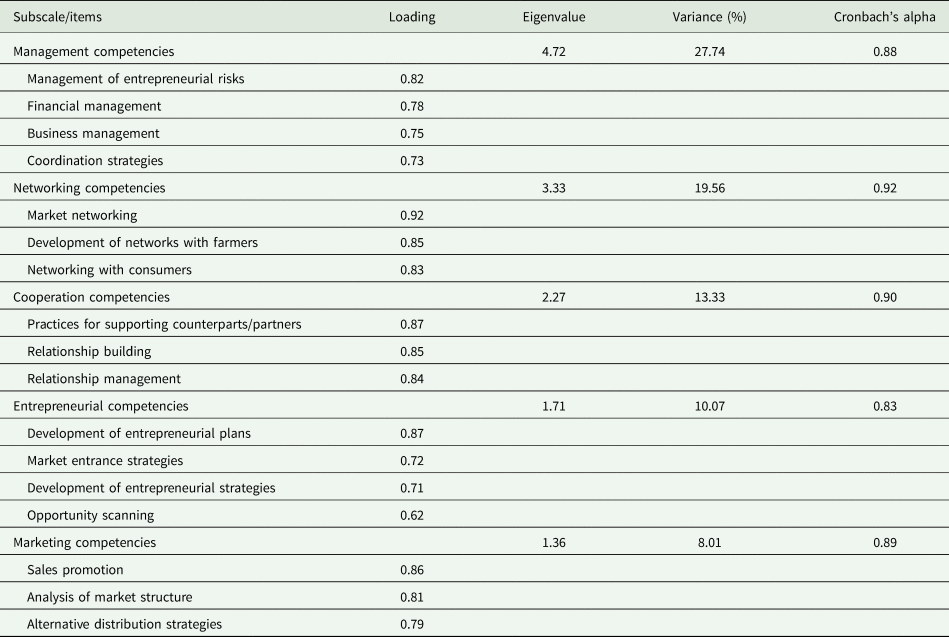
To assess the levels of farmers' self-perceived competencies we developed a list of 17 items (Table 1) which are related to factors determining the success of SFSCs. Items were developed after an extended literature review in the fields of AFNs and entrepreneurial competencies. Related work was identified by electronic search through Scopus and Google Scholar, using combinations of several keywords (competence, competencies, skills, SFSCs, alternative food networks, entrepreneurship, farmers). The 17 items were presented to farmers, who were asked to indicate the level of their competencies in each one of them. A one (very low) to five (very high) scale was used to measure items. Previous studies have also used five-point scales to assess competencies of extension agents (Lakai et al., Reference Lakai, Jayaratne, Moore and Kistler2014), agronomists (Charatsari and Lioutas, Reference Charatsari and Lioutas2019), doctoral students of agricultural universities (Lindner and Dooley, Reference Lindner and Dooley2002) and so on. A principal axis factor analysis with varimax rotation revealed a five-factor structure. Cumulatively, the five new sub-scales explain 78.7% of the total variance (Table 1).
Farmers self-perceived competencies: Factors, items, eigenvalues, explained variance and Cronbach's alphas

Plan of analysis: To analyze our data we used descriptive and inferential statistics. Pearson's correlations and Mann—Whitney U tests were used to test for associations between pairs of variables. Potential predictors of willingness to participate in SFSCs were entered in a hierarchical regression analysis. This way we examined the relative contribution of each set of factors to farmers' willingness.
Results
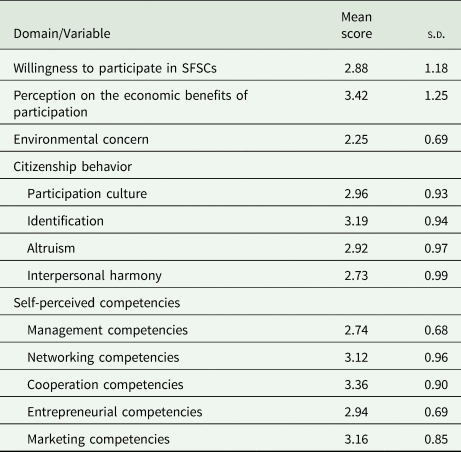
Preliminary analysis: The summary statistics for the key study variables are presented in Table 2. No gender effects were observed on the variables of interest. Age was found to significantly correlate only with environmental concern (r = −0.25, P = 0.010), whereas both age and level of education were not associated with citizenship behavior and perceived competencies. Interestingly, willingness to participate in SFSCs was found to be independent of age (r = 0.02, P = 0.824), level of education (r = −0.06, P = 0.551) and size of the cultivated land (r = 0.05, P = 0.567). Moreover, Mann—Whitney U test revealed no differences between men and women farmers on their willingness to participate in short supply chains (U = 1,096, P = 0.633).
Summary statistics of key study variables

Note: s.d. refers to standard deviation.
Main analysis: The analysis revealed that all four dimensions of citizenship behavior (altruism towards colleagues, identification with a group of colleagues, interpersonal harmony, and participation culture) correlate with farmers' willingness to participate in SFSCs. Pearson's correlation coefficients received values of 0.22 for participation culture (P = 0.021), 0.25 for identification (P = 0.009), 0.29 for altruism (P = 0.003) and 0.36 for interpersonal harmony (P = 0.0001). Moreover, all the variables referred to the levels of farmers' competencies positively correlate with their willingness (P < 0.01), whereas the correlation between willingness and environmental concern is also significant and positive (r = 0.19, P = 0.048). Finally, a positive correlation was found between farmers' willingness to participate in SFSCs and their perception that engagement in such chains can bring economic gains (r = 0.24, P = 0.012).
We developed a hierarchical regression analysis model to examine the relative effect of these variables on farmers' willingness to participate in SFSCs. In the first step, we entered the four dimensions of citizenship behavior. In the second step, the variable referred to farmers' perception of the economic benefits of taking part in a SFSC was added. At step 3 we entered environmental concern, whereas the five constructs which refer to participants' competencies were added at step 4. The analysis confirmed that, with the exception of environmental concern for which ΔR 2 was marginally non-significant (P = 0.055), the other three sets of predictors contribute significantly to the model. The R 2 change was 0.18 for citizenship behavior (ΔF = 5.68, P = 0.0001), 0.05 for perception of the economic benefits (ΔF = 5.98, P = 0.017) and 0.32 for the levels of competencies (ΔF = 14.43, P = 0.0001).
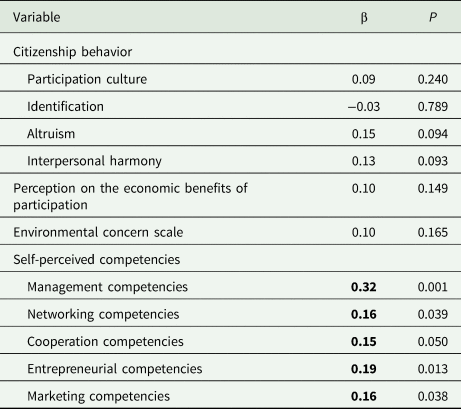
As Table 3 shows, in the final model, only the beta coefficients for the five sets of competencies were significant. Scores on interpersonal harmony and altruism were marginally non-significant, whereas the remaining variables yielded lower beta values. These results indicate that, among the examined variables, farmers' competencies have the highest contribution in predicting willingness to participate in SFSCs. Management competencies received the highest beta coefficient, revealing their pivotal role for the prediction of willingness, whereas entrepreneurial, marketing, networking and cooperation competencies were found to have lower betas.
Standardized coefficients for the final model of the regression analysis

Note: Significant coefficients are presented in boldface.
Study 2
Methods
Participants and sampling procedure: Data for this study were drawn from two samples of farmers. The first sample consists of 33 farmers who participate in SFSCs and the second sample of 38 farmers who distribute their products through conventional marketing channels. All the participants own farm enterprises that are located in the region of Thessaly (Greece). Given that the population of farmers who sell their products through SFSCs is unknown; to recruit participants we contacted local agronomists, who provided us with the names of 40 producers (10 from each administrative region of Thessaly). Other 40 neighboring farmers were invited to participate. The response rate for the total sample was 88.7%. As in the previous study, data were collected face to face.
The mean age for the total sample was 41.8 years (s.d. = 9.3, ranging from 24 to 62 years), whereas 71.8% of the participants were men. More than two-thirds of the subjects had secondary education (67.6%). The average size of the cultivated land was 4.03 ha (s.d. = 2.9, median = 3) and the mean farm income per farm family was €13,408 (s.d. = 4,674, median = 12,000). No significant differences were found between the two samples on gender (Fisher's P = 0.338), whereas Mann—Whitney test revealed no differences in the level of education (U = 559.5, P = 0.346). Independent samples t-test confirmed that the two groups did not differ in age (t = 1.95, P = 0.055). Nevertheless, the analysis indicated that participants in SFSCs hold larger farms (t = −3.48, P = 0.001, mean difference = 2.38 ha).
As in the previous study, participants were given the same definition: ‘A SFSC is a distribution scheme in which individual farmers or farmers’ groups sell their products to consumers directly or with the intervention of only one actor.’
Instruments used: To assess farmers' competency needs we used the scale developed in our first study. Participants were asked to assess their needs on each one of the 17 items using the same one to five scale. A varimax rotated factor analysis uncovered the same factorial structure for the scale. The five sub-scales cumulatively explain 75.7% of the total variance. Mean scores and standard deviations for the sub-scales are presented in Table 4.
Competency needs: Factors, eigenvalues, explained variance, summary statistics and Cronbach's alphas

Note: s.d. refers to standard deviation.
Plan of analysis: To examine whether participation in SFSCs affects farmers' needs for new competencies, we followed a hierarchical regression strategy. The five constructs referring to the categories of competency needs were used as response variables. In the first step of each regression, we added gender, age, education and the size of cultivated land as control variables. Then, we added the binary variable indicating whether farmers participate (value: 2) or not (value: 1) in a SFSC.
Results
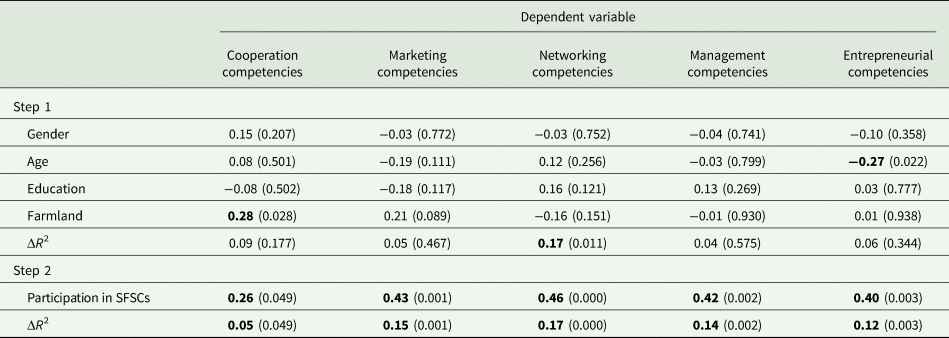
The standardized beta coefficients for the five regressions (Table 5) revealed that participation in SFSCs generates the need for new competencies. In all models the sign of beta coefficient for participation is positive, suggesting that participation in SFSCs leads to an increase in the need for competencies. The changes in R 2 after entering the variable referring to participation were in all cases statistically significant (P < 0.05). It is also noteworthy that age emerged as a significant predictor in the first model and the size of cultivated land also yielded a significant beta coefficient in the model for cooperation competencies, but their contribution to the variance of the dependent variables diminished after entering the second set in each model.
Standardized beta coefficients and R 2 changes for the regressions predicting competency needs

Note: Significant coefficients are presented in boldface.
These results support the hypothesis that participation in SFSCs generates new competency needs in farmers. In the regressions for marketing, networking, management and entrepreneurial competencies the beta coefficients correspond to P-values of 0.01 and below, indicating a very strong association between participation in SFSCs and these four types of competencies.
Discussion and conclusions
The present set of studies examined the association between participation in SFSCs and farmers' competencies. In the first study, we tested the effects of five different categories of competencies on willingness to participate in SFSCs, whereas our second study investigated the effect of farmers' participation in SFSCs on their competency needs. Hence, although previous work also suggests that to succeed in alternative food distribution channels farmers need to develop cooperation and networking competencies (Rucabado-Palomar and Cuéllar-Padilla, Reference Rucabado-Palomar and Cuéllar-Padilla2019; Sellitto et al., Reference Sellitto, Vial and Viegas2018), managerial and marketing skills (Volpentesta and Ammirato, Reference Volpentesta and Ammirato2013), and entrepreneurial knowledge (De Rosa et al., Reference De Rosa, McElwee and Smith2019), the present studies revealed that the deployment of competencies in all the above-mentioned categories is critical for both the development (study 1) and success (study 2) of SFSCs. In this vein, the current work can be viewed as a jumping-off point for discussing the importance of competencies for the growth of SFSCs. Moreover, by integrating different internal constructs (citizenship behavior, environmental concern) and external motives (economic incentives) our studies confirm the multidimensional nature of drivers that influence farmers' involvement in SFSCs (Mastronardi et al., Reference Mastronardi, Marino, Cavallo and Giannelli2015; Aggestam et al., Reference Aggestam, Fleiß and Posch2017).
Study 1, using data from farmers who use conventional distribution channels, uncovered that levels of self-perceived competencies predict farmers' willingness to participate in SFSCs, even when controlling for other factors that also have an effect on this willingness, namely citizenship behavior, perception of the economic benefits associated with participation in SFSCs and environmental concern. These results indicate that felt deficiencies in competence discourage farmers' engagement is SFSCs, confirming work from different fields such as academic entrepreneurship (Obschonka et al., Reference Obschonka, Silbereisen and Schmitt-Rodermund2010) or technology-based firms (Fini et al., Reference Fini, Grimaldi, Marzocchi and Sobrero2012), which points to a strong link between competencies and entrepreneurial intentions. On the other hand, the finding that perceived competencies are more important in predicting willingness than the four dimensions of citizenship behavior indicates that, despite the pivotal role of social cohesion and collectivity for the success of alternative supply schemes (Berti and Mulligan, Reference Berti and Mulligan2016), the expansion of SFSCs depends mainly on farmers' operant resources, i.e., resources like knowledge, skills and competencies, which operate and act upon tangible resources thus transforming them into value (Vargo et al., Reference Vargo, Maglio and Akaka2008). This observation calls for more nuanced research on the types of competencies needed by farmers to effectively operate within the framework of a SFSC.
Another interesting finding was that the potential economic benefits of participation did not contribute to the variance in willingness to participate in SFSCs, supporting previous findings that the pursuit of economic returns is not the main drive leading farmers to engage in alternative food distribution schemes (Conner et al., Reference Conner, Sevoian, Heiss and Berlin2014; Balázs et al., Reference Balázs, Pataki and Lazányi2016). Despite the fact that such schemes are viewed by farmers as opportunities to increase their profit and to expand their client base (Feenstra and Lewis, Reference Feenstra and Lewis1999) thus developing their enterprises (Feenstra et al., Reference Feenstra, Lewis, Hinrichs, Gillespie and Hilchey2003), this finding is an indication that the expectation of economic returns cannot adequately explain farmers' engagement in SFSCs, as studies focused exclusively on the economic dimension of participation in SFSCs suggest (Zhang et al., Reference Zhang, Qing and Yu2019).
Our results indicate the need for a shift in policy emphasis from the offering of economic incentives to the opening of opportunities for farmers to attain and develop new competencies, especially those referred to intra-community networking and cooperation capacities, marketing and management skills and entrepreneurial capabilities. Our second study further supports this argument, by showing that participation in SFSCs increases farmers' competency needs. The vertical integration of supply chain functions by the farmers in SFSCs (Chiffoleau, Reference Chiffoleau2009; Carbone, Reference Carbone2018), amplifies these needs, and perhaps creates new needs that should be met by appropriate extension interventions. Nonetheless, to date, the philosophy of extension services continues to be anchored to conventional production and marketing approaches, thus paying limited attention to the needs and demands of farmers who use alternative routes of food production and distribution (Chiffoleau et al., Reference Chiffoleau, Millet-Amrani and Canard2016). Especially in Greece, where extension services lack organizational functionality, underemphasize farmers' real needs and underserve middle- and small-scale producers (Lioutas and Charatsari, Reference Lioutas and Charatsari2011; Charatsari et al., Reference Charatsari, Papadaki-Klavdianou and Koutsouris2012; Lioutas et al., Reference Lioutas, Charatsari, Černič-Istenič, La Rocca and De Rosa2019) the identification of appropriate strategies to facilitate competency development of farmers is a real challenge. As two recent studies indicate, the success of alternative food distribution schemes in Greece depends on farmers' competencies in all the five categories used in this research, namely management and cooperation with farmers and other actors, as well as marketing, networking and entrepreneurial competencies (Darrot et al., Reference Darrot, Diaz, Tsakalou, Zagata, Sutherland, Darnhofer, Zagata and Wilson2014; Lioutas et al., Reference Lioutas, Charatsari, Černič-Istenič, La Rocca and De Rosa2019a, Reference Lioutas, Charatsari, De Rosa, La Rocca and Černič-Istenič2019b).
Moreover, the enhancement of farmers' competencies can facilitate the adoption of sustainable practices (Ommani et al., Reference Ommani, Chizari, Salmanzadeh and Hosaini2009) which, according to Clancy and Ruhf (Reference Clancy and Ruhf2010) is a critical dimension of any alternative food distribution scheme. On the other hand, as the classic works by Lewicki and Bunker (Reference Lewicki, Bunker, Kramer and Tyler1996) and Mayer et al. (Reference Mayer, Davis and Schoorman1995) argue, the existence of competencies strengthens trust between collaborating actors, thus increasing institutional and cognitive proximity. Going back to the common characteristics of any SFSC (inter-actor trust, proximity and opening of opportunities for sustainable development), one can see that competencies are not only crucial for helping farmers succeed in these alternative food supply networks, but they also have wider positive impacts for the whole SFSC. Importantly, when the competencies of different actors are combined, new higher-order resources (collective competencies) are created (Lusch et al., Reference Lusch, Vargo and Gustafsson2016). Although it was beyond the scope of this work, an interesting avenue for future research is to unravel the way individual competencies are integrated within the framework of SFSCs and they are transformed into collective resources.
To sum up, in spite of the limitations arising from the small sample sizes, the pair of studies presented herein contributes to the literature on SFSCs by offering considerable support for the importance of farmers' competencies in the development of short supply chains. Although future researchers can add other factors that might also affect farmers' participation in SFSCs – such as their entrepreneurial orientations (Aggestam et al., Reference Aggestam, Fleiß and Posch2017), the existing social relations (Blandon et al., Reference Blandon, Henson and Cranfield2009), cultural factors (Sellitto et al., Reference Sellitto, Vial and Viegas2018), ethical and ecological values (Conner et al., Reference Conner, Campbell-Arvai and Hamm2008) etc. – our work indicates that to promote and sustain the development of supply schemes that are based on zero or at most one intermediary it is important to focus on the issue of farmers' competencies. Diagnosing and scanning farmers' competency needs, and offering opportunities for farmers' competence development could facilitate both engagement and persistence in these alternative supply schemes.