INTRODUCTION
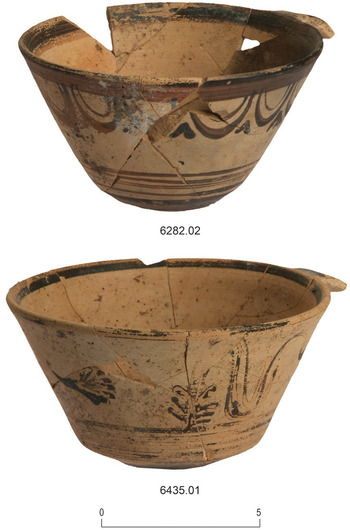
In the course of the 2009 season of excavations at Tel Beth-Shemesh, Israel, two rare and well-preserved Late Minoan IIIA1 decorated cups (Fig. 1) were found in a sealed and well-dated destruction context.Footnote 1 They were part of a larger assemblage dated to the local Late Bronze Age II (Fig. 2). A scarab bearing the name of Amenhotep III was found alongside the cups, providing further chronological evidence. The Minoan cups and the scarab are the subject of two successive articles which analyse both finds and discuss their important implications for the study of Late Bronze Age Aegean cultural contacts and chronology. The present article examines the Late Minoan IIIA1 cups from Beth-Shemesh within their Aegean context and emphasises their close affinity with comparable cups from the palace at Knossos, catalogued and republished here. The second, subsequent article (Brandl, Bunimovitz and Lederman Reference Brandl, Bunimovitz and Lederman2013), is devoted to innovative reading and interpretation of Amenhotep III scarabs found with Late Minoan IIIA1 pottery at Tel Beth-Shemesh and Sellopoulo Tomb 4 as commemorative scarabs related to the first Jubilee (Sed festival) in his thirtieth regnal year. In view of the fragility of the traditional archaeological-historical chronology of the Aegean Late Bronze Age and the current debate concerning some of its major tenets (see e.g. Manning Reference Manning1999; Manning et al. Reference Manning, Bronk Ramsey, Kutschera, Higham, Kromer, Steir and Wild2006; Warburton Reference Warburton2009), the new finds from Beth-Shemesh and their implications for the synchronisation between Amenhotep III and Late Minoan/Late Helladic IIIA1 gain special significance.
Two Late Minoan IIIA1 decorated cups from Tel Beth-Shemesh.

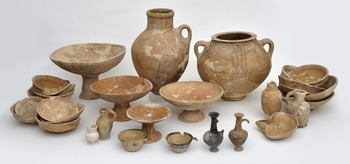
Pottery assemblage of context L1556 including two Late Minoan IIIA1 decorated cups.

THE ARCHAEOLOGICAL CONTEXT OF THE TEL BETH-SHEMESH LATE MINOAN IIIA1 CUPS
The renewed excavations at Tel Beth-Shemesh
Tel Beth-Shemesh is a three hectare mound, located on the northern part of the gentle hilly lowland (Shephelah) between the southern coastal plain and the central mountain ridge of Israel. This is a multi-period site, spanning more than 1100 years of occupational history. Three cycles of excavations (1911–12; 1928–33; 1990–present) revealed that it was first settled in the Middle Bronze Age (seventeenth century bc), and finally deserted in the mid-seventh century bc as a result of Assyrian and Philistine violence (Bunimovitz and Lederman Reference Bunimovitz, Lederman and Stern1993; Reference Bunimovitz, Lederman and Stern2008; Reference Bunimovitz and Lederman2009).Footnote 2
Previous excavations at Tel Beth-Shemesh exposed Late Bronze remains (fifteenth–thirteenth centuries bc) spread all over the site, indicating a prosperous city (Stratum IV; Grant and Wright Reference Grant and Wright1939, 9–12, 35–50). The finds from this city attest its wide cultural connections within the eastern Mediterranean (e.g. Late Cypriot and Late Helladic IIIA–B Mycenaean pottery, and a cuneiform tablet written in the Ugaritic alphabet – Grant and Wright Reference Grant and Wright1939, 118–21; Stubbings Reference Stubbings1951, 64, 84; Leonard Reference Leonard1994; Sanders Reference Sanders, Horowitz and Oshima2006, 157–60).The current investigation of the Late Bronze levels of Tel Beth-Shemesh is concentrated mainly on the northern slope of the mound. In this sector two Late Bronze Age strata were exposed under Early Iron Age remains from the twelfth–eleventh centuries bc. The upper one – Level 8 – dates from the thirteenth century bc and comprises two large buildings separated by an alley. A thick destruction layer was unearthed immediately under the remains of Level 8, sealing a spacious building of Level 9 – tagged ‘palace’ by the current excavation directors due to its size, style of construction and rich contents. It is in one of the rooms of this architectural complex that the two Minoan cups were discovered.
The Late Bronze Age ‘palace’ of Level 9
The ‘palace’ of Level 9 was found completely covered by a heavy mantle of fallen sun-dried mud bricks that had been fired by a tremendous conflagration when the entire complex was destroyed. So far, only a part of the northern quarters of this multi-roomed structure has been exposed, yet the architectural remains – at least eight to ten rooms – already extend over more than 250 m2. To the north, the building makes use of the massive city wall, which may have been originally constructed in the Middle Bronze Age (seventeenth century bc), and repaired and rebuilt in some sections during the Late Bronze Age. The southern sector of the large building is still hidden under later levels which are currently being excavated.
The picture emerging from the excavations of the ‘palace’ is of functional variability between its rooms. Along the eastern wall of the building a row of four rooms was exposed. One room was packed with at least 15 storage jars containing a variety of plant remains, as well as dozens of other vessels. Another room is characterised by a group of four-handled storage jars. A large saddle quern found in a large room, which may have served as an inner courtyard, attests food preparation there.
The find context of the Late Minoan IIIA1 cups
The room in which the two Late Minoan IIIA1 cups were found is located on the southern edge of the excavated quarters of the ‘palace’. Indeed, part of it is still concealed by later levels still under investigation. Two parts of the same archaeological context of brick debris typical of the ‘palace’ destruction were found here on either side of a baulk and excavated as layers L1556 and L1530. The sherds of the two broken Late Minoan IIIA1 cups (Reg. Nos. 6282.02; 6435.01) were found in layer L1556 adjacent to a remarkable assemblage of artefacts. The assemblage comprises 27 pottery vessels exposed nesting within large pieces of what seems to have been a free-standing half-barrel-shape pottery bin. Presumably, the group of vessels was stored in the bin and both shattered under the collapsing walls of the room during the fire destruction. The composition of the assemblage (Fig. 2) – a group of 14 carinated and open bowls, four chalices, a large jug, a krater, juglets (including two Cypriot Base Ring I juglets; a third one was found in L1530) and a single oil lamp, supplemented by the two Late Minoan IIIA1 cups and a strainer tip of a bronze drinking straw for alcoholic beverages found in layer L1530 (for the latter see Sparks Reference Sparks, Bourriau and Phillips2004, 37–8; Maeir Reference Maeir, Garfinkel and Cohen2007; Stockhammer Reference Stockhammer2012a, 23–5) – may hint at ceremonial or ritual paraphernalia, packed all together. Presumably, the ceremony or ritual involved communal drinking and eating by a number of individuals, i.e. feasting.Footnote 3 Notably, no food preparation vessels or tools were found in this room (e.g. cooking pots and grinding stones, found in adjacent rooms). The idea of a ceremonial/ritualistic assemblage is corroborated by finding among the pottery vessels a group of crude-looking, handmade human and animal figurines and a boat model.
Excavations in the western corner of this room, in context L1530, revealed a medium-size commemorative scarab of Amenhotep III and a unique plaque figurine, presumably of a female ruler presented as a male (Ziffer, Bunimovitz and Lederman Reference Bunimovitz and Lederman2009). Other finds in this context include the aforementioned bronze strainer and a Base Ring I juglet. Three bronze arrowheads, also found in the destruction debris, may attest the violent circumstances in which the ‘palace’ of Level 9 at Beth-Shemesh came to its end.
In the following two sections we present a description of the Late Minoan IIIA1 cups from Tel Beth-Shemesh (TBS henceforth) and a discussion of comparative material from Knossos catalogued and republished here.
THE LATE MINOAN IIIA1 CUPS FROM TEL BETH-SHEMESH
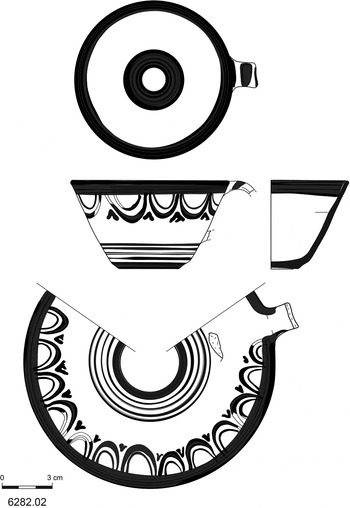
TBS 6282.02 ( Fig. 1 , Fig. 3 ): bell-shaped cup with a straight-sided profile, thin walls and a low carination near the flat, string-cut base. The cup is almost complete save for a missing strap handle of which a piece of the upper part is still attached to the cup's lip, and traces of its base are left on the side. The cup's measurements are: height – 52 mm; rim diameter – 95 mm; base diameter – 37 mm.
Drawing of cup 6282.02.

The fabric is fine buff, light in weight with a pinkish core (7.5YR 8/4) almost without inclusions. Pale buff slip (10YR 8/3) can be discerned.
The decoration on the outside of the cup – a frieze of pendent undulating lines with iris buds as fillers – is framed by a thick rim band and four thin body bands. The base is outlined with paint but its underside is plain. The interior of the cup is plain except for a thick rim band and a thick bottom band that left a plain circle at the centre. Transverse strokes of paint on the strap handle. The paint is brown (7.5YR 5/4).
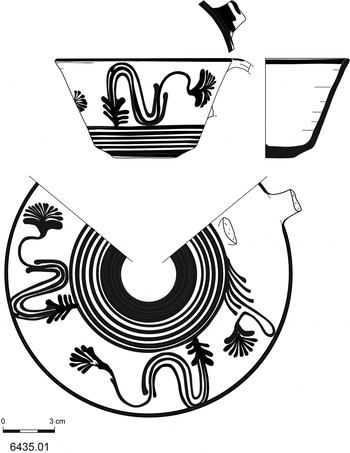
TBS 6435.01 ( Fig. 1 , Fig. 4 ): bell-shaped cup with a straight-sided profile and slightly flaring rim, thin walls and low carination near the flat, string-cut base. The cup is almost complete save for a missing strap handle of which a piece of the upper part is still attached to the cup's lip, and traces of its base are left on the side. The cup's measurements are: height – 56 mm; rim diameter – 103 mm; base diameter – 36 mm.
Drawing of cup 6435.01.

The fabric is fine buff, light in weight almost without inclusions. Core and slip are of the same colour (10YR 8/3).
The decoration on the outside of the cup – a frieze of curve-stemmed Minoan flowers – is framed by a thin rim band and five thin body bands. The base is outlined with paint but its underside is plain. The interior of the cup is plain except for a thin rim band. Transverse strokes of paint on the strap handle. The paint is fugitive brown (10YR 3/2).
KNOSSIAN COMPARANDA FOR THE LATE MINOAN IIIA1 CUPS FROM TEL BETH-SHEMESH
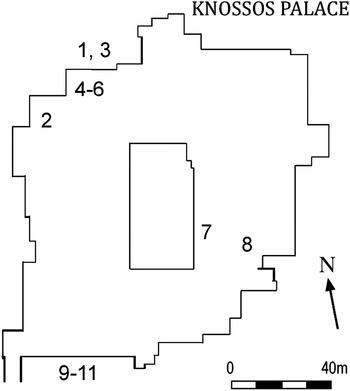
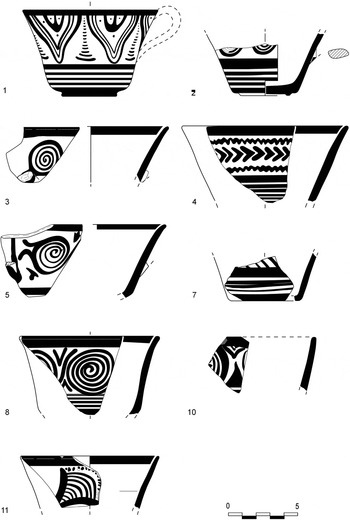
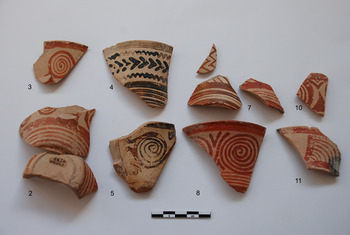
In his seminal publication on Late Minoan IIIA pottery from the palace and town of Knossos, Popham (Reference Popham1970, 70, cup Type D) identified for the first time in Crete a fine buff dark-on-light lustrous bell-shaped cup.Footnote 4 Nine fragmentary examples were published (see below, catalogue of Knossian comparanda nos. 1–9), to which Mountjoy (Reference Mountjoy2003) has added two (catalogue nos. 10–11), all of which come from within, or from the immediate vicinity, of the palace (Fig. 5; Fig. 6; Fig. 7). Although the shape corresponds closely to the Mycenaean Furumark Shape 230 (and by extension to its Furumark Shape 211/Late Helladic IIA and Furumark Shape 230/Late Helladic IIB predecessors),Footnote 5 it will be argued that the Knossian examples are local (with Neopalatial bell-cup predecessors), date to Late Minoan IIIA1 and provide the closest parallels for the two bell-shaped cups found at Tel Beth-Shemesh on the basis of fabric, ware and general form. This section discusses the chronological development of this rather rare Late Minoan IIIA1Footnote 6 shape, and reviews the relevant data sets with an emphasis on its production as well as consumption within the context of Final Palatial Knossos, Crete and beyond.
Sketch plan of Knossos Bronze Age palace showing findspots of catalogued Late Minoan IIIA1 bell-shaped cups.

Drawings of catalogued Late Minoan IIIA1 bell-shaped cups from Knossos.

Photograph of catalogued Late Minoan IIIA1 bell-shaped cups from Knossos.

Stylistic analysis
Fabric
All Knossian examples are in a fine buff, medium hard, rather light-in-weight fabric (paste hues ranging from pinkish to orange buff)Footnote 7 with almost no inclusions, shaped into a thin-walled vessel. This is a fabric local to Knossos, which corresponds best with Late Minoan IIIA1 examples, especially because of the absence of a greenish hue and lighter fabric characteristic of Late Minoan II, or of a heavier, denser paste (combined with thicker walled vessels) typical of Late Minoan IIIA2 (compare Hood Reference Hood, Brogan and Hallager2011, 157 fig. 7; Hatzaki Reference Hatzaki and Momigliano2007a, 202–3; Hatzaki Reference Hatzaki and Momigliano2007b, 215–16, 227). Optical emission spectroscopy analysis of catalogue no. 8 by R.E. Jones (Reference Jones1986, 449 pl. 6.2 no. 70, 452 table 6.4, 454) suggests a Knossian provenance (although note that Jones [1986] erroneously dated this piece to Middle Minoan III). Macroscopically, the fabric of the two Tel Beth-Shemesh examples is closely comparable to Late Minoan IIIA1 Knossian fine fabric.
Ware
A lighter-coloured buff slip is discernible only in catalogue nos. 4–5 and TBS 6282.02; slip can also be macroscopically indistinguishable from the paste (catalogue nos. 2–3); all examples are in dark-on-light lustrous ware, the decorative ware par excellence of Final Palatial Knossos (Hatzaki Reference Hatzaki and Momigliano2007a, 216–19). Paint colour can range from dark brown to bright orange; a fugitive effect is discernible normally only among some of the brown or black coloured specimens. TBS 6435.01 closely parallels catalogue no. 4.
Except for a rim band the interior is usually left plain, although monochrome interiors were also made (catalogue nos. 9–10). Decoration is within a frieze framed by a thick or thin rim band (compare TBS 6435.01 and TBS 6282.02, catalogue no. 8), and three to four thin body bands (e.g. TBS 6435.01 and TBS 6282.02, catalogue no. 8); alternatively the bands that frame the frieze are thick, the remaining bands thin (catalogue nos. 2, 4). The base and underside of the Knossian (catalogue nos. 1–2) as well as the Tel Beth-Shemesh (TBS 6435.01 and TBS 6282.02) examples is left plain.
Decorative motifs are far from standardised and range from pendent undulating lines (TBS 6282.02, catalogue no. 1), to spirals (catalogue nos. 2, 3, 5, 8, 10), zigzag and foliate band (catalogue no. 4), multiple vertical zigzags (catalogue nos. 6–7), curve-stemmed spiral (catalogue no. 9), papyrus (catalogue no. 11), and the Minoan flower (TBS 6435.01). Iris buds (TBS 6282.02, catalogue nos. 5, 8), tricurved arch motif (catalogue no. 1), or undulating lines (catalogue no. 10) are typical fillers in between the main decorative motif.
While the pendent undulating lines of TBS 6282.02 are a popular decorative motif that occurs at Knossos in Late Minoan II (Popham Reference Popham1984, pls. 50 b, 53 c, 55 g, 164.15), Late Minoan IIIA1 (Popham Reference Popham1984, pl. 171.7–8), and Late Minoan IIIA2 (Popham Reference Popham1984, pl. 173.6–7), the curve-stemmed motif of TBS 6435.01 (with a flower rather than the more popular papyrus or spiral) as a decorative concept finds closer parallels on the Greek mainland (Furumark Reference Furumark1941, 258 fig. 32.13–17, 265 fig. 34.48, 366 fig. 63.1–2; Blegen Reference Blegen1937, fig. 126 nos. 234 and 257; for a Late Helladic IIIA1 import to Chania see Hallager and Hallager Reference Hallager and Hallager2011, 369, pl. 141.77-P 0565). Nevertheless, curve-stemmed motif does also occur at Knossos, although rarely (Popham Reference Popham1970, pl. 29 c bottom and pl. 32 d). Also, the flower on TBS 6435.01 resembles one depicted on a sherd from the Royal Villa (Popham Reference Popham1970, pl. 16 e top row, 2nd from left).
Form
The vessels have a straight-sided profile, with a slightly flaring rim and a low carination near the ring-base. Two of the Knossian examples (catalogue nos. 1–2) have a ring-foot base; the remainder are either rim or body fragments only. The absence of a ring-foot on the Tel Beth-Shemesh examples may suggest that the shape was not standardised. This is further confirmed by comparanda from Kommos: a single monochrome example with a flat base of local manufacture found in a Late Minoan IIIA2 early context (Watrous Reference Watrous1992, 42 no. 730, fig. 31.730), and a Knossian monochrome version with a low but flaring pedestalled foot from a Late Minoan IIIA2 context from House X.Footnote 8 Of the Knossian cups the base of a strap handle is preserved on only one (catalogue no. 3), the shape confirmed by the better-preserved Tel Beth-Shemesh cups, which are also missing their handles, perhaps intentionally broken off so as to suit local taste in drinking habits (Stockhammer Reference Stockhammer2012b, 79–80). To distinguish it from the standard rounded cup (Types A–B) and the shallow cup (Type C), Popham (Reference Popham1970, 70) named the straight-sided cup Type D, but this terminological scheme never became popular or widely adopted (Popham Reference Popham1984, 160–1, 181; Hatzaki Reference Hatzaki and Momigliano2007a, 204, 219, 227).
No Late Minoan II Knossian examples have been identified. Regarding a Late Bronze I predecessor, Mountjoy (Reference Mountjoy and Renfrew2007, 331–2, fig. 8.17.359), discusses a Late Helladic IIA/Late Minoan IB equivalent from Phylakopi and parallels from the Cyclades and the mainland, to which she attributes a mainland origin (see also Mountjoy Reference Mountjoy1986, 33 fig. 33). However, it could be argued that the shape developed locally since it resembles in form and proportions the Neopalatial bell-shaped cup going back to Middle Minoan IIIB.Footnote 9 In such a case it follows the general Final Palatial tendency for transforming Neopalatial shapes, by creating a smoother-shaped and thinner-walled vessel, with a more metallic/polished finish, decorated with dark-on-light lustrous paint – something that, for this shape, had already happened by Late Minoan IB.Footnote 10 Late Helladic IIB and Late Helladic IIIA1 equivalents suggest a parallel development on the mainland: the swap from an S-shaped profile to a carinated one was well under way in Late Helladic IIB, but came about fully in Late Helladic IIIA1 (for Late Helladic IIB, see Mountjoy Reference Mountjoy1986, 46 fig. 51; for Late Helladic IIIA1, Mountjoy Reference Mountjoy1986, 64 fig. 74). The shape does not seem to survive beyond Late Helladic IIIA2 (Mountjoy Reference Mountjoy1986, 86 fig. 102). Outside Knossos the only published example comes from Kommos, a local monochrome carinated cup with a flat base and thicker walls than the Knossian comparanda, deriving from an early Late Minoan IIIA2 context (Watrous Reference Watrous1992, 42 no. 730, fig. 31.730).
DATING THE KNOSSIAN AND TEL BETH-SHEMESH CUPS
None of the Knossian cups comes from a closed or securely dated or stratigraphically isolated deposit; therefore dating has been based on stylistic attributions. While individual elements of the cups from Knossos and Tel Beth-Shemesh, such as decoration, could suggest a Late Minoan II or a Late Minoan IIIA2 date, the combined study of fabric, ware and form indicate a Late Minoan IIIA1 date of manufacture.
The pottery assemblage contextually related to the Tel Beth-Shemesh Late Minoan IIIA1 cups (i.e. from layers L1556/L1530) is but part of a larger pottery deposit exposed all over the ‘palace’ under the mantle of destruction debris. The study of this larger assemblage, which comprises dozens of local vessels accompanied by some Cypriot imported ware (Base Ring I juglets and White Slip II bowls) shows that it spans the local Late Bronze IB–IIA period, namely the late fifteenth and first half of the fourteenth centuries bc. This dating is corroborated by the reading and interpretation of the Amenhotep III scarab found near the Late Minoan IIIA1 cups as a commemorative scarab produced on the occasion of Amenhotep III's celebration of the Jubilee (Sed festival) in the thirtieth year of his reign (which spanned the years 1390–1353 bc, cf. Hornung, Krauss and Warburton Reference Hornung, Krauss and Warburton2006, 204–6, 492; for further discussion see Brandl, Bunimovitz and Lederman Reference Brandl, Bunimovitz and Lederman2013). The pottery from the ‘palace’ indicates that its destruction happened shortly after this terminus post quem.
The Tel Beth-Shemesh cups are the second occurrence of Knossian Late Minoan IIIA1 pottery found together with an Amenhotep III scarab. At Sellopoulo Tomb 4 (Popham, Catling and Catling Reference Popham, Catling and Catling1974; Hatzaki Reference Hatzaki and Momigliano2007a, 222–3) Burial III was associated with a scarab of Amenhotep III and Knossian pottery firmly dated to Late Minoan IIIA1 (contra Manning [1999, 222–3], who argues for a Late Minoan IIIA2 date for this tomb). Sellopoulo Tomb 4 Burials I and II are also associated with Late Minoan IIIA1 pottery. The new evidence from Tel Beth-Shemesh strengthens the probability of an overlap between Late Minoan IIIA1, Late Helladic IIIA1 and the reign of Amenhotep III (see further discussion of this issue in Brandl, Bunimovitz and Lederman Reference Brandl, Bunimovitz and Lederman2013).
THE CULTURAL CONTEXT OF THE LATE MINOAN IIIA1 CUPS AT KNOSSOS AND BETH-SHEMESH
It is notable that all Knossian examples derive from within, or the immediate vicinity of, the palace of Knossos, i.e. none have so far been identified from the town or cemeteries. Apart from catalogue nos. 7–8, which come from within the palace, i.e. the Domestic Quarter (Passage of Demon Seals and the Queen's Megaron Area of Fish Fresco respectively), all others derive from adjacent exterior areas to the north and south, along the North-West Palace Corner (catalogue nos. 1–6), or the South Front (catalogue nos. 9–11). The latter two contexts most likely represent re-deposited material originating from within the palace (Hatzaki Reference Hatzaki2007c), but, because of how the pottery was selected in the early 1900s, one cannot define the nature of these depositions as site clearance, occasional rubbish tips, or intentional discards of feasting residues. Despite these limitations, this dispersed spatial distribution suggests that, while this is an extremely rare shape in production aimed predominantly (but perhaps not exclusively) at the palace, its distribution and use within may not have been restricted only to one part of the building. It is widely acknowledged that little ceramic material from the palace at Knossos survives today, and that much was thrown away. What is kept largely consists of pattern-decorated pottery, especially rim or elaborately decorated body sherds (hence the paucity of handles and bases; see Popham Reference Popham1970, 12–13; Hatzaki Reference Hatzaki2005, 101–2). Therefore, while the sample is biased, the small number of such cups so far identified remains meaningful, especially when compared with other Late Minoan IIIA fine tableware from the palace, town and cemeteries of Knossos. While the fine buff, dark-on-light lustrous pattern-decorated rounded cup was consumed in staggering numbers in the town of Knossos (e.g. Popham Reference Popham1970; Reference Popham1984; Warren Reference Warren, Hallager and Hallager1997; Hatzaki Reference Hatzaki2005), in the palace it is found in relatively small numbers (Hatzaki Reference Hatzaki2007c), but nevertheless in larger quantities than the bell-shaped cup. To sum up, one can argue that the bell-shaped cup had a markedly low production among Knossian tablewares, and, at Knossos at least, a restricted circulation, probably exclusive to the palace. The single local Kommian example, albeit in monochrome (Watrous Reference Watrous1992, 42 no. 730, fig. 31.730), as well as the Knossian import from Kommos House X implies a more or less parallel phenomenon elsewhere in Crete associated with a very low production line and by default limited circulation. Finally, the small volume capacity of this vessel may suggest the likely consumption of liquid(s) rather than food (i.e. in a solid or semi-solid state), for which the much larger rounded cup (i.e. Hatzaki Reference Hatzaki and Momigliano2007b, 216 fig. 6.12.1–3) seems more suitable.
As archaeology testifies, in the Late Bronze Age Beth-Shemesh was a medium-size city-state within the network of Canaanite city-states documented in the Amarna archive of the fourteenth century bc (for the array of these city-states see Bunimovitz Reference Bunimovitz and Levy1995, 326–7; Finkelstein Reference Finkelstein1996; Goren, Finkelstein and Na'aman Reference Goren, Finkelstein and Na'aman2004, 320–2; Na'aman Reference Na'aman, Finkelstein and Na'aman2011). Two letters (El-Amarna Tablets 273–4) written by a female ruler named fNIN.UR.MAHmeš (Bēlit-labi)t – ‘lady of the lionesses’) may have been sent to the Egyptian court (still in the days of Amenhotep III) from Beth-Shemesh, according to their contents as well as petrographical analysis (Goren, Finkelstein and Na'aman Reference Goren, Finkelstein and Na'aman2004, 276–7; Na'aman Reference Na'aman, Finkelstein and Na'aman2011; Ziffer, Bunimovitz and Lederman Reference Bunimovitz and Lederman2009). While it is certainly possible that the Late Minoan IIIA1 cups came to Beth-Shemesh directly from Knossos, another viable option is that they arrived as a gift from the Egyptian court.
The special relations between Amenhotep III and the Aegean in the Late Minoan/Late Helladic IIIA1 period have drawn much scholarly attention, envisioning an official Egyptian embassy visiting important sites in this region, including Knossos (Cline Reference Cline, O'Connor and Cline2001; Cline and Stannish Reference Cline and Stannish2011, with previous literature). The two Knossian cups from Beth-Shemesh could have reached Egypt on this occasion and then been sent as part of royal gifts to the ruler of Beth-Shemesh. Notably, this was not the only gift endowed by Amenhotep III to Beth-Shemesh, as one of his large commemorative scarabs is known from Grant's excavations at the site (Blankenberg-Van Delden Reference Blankenberg-Van Delden1969, 47–8).
In light of the contextual evidence from both Knossos and Beth-Shemesh it is clear that the two Late Minoan IIIA1 cups had an intriguing biography (Kopytoff Reference Kopytoff and Appadurai1986; Gosden and Marshall Reference Gosden and Marshall1999), in both their Cretan and subsequent non-Cretan contexts. The cups served as active agents for social relations (Bevan Reference Bevan2007, 12–16) at a high-ranking level between Knossos and Tel Beth-Shemesh, possibly via Egypt. They also contribute to the current discussion about the socially embedded but contextually varied use of pottery (cf. Wilson and Day Reference Wilson and Day2000; Day and Wilson Reference Day, Wilson, Halstead and Barrett2004; Knappett Reference Knappett, Cadogan, Hatzaki and Vasilakis2004; Urem-Kotsou and Kotsakis Reference Urem-Kotsou, Kotsakis and Renard2007; Haggis Reference Haggis2007; Macdonald and Knappett Reference Macdonald and Knappett2007, 164 fig. 6.1; Hatzaki Reference Hatzaki, Knappett, Macdonald and Banou2013; in press).
CATALOGUE OF KNOSSIAN COMPARANDA
North-West Palace Corner / North-West Front / North Foundations
-
1 (Fig. 6.1)
Complete profile, two fragments, rim and base.
Location: Stratigraphic Museum Knossos E.I. 1 no. 594; sherds not found in Stratigraphic Museum December 2011.
Publication: Popham Reference Popham1970, 102 fig. 8.4, pl. 29 b top left.
-
2 (Figs. 6.2, 7.2)
Two joining fragments; base and lower body to base of strap handle; diameter base 4 cm; fine buff fabric 7.5YR 8/4 or 7/4 (pink), slightly grey core at base 7.5YR 7/2 or 6/2 (pinkish grey); interior plain but smoothed, rim band; exterior reddish-orange paint 2.5YR 7/6 or 6/8 (light red) worn similarly on both sherds (i.e. same taphonomic conditions); exterior underside plain, base outlined, three thin body bands; frieze of spirals.
Location: body fragment: Stratigraphic Museum Knossos E.I. 1 no. 594 (body), 18th Magazine, below floor D.XX.II. 1 no. 562 (base).
Publication: Popham Reference Popham1970, pl. 29 b bottom right.
-
3 (Figs. 6.3, 7.3)
One rim fragment, base of strap handle; diameter rim 9–10 cm; fine buff fabric (same fabric/paint as catalogue no. 2) 7.5YR 8/4 or 7/4 (pink); interior plain but smoothed, buff slipped (self-slipped), rim band; exterior reddish-orange paint 2.5YR 7/6 or 6/8 (light red) worn, exterior rim band and frieze of spirals.
Location: Stratigraphic Museum Knossos E. I. 1 no. 594.
Publication: Popham Reference Popham1970, pl. 29 b bottom right.
NW Palace Corner / NW Front / Area NW of N Tank
-
4 (Figs. 6.4, 7.4)
One rim fragment; diameter rim 11 cm; fine buff fabric (same fabric/paint as catalogue no. 1) 7.5YR 8/4 or 7/4 (pink); interior plain but smoothed, buff slipped (self-slipped), rim band; exterior brownish-black paint 7.5YR 3/2 or 3/3 (dark brown) worn at frieze, exterior rim band and frieze of vertical Vs framed between wavy bands, spirals, one thick and five thin body bands.
Location: Stratigraphic Museum Knossos E.I. 12 no. 630.
Publication: Popham Reference Popham1970, 102 fig. 8.5, pl. 48 i middle.
-
5 (Figs. 6.5, 7.5)
One rim fragment, base of strap handle; diameter rim 10 cm; fine buff fabric (same fabric/paint as catalogue no. 1, slightly browner) 7.5YR 8/4 or 7/4 (pink); interior plain, buff slipped (lighter buff colour than core), rim band; exterior brownish- to reddish-orange paint 2.5YR 5/8 or 4/8 (red) worn, exterior rim band, frieze of running spirals with alternating iris buds, base band.
Location: Stratigraphic Museum Knossos E.I. 12 no. 630.
Publication: Popham Reference Popham1970, pl. 29 g top middle.
-
6 Single body sherd; sherd not found in Stratigraphic Museum Knossos, December 2011.
Location: Stratigraphic Museum Knossos E.I. 12 no. 630.
Publication: Popham Reference Popham1970, pl. 48 i right.
Domestic Quarter, Passage of Demon Seals
-
7 (Figs. 6.7, 7.7)
Three non-joining body fragments, one at carination point at base; diameter base at carination 6 cm; fine buff fabric 7.5YR 8/4 or 7/4 (pink); interior plain but smoothed; exterior reddish-orange paint 2.5YR 7/6 or 6/8 (light red); exterior two thick body/base bands with four thin ones, frieze of vertical zigzags.
Location: Stratigraphic Museum Knossos N.I. 8 no. 1254.
Publication: Popham Reference Popham1970, pl. 18 g.
Domestic Quarter, Queen's Megaron Area of Fish Fresco
-
8 (Figs. 6.8, 7.8)
One rim sherd, one body sherd (missing); diameter rim 10 cm; fine buff fabric with a pinkish hue 2.5YR 7/6 (light red); interior plain but well smoothed, rim band; exterior bright lustrous reddish-orange paint 2.5YR 6/8 or 5/8 (light red/red); interior rim band, exterior slipped (buff self-slipped) and polished surface, rim band, frieze of running spirals with alternating Vs, four thin body bands, one thick base band. Sherd sampled (Sample 70) by Jones (Reference Jones1986, 452 table 6.4) but erroneously dated to Middle Minoan III; for photograph see Jones Reference Jones1986, 449 pl. 6.2 no 70; for sample no. and Fiche no. see Jones Reference Jones1986, 452 table 6.4; for discussion see Jones Reference Jones1986, 454.
Location: Stratigraphic Museum Knossos N.II. 18 no. 1281.
Reference: Popham Reference Popham1970, pl. 20 e middle right, pl. 48 i left.
South Front
-
9 Rim sherd with curve-stemmed spiral decoration; sherd not found in Stratigraphic Museum, December 2011.
Location: Stratigraphic Museum Knossos C.V. 1 no. 484.
Reference: Popham Reference Popham1970, pl. 48 j; Mountjoy Reference Mountjoy2003, 137 fig. 4.38.676.
-
10 (Figs. 6.10, 7.10)
One rim fragment; fine buff fabric 7.5YR 8/4 or 7/4 (pink), interior plain but smoothed, rim band; exterior reddish-orange paint 2.5YR 7/6 or 6/8 (light red); exterior rim band, frieze of running spirals, undulating lines.
Location: Stratigraphic Museum Knossos C.V. 1 no. 484.
Reference: Mountjoy Reference Mountjoy2003, 137 fig. 4.38.677.
-
11 (Figs. 6.11, 7.11)
One rim fragment; diameter rim 10 cm; fine buff fabric 7.5YR 8/4 or 7/4 (pink), interior plain but smoothed, rim band; exterior reddish-orange paint 2.5YR 7/6 or 6/8 (light red); exterior rim band, frieze of papyrus; sherd is burned at break, internally and externally.
Location: Stratigraphic Museum Knossos S.I. 7 no. 1606.
Reference: Mountjoy Reference Mountjoy2003, 137 fig. 4.38.675.
ACKNOWLEDGEMENTS
The authors express their deep appreciation to Dr S. Sherratt, co-editor of the Annual of the British School at Athens, and two anonymous reviewers for their insightful comments on an earlier version of the manuscript.