Introduction
The population in South Korea (Korea hereafter) is rapidly aging. The share of those aged 65 years or more in Korea, which was 7.2% in Year 2000 (Y2000 hereafter), is expected to exceed 14% in Y2017 and 20% in Y2026 (Statistics Korea, 2012). Depression is a significant health issue in old populations (Fiske et al., Reference Fiske, Wetherell and Gatz2009; Solhaug et al., Reference Solhaug, Romuld, Romild and Stordal2012). It can be the main cause of disability and motor decline among the old (World Health Organization, 2002; Buchman et al., Reference Buchman, Boyle, Wilson, Fleischman, Leurgans and Bennett2009). Also, it can increase mortality risk among old people with significant suffering and family disruption (Alexopoulos, Reference Alexopoulos2005).
Various studies report a negative linkage between depression and social activity (Glass et al., Reference Glass, Leon, Bassuk and Berkman2006; Isaac et al., Reference Isaac, Stewart, Artero, Ancelin and Ritchie2009; Lou et al., Reference Lou, Chi, Kwan and Leung2013; Schwarzbach et al., Reference Schwarzbach, Luppa, Forstmeier, König and Riedel-Heller2013; Teo et al., Reference Teo, Choi and Valenstein2013). Based on the existing literature, however, a relationship between depression and social activity varies by the type of social activity. Depression was found to have negative associations with leisure or physical activities (Dupuis and Smale, Reference Dupuis and Smale1995; Strawbridge et al., Reference Strawbridge, Deleger, Roberts and Kaplan2002; Marcellini et al., Reference Marcellini, Giuli, Papa, Gagliardi, Malavolta and Mocchegiani2010; Litwin, Reference Litwin2012), family or school reunion (Jang and Chiriboga, Reference Jang and Chiriboga2011), volunteer work (Musick and Wilson, Reference Musick and Wilson2003; Li and Ferraro, 2005; Borgonovi, Reference Borgonovi2008; Choi et al., Reference Choi, Stewart and Dewey2013), and participation in political organizations (Chen et al., Reference Chen, Subramanian, Acevedo-Garcia and Kawachi2005). But evidences on participation in religious organizations are mixed. Some studies suggest that religious activities might play a protective role regarding depression (Idler, Reference Idler1987; Hahn et al., Reference Hahn, Yang, Yang, Shih and Lo2004; Hayward et al., Reference Hayward, Owen, Koenig, Steffens and Payne2012; Zou et al., Reference Zou, Huang, Maldonado, Kasen, Cohen and Chen2013), whereas another indicates no such linkage (Mechakra-Tahiri et al., Reference Mechakra-Tahiri, Zunzunegui, Préville and Dubé2010). More systematic research needs to be done on dynamic interplays between depression and different categories of social activity.
Moreover, a significant part of the existing literature on depression and social activity did not consider a change in social activity over time. In this context, this study used longitudinal data on the demographic, socioeconomic, and health-related characteristics of Koreans aged 45 years or more during 2006–2010, examining (1) how a change in social activity affects depression and (2) how this causal association varies across different categories of social activity. Specifically, this study tested the following hypotheses derived from the existing literature above:
Hypothesis 1: Those with consistent non-participation or a change from participation to non-participation are more likely to be depressed than those with consistent participation or a change from non-participation to participation in social organizations.
Hypothesis 2: The magnitude of the negative effect of continued or new participation in social activity on depression varies across different categories of social activity.
Indeed, this study presented policy implications for improving the mental health of the old population in Korea, where 29.2% of those aged 65 years or more had depression in Y2011 (Jung et al., Reference Jung, Lee, Park, Lee and Lee2012).
Methods
Participants
Data came from the KLoSA in Y2006, Y2008, and Y2010. The KLoSA is designed to create nationally representative longitudinal data on Koreans aged 45 years or more, which help to trace their characteristics over time and develop socioeconomic policies for these rapidly growing populations. This biennial survey involves a multi-stage stratified sampling based on geographical areas and housing types across the nation. It uses computer assisted personal interviewing and covers a wide range of demographic, socioeconomic, and health-related topics. The panel in the 1st wave for Y2006 consisted of 10,254 participants aged 45 years or more in 6,171 households (1.7 per household). In the 2nd wave for Y2008, 8,688 participants (or 86.9% of the panel in the 1st wave) were followed up with the exclusion of 254 descendants. In the 3rd wave for Y2010, 7,920 participants (or 82.0% of the panel in the 2nd wave) were followed up with the exclusion of 410 descendants. Among these 7,920 participants, 162 (or 2,431) participants were excluded in this study, given that they lacked demographic or socioeconomic information (or they had depression in Y2006). The final sample of this study consisted of 5,327 participants aged 45 years or more.
Measures
Depression in Y2008 and Y2010: Depression was measured based on the CES-D10. The CES-D10 is a screening tool for depression and its KLoSA version includes the following ten items on the feeling or behavior during the past week (C142-C151): (1) “I was bothered by things that usually do not bother me”; (2) “I had trouble keeping my mind on what I was doing”; (3) “I felt depressed”; (4) “I felt that everything I did was an effort”; (5) “I felt hopeful about the future”; (6) “I felt fearful”; (7) “My sleep was restless”; (8) “I was happy”; (9) “I felt lonely”; and (10) “I could not ‘get going’”. As in previous studies on the criterion validity of the CES-D10 (Irwin et al., Reference Irwin, Artin and Oxman1999; Nezu et al., Reference Nezu, Nezu, McClure, Zwick, Gotlib and Hammen2002), all responses were dichotomized into no (i.e. the feeling or behavior for shorter than one day) and yes (otherwise) with the total value of 0–10, and the total value of 4 or more was considered to indicate depression. This “Boston version of the CES-D10” reported the α coefficients of 0.92 and 0.80 for the middle-aged (Irwin et al., Reference Irwin, Artin and Oxman1999) and the old (Kohout et al., Reference Kohout, Berkman, Evans and Cornoni-Huntley1993), respectively.
Participation in social activities during 2006–2008 and 2008–2010: The KLoSA question on social activity was “Are you participating in the following organization(s)? If so, please, state all of them. (1) Religious organizations (2) friendship organizations (3) leisure, culture or sports clubs (4) family or school reunion (5) voluntary work (6) political organizations (7) others” (A033). All responses were coded into six types of social activity as in the questionnaire. Indeed, a change in social activity was classified with four categories: (1) “consistent participation” for participation in Y2006 and Y2008, or in Y2008 and Y2010; (2) “consistent non-participation” for non-participation in Y2006 and Y2008, or in Y2008 and Y2010; (3) “non-participation to participation” for non-participation in Y2006 (or Y2008) then participation in Y2008 (or Y2010); and (4) “participation to non-participation” for participation in Y2006 (or Y2008) then non-participation in Y2008 (or Y2010).
Demographic, Socioeconomic, and Health-Related Factors in Y2008 and Y2010: The following independent variables were also included in this study: demographic factors, i.e. sex, age (45–54, 55–64, 65–74, 75-), and marital status (married, otherwise – i.e. divorced/widowed/unmarried); socioeconomic status including educational level (elementary school or below, middle school, high school, college or above), household income (quartiles), and employment status (employed, unemployed); health-related factors such as the number of chronic diseases (0, 1, 2, 3 or more) and regular exercise (yes, no); and the other determinants, i.e. region (large, medium-size, small city) and religion (yes, no).
Analysis
Given that there exists a between-subject variation in the longitudinal design, the GEE with the logit link was used to test the hypotheses on a causal association between a change in social activity (e.g. during 2006–2008 and during 2008–2010) and depression (e.g. in Y2008 and Y2010). In order to control a change in depression during 2006–2008 and during 2008–2010, the analysis was undertaken only for those who were not depressed in Y2006 (with the incidence of depression in Y2008 as the outcome) and those who were not depressed in Y2008 (the “incidence” of depression in Y2010 as the outcome). In the first step, social activity included all elements of social activity. In the second step, social activity was divided into various categories and the analysis was conducted for each of these categories. SAS 9.2 (SAS Institute, Cary, NC) was employed for the analysis.
Results
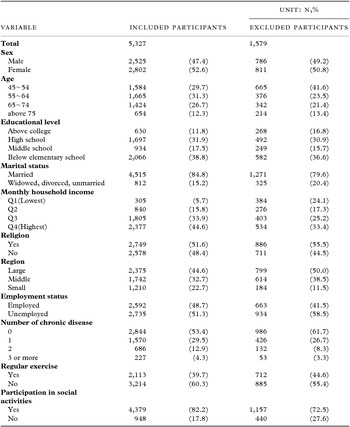
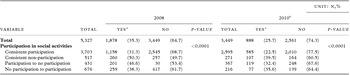
Table 1 shows the characteristics of KLoSA participants in Y2006, included versus excluded in this study (N = 5,327 vs. 1,579) among those who were not depressed in Y2006. Compared to the excluded, the included group had lower proportions of those with the age of 35–44 (0.30 vs. 0.42) and the lowest quartile of household income (0.06 vs. 0.24). In general, however, the characteristics of the two groups looked similar in Y2006. Table 2 presents the incidence of depression in Y2008 (or Y2010) by social activity during 2006–2008 (or during 2008–2010). The proportion of the depressed was the lowest (or the highest) among those with consistent participation (or consistent non-participation) in social activities, i.e. 31.3% and 22.5% for those with consistent participation in Y2008 and Y2010, 50.3% and 39.5% for those with consistent non-participation in Y2008 and Y2010, respectively.
The characteristics of KLoSA participants in Y2006: included versus excluded in this study among those who were not depressed in Y2006

Proportion of the depressed in Y2008 (or Y2010) by social activity during 2006–2008 (or during 2008–2010)

aAmong 5,327 participants included in Y2006, 1,878 participants were excluded who had depression in Y2008.
*Yes indicates the incidence of depression.
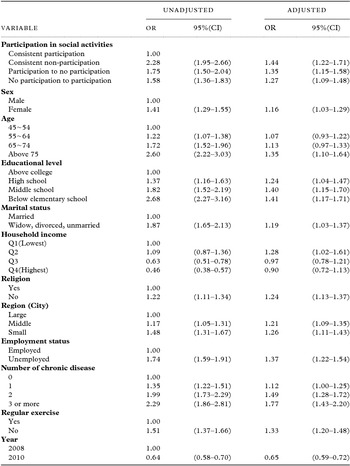
Table 3 presents the results of the GEE with the logit link on depression among Koreans aged 45 years or more in Y2008 (or in Y2010) by a change in their social activity during 2006–2008 (or during 2008–2010). These findings support the first hypothesis: With all the other factors remaining constant, those with consistent non-participation or from participation to non-participation were more likely to be depressed in Y2008 (or in Y2010) than those with consistent participation or from non-participation to participation in social activities during 2006–2008 (or during 2008–2010) (OR 1.44 [95% CI 1.22–1.71], OR 1.35 [95% CI 1.15–1.58] vs. OR 1.00 [Reference], OR 1.27 [95% CI 1.09–1.48]). With all the other factors remaining constant, indeed, those with the following characteristic were more likely to be depressed than those with the opposite in Y2008 and in Y2010: Female (OR 1.16 (95% CI 1.03–1.29) vs. male); divorced, widowed or unmarried (OR 1.19 (95% CI 1.03–1.37) vs. married); unemployed (OR 1.37 (95% CI 1.22–1.54) vs. employed); without regular exercise (OR 1.33 (95% CI 1.20–1.48) vs. with regular exercise); and without religion (OR 1.24 (95% CI 1.13–1.37) vs. with religion). Likewise, the adjusted odds of depression in Y2008 and in Y2010 were higher for those aged 75 years or more (OR 1.35 (95% CI 1.10–1.64) vs. those aged 45–54), with lower educational levels (OR 1.24 (95% CI 1.04–1.47), OR 1.40 (95% CI 1.15–1.70), OR 1.41 (95% CI 1.17–1.71) for high school, middle school, elementary school or lower vs. college or above), with greater numbers of chronic diseases (OR 1.12 (95% CI 1.00–1.25), OR 1.49 (95% CI 1.28–1.72), OR 1.77 (95% CI 1.43–2.20) for 1, 2, 3+ vs. 0), or residing in the cities of middle/small sizes (OR 1.21 (95% CI 1.09–1.35)/OR 1.26 (95% CI 1.11–1.43) vs. large cities) in Y2010. However, depression was found to have no significant relationship with household income in Y2008 and Y2010.
Results of the GEE with the logit link on depression among Koreans aged 45 or More in Y2008 (or Y2010) by a change in their social activity during 2006–2008 (or during 2008–2010)

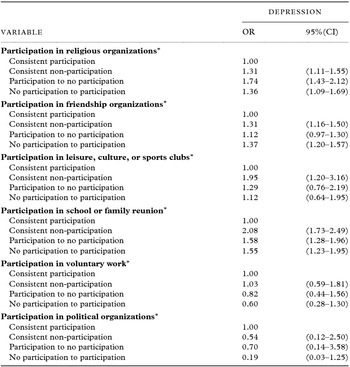
Table 4 shows the results of the GEE with the logit link on depression among Koreans aged 45 years or more in Y2008 (or in Y2010) by a change in each category of social activity during 2006–2008 (or during 2008–2010). The findings are consistent with the second hypothesis: The magnitude of the negative effect of continued or new participation in social activity on depression varied across different categories of social activity. The negative impact of continued or new participation during 2006–2008 (or during 2008–2010) on depression in Y2008 (or in Y2010) was particularly strong for leisure, culture or sports clubs (OR 1.95 (95% CI 1.20–3.16), OR 1.29 (95% CI 0.76–2.19) vs. OR 1.00 (Reference), OR 1.12 (95% CI 0.64–1.95)) and for family or school reunion (OR 2.08 (95% CI 1.73–2.49), OR 1.58 (95% CI 1.28–1.96) vs. OR 1.00 (Reference), OR 1.55 (95% CI 1.23–1.95)). On the contrary, a change in voluntary work or political activity during 2006–2008 (or during 2008–2010) did not have any significant effect on depression in Y2008 (or in Y2010). Finally, depression was considered to be a continuous variable, the GEE was used in a similar manner with the logit link above, and all the results were presented as supplementary tables (The findings of the two analyses were largely consistent with each other).
Results of the GEE with the logit link on depression among Koreans aged 45 or more in Y2008 (or Y2010) by a change in their social activity during 2006–2008 (or during 2008–2010): based on different categories of social activity

*adjusted by age, sex, educational level, marital status, household income, religion, region, employment status, the number of chronic disease, regular exercise and years.
Discussion
The existing literature suggests that depression might have a negative relationship with social activity, albeit by varying extents across different categories of social activity. More comprehensive analysis is needed on dynamic interplays between depression and different categories of social activity. In addition, only a limited amount of examination with the longitudinal design has been available on this topic. In this vein, this study employed longitudinal data on the various characteristics of Koreans aged 45 years or more during 2006–2010, evaluating whether a change in social activity (e.g. during 2006–2008/2008–2010) affects depression (e.g. in Y2008/Y2010) and if so, how this causal association varies across different categories of social activity.
Based on the results of this study, continued or new participation among Koreans aged 45 years or more in social activity during 2006–2008 (or during 2008–2010) had a negative impact on their depression in Y2008 (or in Y2010). It was also found that such negative effect was particularly strong for leisure, culture or sports clubs, and family or school reunion, but not significant for either voluntary work or political activity during 2006–2010. One possible explanation for these findings might be the reality that the quality of voluntary work might not be high enough to improve the quality of life for those in middle or old ages in Korea: the demand of the middle-aged or older for voluntary work is growing rapidly in Korea with a steady increase of their early retirement but the nation still suffers from the lack of legal or systematic support for effective voluntary work (Ministry of Health and Welfare in Korea, 2011). Given that voluntary work with formal compensation might reduce depression more effectively than its informal counterpart (Li and Ferraro, 2005), the following initatives might be essential for the mental health of those in middle or old ages in Korea: Developing voluntary programs, organizations, and systems tailored to meet the needs of the middle-aged or older, especially after their retirement; establishing rigorous systems of education, certification, and compensation for voluntary work; promoting media exposures and public campaigns for voluntary work; and improving information networks among the members and organizations of voluntary work (Ministry of Health and Welfare in Korea, 2011).
Indeed, the findings of this study indicate that the promotion of consistent participations among those aged 45 years or more in leisure/culture clubs and family/school reunion might be needed to improve their mental health in Korea. But the participation of Koreans aged 60 years or more for leisure, culture or sports activity was found to be much lower than for religious activity in Y2009 (i.e. 6.3% vs. 17.9% for the proportion of the participants during the weekend), and economic burden was reported to be a major reason for the result (Statistics Korea, 2009). Unfortunately, however, government spending for leisure activity among the old population is very small among government spending for their welfare: The proportion for supporting leisure activity was only 3.5%, whereas the proportion for operating welfare institutions was 57% in Korea for Y2011 (Lee et al., Reference Lee, Jung, Oh, Yeom and Kim2012). In this context, the following strategies and actions might be imperative for encouraging leisure/culture activity and improving the mental health of the old in the nation: Expanding the system of vouchers and discount rates for leisure/culture activity among old populations; creating more leisure/culture institutions for the old especially in rural areas; bringing more variety into leisure/culture activity in these institutions, given that the demand for the activity is becoming more diverse across the age, sex, marital status, socioeconomic conditions, and health-related characteristics of the old population; and strengthening education programs for the old, e.g. those on how to use computers for more effective leisure/culture activity (Ministry of Health and Welfare in Korea, 2011; Lee et al., Reference Lee, Jung, Oh, Yeom and Kim2012).
This study had some limitations. First, this study did not consider a change from one category of social activity into another. Second, the frequency or intensity of participation in social activity was not included in this study. Third, social network and support, which might buffer depression, were not included in this study. Fourth, depression can lead to a change in social activity as well but this study did not consider the inverse causation. In a similar vein, a more complete analysis of two-way interaction between depression and social activity over time (e.g. structural equation modeling) might add a great contribution to this line of research. Finally, sub-group analysis, e.g. 45–54, 55–64, 65–74, 75+, might have offered more insight on the relationship between a change in social activity and depression.
Supplementary Material
To view supplementary material for article, please visit http://dx.doi.org/10.1017/S1041610214002439
Conflict of interest
None.
Description of authors’ roles
Young Choi (the first author), Eun-Cheol Park, and Kwang-Sig Lee (the corresponding author) have directly participated in the planning, execution, and analysis of the study. Jae-Hyun Kim, Ki-Bong Yoo, and Jae-Woo Choi provided assistance for the analysis of the study.
Acknowledgment
The authors appreciate the Yonsei University Institute of Health Services Research for its administrative support.