Introduction
In the late summer of 1884, the Dutch residential capital The Hague was in the spell of an unprecedented outburst of political agitation and election fever. According to a chronicler “people shouted, quarrelled, threatened, as if political life in the city had only just awakened.”Footnote 1 Another journalist observed with surprise that candidates were abused and treated “like they only use to do with the candidates for the American presidency.”Footnote 2 While the opponent candidates beleaguered each other with public meetings and newspaper advertisements, a self-assured electorate asserted its rights to a government that should be more representative, more responsive to their demands, financially more reliable, and more effective in getting things done.
Remarkably, these journalists were not talking about the elections for the national parliament or the local council. Instead, they referred to the elections for the board of the city's local zoo. Established in 1863, The Hague's zoo (Zoölogical and Botanical Association, in short “the Zoo”) had become one of The Hague's largest voluntary associations, listing about 2,700 members in 1884: almost 11 percent of the heads of households in the city and a number as large as all local citizens with the right to vote for the national parliament and 60 percent of the electors for the local council (Jaarverslag 1884; Verslag Gemeente 1884: 4; Volkstelling 1879, Reference Volkstelling1889). The commitment of the Zoo members with the governance of their zoo seemed to be astonishingly high. According to a journalist, the election for the Zoo's board of directors usually encountered much more public interest than was the case for the local council. While reflecting a deep concern for the low public interest in local politics, the statement also emphasized the political importance of the Zoo. Interestingly, he added, “We all know that in this city the Zoo is the pépinière [the breeding station] of any political reputation. Who survives here all the exercises under fire and all stages of opposition, cabinet crisis, dissolution and Tarpeic riots, has acquired his entrance exam for the local council and what will be following next.”Footnote 3 Some contemporaries argued that the elections for the local zoo even functioned as a sort of trial exam for the national parliament. But even that did not completely cover the broad political significance of the Zoo. Focusing on how the members of the Zoo exercised and experimented with their political statutory rights, several journalists also emphasized that The Hague's zoo also functioned as “a pépinière for the creation of political citizens and electors.”Footnote 4
This essay explores the relationship between nineteenth-century associational life and local politics, focusing on the question regarding to which extent social and cultural associations promoted a civil society that fostered local democracy and an effective local government. In the well-known tradition of Tocqueville, sociologists and political scientists like Robert Putnam optimistically assert that dense networks of voluntary associations foster democracy by stimulating among their members democratic attitudes and values such as civic participation, cooperation, equality, tolerance, respect, reciprocity, social trust, and a self-aware and critical attitude toward chosen leaders (Putnam Reference Putnam1993; also Almond and Verba Reference Almond and Verba1963). The ongoing cultivation of these values among citizens is, in turn, regarded to enhance the representative quality of politicians and public administrators, their responsiveness toward citizen's needs, their ability to put general interest above self-interest, their capacity to compromise, and their capability not only to make decisions but also to effectively implement their policies. Just as nineteenth-century contemporaries understood the political significance of The Hague's zoo, voluntary associations in this view are seen as breeding stations or training schools for politicians, public administrators, and citizens all together (ibid.; for a critique Jackman Reference Jackman2005).
This theoretical perspective raises some interesting and important questions on the relation between associations and local politics in the nineteenth-century urban context. While some historians have elaborated the argument that nineteenth-century voluntary associations on the whole had a positive impact on democratization (e.g., Morris Reference Morris1990; Morton et al. Reference Morton, de Vries and Morris2006), other historians have stressed that the relation between associations, democratic culture, and local politics was actually much more ambivalent (Bermeo and Nord Reference Bermeo and Nord2000; Hoffmann Reference Hoffmann2003, Reference Hoffmann2006). In his recent comparative overview on Western civil society in the long nineteenth century, the German historian Stefan-Ludwig Hoffmann concludes that the rise of associations in the nineteenth century not only reflected and stimulated but in some ways also hampered processes of political and social democratization. Building on studies on French, English, German, and American associations, he stresses how the apparent egalitarian and inclusive discourse at the heart of many early-nineteenth-century associations often and increasingly contrasted with elitist strategies of distinction and exclusion, creating as many possibilities for increasing distribution of power as for continuing power concentration (Hoffmann Reference Hoffmann2006: 31–33).
The case study of the Dutch residential capital of The Hague in the second half of the nineteenth century will offer arguments for both the optimistic and the pessimistic perspective, problematizing the ideal type of nineteenth-century associations that often also hampers comparative research on early modern civil societies. What it aims to add to the discussion, is, on the one hand, a richer and more detailed quantitative analysis of nineteenth-century local associational culture, which will help us get a better view of patterns of social inclusion and exclusion in relation to local political representation. On the other hand, the article will zoom in on the political culture of a selection of important clubs and associations, helping us to get a better understanding how associational and municipal political cultures were, in practice, interrelated.
The Hague's Vibrant Associational Culture
In the second half of the nineteenth century, social, cultural, and political life in Dutch cities was characterized by an exceptional strong urban associational culture. Tracing back to the early modern period and especially to the “associational mania” in the late eighteenth century, many cities had a large and fast-growing number of active associations (De Vries Reference De Vries, Morton, de Vries and Morris2006; Kloek and Mijnhardt Reference Kloek and Mijnhardt2004). In 1850, the city almanac of The Hague, with 72,000 inhabitants including 17,000 adult men, listed at least 50 formal associations—ranging from social clubs; cultural associations such as literary, musical, and scientific; artistic societies; and freemason lodges, to sport clubs like rifle clubs and a chess club, but also including a large number of philanthropic associations, religious missionary associations, professional organizations, electoral associations, single-issue associations like temperance and abolition societies, and finally various mutual aid societies (Residentie- en stadsalmanak 1850). With about one association for every 1,400 residents (and one for every 340 adult men), the density of The Hague's voluntary associations was comparable to the numbers Putnam found for late-twentieth-century Northern Italy and ten times more than he did for Sardinia (Putnam Reference Putnam1993). Between 1850 and 1900, the number of associations in The Hague strongly increased. In 1880 the city almanac already listed 120 associations: one for every 940 residents and one for every 220 adult men (Rijks- en Residentie-almanak 1880). Between 1880 and 1900, as the population almost doubled, no less than 320 new associations requested and were granted a formal recognition of the state.Footnote 5
Many of the voluntary associations in The Hague attracted a high number of members. As a result, the city could boost on a remarkably high level of associational participation. In 1850, the six social clubs and six cultural associations that I have studied in the most detail had already assembled more than 1,700 members. Because most of these associations excluded female members and boys under the age of 21, we may conclude that about 10 percent of the adult males joined this relatively small number of associations. The level of participation was even more striking as we limit ourselves to the 2,500 male heads of households whose tax assessment granted them the right to vote for the local council and who were most likely to actively participate in local politics. More than 50 percent of the electors joined at least one of the selected clubs. In the course of the nineteenth century, the same clubs and associations pushed up the level of participation even further. In 1880, they included more than 4,000 members: 15 percent of the adult males and 70 percent of the electorate for the local council.Footnote 6
The intensity to which inhabitants of The Hague actively participated in local associations appears to be even more striking as we look at the number of double memberships. Almost a third of all the members of the selected clubs (500 out of 1,700) participated in more than two—and often even three to five—associations at the same time, with a total of 2,400 memberships. In 1880, the level of double membership between these clubs was increased even further: at that time, almost two-third of all their members (2,500 out of 4,000) participated in more than one association, with a total of 6,500 memberships.Footnote 7
This initial analysis of the level of participation and the level of double membership appears to bring us to a first conclusion. With these social clubs and cultural associations already attracting and activating thousands of its inhabitants in often two or more clubs at the same time, we may safely assert that the significance and impact of the hundreds of voluntary associations established in the course of the second half of the nineteenth century in The Hague's social and political fabric can hardly be underestimated.
Local Political Culture: Democratic?
In the spirit of scholars like Putnam, the high number of associations and the high level of participation and double membership in The Hague would appear to have created ideal preconditions for a vibrant civil society and a well-functioning democratic political culture. But was that indeed the case? Did this intense associational culture, with its frequent emphasis on friendship, cooperation, and trust in official statutes, reflect and stimulate a democratic local political culture, with politicians and public administrators able to represent their electorate, respond to the citizen's needs, favor public interest above self-interest, compromise, and effectively realize their decisions? Contrary to the general positive reputation of the Dutch republican tradition, the answer should be quite negative.
Since 1815, just after the French Occupation, The Netherlands had been a constitutional monarchy, albeit with many aspects of an autocratic and even a police state (Van Sas Reference Van Sas2004; Van Zanten Reference Van Zanten2004). On the local level, King William I (1814–40) appointed the mayors and the members of the new local council for life, leaving the vacancies to be filled by indirect elections, with an election council chosen from the richest inhabitants by an electorate of about 14 percent of the male adult population (Blok Reference Blok1987). Although The Hague's electorate included a substantial number of shopkeepers, artisans, and manufacturers, the city was governed by a small and closely-knit elite dominated by the court aristocracy, together with high-ranking and interrelated magistrates and academic professionals (Stokvis Reference Stokvis1987: 311–31; Van Doorn Reference Van Doorn1985). This political elite primarily governed the city from the perspectives of their own interests. Employing heavy excise taxes drawn from the whole population, local government spent more money on the acquisition and exploitation of the Royal Theatre and the development of the aristocratic seaside resort of Scheveningen than on local medical care and education: officially to attract wealthy foreigners and other people of independent means to invest their money in the local economy—yet at the same time benefitting their own aristocratic pleasures (Furnée Reference Furnée, Lucassen and Willems2012b). Citizens had very limited opportunities to contest these political choices. The meetings of the local council were not freely accessible and were not reported in newspapers, while the political role of newspapers was in general restricted by a heavy tax and censorship. As a result, local political participation was extremely low, with turnouts of 10 to 15 percent being no exception (Blok Reference Blok1987).
In 1848, the new liberal constitution established the institutional foundation of a new, much more democratic political system, with, on the local level, the introduction of direct elections; the abolishment of life-long appointments and kinship in the second grade; and the establishment of public council meetings, public council minutes in newspapers, and public annual reports (ibid.). Although local newspapers and a few election associations reflected and stimulated high expectations of structural political change, the local political culture hardly changed at all. Traditional elite families successfully protected and continued their political monopoly, with newcomers predominantly having traditional elite occupations and quickly adapting themselves to the conservative habitus of the political establishment. Although kinship in the second grade was now officially forbidden, many deceased councilors were succeeded by their sons or other close relatives. Local councilors who wished to prolong their term of office after their fixed term of six years were nearly always re-elected without any kind of debate—even when they had hardly said anything in the council meetings in years. Between 1851 and 1890, the total number of 132 council members remained dominated by court dignitaries; high state officials and magistrates (23 percent); civil servants and military officers (25 percent); lawyers, doctors, and other professionals (23 percent); and prominent men without occupation (8 percent). The economic productive elite of wealthy merchants and manufacturers was much less represented, with a mere 13 percent. Shopkeepers and master artisans, who made up 44 percent of the electorate in 1851 and 37 percent in 1881, succeeded in having their first representative—a building contractor—only in 1881 (Furnée Reference Furnée, Couperus, Smit and Wolffram2007).
In the course of the nineteenth century, The Hague's local council continued to govern the city primarily in accordance with the class interests of the local aristocracy. Especially in the 1850s and 1860s, the local government fiercely resisted in spending the statutory required money in primary and secondary education; endlessly delayed the investments in the city's sewerage, water supply system, and public transport; and obstructed the nationwide introduction of a local income tax, which would replace the excess tax system that disproportionately burdened the urban working and lower middle classes. In contrast, the city's political elite continued to invest heavily in urban embellishments and the cultural infrastructure of the elite, and tried to prevent rather than to stimulate industrialization (Furnée Reference Furnée, Lucassen and Willems2012b).
In the course of the nineteenth century, some local newspapers and journalists increasingly accused the local government of ignoring the real needs of the citizens and contested the weak discussions in the local council and the largely ineffective implementation of its decisions. “Even the smallest, ugliest borough in our country is less backward in local government than The Hague,” a liberal journalist complained in 1878.Footnote 8 But the local political culture hardly changed. With an average electoral turnout of 24 percent between 1850 and 1880, it was no surprise that journalists often used the English expression “public spirit” instead of the Dutch phrase “publieke geest.” In their opinion, the whole phenomenon of public spirit had not yet been firmly rooted here at all.Footnote 9
Clearly, in nineteenth-century The Hague a rich associational culture and a democratic political culture by no means went hand in hand. In contrast to well-established theories on civil society, the high number of associations, the high level of participation, and the dense social networks created by double memberships did not appear to foster democracy: neither by advancing politicians and public administrators well representing the electorate, favoring public interest above self-interest, nor by empowering the underrepresented part of electorate to effectively challenge the existing political status quo.
Hierarchies in The Hague's Landscape of Associations
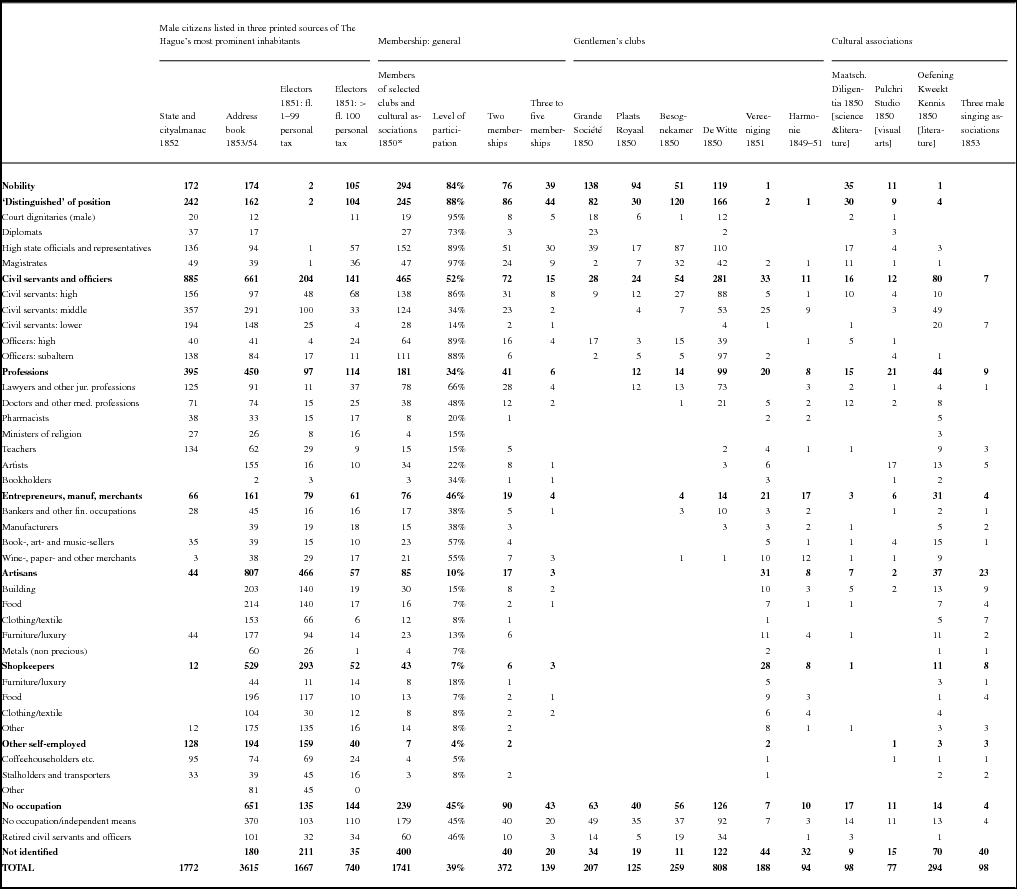
How can we explain this divergence from theory? A major part of the explanation, I would argue, is to be found in the specific structure of The Hague's associational life. A detailed quantitative analysis of the selected social clubs and cultural associations learns that—even within the city's upper and middle classes—both the level of participation and the amount of double membership varied strikingly according to birth and occupation. This is a crucial insight that quantitative analysis of nineteenth-century sociability usually does not deliver (see table 1; cf. expanded form of table 13.1 in Morris Reference Morris1990: 327).
Members of The Hague's gentlemen's clubs and a selection of cultural associations, ranked by occupation and contextualized with figures from the State and City Almanac, Address Book and List of Electors, ca. 1850

Source: Furnée 2012: tables 1.1, 2,1, 3, 4 and membership lists of cultural associations (see Footnote note 6).
In 1850, no less than 84 percent of the male nobility, 95 percent of the male court dignitaries, 89 percent of the high state officials, 97 percent of the magistrates, and 89 percent of the higher military officers were members of at least one of the selected associations: For these elite men it was an individual choice not to join them than to simply become member. In these circles the degree of double membership was also surprisingly high: 33 percent of the male nobility, 48 percent of the high state officials, and 67 percent of magistrates were members of two to five of the selected associations. Just below this elite stratum of The Hague's society, we still find remarkably high levels of participation in the selected clubs among especially higher civil servants (86 percent), lawyers (66 percent), doctors (48 percent), and entrepreneurs (46 percent), even though the level of double membership of the selected associations decreases to 24, 27, 18, and 14 percent respectively. However, as we look at the selection of master artisans, shopkeepers, coffeehouse holders, and so forth listed in the city's address book the level of participation drops dramatically to 10, 7, and 4 percent. Even if we concentrate only on the master artisans, shopkeepers, and coffeehouse holders, and so forth who were part of the city's electorate, only 15, 11, and 3 percent were members of one of the selected associations. Among them the number of double members was almost negligible.
This striking variation in participation and double membership of some of the most prominent social clubs and cultural associations in The Hague offers an important part of the explanation regarding why not only prominent members of parliament and magistrates, but also higher civil servants, military officers, and academic professions, were largely overrepresented in the city's local council, and why the local policy favored exactly these social circles. This was definitely not because these occupational groups—in some ways comparable to the German Bildungsbürgertum—were generally much wealthier than the master artisans and shopkeepers in the electorate. To the contrary: As table 1 shows, the latter did not only make up a greater proportion in the electorate, but many of them were actually quite better off than most civil servants and military officers, who continuously complained about their low state salaries. What really differed, however, was that civil servants, officers, and academic professionals were simply much better organized.
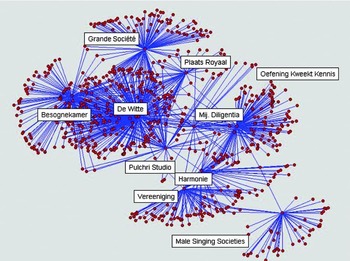
In order to understand why a rich associational life and high average levels of participation do not in itself promote processes of democratization, we may turn to a visualization of the social networks created by the high frequency of double memberships between the selected social clubs and cultural associations in nineteenth-century The Hague. Figure 1, constructed with the social network software Pajek, gives a clear idea of the power concentration in the four aristocratic and respectable gentlemen's clubs Grande Société (established in 1748), Plaats Royaal (1768), Besognekamer (1795), and De Witte (1802) and the boundaries and distance separating the world of these respectable classes from the well-to-do middling classes, predominantly organized in the burgher clubs De Vereeniging (1851) and De Harmonie (1818). In this social world, local politics not only was made and negotiated by rich noblemen and high state officials, but also by relatively low-paid yet respectable civil servants and military officers: Well-to-do manufacturers, artisans, and shopkeepers did not succeed in organizing themselves with the same density and effect. To some extent, the cultural associations Diligentia (focused on science, established in 1797), Oefening Kweekt Kennis (literature, 1834), and Pulchri Studio (arts, 1843) enabled some well-to do artisans and shopkeepers to bridge the social boundaries with the respectable classes and to enter their world of power. This did not, however, count for the three male singing choirs, whose members hardly even entered the social clubs of the well-to-do middling classes.
Visualisation of the social network created by double memberships in a selection of The Hague's clubs and cultural associations, ca. 1850 (processed with Pajek on the basis of 1000 memberships Van Aalst-Hendrikse).

Over the last decades, many historians have acknowledged that nineteenth-century associations creating civil society were as much about inclusion as about exclusion. However, most narratives still tend to suggest that only in the second half of the century, with the rise of working-class associations, the balance between egalitarian and elitist tendencies in the (bourgeois) associational world tended to shift to the latter, implying that for most of the century voluntary associations bridged rather than created and reinforced social boundaries within the upper and middle classes (e.g., Hoffmann Reference Hoffmann2006). Figure 1 appears to confirm this conclusion for the dense social network between The Hague's four elite gentlemen's clubs, but not for the social integration of the city's upper and middle classes. Moreover, table 1 demonstrates that even the four elite gentlemen clubs—crucial institutions in the local political sphere—showed a strong tendency toward exclusion and creating social and political hierarchy, with clear-cut social boundaries. The Grande Société did not accept any lawyers, doctors, bankers, merchants, manufacturers, teachers, or artists. In addition, the Plaats Royaal accepted only the first and De Besognekamer only the first four occupational groups.
Obviously, this quantitative analysis is partial in its focus on The Hague's most prominent social clubs and cultural associations. Especially the absence of membership lists of some undocumented middle-ranking social clubs might in theory distort the picture. However, despite their often relatively substantial economic capital, artisans and shopkeepers did not organize themselves in the same degree and intensity as the respectable classes. In 1847, a member of De Harmonie, a social club joined by many electors with economic productive middle-class occupations, emphasized for members of this circle “the difficulty to find elsewhere a truly pleasant social traffic in this town.”Footnote 10 A few years later, the initiators of De Vereeniging, reflecting a new ambition among a broad middle-class elite to organize and emancipate themselves to the example of, and in contrast to, members of De Witte, explicitly aimed to “challenge the spirit of seclusion and separation which is, especially in this city, also cultivated by our good middle and burger classes.”Footnote 11 This relative lower level of participation and integration among the city's artisans and shopkeepers resulted in a lower level of social capital, less power, and a less direct influence on local government.
Breeding Grounds for Democracy?
As indicated, some historians have already suggested that because of their exclusive character, nineteenth-century associations not only stimulated but also hampered political democratization (Bermeo and Nord Reference Bermeo and Nord2000; Hoffmann Reference Hoffmann2006). Nevertheless, it is still generally accepted that at least from an internal point of view associations functioned as crucial vehicles for democracy. By creating a formal culture of public accountability, with a chosen board obliged to present yearly budgets, financial accounts, and annual reports to be approved by audit committees and by members gathering in regular meetings expressing their opinion and voting for changes in policy, nineteenth-century associations are often regarded as vital training schools for respondent politicians and self-confident citizens (Hoffmann Reference Hoffmann2006; Morris Reference Morris1990).
A closer look at The Hague's social clubs and cultural associations learns that also from the point of view of their internal political culture their democratic character was extremely limited. By the mid-nineteenth century, the boards of the three aristocratic social clubs, constituted by co-optation, did not organize any regular meetings with their members. But even the elected board of De Witte governed its club, with about a thousand members, in a remarkably autocratic fashion. Members could have a look at the yearly accounts, but the statutes did not provide for an audit committee or a yearly general meeting at which the board had to give account. Lacking the right of amendment, the influence of members on all kinds of proposals was very restricted. Temporary and extraordinary members had no voting rights at all. Even in the turbulent 1840s, when liberal politicians eventually convinced King William II to adopt a new constitution including ministerial responsibility, De Witte's political regime did not change. All these gentlemen's clubs offered their members a surprisingly wide range of newspapers, stimulating intense and sometimes heated political debate on (inter)national and local politics—but no debate about their internal lack of democracy (Furnée Reference Furnée, Morris, Morton and de Vries2006).
In The Hague's cultural associations the situation was greatly the same. The aristocratic concert association Diligentia practically functioned as a subscriber society. Its board, partly appointed by the local government, did not allow for yearly accounts or formal influence by members (Furnée Reference Furnée2008). Even in the literary society Oefening Kweekt Kennis, where middle-class political support for the new liberal constitution was very strong, the board firmly protected its autocratic rights.
The relatively autocratic political organization of The Hague's clubs and associations did not help to promote democracy on the level of the local government. Indeed, as many local councilors built their local reputations as board members of exactly these clubs and associations, most probably the autocratic style of management trained in the city's associations in the political realm prevented them from developing new democratic attitudes.
In nineteenth-century The Hague, social clubs and cultural associations did not pave the way for liberal constitutions and the democratization of local and national politics. It was the other way around. In 1851, shortly after the establishment of the new liberal constitution, prominent master artisans, shopkeepers, and middling civil servants established a new social club, De Vereeniging. Eagerly anticipating the first direct elections for the local government, the first secretary stressed that the new board, in contrast to De Witte, did not want to govern the club as “arrogant captains” and openly invited members to give advice on all issues all the time. With biannual general meetings on the basis of annual reports, financial accounts, and budgets, the newly established middle-class club radically followed the national political example codified in the new liberal constitution (Furnée Reference Furnée2012a: 278–83).
In the gentleman's club De Witte, the acceptation of the democratic principles of the new constitution took a much longer time. In 1853, a few prominent liberals established a debating society within the club, where they literally started to exercise with liberal forms of politics, seeking emulation on the basis of juridical rationality and quality of speech instead of on birth and status. In the same year, members for the first time protested against the authoritarian rule of the board of directors, suggesting that the board acted as if it ruled a “society of moral improvement.” In 1863, the club's financial problems became the main lever to democracy. In exchange for consenting with an expensive expansion of the club building in the center of The Hague, the board finally acknowledged the member's demand to appoint a committee of representatives to at least control the board's yearly accounts. Nevertheless, in 1875 young members still continued to complain about the board “acting in all [its decisions] in an autocratic fashion” (ibid.: 188–95; 222).
In the course of the second half of the nineteenth century, cultural associations such as Oefening Kweekt Kennis, Concert Diligentia, and Pulchri Studio gradually adapted the rules and the practices of their internal political culture, introducing a more democratic culture of accountability. Nevertheless, in all cases they followed the example of local and national government, rather than anticipating and stimulating it. At best, The Hague's clubs and associations helped local citizens to exercise with and get used to the new political principles of liberal democracy, by getting the chance to attend an increasing number of meetings to discuss the policy and direction of their associations. However, judging by the regular complains about the low turnout of members on annual meetings and even the regular failure to meet the necessary quorum for important decisions, the rosy picture of nineteenth-century associations as breeding grounds for democracy should, at least in the case of The Hague, be taken with a grain of salt.
The Hague's Zoo as a “Political Pépinière”
The dominant social clubs and cultural associations in nineteenth-century The Hague followed rather than stimulated a more liberal and democratic political culture. However, some associations are more likely to have functioned as democratic breeding grounds. The best example in this respect is The Hague's Zoölogical and Botanical Association, in short the Zoo. Initiated by local doctor L. H. Verwey in 1860, many citizens originally objected that the class-conscious residence The Hague was the least suitable city for such a modern institution, which to the example of neighboring countries would help and, out of financial necessity, need to bring together people from divergent layers of society. Only by a careful selection of initiators, each representing one of the city's social coteries, the initiating committee succeeded in expanding the public support. By engaging the successful Royal Military Chapel, which also played at the weekly concerts in De Witte's “country club” outside the city and by granting military officers reduced entrance fees, the initiators successfully attracted the fashionable classes. And by adopting the commercial model of the shareholder association, granting every shareholder full membership rights, the association avoided excluding the well-to-do artisans’ shopkeepers (ibid.: 339–43).
After the opening in 1863, a journalist reported that the Zoo had successfully made “the first breach in the local spirit of caste . . . and succeeded in creating a terrain for all layers of society where the ‘fashionable’ classes no longer excluded all who belonged to the industrious or commercial classes.” And indeed, in 1866 the Zoo had already 1,300 members, equally representing the whole social spectrum from court dignitaries to shopkeepers and coffeehouse holders. Reaching 2,000 members in 1873 and more than 2,700 in 1883, the Zoo evolved in a social and political body enlisting 60 percent of the city's electorate, including the majority of the city's well-to-do artisans and shopkeepers. By cultivating a collective local pride in competition with the zoos in Amsterdam and Rotterdam—reinforced by an imperial rhetoric of colonial utility, science, and entertainment as well as a civilizing rhetoric of rational recreation—the Zoo cultivated a sort of civic culture that to quite some extent bridged, at least temporally, the deep social and political cleavages within the city's electorate. In the Zoo, members and their families literally found a common ground: “a neutral terrain, where you find a company of people from various classes who would perhaps not like to meet each other on other terrains.”
While the Zoo, on the one hand, fostered the sort of social trust, equality, and reciprocity that scholars like Putnam value as the precondition of democracy, the social conflicts that resulted from its mixed social composition, on the other hand, had positive effects as well. The first board of directors, consisting of initiators who were to be replaced by co-optation, acted surprisingly autocratic, even more than in the aristocratic clubs. However, when in 1867 they decided, without consultation of the members, to change the statutes in order to favor civil servants with a reduction of their contribution, a major row was the result. A committee of members intervened and dramatically changed the statutes, reducing the number of board members and substantially enlarging the rights and powers of the members. Since then, the elections for the board of directors increasingly changed into Polish bedlams. In these meetings, ambitious citizens aiming to build a local and national political career in The Hague could train their powers to convince large heterogeneous audiences and survive political turmoil. The Zoo's members, on their turn, effectively exercised with their rights to demand a responsive, reliable, and effective government. By 1880 they no longer hesitated to, twice, drop the whole board of directors, increasingly consisting of local and powerful aristocrats.
There is reason to argue that at the end of the 1880s these political experiences in the Zoo had a very specific impact on The Hague's local political culture. In 1887, a relatively young electoral association Handel en Nijverheid (“Commerce and Industry”), representing the local elite of manufacturers, traders, and especially shopkeepers and master artisans, quite boldly broke with the local tradition that resigning councilors wishing to prolong their term of office could trust that they would be re-elected without any kind of debate. Deeply dissatisfied with the way local government represented their economic and social interests, the young association proposed in the newspapers and political meetings to drop all resigning councilors and replace them with new candidates, as a demonstration of their dissatisfaction of the local government, in general, and the Municipal Executive, in particular. Perhaps to their own surprise, their campaign had a revolutionary success. The Hague's electorate, and in particular the large group of affluent shopkeepers and master artisans, dismissed all of the three aldermen listed for re-election, including a former minister, and eventually forced the resignation of the mayor, a former member of parliament. Although a little speculative, this political revolution—alarmingly described as “Jacquerie” and “July-revolution”—to a great extent may have found its roots in the local zoo, where hundreds of members (and voters) had discovered that in a democratic political system, they should be not afraid to let their voices be heard and use their ultimate right to dismiss their political leaders.Footnote 12
Conclusion
In 1876, a Dutch journalist suggested that the civilized inhabitants of small towns were in general more familiar with the public interest and more interested in local politics than in (relatively) large cities such as The Hague. “Here [in this city] one reads its newspaper and stays generally in his own selected social circle. Contact with other circles is unusual.”Footnote 13 In nineteenth-century The Hague, the spirit of seclusion and separation going hand in hand with the high number of associations and the high but uneven degree of participation appears to have had a negative impact on the city's local public spirit and the process of democratization of local society and politics. Indeed, most prominent clubs and associations in nineteenth-century The Hague operated as an integrated part of the autocratic governance of the municipal authorities, rather than fulfilling a democratic mission in a more or less independent civil society. Future large-scale quantitative and qualitative analyses of local sociability in other European cities may further test and qualify dominant assumptions and arguments about the impact of nineteenth-century networks of voluntary associations for local democratic culture. On the basis of The Hague, we can conclude that their role has been much more complicated than the optimistic assumptions underlying much of the current work on civil society in the political sciences continue to suggest.