Introduction
Phosphorus (P) has been extensively evaluated as an essential nutrient in poultry diets, and for many decades, it has represented the third most expensive nutrient following energy and protein (Potchanakorn and Potter, Reference POTCHANAKORN and POTTER1987). In the study of mineral metabolism, it is generally recognised that the total content of a mineral element in a particular feed ingredient or complete diet has little significance unless it is qualified by a factor indicating the biological availability of the element to animals (Peeler, Reference PEELER1972). Feed factors contributing to the variability in P availability include the proportion of phytate in the diet and the presence of an intrinsic phytase, which vary greatly between plant materials (Eeckhout and de Paepe, Reference EECKHOUT and DE PAEPE1994), or phytase supplements. The availability of non-phytate P (nPP) also varies between sources. In the last 70 years, different response criteria have been developed and used to determine P availability and the definition of the term ‘available P’ (aP) has differed. For instance, the definition of aP and criteria used for investigating P availability are different in various evaluation systems (NRC, Reference NRC (NATIONAL RESEARCH COUNCIL).1994; CVB, Reference CVB DOCUMENTATIERAPPORT NR. 20.1997; Reference GFE (GESELLSCHAFT FÜR ERNÄHRUNGSPHYSIOLOGIE)GfE, 1999; INRA, Reference INRA (INSTITUT NATIONAL DE LA RECHERCHE AGRONOMIQUE)2004), as well as between research groups.
Most phosphate is derived from rock, which is a non-renewable resource, and current global reserves may be depleted in 50-100 years (Cordell et al., Reference CORDELL, DRANGERT and and WHITE2009). Maintaining P resources in the face of finite global stores has been identified as one of the greatest challenges for sustainable food production (Gross, Reference GROSS2010; Neset and Cordell, Reference NESET and CORDELL2011). For the poultry sector, this means that reserves in the overall utilisation of P should be explored, including the harmonisation of evaluation systems and determination of aP. The Working Group 2 of the European Federation of Branches of World's Poultry Science Association (WPSA) identified this as a topic of high relevance and suggests a standard protocol for the determination of aP (WPSA, Reference WPSA (WORLDS'S POULTRY SCIENCE ASSOCIATION WORKING GROUP 2 -NUTRITION- OF THE EUROPEAN FEDERATION OF BRANCHES)2013).
The objectives of this review are to provide a comprehensive description of the various approaches used to determine and estimate P availability, describe their historical development, and compare their methods of evaluating P sources. The approaches can be grouped as follows, and the review is structured according to this grouping:
• Qualitative measurements of P availability (bone, blood, and growth studies);
• Quantitative measurements of P availability (retention, precaecal (pc) digestibility, and comparative whole body analysis studies);
• In vitro tests (solubility).
Qualitative measurements of P availability
According to Nelson and Peeler (Reference NELSON and PEELER1961), in order to obtain valid comparisons of phosphates based on qualitative measurements of P availability, the following are necessary: (1) a sensitive criterion of measure is used, (2) a P-deficient diet is fed, (3) the levels of added P are not in excess to the animals’ requirement, and (4) a suitable standard is used for comparison with the phosphates tested.
bone criteria
Bone development has been considered a suitable test to estimate the bioavailability of Ca and P (Ammerman, Reference AMMERMAN1995). The bone criteria are important criteria for estimating P availability because about 80% of total P retention is in the skeleton in growing birds (De Groote and Huyghebaert, Reference DE GROOTE and HUYGHEBAERT1997). The zone of proliferation in the developing bone of the young chick is especially sensitive to nutritional P deficiencies (Nelson and Walker, Reference NELSON and WALKER1964), however, the outcome of experiments based on bone data depends upon the quality of the reference P source and provides only relative values of P availability. In the usual assays that test phosphate supplements in growing chicks, the test sources are added to a P-deficient diet to supply graded, sub-optimal levels of P (Harms et al., Reference HARMS, WALDROUP and DAMRON1967). The reference phosphate that is used is assigned a biological value of 100. The relative biological values of the test phosphates are determined by comparing the results obtained for the bone response criterion among all P sources used and are expressed in relation to the biological value of the standard source employed (Leske and Coon, Reference LESKE and COON2002). However, results have varied quite widely between different researchers because of differences in protocols, reference phosphate used, and the origin of the test phosphates used (IFP, Reference IFP (Inorganic Feed Phosphates sector group of CEFIC)2006). The most useful criteria in growing poultry have been defined as bone ash and P, breaking strength and mineral density.
Bone ash and bone P
Most projects in the past 70 years have focused on bone ash. Heuser and Norris (Reference HEUSER and NORRIS1926; Reference HEUSER and NORRIS1927) were among the first to implement Ca and P determination in tibia ash as an indicator of bone mineralisation in poultry. The authors investigated different brands of cod liver oil for their anti-rachitic potency in chicks. Buckner et al. (Reference BUCKNER, MARTIN and INSKO1929) and Wilgus (Reference WILGUS1931) used Ca and P concentrations in tibia ash to investigate the requirement for Ca and P in chicks.
Following the outbreak of the Second World War, there was an extreme shortage of phosphate-carrying materials, and it was not possible to secure sufficient phosphate from defluorinated products or bone meal to use in poultry diets (Miller and Joukovsky, Reference MILLER and JOUKOVSKY1953). Thus, the evaluation of inorganic P supplements in the 1940s, as well in the 1950s and 1960s, was mostly dedicated to the identification of products which could be applicable as feed phosphates. Bird and Caskey Reference BIRD and CASKEY Jr.(1943) used tibia ash data, and found that P from amorphous calcium metaphosphate was utilised by chicks as effectively as P from tricalcium phosphate. Matterson et al. (Reference MATTERSON, SINGSEN and SCOTT1945) compared the P availability (based on tibia ash) of raw rock phosphate and fused rock phosphate, and concluded that both phosphates were as available as tricalcium phosphate. Bird et al. (Reference BIRD, MATTINGLY, TITUS, HAMMOND, KELLOGG, CLARK, WEAKLEY Jr. and VANLANDINGHAM1945) found that the effect of defluorinated superphosphate on tibia ash in chicks was lower than the respective effects of tricalcium phosphate or bone meal. The so-called ‘replacement’ technique was employed by scientists in the 1950s to evaluate different P sources (Johnson et al., Reference JOHNSON, PHILLIPS and DONOVAN1953; Motzok et al., Reference MOTZOK, ARTHUR and BRANION1956; Baruah et al., Reference BARUAH, DAVIS, REID and COUCH1960). Thus, a portion of a reference phosphate was replaced with a portion of a test source in the diet in order to investigate the effects on different response criteria including tibia ash. Nelson and Peeler (Reference NELSON and PEELER1961) noticed that such biological assays did not give a critical measure of phosphate availability because the comparative availabilities of combinations of phosphates were not determined.
Gillis et al. (Reference GILLIS, NORRIS and HEUSER1954) were the first who employed tibia ash concentration as a reference criterion for quantifying the availability of P for chicks. This method was based on relating the percentage of tibia ash from chicks fed a given test supplement to that of chicks fed a beta-tricalcium phosphate as a reference to establish a relative biological value. Ammerman et al. (Reference AMMERMAN, NORTON and SCOTT1960) suggested using regression coefficients to compare different phosphates. This method partly overcomes the necessity of selecting a certain level of supplementation for comparisons, which was necessary for the Gillis et al. (Reference GILLIS, NORRIS and HEUSER1954) method (Hurwitz, Reference HURWITZ1964). In a summary of 82 experiments from the literature by Nelson and Walker (Reference NELSON and WALKER1964), they reported that an extremely steep response curve to beta-tricalcium phosphate was detected and a slope that was highly reproducible between experiments was shown in the type of assays that were used by Gillis et al. (Reference GILLIS, NORRIS and HEUSER1954). When bone ash was used as the response criterion, the accuracy was better than ± 5% (Nelson and Walker, Reference NELSON and WALKER1964). Reviewing phytate P (PP) utilisation in poultry, Nelson (Reference NELSON1967) also pointed out that bone ash was one of the most sensitive criteria in the evaluation of dietary P.
Hurwitz (Reference HURWITZ1964) developed a method based on the determination of the regression of tibia P as a function of total P intake in growing chicks. Grimbergen et al. (Reference GRIMBERGEN, CORNELISSEN and STAPPERS1985) concluded that tibia P was a solid criterion for estimating P availability from different phosphates in young turkeys.
Femur bone mineralisation has also been used as a response criterion in the evaluation of dietary P and its adequacy in broilers (Buckner et al., Reference BUCKNER, MARTIN and INSKO1929; Wilgus, Reference WILGUS1931; Gardiner, Reference GARDINER1962; Orban and Roland, Reference ORBAN and ROLAND Sr1992; Moran and Todd, Reference MORAN Jr. and TODD1994; Hemme et al., Reference HEMME A., SPARK, WOLF, PASCHERTZ and KAMPHUES2005; Angel et al., Reference ANGEL, SAYLOR, MITCHELL, POWERS and APPLEGATE2006). Moran and Todd (1994) and Angel et al. (Reference ANGEL, SAYLOR, MITCHELL, POWERS and APPLEGATE2006) showed that in broilers, femur measurements were more sensitive than those of the tibia. However, obtaining the tibia or femur ash is quite laborious. Cambell et al. (1945) mentioned that, among the disadvantages of the tibia ash approach, were the dissection and cleaning of the bones and the lengthy fat extraction period. Baird and MacMillan (Reference BAIRD and MACMILLAN1942) proposed the use of toe ash rather than tibia ash as a criterion of calcification in vitamin D evaluation in chicks. Data from Baird and MacMillan (Reference BAIRD and MACMILLAN1942) and Campbell et al. (Reference CAMPBELL, MIGICOVSKY and EMSLIE1945) showed that the ash percent of tibiae and toes (fresh or extracted) gave approximately equal estimates of potency for vitamin D evaluation. The use of toes eliminated the labour and time involved in removing and cleaning the bones (Baird and MacMillan, Reference BAIRD and MACMILLAN1942). Evans and Carver (Reference EVANS and CARVER1944), by feeding various levels of Ca and P, concluded that the toe ash was a satisfactory method for determining calcification in growing chicks and Yoshida and Hoshii (Reference YOSHIDA and HOSHII1977) used toe ash to determine P availability in young birds. A simplified bioassay procedure including a 10-day feeding period was recommended; this analysis used a slope ratio assay of the linear regression lines between the added P and toe ash concentration. In addition, Fritz and Roberts (Reference FRITZ and ROBERTS1968), Yoshida and Hoshii (Reference YOSHIDA and HOSHII1977, Reference YOSHIDA and HOSHII1983), and Shastak et al. (Reference SHASTAK, WITZIG, HARTUNG, BESSEI and RODEHUTSCORD2012b) reported that toe ash was as sensitive as tibia ash in assessing the biological availability of P.
Mendez and Dale (Reference MENDEZ and DALE1998) and Mendez et al. (Reference MENDEZ, DALE and GARCIA1998) proposed foot ash as a rapid means to quantify the degree of bone mineralisation in broilers. Garcia and Dale (Reference GARCIA and DALE2006) confirmed that dietary P level affected bone mineralisation and that this could reliably be reflected by foot ash measurement. Foot ash was found to be as reliable as tibia bone ash in reflecting the degree of mineralisation in chicks during the first 14 days.
Ammerman et al. (Reference AMMERMAN, DOUGLAS, DAVIS and HARMS1961) used the ash content of the lower beak for the measurement of P availability in different inorganic phosphate sources. However, this criterion was not as sensitive as the ash content of the tibiae.
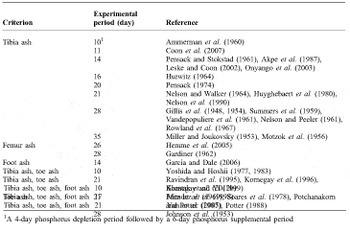
It should be noted that the length of the experimental period differed largely between bone ash studies (Table 1). Ammerman et al. (Reference AMMERMAN, DOUGLAS, DAVIS and HARMS1961) observed that bone ash responses might be affected by the duration of the experiment. They used a degerminated corn-soybean meal-diet in 10-day and 28-day bioassays to evaluate P supplements, and they reported that the 10-day bioassay was less sensitive than the 28-day bioassay for generating data for a tibia ash response curve.
Length of the experimental period in assays for feed phosphates as a source of phosphorus using bone ash in poultry.

1A 4-day phosphorus depletion period followed by a 6-day phosphorus supplemental period
Bone breaking strength
Morrison et al. (Reference MORRISON, DAM, NORRIS and SCOTT1956) applied the breaking strength of the tibiae in a study of unidentified growth factors in chicks. Rowland et al. (Reference ROWLAND Jr., HARMS, WILSON, ROSS and FRY1967) apparently were the first to use bone breaking strength (BBS) as an indicator of dietary P and Ca adequacy in chicks. The correlation coefficient was 0.98 when the average percentage tibia ash was correlated with the average BBS as an indicator, and was 0.63 when calculations were made on an individual bird basis. The authors suggested that BBS was an indicator of P availability was as good as tibia ash. Since then, BBS has been widely used as a response criterion for the evaluation of dietary P in growing poultry (Huyghebaert et al., Reference HUYGHEBAERT, DE GROOTE and KEPPENS1980; Ketels and De Groote, Reference KETELS and DE GROOTE1988; Coffey et al., Reference COFFEY, MOONEY, CROMWELL and AARON1994; Ravindran et al., Reference RAVINDRAN, KORNEGAY, POTTER, OGUNABAMERU, WELTEN, WILSON and POTCHANAKORN1995; Kornegay et al., Reference KORNEGAY, DENBOW and RADCLIFFE1996; Lima et al., Reference LIMA, MENDONCA Jr., ALVAREZ, GARZILLO, GHION and LEAL1997; Fernandes et al., Reference FERNANDES, LIMA, MENDONCA Jr., MABE, ALBUQUERQUE and LEAL1999; Kornegay and Yi, Reference KORNEGAY and YI1999; Leske and Coon, Reference LESKE and COON2002; Hemme et al., 2005; Coon et al., Reference COON, SEO and MANANGI2007; Shastak et al., Reference SHASTAK, WITZIG, HARTUNG, BESSEI and RODEHUTSCORD2012b). However, BBS was reported to have poor sensitivity by Huyghebaert et al. (Reference HUYGHEBAERT, DE GROOTE and KEPPENS1980), Ravindran et al. (Reference RAVINDRAN, KORNEGAY, POTTER, OGUNABAMERU, WELTEN, WILSON and POTCHANAKORN1995), Kornegay and Yi (Reference KORNEGAY and YI1999), and Shastak et al. (Reference SHASTAK, WITZIG, HARTUNG, BESSEI and RODEHUTSCORD2012b). Furthermore, values for BBS may be affected by the type of instrument used, procedures used to prepare the bones for testing, and the physical and mechanical properties of bones (Orban et al., Reference ORBAN, ROLAND, SR., BRYANT and WILLIAMS1993).
Bone densitometry methods
The efforts towards bone ash determination initiated the search for precise, accurate, and rapid assays that could replace mineral evaluations. Initially, Meyer et al. (Reference MEYER, BABCOCK and SUNDE1968) adapted the Cameron-Sorenson technique for measuring bone mineral content (BMC) in humans to chickens. BMC was determined by measuring the transmission of a mono-energetic photon beam through the right tibia with a scintillation detector. Akpe et al. (Reference AKPE, WAIBEL, LARNTZ, METZ, NOLL and WALSER1987) examined the precision of bone densitometry (single photon absorptiometry) and bone ash as response criteria in young turkeys. The authors reported a correlation coefficient of 0.986 between percentage bone ash and bone density. The relative biological availabilities of P from various supplements were nearly equal using the two approaches. More advanced technology, such as dual-energy X-ray absorptiometry (DEXA), has been used as invasive or non-invasive technique for measuring the bone mineral status in poultry (Onyango et al., Reference ONYANGO, HESTER, STROSHINE and ADEOLA2003; Hester et al., Reference HESTER, SCHREIWEIS, ORBAN, MAZZUCO, KOPKA, LEDUR and MOODY2004). Onyango et al. (Reference ONYANGO, HESTER, STROSHINE and ADEOLA2003) determined the BMC and bone mineral density (BMD) of defrosted tibiae in 3-week-old broilers fed low, medium and adequate P diets. The authors found that bone densitometry criteria were highly correlated with bone ash (0.92 and 0.93 for BMC and BMD, respectively). They concluded that BMC and BMD might be used to predict percent tibia ash in broilers. DEXA also allows measurements of the whole body mineral content and density (Mitchell et al., Reference MITCHELL, ROSEBROUGH and CONWAY1997; Angel et al., Reference ANGEL, SAYLOR, MITCHELL, POWERS and APPLEGATE2006). Mitchell et al. (Reference MITCHELL, ROSEBROUGH and CONWAY1997) reported that the ratio of DEXA BMC to total body ash was 0.77; however, the correlation between the two values was only 0.46.
Using the DEXA method, only a two dimensional determination of the bone's mineral density (g/cm2) is possible. Quantitative computed tomography (QCT) allows measurements of the volumetric bone density in mass per unit of volume (g/cm3). Cortical and trabecular density values (g/cm3) can be measured. Korver et al. (Reference KORVER, SAUNDERS-BLADES and NADEAU2004) concluded that QCT was appropriate to follow changes in BMD in meat-type birds as they grew and their skeletal structures were remodelled to support increased body mass. Saunders-Blades et al. (Reference SAUNDERS-BLADES, KORVER and NADEAU2003) showed that bone density measured by QCT was linearly related to other common bone quality measurements used in poultry research. Shastak et al. (Reference SHASTAK, WITZIG, HARTUNG, BESSEI and RODEHUTSCORD2012b) reported that QCT measurements (the total mineral density and the cortical mineral density) were well related to tibia ash amount in 3-week-old (r2 = 0.78 and 0.74, respectively) but not in 5-week-old broilers (r2 = 0.39 and 0.31, respectively). However, BMD values are affected by several factors, such as age, sex, type of production, diet, and management (Almeida Paz and Bruno, Reference ALMEIDA PAZ and BRUNO2006).
Methods such as nuclear magnetic resonance, magnetic resonance spectroscopy, and magnetic resonance imaging may be used to determine BMD and BMC in vivo (Taicher et al., Reference TAICHER, TINSLEY, REIDERMAN and HEIMAN2003). All of these techniques also have the potential to be used in P evaluation as quick and labour-saving approaches to estimate bone mineralisation in growing poultry.
blood criteria
Hart et al. (Reference HART, HALPIN and STEENBOCK1922) and Steenbock et al. (Reference STEENBOCK, HART, JONES and BLACK1923) had already used inorganic P (Pi) concentration in blood serum in studies on leg weakness in chicks. In addition, Ackerson et al. (Reference ACKERSON, BLISH and MUSSEHL1925) determined the serum Pi to evaluate normal and rachitic chicks. However, Gardiner (Reference GARDINER1962) was apparently the first to investigate the relationship between dietary P level and the level of plasma Pi in chicks. Four experiments using corn-wheat-soybean meal-based diets were conducted. The author concluded that the level of plasma Pi responded linearly to dietary increases in supplemental P up to 0.3%. Hurwitz (Reference HURWITZ1964) arrived at similar results and suggested that plasma Pi was a useful measure to estimate the relative P availability (Hurwitz, Reference HURWITZ1964). More recently, other investigations used plasma Pi (Lima et al., Reference LIMA, MENDONCA Jr., ALVAREZ, GARZILLO, GHION and LEAL1997; Fernandes et al., Reference FERNANDES, LIMA, MENDONCA Jr., MABE, ALBUQUERQUE and LEAL1999) and serum Pi (Hemme et al., 2005; Shastak et al., Reference SHASTAK, WITZIG, HARTUNG, BESSEI and RODEHUTSCORD2012b) to evaluate dietary P.
Summers et al. (Reference SUMMERS, SLINGER, PEPPER, MOTZOK and ASHTON1959) tried to estimate P availability from responses in plasma alkaline phosphatase (AP) activity in chicks. However, the authors reported that AP gave a diverse and imprecise estimate of P availability compared to body weight gain or bone ash. Later, a few studies were conducted using AP as a response criterion in the evaluation of dietary P in broilers (Lima et al., Reference LIMA, MENDONCA Jr., ALVAREZ, GARZILLO, GHION and LEAL1997; Viveros et al., Reference VIVEROS, BRENES, ARIJA and CENTENO2002). Systemic Ca and P homeostasis is regulated by the parathyroid hormone-1,25(OH)2D3 axis and fibroblast growth factor 23 which together form the intestine-bone-kidney-parathyroid gland feedback loop (Sapir-Koren and Livshits, Reference SAPIR-KOREN and LIVSHITS2011). Thus, blood inorganic Pi and AP reflect the animal's adaptive reaction and may be influenced by diurnal variation and stress during sampling (Gueguen, Reference GUEGUEN1999). Gueguen (Reference GUEGUEN1999) and De Groote and Lippens (Reference DE GROOTE and LIPPENS2002) pointed out that AP and serum/plasma Pi were not suitable for determining P bioavailability in poultry. This was confirmed by Shastak et al. (Reference SHASTAK, WITZIG, HARTUNG, BESSEI and RODEHUTSCORD2012b).
growth and feed conversion
Body weight has been used as a criterion to assess the relative bioavailability of phosphate sources. Buckner et al. (Reference BUCKNER, MARTIN and INSKO1929) and Wilgus (Reference WILGUS1931) used body weight gain in addition to bone ash to investigate the requirement for Ca and P in chicks. Gillis et al. (Reference GILLIS, NORRIS and HEUSER1948) determined the relative availability of P from different phosphate sources in chicks using body weight and mortality together with tibia ash. Motzok et al. (Reference MOTZOK, ARTHUR and BRANION1956) reported improved feed efficiency with more available P supplements. Summers et al. (Reference SUMMERS, SLINGER, PEPPER, MOTZOK and ASHTON1959) and Vandepopuliere et al. (Reference VANDEPOPULIERE, AMMERMAN and HARMS1961) reported that the growth rate was a criterion that was as good as bone ash. It has been stated for young turkeys (Potchanakorn and Potter, Reference POTCHANAKORN and POTTER1987; Potter, Reference POTTER1988) and broilers chicks (Potter et al., Reference POTTER, POTCHANAKORN, RAVINDRAN and KORNEGAY1995) that bioassays based on weight gain and toe ash provided equally sensitive evaluations of P bioavailability. Broilers are often more sensitive in their performance to differences in mineral supply than other animals because they have low body reserves of minerals and relatively high growth rates (Jongbloed and Kemme, Reference JONGBLOED and KEMME2002). Nevertheless, Pensack and Stokstad (Reference PENSACK and STOKSTAD1961) and Nelson and Walker (Reference NELSON and WALKER1964) showed that growth was less sensitive than bone ash as a criterion for evaluating phosphates; growth was even more inaccurate when the level of dietary P almost met the chick's requirement for this element. Clearly, growth occurs because of many different processes in the animal, and these, in turn, are controlled or fine-tuned by several biological or biochemical events, for which data on weight gain cannot provide information (Adeola and Cowieson, Reference ADEOLA and COWIESON2011). Therefore, differences in performance can only be noted when large differences in bioavailability or mineral supply occur (Jongbloed and Kemme, Reference JONGBLOED and KEMME2002). Huyghebaert et al. (Reference HUYGHEBAERT, DE GROOTE and KEPPENS1980), Grimbergen et al. (Reference GRIMBERGEN, CORNELISSEN and STAPPERS1985), and Shastak et al. (Reference SHASTAK, WITZIG, HARTUNG, BESSEI and RODEHUTSCORD2012b) concluded that weight gain and feed conversion could not be used as indicators of P availability.
combined response criteria
Sullivan (Reference SULLIVAN1966) proposed a triple response method for determining the relative availability of P sources using young turkeys. This method involved tibia ash percentage, body weight gain, and feed efficiency using monocalcium phosphate as the reference. The following equation was put forward from this work:
P availability = (21-day body weight/10) + 21-day tibia ash (%) + 10 × feed efficiency
Soares et al. (Reference SOARES, SWERDEL and BOSSARD1978) combined feed consumption, body weight gain and toe ash to assess P availability, using monobasic sodium phosphate as the reference. They suggested a biological index (BI) could be calculated as follows:
BI = % toe ash × feed efficiency × BW3/4 (kg)
However, as previously noticed by Peeler (Reference PEELER1972), the approach of combining various criteria into one value greatly reduces the sensitivity of the assay. This is to be expected because the different response criteria provide different relative biological values of P from a given source.
Quantitative measurements of P availability
retention in balance studies
Bioassays that are based on growth, bone, or blood criteria are able to provide relative values of P availability hence, the data are more qualitative than quantitative in nature (Peeler, Reference PEELER1972). The information obtained from a relative biological availability assay has limited value for a nutritionist formulating diets because they need retention values to assess the impact of dietary formulations on animal performance and on the elements remaining in excreta (Coon et al., Reference COON, LESKE and SEO2002). The retention of P may be measured either by complete excreta collection or by calculating the retention value with the help of an indigestible marker.
Nikolaiczuk et al. (Reference NIKOLAICZUK, BETHKE and SUTTON1949) reported P retention values from organic and inorganic sources determined in balance trials with 1 to 7-week-old broilers. Edwards and Gillis (Reference EDWARDS and GILLIS1959) used chromic oxide to evaluate P availability in Comb Leghorn cockerels that were fed a blood-fibrin-gelatin-starch diet. Nwokolo et al. (Reference NWOKOLO, BRAGG and KITTS1976) applied purified mineral-free diets to estimate the true availability of Ca, P, and other minerals in soybean meal, cottonseed meal, rapeseed, and palm kernel meal in tests with 4-week-old broilers. The availability of the minerals was determined by the amount retained (%) with an adjustment for endogenous faecal excretion. Van der Klis and Versteegh (Reference VAN DER KLIS and VERSTEEGH1996) developed a method to evaluate P availability in feedstuffs for poultry, whereby the P availabilities in commonly used feedstuffs were measured in 3-week-old male broilers under standardised conditions. The test feedstuff was the only dietary source of P present in the purified experimental diet, which was standardised at 1.8 g available P and 5 g available Ca per kg feed. A three day balance period followed 10 days of feeding the experimental diets. A similar technique was used by De Groote and Huyghebaert (Reference DE GROOTE and HUYGHEBAERT1997), who investigated the retention of P from three different feed phosphates in two balance trials using a nearly P-free purified basal diet. Each balance trial consisted of a seven day period of adaptation to the respective experimental diets and a four day main balance period with restricted feeding and total excreta collection.
Leske and Coon (Reference LESKE and COON2002) developed a five day bioassay using acid insoluble ash as the marker for determining the retainable P. Broilers were acclimated to cages and test diets for three days prior to initiating a 48-h excreta collection period. Retainable P values of feed-grade calcium phosphates were reported. Rodehutscord and Dieckmann (Reference RODEHUTSCORD and DIECKMANN2005) used a 10 day balance trial with quantitative excreta collection to investigate the P utilisation from a monobasic calcium phosphate in different poultry species. The balance trial consisted of a five day adaptation period and a five day main balance period with restricted feeding and complete excreta collection. Rodehutscord et al. (Reference RODEHUTSCORD, TIMMLER and WENDT2003) and Wendt and Rodehutscord (Reference WENDT and RODEHUTSCORD2004) applied similar approaches for White Pekin ducks, and Rodehutscord et al. (Reference RODEHUTSCORD M., DIECKMANN, WITZIG and SHASTAK2012) and Shastak et al. (Reference SHASTAK, WITZIG, HARTUNG K. and RODEHUTSCORD2012a) did the same for broilers.
digestibility
Precaecal (PC) digestibility is an established criterion for measuring protein quality in poultry. It is preferred because the values are unaffected by post-ileal microbial activity. It also implies that any urinary excretion is excluded. Hurwitz et al. (Reference HURWITZ, DUBROV, ELSNER, RISENFELD and BAR1978) measured P PC digestibility in young turkeys at the lower half of the ileum with the aid of yttrium-91 as a reference substance. The phosphate level in the diets was varied by supplementation with monocalcium phosphate. Grimbergen et al. (Reference GRIMBERGEN, CORNELISSEN and STAPPERS1985) and Kornegay et al. (Reference KORNEGAY, DENBOW and RADCLIFFE1996) assessed the PC digestibility of P in various inorganic feed phosphates in young turkeys, and Ketels and De Groote (Reference KETELS and DE GROOTE1988), Dieckmann (Reference DIECKMANN2004), and Shastak et al. (Reference SHASTAK, WITZIG, HARTUNG K. and RODEHUTSCORD2012a) assessed the PC digestibility of P in various inorganic feed phosphates in broilers. PC digestibility can be developed as an alternative tool to measure P availability, as it has the advantage of being less sensitive to the P level in the diet than other approaches (Rodehutscord et al., 2012). This can be an advantage in studies on P availability because urine is the major pathway of regulatory excretion if intake is above the requirement, but P excretion with urine is negligibly low below the P requirement. Moreover, the response in P PC digestibility to increments in dietary P concentration is linear in a wider range of dietary P than the response in P retention (Rodehutscord et al., 2012), and both approaches provide similar results in evaluation of mineral P sources in poultry (Shastak et al., Reference SHASTAK, WITZIG, HARTUNG K. and RODEHUTSCORD2012a).
comparative whole body analysis
The total amount of an element that is retained in the animal's body is one of the best response criteria for those minerals with a low turnover, such as Ca and P, if the animals are fed below their requirement (Jongbloed and Kemme, Reference JONGBLOED and KEMME2002). Retention can be determined either in a balance trial or by a whole body analysis. However, the latter is very laborious, and it is not always easy to obtain a homogeneous representative sample of the whole body. Thus, studies that employ whole body analysis are rare.
Mitchel et al. (Reference MITCHELL, CARD and HAMILTON1926) determined the chemical composition of White Plymouth Rock chickens using the analysis of five birds of the same sex and weight. One of the first reports about the Ca and P contents of the entire body in poultry was given by Haag (Reference HAAG1939), who analysed White Leghorn chickens of various ages (from 0 up to 20 weeks of age). WPSA (Reference WPSA (WORLD'S POULTRY SCIENCE ASSOCIATION)1985) presented the mineral composition of the bodies (Ca, P, Mg, Na, K, and Cl) at different ages for chicks, turkey, quails, pheasants, ducks, and goslings.
Later, Dieckmann (Reference DIECKMANN2004) used a comparative whole body analysis to quantify P retention from monobasic calcium phosphate supplemented in a low P basal diet at different levels. Hemme et al. (2005) determined the retention of Ca and P in broilers that were fed four different Pi sources by analysis of body composition. At the beginning of the trial, three pooled samples were completely analysed (whole-body analysis) to obtain baseline information on the Ca and P contents in the whole body. At the end of the trial, the chemical body composition (e.g. Ca and P content) was analysed to obtain information on the retention of both minerals in the experimental period. However, the procedure may be criticised because birds of the same age or body weight at the beginning of trial can have different composition and may not reflect the body composition of the whole experimental group (Wolynetz and Sibbald, Reference WOLYNETZ and SIBBALD1985). Moreover, whole body analysis of poultry is often simply avoided because feathers are resistant to cutting in meat grinders and similar macerating equipment (Sibbald and Fortin, Reference SIBBALD and FORTIN1982), and preparation of dry homogenates of entire birds is impeded by the need to lyophilise large quantities of wet material (Sibbald and Wolynetz, Reference SIBBALD and WOLYNETZ1984). Since sample preparation from a whole body is not easy, both accuracy of sampling and amount of increase of minerals in the animal body may result in a substantial variation of the estimated amount of the mineral in the whole body (Jongbloed and Kemme, Reference JONGBLOED and KEMME2002). Thus, determination of retention in balance studies seems to be more suitable in P evaluation studies with growing poultry compared to the comparative whole body analysis.
In vitro tests for estimating P availability
In attempts to search for quicker and cheaper methods, which could substitute expensive and long-lasting bioassays, P availability was tested in vitro. These tests concern inorganic phosphates and are not applicable to organic P of either plant or animal origin (Gueguen, Reference GUEGUEN1999). Conflicting results have been reported regarding the suitability of such tests in estimating the bioavailability of phosphates (Waldroup, Reference WALDROUP1999).
Reynolds et al. (Reference REYNOLDS, HILL and JAKOB1944) assessed the solubility of various phosphates as P supplements for livestock in 0.4% diluted hydrochloric acid (HCl), and found that the investigated materials had widely different solubilities. Similarly, Hill et al. (Reference HILL, REYNOLDS, HENDRICKS and JACOBS1945) evaluated the nutritive value of defluorinated phosphates (DFP) and other P supplements by their solubility in diluted HCl, citric acid (CA), and neutral ammonium citrate (NAC). However, these researchers did not compare the results with those that were determined in vivo. Bird et al. (Reference BIRD, MATTINGLY, TITUS, HAMMOND, KELLOGG, CLARK, WEAKLEY Jr. and VANLANDINGHAM1945) attempted to correlate the relative availability of P from different supplements determined in vivo (bioassay with chicks) with the solubility of the P in dilute acid (0.25% HCl). The authors concluded that solubility could be used as a quick, approximate estimate of availability. Gillis et al. (Reference GILLIS, NORRIS and HEUSER1948) compared solubility data for different phosphates in 0.4% HCl with the biological availability data for the same materials. The authors stated that solubility had limited usefulness in estimating the availability for animals. Gillis et al. (Reference GILLIS, EDWARDS Jr. and YOUNG1962) compared the solubility of various sources of calcium phosphate in NAC and water with the percentage of bone ash in chicks and young turkeys. The differences in bone ash responses from various types of phosphates did not appear to be correlated with the solubility tests except that the more water-soluble compounds tended to be more available. Day et al. (Reference DAY, MCNAUGHTON and DILWORTH1973) analysed P solubility in 0.4% HCl, 2% CA, and NAC. The samples were further evaluated for biological availability using bone ash. The authors concluded that P solubility in dilute acids could not be used to predict bioavailability. Yoshida et al. (Reference YOSHIDA, ISHIKAWA, NAKAJIMA and HOTTA1979) observed a highly significant correlation between solubility in CA solution and biological availability of P in chicks. The solubilities of reagent grade mono-, di-, and tribasic calcium phosphates in 0.5% aqueous CA solution were 100%, 81.6%, and 54%, respectively. The biological availabilities were 126%, 114%, and 96%, respectively. The authors suggested an equation, which allowed the estimation of biological availability of P in samples of inorganic or animal origin from the solubility of the samples in the CA solution. Caswell (Reference CASWELL1987) also reported a positive relationship between weight gain and bone ash responses in young turkeys and solubility of DFP in NAC.
Pensack (Reference PENSACK1974) determined the water solubility of P in different commercially available dicalcium and DFP. The author noticed that although the P in DFP was not soluble in water, the chicks were able to utilise a major portion of the P contained therein. Gueguen (Reference GUEGUEN1999) pointed out that water solubility, which is not necessary for absorption, is a poor and unacceptable indicator of the availability of feed phosphates.
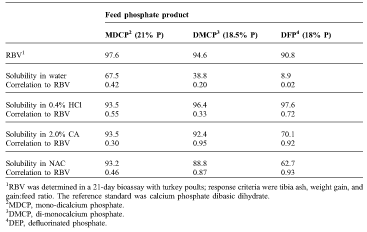
Sullivan et al. (Reference SULLIVAN, DOUGLAS, GONZALEZ and BOND Jr.1992) assessed the correlation between the biological value of feed phosphates and their solubilities in water, dilute HCl, CA, and NAC. The correlation of the water solubility of phosphates with their relative bioavailability was low, and water solubility was deemed a poor indicator of bioavailability. When 0.4% HCl was used, the correlation coefficients were 0.55, 0.33, and 0.72 for mono-dicalcium phosphate, di-monocalcium phosphate, and DFP, respectively. The solubility of feed phosphates in 2.0% CA or NAC was positively correlated with bioavailability (Table 2). Sullivan et al. (Reference SULLIVAN, DOUGLAS, GONZALEZ and BOND Jr.1992) concluded that users could perform either a 2% CA or a NAC solubility test as a screen for a biological value along with other quality control procedures.
Relative biological value (RBV) (%) of feed phosphates and correlation (r) with their solubility (%) in water, 0.4% hydrochloric acid (HCl), 2.0% citric acid (CA), and neutral ammonium citrate (NAC) (Sullivan et al., Reference SULLIVAN, DOUGLAS, GONZALEZ and BOND Jr.1992).
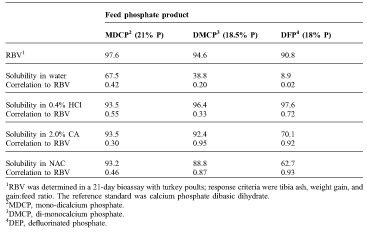
1RBV was determined in a 21-day bioassay with turkey poults; response criteria were tibia ash, weight gain, and gain:feed ratio. The reference standard was calcium phosphate dibasic dihydrate.
2MDCP, mono-dicalcium phosphate.
3DMCP, di-monocalcium phosphate.
4DEP, defluorinated phosphate.
Coffey et al. (Reference COFFEY, MOONEY, CROMWELL and AARON1994) evaluated the bioavailability of P in five DFPs that differed in P solubility in NAC. A slight positive relationship existed between the NAC solubility and the bioavailability of P in DFP for chicks. Kornegay et al. (Reference KORNEGAY, DENBOW and RADCLIFFE1996) could not discern the relationship between NAC solubility and availability of different feed phosphates in young turkeys. From the contradicting results, it must be concluded that a reliable in vitro method for the evaluation of available P in inorganic phosphates does not exist. Therefore, the solubility of phosphate sources cannot be taken as a reflection of the availability of the same phosphates in vivo.
Comparison of approaches in P evaluation
In spite of the large number of experiments carried out using different P sources, there is little information about the relationship between the different criteria that are used to assess P availability. Methodological details and experimental conditions can substantially affect the results (Rodehutscord, Reference RODEHUTSCORD2009). Additionally, it is not clear how relative and quantitative criteria of P evaluation relate to each other.
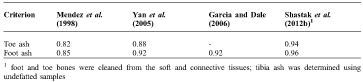
Ravindran et al. (Reference RAVINDRAN, KORNEGAY, POTTER, OGUNABAMERU, WELTEN, WILSON and POTCHANAKORN1995) applied various response criteria to evaluate the biological availability of P for broilers. The criteria that were estimated included body weight, toe ash, tibia ash, tibia-specific gravity, tibia shear force, toe shear force, and metatarsal shear force; weight, length, diameter, and volume of tibia; weight, volume, and specific gravity of metatarsus; and volume and specific gravity of toe. The authors concluded that the chosen response criterion would considerably influence the relative availability estimates of a P source. Furthermore, Nelson et al. (Reference NELSON, KIRBY and JOHNSON1990) pointed out that there was no standard method for conducting a biological value assay for P; thus, the differences in procedures that might influence the biological value of an individual sample included experimental species, reference phosphate, criteria of response, and Ca level in the test diets. However, a high degree of relationship between tibia, toe and foot ash was reported by Mendez et al. (Reference MENDEZ, DALE and GARCIA1998), Yan et al. (Reference YAN, KEEN, ZHANG and WALDROUP2005), and Shastak et al. (Reference SHASTAK, WITZIG, HARTUNG, BESSEI and RODEHUTSCORD2012b) (Table 3).
Relationship (r2) between tibia ash and toe or foot ash in broilers.
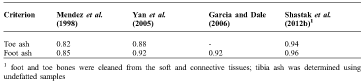
1 foot and toe bones were cleaned from the soft and connective tissues; tibia ash was determined using undefatted samples
Therefore, tibia, toe, and foot ash provide similar results for the evaluation of mineral P sources in broilers. Moreover, Shastak et al. (Reference SHASTAK, WITZIG, HARTUNG, BESSEI and RODEHUTSCORD2012b) found that the relationship (r2) between the amounts of P and ash in tibia bone was 0.99 in 3-week-old and 0.97 in 5-week-old broilers. Thus, the bone ash amount is as precise as the amount of P for ranking availability in different P sources. This makes P determination in bones unnecessary for this purpose and helps by saving labour and lowering expenses. Shastak et al. (Reference SHASTAK, WITZIG, HARTUNG, BESSEI and RODEHUTSCORD2012b) also reported that the P concentration in bone ash was not affected by the level or source of P in the diet.
The relationship between quantitative and qualitative criteria in P evaluation was estimated by Shastak et al. (Reference SHASTAK, WITZIG, HARTUNG, BESSEI and RODEHUTSCORD2012b). The authors showed that relative availability values based on bone ash, body weight, or blood Pi resulted in different rankings for mineral P sources than retention or PC digestibility data. The observed differences in the ranking make it difficult to compare results from studies that used different methodologies. Because of the need for quantitative values of availability, retention and PC digestibility should be the preferred methods for evaluating P sources in poultry. However, the P availability from different sources can vary considerably between avian species (Rodehutscord and Dieckmann, Reference RODEHUTSCORD and DIECKMANN2005). These are probably related to differences in anatomy and physiology of the digestive tract, or due to different environmental conditions (e.g. broilers vs. ducks). Thus, the relationship between quantitative and qualitative criteria or differences in the sensitivity between various qualitative criteria in P evaluation may not be the same for different poultry species. This needs to be further investigated.
The conflict between the demand for data and the effort for retention studies points to the question of whether the retention of P in an individual bone can be considered a reliable indicator of whole body retention. Hurwitz (Reference HURWITZ1964) tried to use tibia as a measure of body P, and found a fairly constant ratio between carcass and tibia P (19.6 ± 1). Huyghebaert et al. (Reference HUYGHEBAERT, DE GROOTE and KEPPENS1980) determined that the ratio of body:tibia P averaged 17.95 ± 0.46 for chicks that were fed diets with less than 0.6% P content. Latterly, Shastak et al. (Reference SHASTAK, WITZIG and RODEHUTSCORD2012c) reported values of 21.3 ± 1.3 for 3-week-old and 19.8 ± 1.1 for 5-week-old broilers. The slope of the linear relationship between the tibia and body P for both sources obtained by regression analyses for both ages was identical (17.7). This means that with each mg of tibia P retention, the whole body retention increased by 17.7 mg. These studies show good evidence that tibia retention may be a suitable criterion for estimating whole body P retention.
In vitro determination of P availability might be an alternative to in vivo P evaluation. However, there are no reliable in vitro approaches for estimating the availability of phosphates. The percent solubility of P supplements should not be taken as absorbability because it is merely a simple means of classifying good, medium, and bad feed phosphates and it is not discriminating enough to differentiate between high-quality phosphates (Gueguen, Reference GUEGUEN1999). Ammerman (Reference AMMERMAN1995) pointed out that, generally, in vitro solubility was a poor indicator of in vivo bioavailability.
Conclusions
In the last few decades, scientists have been encouraged to develop and improve or simplify appropriate approaches for P evaluation in poultry both in vivo and in vitro. Different ‘schools of thinking’ were followed, and these mainly distinguished between quantitative and qualitative approaches. Both have advantages and disadvantages. As suggested by Coon et al. (Reference COON, LESKE and SEO2002), quantitative (i.e. retainable P) values for feed raw materials are needed in order to allow meat and egg producers to make feed formulation decisions about feed P and commercial phytase based on the economic value of products compared to the disadvantages of P in poultry excreta. P PC digestibility and retention, therefore, seem to be the most appropriate criteria for evaluating P sources in poultry. Both criteria provide similar quantitative values of P availability. In contrast, blood Pi and performance criteria should not be taken as a measure of P availability. Bone response data provide only relative availability values for tested P sources. From this review it is suggested that further studies be conducted to explore whether P retention data can be re-calculated from existing bone response data, and that there is a need to improve of in vitro approaches for estimating P availability.
Acknowledgements
Y. Shastak was financially supported through a doctoral fellowship by the H. Wilhelm Schaumann Foundation, Hamburg, Germany, which is gratefully acknowledged.