Racial discrimination, actions executed by members of a dominant racial group that have negative or differential effects on members of nondominant racial groups (Williams, Neighbors, & Jackson, Reference Williams, Neighbors and Jackson2003), is a common experience for many African Americans. Racial discrimination has been consistently, positively associated with depressive symptoms (Brown et al., Reference Brown, Williams, Jackson, Neighbors, Torres, Sellers and Brown2000; Chou, Asnaani, & Hofmann, Reference Chou, Asnaani and Hofmann2012; Gaylord-Harden & Cunningham, Reference Gaylord-Harden and Cunningham2009; Klonoff, Landrine, & Ullman, Reference Klonoff, Landrine and Ullman1999; Miranda, Polanco-Roman, Tsypes, & Valderrama, Reference Miranda, Polanco-Roman, Tsypes and Valderrama2013), even after accounting for general stress, socioeconomic status, and demographic factors (e.g., Banks, Singleton, & Kohn-Wood, Reference Banks, Singleton and Kohn-Wood2008). This evidence base is bolstered by longitudinal studies revealing that increases in racial discrimination exposure are associated with increases in depressive symptoms over time. These longitudinal studies also indicate that racial discrimination experiences precede the onset of depressive symptoms (Brown et al., Reference Brown, Williams, Jackson, Neighbors, Torres, Sellers and Brown2000; Schulz et al., Reference Schulz, Gravlee, Williams, Israel, Mentz and Rowe2006), not vice versa, further establishing that racial discrimination is a risk factor for depression among African Americans.
Recent scholarship indicates that vigilance against the threat or anticipation of future racial discrimination occurrences, or racism-related vigilance, may also be uniquely associated with mental health outcomes among African Americans. Clark, Benkert, and Flack (Reference Clark, Benkert and Flack2006) define racism-related vigilance as “the propensity to attend to environmental events that could be perceived as involving racism” (p. 563). LaVeist, Thorpe, Pierre, Mance, and Williams (Reference LaVeist, Thorpe, Pierre, Mance and Williams2014) define vigilance as “dealing with an ensuing situation attentively through greater alertness and preparation in expectation of what may occur. … It entails taking sometimes extraordinary steps to prevent or reduce the likelihood of being targeted for racial discrimination” (p. 242). Racism-related vigilance may be as predictive of health and well-being as previous racial discrimination (Williams & Mohammed, Reference Williams and Mohammed2009). Racism-related vigilance has been shown to be positively associated with depressive symptomatology and distress (Himmelstein, Young, Sanchez, & Jackson, Reference Himmelstein, Young, Sanchez and Jackson2015; LaVeist et al., Reference LaVeist, Thorpe, Pierre, Mance and Williams2014) as well as with sleep difficulty (Hicken, Lee, Ailshire, Burgard, & Williams, Reference Hicken, Lee, Ailshire, Burgard and Williams2013), a correlate and symptom of depression (for review, see Tsuno, Besset, & Ritchie, Reference Tsuno, Besset and Ritchie2005). Thus, a sole focus on previously experienced racial discrimination may lead to a gross underestimation of the impact of racism on mental health. In this paper, we focus on both previous experiences of everyday racial discrimination and race-related vigilance and refer to both terms collectively as race-related stress.
The contributory influence of race-related stressors on mental health may be especially problematic for African American women given evidence of consistent gender differences in depression risk. It is well established that women are twice as likely to develop depression in adolescence relative to men (Nolen-Hoeksema & Aldao, Reference Nolen-Hoeksema and Aldao2011). For example, a recent meta-analysis of cross-national studies comprising a total sample size of over 3 million individuals reported that gender differences in depression emerge around age 12 and peak in adolescence. While the overall magnitude of this difference declines, to some extent, with age, women face a stably greater risk of being diagnosed with major depression, relative to men, across adulthood (Salk, Hyde, & Abramson, Reference Salk, Hyde and Abramson2017). This pattern was shown to be consistent across multiple cultural/ethnic groups, including among African Americans. Moreover, previous research has documented that African American women are at risk for depression (Adkins, Wang, & Elder, Reference Adkins, Wang and Elder2009; Grant et al., Reference Grant, Lyons, Finkelstein, Conway, Reynolds, O'koon and Hicks2004), with some indication that prevalence rates of depression among African American women may actually exceed the national average (Hedden, Reference Hedden2015). African American women's disproportionate exposure to chronic stressors (Lewis et al., Reference Lewis, Everson-Rose, Powell, Matthews, Brown, Karavolos and Wesley2006; Woods-Giscombe & Lobel, Reference Woods-Giscombe and Lobel2008), including racism, sexism, racialized sexism, and gendered racism (Essed, Reference Essed1991), may contribute to their elevated depression risks. According to the “weathering hypothesis,” African American women are at risk for accelerated aging and premature stress-related illness resultant from exposure to interpersonal and institutional racial discrimination as well as socioeconomic deprivation (Geronimus, Hicken, Keene, & Bound, Reference Geronimus, Hicken, Keene and Bound2006). Moreover, there is some evidence that chronic stress-related weathering may begin in early childhood (i.e., age 7) among African Americans and other minorities (Schmeer & Tarrence, Reference Schmeer and Tarrence2018).
Nevertheless, the relationship between race-related stress and depression or depression risk (i.e., symptomatology) has been underexamined among African American women who are transitioning into adulthood. Emerging adulthood is a transitional developmental period, inclusive of ages 18 to 29, marked by extended identity exploration (Arnett, Reference Arnett2000; Syed & Mitchell, Reference Syed and Mitchell2013) and turning points, including education, employment, parenthood, and marriage (Rumbaut, Reference Rumbaut2005; Syed & Mitchell, Reference Syed and Mitchell2013). African American emerging adults experience these turning points amid institutional racial discrimination (e.g., residential segregation and ethnic density, and aggressive policing) that systematically disadvantages African Americans (Bonilla-Silva, Reference Bonilla-Silva2001; Feagin, Reference Feagin2013). Moreover, African American emerging adults are burdened with the negative sequelae of interpersonal racial discrimination in relation to normal developmental tasks (Harrell, Reference Harrell2000; Hope, Hoggard, & Thomas, Reference Hope, Hoggard and Thomas2015; Spencer, Reference Spencer, Lerner and Damon2006). Thus, in addition to the typical stresses and strains associated with this period of life, the additional burden posed by more frequent and direct exposure to racial discrimination may take a more substantial toll on mental and physical health during emerging adulthood in African Americans.
Guiding Theoretical Frameworks
In the present study, we consider both factors that may potentially facilitate or attenuate the association between race-related stress and depressive symptomatology in a sample of African American emerging adult women. This work is broadly guided by three distinct, but complementary theoretical frameworks. First, we draw upon the biopsychosocial model of racism (Clark, Anderson, Clark, & Williams, Reference Clark, Anderson, Clark and Williams1999), which pinpoints racism and discrimination as unique forms of chronic stress with deleterious effects on physical and mental health for African Americans and other minorities. This model identifies both rumination, a repetitive focus on one's negative emotions, and John Henryism, a form of persistent active coping, as potential psychological and behavioral responses, respectively, to more frequent exposure to race-related stress. Second, we draw from the phenomenological variant of ecological systems theory (PVEST; Spencer, Reference Smith and Alloy1995, Reference Spencer, Lerner and Damon2006), which has emerged as a valuable framework for interrogating the intersections of culture, development, and psychopathology (Causadias, Reference Causadias2013) within an ecological systems context. Specifically, the PVEST asserts that discrimination, a risk factor, contributes to risks faced by youth of color, thereby increasing their net level of vulnerability in relation to normative developmental tasks. The net vulnerability may result in protracted, adverse consequences for youth of color who do not develop adaptive coping strategies (Spencer, Reference Spencer, Lerner and Damon2006). PVEST simultaneously acknowledges that youth of color may experience positive outcomes, well-being, and resiliency in the face of systematic inequality, as protective factors serve to balance against the impact of risk factor presence (Spencer, Reference Spencer, Lerner and Damon2006).
Third and finally, we follow conceptualizations of the interplay between social- and individual-level cultural processes as dynamic influences in the development of (ab)normal behavior. According to Causadias (Reference Causadias2013), social-level cultural processes, such as racial discrimination, may shape individual-level self-regulatory responses (i.e., active coping) which, in turn, further influence individual-level behavior in the presence of additional experiences of discrimination. From this cultural developmental psychopathology perspective, both social- and individual-level cultural processes can be described as risk, protective or promotive factors (Causadias, Reference Causadias2013). Risk factors are social- or individual-level processes associated with a greater probability of a maladaptive response or outcome, such as the association between institutional and interpersonal racial discrimination and depressive symptomatology. Protective factors shield or buffer against the deleterious effects of negative stressors, whereas promotive factors not only counteract negative experiences but also increase the likelihood of developing successful, sustained response behaviors. Drawing collectively from these frameworks, we examine the influence of potential risk (i.e., rumination) and protective (i.e., John Henryism) factors on the relations between race-related stress and depressive symptomatology.
Race-Related Stress and Rumination
Despite significant examinations of the role that rumination may play in magnifying the impact of negative stressors on mental health and psychological functioning among both clinical and nonclinical populations, little research has examined the relationship between rumination and race-related stress. This relative dearth is surprising, as the biopsychosocial model of racism identifies rumination as one of several potential responses to racial discrimination among African Americans (Clark et al., Reference Clark, Anderson, Clark and Williams1999). Although there are several models of rumination (for review, see Smith & Alloy, Reference Spencer2009), Nolen-Hoeksema's response styles theory is one of the most widely accepted (Nolen-Hoeksema, Reference Nolen-Hoeksema, Papageorgiou and Wells2004). Under this conceptualization, rumination reflects a repetitive focus on the origins, indicators, and consequences of one's negative emotions and experiences. Substantial empirical work documents that rumination is a common, maladaptive self-regulatory process strongly associated with risk for depression onset, severity, and recurrence across the developmental life span (for review, see Aldao, Nolen-Hoeksema, & Schweizer, Reference Aldao, Nolen-Hoeksema and Schweizer2010). The well-known gender disparity in depression prevalence may, to some extent, be explained by women's greater use of rumination as a primary emotion- and self-regulatory strategy, as compared to men (Nolen-Hoeksema, Wisco, & Lyubomirsky, Reference Nolen-Hoeksema, Wisco and Lyubomirsky2008).
Emerging evidence reveals that rumination is related to race-related stress among African American emerging adults (Borders & Liang, Reference Borders and Liang2011; Hoggard, Byrd, & Sellers, Reference Hoggard, Byrd and Sellers2012; Miranda et al., Reference Miranda, Polanco-Roman, Tsypes and Valderrama2013). For example, rumination has been shown to be correlated with greater perceptions of overall discrimination, as well as race-related threat or harm (Williams, Feeling, et al., Reference Williams, Feeling, Hill, Spangler, Koenig and Thayer2017). Another study revealed that rumination was more strongly related to race-related, relative to non-race-related stress among young adult African Americans (Hoggard et al., Reference Hoggard, Byrd and Sellers2012). Moreover, rumination may also elucidate the relatively consistent findings linking other negative emotional reactions, such as anger and hostility, to racial discrimination (cf. Hill et al., Reference Hill, Sherwood, McNeilly, Anderson, Blumenthal and Hinderliter2018). For example, rumination related to sadness and anger are strongly correlated (i.e., r ≈ .70) but may be uniquely related to overt aggression and depressed mood, respectively (Peled & Moretti, Reference Peled and Moretti2010).
Research also has directly assessed the potential mediating role of rumination in the relationship between race-related stress and depression. Borders and Liang (Reference Borders and Liang2011) found that angry rumination significantly mediated the relationship between perceived racial discrimination and depressive symptoms among minority emerging adults. Another study found that brooding, a subtype of rumination argued to reflect a passive self-focus, or dwelling, on one's negative emotions, but not reflective problem solving, significantly mediated the relation between racial discrimination and depressive symptoms among Hispanic/Latino emerging adults (Miranda et al., Reference Miranda, Polanco-Roman, Tsypes and Valderrama2013).
Further, research also indicates that the mediating effects of rumination may extend to other stigmatized groups. Hatzenbuehler, Nolen-Hoeksema, and Dovidio (Reference Hatzenbuehler, Nolen-Hoeksema and Dovidio2009) examined both rumination and suppression, an emotion regulation strategy characterized by the conscious inhibition of emotional and behavioral responses to distressing stimuli, as mediators of the link between stigma-related stress and psychological distress in a sample composed of young adult African Americans and individuals identifying as lesbian, gay, or bisexual. In this daily diary study, participants recorded their responses and resulting level of emotional distress to stigma-related encounters for 10 consecutive days. Analyses conducted on the combined sample revealed that participants experienced both greater suppression and rumination on days on which they encountered stigma-related stress. In addition, while both emotion regulation strategies predicted greater psychological distress across the entire 10-day period, rumination, but not suppression, significantly mediated the relationship between stigma-related stress and psychological distress (Hatzenbuehler et al., Reference Hatzenbuehler, Nolen-Hoeksema and Dovidio2009). As these prospective findings suggest, rumination also may portend deleterious mental health consequences for individuals who experience discriminatory treatment based on factors other than race/ethnicity.
Taken collectively, the limited available evidence supports the assertion that rumination may be a common response to race-related stressors, as well as stigmatization more broadly, and may uniquely connect the deleterious effects of these stressors to depression risk among minority emerging adults. Based on this evidence, as well as the well-characterized association between rumination and depression, we sought to further examine whether rumination might serve as a reliable indirect pathway linking race-related stress to depressive symptoms in the present study.
John Henryism: An Adaptive Mechanism for Coping With Race-Related Stress?
Adaptive coping strategies have been shown to at least partially counteract or compensate for the negative effects of maladaptive strategies (i.e., rumination) in risk for depression and poor mental health overall (Aldao & Nolen-Hoeksema, Reference Aldao and Nolen-Hoeksema2012; Aldao et al., Reference Aldao, Nolen-Hoeksema and Schweizer2010). Defined as the mental and/or physical efforts aimed toward perceived or actual control over an outcome (Waldstein, Bachen, & Manuck, Reference Waldstein, Bachen and Manuck1997), active coping is generally considered to be a more adaptive form of self-regulation, relative to negative or maladaptive strategies (Holahan & Moos, Reference Holahan and Moos1987; Moos & Holahan, Reference Moos and Holahan2003).
John Henryism is one form of active coping that has been extensively studied in African Americans, although predominantly in relation to physical health outcomes. The term was first coined by Dr. Sherman James to describe an “individual's self-perception that they can meet demands of their environment through hard-work and determination” (James, Hartnett, & Kalsbeek, Reference James, Hartnett and Kalsbeek1983, p. 263). This conceptualization is partially based on the folktale of John Henry, an African American steel driver who famously raced and beat a steam-driven machine in a contest driving railway spikes. In the tale, after winning, John Henry dies as a result of exhaustion from his extraordinary efforts. An alternative story is rooted in Dr. James's early research on the impact of stress on health among African Americans in rural North Carolina. It was reported that the researcher encountered a middle-aged African American man named John Henry Martin, who despite significant economic and health-related hardships, overcame his relatively humble beginnings as a sharecropper to become an independent property owner and farmer (Flaskerud, Reference Flaskerud2012; James et al., Reference James, Hartnett and Kalsbeek1983). Contemporary research has conceptualized John Henryism as a culturally imbued coping style that emphasizes hard work and determination as means of overcoming social and economic barriers commonly faced by African Americans (Flaskerud, Reference Flaskerud2012). The construct also has demonstrated considerable validity in use across different cultural groups, including in Dutch (Duijkers, Drijver, Kromhout, & James, Reference Duijkers, Drijver, Kromhout and James1988), Nigerian (Markovic, Bunker, Ukoli, & Kuller, Reference Markovic, Bunker, Ukoli and Kuller1998) and Korean (Logan, Barksdale, James, & Chien, Reference Logan, Barksdale, James and Chien2017) samples.
Since its initial conceptualization, empirical work on John Henryism has significantly guided subsequent frameworks (e.g., the biopsychosocial model of racism; Clark et al., Reference Clark, Anderson, Clark and Williams1999) and research seeking to delineate how African Americans uniquely experience and respond to race-related stress. John Henryism has been argued to reflect the extent to which one perceives control, or mastery, over his or her environment (James et al., Reference James, Hartnett and Kalsbeek1983), and previous research has shown that John Henryism is positively associated with perceived control (Kiecolt, Hughes, & Keith, Reference Kiecolt, Hughes and Keith2016). Research in Asian and African American emerging adults has suggested that members of these racial/ethnic groups may minimize their experiences of discrimination as a way of maintaining their sense of perceived control (Ruggiero, Taylor, & Lydon, Reference Ruggiero, Taylor and Lydon1997).
While there have been relatively few studies of the relationship between John Henryism and mental health outcomes among emerging adults, recent findings have further illustrated the importance of examining how John Henryism may be differentially adaptive or maladaptive across domains of health. Several studies have shown that elements of John Henryism (i.e., self-control and resilience) observed in adolescence may have a significant impact on mental health outcomes in early adulthood. For instance, Brody et al. (Reference Brody, Yu, Chen, Miller, Kogan and Beach2013) examined the relation of a combined measure of self-control and psychosocial competence and socioeconomic risk assessed between ages 11 and 13 with depressive symptoms, externalizing behaviors, and physiological markers of accumulative stress at age 19 in an African American sample (N = 489). These researchers found that young adults who were rated as having greater self-control and competence in adolescence exhibited fewer depressive symptoms and externalizing problems at age 19. This effect was strongest among individuals who had faced greater socioeconomic disadvantage; however, these individuals also exhibited significantly higher levels of allostatic load, a composite index of multiple physiological markers (i.e., resting blood pressure, body mass index, and urinary catecholamines) associated with increased risk for poor physical health (Brody et al., Reference Brody, Yu, Chen, Miller, Kogan and Beach2013). These findings were later replicated in another cohort of African American emerging adults. In particular, Miller, Yu, Chen, and Brody (Reference Miller, Yu, Chen and Brody2015) reported that individuals with greater socioeconomic disadvantage and higher self-control at age 17 exhibited lower depressive symptoms and internalizing problems, but greater evidence of epigenetic aging at age 20, compared to individuals from less disadvantaged backgrounds or endorsing lower levels of self-control. One implication of this line of research is that the determined, effortful coping characterized by John Henryism may be differentially beneficial for psychological compared with physical health trajectories across development (for review, see Brody, Yu, & Beach, Reference Brody, Yu and Beach2016).
Other research also indicates that John Henryism may be differentially associated with physical health outcomes among African American men and women. For instance, higher John Henryism has been shown to predict increased risk of cardiovascular disease in African American men, but decreased risk among African American women (Bonham, Sellers, & Neighbors, Reference Bonham, Sellers and Neighbors2004). With little exception, few studies have closely examined the potential risk-buffering effects of John Henryism on depression risk among early adulthood African American women. In this context, another aim of the present study was to examine whether John Henryism might represent an adaptive, self-regulatory moderator in the interrelations among race-related stress, rumination, and depressive symptomatology.
Heart Rate Variability: A Biomarker of Active Coping?
The autonomic nervous system has long been characterized as an important pathway connecting the experience of chronic race-related stress with poorer physical health among African Americans and other minorities (Anderson, McNeilly, & Myers, Reference Anderson, McNeilly, Myers, Turner, Sherwood and Light1992). However, research examining potential associations among race-related stressors, autonomic nervous system functioning, and mental health outcomes has been a relatively recent development. Although largely studied in the context of physical illness and disease risk, vagally mediated heart rate variability, an index of parasympathetic nervous system modulation of the heart via the vagus nerve, also is an important predictor of mental health.Footnote 1 In general, higher vagally mediated heart rate variability is argued to reflect better cognitive and emotional health and overall well-being (Kemp & Quintana, Reference Kemp and Quintana2013). In contrast, lower vagally mediated heart rate variability has been so consistently associated with a range of psychopathological conditions among children, adolescents, and adults, that it has been characterized as a “transdiagnostic” biomarker of psychopathology (Beauchaine, Reference Beauchaine2015; Beauchaine & Constantino, Reference Beauchaine and Constantino2017; Beauchaine & Thayer, Reference Beauchaine and Thayer2015).
Research on vagally mediated heart rate variability in the context of psychological functioning and dysfunction has been guided predominantly by two major theoretical frameworks: the polyvagal theory initially proposed by Porges (Reference Porges1995, Reference Porges2009), and the neurovisceral integration model posited by Thayer and Lane (Reference Thayer and Lane2000, Reference Thayer and Lane2009). A major theme in both models is the notion that resting state vagally mediated heart rate may serve as a relative biomarker of self-regulatory capacity, with higher levels reflecting a more flexible ability to interpret and navigate stressors encountered in one's environment (Appelhans & Luecken, Reference Appelhans and Luecken2006; Segerstrom & Nes, Reference Segerstrom and Nes2007). Meta-analytic evidence has provided further support for this notion, with effect size estimates (i.e., r = .09–.15) indicating a modest, but positive association between vagally mediated heart rate variability and various indicators of self-regulation (Holzman & Bridgett, Reference Holzman and Bridgett2017; Zahn et al., Reference Zahn, Adams, Krohn, Wenzel, Mann, Gomille and Kubiak2016).
Other recent meta-analytic evidence has suggested that African Americans tend to exhibit higher vagally mediated heart rate variability relative to European Americans (Hill et al., Reference Hill, Hu, Koenig, Sollers, Kapuku, Wang and Thayer2015). In the context of physical health, higher vagally mediated heart rate variability among African Americans stands in stark contrast to well-characterized disparities in cardiovascular disease risk favoring this group. Lower vagally mediated heart rate variability has been shown to be a reliable correlate and predictor of cardiovascular disease onset, morbidity, and mortality (Thayer & Lane, Reference Thayer and Lane2007). One explanation that has been tentatively offered to account for this paradoxical pattern is that higher vagally mediated heart rate variability among African Americans may actually reflect a type of psychophysiological compensation, indicating either a greater need or greater effort to self-regulate, putatively, in response to chronic race-related stress (Hill & Hoggard, Reference Hill and Hoggard2017).
While there has been fairly consistent evidence indicating that race-related stress is inversely associated with vagally mediated heart rate variability among African American emerging adults (Hill et al., Reference Hill, Hoggard, Richmond, Gray, Williams and Thayer2017; Hoggard, Hill, Gray, & Sellers, Reference Hoggard, Hill, Gray and Sellers2015), virtually no studies have explored its potentially stress-buffering effects among emerging adult African Americans. The lone exception is an investigation by Utsey and Hook (Reference Utsey and Hook2007), which reported that vagally mediated heart rate variability significantly attenuated the association between race-related stress (i.e., institutional racism) and psychological distress among young adult African American men, but not women (Utsey & Hook, Reference Utsey and Hook2007). In addition, there is some evidence that individuals facing a higher burden of race-related stress may also exhibit higher vagally mediated heart rate variability. Kemp et al. (Reference Kemp, Koenig, Thayer, Bittencourt, Pereira, Santos and Lotufo2016) found racial discrimination to be positively associated with vagally mediated heart rate variability in Brazilian adults self-identifying as “Black” and “Brown.” Individuals identifying as “Black” exhibited higher vagally mediated heart rate variability relative to “Brown” individuals, and both groups exhibited higher vagally mediated heart rate variability relative to individuals who identified as “White” (Kemp et al., Reference Kemp, Koenig, Thayer, Bittencourt, Pereira, Santos and Lotufo2016). These researchers regarded their findings as an indication of the proposed compensatory function of vagally mediated heart rate variability based on established evidence that “Black” and “Brown” Brazilians face many of the same social burdens and health consequences of race-related stress as African Americans in the United States.
Overall, these data provide modest support for the view that higher vagally mediated heart rate variability in African Americans may function as a buffer against the negative effects of race-related stress. This conceptualization also presents an interesting parallel to findings showing that John Henryism may have relative protective effects, at least with respect to mental health outcomes, among African American emerging adults (e.g., Brody et al., Reference Brody, Yu and Beach2016). To our knowledge, there has only been one previous study to consider the potential relation between vagally mediated heart rate variability and John Henryism, an investigation by Bennett, Merritt, Edwards, and Sollers (Reference Bennett, Merritt, Edwards and Sollers2004), which observed no association between these factors in a sample of African American men. Given the relative lack of evidence examining either the potential buffering effects of vagally mediated heart rate variability among African Americans or its association with John Henryism, we also considered vagally mediated heart rate variability as a potential self-regulatory moderator in our analyses.
The Present Study
Guided by two aims of the cultural developmental and psychopathology framework (Causadias, Reference Causadias2013), which emphasize the intersection of social- and individual-level cultural processes as well as the interplay between cultural and biological factors as important mechanisms for understanding the development of normal and abnormal behavior, we sought (a) to confirm previous cross-sectional and longitudinal findings that race-related stress is indirectly associated with depressive symptoms through rumination; and (b) to examine whether the association between race-related stress and rumination, as well as the indirect relation between race-related stress and depressive symptomatology through rumination is contingent (i.e., conditional) upon levels of John Henryism and vagally mediated heart rate variability.
Drawing on previous findings, we predicted that race-related vigilance and everyday racial discrimination would be positively associated with depressive symptoms, directly as well as indirectly through rumination (Hypothesis 1). Given growing support for prior assertions that rumination is a common maladaptive self-regulatory response to race-related stress, we expected that race-related stress would be positively associated with rumination. Further, based on evidence indicating that more adaptive (i.e., active) forms of coping may buffer the negative effects of rumination, as well as emerging research suggesting the relatively higher vagally mediated heart rate variability among African Americans may reflect a biomarker of greater active coping efforts, we hypothesized that the association between race-related stress and rumination would be attenuated at relative high levels of both John Henryism and vagally mediated heart rate variability (Hypothesis 2). Finally, we also were interested in examining whether the indirect association of race-related stress with depressive symptoms, through rumination, would be attenuated among individuals with relative high levels of John Henryism and vagally mediated heart rate variability (Hypothesis 3).
Method
Participants
Data were collected during a screening session for a larger study with an initial target sample of N = 75 African American women. Oversampling was employed to account for expected variations in physiological data signal quality. In total, 91 women were recruited via the university registrar and the introductory subject pool at a predominantly White, public university in the southeastern United States. Exclusion criteria included being less than 18 years of age; having any major medical condition or currently using medications for cardiovascular disease; and currently being pregnant. Two participants self-reported high blood pressure and immune-related illness at the time of the screening and were excluded from further participation. Of the remaining eligible women (N = 89), analyses were restricted to include only participants who attributed their experiences of everyday discrimination to their race or ancestry resulting in a final analytic sample of N = 69.Footnote 2 Participants were instructed to refrain from consuming caffeine, smoking, and engaging in physical activity for at least 2 hr prior to their scheduled appointment. Participants earned $20 for their participation. The present study was conducted in compliance with the institutional review board at the University of North Carolina at Chapel Hill.
Procedure
Upon arrival to the laboratory, participants received the informed consent form and provided their written consent. Thereafter, each participant was outfitted with a heart rate monitoring device to record resting heart rate variability. Finally, participants completed a survey using Qualtrics web-based software (http://Qualtrics.com), which consisted of measures of depressive symptomatology, race-related stress, rumination, and John Henryism. The order of presentation of measures included in the survey was not randomized and was identical across all participants. Upon completion of the survey, participants were debriefed verbally, and provided with a written debriefing form.
Measures
Covariates
Previous research has shown that exposure to race-related stressors increases with age (Williams & Mohammed, Reference Williams and Mohammed2009); thus, we opted to include age as a covariate in all analyses to account for potential age-related differences in race-related stress experiences. In addition, given that social class has been linked to an increased risk of exposure to race-related stress (Clark et al., Reference Clark, Anderson, Clark and Williams1999), as well as research indicating that subjective measures of social class are more consistently related to psychological functioning, as compared to objective measures of social status (i.e., Demakakos, Nazroo, Breeze, & Marmot, Reference Demakakos, Nazroo, Breeze and Marmot2008; Singh-Manoux, Marmot, & Adler, Reference Singh-Manoux, Marmot and Adler2005), we also included participant ratings of their subjective social class (1 = lower class/poor, 2 = working class, 3 = lower middle class, 4 = middle class, 5 = upper middle class, or 6 = upper class) as an additional covariate in all analyses.
Everyday discrimination
Past experiences of racial discrimination were assessed using the Everyday Discrimination Scale (EDS; Williams, Yan, Jackson, & Anderson, Reference Williams, Yan, Jackson and Anderson1997). The EDS is a 10-item scale asking participants to indicate how often they had experienced various forms of day-to-day discrimination. A sample item is “You received poorer service than other people at restaurants or stores.” Each of the 10 types of day-to-day discrimination was assessed on a 6-point scale ranging from 1 (never) to 6 (almost everyday). After responding to the items, the participants were prompted to provide an attribution (e.g., race, gender, other, etc.) for the discriminatory events. Cumulative scores were computed by calculating the mean score, with higher scores corresponding to more frequent discrimination experiences. The EDS has demonstrated good internal consistency (Kessler, Mickelson, & Williams, Reference Kessler, Mickelson and Williams1999), stability over time (Lewis et al., Reference Lewis, Everson-Rose, Powell, Matthews, Brown, Karavolos and Wesley2006), and convergent and divergent validity (Krieger, Smith, Naishadham, Hartman, & Barbeau, Reference Krieger, Smith, Naishadham, Hartman and Barbeau2005). Cronbach's α in the present sample was 0.83. Approximately 78% of the participants in the present study indicated race or ancestry as the primary attribute to which they ascribed their experiences.
Race-related vigilance
Anticipatory race-related stress was assessed using the 6-item Racism-Related Vigilance (RRV) scale initially developed in the Detroit Area Study (Clark et al., Reference Clark, Benkert and Flack2006; α = 0.85). Sample items included “Think in advance about the kinds of problems you are likely to experience,” and “Carefully observe what happens around you.” Responses to all items were made on a 5-point Likert-type scale ranging from 0 (never) to 4 (almost always). Level of racism-related vigilance was computed by calculating the mean score for the six items, with higher scores corresponding with more racism-related vigilance. Previous studies employing the 6-item version of the RRV scale have shown moderate to good internal consistency (Clark et al., Reference Clark, Benkert and Flack2006; Himmelstein et al., Reference Himmelstein, Young, Sanchez and Jackson2015; LaVeist et al., Reference LaVeist, Thorpe, Pierre, Mance and Williams2014: α = 0.85, 0.77, 0.69, respectively). Cronbach's α for the RRV scale in the present sample was 0.85.
Depressive symptoms
Depressive symptomatology was assessed using a 20-item version of the Center for Epidemiologic Studies Depression Scale (CES-D; Radloff, Reference Radloff1977). The CES-D scale strongly correlates with other self-reported depression inventories as well as with variables closely related to clinical diagnoses of depression (e.g., Nguyen, Kitner-Triolo, Evans, & Zonderman, Reference Nguyen, Kitner-Triolo, Evans and Zonderman2004). A sample item is “I felt depressed.” Responses to all items ranged from 1 (rarely or none of the time) to 4 (most or all of the time). A mean score was calculated, with higher scores indicating greater depressive symptomatology. The CES-D has also been shown to be internally consistent and valid in African American samples (e.g., Conerly, Baker, Dye, Douglas, & Zabora, Reference Conerly, Baker, Dye, Douglas and Zabora2002) and Cronbach's α in the present study was 0.85.
Rumination
Rumination was assessed using the Ruminative Responses Scale (RRS; Nolen-Hoeksema & Morrow, Reference Nolen-Hoeksema and Morrow1991). The RRS is a 22-item scale designed to assess ruminative tendencies. A sample item is “How often do you think: Why do I always react this way?” Participants reported the frequency with which they ruminate on a 1 (almost never) to 4 (almost always) scale. A mean score was calculated, with higher scores indicating greater ruminative tendencies. Cronbach's α for the RRS in the present sample was 0.94.
John Henryism
John Henryism was assessed using the John Henryism Active Coping Scale (JHAC-12), a 12-item scale developed by James et al. (Reference James, Hartnett and Kalsbeek1983) to assess the degree to which people feel that they can control their environment. A sample item is “When things don't go the way I want them to, that just makes me work even harder.” Responses to all items were made on a 5-point Likert-type scale ranging from 1 (completely false) to 5 (completely true). Scores were computed by calculating the mean score for the 12 items, with higher scores corresponding with higher levels of John Henryism. The JHAC-12 has been psychometrically validated in African American populations and has demonstrated high reliability, with reported Cronbach's α ranging from 0.61 to 0.80 (Fernander, Duran, Saab, Llabre, & Schneiderman, Reference Fernander, Duran, Saab, Llabre and Schneiderman2003). Cronbach's α of the JHAC-12 in the present study was 0.70.
Heart rate variability
Heart rate data were collected using the Polar RS800 Heart Rate Monitor. This device has a sampling rate of 1 kHz and has been shown to provide valid and reliable measurements in other studies of heart rate variability (Williams, Jarczok, et al., Reference Williams, Jarczok, Ellis, Hillecke, Thayer and Koenig2017). Raw interbeat interval data were visually inspected for artifacts and corrected according to published guidelines (Task Force of the European Society of Cardiology and the North American Society of Pacing and Electrophysiology, 1996). The raw data was then subjected to spectral analysis using the Kubios HRV analysis software package (Tarvainen, Niskanen, Lipponen, Ranta-Aho, & Karjalainen, Reference Tarvainen, Niskanen, Lipponen, Ranta-Aho and Karjalainen2014) to derive time and frequency domain measures of heart rate variability. We employed the time domain parameter, the root mean square of successive differences (RMSSD) to operationalize vagally mediated heart rate variability (Task Force of the European Society of Cardiology and the North American Society of Pacing and Electrophysiology, 1996). Previous research has shown the RMSSD to be a robust, short-term measure of vagal cardiac influence that may also be less susceptible to respiratory variations compared to other indices of vagally mediated heart rate variability (Hill, Siebenbrock, Sollers, & Thayer, Reference Hill, Siebenbrock, Sollers and Thayer2009; Penttilä et al., Reference Penttilä, Helminen, Jartti, Kuusela, Huikuri, Tulppo and Scheinin2001). RMSSD values were not normally distributed; thus, we natural log-transformed the data to normalize skewness.
Statistical analysis
We sought to test (a) whether race-related stress was indirectly related to depressive symptomatology through rumination, (b) whether the association between race-related stress and rumination was conditional (i.e., moderated) on levels of John Henryism and/or vagally mediated heart rate variability, and (c) whether John Henryism and vagally mediated heart rate variability might influence the indirect relation between race-related stress and depressive symptomatology. Descriptive statistics were computed to characterize the sample. Pearson's correlations (r) were computed to quantify associations between the study variables. To examine our primary hypotheses, we employed the PROCESS macro developed by Hayes (Reference Hayes2012). This flexible model estimation utility is widely used to test theoretically derived hypotheses regarding the conditional or process-oriented relation among a set of variables using an ordinary least squares regression approach (Hayes, Reference Hayes2012, Reference Hayes2017; Hayes & Rookwood, Reference Hayes and Rockwood2017). To test the hypothesis that race-related stress (X) would be indirectly related to depressive symptomatology (Y) through rumination (M), we used PROCESS Model 4. A total of two models, one for race-related vigilance and one for everyday racial discrimination, were tested. Point and interval estimates for direct effects (X → Y) are automatically generated in PROCESS, which further applies bootstrapping in the generation of the 95% confidence intervals (CIs) for the indirect effects (X → M → Y). There would be evidence of a robust indirect effect if the product of the X → M coefficient (path a) and the M → Y coefficient (path b) produces a bootstrapped coefficient (ab) whose CI does not straddle zero. To test whether the relation between race-related stress and rumination was moderated by John Henryism and vagally mediated heart rate variability, we also employed the PROCESS macro (Model 2). In particular, we tested two separate models (one for everyday discrimination and one for race-related vigilance, respectively) that included the main effects of either measure of race-related stress, John Henryism, and vagally mediated heart rate variability; as well as the interaction term for race-related stress with both John Henryism and vagally mediated heart rate variability. Finally, we also were interested in evaluating whether the indirect effect of race-related stress on depressive symptomatology through rumination varied at relative high and low levels of either John Henryism or vagally mediated heart rate variability. Evidence for these relations was evaluated using PROCESS (Model 58), which yields an index of the conditional or moderated indirect effect. This index has been recommended as a useful parameter in the context of models incorporating both moderation and mediation (Hayes, Reference Hayes2015) and is considered meaningful (i.e., the indirect effect is reliably related to the moderator) if the associated boot-strapped CI does not contain zero (Hayes, Reference Hayes2017, pp. 424–430). The index of the conditional indirect effect is generated automatically for dichotomous moderators using PROCESS, which also provides a point estimate and associated boot-strapped CIs of the linear relation between the indirect effect and the moderator. Age and subjective social class were included as covariates in all analyses. The significance level was set to .05. All analyses were performed using SPSS Statistics 20 (IBM, Armonk, NY, USA).
Results
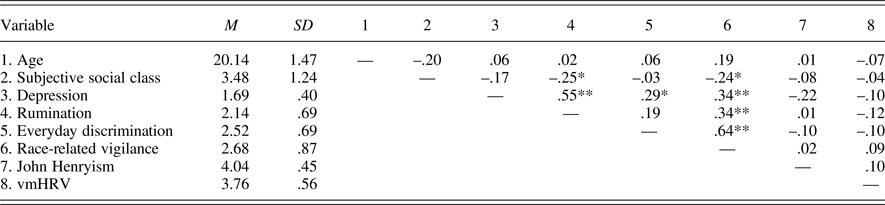
Descriptive statistics for the sample are presented in Table 1. The average age of participants in our sample was 20 ± 1.5 years, and participants endorsed an average subjective social class ranging between “lower middle class” and “middle class.” Subjective social class was inversely associated with rumination (r = –.25, p = .036). Depressive symptoms were positively associated with rumination (r = .55, p < .001), everyday discrimination (r = .29, p = .017), and race-related vigilance (r = .34, p = .004). Rumination was positively correlated with race-related vigilance (r = .34, p = .005), and race-related vigilance was positively correlated with everyday racial discrimination (r = .64, p < .001). Neither John Henryism nor resting vagally mediated heart rate variability was reliably associated with any of the study variables.
Sample descriptive statistics (means, standard deviations, and intercorrelations)

Note: Subjective social class: 1 = lower class/poor, 2 = working class, 3 = lower middle class, 4 = middle class, 5 = upper middle class, 6 = upper class. vmHRV, vagally mediated heart rate variability. *p ≤ .05. **p ≤ .01.
Indirect effect of race-related stress on depressive symptoms through rumination
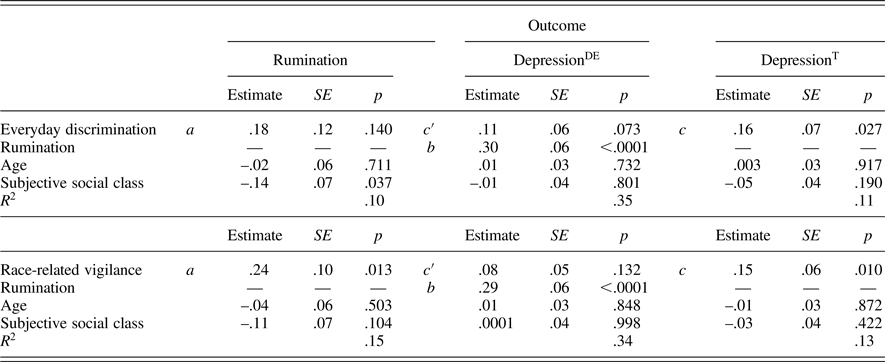
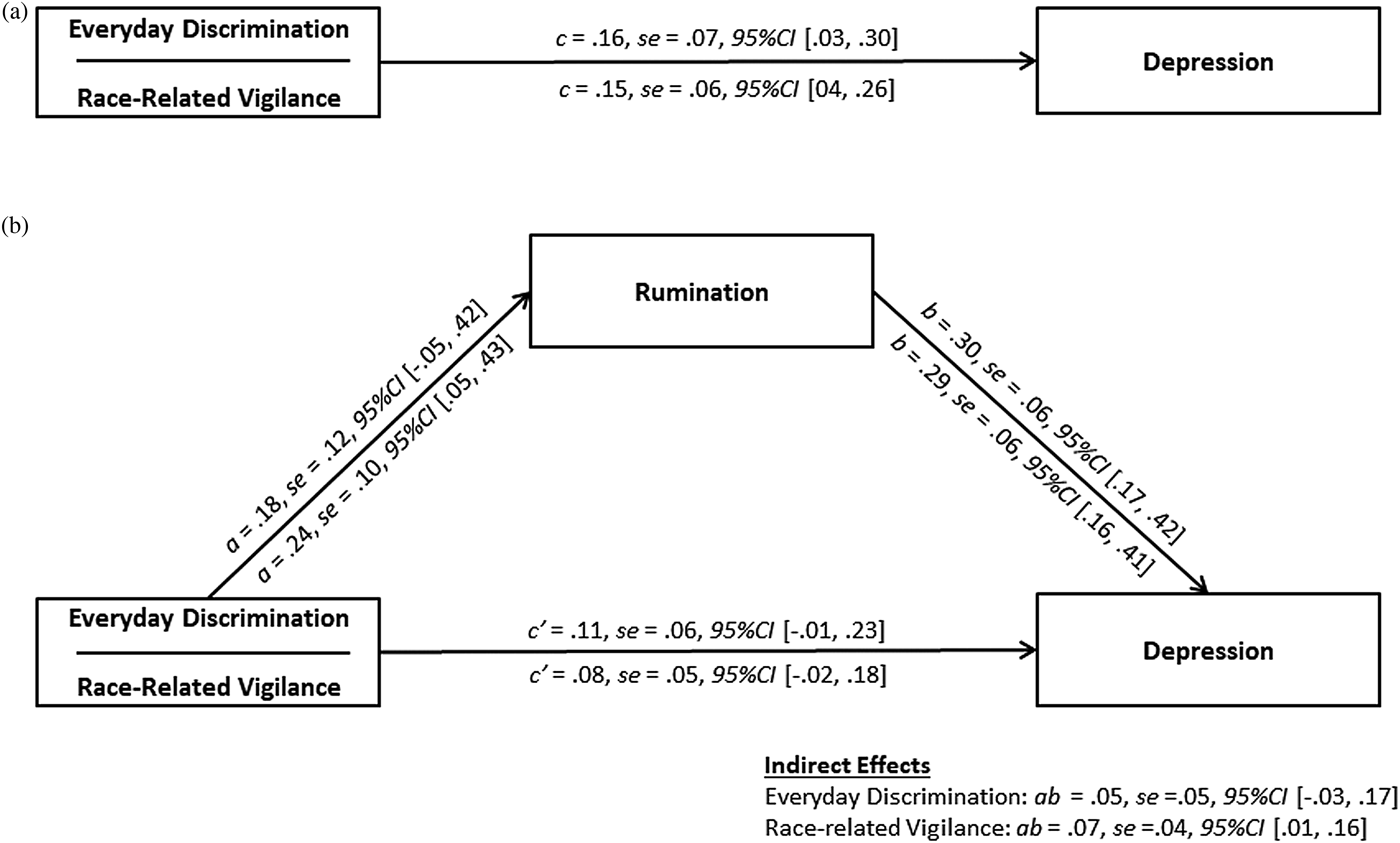
Consistent with our first hypothesis, we examined the indirect relation between race-related stress and depressive symptoms though rumination. As presented in Table 2, everyday racial discrimination was not directly associated with rumination (path a: estimate = 0.18, SE = 0.12, 95% CI [–0.06, 0.42], p = .140), or depressive symptoms (path c’: estimate = 0.11, SE = 0.06, 95% CI [–0.01, 0.23], p = .073). As depicted in Figure 1a (coefficients above the solid line), the indirect effect of everyday racial discrimination on depressive symptoms through rumination was also not reliable (ab = 0.05, boot-strapped 95% CI [−0.03, 0.17]). Race-related vigilance was positively associated with rumination (path a: estimate = 0.24, SE = 0.10, 95% CI [0.05, 0.43], p = .013). The direct effect of race-related vigilance on depressive symptoms was not robust (path c’: estimate = 0.08, SE = 0.05, 95% CI [–0.02, 0.18], p = .132); however, as depicted in Figure 1b (coefficients below the solid line), race-related vigilance was indirectly associated with depressive symptoms through rumination (ab = 0.07, boot-strapped 95% CI [0.01, 0.16]).
Direct and total effect models of the relation between race-related stress and depressive symptoms through rumination

Note: DE, direct effect model. T, total effect model.
(a) Total effect path model of the association between everyday discrimination and race-related vigilance with depressive symptomatology. (b) Indirect effect path model of the association between everyday discrimination and race-related vigilance with depressive symptomatology through rumination.

Active coping as a moderator of the relation between race-related stress and rumination
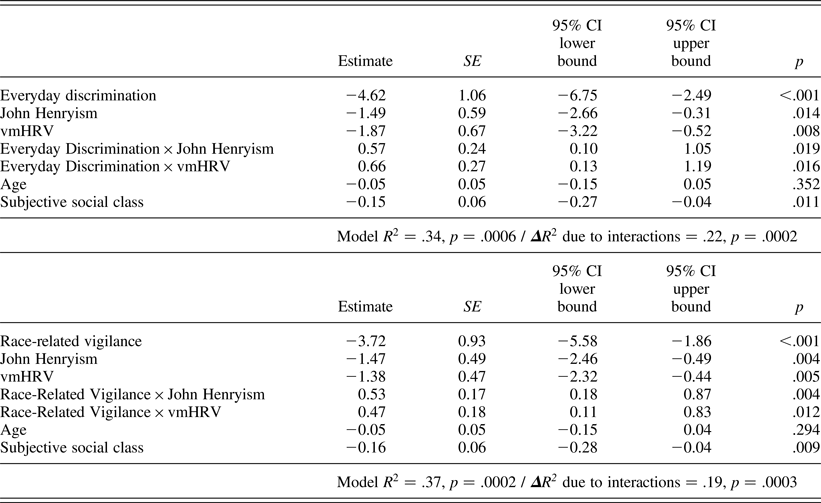
To test our second hypothesis, we examined whether the relation between race-related vigilance and everyday discrimination with rumination was contingent on levels of John Henryism and vagally mediated heart rate variability. Robust conditional (i.e., interaction) effects were observed for the interaction of race-related stress with John Henryism and vagally mediated heart rate variability in all models. As shown in Table 3, the confidence intervals for the interaction of everyday discrimination with John Henryism (b = 0.57, SE = 0.24, 95% CI [0.10, 1.05]) and vagally mediated heart rate variability (b = 0.66, SE = 0.27, 95% CI [0.13, 1.19]) indicated a reliable effect for both moderators. This pattern was similarly robust for the interaction of race-related vigilance with John Henryism (b = 0.53, SE = 0.17, 95% CI [0.18, 0.87]) and vagally mediated heart rate variability (b = 0.47, SE = 0.18, 95% CI [0.11, 0.83]).
Moderation model of race-related stress and active coping (John Henryism and vmHRV) predicting rumination
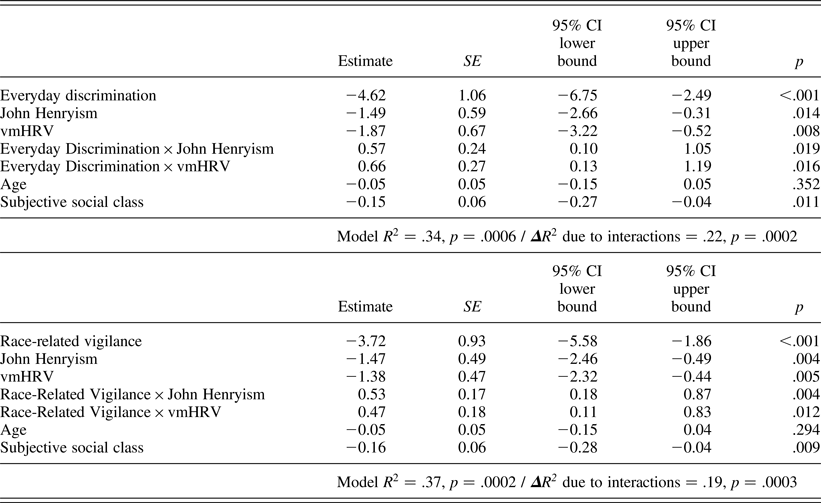
Note: vmHRV, vagally-mediated heart rate variability. SE, standard error.
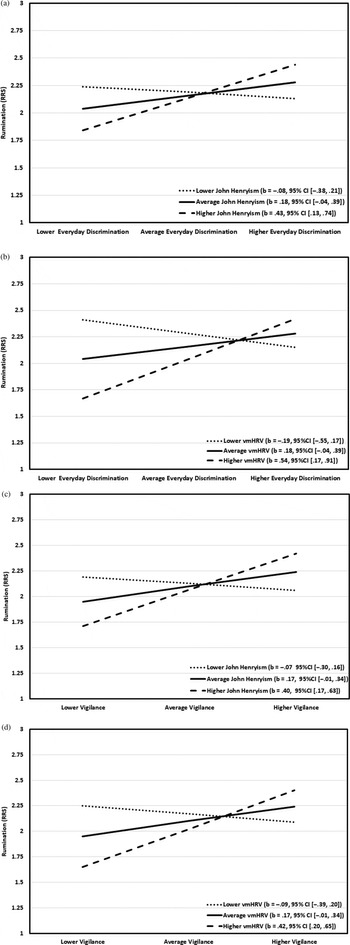
As our initial analysis indicated that the conditional effects observed for John Henryism and vagally mediated heart rate variability were independent of one another, we present the unique simple effects attributable to each moderator, separately in Figures 2a–2d. An examination of the simple slopes revealed that increasing everyday racial discrimination was associated with rumination at higher (b = 0.43, SE = 0.15, 95% CI [0.13, 0.74], p = .006), but not at average (b = 0.18, SE = 0.11, 95% CI [–0.04, 0.39], p = .102), or lower (b = –0.08, SE = 0.15, 95% CI [–0.38, 0.21], p = .579) levels of John Henryism (Figure 2a). Effects for vagally mediated heart rate variability, mirrored those for John Henryism, as the association between everyday racial discrimination and rumination was most robust at higher (b = 0.54, SE = 0.18, 95% CI [0.17, 0.91], p = .005), but not average (b = 0.18, SE = 0.11, 95% CI [–0.04, 0.39], p = .102), or lower (b = –0.19, SE = 0.18, 95% CI [–0.55, 0.17], p = .288) levels of vagally mediated heart rate variability (Figure 2b).
(a) Interaction of everyday discrimination and John Henryism on rumination. (b) Interaction of everyday discrimination and vagally mediated heart rate variability on rumination. (c) Interaction of race-related vigilance and John Henryism on rumination. (d) Interaction of race-related vigilance and vagally mediated heart rate variability on rumination. Simple slope effects representing the moderated relation between race-related vigilance and everyday discrimination with rumination are presented at low (–1 SD, dotted line), average (mean, solid line), and high (+1 SD, dashed line) levels of John Henryism (Ns = 15, 42, and 12, respectively, for low, average, and high subgroups) and vagally mediated heart rate variability (Ns = 12, 21, and 36, respectively, for low, average, and high subgroups).
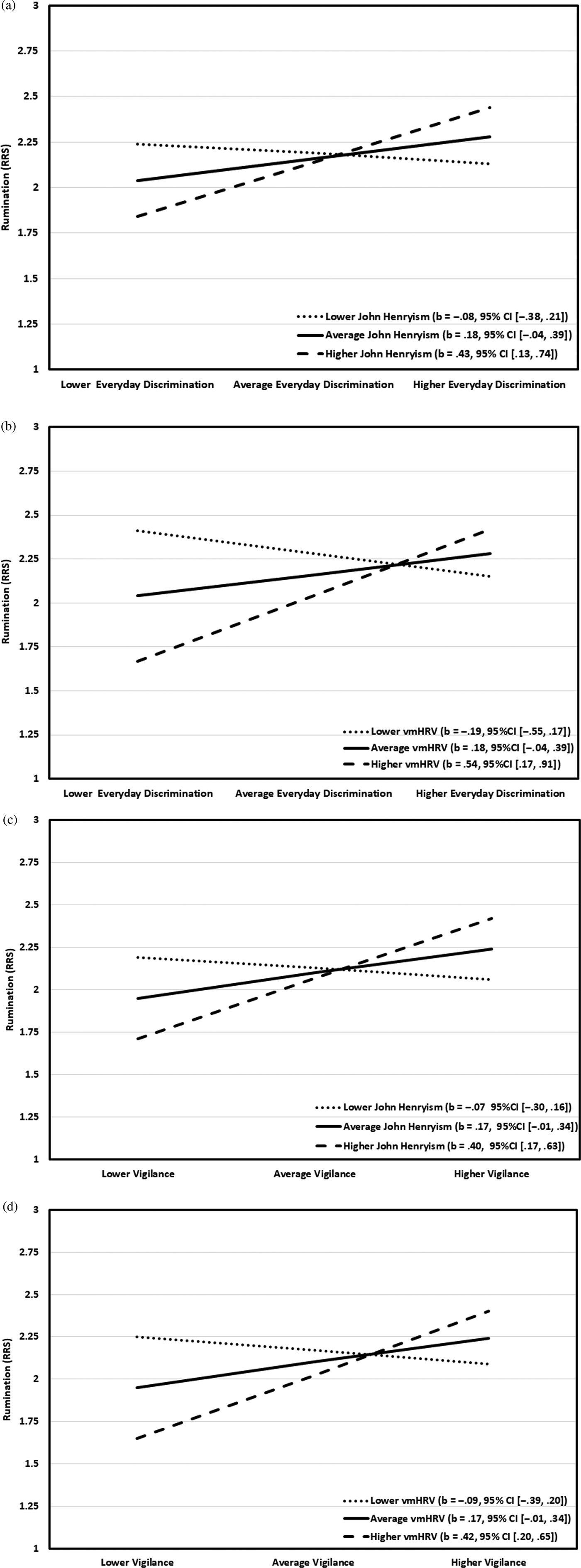
Similar effects were observed when the relation between race-related vigilance and rumination was examined at representative levels (i.e., mean±SD) of John Henryism and vagally mediated heart rate variability. In particular, race-related vigilance was more strongly associated with rumination at higher (b = 0.40, SE = 0.12, 95% CI [0.17, 0.63], p = .001), but not average (b = 0.17, SE = 0.09, 95% CI [–0.01, 0.34], p = .061), or lower (b = –0.07, SE = 0.12, 95% CI [–0.30, 0.16], p =.545) levels of John Henryism (Figure 2c). A virtually identical pattern of results emerged for vagally mediated heart rate variability, as the relation between race-related vigilance and rumination was robust at higher (b = 0.42, SE = 0.11, 95% CI [0.20, 0.65], p < .001), but not average (b = 0.17, SE = 0.09, 95% CI [–0.01, 0.34], p = .061), or lower (b = –0.09, SE = 0.15, 95% CI [–0.39, 0.20], p = .529) levels of vagally mediated heart rate variability (Figure 2d).
Testing for evidence of a conditional indirect effect in the relation between race-related stress and depressive symptoms through rumination
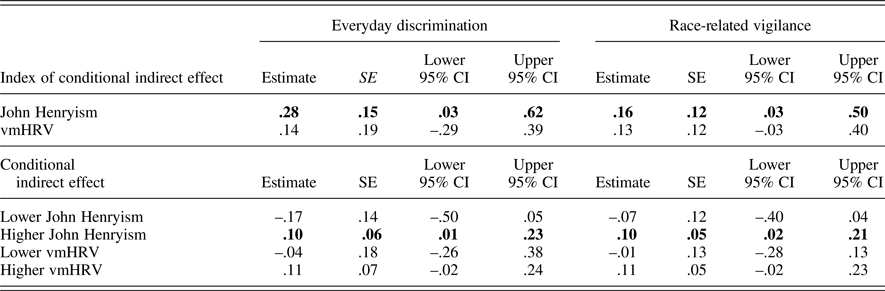
Given the conditional effects observed for John Henryism and vagally mediated heart rate variability, we examined whether the indirect effect of race-related stress on depressive symptoms through rumination was also moderated by these factors. As their general pattern was similar, we combined participants from the average and high subgroups in the simple moderation models, in order to contrast the conditional indirect effect of race-related stress on depressive symptoms through rumination at relative higher and lower levels of John Henryism and vagally mediated heart rate variability. Parameter estimates and 95% CIs for the index of the moderated indirect effect and the conditional indirect effects are presented in Table 4.
Estimates of the index of the conditional indirect effect for race-related stress at lower and higher levels of active coping

Note: vmHRV, vagally mediated heart rate variability.
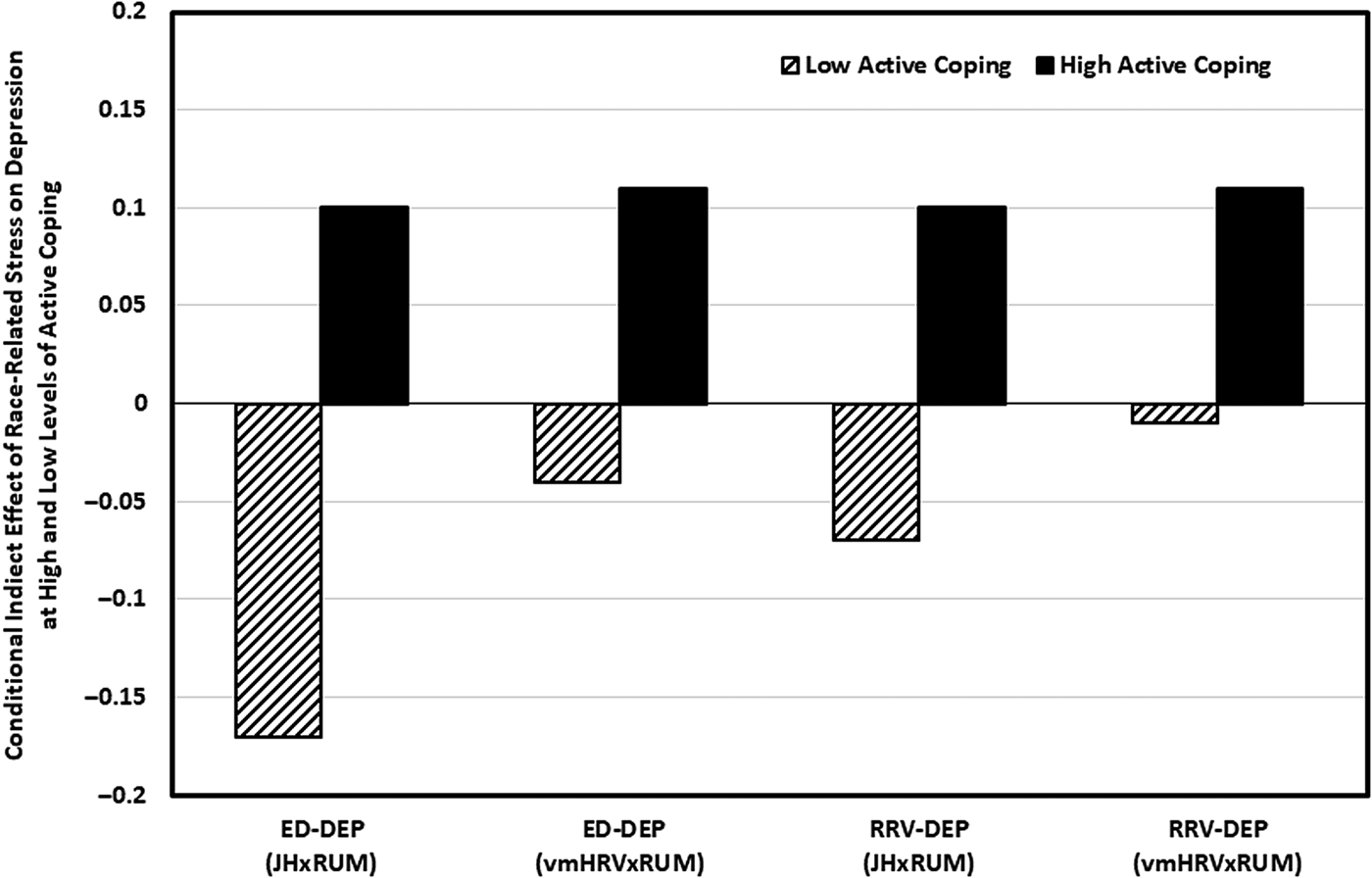
Results indicate that the indirect effect of everyday racial discrimination on depressive symptoms through rumination, was moderated by John Henryism (estimate = 0.28, 95% CI [0.03, 0.62]) but this effect was not reliable for vagally mediated heart rate variability (estimate = 0.14, 95% CI [–0.29, 0.39]), as the boot-strapped confidence interval for the index of the conditional indirect effect contained zero. Examination of the simple conditional (i.e., at distinct levels of John Henryism and vagally mediated heart rate variability) indirect effects indicates that everyday racial discrimination was associated with depression through rumination at higher levels of John Henryism (estimate = 0.10, 95% CI [0.01, 0.23]). The magnitudes of the simple conditional indirect effects at relative higher and lower levels of John Henryism and vagally mediated heart rate variability are presented in Figure 3.
Estimates of the conditional indirect effect of race-related stress on depressive symptoms, through rumination and at high and low levels of John Henryism and vmHRV, respectively. RRV, race-related vigilance. ED, everyday discrimination. RUM, rumination. DEP, depressive symptomatology. JH, John Henryism. vmHRV, vagally mediated heart rate variability.
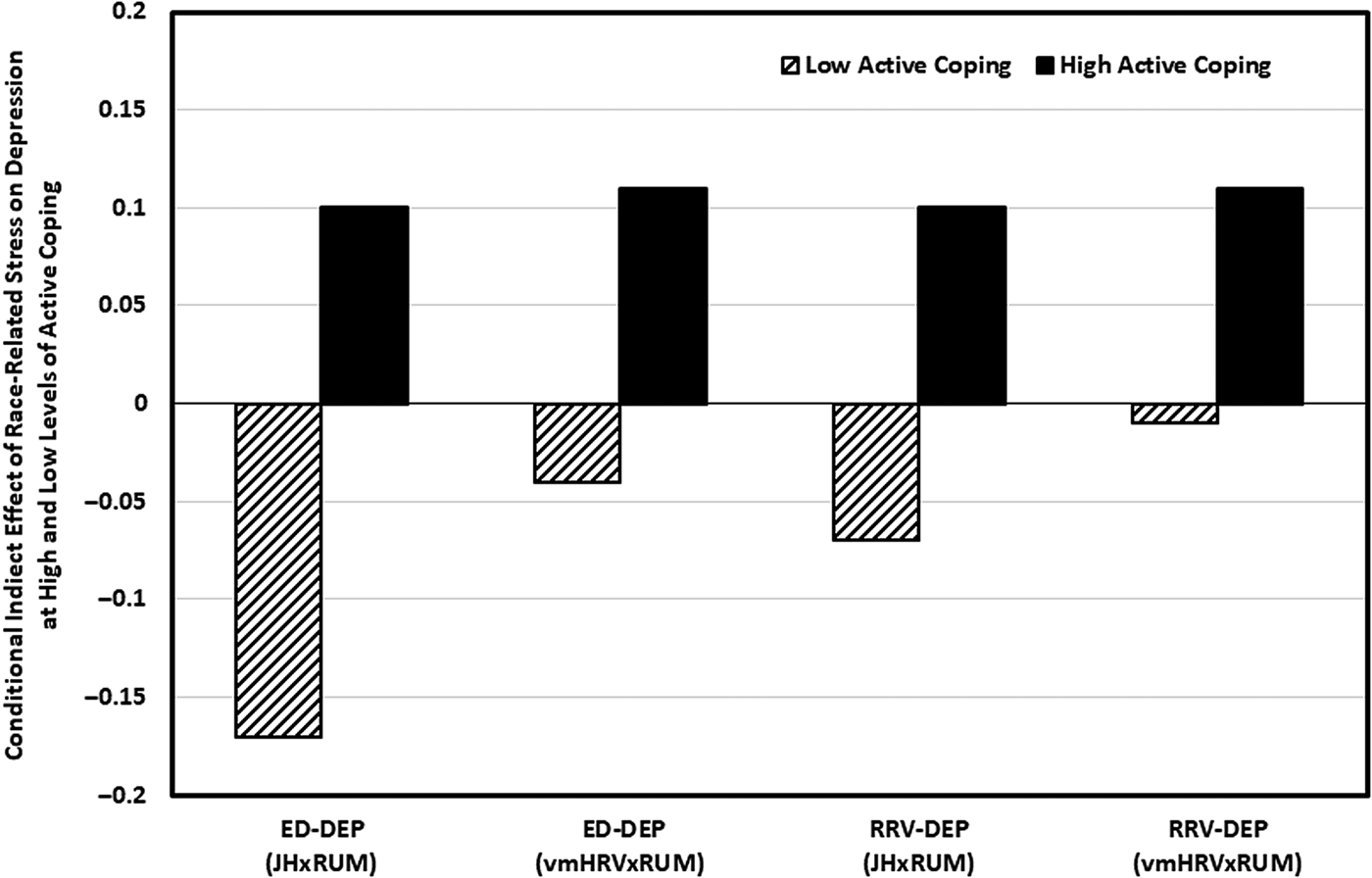
Effects for race-related vigilance were similar to those observed for everyday racial discrimination, as the index of the conditional indirect effect was robust for John Henryism (estimate = 0.16, 95% CI [0.03, 0.50]), but not vagally mediated heart rate variability (estimate = 0.13, 95% CI [–0.03, 0.40]. The pattern of conditional indirect effects further supports that race-related was associated with depressive symptoms through rumination at higher levels of John Henryism (estimate = 0.10, 95% CI [0.02, 0.21]).
Discussion
Experiences of racial discrimination among African American and other minority emerging adults may place these individuals at greater risk for depression over time (i.e., Brown et al., Reference Brown, Williams, Jackson, Neighbors, Torres, Sellers and Brown2000). Emerging adult African American women may face an especially greater risk due to the compounding effects of race-related stressors and rumination, a well-established risk factor for depression onset. In light of previous evidence that rumination may indirectly link race-related stress and depressive symptoms, we further examined the influence of rumination on the relation between race-related and depressive symptoms in a sample of African American emerging adult women. Based on growing evidence that elements of John Henryism active coping (i.e., self-control and striving) may have protective effects on psychological health among emerging adult African Americans, and emerging research suggesting that vagally mediated heart rate variability may index active coping among African Americans, we also evaluated whether these factors might exhibit similar moderating effects on the association between race-related stress with rumination and depressive symptomatology through rumination.
In support of our first hypothesis, we observed that race-related vigilance, but not everyday discrimination attributed to race, was indirectly related to depressive symptomatology through rumination. With respect to our second hypothesis, John Henryism and vagally mediated heart rate variability yielded nearly identical moderating effects on the association between race-related stress and rumination, a pattern that suggests that these factors may represent distinct behavioral and biological components of a common underlying self-regulatory process. In addition, we found partial support for our third hypothesis, in that both greater race-related vigilance and greater everyday discrimination attributed to race were indirectly related to depressive symptoms through rumination, but only at higher levels of John Henryism. Vagally mediated heart rate variability did not reliably moderate the indirect effect.
Rumination is widely regarded as an important contributor to risk for depression onset, symptom worsening, and recurrence (Aldao et al., Reference Aldao, Nolen-Hoeksema and Schweizer2010), and has long been considered a likely response to increased exposure to racial discrimination (Clark et al., Reference Clark, Anderson, Clark and Williams1999). In simple indirect effect models, neither race-related vigilance nor everyday discrimination attributed to race were directly associated with depression; however, race-related vigilance was indirectly linked with depressive symptoms through rumination among emerging adult African American women in our study. While often characterized as a trait-like individual difference, rumination is also viewed as an important factor that may repeatedly initiate and prolong emotional and behavioral responses to stress (Brosschot, Pieper, & Thayer, Reference Brosschot, Pieper and Thayer2005). This latter conceptualization may be more consistent with the maladaptive function of rumination suggested by the biopsychosocial model of racism (Clark et al., Reference Clark, Anderson, Clark and Williams1999), where perseverating on past experiences of race-related stress or anticipating future encounters may have a recurring impact on mental health risk. The perseverative cognition (PC) hypothesis (Brosschot, Gerin, & Thayer, Reference Brosschot, Gerin and Thayer2006) characterizes rumination as a key component in a larger pattern of cognitive, emotional, and physiological responses that underlie an increased risk for poorer physical and mental health, more generally. Under this hypothesis, rumination and other PC processes (i.e., worry) share a common feature: repetitive, or recurrent negative thinking that may be uncontrollable (Brosschot et al., Reference Brosschot, Gerin and Thayer2006), and also may occur in a largely automatic fashion, outside of conscious awareness (Brosschot, Reference Brosschot2010; Brosschot, Verkuil, & Thayer, Reference Brosschot, Verkuil and Thayer2010).
Researchers have characterized PC as a common pathway underlying poor mental health (i.e., Zawadzki, Sliwinski, & Smyth, Reference Zawadzki, Sliwinski and Smyth2018). In addition, there is some evidence to suggest that rumination may be the more potent component of PC, relative to worry, at least in relation to race-related stress. For example, Hoggard and Hill (Reference Hoggard and Hill2018) examined the simultaneous influence of both worry and rumination as mediators of the relationship between racial discrimination and subjective sleep quality in a sample of young adult African Americans. While racial discrimination was shown to have a direct, positive association with depression, and was positively associated with both indicators of PC, rumination, but not worry, was the only component to significantly mediate the relation between racial discrimination and subjective sleep quality. While the overall association was modest in the present study, rumination was more strongly correlated with race-related vigilance than with everyday discrimination attributed to race in our sample. This finding gives further credence to the notion that race-related vigilance may operate in a similar space as rumination and other forms of PC (Hicken et al., Reference Hicken, Lee, Ailshire, Burgard and Williams2013). Although race-related vigilance and everyday racial discrimination are conceptually overlapping, future research should more closely examine their potential dual impact on mental and physical health, a notion consistent with the “net level of vulnerability” described in the PVEST (Spencer, 1995, Reference Spencer, Lerner and Damon2006). For example, the effects of ruminating on past experiences of discrimination as well as the effects of anticipating future encounters create a context where thoughts, emotions, and possibly underlying physiological reactions related to discrimination are constantly present, for some individuals. When considered collectively with previous cross-sectional and prospective evidence showing rumination to mediate the relation between race-related stress and depressive symptoms (e.g., Borders & Liang, Reference Borders and Liang2011; Miranda et al., Reference Miranda, Polanco-Roman, Tsypes and Valderrama2013), our results lend further support to the notion that rumination may be a significant driving force underlying the relation between race-related stress and increased depression risk among minority emerging adults, and particularly among African American emerging adult women.
Our analyses revealed that John Henryism was a robust moderator in the association between both race-related vigilance and everyday discrimination attributed to race with rumination, and further influenced the indirect relation between race-related vigilance and depressive symptomatology through rumination. The pattern of effects revealed in simple moderation models indicates that race-related vigilance and everyday discrimination attributed to race were positively associated with rumination at higher levels of John Henryism. In contrast, the slope/line was virtually flat among individuals with relatively low John Henryism, indicating, instead, a relatively stable, and generally elevated level of rumination, irrespective of increasing race-related vigilance or everyday discrimination. This seemingly static association further suggests that there may be significant variability in the ways in which African Americans cope with race-related stress (Brenner, Diez-Roux, Gebreab, Schulz, & Sims, Reference Brenner, Diez-Roux, Gebreab, Schulz and Sims2017; Ruggiero et al., Reference Ruggiero, Taylor and Lydon1997).
As noted by Causadias (Reference Causadias2013), coping is shaped by several factors, including social influences (i.e., exposure to racial discrimination) and cultural norms regarding what constitutes acceptable and (ab)normal emotional and behavioral responses. Thus, coping may be maladaptive (i.e., associated with increased risk for depression), protective (i.e., risk buffering), or promotive (i.e., perpetuating resilience in the face of future risk exposures) in relation to mental health. Whereas daily encounters with discrimination and race-related vigilance can clearly be viewed as examples of society- and individual-level cultural risk factors, our ability to characterize John Henryism as either a cultural protective or a promotive factor is less clear. For example, our findings indicate that the indirect effect of race-related stress on depressive symptoms was most pronounced among individuals endorsing comparatively higher levels of John Henryism. At first glance, this pattern may appear puzzling, as it seemingly suggests greater John Henryism may ultimately be a risk factor for greater depressive symptomatology in the context of race-related stress(ors). While this interpretation is supported by some previous evidence linking John Henryism to increased depression risk among African Americans (Hudson, Neighbors, Geronimus, & Jackson, Reference Hudson, Neighbors, Geronimus and Jackson2016), it stands in stark contrast to other findings indicating that John Henryism may be a protective factor in the association between race-related stress and depressive symptoms among both African American women (Bronder, Speight, Witherspoon, & Thomas, Reference Bronder, Speight, Witherspoon and Thomas2014) and men (Matthews, Hammond, Nuru-Jeter, Cole-Lewis, & Melvin, Reference Matthews, Hammond, Nuru-Jeter, Cole-Lewis and Melvin2013).
Acknowledging the fact that our analysis is cross-sectional, we submit that the moderating effects observed for John Henryism may reflect a snapshot of the hypothesized pattern of “compensation” proposed by Hill et al. (Reference Hill, Hu, Koenig, Sollers, Kapuku, Wang and Thayer2015, Reference Hill, Sherwood, McNeilly, Anderson, Blumenthal and Hinderliter2018). However, instead of a biomarker, John Henryism represents a dispositional cognitive and behavioral frame that is, at least partially, transmitted through shared culture. For example, Whitfield et al. (Reference Whitfield, Brandon, Robinson, Bennett, Merritt and Edwards2006) examined the heritability of John Henryism in a sample of middle-aged and older adult twins participating in the Carolina African American Twins Study of Aging. Their findings indicated that approximately 35% of the variance in John Henryism was attributable to genetic factors, while 65% of the individual variability in John Henryism was attributable to environmental influences, arguably reflecting learned behavior in response to persistent stressors (Whitfield et al., Reference Whitfield, Brandon, Robinson, Bennett, Merritt and Edwards2006). A later investigation from the Georgia Twin Study produced virtually identical estimates for the relative contribution of genetic (i.e., 34%) and environmental (i.e., 66%) factors on John Henryism in a sample that included both European American and African American adolescent twins (Wang, Trivedi, Treiber, & Snieder, Reference Wang, Trivedi, Treiber and Snieder2005). While the remarkably consistent findings from these two developmentally distinct samples provide solid evidence that environment, and perhaps culture, exerts a substantial influence on John Henryism, the question of whether John Henryism is also protective or promotive remains to be further elucidated.
Overall, our findings regarding the moderating role of John Henryism are partially consistent with our hypotheses in that race-related stress was most strongly associated with rumination, and indirectly with depression through rumination only at relative higher levels of John Henryism. This latter finding offers an interesting consideration for future prospective research in order to better characterize potential changes in the interrelations among John Henryism, race-related stress, rumination, and depressive symptoms over time.
While the significant role of autonomic nervous system functioning in physical health has been well established, growing evidence suggests that activity of the parasympathetic branch also may serve as an important, global index of mental health (Beauchaine, Reference Beauchaine2015; Beauchaine & Thayer, Reference Beauchaine and Thayer2015; Kemp & Quintana, Reference Kemp and Quintana2013). We hypothesized that resting-state vagally mediated heart rate variability would demonstrate effects comparable to John Henryism when considered as a moderator of the direct and indirect relations between race-related vigilance and everyday discrimination attributed to race with rumination and depressive symptoms, respectively. With the lone exception of results for the conditional indirect effect of race-related stress on depression through rumination, vagally mediated heart rate variability yielded virtually identical results to those observed for John Henryism. This is especially interesting when considering our findings for the relation between race-related stress and rumination, as effects for both John Henryism and vagally mediated heart rate variability remained robust when modeled simultaneously. Overall, this pattern of results suggests that the potentially “compensatory” influence of each factor was independent of the other.
While the “mirroring” effects that we observed for John Henryism and vagally mediated heart rate variability appear to be reliable, our findings should be interpreted with caution. Race-related stress has previously been linked with lower vagally mediated heart rate variability among African American emerging adults (for review, see Hill and Hoggard, Reference Hill, Sherwood, McNeilly, Anderson, Blumenthal and Hinderliter2018), a finding that would seem to undermine the purported compensatory role of vagally mediated heart rate variability. In addition, there also has been some research to suggest that general interpretations regarding the relative meaning of higher vagally mediated heart rate variability in relation to both physical and mental health outcomes may not hold true for African Americans. For example, Keen, Turner, Mwendwa, Callender, and Campbell (Reference Keen, Turner, Mwendwa, Callender and Campbell2015) observed a positive association between vagally mediated heart rate variability and self-reported depressive symptoms in a sample of middle-aged African Americans. Other work has shown that vagally mediated heart rate variability also may be diminished among socioeconomically disadvantaged African American adults (Boylan, Jennings, & Matthews, Reference Boylan, Jennings and Matthews2016; Fuller-Rowell et al., Reference Fuller-Rowell, Williams, Love, McKinley, Sloan and Ryff2013; Lampert, Ickovics, Horwitz, & Lee, Reference Lampert, Ickovics, Horwitz and Lee2005). Subjective social class did not appear to have a meaningful impact on our findings; nonetheless, it remains to be determined whether socioeconomic factors may have a stronger effect in a larger sample. Overall, there is a substantial need for additional research examining factors that may influence vagally mediated heart rate variability among African American women as well as among African men and other stigmatized groups, in addition to investigating its potential role as a protective factor against the negative effects of race-related stress on both physical and mental health.
Limitations
There are some limitations that should be considered in interpreting our findings. Our study was cross-sectional and provides little inference to the causal ordering of the relations observed among our study variables. Although we employed an analytic approach commonly utilized in longitudinal designs, we note that our decision to do so was theoretically and empirically grounded. In particular, there is limited, but consistent prospective evidence supporting that race-related stress predicts increased depressive symptomatology, as well as cross-sectional and longitudinal data supporting rumination as a reliable mediator of this relation. Nonetheless, truly prospective data is needed to inform our findings, especially with respect to the mirrored, moderating effects observed for John Henryism and vagally mediated heart rate variability. In addition, our sample was composed entirely of apparently healthy, young African American women; thus, additional research is needed to evaluate whether our findings may generalize to older African American women, African American men at various stages of the life course, and other minority emerging adults. We also acknowledge the relatively modest size of our study sample. The few previous studies examining similar relationships among emerging adults (i.e., Borders & Liang, Reference Borders and Liang2011; Miranda et al., Reference Miranda, Polanco-Roman, Tsypes and Valderrama2013) have typically featured larger samples. Although this raises possible concerns regarding the reliability of our observations, we note that our present results are consistent with results obtained in an analysis of the entire sample, which included the 20 additional women who did not attribute their experiences of everyday discrimination to their race or ancestry. While this modest difference in sample size cannot fully address all potential concerns regarding our observed effects, additional support is drawn from the fact that the confidence intervals for all of our indirect effects were derived empirically using percentile boot-strapping with 10,000 resamples. Boot-strapped estimates for all other regression parameters (not reported) also were consistent in pattern and magnitude with our reported findings. Nonetheless, as noted by Cohen, Cohen, Aiken, and West (Reference Cohen, Cohen, West and Aiken2003, p. 190), our findings should be considered tentatively, especially in consideration of the limited amount of prior available information regarding the unique associations considered in the present investigation.
While there is clearly growing interest in examining the dynamic interplay between cultural and biological factors in relation to normal and abnormal development and health, there is a critical need for additional research on the potential protective and/or promotive effects of John Henryism and vagally mediated heart rate variability. Previous research indicates that socioeconomic resources may play an important role in determining the relation of John Henryism and vagally mediated heart rate variability with mental and physical health outcomes. In our study, subjective social status was the only significant covariate across all models, with effects indicating an inverse association with both rumination and depressive symptoms. Over 60% of the women in our analytic sample endorsed a social class rating of “middle class” or “upper middle class”; thus, there was likely limited variation in relative socioeconomic status among participants in our study. This further underscores the importance of future work to examine the interrelations among race-related stress, depressive symptoms, and adaptive and maladaptive forms of coping in more socioeconomically diverse contexts. Finally, while the negative effects of rumination are well characterized, it represents only one form of maladaptive coping. Therefore, it may be particularly informative to examine the interrelations among race-related stress, depressive symptoms, John Henryism, and vagally mediated heart rate variability with additional maladaptive (i.e., suppression) as well as adaptive (i.e., acceptance and reappraisal) self-regulation strategies.
Implications/considerations for future research
What can be done to combat the effects of race-related and other forms of discrimination? An answer to this query far exceeds the scope of the present work, but further represents a crucial issue that must be continually examined in the context of the ongoing milieu of coffee shop arrests, discriminatory penal policies, threats of mass deportations, and other social inequities. It must also be noted that our ability to share and learn about the experiences of the additive discriminatory stress faced by others is only a relatively recent development; yet within communities of color, such experiences are common knowledge, potentially transmitted at the cultural level (Causadias, Reference Causadias2013). Prolonged exposure to social and cultural truisms may further illustrate how such colloquialisms as “You need to work twice as hard to get half as far” become/are translated into the determined, hard-striving, “skin deep” resilience (e.g., Brody et al., Reference Brody, Yu, Chen, Miller, Kogan and Beach2013) encompassed within John Henryism. In a social environment where one is seemingly always at risk, a state of heightened vigilance concomitant with the long-term physiological costs may be an adaptive, albeit ill-fated, response.
While we should be careful to avoid pathologizing experiences of discrimination and the potential behavioral responses to these experiences, we also must consider that the additive burden of chronic race-related and other forms of discrimination is unique and impactful to those who are affected. It would seem excessive to label race-related stress as a diagnostic entity or to envision that such a classification is necessary in order to “validate” what for many is a daily, stressful life experience. Instead, a broader approach to intervention may need to focus on leveraging the very same information networks through which discriminatory experiences are now shared, as a potential source of systemic intervention aimed at continually acknowledging these experiences and promoting strategies that will not only facilitate more optimal coping but also emphasize the important implications for long-term mental and physical health. One factor that will need to be considered within this space is growing evidence of “cyber-racism” (Bliuc, Faulkner, Jakubowicz, & McGarty, Reference Bliuc, Faulkner, Jakubowicz and McGarty2018), which may be even more insidious than overt manifestations of discrimination because of the ever-growing reliance on social media as a primary means of connecting with others.
This call for a broad interventional approach is not inconsistent with the systems-level perspective of the PVEST model, and also resonates with excellent recommendations proposed by Williams and Mohammed (Reference Fuller-Rowell, Williams, Love, McKinley, Sloan and Ryff2013). These researchers emphasize the critical need for systematic media campaigns and educational initiatives that increase collective awareness of the persistence of discrimination in contemporary society and that disseminate positive race-centered messages. An example cited by these investigators is previous efforts to combat dehumanizing images, including the campaigns against use of Native American mascots in college and professional sports. Such approaches may contribute to a shift in cultural values and images, thereby reducing prejudice and discrimination in the general public and within institutional settings. Previous work has demonstrated the potential effectiveness of relatively broad intervention strategies. For example, Kwate (Reference Kwate2014) conducted a public health intervention that used outdoor advertising to disseminate a “countermarketing” campaign. Over a 6-month period, Kwate showcased six advertisements (e.g., “Don't Want to Get Stopped by the NYPD? Stop Being Black”) in New York City bus shelters. Three months post-intervention, Kwate observed statistically significant declines in psychological distress among participants exposed to the campaign as compared to participants who were recruited from a neighborhood not exposed to the advertisements. This study provides promising initial evidence that community-based interventions can effectively attenuate the effects of race-related stress on mental health. Efforts to “upscale” this and similar approaches are greatly needed and may be of particular importance in the current social climate.
Conclusions
In conclusion, our findings add to growing evidence that rumination may be a significant pathway linking the experience and expectation of race-related stress to depression risk in minority emerging adults. In addition, active coping, conceptualized using both a culturally relevant measure of goal striving, and a biomarker of self-regulatory capacity, significantly moderated the association between race-related stress and rumination among the young African American women in our study, and further influenced the indirect relation of race-related stress with depressive symptoms. Our observations provide further support to previous theoretical and empirical work indicating that greater race-related stress is associated with an increased tendency to ruminate among African Americans, and provides additional empirical support for the notion that the greater resting vagally mediated heart rate variability observed among some African Americans may be a compensatory response to more frequent experiences of, and attempts to cope with, race-related stress. Collectively, these findings underscore the crucial need for additional research examining the complex interrelations among cultural and biological factors underlying mental health among minority emerging adults.