INTRODUCTION
Canopy gaps associated with falling trees are a basic unit of turnover in forested communities, as they provide a temporary spatial heterogeneity. Gap turnover has been well studied in tropical rain forests, where gap formation allows new individuals of pioneer species to infiltrate the forest, contributing to the high tree species diversity across the biome (Canham et al. Reference CANHAM, DENSLOW, PLATT, RUNKLE, SPIES and WHITE1990, Denslow Reference DENSLOW1987, Ricklefs Reference RICKLEFS1977, Swaine & Whitmore Reference SWAINE and WHITMORE1988). The creation of treefall gaps is one of several processes that allow one tree to replace another; collectively these processes represent forest succession (Runkle Reference RUNKLE1981). Immediate changes in canopy-gap species composition may initiate a small-scale secondary succession, as the increase in resource availability in the gaps favours pioneers, as long as the gap is sufficiently large (Brokaw Reference BROKAW1987, Canham Reference CANHAM1989, Dalling et al. Reference DALLING, HUBBELL and SILVERA1998, Denslow Reference DENSLOW1980, Kupfer & Runkle Reference KUPFER and RUNKLE1996, Schnitzer & Carson Reference SCHNITZER and CARSON2001, Whitmore Reference WHITMORE1989). Whereas there appears to be a consensus about the role of gaps in tropical rain forests, it is less clear if gaps help establish pioneer species in dry tropical forests.
Canopy gaps may play an opposite role in seasonally dry tropical forests than in their rain-forest counterparts. Several factors suggest that canopy gaps in the dry tropics should be smaller and occur less frequently than in rain forests. Dickinson et al. (Reference DICKINSON, HERMANN and WHIGHAM2001) suggest numerous factors that could explain lower rates of background disturbance in the dry tropics than the wet tropics. Lower annual rainfall and seasonal drought act as evolutionary selection pressures that favour trees with large diameter to height ratios and small crowns, thus the gaps created should be relatively small. Greater tree stability in dry tropical forests leads to less mortality and fewer gaps, resulting also in more standing deaths and smaller gaps (Dickinson et al. Reference DICKINSON, HERMANN and WHIGHAM2001). Canopy height is low, especially in Caribbean dry forests (Van Bloem et al. Reference KEIM, MULLER and STONE2007). Among the driest tropical forests, gap-phase dynamics does not appear to exist (Swaine et al. Reference SWAINE, LIEBERMAN and HALL1990).
Tropical hardwood hammocks are a type of tropical dry forest native to South Florida. Much of the vegetation is West Indian in origin, in contrast to the majority of vegetation of the east coast of the USA. Woody plant succession has been observed in the tropical hardwood hammocks of Key Largo. In forests sampled immediately after Hurricane Andrew in 1992, pioneer species incurred higher mortality rates than mature species, indicating that the immediate effect of the hurricane was to advance the overall successional status of the forest, rather than resetting it (Ross et al. Reference ROSS, CARRLNGTON, FLYNN and RUIZ2001). Juvenile trees sampled several years after the hurricane were primarily late-successional species, further indicating that Hurricane Andrew accelerated the successional process in this forest (Carrington et al. Reference CARRINGTON, ROSS and BASIT2015). The tree mortality caused by Hurricane Andrew created many canopy gaps, but these gaps were likely filled during the two decades that followed, during which no major tropical storms affected the area. Gaps initiated during this period were attributable to smaller-scale disturbances or other local mortality agents. Our objective was to assess the role of gap-phase dynamics in the Key Largo forest by quantifying the successional position of the juvenile tree assemblage that colonized these openings relative to the surrounding forest. We hypothesized that the short stature of this tropical dry forest would limit gaps to sizes too small to promote the establishment of pioneer tree species.
METHODS
Forest historical analysis
The largest remaining contiguous area of tropical hardwood hammock is in North Key Largo, with over 1000 ha conserved by state and federal agencies (Karim & Main Reference KARIM and MAIN2009). The hardwood hammocks of the Florida Keys occur on high ground that is otherwise suitable for urban development and agriculture. Early settlers cleared hammocks to cultivate pineapples, melons, tomatoes and key limes (Bertelli & Wilkinson Reference BERTELLI and WILKINSON2012). The Overseas Railroad, completed by Henry Flagler in 1912, linked farmers in the Florida Keys with northern markets. Agricultural land abandonment was widespread after the Labor Day hurricane of 1935, which heavily damaged the railroad. Decades later, urban development became the major driver of deforestation (Karim & Main Reference KARIM and MAIN2009). The youngest forests in Key Largo were residential developments abandoned following Hurricane Andrew in 1992. Although Hurricane Andrew was a major storm, maximum 1-min sustained winds in most of the forest only reached 40–45 m s−1, i.e. Category 2 strength or less (Powell & Houston Reference POWELL and HOUSTON1996). The ages of forests in Key Largo were determined by analysing a time series of aerial photographs. Low-resolution images were available from as early as 1928. Subsequent higher resolution photos were available in 1940, 1959, 1971, 1985, 1992 and 2012. The 1928 photographs did not cover the entire study area, so in areas lacking coverage, interpretation was based on canopy appearance in 1940. To compare forest changes over the time sequence, forests less than 43 y since abandonment were categorized as young, forests 44–74 y of age were categorized as medium in age, and forests over 75 y old were categorized as old (Figure 1). More precise forest ages were used to assess species assemblage positions along the successional gradient, assuming forest age to be at a midpoint between each set of observations.
Tropical hardwood hammock forests in Key Largo, Florida, USA, were divided into three age classes. The ages of forests were determined by analysing a time series of aerial photographs. Forests under 43 y of age were categorized as young. Forests 44–74 y of age were categorized as medium. Forests over 75 y old were categorized as old.

Gap identification
LiDAR data collected by the Florida Division of Emergency Management were used to create a digital canopy model (DCM) of the height of the forest. The data (publicly available through Florida International University at www.digir.fiu.edu/lidar) were collected in January and February 2008. The LiDAR point cloud was flown at a density sufficient to support a 1.22-m maximum resolution. These data were divided into 1524 × 1524-m Log ASCII Standard (LAS) files, therefore requiring 20 LiDAR files to cover the entire study area. The LiDAR data were analysed in ArcMap version 10.2.0.
A digital elevation model (DEM) was created by applying a ground filter to the LAS dataset that selected the lowest elevation returns from each point cloud. A digital surface model (DSM) was then created through a similar procedure, but in this case the filter on the LAS dataset was set to non-ground. A digital canopy model (DCM) representing the 70th percentile of height returns (Wasser et al. Reference WASSER, DAY, CHASMER and TAYLOR2013) was created by subtracting the values of each DEM raster from the corresponding DSM raster. Finally, areas of hardwood hammock were visually identified using 2012 aerial photographs. Forest boundary polygons were drawn that separated the forest from nearby marsh, mangroves and developed land; 10-m buffers inside the polygon borders were excluded to avoid the ecotone between upland forest and mangrove.
Focal statistics were applied to the DCM. A neighbourhood operation computed an output raster where the value for each cell was a function of the values of all input cells within a block of 13 × 13 1.5-m pixels, or 380.25 m2. Average canopy height (the neighbourhood focal mean) was then compared with the DCM. DCM pixels with heights less than 50% of the neighbourhood focal mean were classified as canopy-gap pixels. The output of this operation was a Boolean raster consisting of canopy pixels and gap pixels. Finally, the canopy gap model was converted from a raster into individually selectable shapefiles in ArcMap. Gaps were classified as small, medium and large. The small gaps were equivalent in area to a circle with a radius of 2.5–3 m. This produced a minimum area of 19.23 m2. Brokaw (Reference BROKAW1982) defined canopy gaps as holes in the forest extending from the canopy down to a mean height of at least 2 m above the ground surface, with a minimum size of 20 m2, roughly the minimum size of our small-gap category. A medium-sized gap was defined as a gap area equivalent to a circle with a radius of 3–4 m, and a large gap was equal in area to a circle of radius of 4 m or more. The largest gap identified by the model had an area equivalent to a radius of approximately 6.5 m.
Forest sampling
Gaps were selected randomly, to create a set of five replicates of each combination of forest age class and gap size class, for a total of 45 gaps sampled. Within each gap, juvenile trees (woody species, excluding lianas), 1–5 m tall were sampled. Juvenile trees were classified as saplings (1–3 m) or poles (3–5 m). Seedlings less than 1 m tall were not recorded. The species and height class of each tree within circular, 2-m-radius plots were recorded. The number of plots per gap was scaled to gap size, with small gaps including one, medium gaps two, and large gaps three randomly placed samples per gap. The species and number of gap-forming tree(s) were recorded. Nomenclature for tree species followed Wunderlin & Hansen (Reference WUNDERLIN and HANSEN2011).
Composition of canopy trees and saplings in intact forest was derived from 2013–2014 re-surveys of transects initially established in 1994–1995 (Ross et al. Reference ROSS, CARRLNGTON, FLYNN and RUIZ2001). These transects were 60–100 m in length, located mostly within 200 m of County Road 905, which bisects the Key Largo hammock. In the initial survey, species and diameter at breast height (dbh) were recorded for trees rooted within 1 m (stems 1.0–9.9 cm dbh), 2 m (stems 10.0–24.9 cm dbh), or 5 m (stems ≥ 25 cm dbh) of the centre line (Ross et al. Reference ROSS, CARRLNGTON, FLYNN and RUIZ2001). Seedlings within 0.5 m of the line were counted in three size classes (small, < 10 cm height; medium, 10–100 cm height; and large, > 1 m height and < 1 cm dbh) (Carrington et al. Reference CARRINGTON, ROSS and BASIT2015). In 2013–2014, we resampled the seedlings and trees < 5 cm dbh using similar protocols. The large-seedling category corresponded to measurements for saplings in canopy gaps. Trees between 1.0 and 4.9 cm dbh were typically 3–5 m in height, roughly equivalent to the pole category recorded in the canopy gaps.
The LiDAR DCM identified several gaps in or within 5 m of the existing forest transects. Using the measuring tool in ArcMap, areas in which a transect intercepted a gap were identified and removed from analysis of sapling composition; areas totalling 70 m2 along four transects were removed on this basis.
Data analysis
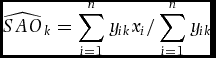
In order to determine the successional positions of different gap tree cohorts, and gap juvenile and canopy tree assemblages, weighted averaging (WA) regression and calibration was performed with C2 version 1.4.2 (Juggins Reference JUGGINS2003). WA regression was performed on canopy tree relative abundance (basal area) calibrated by successional age, creating a species-successional relationship. The optimal forest age for each species was determined by abundance-weighted averaging in a calibration data set where the stand age is known (Carrington et al. Reference CARRINGTON, ROSS and BASIT2015, Ross et al. Reference ROSS, CARRLNGTON, FLYNN and RUIZ2001). As in Ross et al. (Reference ROSS, CARRLNGTON, FLYNN and RUIZ2001) and Carrington et al. (Reference CARRINGTON, ROSS and BASIT2015), each species’ successional age optimum  ${\widehat {SAO}_k}$ was calculated from tree composition in the 2013–2014 survey as
 $$\begin{equation*}
{\widehat{SAO}_k} = \mathop \sum_{i = 1}^{n} {y_{ik}}{x_{i}}/\mathop \sum_{i = 1}^{n} {y_{ik}}
\end{equation*}$$
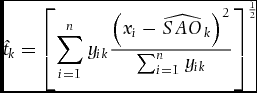
and its tolerance (weighted standard deviation,  ${\hat t_k}$) as
 $$\begin{equation*}
{\hat t_k} = {\left[ {\mathop \sum \limits_{i = 1}^n {y_{ik}}\frac{{{{\left( {{x_i} - {{\widehat {SAO}}_k}} \right)}^2}}}{{\mathop \sum \nolimits_{i = 1}^n {y_{ik}}}}} \right]^{\frac{1}{2}}}
\end{equation*}$$
where xi is time since last land clearing in stand i and yik is relative abundance of species k in stand i (i = 1, …n stands and k = 1, …m species).
Classical deshrinking was used in WA regression to correct for a contraction in the range of estimated values (overestimates at the low end and underestimates at high values of the environmental variable), a byproduct of the double averaging during WA regression and calibration (ter Braak & van Dam Reference TER, F. and VAN DAM1989).
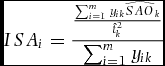
To compare the successional stage of trees in canopy gaps versus the non-gap tree canopy, a WA model without downweighting by species tolerances was used to infer successional ages. An inferred stand age (ISA) was calculated for each site as:
 $$\begin{equation*}
IS{A_i} = \frac{{\frac{{\mathop \sum \nolimits_{i = 1}^m {y_{ik}}{{\widehat {SAO}}_k}}}{{\hat t_k^2}}}}{{\mathop \sum \nolimits_{i = 1}^m {y_{ik}}}}
\end{equation*}$$
where yik is the relative abundance of non-gap canopy-tree species i, saplings of gap species i, or poles of gap species i, in stand k. In order to test the effects of gap tree cohort and stand age on successional position, two-way ANOVA was applied to sapling and pole ISAs in canopy gaps and transects in young, middle-aged and old stands. Three-way ANOVA was applied to evaluate the effects of forest age class, forest structure (canopy gap or intact forest) and gap tree cohort on ISA. Post hoc comparisons between populations were made using the Tukey honest significant difference test.
RESULTS
Thirteen tree species in Key Largo were involved in the formation of canopy gaps. The greatest number of gap-forming trees were unidentified, usually due to the state of decomposition. One hundred and thirty gap-forming trees were observed across the 45 treefall gaps, a mean of 2.89 trees per gap. Lysiloma latisiliquum was the most common gap-forming species, with more than twice as many individuals forming gaps than the next most common species. The other frequent gap-forming species were the most common canopy trees, including Coccoloba diversifolia and Bursera simaruba.
The LiDAR DCM included more than three million pixels of eligible forest canopy, with a representative height of 13.7 m (median = 12.7 m). Of the eligible forest pixels, 68244 were classified as canopy-gap pixels, representing 2.19% of the total forest. When grouped into continuous polygons, most of these openings were smaller than 20 m2 in area, and were excluded from further analysis. Six hundred and forty-eight canopy gaps larger than minimum size were identified, comprising 0.34% of total eligible forest area. In North Key Largo, where 18.9% of the forest was young, 42.4% medium and 38.7% old, the young-forest category contained almost as many eligible canopy gaps as middle-aged and mature forests combined. Young forests contained 278 canopy gaps, medium contained 143 canopy gaps, and old forest had 144 canopy gaps. Gaps comprised 1.05% of young-forest area, 0.17% of medium forest, and 0.18% of old-forest area. In the young forest, 110 gaps were small, 124 were medium and 44 were large. Medium forests contained 70 small gaps, 58 medium gaps and six large gaps. Old forests contained 88 small gaps, 49 medium gaps and seven large gaps.
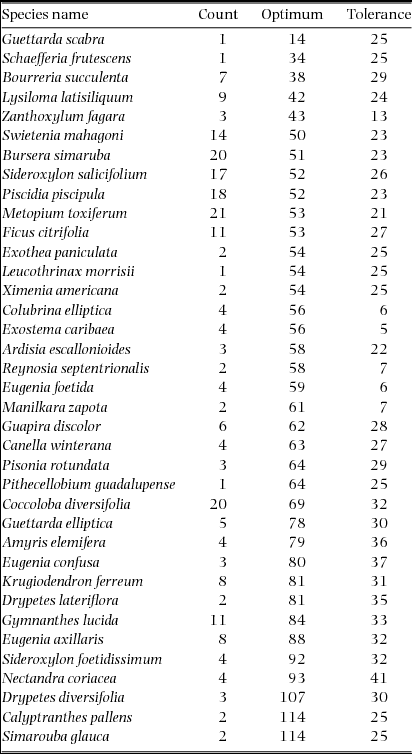
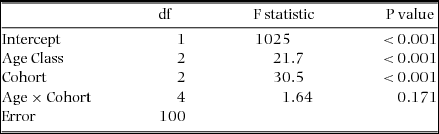
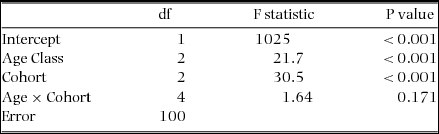
Table 1 lists the successional age optima of 37 Key Largo tree species, used to calculate Inferred Successional Ages (ISAs) for various tree cohorts. ISAs of saplings and poles found in the gaps were first compared with ISAs based on canopy trees. Two-way ANOVA testing the effects of cohort and forest age class indicated that both of the main effects were significant (P < 0.001), but the interaction between these effects was not significant (P = 0.171) (Figure 2, Table 2). The mean ISAs of gap juvenile trees of both size cohorts were consistently higher than the canopy in all age classes. The Tukey test indicated that the ISA of both of these cohorts were significantly higher than the canopy (both P < 0.005) but not significantly different from each other (P = 0.435). The juvenile trees of these gaps display a species composition more typical of an older forest than what is observed in the canopy layer.
Weighted averaging regression was used to calculate optimum ages (y) for the presence of each of 37 Key Largo, Florida, USA tree species (adapted from Ross et al. Reference ROSS, CARRLNGTON, FLYNN and RUIZ2001). Frequency is the count of up to 21 transects where each species was identified in 1994–1995. Tolerance, the weighted standard deviation, suggests the level of flexibility of species’ optimum forest age (y). Wunderlin & Hansen (Reference WUNDERLIN and HANSEN2011) was used as the standard nomenclatural reference.
Results of the two-way ANOVA for comparing ISAs of gap juvenile trees and intact canopy trees in Key Largo, Florida, USA. Age classes of the forest are young (up to 43 y), medium (44–74 y), and old (75 y and over). Canopy gap cohorts were juvenile trees split into two size classes, saplings (1–3 m) and poles (3–5 m). The effects of age class and cohort were significant, but the interaction was not.
The inferred ages of canopy-gap juvenile trees were compared with the transect canopy in Key Largo, Florida, USA. Sapling and pole ISAs were compared with the ISAs of the canopy. Two-way ANOVA indicated no interaction between forest age class and these three populations (P = 0.171). Juvenile gap tree ISAs were consistently higher than the canopy, with the largest difference in the young age class. A post hoc Tukey HSD test indicated that both saplings and poles in gaps had significantly higher ISAs than the canopy, although not significantly different from each other.
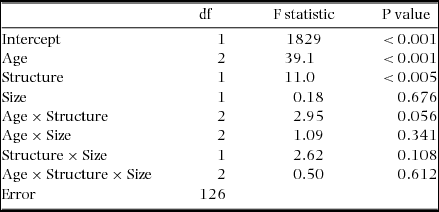
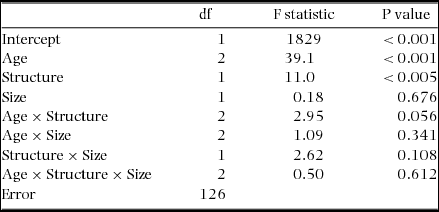
ISAs of juvenile trees growing in canopy gaps were compared with juvenile trees growing in intact-forest transects. Three-way ANOVA compared the effects of forest age class, forest structure (canopy gap or intact forest), and juvenile tree cohort on ISA. Forest age class and forest structure were significant effects (age: P < 0.001, structure: P < 0.005), but the effect of juvenile tree cohort was not significant, nor were any of the interactions (Table 3). Juvenile tree ISA increased with forest age, with Tukey test indicating only significant differences between the young age class and the two older classes (P < 0.001). Likewise, canopy-gap juvenile trees had higher ISAs than juvenile trees growing in intact forest, irrespective of cohort (Figure 3).
Results of the three-way ANOVA for comparing ISAs of canopy gap and intact forest juvenile trees, Key Largo, Florida, USA. Age classes of the forest are young (up to 43 y), medium (44–74 y), and old (75 y and over). Structure is gap juvenile trees versus intact forest juvenile trees. Sizes are saplings (1–3 m) and poles (3–5 m). The effects of age and structure were significant, but size was not significant, and none of the interactions were significant.
Histograms of young forest juvenile tree ISAs in transects of intact forests (a), and canopy gaps (b) in Key Largo, Florida, USA. The juvenile trees in young forests growing outside of gaps represent lower ISAs than other forest ages, and juvenile trees growing in canopy gaps. The canopy gap juvenile trees represent an increase in ISA, advancing the successional status of the forest. Non-gap forest transects recorded the greatest number of trees in the 31–40-y age class, especially due to the pioneer tree species Bourreria succulenta (ISA = 38). Canopy gaps recorded the greatest number of trees in the 61–70-y age class, primarily Coccoloba diversifolia (ISA = 69) and Pithecellobium guadalupense (ISA = 64).
DISCUSSION
The traditionally accepted model of forest canopy gap dynamics envisions early-successional species regenerating in canopy gaps. If this gap replacement model were in effect in the forest of North Key Largo, the ISAs of canopy-gap juvenile trees would be lower than the ISAs of the canopy trees, and lower than the ISAs of the juvenile trees growing in closed-canopy transects of a similar forest age. Neither of these trends was observed in this forest. Instead, juvenile trees growing in the canopy gaps exhibited a significantly higher ISA than those in the surrounding forest. The canopy-gap juvenile trees also had significantly higher ISAs than juvenile trees in the surrounding intact forest, although the differences were small in all except the young forests.
The distribution of canopy gaps across age classes of the forest further indicates that the gaps are not resetting the successional sequence. On a percentage basis, gaps were three times as abundant in young Key Largo forests as in medium and old forests combined. In order for gaps to function importantly in resetting the seral sequence, a higher proportion of gaps should occur in older forests. Since most gaps were found in young forests, and the ISAs of these gaps were higher than surrounding forests, the gaps appear to represent an intermediate step in the successional process, not a transition to the next sequence. In the Key Largo young forest canopy gaps, large individuals of pioneer species like Lysiloma latisiliquum die, and are replaced by mid-successional saplings such as Nectandra coriacea.
The life history of L. latisiliquum and other pioneer species is important to the successional pattern of this hardwood hammock. Lysiloma latisiliquum grows quickly, producing a broad canopy and emerging above its neighbours. It is the fourth most common species in the entire forest; however it is the most active gap-former, with more than twice as many gap-forming individuals as any other species. Other species, such as Metopium toxiferum and Bursera simaruba, are also early pioneers of disturbed habitats, but these species persist longer as large canopy trees than L. latisiliquum, and as a result have higher successional age optima. The death and replacement of common pioneers that do not persist or regenerate in gaps, for instance L. latisiliquum, Bourreria succulenta, Swietenia mahagoni and Piscidia piscipula, create the major shift in species composition and ISA in this forest.
Key Largo's dry forest displays a pattern of gap distribution that is intermediate between the rain-forest model of gap creation and pioneer infiltration, and the non-gap model of xeric forests (Swaine et al. Reference SWAINE, LIEBERMAN and HALL1990). The high ratio of tree diameter to height that characterizes trees in the dry forest makes them more windfirm, leading to lower rates of gap formation and smaller gap areas than in rain forest (Dickinson et al. Reference DICKINSON, HERMANN and WHIGHAM2001). Seemingly, South Florida's intermediate seasonality and precipitation lead to an environment in which the small canopy gaps that form at a low background rate do not favour the establishment and growth of pioneer tree species.
Species establishment depends on microclimatic factors, which usually differ between the gap environment and the non-gap understorey (Denslow Reference DENSLOW1987). The reason that gaps advance the succession of Key Largo and other dry tropical forests may involve the size of the openings, and its effect on the availability of light and soil moisture to seedlings. These resources were not measured in this study, but have been shown to constrain species establishment in several studies of temperate and tropical forests (Clinton Reference CLINTON2003, Everham et al. Reference EVERHAM, MYSTER and VANDEGENACHTE1996). In Panama, the availability of soil water is a direct determinant of the local distribution of tropical tree species (Engelbrecht et al. Reference ENGELBRECHT, COMITA, CONDIT, KURSAR, TYREE, TURNER and HUBBELL2007). Supplementing the supply of water promotes survival of tropical dry-forest seedlings, and augments seedling growth (McLaren & McDonald Reference MCLAREN and MCDONALD2003). Because the amount of soil water in a gap often increases with gap size (Latif & Blackburn Reference LATIF and BLACKBURN2010, Marthews et al. Reference MARTHEWS, BURSLEM, PATON, YANGÜEZ and MULLINS2008), the small Key Largo gaps may not increase water availability sufficiently for pioneer species (Horn Reference HORN1974, Swaine & Whitmore Reference SWAINE and WHITMORE1988). The increased availability of light in canopy gaps also promotes the establishment of pioneer tree species (Canham et al. Reference CANHAM, DENSLOW, PLATT, RUNKLE, SPIES and WHITE1990, Denslow Reference DENSLOW1987, Swaine & Whitmore Reference SWAINE and WHITMORE1988, Whitmore Reference WHITMORE1989). However, forests in the dry tropics have shorter canopies than in most wet tropical and temperate forests, and Caribbean forests are some of the lowest in the biome (Van Bloem et al. Reference VAN, J., MURPHY and LUGO2007). Tropical dry forests have few vegetation layers, creating a well-lit forest floor, and limited differentiation between gap and understorey environments (Frankie et al. Reference FRANKIE, BAKER and OPLER1974).
In the Key Largo hardwood hammocks, the canopy is short and gaps are small. The result is a forest mosaic in which the contrast between gap and understorey environmental conditions is minimal, and the composition of gap and understorey tree assemblages are similar. In this forest, gap dynamics outside of those caused by major disturbance events do not favour the establishment of pioneer tree species. Rather, the conditions necessary for colonization by early-successional species presumably result from large-scale disturbances, i.e. major hurricanes and fires (Fernandez & Fetcher Reference FERNANDEZ and FETCHER1991). Such events, especially the latter, recur infrequently in nature. In South Florida the average return period for a hurricane category 3 and higher is 13–35 y (Keim et al. Reference KEIM, MULLER and STONE2007). The occurrence of fire in hammocks is even less frequent, from 25 to over 200 y (Wade et al. Reference WADE, EWEL and HOFSTETTER1980). However, in Key Largo, these disturbances appear to have been mimicked in part by 20th century agricultural abandonment, which created large areas suitable for pioneers. In the absence of a new major disturbance, late-successional species will continue to proliferate in this forest.
ACKNOWLEDGEMENTS
We thank the staff of Crocodile Lakes National Wildlife Refuge and Dagny Johnson Key Largo Hammock Botanical State Park for logistical support. We thank J. Rehage and K. Zhang for guidance on this project, S. Stoffella for analytical assistance, and the GIS Center at FIU for technical assistance. We thank the members of the South Florida Terrestrial Ecosytems Lab for helpful discussion and comments. This is contribution number (776) from the Southeast Environmental Research Center at Florida International University.