Introduction
For a certain period after an acute vestibular disturbance, patients often report imbalance, head movement induced dizziness and visual blurring (oscillopsia).Reference Gresty, Hess and Leech1–Reference Bhansali, Stockwell and Bojrab3 Pharmacological and surgical interventions offer limited improvement. Medication is often directed at vestibular suppression and/or control of symptoms such as nausea, and seems to have very little effect on balance disorders.Reference Smith-Wheelock, Shepard and Telian4
After an acute vestibular disturbance, central compensatory mechanisms lead to recovery from balance impairment. Compensation occurs in about 70 per cent of cases, in the form of overweighting of visual and proprioceptive cues for balance control.Reference Mira5
Since the first reports by CawthorneReference Cawthorne6 and Cooksey,Reference Cooksey7 rehabilitation has demonstrated its effectiveness; such rehabilitation has comprised a physical therapy programme with the main purpose of brain training to compensate for defective or abnormal vestibular input.Reference Cohen8–Reference Lacour, Toupet, Denise and Christen11
In a prospective, randomised study, Strupp et al. showed that patients with acute, unilateral vestibular hypofunction who performed a combination of habituation and Cawthorne–Cooksey exercises had significantly improved postural stability, compared with an untreated control group, after one month of vestibular rehabilitation.Reference Strupp, Arbusow, Maag, Gall and Brandt12
Dysfunction of the vestibular system can trigger anxiety. Anatomical and functional connections between the vestibular system and structures involved in the pathogenesis of anxiety and panic disorder or conditioning of fear responses, such as the locus ceruleus and the raphe nucleus, further corroborate this concept. A recent comparative questionnaire study found that patients with acute vestibular dysfunction experienced more anxiety and depression and/or subjective disability than patients with other acute, non-vestibular neurological deficits. Moreover, generalised anxiety or depressive states and somatoform disorders can all compound the sensation of dizziness.Reference Yardley, Masson, Verschuur, Haacke and Luxon13–Reference Pollak, Klein, Stryjer, Kossych and Rabey18
We conducted a comparative study in order to assess the importance of rehabilitative management of dizzy patients following a recent acute vestibular disturbance, and to estimate the importance of anxiety disorders in preventing balance compensation.
Materials and methods
Patients
Forty patients hospitalised between March 2005 and December 2005 for an acute, rotational vertigo episode that lasted for several days were randomly divided into two groups. The first group of 20 patients (group R) undertook rehabilitative therapy, consisting of 45-minute sessions three times a week for a total of 10 sessions. This therapy was delivered by a therapist trained in vestibular disorders, and began 10 days after the baseline measurement. The second group of 20 patients (group C) did not undertake any active physiotherapy, but were instead advised to ‘perform their daily activities’. No patient in either group had spontaneous nystagmus at baseline.
The inclusion criteria were as follows: recent rotational vertiginous episode with autonomic symptoms, lasting for several days, with a peripheral pattern (positive head-thrust) (all patients displayed third degree, horizontal nystagmus during hospitalisation, and all were given a definitive diagnosis of vestibular neuritis); no other previous vertiginous episodes; no other neurological disorders (especially migraine – all patients underwent central nervous system MRI); no therapy with drugs active on the central nervous system, except betahistine 16 mg twice a day; no previous psychiatric disorders, especially anxiety; no significant visual deficits or acute orthopaedic disorders; and an age of 18–75 years.
Group R comprised eight men and 12 women (mean age 53.5 ± 9.8 years), while group C comprised 11 women and nine men (mean age 51.4 ± 9.1 years). No statistical difference was detected between the two groups.
Procedure
Outcome measures to assess therapeutic results were performed at baseline and on completion of rehabilitative therapy for group R or after 25 days for group C.
Static stabilometry (posturography)
This test was undertaken using a force platform (Amplaid, Milan, Italy) SveP platform, 10-Hz signal acquisition). Vertical force transducers recorded changes in successive positions of the centre of pressure, obtaining the total centre of pressure sway path under different conditions. Stabilometry was conducted by otolaryngologists, according to a standardised procedure.Reference Gagey and Weber19
Each recording took 30 seconds. We calculated the following two variables: length of body sway (expressed in millimetres), being the sum of the distances between the sequentially sampled centre of pressure positions (i.e. total sway path described by the centre of pressure; length was considered to be the main stabilometric variable); and surface of body sway (expressed in millimetresReference Chambers, Mai and Barber2), being the confidence ellipse containing 90 per cent of the sampled positions of the centre of pressure, indicating the precision of the postural system.
Examination was performed under the following conditions: eyes open; eyes closed; eyes open and standing on a 10 cm piece of thick foam rubber; and eyes closed and standing on a 10 cm piece of thick foam rubber.
During such testing, when their eyes were open subjects were instructed to look at a white line on a black background projected in front of them on a 43 cm display.
For the length of body sway parameter, the following quotients were calculated: eyes open / eyes closed (Q1); eyes open on foam rubber / eyes closed on foam rubber (Q2); and eyes open / eyes closed on foam rubber (Q3). The first two calculations were considered to be a measure of visual cues in balance control (with and without proprioceptive variables). The third calculation was considered to be a complementary measure of unmasked vestibular function without vision and proprioception.
Dynamic gait index
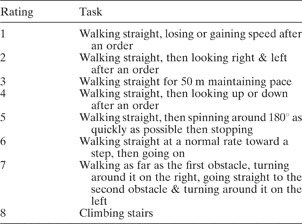
This index is a good instrument in the evaluation of dynamic balance. It consists of eight tasks to be performed, each scored between zero (i.e. the patient is unable to perform the task) and three (i.e. normal performance), as shown in Table I. All tests were supervised by the same physician, who had been trained in vertiginous disorders. Patients with a total dynamic gait index score of less than 19 (out of a possible total of 24) have a 2.5 times higher probability of falling in the next six months; moreover, the total score is correlated with a serious risk of falls in patients with vestibular disorders, in addition to age.Reference Wrisley, Walker, Echternach and Strasnick20, Reference Whitney, Marchetti, Schade and Wrisley21
Dynamic gait index

Dizziness handicap inventory
Jacobson, Newman and colleagues have proposed a self-administered questionnaire with the purpose of evaluating balance disorders as perceived by patients; physical, emotional and functional aspects of the handicap are considered.Reference Jacobson and Newman22, Reference Jacobson, Newman, Hunter and Balzer23 The final version of the dizziness handicap questionnaire consists of 25 questions, of which nine address functional aspects, nine emotional aspects and seven physical aspects. For each question, there is a score of four points for ‘yes’, two for ‘sometimes’ and zero for ‘no’. The total score scale ranges from zero (i.e. no handicap) to 100 (i.e. severely handicapped). Partial scores for the physical, functional and emotional subscales are calculated using the following key: functional scale, answers to questions three, five, seven, 12, 14, 16, 19 and 24; emotional scale, answers to questions two, nine, 10, 15, 18, 20, 21, 22 and 23; and physical scale, answers to questions one, four, eight, 11, 13, 17 and 25.
Visual analogue scale for anxiety
This visual analogue scale (VAS) indicates the patient's severity of anxiety in everyday life, on a continuum from zero (i.e. no anxiety) to 100 (i.e. worst anxiety imaginable). Patients were asked to answer the question, ‘after your vertigo, how anxious do you feel?’. Changes in the anxiety VAS were evaluated (as the percentage of maximum increment or decrement possible) and calculated as follows: Δ per cent VAS-A = ΔVAS-A × 100/(100 − VAS-A at baseline), where VAS-A = anxiety VAS.
Changes in results for the dizziness handicap questionnaire, dynamic gait index and posturographic parameters were evaluated using the same calculation.
The rehabilitation sessions took place three times a week for a total of 10 sessions, each lasting for 45 minutes. The following exercises were performed, some with the help of a stabilometric platform and with visual feedback. To develop visual feedback on a stabilometric platform, the patient was requested to stand on the stabilometric platform and to minimise any swaying of their centre of pressure by viewing their centre of gravity on a monitor in front of them; the monitor also displayed circles to serve as a spatial reference (the size of these references could be modified in order to sensitise and customise the exercises). To develop dynamic visual stimulation, the patient was asked to stand on the stabilometric platform while looking at an optokinetic stimulus on a display in front of them, in order to create conditions of potential difficulty in postural control. To develop sensory contrast, the patient was asked to stand on a stabilometric platform on 10 cm of foam rubber, once unaided and a second time while looking at an optokinetic stimulus. To develop ability with visual targets, the patient was asked to stand on the platform and to control their voluntary movements, graphically represented on a display in front of them; they were encouraged to hit a series of targets which randomly appeared on the monitor. To increase vestibulo-oculomotor gain with point de mire, patients were asked to look at a point in front of them while oscillating their heads on yaw and pitch plane; exercise was performed initially, while sitting, and then, after the first few sessions, whilst standing in the Romberg position. To develop balance maintenance, the patient was asked to maintain their balance alternately on their heels and toes. Patients also used ‘technique five’, consisting of five exercises to be repeated five times a day, as follows: one, quickly shake your head from right to left 20 times with your eyes closed, then stop and stare at a point in front of you; two, turn your head to the right and lay down rapidly on your back, maintaining your head turned, stare at a point, then sit up and stare at a point; three, the same as exercise two but with your head turned to the left; four, the same as exercise two but looking straight ahead; and five, lay down on a bed on your back with your head hanging down. Patients were asked to perform the last three exercises at home, twice a day.
Statistical analysis
Continuously distributed variables were described as mean and standard deviation. The significance of any difference between groups was analysed using the t-test for independent or dependent samples.
Results
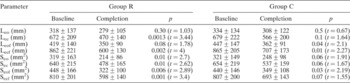
The results of posturographic examinations and statistical analyses are summarised in Table II. Values for length of body sway with eyes open did not show any statistically significant change in either group. Values for length of body sway with eyes closed decreased in group R but not in group C, as did the values for surface of body sway with eyes open and surface of body sway with eyes closed. Values for surface of body sway with eyes closed on foam rubber decreased only in group R. Values for length of body sway with eyes closed on foam rubber decreased in both groups.
Results of posturographic examinations and statistical analysis

Group R = rehabilitation patients; group C = control patients; L = length of body sway; S = surface of body sway; eo = eyes open; ec = eyes closed; eof = eyes open on foam rubber; ecf = eyes closed on foam rubber
The quotients Q1 (eyes open / eyes closed), Q2 (eyes open on foam rubber / eyes closed on foam rubber) and Q3 (eyes open / eyes closed on foam rubber) improved only in group R. These results are shown in Table III.
Values of Q1, Q2 and Q3 and statistical analysis

Q1 = Leo/Lec; Q2 = Leof/Lecf; Q3 = Leo/Lecf. Group R = rehabilitation patients; group C = control patients; L = length of body sway; eo = eyes open; ec = eyes closed; eof = eyes open on foam rubber; ecf = eyes closed on foam rubber
The dizziness handicap questionnaire total score and subscale scores improved in both groups, while the anxiety VAS score improved only in group R. The dynamic gait index decreased only in group R. A statistical correlation was found between the dizziness handicap questionnaire emotional subscale score and the dynamic gait index, and also between the anxiety VAS score and the dynamic gait index (p < 0.05) in both groups, at baseline and after completion of rehabilitation (group R) or after 25 days (group C). These results are summarised in Table IV.
Values for DHI total score and subscales, DGI and anxiety VAS scores in the two groups at baseline and on completion

DHI = dizziness handicap questionnaire; DGI = dynamic gait index; VAS-A = anxiety visual analogue scale; group R = rehabilitation patients; group C = control patients; emo = emotional subscale; func = functional subscale; phys = physical subscale
Moreover, improvements (as Δ per cent) in the two groups were compared. There was a statistically significant difference in Δ per cent dizziness handicap questionnaire total scores between the two groups (t = 4.02; p = 0.002), and in Δ per cent anxiety VAS scores between the two groups (t = 6.91; p < 0.001). On the other hand, there were no statistically significant differences in Δ per cent dynamic gait index between the two groups (t = 1.93; p = 0.095), although rehabilitated patients showed better results.
No correlation was detected in the Δ per cent anxiety VAS scores and the Δ per cent Q1 and Q2 between the two groups. However, a statistically significant correlation was detected between the Δ per cent anxiety VAS scores and the Δ per cent Q3 (t = 3.64 and p = 0.0017 in group R, compared with t = 5.21 and p < 0.001 in group C). A correlation between the Δ per cent anxiety VAS scores and the Δ per cent dizziness handicap questionnaire results was detected in group R (t = 3.3; p = 0.0038) and in group C (t = 6.35; p < 0.001), and between the Δ per cent anxiety VAS scores and the Δ per cent dynamic gait index (t = 2.04 and p = 0.05 in group R, and t = 6.17 and p < 0.001 in group C). Differences in anxiety VAS scores alone could explain improvements in the dynamic gait index in group C. Moreover, a statistically significant correlation was detected between the Δ per cent dizziness handicap questionnaire emotional subscale scores and the Δ per cent dynamic gait index in both groups (t = 3.14 and p < 0.01 in group R, and t = 4.45 and p < 0.001 in group C).
Discussion
Several studies have demonstrated the efficacy of vestibular rehabilitation in improving postural stability and reducing subjective dizziness. However, few studies have focused on vestibular rehabilitation for patients with an acute onset of vestibular disturbance. Our data seem to support the effectiveness of a supervised exercise programme, and our results are in accordance with those of previous studies.Reference Krebs, Gill-Body, Riley and Parker24–Reference Herdman, Clendaniel, Mattox, Holliday and Niparko26
The posturographic parameters and quotients obtained demonstrate visual dependence in both groups. However, quotients were significantly reduced after therapy only in group R, underlining a more critical condition of the balance system when lacking one of the three cues. Moreover, quotients are significantly increased after therapy only in Group R, underlining a more critical condition of the balance system in group C patients when lacking visual cues.
Values of surface decreased more than length in eyes opened condition in both groups. According to recent studies, the surface of body sway parameter seems to be more related to vestibular function than does length of body sway.Reference Yasuda, Nakagawa, Inoue, Iwamoto and Inokuchi27
Improvements in dynamic gait index differ between the two groups and show poor correlation with posturographic parameters. This is not surprising, considering that posturography only examines standing balance, while the dynamic gait index tests the functional aspects of gait. In our opinion, posturography should be used only as part of a battery of outcome measures evaluating the success of rehabilitative therapy.
Anxiety should always be considered when managing rehabilitative therapy.
The dizziness handicap questionnaire results showed that the emotional subscale scores decreased more than the physical and functional subscale scores in rehabilitated patients compared with control patients.
In a comparative questionnaire study of 30 patients with a first attack of vestibular dysfunction and 35 patients with a non-vestibular neurological deficit of acute onset, Pollak et al. Reference Pollak, Klein, Stryjer, Kossych and Rabey18 found that the vertigo patients reported more post-attack anxiety than patients with non-vestibular neurological deficits, despite the fact that pre-morbid anxiety was similar in both groups. Moreover, vertigo patients felt more disabled than non-vertigo patients, irrespective of the objective restrictions caused by the disease. The rate of depression did not differ between the groups of patients.
In other studies, Yardley and colleaguesReference Yardley, Vershuur, Masson, Luxon and Haacke14, Reference Yardley and Putman28 underlined how the degree of handicap experienced after an acute vestibular disturbance was influenced by a mixture of somatic and psychological variables, and stated that anxiety was only indirectly related to the severity and duration of vertigo. In their opinion, the partial dissociation between somatic and psychological aspects of patient wellbeing suggested a need for separate evaluation of problems.
• After an acute vestibular disturbance, patients often suffer from imbalance, head movement induced dizziness and visual blurring (oscillopsia)
• This study assessed the efficacy of rehabilitative management for dizzy patients after a recent acute vestibular disturbance
• Patients receiving specific vestibular rehabilitation obtained better results than did controls, for all recorded outcomes
• These results seem to support the effectiveness of a supervised exercise programme for patients following acute onset of vestibular disturbance
As shown before, we found that the patients with the best dynamic gait index results were those with lower values for anxiety on the dizziness handicap questionnaire emotional subscale and the anxiety VAS. Moreover, in both groups, patients with lower anxiety levels after completion of rehabilitation (for group R) or after 25 days (for group C) had higher dynamic gait index results.
Conclusion
Our work seems to support the effectiveness of a rehabilitation programme for all patients following acute vestibular disturbance. We suggest that both physical and emotional factors should be considered during rehabilitation; in our opinion, in occasional patients, benefits may therefore result from counselling or behavioural therapy.