The coronavirus disease 2019 (COVID-19) pandemic continues, and healthcare workers (HCWs) are at increased risk of infection.Reference Nguyen, Drew and Graham1 In addition to the morbidity associated with initial illness, persistent postviral symptoms, currently classified as postacute sequelae of COVID-19 (PASC),Reference Groff, Sun and Ssentongo2 also affect HCWs, causing further disruptions in their work, home, and social lives.Reference Havervall, Rosell and Phillipson3 To further characterize PASC in this population, who are otherwise expected to be highly functional and in relatively good health, we sought to identify predictors and functional status of HCWs with persistent symptoms beyond 4 weeks after their initial COVID-19 diagnosis.
Methods
We conducted an observational cross-sectional study from February 18 to April 10, 2021, within 3 healthcare systems in 2 Midwestern states (Froedtert & Medical College of Wisconsin, University of Wisconsin Hospital and Clinics in Madison and Swedish American Health in Illinois), with a total of 1,625 beds. Eligible participants included all HCWs identified through occupational health to have had at least 1 laboratory-confirmed severe acute respiratory coronavirus virus 2 (SARS-CoV-2)–positive polymerase chain reaction (PCR) diagnosis of COVID-19 between March 1, 2020, and January 15, 2021. Methods to identify HCWs positive for COVID-19 by occupational health departments were similar across the 3 healthcare systems and captured HCWs working in the outpatient and/or inpatient setting, regardless of symptom presence at the time of their initial positive COVID-19 test.
Most HCWs received COVID-19 testing through their occupational health departments. HCWs who underwent outside testing were required to notify their occupational health departments of any positive results. Eligible participants were invited to respond to an anonymous online survey, with e-mails inviting participation sent from occupational health departments on 2 occasions, 3 weeks apart. Each site’s institutional review board exempted the study from approval because it involved deidentified participants.
Functional status in everyday life at the time of the survey was assessed in relation to symptoms presence using the post–COVID-19 functional status scale described by Klok et al.Reference Klok, Boon and Barco4 Respondents reporting persistent symptoms (either continued from initial illness or newly developed after initial illness) for longer than 4 weeks after initial positive test were compared with respondents who remained asymptomatic or experienced symptoms ≤4 weeks after their initial positive test. Associations between categorical variables were analyzed using χ2 tests, and logistic regression was used to determine independent predictors for persistent symptoms. Observations with missing data resulting from unanswered survey items were excluded from the analysis of the corresponding affected variable. A 2-sided P value of .05 was considered statistically significant. All analyses were conducted in Stata version 16 SE software (StataCorp, College Station, TX).
Results
The survey response rate was 25% (1,012 of 4,029 HCWs). Most survey participants (53%) were from the Milwaukee healthcare systems, followed by Madison (27%) and Illinois (20%) healthcare systems, respectively. Demographics, underlying comorbidities, and severity of initial illness were similar among participants, except for a slightly higher incidence of age >50 years (P = .02) and reported obesity (P = .02) among HCWs from one institution, and a higher incidence of women among participants from another institution (P = .01). Also, 701 respondents (70%) had duties that involved direct patient contact, such as nurses, nurse practitioners, and nurse aids (38%), physicians and physician assistants (6%), medical assistants (6%), and others (ie, pharmacists, medical technologists, phlebotomists, dietary specialists, ambulatory clinic personnel, environmental specialists, 20%). Most HCW respondents were female (87%), and most were aged 25–45 years (59%). The race or ethnicity of study participants was white (84%), Hispanic/Latino (6%), Black or African American (4%), or Asian (3%). For comparison, among all 33,009 HCWs employed by the participating institutions, 79% were women and 64% performed direct patient-care duties.
Persistent symptoms beyond the initial 4 weeks were reported by 679 (67%) of participants and included anosmia or ageusia (36%), excessive fatigue (34%), dyspnea (24%), difficulty concentrating in (21%), insomnia (14%), anxiety (13%), memory loss (13%), palpitations or tachycardia (12%), diffuse myalgias (11%), depression (10%), and chest pain (8%). Persistent symptoms lasted up to 6 weeks in 161 survey respondents (16%), up to 3 months in 119 HCW respondents (12%), and up to 6 months in 41 HCWs (4%). Furthermore, 353 HCWs (35%) reported ongoing symptoms at the time of the survey (range, 44 days–11 months). Only 333 HCWs (33%) reported no symptoms beyond the initial 4 weeks.
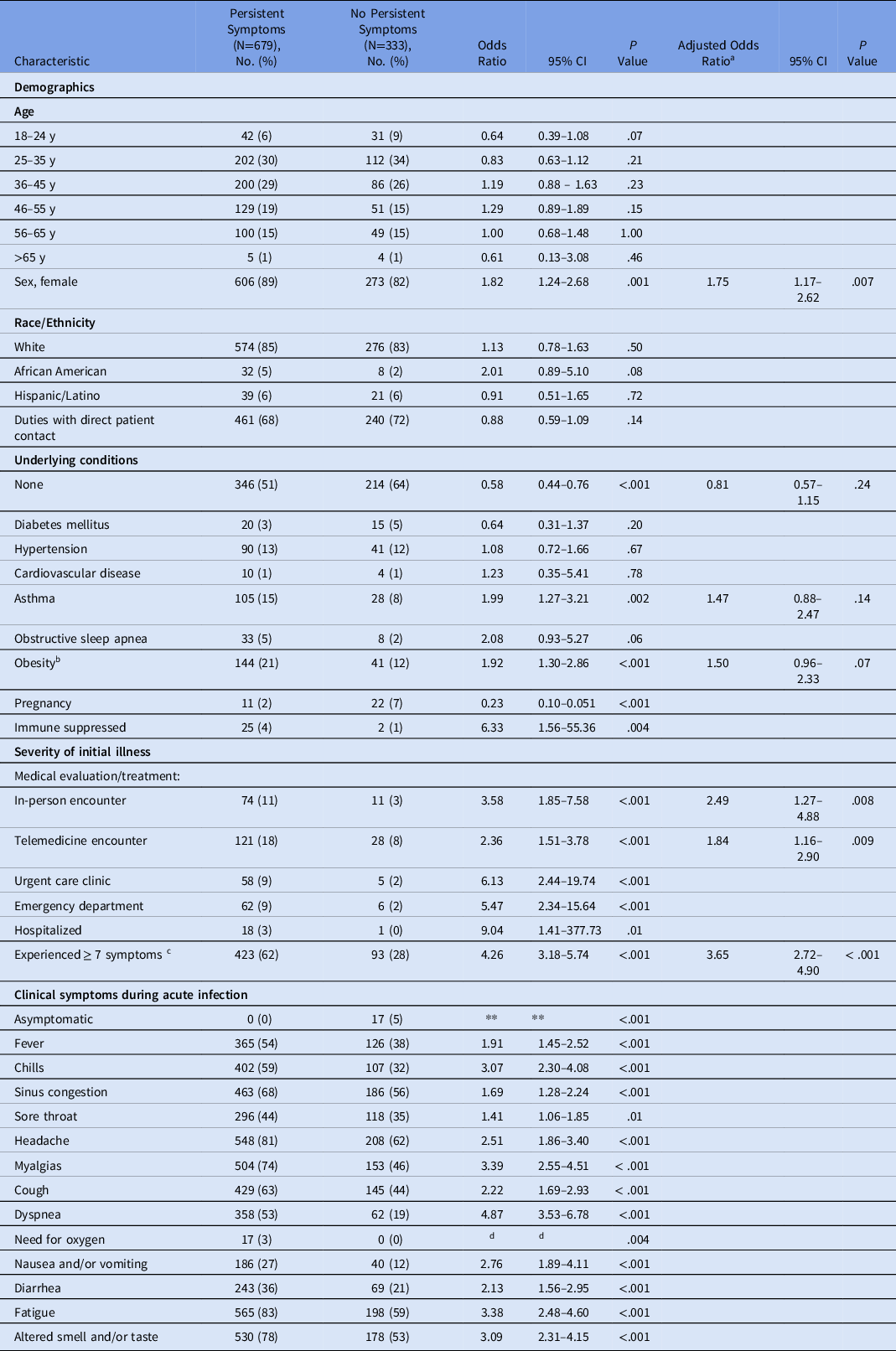
Demographic and clinical characteristics between HCWs with and without persistent symptoms beyond the initial 4 weeks are summarized in Table 1. The survey results indicated several independent predictors of persistent symptoms: ≥7 symptoms during initial infection, an initial evaluation and treatment though an in-person or a telemedicine encounter, and female sex. The area under the receiver operating curve for this model was 0.73.
Predictors of Persistent Symptoms Beyond 4 Weeks After Initial Infection Among Healthcare Workers, by Univariate and Multivariate Analysis

Note. CI, confidence interval; BMI, body mass index.
a Calculated by logistic regression, adjusted for: sex, no underlying illnesses, asthma, obesity, in-person or telemedicine healthcare evaluation during acute infection, and ≥ 7 symptoms during acute infection.
b Self-reported as “obesity” (BMI, height or weight measurements not collected).
c Mean and median number of initial symptoms = 6.35 and 7, respectively.
d Cannot be calculated.
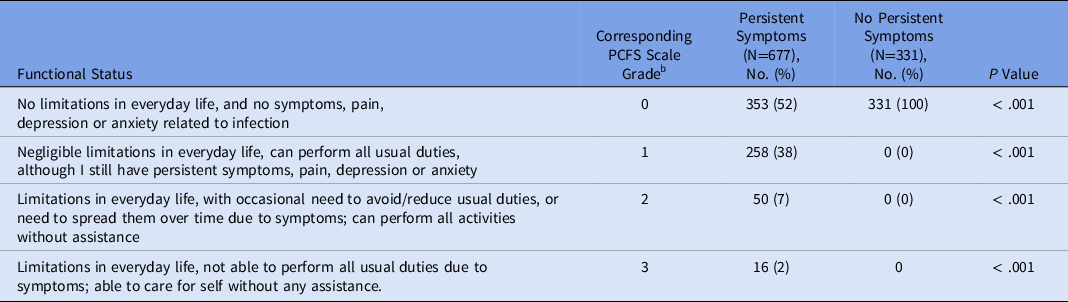
After COVID-19 diagnosis, 987 HCW respondents (98%) resumed all previous duties at work; 19 HCWs (1.89%) required work duty restrictions, and 1 HCW (0.1%) who was hospitalized in the intensive care unit was not able to return to work. Functional status descriptions and scores among HCWs with and without persistent symptoms are summarized in Table 2. None of the HCWs without persistent symptoms reported any limitations in their everyday duties or activities. Severe limitations in everyday life with dependence on others for care (scale grade 4) were not reported by any repondent.
Differences in Reported Everyday Functional Status Among Healthcare Workers With and Without Persistent Symptoms >4 Weeks Beyond Initial Infection, by Univariate Analysisa

Note. PCFS, post–COVID-19 functional status scale.
a Excludes 4 participants who did not respond to this question.
b Post COVID-19 functional status scale adapted from Klok et al.Reference Klok, Boon and Barco4
Discussion
Approximately two-thirds of HCWs in our study reported persistent symptoms consistent with PASC. This incidence was higher than the 26% reported in a Swedish HCW cohortReference Havervall, Rosell and Phillipson3 but lower than the 73% reported in a multicenter, prospective HCW cohort from Switzerland.Reference Strahm, Seneghini and Gusewell5 Although functional status was generally good, 9% of HCWs with PASC reported significant limitations in performing their routine daily activities, suggesting that some HCW with PASC would benefit from workplace accommodations. Developing workplace policies that are best suited to the needs of those returning to demanding healthcare professions after initial infection is particularly important in preserving the well-being of a workforce at high risk of exhaustion and burnoutReference Strahm, Seneghini and Gusewell5 that continues to be stressed beyond limits during this pandemic.Reference Praschan, Josephy-Hernandez and Kim6,Reference Dzau, Kirch and Nasca7
Female sex and more severe initial illness (ie, ≥7 initial symptoms and need for medical evaluation and treatment via in-person or telemedicine encounters) were predictors of PASC, confirming that the previously reported model by Sudre et al,Reference Sudre, Murray and Varsavsky8 which identified ≥5 symptoms during the first week of illness as a predictor of PASC for the general population is applicable to HCWs. Age ≥50 years, number of pre-existing comorbidities,Reference Tenforde, Kim and Lindsell9 asthma,Reference Sudre, Murray and Varsavsky8 and obesityReference Aminian, Bena, Pantalone and Burguera10 have also been identified as risk factors for PASC in recent studies. Both asthma and obesity were associated with persistent symptoms in our univariate analysis. These findings highlight a high-risk HCW subset that should be closely monitored for PASC development, with prompt evaluation and management of persistent symptoms.
Our study was limited by possible recall bias and the subjective nature of symptom reporting associated with survey design. Given the 25% response rate, selection bias was also possible, although respondent demographics reflected those of the HCWs in the region. The study was performed before HCW COVID-19 vaccination was completed and before the δ (delta) and o (omicron) pandemic waves. These latter variants may have had different epidemiologies, risk factors, clinical manifestations, and outcomes in fully vaccinated HCWs.
In summary, the PASC burden in HCWs is substantial and underscores the urgent need for interventions and resources to mitigate the persistent effects of SARS-CoV-2 infection in this critical workforce.
Acknowledgments
Financial support
This study was supported by the Department of Medicine, University of Wisconsin School of Medicine and Public Health1, Madison, Wisconsin.
Conflicts of interest
All authors report no conflicts of interest relevant to this article.