

1 Introduction
The Croatian system of old-age provision is in the midst of a transition to a new overall structure, following a half-hearted attempt at establishing a funded pillar for younger workers more than 10 years ago. It is also plagued by lasting consequences of the Great Recession, resulting in a low level of economic activity, while the system encourages inflows into disability and early retirement. Benefits are rather low already today, while pension finances and the entire public budget are under strong pressure. With current rules, the benefit level will become even lower over time, due to an ageing process of considerable scale. As a result, securing adequate amounts of retirement income will become an issue soon, while the fiscal space for doing so first needs to be established.
The Croatian pension system is in a particularly difficult situation, as it combines a number of problems, which are present also in other transition countries in Central and Eastern Europe, among them several EU member countries. Its institutional set-up is similar to that in the Baltic states, Bulgaria, Hungary, Poland, Romania or the Slovak Republic (Nickel and Almenberg, Reference Nickel and Almenberg2006; Altiparmakov and Nedeljkovic, Reference Altiparmakov and Nedeljkovic2016). Many of these countries showed a weak economic performance in recent years as well (European Commission, DG ECFIN, 2015). Public pension schemes are continuously in deficit in Bulgaria, Hungary, Poland and Slovakia; spending on disability and/or early retirement is relatively high in Hungary and Poland, plus Bulgaria; public debt also plays a major role in financing switches to partially funded systems in the same two countries, plus Romania (Kąsek et al., Reference Kąsek, Laursen and Skrok2008: ch. 1; Schwarz et al., Reference Schwarz, Arias, Zviniene, Rudolph, Eckardt, Koettl, Immervoll and Abels2014: ch. 2–4). Therefore, analyzing the current stance and the prospects for further reforming the system in Croatia may provide lessons that are of broader interest. In fact, our case study may highlight some of the reasons why pension reforms in transition countries have recently been reported to perform poorly (see, again, Altiparmakov and Nedeljkovic, Reference Altiparmakov and Nedeljkovic2016).
We begin by describing the Croatian pension system as it is shaped today, in the run-up to a period of acute demographic ageing. Then, we illustrate the main challenges for operating the system using projections regarding expected performance under the existing legal framework over the next five decades. Last but not least, we discuss a number of options for reforming the system, showing their potential impact on pension finances, public budgets and retirement incomes. We conclude by summarizing the main lessons that can be derived.
2 The current system
Old-age provision in Croatia is dominated by a public pension scheme, which is pay-as-you-go financed and offers benefits that are related to earlier wages and to the length of individual work records (Bejaković, Reference Bejaković2002; Nestić and Rašić Bakarić, Reference Nestić, Rašić Bakarić and Vehovec2008). In an attempt to fundamentally overhaul the system, a funded second pillar was added in 2002 (Šonje, Reference Šonje2011). It is financed from earnings-related contributions and operated by private pension funds. Participation in the second pillar was mandatory for all individuals aged up to 40 years at the time of the introduction. Those aged from 40 to less than 50 years had a right to choose whether to participate or not. Everyone aged 50 years and older had to stay entirely with the public, first-pillar scheme. Full contributions to the public scheme amounted to 20% of taxable wages at that time (and have remained constant since then). Those joining the mixed regime continue to pay the same contribution rate, of which 5 percentage points are channelled to their private pension funds as a second-pillar allocation. Their benefit entitlements acquired in the public scheme are adjusted accordingly, based on effective contributions of 15% of their wages in all subsequent years. The 2002 reform triggered a process of transition towards a partially pre-funded system of old-age provision, which will last several decades until the large majority of pensioners eventually receive benefits based on full life-time work records under both pillars. Originally, the plan had been to extend the shift by gradually increasing second-pillar allocations to 10% of taxable wages (reducing contributions to the public scheme correspondingly; World Bank, 2011). But a precise timing for this further step was never defined, and it has not been taken to date.
The public scheme offers disability, old-age and survivor pensions as a typical benefit package provided by such schemes (see MISSOC, 2015 for more detailed descriptions). For individuals fulfilling a certain number of qualifying years, early retirement is possible starting from 5 years before reaching the statutory age threshold. The statutory retirement age is 65 for males, while it is increasing from 60 to 65 for females between 2011 and 2030 (the precise threshold being 61 years and 3 months in 2015). It has already been legislated that the age threshold will be further increased to 67, for males and females alike, from 2031 to 2038. Benefit assessment is based on a point system translating individual work records and life-time earnings into pension entitlements for old age. In cases of disablement, pension points are added based on imputed contributions. Benefits are up-rated twice a year based on a mixed indexation rule (50% CPI inflation, 50% nominal wage growth). Implicitly, this rule also applies to the valorization of life-time earnings when assessing benefits at award. Therefore, compared with current (or earlier) wages, the rule has far-reaching consequences for the average level of benefits (or for individual replacement rates) when it is applied invariably over a longer period of time. Early-retirement pensions are subject to permanent deductions against the results of regular benefit assessment, but these deductions are generally low and vary by the number of qualifying years. Survivor benefits are derived (as a certain percentage) from pension entitlements of the deceased; in Croatia, they also apply to divorced spouses, cohabiting partners and parents if any of these persons were economically dependent.
In 2014, the gross level of old-age pensions (i.e., average old-age pensions divided by current average taxable wages) was about 32%.Footnote 1 On net terms, the figure would look a little more friendly (estimated to be around 40% in World Bank, 2011).Footnote 2 Yet, it is very low compared with benefit levels in other EU or OECD countries (OECD, 2015). The figure encompasses cases with privileged pension entitlements (mainly for soldiers and policemen, but also for politicians or academics) that can be substantially higher, while further types of privileged pensions (especially for war veterans) are administered separately. The system gives rise to considerable inequities, both within and across age cohorts, but it is not very generous in terms of average annual benefits provided. The system is generous, however, in terms of granting access to pensions relatively early. The total number of beneficiaries amounts to 130% of the population of pensionable age (defined by statutory age limits). Conversely, almost 20% of the population aged 20–64 (for males) or 20–60 (for females) are receiving some kind of pension benefits. The support ratio (i.e., the number of active members per beneficiary) is currently no more than 1.2, down from 1.4 around 2000 and 3.0 in 1990 (Nestić and Rašić Bakarić, Reference Nestić, Rašić Bakarić and Vehovec2008).
Expenditure of the first-pillar scheme amounts to 11.1% of GDP in 2014,Footnote 3 while contributions cover only about 55% of this total. The actual current cost rate – that is, the contribution rate that would balance the budget – is correspondingly higher: including the second-pillar allocation, it is no less than 32.5% of taxable wages. Therefore, the public scheme regularly receives a sizable subsidy from the central-government budget (5% of GDP in 2014, which compares unfavourably with the current budget deficit of 5.7% of GDP; European Commission, DG ECFIN, 2015). In fact, the state subsidy could be considered to be fully debt-financed virtually each year since 2000.Footnote 4 In any case, the scheme imposes a substantial burden on central-government finances, which are currently under pressure also for other reasons (European Commission, 2015: ch. 2.3).
The fully-funded second-pillar scheme also offers benefits for old age, disability and survivors, based on actuarial principles. It follows a defined-contribution (DC) logic, so that no funding risks or budgetary risks should arise. Benefits are determined by individual contributions, hence by wages and the size of the second-pillar allocation; by the number of years covered with contributions to this pillar; and by the effective rate of return earned by a specific pension fund. First benefits were paid out in 2007, but their annual amount is still negligible. The system is in the early phase of net accumulation, total assets held in the second pillar now having reached 20% of GDP (HANFA, 2015a).Footnote 5 Under current rules, this ratio will continue to grow over the next few decades.
Second-pillar pensions were meant to be operated by a larger number of pension funds competing with each other. After an initial phase, when new funds had to find a certain minimum number of members, four large providers have effectively established themselves in this market. In 2014, providers had to split their funds into three separate categories, differentiated by risk classes (and expected returns) of their investment. Before, the structure of investment had been rather similar across funds, with about 20% of foreign and 80% of domestic assets. Among the latter, government bonds have been by far the dominant form of investment. They currently account for 70% of total assets. Together with shares and corporate bonds issued by (quasi-) publicly owned firms, this fraction is even higher. Preference for domestic government bonds is strongly backed by regulations, requiring initially at least 50% of assets to be held in long-term bonds and securities of this kind. More recently, this rule has been extended to bonds issued by public bodies from the EU and OECD, with only limited effect for actual investment strategies. Average returns since 2002 have been around 6.1% p.a. on nominal terms (measured by the MIREX index; HANFA, 2015b). As in many other countries with mandatory or voluntary private provision (Mitchell, Reference Mitchell and Feldstein1998; Dobronogov and Murthi, Reference Dobronogov and Murthi2005), overhead costs charged to members' accounts have been an issue of repeated debates. Today, they are subject to an upper limit (of 0.45% of total investment per year).
The financial situation of the public pension scheme is rather strained, and some features of the first as well as the second pillar may not appear ideal. The on-going shift to a partially funded system can nevertheless be considered a sensible idea (Sinn, Reference Sinn2000), due to the pronounced ageing process that is likely to materialize over the next two to five decades. Currently, Croatia has a total population of about 4.3 million individuals (Eurostat, 2014), the old-age dependency ratio being around 28 (individuals aged 65+ per 100 individuals aged 15–64). Over the next 50 years, total population may shrink by between 300,000 and 1.5 million individuals, a reasonable baseline variant leading to a reduction by 1 million or by about 20% (see Appendix A.1 which is available online). Old-age dependency will increase substantially, to a ratio between 47 and 71, the baseline result being around 57. This is a perspective that old-age provision in Croatia has to be adapted to.
3 Challenges for the Croatian pension system under current rules
To illustrate the challenges that the Croatian system of old-age provision is faced with, we now present long-term projections regarding the future performance of the existing two-pillar system under current rules.
3.1 Assumptions
Given the uncertainties, which arise over a long time horizon, constructing meaningful scenarios for the future development of Croatian pension finances – with intermediate results regarding employment, wages, and GDP growth – is difficult and certainly disputable with respect to virtually any detail. As an important basis, we use the demographic scenarios just mentioned, focusing on the medium, or baseline scenario (see, again, online Appendix A.1).
First, we construct a ‘static’ scenario for pension finances in which we keep many ingredients for our numerical projections unchanged against current figures. Most notably, this relates to age-specific labour-force participation rates for females and males, the unemployment rate, and all age- and gender-specific rates of transition into different categories of (disability, early-retirement, old-age and survivor) pensions.Footnote 6 We also ignore possible behavioural reactions to on-going increases in the statutory retirement age. The implicit assumption that nothing changes in any of these areas as the population ages is not meant to be very realistic. However, the results are suited to highlight that the system is currently in a very difficult situation.
What is considered as a true ‘baseline’ scenario is then derived building on the following assumptions:
• Participation rates by age and gender are projected into the future relying on cohort effects that are present in actual data (using an approach developed by Burniaux et al., Reference Burniaux, Duval and Jaumotte2003).
• Entries into disability and early retirement are adjusted accordingly; in addition, age-specific disability risks are assumed to go down as life expectancy increases (shifting to higher ages with each additional year of life on a one-for-one basis).
• Behavioural reactions to increases in the statutory retirement age are added, assuming that a 1-year increase leads to 1-year delays in actual retirement.
• Unemployment decreases to current estimates for the NAWRU (14.4% according to the AMECO database) until 2019, thereby removing business-cycle dynamics from our long-term projections.
• Growth rates of labour productivity (and wages) are borrowed from projections for the ‘2015 Ageing Report’ (European Commission and EU Economic Policy Committee, 2014: 83–86), the average real growth rate being 1.8% p.a.Footnote 7
• Employment projections and productivity assumptions are combined to obtain simple projections for GDP, which is useful as a background scenario.
• The real interest rate for government bonds is assumed to be 3% p.a.; to the extent that it matters, the inflation rate is set to 2% p.a.
• The current legal framework for assessing and up-rating public pensions is modelled as it is. Accumulation and decumulation of second-pillar funds is re-constructed assuming that annuitization is actuarially fair.
Some of these assumptions may appear friendly (e.g., those on labour-force participation and retirement), others not (e.g., the high level of structural unemployment). All in all, we believe this to be a meaningful scenario for what could possibly happen, given our fundamental ignorance about the future. (Results for the baseline scenario regarding labour-market performance and economic growth are summarized in the online Appendix A.2, together with results for parameters of the pension system that we will discuss next.)
3.2 Results for pension finances
Under baseline assumptions, the support ratio in the public pension scheme will stabilize at slightly below 1.2 until 2040, in spite of a considerable increase in old-age dependency. Afterwards, it will start declining again and reach 1.0 by 2065. These projected figures are less unfavourable than they may seem. In the static scenario, the support ratio would fall to 1 already around 2030, and it would approach 0.8 towards the end of the projection horizon. Financial pressure associated with a given level of the support ratio will diminish over time, since a growing share of pensioners will have spent growing portions of their working lives under the two-pillar regime. Their benefit entitlements in the public scheme will therefore become smaller, while supplementary funded pensions should increase. A further effect is due to annual benefit up-ratings that follow inflation, but reflect only half of real wage growth.
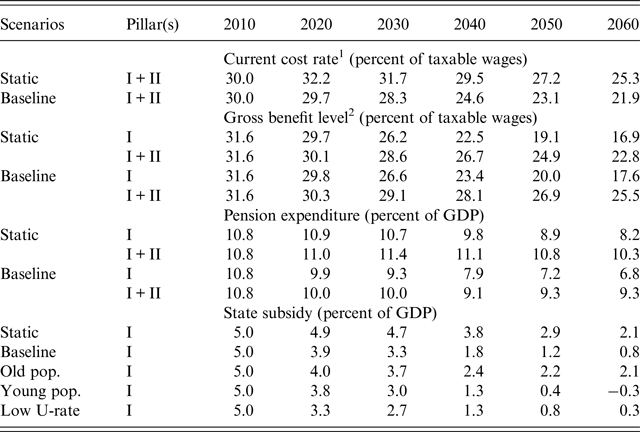
Since contributions currently cover only just over half of total expenditure of the public scheme, their rate is not very telling. For the scenarios looked at here, we assume that it remains constant throughout at 20% of taxable wages, including a second-pillar allocation of 5 percentage points. We also calculate the current cost rate that would balance the budget of the public scheme. Results are shown in Table 1. In the baseline scenario, the cost rate will remain at its current, elevated level only for a few more years. It will then decline until 2040, but remain above the total contribution rate until 2060, slowly approaching it towards the end of the projection horizon. Still, these are much better prospects than under the static scenario where cost rates remain very high until 2030 and then slowly start declining, the gap still being considerable in 2060.
Parameters of the pension system (2010–2060)

Sources: HZMO (2015); own calculations.
1 Contribution rates that would balance the budget of the public scheme (total first-pillar expenditure per taxable wages), plus the second-pillar allocation included in total contribution rates.
2 Relation of average old-age pensions to average taxable wages, both gross of taxes and social insurance contributions.
Pension expenditure per GDP declined noticeably between 2000 and 2006, from around 11% to around 9% in a very short time, mainly due to strong GDP growth. A substantial re-increase was brought about by the Great Recession, which still has not given way to a recovery. In our baseline simulations, the current peak will disappear within a few years, mainly because we are taking out the unfavourable business-cycle component and let labour-force participation and retirement behaviour adjust as described above. From 2020 onwards, the ratio will continue to decline for more fundamental reasons, with an accelerated speed between 2030 and 2040. Pension expenditure of the second pillar will be negligible until 2020 and will gradually increase afterwards.
Another important result displayed in Table 1 relates to the state subsidy paid to the public pension scheme. Current levels of around 5% of GDP clearly indicate the strained situation of first-pillar pension finances. If the total contribution rate (including the second-pillar allocation) remains unchanged, the subsidy is projected to decline in line with public pension expenditure, reaching 4% of GDP around 2020, 2% around 2040 and only 0.5% at the end of the projection horizon.
The long-term decline in current cost rates and in (public) pension expenditure per GDP does not come entirely unexpected, in spite of a pronounced ageing process. However, we should try to disentangle the relative importance of the two main effects behind these trends, viz., the shift towards a partially funded system, plus the reduction in benefit levels (compared with current wages) due to restrictive benefit up-ratings over many years.Footnote 8 Table 1 shows results projected for the gross level of pension benefits, taking average amounts of old-age pensions paid out by the public pension scheme and relating them to current average taxable wages (all gross of taxes and contributions to the different branches of social insurance; cf. footnote 2).Footnote 9 To obtain a fuller picture, we add average old-age pensions deriving from the second pillar.
The gross level of public pension benefits has been low already in recent years, modified by a few discretionary changes with transitory effects. From a current 32%, it is projected to decline to 25% sometime between 2030 and 2040, to around 20% until 2050 and to just above 15% at the end of the projection horizon in the static as well as in the baseline scenario. Partly, this is again due to the on-going shift to partial pre-funding. But even the total benefit level (deriving from both pillars) will decline substantially, to around 25% of current wages in 2060 (or by about 20% against recent values). In other words, total old-age provision will most likely become inadequate.
Higher amounts of second-pillar pensions will thus be needed in the future than those resulting from the 2002 reform. Alternatively, one may have to re-consider the rules for benefit up-ratings in the first pillar at some point in time in the future. Of course, both approaches can be mixed in one way or another – the most important drawback being that they could both have unfavourable effects for current pension finances, either because revenues of the first-pillar scheme will be affected by a higher second-pillar allocation, or because more generous up-ratings will increase expenditure.
The projections presented here should never be taken as point estimates. They extend current trends into the future – the main drivers being strong and robust changes in demographic fundamentals – in order to provide an orientation about the direction and dimension of long-term consequences. In Table 1, we add a very limited amount of sensitivity analyses, concentrating on two different issues and three alternative scenarios. Also, we only look at GDP-ratios of state subsidies to the first-pillar scheme as a very telling set of results.
• The two extreme variants of the demographic projections mentioned above (see online Appendix A.1) are used to run projections for an old-population and a young-population scenario, leaving all other assumptions unchanged against the baseline variant.
• The impact of stronger improvements in labour-market performance is also looked at, assuming that the unemployment rate will decrease to 9% until 2019 (i.e., the average of current AMECO-NAWRU estimates for transition countries, which was observed in Croatia for the last time in 2008); again, all other assumptions (including baseline demographics) remain unchanged.
Results for the two population variants highlight an aspect that is true also regarding the underlying demographic trends. Until around 2030 and even 2040, variation in old-age dependency is not very strong, even if one combines only favourable or only unfavourable assumptions on all major determinants. Consequently, GDP-ratios of state subsidies to the public pension scheme look less friendly (old population) or friendlier (young population) over the next two decades than for the baseline scenario, but the problems in financing current pensions and the impact on the central budget are essentially the same. Things become really diverse only in the long run.
Assumptions regarding the unemployment rate were relatively pessimistic in the baseline scenario, while labour market performance is a very important determinant of pension finances in any unfunded scheme – in fact, more important in the short to medium run than demographics. The low-unemployment variant neglects up-ward risks and concentrates on a more optimistic scenario. The result is as expected – a favourable effect on pension finances, which comes about immediately and then remains largely constant. An effect of this kind would be extremely helpful in dealing with the budgetary problems arising in the period until 2030 or 2040.
3.3 Impact on public finances
It was mentioned already that state subsidies paid to the first-pillar scheme create a direct, unfavourable impact of the Croatian pension system on the central-government budget. There is another link between public finances and the pension system through the high share of domestic government bonds among the reserves held in the second pillar. Building on actual figures (provided in the AMECO database and by HANFA, 2015a, respectively), we conduct further projections and analyses to see what happens on both sides (see online Appendix A.2 for more detailed results).
Future trends in the debt ratio are derived interpreting projected changes in state subsidies (per GDP) as changes in the primary deficit ratio (as if expenditure on all other budget items and revenues were to remain constant compared to GDP), while interest payments and total deficit ratios adjust accordingly. As a result, the debt ratio does not continue to increase as sharply as it did since 2008, but it goes up throughout the projection period from 85% in 2014 to 170% in 2060. Meanwhile, funds accumulated in the second pillar also continue to grow, coming close to 85% of GDP by 2060, when the scheme will be almost mature. If the current structure is maintained, implying that 70% of these funds are effectively invested in domestic government bonds, assets of this type will then amount to almost 60% of GDP, or to roughly one third of total government debt.
These projections point to two serious drawbacks of the transition path currently pursued in Croatia. Switching to a (partially) funded system ideally means that (a) (part of the) burdens involved in providing for current benefits are shifted across time and borne earlier, as much as this is possible via an increase in aggregate saving and investment (see Barr, Reference Barr2002 for a rather sceptic view; Diamond, Reference Diamond2002: ch. 1 and 3 for a balanced discussion); (b) the distribution of these burdens is no longer directly linked to demographics of domestic wage-earners, but it is diversified, among other things internationally (Diamond and Geanakoplos, Reference Diamond and Geanakoplos2003; Börsch-Supan et al., Reference Börsch-Supan, Ludwig and Winter2006). Yet, it appears that none of this truly happens in Croatia.
The public pension scheme now receives reduced contributions and relies on state subsidies that are mostly debt-financed. As a result, the implicit debt involved in unfunded pensions is gradually transformed into explicit debt, which leaves the effects for the intergenerational distribution basically unchanged. For second-pillar funds in transition countries, using domestic government bonds as the main type of investment is not uncommon (see, e.g., Nickel and Almenberg, Reference Nickel and Almenberg2006: ch. 4.3; Kąsek et al., Reference Kąsek, Laursen and Skrok2008: ch. 1; or Altiparmakov and Nedeljkovic, Reference Altiparmakov and Nedeljkovic2016), and the same applies to the Social Security Trust Fund in the USA. However, depending on whether government bonds are absorbed that would have been issued anyway or whether public debt is expanded, this can actually undermine the strategy of partially pre-funding future retirement income (and may also reduce the rate of return earned in the funded scheme). Government bonds need to be redeemed to start paying out second-pillar benefits, which requires tax-payers' money in the same period and turns the pre-funding strategy into a hidden form of pay-as-you-go financing (Barr and Diamond, Reference Barr and Diamond2008: ch. 6.3).
3.4 Challenges
Having described the system and projected its future performance under current rules, we may now list major challenges for old-age provision in Croatia, which need to be addressed through further pension reforms.
First, high unemployment and a low level of economic activity contribute to budgetary pressures in the short to medium run, for the public pension scheme as well as for public finances in general. Consequences that are directly harmful for the pension scheme are high inflows into disability and early retirement.
Second, a problem which becomes more and more pressing in the long run is given by demographic ageing. The combined effects of low fertility and increasing life expectancy lead to a continuous increase in old-age dependency that is an important fundamental for the support ratio of a pay-as-you-go pension scheme.
Third, pension finances and general-government budget balances may nevertheless improve in the long run (provided that the problems affecting it in the short to medium run can somehow be solved), but this is mainly due to the fact that benefit levels may be, and certainly will become, inadequately low.
Fourth, this is partly caused by the fact that the switch to a partially funded system initiated in 2002 is incomplete. Supplementary pensions deriving from the second pillar will be too low to make up for declining levels of public pay-as-you go pensions.
Fifth, attempts at solving the last two problems are constrained by severe problems with financing the system in the short to medium run, with a close link to current deficits and accumulating debts in the central government budget.
Sixth, the structure of investment of funds accumulated in the second pillar, with a very dominant share of domestic government bonds, is not at all ideal. It does not really isolate funded pensions against the risks of demographic ageing.
4 Options for reforms
The challenges for old-age provision in Croatia and the international experience in how to deal with similar problems (see, e.g., Meier and Werding, Reference Meier and Werding2010) set the agenda for further pension reforms. Overarching goals that need to be accomplished are (a) getting the system out of the current financial strain and (b) setting it on a new path on which sustainability and adequacy of old-age provision can be combined in the long run. As the problems we have observed are diverse, appropriate reforms should be multi-faceted. Besides, the ideal timing of reforms will be an issue to look at, as some of the elements will have effects for pension finances and retirement incomes that work in opposite directions.
4.1 Cutting costs
A problem which needs to be addressed immediately is the current huge inflow of working-age individuals into the pension scheme, mostly caused by continued, weak labour-market performance. Measures that are suited to deal with this problem are tighter eligibility criteria for disablement and a higher age for first claiming old-age pensions – say, 2 or 3 years rather than 5 years in advance of the statutory retirement age. This could be reinforced by increasing deductions from benefits in cases of early retirement to actuarial levels (i.e., to 5% or even 6% p.a.; OECD, 2015). Assuming that, by these means, age-specific rates of entries into disablement and early retirement could be reduced by 50% until 2019 compared with the baseline scenario, budgetary pressure as measured by the share of state subsidies in GDP would be notably reduced in the short to medium run. Together with improvements in labour-market performance (e.g., those assumed for the low-unemployment scenario presented above), state subsidies per GDP would fall to about 3% until 2020, to about 1% until 2040, and to 0% at the end of the projection horizon.
Another modification that should start taking effect soon and fully unfold over the next few decades is a further increase of the statutory pension age. In an unfunded pension scheme, increasing the retirement age is an appropriate response to demographic ageing, certainly to the extent that it is driven by increases in life expectancy (Barr and Diamond, Reference Barr and Diamond2008: ch. 5.4). However, enacting increases in statutory age thresholds is often politically difficult. An elegant way of avoiding repeated discussions about adjustments in the statutory retirement age is to link the threshold to observed changes in life expectancy by a transparent, rule-based definition, which works automatically. For instance, under the current law the number of years individuals are expected to be economically active (from around age 20–60, which according to our calculations, is the current average retirement age across all types of pension benefits) and in retirement (for about another 16 years) relate to each other in a 5:2-ratio. One could try to keep this ratio constant if life expectancy is increasing, implying that the statutory retirement age needs to be increased by 1 month against current age limits when life expectancy has increased by 1.4 months in the preceding year (or any multiple of these two figures).
The parameters for this rule have been set on a unisex basis. Yet, they should be directly applied only to the situation of males (for which the current statutory pension age is 65). Under the assumptions for the baseline scenario, this age limit would automatically increase to about 70 years of age until 2060 in a continuous process. The increase suggested here starts considerably earlier than the increase to 67 scheduled for the period between 2030 and 2038 in the existing legal framework, but it is far less steep. It will therefore have a positive impact on pension finances starting soon, but will reduce inequities between different age cohorts involved in the current law. The age limit for females is brought in line with the one for males in an on-going process lasting until 2030. This process could be modified in such a way that it tends to follow the automatic adjustments for males, but avoids extra-increases that become too strong. For instance, increases by 3 months per year involved in the current schedule could be accelerated by just one week if life expectancy has increased by 1.4 months in the preceding year. As a result, statutory pension ages for females and males would be the same starting from 2038 and move together over the remaining projection period.
Compared with the options for reform already considered, changes in the statutory pension age would have relatively weak effects in the short run, but very strong ones in the long run. If everything else remains unchanged against the baseline scenario, state subsidies would decline to just fewer than 4% of GDP until 2020, to 1.5% until 2040, and fall below zero around 2060. Afterwards, expenditure of the public pension scheme could be fully covered by the contribution rate. Combined with the other reforms, this situation could in fact be reached already by 2050. However, while this result sounds like good news with respect to budgetary effects and fiscal sustainability, it is still based on a level of public pension benefits, which declines considerably throughout the projection period – to about half of the current, low level.Footnote 10
4.2 Stabilizing the benefit level
This prospect is not satisfactory from a social-policy point of view. It may as well not be politically feasible, since a growing share of older voters may reject the idea that public pensions and the overall level of old-age income continues to decline. Within a more complex bundle of reforms, there are thus good reasons to give future pensioners a share in the cost-saving effects of the options for reform considered thus far. Basically, there are two ways of keeping up future benefit levels. Increasing the second-pillar allocation could strengthen supplementary funded provisions. Alternatively, the level of public pension benefits could be stabilized by replacing the current, mixed rule for benefit up-ratings (50% inflation, 50% nominal wage growth) with stronger, or even pure, wage-indexation. Both approaches have their pros and cons.
The literature suggests that, besides increasing the retirement age, expanding funded second-pillar pensions is indeed the way to go if existing pay-as-you-go systems can no longer deliver adequate benefits due to demographic ageing – or could do so only with a major increase in contribution rates. However, this strategy needs time to fully unfold its effects. If a reform of this kind has not been taken well before the financial pressure in the unfunded scheme becomes acute (or if the switch has not been strong enough), it takes about (another) two decades until (additional) funded pensions will be sizeable, five to six decades until the system is mature.
Also, increasing the second-pillar allocation would have adverse effects on the budget of the first-pillar scheme; hence require higher state subsidies from the central budget. This could be avoided by increasing the total contribution rate as well, either on a one-for-one basis or at least to partially cover revenue losses for the public scheme. The downside might be an unfavourable effect for total wage costs and/or for labour supply of working-age individuals. However, it can be argued that these effects should be small if the increase is caused by higher injections into a funded pension scheme, not by higher contributions to a pay-as-you-go scheme. The reason is that funded pensions that are actuarially fair contain no tax-like element, which might create behavioural responses in the contexts of wage bargaining or labour supply.Footnote 11
While expanding supplementary provisions through the second pillar has an impact on the total level of pension benefits only with a considerable delay, more generous up-ratings of benefits deriving from the first pillar have an immediate effect. The latter may thus not be a measure of first choice in the context of ageing, but it could be used to stabilize the level of pension benefits for a limited period of time. A further advantage of changes in rules for benefit up-ratings is that they can be used at short foresight. For instance, they can be suspended or cancelled entirely, if other reforms have not (yet) established the financial room for manoeuvre, which would be required.
4.3 Results for a combined reform strategy
Taking together these considerations, a mixed strategy for cutting pension expenditure in the short run and (re-) increasing benefit levels in the future can be conceived of. Ideally, it should combine a further shift towards partial pre-funding that is initiated soon and pursued unwaveringly with (temporary) increases in benefit up-ratings, which can be used flexibly, depending on what the benefit level appears to require and what other circumstances allow for.
To illustrate the potential effects, we look at two additional projections, which are built on the baseline scenario, modified by the following assumptions.
• Age specific rates of entry into disability pensions and early retirement are reduced (to 50% of their baseline values until 2019) and the unemployment rate decreases (to 9% until 2019), with favourable effects for pension finances that were already discussed.
• The statutory pension age is increased (throughout the projection period), with an automatic link to on-going increases in life expectancy, leading to a uniform age threshold at age 70 for both males and females around 2060.
• Total contribution rates and second-pillar allocations are increased by 1 percentage point per year against their current values starting from 2016; the weight of nominal wage growth in the rule for benefit up-ratings (currently: 50%) is also increased, at least temporarily. Both these changes come in two possible variants:
◦ 8/80 scenario: second-pillar allocations reach 8% of taxable wages (in 2018), then remain constant; the weight of wage growth in benefit up-ratings goes up to 80% (until 2018), but back to 50% later on (from 2039 to 2041);
◦ 10/100 scenario: second-pillar allocations go up to 10% (until 2020), while the weight of wage growth becomes 100% (in 2020) and then goes down to 50% again (from 2042 to 2047).Footnote 12
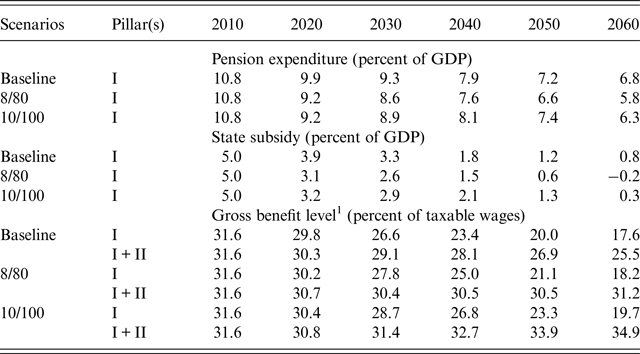
Table 2 shows the impact of these reforms on pension expenditure of the public scheme and on the state subsidy, hence on the central-government budget. Compared with the baseline scenario, both reform strategies lead to reductions in expenditure and in subsidies needed to balance the scheme in the short to medium run. This advantage would be even larger if gradual increases in the weight of wage growth for benefit up-ratings were postponed. Conversely, if cost-saving effects of other elements of reform turn out to be weaker than expected, or take more time to come about, postponing these increases could be a way of containing expenditure and avoiding additional fiscal strain at an early stage of the reform process. The increase in second-pillar allocations, however, should be phased in immediately to create a sizable impact on total levels of benefits as soon as possible (while the impact on the budget of the public scheme is assumed to be fully neutralized by parallel increases in total contribution rates).
Effects of the reform scenarios (2010–2060)

Source: HZMO (2015); own calculations.
1 Relation of average old-age pensions to average taxable wages, both gross of taxes and social insurance contributions.
In the 8/80 scenario, public pension expenditure and state subsidies remain below those in the baseline scenario throughout. The difference becomes larger after 2040, due to the return to the old rule for benefit up-ratings, and the state subsidy falls to zero around 2055. In the 10/100 scenario, expenditure and subsidies exceed those in the baseline scenario between 2035 and 2050, that is, when they may have become acceptably low in all the cases considered here. As more generous benefit up-ratings are phased out in the 2040s, expenditure falls below corresponding baseline figures again, and the state subsidy tends towards zero at the end of the projection horizon.
Table 2 also displays the impact of the reform scenarios on the level of average pension benefits – those provided by the public scheme as well as total benefits deriving from the two-pillar system. Our two scenarios have been deliberately designed to demonstrate the options arising in this respect. The 8/80 scenario stabilizes total pension benefits almost perfectly at their current level. The 10/100 scenario even leads to a long-term recovery of the benefit level, in case this is considered desirable.Footnote 13 In both cases, the favourable long-run effects are mainly driven by higher second-pillar pensions.
Last but not least, we may consider the consequences of these reforms for public finances. Building on projected state subsidies paid to the first pillar, general-government debt would increase to about 125% of GDP until 2060 in the 8/80 scenario or to about 150% in the 10/100 scenario (instead of 170%, as in the baseline scenario). Due to higher annual injections, total funds accumulated in the second pillar would reach 130% and 160% of GDP, respectively (instead of 85%). An important aside is that these funds should no longer be mostly invested in domestic government bonds. Investment rules that contributed to this bias have already been modified, but there may be informal rules that are still working in this direction. Instead of defining lower limits for the share of domestic government bonds (e.g., a minimum of 50%, as until 2007), new rules imposing an upper limit on this share may be called for (e.g., a maximum of considerably less than 50%, allowing for a sufficient time for restructuring investment). Besides making retirement income – and also public finances – less exposed to the impact of ageing, this may also have effects for the rate of return, hence for the level of second-pillar pensions accruing in the future, that we do not want to speculate about in our projections. At the same time, this might increase the cost of government borrowing (from other sources, where investors require higher returns) adding pressure on public finances – and discouraging debt financing.
5 Conclusion
In this paper, we have described in some detail complications and possible reform paths of the Croatian pension system. Essentially, the agenda we have been looking at consists of two types of measures: (a) measures suited to bring down high pension expenditure in the short to medium term and (b) measures, which will avert an erosion of the level of retirement income in the long run.
Specific measures of the first type are changes in eligibility rules for disability pensions and early retirement, plus gradual increases in the retirement age, which are automatically linked to increases in life expectancy. Reforms of this kind need to be taken soon. Depending on the budgetary situation of existing pension schemes and the strength of ageing processes, there are not many alternatives to going in these directions. Measures of the second type are further expansions of pre-funded pensions, probably complemented with (transitory) switches to more generous up-ratings of unfunded pensions. These elements can be combined in various ways – with parallel increases in total (first and second-pillar) contribution rates to avoid financial pressure for the unfunded scheme and with a timing that can be flexibly adjusted. The expansion of the second pillar should not be postponed, as this is an element of reform that needs time to fully unfold its effects and, subject to a few caveats, can be really favourable.
None of the problems that old-age provision in Croatia is currently faced with is unique. Our analysis coincides with the conclusions reached in a recent panel study by Altiparmakov and Nedeljkovic (Reference Altiparmakov and Nedeljkovic2016), by which the expansion of pre-funded pensions has been lacking positive effects in many transition countries, while reforms aiming at cost-containment appear to be urgent. Yet, some of the underlying problems are bigger in Croatia than elsewhere, and their combination creates a situation that is particularly difficult. Another peculiarity is given by the political economy of pension reform in Croatia, which has, so far, posed a great challenge for further reforming the system. Since electoral races in Croatia typically resemble a dead heat between the two largest political options (the Croatian Democratic Union and the Social Democratic Party), a small parliamentary group (of the Croatian Party of Pensioners, CPP, founded in 1996) has supported or even entered governments led by different parties continuously between 2003 and 2015, effectively blocking any far-sighted reform. As it may now have become possible to form a stable coalition without the CPP, prospects for going ahead with pension reforms are improved. Also, public awareness of unresolved problems has increased in recent years, and EU membership now creates additional pressure to make the overall fiscal system financially sustainable.
All in all, our study is meant to illustrate important pre-requisites and ingredients of successful reform strategies for old-age provision in Croatia that are applicable to other countries facing similar problems. In doing so, we do not want to come up with a one-size-fits-all solution. Instead, we are trying to provide a set of tools which can be applied with some flexibility, depending on the goals pursued and the economic conditions affecting the pension system.
Supplementary material
The supplementary material for this article can be found at https://doi.org/10.1017/S1474747217000166.