I. INTRODUCTION
Precipitation hardening to optimize mechanical performance of aluminum alloys is an important technology.Reference Hu, Baskes, Stan and Chen1–Reference Li and Purdy8 The metastable θ′ precipitate phase of aged Al–Cu alloys has been a well-known system for studying the mechanisms of phase transformation in Al alloys,Reference Bourgeois, Dwyer, Weyland, Nie and Muddle2 which establishes an exemplary structure–mechanic relationship. The classical precipitation sequence during aging process/heating is generally reported as solid solution (SS) → Guinier-Preston zones (GPZ) (or GPZ I zones) → θ″ (or GPZ II) → θ′ → stable θ.Reference Hu, Baskes, Stan and Chen1–Reference Biswas, Siegel, Wolverton and Seidman3 The nucleation, growth, and phase transition of intermediate (metastable) GPZ, θ″ and θ′ precipitates starting from the decomposition of a supersaturated solid solution have been of academic interest. However, the conventional experimental approach on Al–Cu alloys typically applies the static measurement tools, such as transmission electron microscopy,Reference Bourgeois, Dwyer, Weyland, Nie and Muddle2,Reference Tolley, Mitlin, Radmilovic and Dahmen4–Reference Bourgeois, Dwyer, Weyland, Nie and Muddle7 atom-probe tomography,Reference Biswas, Siegel, Wolverton and Seidman3 and x-ray diffraction (XRD). Although differential scanning calorimeter (DSC)Reference Sehitoglu, Foglesong and Maier9–Reference Starink and van Mourik12 can record the dynamic phenomena, DSC coupled with the aforementioned static measurements is still not trivial to simultaneously provide a comprehensive understanding of both the phase transformation between the intermediate phases and concurrently complex structural and morphological evolution in this precipitation sequence.
In contrast, in situ small-angle x-ray scattering (SAXS) is an effective tool for directly tracing the evolution of shape and size distribution of a large number of particles in the bulk sample.Reference Glatter and Kratky13,Reference Liao, Tsao, Lin, Jao, Chuang, Chang, Huang, Shao, Chen, Su, Jeng, Chen and Su14 It was extensively used to study the precipitates and phase separation in the bulk alloys, such as Al–Cu,Reference Tsao, Huang, Wen, Kuo, Jeng, Jeng and Sun15 Al–Li,Reference Tsao, Chen, Kuo, Lin and Yu16,Reference Tsao, Chen and Huang17 Al–Mg–Si,Reference Tsao, Chen, Jeng and Kuo18 and the other systems.Reference Deschamps and Brechet19–Reference Chou, Du, Lee and Huang21 On the other hand, non-isothermal heating is practically more relevant to the industrial applications, such as welding etc., which is the main target of the current study. In our previous investigation,Reference Tsao, Huang, Wen, Kuo, Jeng, Jeng and Sun15 an approach using simultaneously synchrotron SAXS and wide-angle x-ray scattering (WAXS; or called XRD) techniques was successfully established to first study the concurrent evolutions of lattice structure, volume fraction (growth and dissolution), and morphology (in thickness and length directions) with temperature for various plate-like intermediate precipitates in the non-isothermally aged Al–5.4 wt%Cu alloy. The result demonstrated that the precipitation sequence is mapped as SS → GPZ → θ″ → θ′ → (θ′ + θ) → θ (i.e., there exists a certain stage of coexisting θ′ and θ phases with concurrent phase transformation). In the present study, we further tailored the pretreatments to generalize the non-isothermal precipitation sequence to be θ″ → (θ″ + θ′) → θ′ → (θ′ + θ) → θ by the in situ synchrotron SAXS/WAXS measurement extending from the previous study.Reference Tsao, Huang, Wen, Kuo, Jeng, Jeng and Sun15 The result could construct in detail an atlas of phase diagram relating to the starting phases (or pretreatments) and heating temperatures.
Moreover, in our recent study,Reference Tsao, Huang, Wen, Kuo, Jeng, Jeng and Sun15 we applied a SAXS model analysis based on the average of the intensities from all orientations to summarize a mechanism of phase transformation and structural evolution for the coexisting θ′ and θ phases. The reported SAXS analysis is based on the ensemble average, which was not the behavior of the orientation-dependent precipitation. To further resolve our previously averaged SAXS intensity distribution,Reference Tsao, Huang, Wen, Kuo, Jeng, Jeng and Sun15 in this work, we applied two-dimensional (2D) SAXS patterns to focus on specific oriented precipitates (nucleating and growing on {100} lattice plane) as the emphasis of observation and then analyze the sliced SAXS intensity corresponding to these precipitates. In the current work, we adopt the Guinier approximation to reduce fitting parameters and free-assumption of shape compared to the previous model fitting.Reference Tsao, Huang, Wen, Kuo, Jeng, Jeng and Sun15 The comparable quantitative analysis also provides an independent validation to the previous results.Reference Tsao, Huang, Wen, Kuo, Jeng, Jeng and Sun15 In combination of the simultaneous WAXS patterns, the concurrent variation of both phase transition and morphology of the illuminated precipitates, scattering to the sampled orientation, was quantitatively revealed in this precipitation sequence including the various stages of two coexisting precipitate phases (i.e., θ″ + θ′; θ′ + θ). Based on this direct and SAXS analysis, we revisit our previous data, but one step further to refine orientation-dependent information. This information provides the insight into the finer understanding of phase transformation of multiple phases. The coexistence stage of two precipitate phases can play an important role in studying the mechanical performance influenced by non-isothermal heating.
II. EXPERIMENTAL
Three 2-mm-thick Al–5.4Cu weight percentage (wt%) with preheat treatments and one Al–2 wt%Cu alloy without any heat treatments, as the reference, sheets were fabricated by ALCAN International. The alloy sheets were treated at 542 °C for heat solution and then quickly quenched to room temperature (RT). Before the SAXS/WAXS experiment, the pretreatment conditions of two Al–5.4 wt%Cu samples were aged at 200 °C for 2 and 6 h, respectively. The in situ SAXS/WAXS experiment was performed at the National Synchrotron Radiation Research Center. The details of materials, experimental procedure, and instrument configuration can be found in our recent report.Reference Tsao, Huang, Wen, Kuo, Jeng, Jeng and Sun15 The thickness for the SAXS/WAXS specimens is ∼200 μm. The average grain size in the alloy specimens is 120 μm. The beam size (∼1 mm2) allows us to probe the precipitates lying in different oriented grains. The SAXS/WAXS specimens were placed in a program-controlled heater. In situ SAXS/WAXS measurements were conducted to study the precipitation behavior during non-isothermal heating from RT to 500 °C at a heating rate of 20 °C/min. The 2D SAXS and WAXS patterns were simultaneously collected at specific 2D detectors. Following the standard data reduction procedures, the data were reduced into 1D SAXS and WAXS profiles as a function of the scattering vector, Q (= 4π/λsin(θ/2); θ is the SAXS scattering angle, λ is the incident radiation wavelength), respectively. Because the SAXS and WAXS data collection were programmed in a temporal sequence, the recorded temperatures for SAXS and WAXS data were slightly shifted based on the measurement sequence.
III. RESULTS AND DISCUSSION
A. Non-isothermal precipitation starting from different initial phases
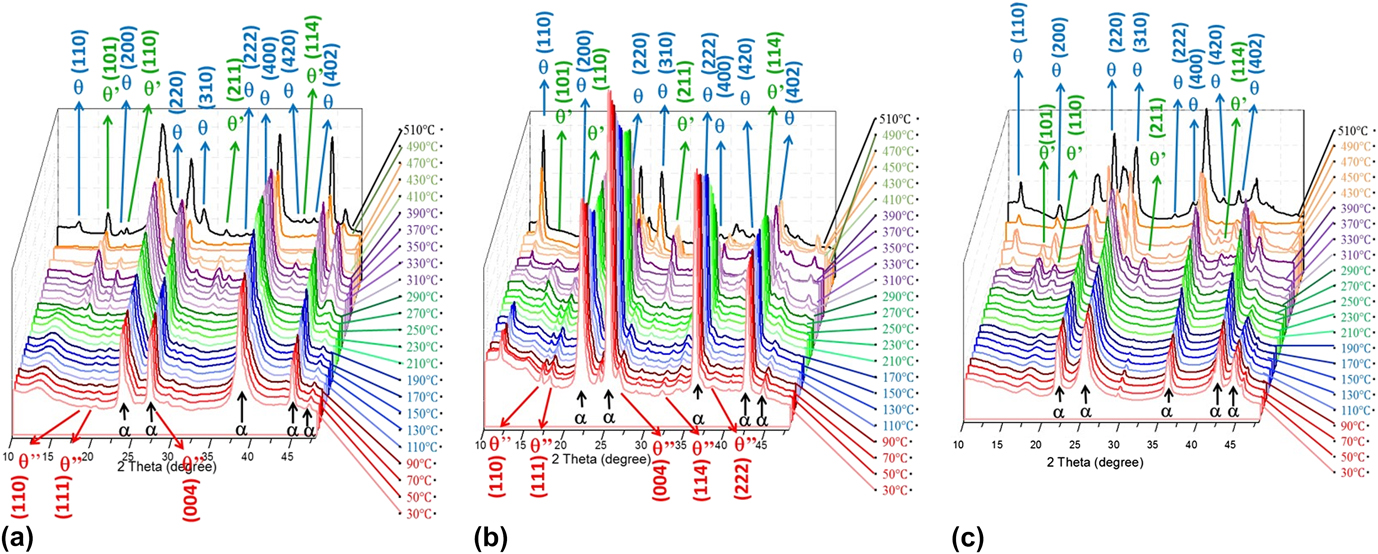
The microstructural evolution subjected to the non-isothermal precipitation can be observed in Fig. 1. The Al–Cu systems with and without preheat treatments, as described earlier, are examined as a function of temperature from RT up to 510 °C for preheating of 2 h in Fig. 1(a) and 6 h in Fig. 1(b) and without preheat treatment as the reference in Fig. 1(c). The α matrix is marked in the bottom. Driven by the enhancing potential gradient between phases with the increase of environmental temperature, the atoms gradually segregate on certain planes from the matrix and gradually transform to form another crystalline phase. Hence, upon heating, there are formation and dissolution of θ″, θ′, and θ phases, respectively, as summarized in the introduction and marked with {hkl} planes. The characterization methods can be referred to our previous report. On the other hand, for the Al–2%Cu alloy without any heat treatments, as the reference shown in Fig. 1(c), there is no θ″ phase. The results show that our preheat treatment induced θ″ phase. The phase evolution, phase transformation, or precipitation of Al–2 wt%Cu during non-isothermal heating is very slow (Fig. 1). This evidence is consistent with the DSC study for similar Al–Cu alloys.Reference Son, Takeda, Mitome, Bando and Endo10
Variation of 1D WAXS profiles with temperature during the heating process for the Al–5.4 wt%Cu samples pre-aged at 200 °C for (a) 2 h and (b) 6 h and (c) Al–2 wt%Cu sample without preheat treatment as the reference.

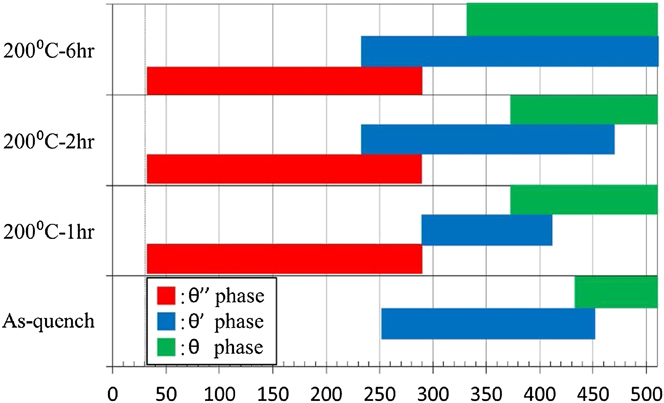
It is important to note that there is a multiple-phase coexistence of the matrix and the precipitates as intermediate stages. The precipitate phases temporally appear within certain temperature ranges. To clearly see the map of the phase evolution, Fig. 2 summarizes the starting and dissolving temperatures of the phases shown in Fig. 1, respectively. The qualitative feature is noticed that, even with different preheat treatments, the intermediate temperature ranges do show that the dynamical transitions contain several transient phases. With our applied heating rate, the phase transformations have certain intermediate steps, which allow structural intermediates to accumulate at observable concentrations via in situ WAXS. Since the rates of individual phase transformation steps could be affected differently by temperature, different morphology of intermediates may be different subjected to environmental temperatures. Hence, there is a morphological evolution of multiple phases and the complex structures might not be isomorphic. The phase diagram in Fig. 2 for Al–5.4 wt%Cu experimentally shows the temporal precipitation sequence θ″ → (θ″ + θ′) → θ′ → (θ′ + θ) → θ, which the conventional DSC study might report as θ″ → θ′ → θ. The phase diagram in Fig. 2 considers the coexistence of two phases. The evolution of these metastable phases during the non-isothermal processing of Al–Cu alloys is important for industrial application. For example, we may tailor the multiple-phase structure embedded in the alloys and thus optimize the desired mechanical properties facilitating the concept of the pretreatment, heating rate, and working temperature ranges accordingly.
Phase diagram in the precipitation sequence as a function of temperature and the starting phase for Al–5.4 wt%Cu alloy at a given heating rate.

To capture the morphology evolution of the intermediates during the phase transformation, the concurrent orientation-resolved SAXS experiment collected the inter-precipitate scattering while the phase transformation progressed at different temperatures in the Al–Cu systems. With a sufficient difference in the x-ray scattering-length density from the locally segregated atoms, the 2D detector could numerically resolve the heterogeneous structural species. The results are summarized below.
B. Evolution of thickness determined by direct analysis to 2D SAXS patterns
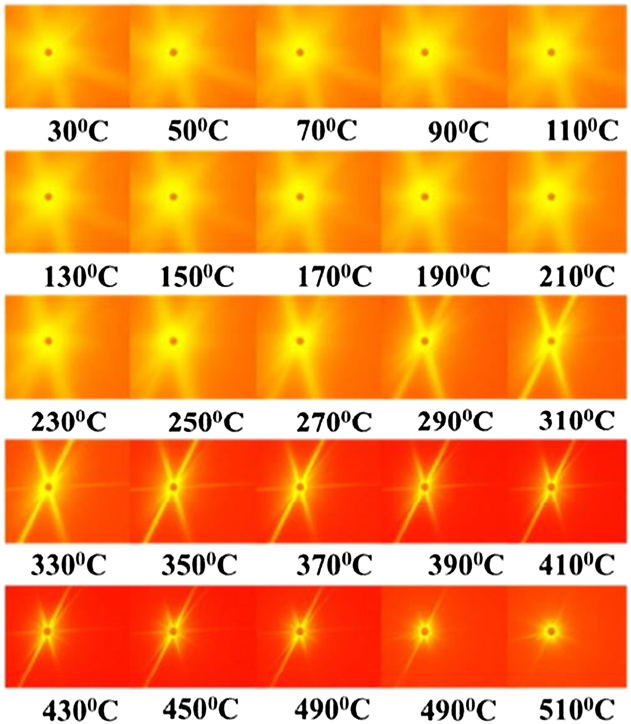
Previous studies of the Al–Cu alloys have indicated that the plate-like precipitates have their broad faces parallel to (001) plane//{001}α-Al interfaces.Reference Tsao, Huang, Wen, Kuo, Jeng, Jeng and Sun15 The in situ measurement is suited to investigate the formation, growth, dissolution, and phase transition of the GPZ, θ″, θ′, and θ phase precipitates on the {100} planes of the matrix. The in situ 2D SAXS patterns in this study can specify orientation-resolved information of these intermediate plate-like precipitates represented by several radial streaks, as shown in Fig. 3.
2D SAXS patterns corresponding to the 1D SAXS profiles showing the radial streaks evolution as a function of temperature caused by the oriented precipitates lying on {100} lattice plane of different grains. The pre-aging condition is 2 h. (Bright color represents the high intensity.)

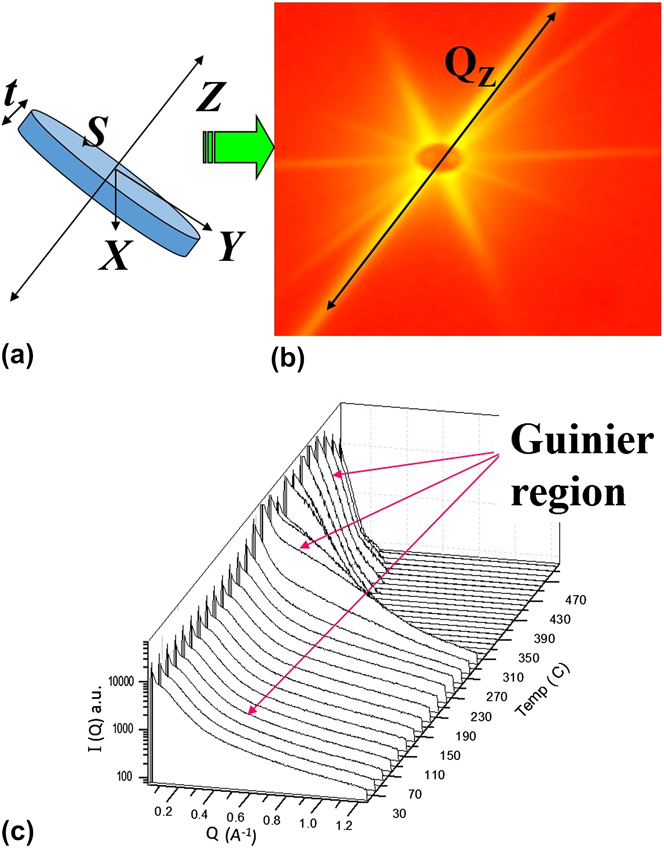
During the early stage (corresponding to the θ″ phase, as evidenced by WAXS profiles), each cross-like shape, comprising the radial streaks, is caused by the scattering of plate-like particles lying on the {100} orthogonal planes of the matrix in a specific grain, depending on the matrix orientation of this grain relative to the incident synchrotron beam. The thickness t of plate-like precipitates with a certain of orientation can be directly determined by the profiles slicing along the corresponding streaks. The evolution of the streak intensity (3D SAXS intensity pattern) corresponds to the morphological change of these same oriented precipitates. According to the literature,Reference Fratzl, Langmayr and Paris22,Reference De Geuser, Bley and Deschamps23 the SAXS intensity from the plate-like precipitates is concentrated along radial streaks in reciprocal space perpendicular to the habit planes of the precipitates [Figs. 4(a) and 4(b)]. We assume that the precipitate can be approximated by a disk with cross section S and thickness t. Hence, the scattering function can be separated into a product of two terms:
 $$I\left( Q \right)/I\left( {Q = 0} \right) =\; {\left[ {\sin ({Q_Z}t/2)/({Q_Z}t/2)} \right]^2} \times {\left| {{1 \over S}\int\limits_S {\exp \left[ {i({Q_X}x + {Q_Y}y)} \right]{\mathop{\rm d}\nolimits} x{\mathop{\rm d}\nolimits} y} } \right|^2}\quad ,$$
where the x–y plane is defined to lie on the cross section and z direction is perpendicular to the x–y or cross-sectional plane, as shown in Fig. 4(a).
(a) Coordinate system in the disk-like precipitate with a spatial oriented. (b) 2D WAXS pattern showing the slice region (marked by line) along the streak (radial) direction (i.e., Q Z direction; perpendicular to the disk surface) corresponding to this selected precipitate. (c) Variation of the sliced SAXS intensity profiles, I(Q Z), with temperature corresponding to Fig. 3.

Slice along Q Z direction [i.e., the direction of radial streak; see Fig. 4(b)] give the thickness information of this orientated precipitate by fitting a modified Guinier approximation to the experimental data, I(Q Z). For small values of Q Z (Q X = Q Y = 0), Eq. (1) can be approximated as
 $$I\left( {{Q_Z}} \right)/I\left( {{Q_Z} = 0} \right) = \exp \left[ { - {1 \over 3}Q_Z^2{{(t/2)}^2}} \right]\quad$$
Equation (2) allows the determination of thickness by using Guinier plot [ln I(Q Z) versus  $Q_Z^2$]. In Fig. 3, we select a sample with the pre-aging condition of 2 h. The number of orientation of radial streaks is almost fixed during the full precipitation (from metastable θ″ to stable θ phase), indicating that their orientations (lying on the lattice planes) may not change. We chose a streak with a Q Z direction as a target, as shown in Fig. 4(b). The shape and orientation of this streak are symmetric with the other related streaks caused by precipitates lying on the same grain but different directions. The targeted grain is well aligned to the incident beam. Variation of the SAXS intensity profiles, sliced along this streak for all 2D SAXS patterns (Fig. 3), with temperature is shown in Fig. 4(c), indicating the growth behavior of thickness of the targeted precipitates.
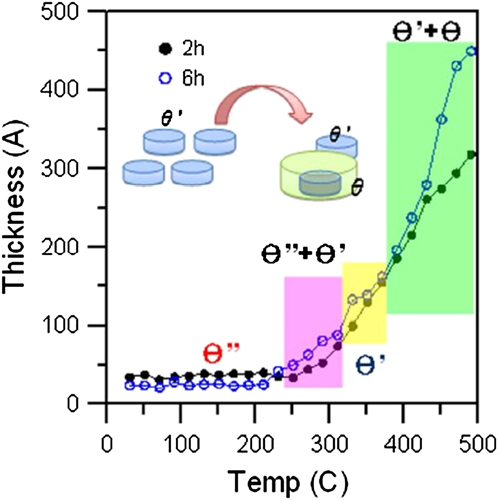
During the early stage (from RT to 300 °C) in Fig. 4(c), there is an upturn intensity in the low-Q region (Q < 0.02 Å−1) for the sliced SAXS intensities, I(Q Z). It comes from the large heterogeneous particles and can be ignored when using Guinier approximation. The available Q range for Guinier approximation determining the thickness is shown in Fig. 4(c) with the arrows. According to Eq. (2), the thickness can be determined from the slopes of Guinier plots at the suitable Q 2 region. Above 300 °C, the SAXS intensity shifts to lower Q region. Some Guinier plots selected as representation (Fig. 5) show the significant growth of precipitate thickness. The variation of thickness, determined by this direct SAXS analysis, with temperature (through various intermediate phases) is shown in Fig. 6. The tendency with temperature and initial size is close to the theoretical predictionReference Nicolas and Deschamps20 and our previous study using the model fitting for the ensemble averages.Reference Tsao, Huang, Wen, Kuo, Jeng, Jeng and Sun15 The current orientation-dependent observations validate the theoretical and experimental prediction. Moreover, the present work directly resolves an evaluation of specific precipitates in the selected orientations. In the current study, we specify a very narrow-azimuthal orientation to trace the evolution of phase formation and the final stabilization. The very fine sampling scope clearly shows a monotonous growth of precipitate during the transitions between single phase and coexisting phases (i.e., (1) θ″ → (θ″ + θ′) → θ′; (2) θ′ → (θ′ + θ) → θ′). On top of our previous averaged results over 360 azimuthal orientations,Reference Tsao, Huang, Wen, Kuo, Jeng, Jeng and Sun15 the present study demonstrates that the concurrent new phase nucleation, transformation, and dissolution on a specific orientation or even the neighboring sites as a conceptual depiction shown in Fig. 6.
Guinier plots (ln I(Q Z) versus  $Q_Z^2$), selected to show the increase of thickness with temperature (determined by the slope of solid lines).

Evolution of thickness of the targeted precipitates (determined by Guinier approximation) with heating temperature in the precipitation sequence of the Al–5.4 wt%Cu samples pre-aged at 200 °C for 2 and 6 h. (Inset shows schematic illustration of dissolution (old phase), growth, and concurrent phase transformation (new phase based on the old phase as nuclei) during the coexistence stage of two precipitate phases.)

IV. CONCLUSION
In summary, the multiscale microstructure evolution in Al–Cu alloys has been investigated. The focus is placed on the understanding of the lattice-structure transformation and the concurrent orientation-resolved precipitation-structural changes in terms of thickness as a function of heating temperature. The XRD results construct a phase diagram showing a precipitation sequence as θ″ → (θ″ + θ′) → θ′ → (θ′ + θ) → θ. There are incorporating stages of coexistence of two intermediate phases. The various phases could be tailored by the pretreatment and non-isothermal heating conditions to achieve the desired properties subjected to precipitate structure and morphology.
ACKNOWLEDGMENT
We appreciate Prof. S. Esmaeili (University of Waterloo, Canada) for providing the Al–Cu samples and useful suggestions. EWH appreciates the financial support from National Science Council (NSC) 101-2221-E-008-039-MY3 Program. MHW and SYT thank the NSC-102-3113-P-007-014 Program.