INTRODUCTION
Like birds and monkeys, tree squirrels are frugivores as well as predators and dispersers of seeds in tropical forests (Emmons Reference EMMONS1980, Payne Reference PAYNE and Chivers1980). The diet of diurnal tree squirrels living in South-East Asia (Callosciurus spp. and Ratufa spp.) is between 62–86% composed of pulp and/or seeds of fruits (Payne Reference PAYNE and Chivers1980). In the lowland rain forests in Gabon, fruits make up the largest proportion of the diet (59–98%) in eight of nine species of squirrel (Emmons Reference EMMONS1980). The role of tree squirrels therefore cannot be ignored when considering animal–plant interactions in tropical forests.
Seed-dispersal syndromes have been interpreted as adaptations of plants to their seed dispersers, and fruit characteristics such as size and colour have been moulded by coevolution between groups of seed dispersers and plants (Gautier-Hion et al. Reference GAUTIER-HION, DUPLANTIER, QURIS, FEER, SOURD, DECOUX, DUBOST, EMMONS, ERARD, HECKETSWEILER, MOUNGAZI, ROUSSIHON and THIOLLAY1985, Janson Reference JANSON1983, Jordano Reference JORDANO1995, Lomáscolo et al. Reference LOMÁSCOLO, SPERANZA and KIMBALL2008, Pizo Reference PIZO, Levey, Silva and Galetti2002, Wheelwright & Janson Reference WHEELWRIGHT and JANSON1985). Most fruit-eating birds are diurnal, have excellent colour vision, a poor sense of smell, and limited gape width, so that plant species favoured by birds have common fruit traits referred to bird syndromes: red, black and purple fruits, which stand out against the green foliage, are odourless and are relatively small in size (Burns & Dalen Reference BURNS and DALEN2002, Janson Reference JANSON1983).
Monkeys are also diurnal and forage on trees by visual cues, unlike other terrestrial mammals that forage for fallen fruits using their sense of smell. Notably, Old World monkeys have trichromatic colour vision, which is exceptional amongst mammals that generally have dichromatic or monochromatic colour vision (Jacobs Reference JACOBS1993). In several species of New World monkey, individual variation was known in colour vision between trichromats and dichromats (Lucas et al. Reference LUCAS, DOMINY, RIBA-HERNANDEZ, STONER, YAMASHITA, LORÍA-CALDERÓN, PETERSEN-PEREIRA, ROJAS-DURÁN, SALAS-PENA, SOLIS MADRIGAL, OSORIO and DARVELL2003, Morgan et al. Reference MORGAN, ADAM and MOLLON1992, Pessoa et al. Reference PESSOA, CUNHA, TOMAZ and PESSOA2005). It has been suggested that trichromacy in primates has been shaped by the need to find coloured fruits or young leaves amongst the foliage (Lucas et al. Reference LUCAS, DOMINY, RIBA-HERNANDEZ, STONER, YAMASHITA, LORÍA-CALDERÓN, PETERSEN-PEREIRA, ROJAS-DURÁN, SALAS-PENA, SOLIS MADRIGAL, OSORIO and DARVELL2003, Osorio & Vorobyev Reference OSORIO and VOROBYEV1996, Regan et al. Reference REGAN, JULLIOT, SIMMEN, VIÉNOT, CHARLES-DOMINIQUE and MOLLON2000). Fruit choice by monkeys has also been investigated in the context of dispersal syndromes (Gautier-Hion et al. Reference GAUTIER-HION, DUPLANTIER, QURIS, FEER, SOURD, DECOUX, DUBOST, EMMONS, ERARD, HECKETSWEILER, MOUNGAZI, ROUSSIHON and THIOLLAY1985), and primates tend to choose yellow, orange and red fruits (Gautier-Hion et al. Reference GAUTIER-HION, DUPLANTIER, QURIS, FEER, SOURD, DECOUX, DUBOST, EMMONS, ERARD, HECKETSWEILER, MOUNGAZI, ROUSSIHON and THIOLLAY1985).
Tree squirrels are diurnal and have cone-dominated retinas, which suggests the importance of colour cues (van Hooser & Nelson Reference VAN HOOSER and NELSON2006). Several species of tree squirrel are known to have dichromatic colour vision (Blakeslee et al. Reference BLAKESLEE, JACOBS and NEITS1988, Jacobs Reference JACOBS1976), although the colour vision of species inhabiting tropical forests has not yet been studied. Dichromatic colour vision seems to be disadvantageous when foraging for fruits in foliage, while the excellent colour vision of frugivorous birds and monkeys may be more advantageous for recognizing colourful fruits. Fruit choice by squirrels has seldom been studied in the context of their dichromatic colour vision, which may be different from the colour sense of birds and primates.
Finlayson's squirrel, Callosciurus finlaysonii, is distributed in dense forests, open woods and plantations in Vietnam, Thailand, Cambodia, Laos and Myanmar (Francis Reference FRANCIS2008). This species is frugivorous in the tropical seasonal forests in Thailand (Kitamura et al. Reference KITAMURA, YUMOTO, POONSWAD, CHUAILUA, PLONGMAI, MARUHASHI and NOMA2002) and plays an important role in seed dispersal for several plant species (Kitamura et al. Reference KITAMURA, SUZUKI, YUMOTO, POONSWAD, CHUAILUA, PLONGMAI, NOMA, MARUHASHI and SUCKASAM2004, Reference KITAMURA, SUZUKI, YUMOTO, POONSWAD, CHUAILUA, PLONGMAI, MARUHASHI, NOMA and SUCKASAM2006). We expect that Finlayson's squirrel selects different types of food compared with birds and monkeys, if the squirrel has a dichromatic colour vision. It will be important to reduce dietary overlap among coexisting frugivorous animals in tropical forests. Therefore, we investigated the colour discrimination ability of Finlayson's squirrel in captive conditions to establish whether squirrels in tropical forests have dichromatic colour vision similar to the squirrel species living in temperate forests (Blakeslee et al. Reference BLAKESLEE, JACOBS and NEITS1988, Jacobs Reference JACOBS1976, van Hooser & Nelson Reference VAN HOOSER and NELSON2006). We also observed its feeding behaviours in the field to know whether fruit choice is affected by its colour vision.
METHODS
Experimental study
Five adult male Finlayson's squirrels were used in the experiments. One of them was acquired from the Saitama Children's Zoo in August 2013, and the other four individuals were captured in Hamamatsu City, Shizuoka, Japan in May 2014. Finlayson's squirrel has become naturalized in Hamamatsu City beginning in the 1970s (Kuramoto et al. Reference KURAMOTO, TORII, IKEDA, ENDO, RERKAMNUAYCHOKE and OSHIDA2012). Because Finlayson's squirrel is designated by Japanese law as an invasive alien species, we obtained permission from the Japanese Ministry of Environment for all required procedures, such as the capture, transportation and rearing of the study animals. The subjects were housed in individual cages (1 m wide × 1 m long × 2 m high) maintained in a laboratory at the Forestry and Forest Products Research Institute in Hachioji, Tokyo, Japan. Several branches were suspended in a cage to assist with the locomotion of the squirrels, and a wooden nest box was set at c. 1.8 m in height. Every morning, a piece of banana (10 g), sweet potato (20 g), apple (10 g), green vegetables (10 g), sunflower seeds (10 g), pellets (10 g) and a cup of water were given to them. The room temperature was maintained at 20–28°C using an air-conditioner throughout the year. Interior lights were turned on at 8h00 and turned off at 17h00, although some sunlight also entered the room through small windows.
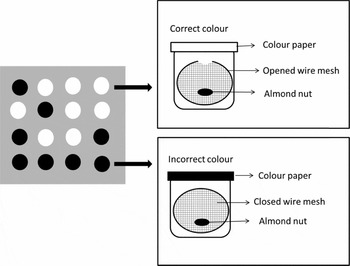
We conducted one experiment per day for each individual from 29 March to 20 October 2014 (experiment 1), and from 20 February to 10 April 2015 (experiment 2). The experiment commenced between 8h00 and 9h00 before food and water were given. The luminance of the room at 8h00 was between 290 and 420 lux. The study apparatus was a square wooden box (460 mm wide, 460 mm long, 60 mm deep) with 16 holes (50 mm in diameter) (Figure 1). A piece of almond (c. 0.5 g) was placed in a wire net as a reward and the wire net was set in each hole, all of which were covered by thick coloured paper (0.15 mm). In all, eight of 16 holes were painted the correct colour and the remaining holes were painted the incorrect colour. If the squirrel selected the correct colour, the nut could be obtained from the wire net opening. However, if it selected the incorrect colour, the wire net was completely closed and the squirrel could not get the nut (Figure 1). Squirrels were allowed to gnaw and open only eight holes in total. We judged that the squirrel discriminated the correct colour when seven or eight correct colours were selected, because the probability of such choices was less than 5% (the probability of eight correct choices amongst 16 holes is 0.000078, that of seven is 0.004973, but that of six is 0.060917). Observations were made through monitoring cameras located in the next room.
The study apparatus used for colour discrimination test of Callosciurus finlaysonii.

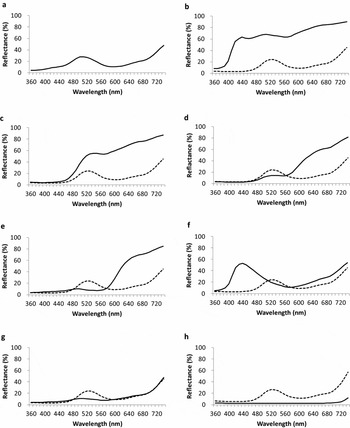
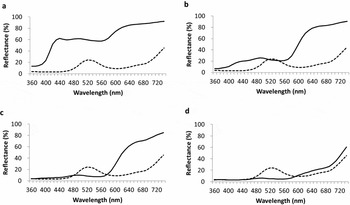
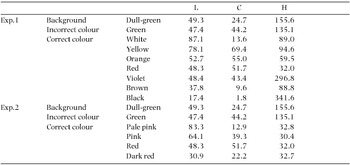
The seven correct colours used for experiment 1 were those with the possibility of being fruit colours (white, yellow, orange, red, violet, brown and black), as shown in Figure 2. The four correct colours used for experiment 2 were adjusted to similar hue but different lightness and chroma; pale pink, pink, red and dark red as shown in Figure 3. The incorrect colour was always green similar to leaves. The background colour was set as a dull green, imitating the colour of the forest background. The reflectance spectra of the colours used in the experiment were determined every 10 nm from 360 to 740 nm using 30-mm-diameter illumination (Konica Minolta Inc., CM-5). The lightness, chroma and hue of each colour used in the experiment are summarized in Table 1. Colour measurements were conducted by a colorimeter (NR-11A, Nippon Denshoku Industries Co., Ltd). Measurements were conducted three times for each colour and the mean values were used. Prior to experiment 1, 1 wk was required for the squirrels to become habituated and learn that they had to remove the coloured paper to obtain the nuts. The main experiment was continued for 10 consecutive days for each colour. The eight correct-coloured holes were changed every day based on a table of random numbers. Experiment 1 was conducted in a sequence of white, yellow, orange, red, violet, brown and black as the correct colours. The sequences of experiment 2 were pale pink, pink, red and dark red as the correct colours.
Reflectance spectra of the colours used in experiment 1. The dashed line in each graph indicates reflectance spectra of green as an incorrect colour. Solid lines indicates the reflectance spectra of background (a) and seven correct colours; white (b), yellow (c), orange (d), red (e), violet (f), brown (g) and black (h).

Reflectance spectra of the colours used in experiment 2. The dashed line in each graph indicates reflectance spectra of green as an incorrect colour. Solid lines indicates the reflectance spectra of four correct colours; pale pink (a), pink (b), red (c) and dark red (d). The background was as same as in experiment 1.

The lightness (L), chroma (C), and hue (H) of each colour used in the experiment.

Field observation
Observation studies were conducted at four study sites in Thailand: the Kao Ang Runai Wildlife Sanctuary (KARN: 13°24′N, 101°52′E), the Khao Kheow Wildlife Conservation Station (KK:13°14′N, 101°02′E), the Sublungka Wildlife Sanctuary (SL:15°35′N, 101°21′E) and on Koh Si Chang (KSC:13°08′N, 100°48′E) (Kanchanasaka et al. Reference KANCHANASAKA, BOONKEOW, HIRANKRILAS, PRAYOON and TAMURA2014). At the KARN study site, 17 h of observation were conducted in March 2011, 29 h in August 2012 and 37 h in February 2014. At the KK study site, 19 h of observation were done in June 2011 and 28 h in November 2012. At the SL study site, squirrels were observed for 24 h in September 2011 and 25 h in February 2013. Observation took place for 25 h in January 2012 and 29 h in June 2013 at the KSC study site. We walked along the census routes in the observation area of c. 10 ha at each study site. Observation was conducted three times per day: morning (6h00–8h00), midday (11h00–13h00) and evening (15h00–17h00). When we encountered a foraging squirrel, the tree species, the fruit colours on the tree, the colours of fruits the squirrels consumed, and the parts of the fruits that they consumed were observed using binoculars (× 8.0). Once we found the squirrels during the census, we tried to trace them for as long as possible. When we lost sight of a particular squirrel, or the squirrel stopped on alert towards observers, we resumed walking the census routes to find other squirrels. The names of plant species followed Smitinand (Reference SMITINAND2014).
RESULTS
Colour discrimination
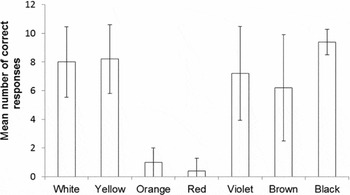
In experiment 1, we defined the correct response when seven or eight correct colours were selected, and calculated the mean number of correct responses among the five individuals for each colour (Figure 4). The number of correct responses was significantly different among colours (ANOVA, F=11.7, df = 34, P < 0.01). The number of correct responses for white was 8.0 ± 2.5 (mean ± SD), yellow 8.2 ± 2.4, violet 7.2 ± 3.3, brown 6.2 ± 3.7 and black 9.4 ± 0.9, respectively. For red and orange, however, the number of correct responses was only 0.4 ± 0.9 for red and 1.0 ± 1.0 for orange. Differences in mean values were significant by Tukey–Kramer multiple comparisons between white and orange (t = 4.71, P < 0.01), white and red (t = 5.11, P < 0.01), yellow and orange (t = 4.84, P < 0.01), yellow and red (t = 5.25, P < 0.01), violet and orange (t = 4.17, P < 0.01), violet and red (t = 4.57, P < 0.01), brown and orange (t = 3.50, P < 0.05), brown and red (t = 3.90, P < 0.01), black and orange (t = 5.65, P < 0.01) and black and red (t = 6.06, P < 0.01).
The mean number of correct responses of five individuals of Callosciurus finlaysonii in experiment 1. Bars indicate SD. Trials were conducted 10 times for each colour combination for each individual. The correct colours were changed in a sequence of white, yellow, orange, red, violet, brown and black. The incorrect colour was always green similar to leaves. We defined the correct response when seven or eight correct colours were selected among 16 holes.

On the final day of experiment 1, we also conducted a test to ascertain whether the squirrel uses colour or olfactory cues. We set the study apparatus as follows: squirrels could obtain food from a half of eight black covers and a half of eight green covers. If the squirrels use olfactory cues, they should open four black and four green covers and successfully get eight nuts. However, if they only use colour as a cue, they should select eight black covers and get only four nuts. All five squirrels selected eight black covers. Thus, we could ascertain that all five squirrels learned to acquire the nuts solely by colour cues.
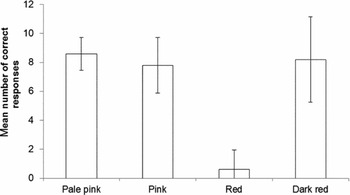
In experiment 2, the number of correct responses differed significantly between colours (ANOVA, F=18.8, df = 19, P < 0.01). The number of correct responses was 8.6 ± 1.1 (mean ± SD) for pale pink, 7.8 ± 1.9 for pink, 8.2 ± 2.9 for dark red, but only 0.6 ± 1.3 for red (Figure 5). An analysis using Tukey–Kramer multiple comparisons showed significant differences between pale pink and red (t = 6.43, P < 0.01), pink and red (t = 5.78, P < 0.01, and dark red and red (t = 6.10, P < 0.01).
The mean number of correct responses of five individuals of Callosciurus finlaysonii in experiment 2. Bars indicate SD. Trials were conducted 10 times per each colour combination for each individual. The correct colour was changed in a sequence of pale pink, pink, red and dark red. The incorrect colour was always green similar to leaves. We defined the correct response when seven or eight correct colours were selected among 16 holes.

Fruit colour
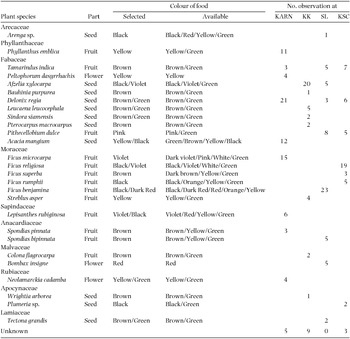
During a total of 233 h of observation, 237 feeding events were recorded and 220 of them were identified to species (Table 2). Finlayson's squirrel fed mainly on seeds and fruits (24 species) and occasionally on flowers (3 species). The most frequent food was seeds of Fabaceae (including 10 species) and this comprised 49.5% of all observations. Young pods of Fabaceae were usually green but they changed to brown when ripe. Squirrels selected brown or partly brown husks and fed on the seeds. One exception was a pod of Pithecellobium dulce, the colour of which was pink when it had ripened. Squirrels selected the pink pods to eat the pod itself.
Plant species eaten by Callosciurus finlaysonii in Thailand. Abbreviations of study sites: KARN: Kao Ang Runai Wildlife Sanctuary; KK: Khao Kheow Wildlife Conservation Station; SL: Sublungka Wildlife Sanctuary; KSC: Koh Si Chang.

Fruits of Ficus (Moraceae) were also frequently used and accounted for 29.5% of all observations. The fruit colour of Ficus showed variation amongst species and it changed with ripeness even on a single tree, with colours ranging from green, white, pink, yellow, orange, red, violet and black. Squirrels selected black, violet and dark red fruits to eat over white, pink, yellow, orange, red or green ones. Quantitative analyses of available fruits for each colour were difficult because the frequency of each colour changed with time and differed between parts of the tree. However, black or violet fruits never covered the majority of the tree. Thus, squirrels usually took time to select and eat the target fruits amongst a lot of fruits of various colours.
Most other fruits that the squirrels selected were black, brown or violet in colour, despite various fruit colours being present on the same tree. As a whole, black (including violet and dark red) was most frequently selected and accounted for 52.2% of fruits eaten. The next most selected colour was brown, which accounted for 34.3%. Selection of yellow (including orange) in comparison was much less frequent (7.2%). Pink was selected 6.2% of the time, but red fruits were not selected at all.
DISCUSSION
Finlayson’ s squirrel recognized colours and was able to discriminate between green and the colours white, yellow, violet, brown and black. However, the squirrels were less able to discriminate between green and orange, and particularly green and red. Whilst the squirrels discriminated between green and pale pink, pink and dark red, they appeared unable to distinguish red from green. As the hue of the four colours (pale pink, pink, red and dark red) was similar, the squirrels may have identified the correct colour based on the lightness and chroma but not on the hue. However, the values of lightness and chroma were similar for red, orange, violet and green, and the squirrels discriminated only between violet and green. This suggests that squirrels identify violet from green based on hue, but do not identify red and orange from green based on hue.
These results are consistent with previous work showing that both ground and arboreal squirrels possess dichromatic colour vision (Blakeslee et al. Reference BLAKESLEE, JACOBS and NEITS1988, Crescitelli & Pollack Reference CRESCITELLI and POLLACK1972). The grey squirrel (Sciurus carolinensis) has a spectral neutral point at about 500 nm (Blakeslee et al. Reference BLAKESLEE, JACOBS and NEITS1988). The antelope ground squirrel (Ammospermophilus leucurus) is unable to discriminate red or green on the basis of wavelengths, but is able to discriminate blue-yellow systems (Crescitelli & Pollack Reference CRESCITELLI and POLLACK1972). However, MacDonald (Reference MACDONALD1992) conducted a field experiment and indicated that the grey squirrel can discriminate red from green, and the discrimination is based on hue rather than brightness. The results of MacDonald (Reference MACDONALD1992) were different from our study and other previous studies, probably because squirrels in the field can select targets using various signals in addition to colours.
For diurnal tree squirrels, dichromatic colour vision seems to be disadvantageous in foraging for fruits in foliage. The excellent colour vision of frugivorous birds may be more advantageous for finding colourful fruits (Hart Reference HART2001, Wheelwright & Janson Reference WHEELWRIGHT and JANSON1985). Most of the primates also have trichromatic colour vision and trichromacy seems to be important for acquiring foods such as fruits and leaves (Caine & Mundy Reference CAINE and MUNDY2000, Lucas et al. Reference LUCAS, DOMINY, RIBA-HERNANDEZ, STONER, YAMASHITA, LORÍA-CALDERÓN, PETERSEN-PEREIRA, ROJAS-DURÁN, SALAS-PENA, SOLIS MADRIGAL, OSORIO and DARVELL2003, Osorio & Vorobyev Reference OSORIO and VOROBYEV1996, Regan et al. Reference REGAN, JULLIOT, SIMMEN, VIÉNOT, CHARLES-DOMINIQUE and MOLLON2000, Smith et al. Reference SMITH, BUCHANAN-SMITH, SURRIDGE, OSORIO and MUNDY2003). Of course, beyond colour vision and other visual cues, olfactory cues might be important for foraging for fruit, as in nocturnal mouse lemurs (Valenta et al. Reference VALENTA, BURKE, STYLER, JACKSON, MELIN and LEHMAN2013). For diurnal tree squirrels, however, the importance of colour signals in foraging situations cannot be denied, although they may also use olfactory cues.
Field observations revealed that Finlayson's squirrel tends to select black, violet or brown fruits rather than red, orange or yellow ones. Gautier-Hion et al. (Reference GAUTIER-HION, DUPLANTIER, QURIS, FEER, SOURD, DECOUX, DUBOST, EMMONS, ERARD, HECKETSWEILER, MOUNGAZI, ROUSSIHON and THIOLLAY1985) analysed the fruit characters in Gabon and described ‘squirrel fruits’ as dull coloured with dry fibrous flesh and few seeds. According to Kitamura et al. (Reference KITAMURA, YUMOTO, POONSWAD, CHUAILUA, PLONGMAI, MARUHASHI and NOMA2002), squirrels in Thailand (including two species, C. finlaysonii and R. bicolor) tended to eat black, red and yellowfruits.
Many fruits undergo a change in their colour as they ripen, and colour vision provides a reliable cue for discriminating between ripe and unripe fruits (Sumner & Mollon Reference SUMNER and MOLLON2000). Through observation, we found that the squirrels selected black, violet or brown fruits, although fruits of other colours were also available on a tree, such as green, red, orange, yellow or white ones. Squirrels in tropical forests often eat pulp, but the seeds are their main objective (Gautier-Hion et al. Reference GAUTIER-HION, DUPLANTIER, QURIS, FEER, SOURD, DECOUX, DUBOST, EMMONS, ERARD, HECKETSWEILER, MOUNGAZI, ROUSSIHON and THIOLLAY1985, Payne Reference PAYNE and Chivers1980), so the ripeness might be particularly important for squirrels. For example, squirrels selected the brown pods of Fabaceae including mature seeds, but they seldom used the unripe green ones. They did not eat the pods themselves, but their colour vision might be useful in selecting the proper food. In conclusion, dichromatic colour vision in squirrels may be useful for selecting ripe fruits of black and brown against unripe green, orange or red fruits.
ACKNOWLEDGEMENTS
We would like to thank Dr P. Lurz (University of Edinburgh) for providing valuable comments to improve this manuscript, and Dr P. Pipat (Chulalongkorn University) and Dr R. Tabuchi (Forestry and Forest Products Research Institute) for making our study possible. The present study was permitted by the National Research Council of Thailand (NRCT). A part of this study was financially supported by a Grant-in-Aid for Scientific Research by the Japanese Ministry of Education and Environment Research and Technology Development Fund (E-092). We also wish to thank the staff of the Aquatic Resources Research Institute, Chulalongkorn University, the Khao Kheow Wildlife Conservation Station, the Kao Ang Runai Wildlife Sanctuary, and the Sublungka Wildlife Sanctuary for their kindness and considerable help, and thank Mr Karin Hirankrilas, Miss Umphornpimon Prayoon, Mr Pupichi Mungnam and Mr Smith Inton for their sincere assistance during the fieldwork.