Syntactic (or grammatical) awareness refers to the ability to manipulate and reflect on the grammatical structure of language. Tasks that assess this ability include word-order correction tasks, in which the words of a sentence are presented in a jumbled order and have to be rearranged, for example, “strokes the cat Sue,” and grammatical correction tasks, where a grammatical or morphological anomaly in a sentence must be repaired, for example, “The girl eat the chocolate.” Syntactic awareness is a metalinguistic skill, distinct from the comprehension or production of a sentence, because it concerns the ability to consider the structure rather than the meaning of a sentence. Performance on measures of syntactic awareness improves with age and is related to reading ability (Bowey, 1986a, 1986b; Siegel & Ryan, 1989). The current research had two aims: to determine the contribution made by vocabulary, grammatical knowledge, and memory to performance on different measures of syntactic awareness and to investigate whether these skills mediate the relations between syntactic awareness and reading ability.
The central focus in the study of syntactic awareness has been its relation to reading ability. Syntactic awareness has been hypothesized to relate specifically to both word reading and reading comprehension. It is thought to aid word recognition skills by enabling a reader to use the syntactic constraints of a sentence to decode unfamiliar words (Rego & Bryant, 1993; Tunmer, 1989; Tunmer & Hoover, 1992) and reading comprehension by facilitating sentence- and text-level integration and monitoring skills (Tunmer & Bowey, 1984). Syntactic awareness predicts 5-year-olds' ability to use context to read words that they are unable to read in isolation (Rego & Bryant, 1993) and 9-year-old's accuracy at reading words in context (Muter & Snowling, 1998). Some studies find a specific relation between word reading and syntactic awareness even after controlling for receptive vocabulary (Bowey, 1986a) and other variables such as short-term memory (Willows & Ryan, 1986), although studies that control for additional measures, such as sentence repetition do not (Bowey & Patel, 1988).
A number of studies have considered the relations between syntactic awareness and reading comprehension. The two skills are correlated in 6- to 10-year-olds (Bowey, 1986b; Bowey & Patel, 1988), and syntactic awareness in Grade 1 predicts reading comprehension 1 year later via its influence on decoding and listening comprehension (Tunmer, 1989). Cross-sectional studies of children with poor reading comprehension report weaknesses on measures of syntactic awareness relative to same-age good comprehenders (Bentin, Deutsch, & Liberman, 1990; Gaux & Gombert, 1999; Nation & Snowling, 2000; Siegel & Ryan, 1988). Some studies find that syntactic awareness explains unique variance in reading comprehension after language and memory control measures (Willows & Ryan, 1986), although others do not (Bowey & Patel, 1988).
Despite over two decades of research investigating syntactic awareness and reading ability, the relation between the two is not clear: some studies report a specific relation between syntactic awareness and either word reading ability or reading comprehension, whereas other work suggests that the relation is mediated by language skills. Some of these differences may be explained by the use of different age groups: all of the skills investigated (reading ability, vocabulary, and metalinguistic awareness) develop with age, and the strength of the relations between them may change. In a longitudinal study of 5- to 8-year-olds, Demont and Gombert (1996) found that the predictive power relations between different measures of syntactic awareness, word reading, and reading comprehension changed over time. For example, 5- to 6-year-olds' syntactic awareness was the only unique predictor of reading comprehension at 8–9 years (after vocabulary and IQ controls), whereas in previous years phonological awareness (related to word reading skill) was also important. Another source of differences is the use of a variety of syntactic awareness tasks, which may make different demands on syntactic knowledge and memory and may rely on different processing strategies. These factors and their relation to performance on different measures of syntactic awareness will be considered next.
Many studies have controlled for vocabulary as a measure of general language ability (e.g., Bowey, 1986a, 1986b; Bowey & Patel, 1988; Willows & Ryan, 1986). Another language ability that may influence performance on measures of syntactic awareness is comprehension of different grammatical structures. If an assessment of syntactic awareness includes late-acquired grammatical structures with which the child is not overly familiar, the test might become one of knowledge rather than one of metalinguistic awareness. Tests of grammatical correction require the detection and repair of a grammatical or morphological anomaly in a sentence, for example, “The rabbit eat the carrot,” whereas word-order correction tasks do not. Thus, some measures of syntactic awareness may be more dependent upon syntactic knowledge than others. Sentence-level comprehension is necessary to understand at the level of the paragraph, and syntactic knowledge is correlated with passage comprehension (e.g., Goff, Pratt, & Ong, 2005). There do not appear to be any investigations of the relation between reading comprehension and syntactic awareness that have included measures of syntactic knowledge or sentence comprehension that are independent of metalinguistic skill. A comprehensive assessment of children's understanding of different syntactic structures was included in the current work, to determine how this knowledge was related to performance on different measures of syntactic awareness and whether it mediated the relation between syntactic awareness and reading comprehension.
Assessments of syntactic awareness tap into memory processes, so memory capacity may be an important determinant of performance on these tasks. Grammatical correction tasks require the storage of the sentence while the error is identified and corrected before a response is made. Word-order correction tasks involve the storage and rearrangement of the jumbled words. Both tasks tap into short-term storage of verbal information and, perhaps, the capacity to simultaneously process and store information. Memory is correlated with word reading and reading comprehension (Cain, Oakhill, & Bryant, 2004; Swanson & Howell, 2001) as well as with syntactic awareness (e.g., Siegel & Ryan, 1988), but syntactic awareness predicts reading ability after statistically controlling for memory (e.g., Gaux & Gombert, 1999; Gottardo, Stanovich, & Siegel, 1996; Willows & Ryan, 1986).
The type of syntactic awareness task used and the length of each trial may influence its relation with memory. Bowey (1994) suggests that word-order correction and grammatical correction trials make different demands on memory. Item length varies considerably (from between 3 and 10 words) in some measures of syntactic awareness (e.g., Bowey, 1986a; Gottardo et al., 1996, although these studies included memory controls). Independent measures of short-term and working memory were included in the current study to determine whether memory is differentially related to performance on these measures of syntactic awareness and to control for its relation with both syntactic awareness and reading. For each task, length of item was also manipulated to explore further the influence of memory on performance.
Alternative measures of syntactic awareness may rely on different processing strategies. Although grammatical knowledge is required to understand the meaning of certain structures such as passives, the meanings of other sentences may be grasped from the component words even if errors are apparent, for example, “my sisters is going shopping.” Bowey (1994) proposes that word-order correction tasks (e.g., “ran after the boy bus the”) rely more heavily on semantic processing strategies than grammatical correction tasks (e.g., “Yesterday, he visit his mother”), and that the contribution of semantic processing strategies to word-order correction tasks may be reduced by the use of semantically reversible materials, such as “ran after the goat the donkey.” If so, reading comprehension should be more strongly related to performance on the word-order correction task, and specifically to semantically reversible items because of a shared reliance on meaning-based processing strategies, compared to performance on the grammatical correction task. However, the reversibility of the items on word-order correction tasks affects performance of both good and poor comprehenders similarly (Nation & Snowling, 2000), which suggests that strategies or skills other than semantic processing are important determinants of performance on this task. In the current research, scores on measures of grammatical correction and word-order correction (including a comparison of items that were either semantically reversible or constrained) were examined in relation to reading comprehension performance.
This review demonstrates that there is a need to take another look at syntactic awareness and the factors that may contribute to success on these tasks (knowledge of grammatical structures, memory, task factors, as well as vocabulary) and also at the relations between syntactic awareness and word reading and reading comprehension. The research questions were as follows:
- 1a. Which skills influence performance on measures of syntactic awareness? A primary aim of this research was to determine how comprehension of different grammatical structures and memory were related to performance on two different measures of syntactic awareness and whether this relation changes with age over and above vocabulary, which has often been used as an index of general language ability in previous studies.
- 1b. Does item length influence the predictive power of memory for the two different measures of syntactic awareness? A subsidiary aim was to explore how memory influenced performance on the two tasks. It was predicted that performance on the word-order correction task would be more adversely affected by item length (number of words in the trial) than grammatical correction, because the former is more dependent on memory, as proposed by Bowey (1994).
- 2a. Is there a special relation between syntactic awareness and reading ability? The second main aim was to determine whether the two different measures of syntactic awareness shared a specific relation with word reading in context and reading comprehension skill, over and above the measures of language and memory, and whether this relation changes with age.
- 2b. Does item type influence the predictive power of word-order correction for reading comprehension? A subsidiary aim was to explore whether word-order correction items that can be processed with meaning-based strategies share a stronger relation with reading comprehension than those that are more dependent on syntactic strategies. Support for this would be a stronger relation between reading comprehension and semantically constrained items in the word-order correction task.
To address these research questions, we investigated the relations between word reading accuracy, reading comprehension, and two measures of syntactic awareness in two groups of young children aged 7–8 and 9–10 years. The relative contributions made by receptive vocabulary, comprehension of different grammatical structures, short-term, and working memory to performance on these tasks was assessed.
METHOD
Participants
Children were selected from 10 classes in three schools serving mixed catchment areas in the east of England. One hundred ninety-six children aged 7–8 and 9– 10 years completed a group-administered vocabulary assessment (see below). All other assessments were individually administered in a quiet room in the child's school. Children were excluded from further assessment on the following basis: their performance on the vocabulary assessment (see below) was at floor or ceiling; their first language was not English; they had a statement of special needs; parental permission to participate in the study was not provided.1
Forty-two children (21.4%) were excluded from the original sample on the basis of their vocabulary scores. A further 37 were excluded because they either had a statement of special educational needs, spoke English as an additional language, or parental permission was not given. The precise numbers for each category are not known because the teachers did not release this information.
Control measures
Vocabulary. Receptive vocabulary has been used as an index of language ability in previous studies of syntactic awareness (e.g., Bowey, 1986b). Receptive vocabulary was measured with a group-administered version of the British Picture Vocabulary Scales (Dunn, Dunn, Whetton, & Pintillie, 1992; see Stanovich & Cunningham, 1992, for a similar modification). The test comprised 38 words. The experimenter read out the word and the child ticked the corresponding picture in their individual booklet. One point was awarded for each correct answer. Reliability, assessed by calculating the Cronbach alpha over items, was adequate at α=0.73.
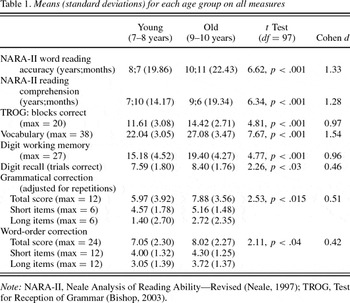
Grammatical knowledge. Children completed the Test for Reception of Grammar—2nd Edition (Bishop, 2003), a standardized assessment of receptive grammatical knowledge. In this test, children are presented with four pictures and an orally presented sentence and are required to select the picture that represents the meaning of the sentence. There are four items to test each grammatical contrast, and testing is discontinued when five consecutive blocks of four items are failed. Standardized scores are available, but raw scores (total number of blocks passed) are used in the analyses with both age groups and are reported in Table 1. The reported internal reliability is high at .88.

Short-term memory. The ability to store and recall verbal information was tested in the following way. Children were presented aurally with lists of digits increasing in length, starting with just two digits. The task was to repeat back the digits, in the order of presentation. There were two items at each level, and testing was discontinued when two consecutive errors were made. The number of trials correctly completed was the measure used in the analyses.
Working memory. The digit reading working memory test developed by Yuill, Oakhill, and Parkin (1989) was used to assess storage and processing. Children read groups of three digits and were required to remember the final digit from each group. They were presented with three trials containing two groups of digits, three trials with three groups of digits, and three trials with four groups of digits. Children were instructed to recall the items in the order of presentation. Two practice items with corrective feedback were given. The total number of items recalled is reported, with a maximum possible of 27. The reliability of this test reported by Seigneuric, Ehrlich, Oakhill, and Yuill (2000) is .67.
Reading ability
The Neale Analysis of Reading Ability—II (Neale, 1997) is an individually administered test in which children read texts increasing in length. After each text a set of questions to tap memory for literal details and inferable information is asked. Word reading errors are corrected up to a prescribed limit: testing is discontinued when this is reached. The test provides a word reading accuracy score, based on the number of word reading errors made, and a reading comprehension score, based on the number of comprehension questions answered correctly. Raw scores are used in the analyses where age is a factor; age-equivalent scores are reported in Table 1. Children completed Form 1, for which reliability for this age range is between .82 and .86 for word reading accuracy and between .93 and .95 for reading comprehension.
Syntactic awareness
Children completed two measures of syntactic awareness: grammatical correction and word-order correction.
Grammatical correction. This task comprised 12 items with four examples each of the following error types: subject–copula verb agreement, for example, “the baby are sick”; subject–verb agreement, for example, “The girls climbs the tree”; tense agreement, for example, “Yesterday, John learn his spellings.” In the current study, there were two items of 4–6 words and two items of 9–10 words, for each error type. Children were told “I am going to read out some sentences that are wrong and I want you to fix them, to make them better.” They were given three practice items with corrective feedback. One repetition of each item was provided, if necessary. One point was awarded for each correct answer.
The measurement of performance on grammatical correction tasks is confounded by automatic corrections, particularly for younger children (Bowey, 1986a). Scores on grammatical correction tasks can be adjusted to take into account spontaneous corrections, an approach adopted in the current study. Spontaneous corrections were measured in a different session, in which children's ability to imitate ungrammatical sentences was recorded. Children heard 12 new items of the same error types and were instructed to repeat the sentence exactly as they heard it “even if it sounds wrong.” Three practice items with corrective feedback were given. In addition, when two consecutive experimental items were corrected by the child rather than repeated, the instruction to repeat back exactly what the child had heard was reiterated. The younger children made more spontaneous corrections than did the older children, t(97)=3.49, p<.005. Performance on the grammatical correction task was corrected for performance on the imitation task (total grammatical performance minus grammatical imitation). The total scores across all trials are used in the primary analyses, and the comparison between short and long items is reported separately to address the relevant subsidiary aim. The total scores are reported in Table 1. Reliability over all items was adequate at α=0.69.
Word-order correction. This task comprised 12 items: 6 were potentially semantically reversible, for example, “the donkeys the horse races,” and 6 were semantically constrained, for example, “the girl the kittens brushes.” There were either five or eight words in each trial. Each item was read out loud to the child with normal prosody such that the error was not emphasized. Two points were awarded for each response in which the grammatical agreement was preserved, and 1 point was awarded when the response made sense but the grammatical agreement was changed, for example, “the donkeys race the horse.” The total scores (sum of short and long trials) are reported in Table 1. Reliability over all items was adequate at α=0.75.
RESULTS
Descriptive statistics
Descriptive statistics for each age group's performance are reported in Table 1. The older age group obtained higher scores than the younger children on all measures. Cohen's d is reported as a measure of effect size (.2 = small, .5 = medium, and .8 = large effect) for all significant t−test comparisons.
Interrelations between measures
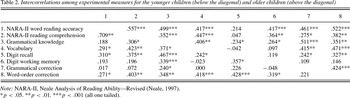
The zero-order correlations between all measures are reported in Table 2. The main findings were as follows. Performance on the word-order correction task was correlated with reading ability and knowledge of vocabulary, as has been found in previous work. In addition, it was correlated with grammatical knowledge and digit recall in both age groups, and also digit working memory for the younger children. For the older children, scores on the grammatical correction task were correlated with the same measures. Grammatical correction did not show the same pattern of performance for the younger children. Different aspects of memory were important for the two age groups. For the older children, working memory was an important predictor of reading ability; for the younger children digit recall correlated with both word reading accuracy and reading comprehension.

Which skills influence performance on measures of syntactic awareness?
A series of fixed-order hierarchical multiple regressions with performance on either the word-order correction or grammatical correction tasks was conducted, to assess the relative contributions made by vocabulary knowledge, grammatical knowledge, and memory. Separate analyses were conducted for each age group. Three pairs of analyses were conducted for the older age group, to determine the predictors of performance on the word-order correction task. In the first pair of analyses, vocabulary scores were entered in the first step. In one analysis, grammatical knowledge and digit recall were entered in the second and third step, respectively; the order of entry was reversed in the second analysis of this pair. The same principle was used for a pair of analyses in which grammatical knowledge was entered in the first step, and again for a pair of analyses in which digit recall was entered in the first step.
For the younger children a memory composite score was created, because both aspects of memory were correlated with performance on the word-order correction task. Scores on the digit recall and digit working memory task were standardized and the composite was used in the analyses.2
Individual analyses with either digit recall or working memory raw scores produced the same pattern of results.

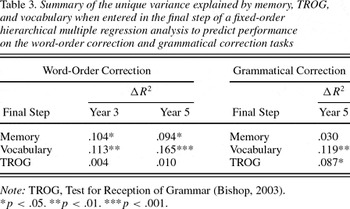
When word-order correction was the criterion, the two sets of analyses produce near identical patterns of prediction. For both age groups, vocabulary predicted unique variance in performance on the word-order correction task when entered last, after grammatical knowledge and digit recall. Similarly, memory predicted unique variance when entered in the third step. Grammatical knowledge only reliably predicted performance on this task when entered first. For the older children, the final R2 was .35, and the β values were vocabulary = .44, p<.001; memory = .32, p<.015; grammatical knowledge = .11, ns. For the younger children, the results were very similar. The final R2 was .34, and the β values were vocabulary = .35, p<.001; memory = .37, p<.015; and grammatical knowledge = .08, ns. When the grammatical correction task was the criterion (older age group only) vocabulary and grammatical knowledge were both reliable predictors and explained significant proportions of variance when entered at the third step. The three variables explained 39.6% of the variance, and the β values were vocabulary = .38, p<.01; memory = .18, ns; grammatical knowledge = .33, p<.015.
Does item length influence the predictive power of memory for the two different measures of syntactic awareness?
Paired sample t tests confirmed that both age groups performed most poorly on the long trials of each task. The mean scores for short and long trials are reported in Table 1. The values for the word order correction task were t(48)=4.58, p<.001 and t(49)=3.16, p<.005, for the younger and older children, respectively. The values for the grammatical correction task were t(48)=9.39, p<.001 and t(49)=10.50, p<.001. Fixed-order multiple regression analyses, parallel to those described above, with performance on the long and short items as separate dependent variables were conducted. For the older children, memory explained a significant 9% of the variance for performance on the long items of the word-order correction task when entered in the third step after vocabulary and grammatical knowledge. The model explained 27.6% of the variance, in total. Memory also explained an additional but nonsignificant proportion of the variance for short items, 5.5% (p=.079), when entered last in the model, which accounted for 21.4% of the variance in total. Memory did not contribute to the prediction of long or short items on the grammatical correction task. For the younger age group, memory explained significant unique variance for both long (6.2%) and short items (9%) of the word-order correction task, when entered at the final step.
What mediates the relationship between syntactic awareness tasks and reading?
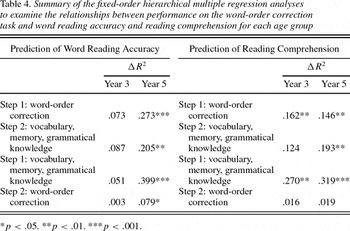
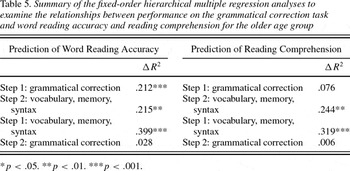
Performance on both measures of syntactic awareness was correlated with word reading accuracy and reading comprehension scores in the older age group. To determine whether the relations between performance on the syntactic awareness tasks and reading were mediated by the language and memory variables, two pairs of fixed-order hierarchical multiple regressions were conducted: one with word reading accuracy as the criterion, the other with reading comprehension. Parallel pairs of analyses were conducted for each criterion. In the first analysis of a pair, word-order correction (or grammatical correction) was entered in the first step and the remaining “control” variables (vocabulary, grammatical knowledge, and memory) in the second step. In the second analysis the order of entry was reversed. For the younger age group, the analyses were conducted for the word-order correction task only and the memory composite score was included as one of the control variables. The results are summarized in Table 4 (both groups: word-order correction) and Table 5 (older children only: grammatical correction).
For the older children, word-order correction was a unique predictor of word reading accuracy after the control variables. The relations between the different measures and the younger children's word reading accuracy were weak and did not reach statistical significance. The results for the prediction of reading comprehension were consistent for both age groups: performance on the word-order correction task did not predict a significant proportion of additional variance in reading comprehension after the control variables. Similarly, grammatical correction was not a unique predictor of variance in word reading accuracy or reading comprehension (older children only).


Does item type influence the predictive power of word-order correction for reading comprehension?
Semantic processing strategies can be used to process semantically constrained trials, for example, “the girl the kittens brushes,” but do not help with semantically reversible ones, for example, “the donkeys the horse races.”Each age group found the latter items the hardest. For the older children, M=4.34 (1.23) and 3.68 (1.28), t(49)=3.16, p<.001. For the younger children, the means in order were M=3.89 (1.46) and 3.15 (1.48), t(48)=2.84, p<.01. There was evidence that meaning-based processing strategies might underpin the relation between some word-order correction tasks and reading comprehension in the older age group. For these children, there was a moderately sized and significant correlation between the semantically constrained items and reading comprehension skill (r=.41, p<.005) and performance on these items explained an additional and significant proportion of variance in reading comprehension (R2=.066, p<.05) in a multiple regression analysis after the vocabulary, grammatical knowledge, and memory controls. Performance on the reversible items did not correlate significantly with reading comprehension for this age group (r=.23, p>.10). The magnitude of the difference between the two correlations was significant, t(47)=1.94, p<.05 (one tailed). In the younger sample, both item types were correlated with comprehension (reversible items, r=.42, p<.005; semantically constrained, r=.31, p<.05), but neither explained unique variance in the prediction of reading comprehension after the control variables.
DISCUSSION
This study demonstrated that different language and memory skills were related to different measures of syntactic awareness suggesting that different measures of syntactic awareness are not equivalent. There was little support for a special relation between syntactic awareness and reading comprehension: the data suggest that the correlation between the two might arise because of variance shared with language and memory skills. In contrast, there was evidence that word reading and syntactic awareness share unique variance that is not explained by vocabulary and grammatical knowledge or memory. The implications for how we measure and conceptualize syntactic awareness, and its relation with reading ability, are discussed in turn.
Word-order correction and grammatical correction tasks are both widely used measures of syntactic awareness. They appear to tap into different additional skills. Vocabulary was the strongest predictor of both measures of syntactic awareness, explaining unique variance in addition to the proportion associated with grammatical knowledge and memory, a finding that is consistent with previous research (e.g., Bowey, 1986a, 1986b; Willows & Ryan, 1986). The novel finding is the contrast between memory and grammatical knowledge as predictors. For both age groups, memory was associated with performance on the word-order correction task, in which words are stored and reordered. Grammatical knowledge was an important variable in grammatical correction tasks, where grammatical and morphological anomalies are presented; it did not predict performance on the word-order correction task over and above vocabulary and memory. These findings provide empirical support for Bowey's (1994) proposal that word-order correction tasks are more dependent on memory than are grammatical correction tasks. In addition, the findings indicate that performance on the grammatical correction task is more closely associated with grammatical knowledge than is performance on the word-order correction tasks. For the younger age group, grammatical knowledge was the only variable that correlated significantly with performance on the grammatical correction task. Together, the results strongly suggest that these two measures of syntactic awareness are not equivalent.
The tasks compared in the current research are two of the most widely used measures of syntactic awareness, and they each have different strengths and weaknesses. The current findings indicate that language and/or memory demands must be considered when choosing a measure of syntactic awareness. Additional factors may also influence performance. Bowey (1994) suggested that word-order correction tasks might be heavily influenced by semantic processing strategies. In the current study items that could be processed with meaning-based strategies, semantically constrained trials, were easier than those than required syntactic constraints to be considered, the semantically reversible trials (see also Nation & Snowling, 2000). In addition, only performance on the semantically constrained trials predicted reading comprehension skill (for the older children).
Syntactic awareness has been linked theoretically to both word reading and reading comprehension. The current findings strongly suggest that the relation between syntactic awareness and reading comprehension is indirect and arises from the variance shared with vocabulary, grammatical knowledge, and memory. There is one important qualification: for the older children, reading comprehension shared unique variance with items on word-order correction tasks that were dependent on semantic (or meaning-based) processing strategies. In contrast, the word-order correction task shared a unique relation with word-reading ability, at least for the older children. This finding is consistent with Gottardo et al.'s (1996) study, in which syntactic awareness explained unique variance in word reading skills after memory controls and Demont and Gombert's (1996) work, where vocabulary and IQ were controlled. However, grammatical correction was not predictive of word reading level in the current study. The findings strongly suggest that the presence or absence of relations between syntactic awareness and word reading and reading comprehension may depend on which task is used to assess syntactic awareness.
The pattern of relations between reading ability, vocabulary, grammatical knowledge, and the two measure of syntactic awareness was not the same for each age group. The reliabilities of the measures were all adequate; thus, it is reasonable to assume that the differences found in the pattern of correlations for the two age groups reflected the strength of the relations between these variables with age. Indeed, Demont and Gombert (1996) found that different metalinguistic skills influenced both word reading and reading comprehension at different time points in their longitudinal work. This is not surprising when we consider the literature on phonological awareness, another metalinguistic skill associated with reading ability. There is strong evidence that different aspects of phonological awareness may have different developmental trajectories: awareness of syllables appears to arise spontaneously, and is evident even in very young children, whereas there is an ongoing debate about whether phonemic awareness requires an external stimulus such as reading instruction (Castles & Coltheart, 2004).
This study presents some interesting findings, but questions remain. We need to determine how best to control methodologically for the tendency of young children to automatically correct ungrammatical sentences. The adjustment used in the current work is not precise because it is not clear what proportion of correct trials are the result of spontaneous corrections rather than identification and deliberate correction. This may account for the absence of correlations between performance on the grammatical correction task and the other measures for the younger children who produced many spontaneous corrections in the imitation condition. Future research needs to address the precise nature of any causal relations between syntactic awareness and different aspects of reading ability with longitudinal designs and intervention studies. We also need to determine whether syntactic awareness impacts upon different aspects of reading at different stages of reading development. In relation to this point, the contribution of phonological processing skills to the apparent link between syntactic awareness and word reading skill should be considered (see Gottardo et al., 1996).
This research has demonstrated that different language and memory skills support different measures of syntactic awareness. These findings suggest that different measures of syntactic awareness are not comparable, a conclusion that has implications for the theoretical construct and the study of this aspect of metalinguistic awareness. The current findings support the hypothesis that syntactic awareness may facilitate the development of word reading in context; they also suggest that the relations between syntactic awareness and reading comprehension may reflect the importance of memory and language to both measures, rather than a special relationship between the two.
This work was supported by a Research Promotion Fund Grant from the University of Essex. Thanks to the schools in Essex who participated in this research, Simon Bignell who assisted with the data collection, and Judy Bowey and two anonymous reviewers for their comments on an earlier version of this paper.