INTRODUCTION
Questions of collective identity and belonging remain highly salient in contemporary South Africa long after apartheid's formal demise. Many black South Africans now are caught between laws, policies and practices regarding traditional leadership and land that privilege different conceptions of membership. On the one hand, the post-apartheid state has buttressed chiefly authority by retaining tribal authority structures, now termed ‘traditional communities’. In maintaining the apartheid linkage of custom, place and authority, traditional leadership policies subject people who live in so-called traditional communities to a form of separate and potentially unequal sub-national citizenship.Footnote 1 On the other hand, post-apartheid land restitution laws and policies have underscored the importance of origin and ancestry by empowering those individuals whose ties to the collective predate dispossession. These contradictory policies and practices exacerbate tensions over collective identity and belonging.
This paper examines the interconnections among struggles over land, struggles over collective identity, and state policies and practices through an in-depth study of the Barokologadi ba ga Maotwe of North West Province. This case is emblematic of communal membership politics in contemporary South Africa. The Barokologadi were forcibly relocated, have an apartheid-shaped traditional council structure, and have pursued a collective land restitution claim. Like many South Africans who experienced forced removal and have sought collective restitution, the Barokologadi are subject to both land reform and traditional leadership policies and must navigate the tensions between them. Close examination of this case therefore allows for deeper understanding of the stakes and dynamics of struggles over collective identity in post-apartheid South Africa.
Building upon recent critiques of post-apartheid traditional leadership and land policy reforms, this paper deepens our understanding of the interaction between these policies and collective identity politics (see Ntsebeza Reference Ntsebeza2005; Ntsebeza & Hall Reference Ntsebeza and Hall2007; Claassens & Cousins Reference Cousins, Claassens and Cousins2008; Walker Reference Walker2008). Decision-makers confronted several vexing ‘policy dilemmas’ such as ‘how to confirm the rights of those with strong claims to land (for example as a result of original or continuous occupation) without rendering later arrivals insecure and vulnerable’ (Cousins Reference Cousins, Claassens and Cousins2008: 11). While traditional leaders lobbied decision-makers to preserve their authority, many activists and scholars advocated the transformation or elimination of state-supported chieftaincy (see Fortin Reference Fortin2010). In the face of these conflicting pressures, policymakers have leaned towards preserving chiefly authority. For example, although the Communal Land Rights Act of 2004 (CLARA) claimed to ‘provide for the democratic administration of communal land by communities’, this act would have allowed traditional leaders to retain influence over communal land by empowering traditional councils to administer this land (CLARA 2004: preface & 21(2–4); Claassens & Cousins Reference Cousins, Claassens and Cousins2008). Accentuating the continuities with apartheid practices, scholars have critiqued the government's approach to these policy domains, highlighted problems in policy implementation, proposed alternatives and participated in the successful legal challenge to CLARA. The particular contribution of this paper is its examination of the interplay between state policies and collective identity struggles.
In exploring the interconnections between struggles over land and struggles over identity, this paper draws attention to the similarities between South African political dynamics and those elsewhere on the African continent. Conflicts over access to, control over and ownership of valued land have served as a catalyst for membership struggles across Africa (Berry Reference Berry, Juul and Lund2002; Peters Reference Peters2004; Geschiere Reference Geschiere2009). Many autochthonous and long-resident groups have attempted to exclude other residents from membership and access to resources by labelling them outsiders, settlers, squatters or migrants who are not proper ‘sons of the soil’ (Geschiere Reference Geschiere2009). Some so-called outsiders, such as the Mandingo of Lofa, Liberia, have been resident for more than a century (Bøås Reference Bøås2012). Others are relatively recent arrivals as in the case of Ndebele and Shona who moved to Binga and Vumba in northern Zimbabwe during the late 1980s and early 1990s (Dzingirai Reference Dzingirai2003). The Ndebele people subsequently were excluded from the Binga District CAMPFIRE programme because they were not seen as ‘bona fide residents’, while Gokwe North district councillors’ labelling of some Vumba settlers as ‘squatters’ both ‘undermine[d] their rights as civic citizens’ and ‘attacked their status and entitlements as ethnic subjects’ (Hammar Reference Hammar, Juul and Lund2002: 227; Dzingirai Reference Dzingirai2003: 452).Footnote 2 The Binga, Vumba and Barokologadi disputes each concern communal belonging. In the Barokologadi case, however, membership struggles centre on long-time residents rather than recent arrivals.
Communal membership matters. Discursive struggles over collective identity, membership and belonging are intertwined with struggles over decision-making and resources. People's acceptance within, or exclusion from, the community strongly influences whether their views and claims are taken seriously by the collective. Contending factions use public and private speech to demarcate the boundaries between insiders and outsiders, and these struggles over the boundaries of belonging have material consequences. Traditional leaders and community associations apply their understandings of membership in determining which people may participate in decision-making, who may have access to collective resources, and who may pursue membership-dependent opportunities. As Mamdani (Reference Mamdani2002: 505) wrote of citizenship, communal membership ‘does not entitle you to resources, [but] it entitles you to enter the struggle for resources’.
Struggles over collective identity in South Africa and elsewhere are intertwined with struggles over authority (Boone Reference Boone2007; Berry Reference Berry2009). Several recent analyses have emphasised the negotiability, ambivalence and unsettled character of such struggles, of property and of authority (Moore Reference Moore1998; Berry Reference Berry2000; Lund Reference Lund2008). Yet negotiability has limits, as Pauline Peters (Reference Peters, Juul and Lund2002) argues. States play an important role in establishing these limits as their selective recognition and enforcement of some claims and not others strongly influences how struggles over identity, property and authority play out. State recognition of communal tenure ‘consolidates local states’, thereby making sub-national citizenship highly consequential (Boone Reference Boone2007: 578). In this context, ‘membership in the local community is a legal status and a political identity – that is, as a relation to the state, rather than just a state of mind’. In South Africa, for example, residents of the former homelands often need letters ‘confirming that they are known and bona fide community members’ in order to obtain identity documents and to access government programmes (Claassens Reference Claassens2011: 11). The Barokologadi case brings the interconnections among struggles over belonging, resource struggles and the state to the fore.
In focusing on collective identity, shared membership and belonging, this paper necessarily engages with the vexed concept of community. The word community evokes both geography and imaginary for, as Gupta & Ferguson (Reference Gupta and Ferguson1992: 8) write, ‘notions of locality or community refer both to a demarcated physical space and to clusters of interaction’. Although communities are often imagined as idyllic, harmonious, cohesive, homogeneous and timeless collectives independent of state and economy, actual communities comprise multiple, differently positioned actors with diverse and sometimes conflicting interests (Gupta & Ferguson Reference Gupta and Ferguson1992; Li Reference Li1996, Reference Li2002; Agrawal & Gibson Reference Agrawal and Gibson1999). Neither timeless nor autonomous, communities are formed and reshaped through discourse, social relations and material practices and by political, economic and social forces. This paper deepens our understanding of these processes through its description and analysis of the interplay between Barokologadi collective identity struggles and the South African government's land and traditional leadership policies and practices.
This paper draws from field research among Barokologadi people in 2005, 2006 and 2010.Footnote 3 My research methods were qualitative: I interviewed people, observed public and private meetings, engaged in informal conversations, and delved into public and private archives in North West and Gauteng provinces. I conducted 83 in-depth, semi-structured interviews with approximately 95 people, interviewing 15 individuals both in 2005–6 and in 2010. I spoke with Barokologadi traditional leaders and land claim activists, self-identified Barokologadi youth, adults and elders, and non-Barokologadi subject to the Barokologadi Traditional Council along with government officials, lawyers, consultants and other people who interact with the Barokologadi.Footnote 4 This paper focuses on identity struggles among self-identified Barokologadi, those people who saw themselves as Barokologadi and wanted to be accepted as such. My Barokologadi informants occupied a wide range of subject positions and had varied perspectives on the struggles this paper describes, but none advocated imposing Barokologadi-ness on people who do not identify as Barokologadi.
The remainder of this paper is organised as follows. The second section describes differing conceptions of Barokologadi identity and situates these competing discourses in historical perspective. I then discuss South Africa's traditional leadership, land tenure and land restitution policies in the third section. The fourth section analyses how these policies have affected Barokologadi identity struggles. My analysis focuses on two recent controversies that illustrate the interplay between these struggles and state policies and practices. The conclusion considers the broader policy implications of this case.
COMPETING IDENTITIES AND SELECTIVE HISTORIES: BAROKOLOGADI-NESS, PLACE AND ORIGIN
As I talked with Barokologadi people in 2005, 2006 and 2010, I found them pulled between competing conceptions of collective identity. On the one hand, the Barokologadi kgosi (chief) articulated an expansive, place-focused understanding of Barokologadi-ness. ‘You are all Barokologadi no matter where you come from. Each of you staying here, you are a Morokologadi’, said Kgosi O.T.S. Maotwe at one 2006 community meeting in Pitsedisulejang (2.3.2006).Footnote 5 On the other hand, T.Z. Molwantwa, the leading Barokologadi land restitution activist, talked of the ‘people who joined our land’, implying that people who had settled in Barokologadi places were not truly Barokologadi (2006 int.).Footnote 6 Addressing the issue more directly in a 2010 interview, Molwantwa told me, ‘I think people who are not beneficiaries of this land, who are not Barokologadi … by nature, who came to this site, are more than Barokologadi … they still have allegiance to their chiefs where they come from.’ Other self-identified Barokologadi also expressed contrasting understandings of identity as the quotations below illustrate.
For me, Barokologadi, those people were once a community in Melorane. And they were then scattered from Melorane … that core, and their descendants, are Barokologadi … you are born Morokologadi or you are married into Barokologadi … (Interview, Pretoria, 2010)
I came to Kgosi Maotwe to ask for a stand, and he welcomed me, and I became a Morokologadi [in 1961]. You can't have two chiefs; it means you are not an honest person. … That is how I came here, and now I am a full member of the Barokologadi community, and I will never migrate to other places. As you can see, I have already built up a house here. Everything that affects Barokologadi also affects me. (Interview, Pitsedisulejang, 2006)
‘For me, it [the Barokologadi community] is everybody who lives there. Those people may not have come from Melorane, but for them to end up at Debrak, they were personally removed from somewhere. … These are the people that every time a little contribution was made – to build a school, to build whatever – they were there as well, you understand … so how do we segregate now, you know?’ (Interview, Midrand, 2010)
There is racism in our village. I am not a pure Morokologadi. The main Barokologadi have discrimination. They don't want to include us. (Interview, Pitsedisulejang, 2006)
These public and private statements articulate competing conceptions of Barokologadi collective identity. For some, Barokologadi-ness is defined by ancestry and history, by one's ties to Melorane, the home place from which Barokologadi were forcibly removed in 1950. For those who adhere to this perspective, it makes no sense to talk of someone becoming Barokologadi. A person can only be Barokologadi if he (or she) can trace his membership in the community back multiple generations or can show that his lineage was part of the Barokologadi before they left Melorane. Others view residence in Barokologadi places and acceptance of Barokologadi customary authority as sufficient for full membership. If a person lives in a Barokologadi place, has joined the community in the way its traditions call for – namely marrying a Barokologadi person or obtaining permission from a Barokologadi clan, a clan leader, and the kgosi or tribal council and agreeing to obey the kgosi – then he or she is Barokologadi. From this perspective, one can become Barokologadi.
These competing Barokologadi identity discourses display the troubled relationship with history that Geschiere (Reference Geschiere2009) argues characterise all autochthony discourses. Although adherents to each viewpoint depict Barokologadi identity and membership criteria as if they are clear, stable and unchanging, each discourse relies upon a partial recounting of Barokologadi history and a selective interpretation of its customs. As with many Southern African communities, the Barokologadi are a diverse group who have a complex history punctuated by coerced and voluntary relocations, fission, emigration and immigration. While the ultimate origin of the Barokologadi is unclear, the Barokologadi have had close ties with the Bakgatla and other Tswana groups since at least the 17th century (Breutz Reference Breutz1953; Barokologadi Royal Council 2001). The Barokologadi resided with the Bakgatla ba ka Kgafela in the Transvaal village of Lengwana in the early 18th century and may have been subject to them. During the 19th century, the Barokologadi moved with the Bakgatla to Mankgodi in present-day Botswana and then separated from the Bakgatla and returned to the Transvaal in present-day South Africa. The Barokologadi then settled in Melorane under the leadership of Kgosi Sentswe Maotwe before the turn of the 20th century.
The Barokologadi also moved during the 20th century. The South African government did not recognise the Barokologadi as the owners of the land they called Melorane, and their occupation became increasingly insecure over time. The government declared the settlement a ‘black spot’ in 1936, sold the land to white farmers in 1938, ordered the Barokologadi to leave the area in 1949, and then removed the people still resident in 1950. Legal efforts to challenge this forced removal were unsuccessful.
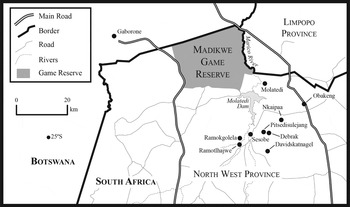
These pressures produced fissures among the Barokologadi as four groups moved to different settlements in what was then Bophuthatswana and is now the North West province. The first two groups moved to private farms in the late 1940s as removal became imminent. Several Barokologadi families collectively purchased Debrak farm and relocated there despite the current kgosi's disapproval. This first group was led by Esser Mokgophe, whose family had been purchasing private farm land since the 1920s. A second group of Barokologadi moved to Motlollo (also called Spitskop), a private farm in the mountains where they lived independently for several decades before relocating to Obakeng in 1985 in order to secure access to pensions.Footnote 7 Kgosi Olefile Maotwe and his remaining followers stayed at Melorane until they were forcibly removed to Misgund in 1950. As conditions there were very poor, this third group moved and fragmented once more. Some moved to the Davidskatnagel farming settlement on the advice of the Native Commissioner, and others founded the village of Pitsedisulejang along with the kgosi. Figure 1 shows the location of Debrak, Obakeng, Davidskatnagel, Pitsedisulejang and other rural Barokologadi places.
Rural Barokologadi Places in North West Province

In addition to these large collective movements, individuals and small groups of people moved to and from Barokologadi places throughout the 20th century. Numerous self-identified Barokologadi recounted relocating from place to place, first with their parents or caregivers and then later as adults for educational and work opportunities. These individual and familial migrations occurred both before and after the community's coerced relocation: many people with ties to Melorane have settled near-permanently in townships, towns and cities that offer greater economic opportunities and place them outside traditional authority structures. Township associations, social networks and trips to Barokologadi places fostered a sense of collective identity among these Melorane Barokologadi. Concurrently, successive Barokologadi chiefs, headmen and clans in Davidskatnagel, Debrak, Motlollo/Obakeng and Pitsedisulejang have allowed people without ties to Melorane to settle in these places. Consequently, the Melorane Barokologadi have dispersed, and every Barokologadi place is now populated by individuals, families and households with diverse ancestral ties.
This brief recounting of Barokologadi history shows the limitations of ancestry and Melorane-focused articulations of collective identity. In arguing that people who were recognised as Barokologadi in the 1940s and their descendants are the only true Barokologadi, adherents to this perspective disregard the inherent arbitrariness of freezing membership in this dynamic, shifting collective at a single point in time. It is far from obvious why the descendants of people who settled in Melorane in the 1930s should be accepted as Barokologadi while those who settled in Pitsedisulejang or Davidskatnagel in the 1950s should not. This perspective also disregards long-established customary practices through which individuals and groups have left one community and joined another.
Yet those who articulate a more inclusive, residence-focused approach to Barokologadi membership also draw selectively from customary practice. Schapera's (Reference Schapera1970: 118) classic description of Tswana practice is consistent with numerous Barokologadi informants’ depiction of their customs. He wrote: ‘Membership of a tribe … is defined, not in terms of birth, but of allegiance to the chief. It is possible for people not born into a tribe to become subjects of its chief, either by conquest or by placing themselves voluntarily under his rule.’ Schapera's description of Tswana conceptions of membership emphasises the importance of allegiance. During colonialism, segregation and apartheid, however, customary practices were substantially transformed as chiefly authority became tied to specific territories rather than to people (Delius Reference Delius, Claassens and Cousins2008).
Place-based approaches to membership encounter few problems when place and allegiance coincide but have severe limitations when they do not. Apartheid and bantustan officials often granted traditional leaders authority over places where most people had no allegiance to these chiefs and little sense of membership in these ‘traditional communities’. This happened in the Barokologadi case. After Kgosi Olefile Maotwe and his followers settled in Pitsedisulejang, the Bophuthatswana government created the Barokologadi Tribal Authority and granted the chief jurisdiction over seven settlements in 1958 (Bophuthatswana 1958, 1959). The government's action gave the kgosi authority over Davidskatnagel and Debrak, which had had their own leaders, and extended his authority to four settlements that were not previously subject to the Barokologadi: Nkaipaa, Ramokgolela, Ramotlhajwe and Sesobe (shown in Figure 1). Obakeng was later placed under the formal jurisdiction of the Batlokwa Tribal Authority.
The apartheid establishment of the Barokologadi Tribal Authority deepened existing fissures among the Barokologadi. Imposition of this authority not only was resisted by residents of the four non-Barokologadi localities but also was resented by many Barokologadi residents of Davidskatnagel and Debrak who had thought that these settlements would be independent of the chief. These tensions remained unresolved when I visited these settlements nearly 40 years later. Pitsedisulejang, the seat of the chieftaincy, was the only settlement in which most of my informants both identified as Barokologadi and accepted the legitimacy of Barokologadi Traditional Council governance. Most Davidskatnagel and Debrak informants identified as Barokologadi, but many expressed ambivalence towards the traditional council. In Nkaipaa, Ramokgolela, Ramotlhajwe and Sesobe, most people retained separate, non-Barokologadi identities, and some continued to protest their inclusion in the Barokologadi council while others accepted it. These dynamics highlight the problems inherent in a place-focused approach to communal identity. As the Barokologadi case illustrates, place-based approaches offers little guidance for defining the collective in places where state-recognised boundaries lack customary legitimacy.
Kgosi O.T.S. Maotwe has tried to finesse these problems since his 2003 appointment. Despite his statement, ‘You are all Barokologadi’, the kgosi has used place-focused language selectively to welcome those who self-identify as Barokologadi while refraining from imposing a Barokologadi identity on his subjects in Nkaipaa, Ramokgolela, Ramotlhajwe and Sesobe. In response to requests for self-governance, Kgosi Maotwe has met with leaders in each subject locality, permitted each village to establish separate financial accounts and advised those seeking independence to file petitions with the Commission on Traditional Leadership Disputes and Claims as he lacks the power to decide this matter.Footnote 8
This brief discussion of identity discourse has shown that Barokologadi people disagree deeply on the boundaries of the collective. Some believe that origin is the fundamental determinant of Barokologadi-ness while others believe that residence and affiliation are sufficient. I have argued that both identity perspectives draw selectively from history and customs, highlighting certain events and practices while neglecting others, and that neither history nor custom offers solid grounds for adjudicating between these competing conceptions of Barokologadi identity.
Discourse is an important arena in which collective identity struggles are carried out. Words and speech can be used to welcome people, inviting them to participate in community discussions and decisions. And language can exclude, marking certain individuals or groups as outsiders or marginal members. Several informants told me of community meetings in which ancestral Barokologadi asked those without such ties, ‘Who are you?’ In so doing, these individuals challenged place-Barokologadi's membership and questioned their right to participate in collective discussions and decisions. Discursive struggles are intertwined with conflicts over decision-making, participation and material resources. But what does this have to do with state policies and practices?
STATE POLICIES, STATE PRACTICES AND COMMUNAL IDENTITY
Barokologadi identity conflicts do not manifest in isolation. State policies, practices and discourses shape the context in which these disputes occur. Traditional leadership, land tenure and land restitution have been important loci of struggle. Since South Africa's transition from apartheid began, chiefs, farmers' organisations, academics and land and gender rights activists have mobilised to shape policy in each area, often advocating radically different approaches (see Ntsebeza Reference Ntsebeza2005; Oomen Reference Oomen2005; Fortin Reference Fortin2010; Kleinbooi Reference Kleinbooi2012). The resultant policies reflect the difficult balancing act between transformational constitutional objectives and pragmatic political compromises.
The Barokologadi are simultaneously subject to traditional leadership, land tenure and land restitution policies. State traditional leadership policies determine how the Barokologadi Traditional Council is organised and establish the scope of the Barokologadi ‘traditional community’. Land tenure policies establish the rights of people who reside on private and communal lands, implicitly defining a land-based Barokologadi community. And land restitution policies set up the process through which groups that were wrongfully deprived of their land can seek redress, thereby creating a Barokologadi claimant community represented by the Barokologadi Land Claims Committee and the Barokologadi Communal Property Association. As I will discuss, each policy domain supports a different conception of communal membership. These policies signal the state's ambivalence over the boundaries of belonging and provide identity activists with resources to employ in their struggles.
Post-apartheid traditional leadership policies
Traditional leadership policies are meant to realise the South African constitution's recognition of traditional leadership, traditional authority and customary law without violating its bill of rights (Chapters 12 & 2). To date, post-apartheid traditional leadership laws and policies have built upon the apartheid framework rather than transforming it (c.f. Williams Reference Williams2009).Footnote 9 One of the most crucial continuities with apartheid is the linkage of communal membership with place of residence. The Traditional Leadership and Governance Framework Act of 2003 (Sections 2(1) & 28(3–4)) not only defined all those subject to customary law as ‘traditional communities’ but also deemed all previously established ‘tribes’ and ‘tribal authorities’ to be ‘traditional communities’ and ‘traditional councils’ and retained apartheid-era tribal boundaries. Although this act and provincial laws empower North West provincial premiers to modify traditional council boundaries and redefine traditional communities, few have exercised this authority.
The traditional leadership act privileges a place-bound definition of membership. As Smith (Reference Smith, Claassens and Cousins2008: 49) wrote of the Communal Land Rights Act of 2004, ‘In the Act's operationalizing mechanisms, the “community” is assumed. All persons living on land under the jurisdiction of a traditional council or apartheid-imposed tribal authority are regarded as being parts of the community for purposes of the Act.’ From the traditional leadership policy perspective then, all people residing in the seven Barokologadi Traditional Council villages are community members.
Recognising that this approach directly conflicts with his ancestry-based understanding of community, Barokologadi land claims leader T.Z. Molwantwa testified in opposition to these aspects of the traditional leadership and communal land rights bills before their adoption (Madikwe Communities 2003; Molwantwa and Madikwe Council Reference Molwantwa2003; also see Molwantwa et al. Reference Molwantwa and Mogale2010). Molwantwa argued that the Barokologadi Traditional Council was an apartheid creation that wrongly subjected communities on state land, communities on private land and communities without historical ties to the Barokologadi to its authority. Kgosi O.T.S. Maotwe has not defended the decidedly non-customary traditional council but instead has pressed for the full inclusion of all self-identified Barokologadi.
Post-apartheid land tenure and land restitution policies
The 1996 constitution obligates the state to redress the segregation and apartheid legacy of black tenure insecurity and racialised dispossession (Section 25). Post-apartheid governments have enacted several laws to improve tenure security and to provide for restitution including the Restitution of Land Act of 1994, the Interim Protection of Informal Land Rights Act of 1996, and the Extension of Security of Tenure Act of 1997. Tenure policy reforms have sought to increase security and to protect vulnerable populations by formally recognising communal land rights and management systems, articulating specific rights to which land occupants and informal land holders are entitled, and establishing that the right to residence can only be removed through processes that meet certain standards.
The Interim Protection of Land Act of 1996 (1(a(ii))) defines a ‘community’ as ‘any group or portion of a group of persons whose rights to land are derived from shared rules determining access to land held in common by such group’. This definition recognises that a traditional council may encompass multiple communities who manage different parcels of land.Footnote 10 This approach has three important implications for the Barokologadi. One, all people with long-term residential rights and individual or shared access to agricultural land in Barokologadi places are members of the community; neither ancestry nor allegiance to the traditional leadership determine membership. Two, the Barokologadi Traditional Council likely comprises seven distinct communities as most land allocation and management decisions are made at the village level or by families. Three, no resident of a Barokologadi place (or any other communal area) can be arbitrarily deprived of his or her land rights.Footnote 11 The Interim Protection of Informal Land Rights Act was intended to serve as a temporary measure to prevent displacement; it remains to be seen whether subsequent land legislation will retain this definition of community.Footnote 12
South African land restitution policies support a different conception of community. The Restitution of Land Rights Act of 1994 established the process through which individuals and groups could seek redress for racialised dispossession. This act's definition of community is nearly identical to that provided in the interim land act.Footnote 13 In its focus on claimant communities comprised of people who held rights in land that were governed by shared rules before dispossession, however, the restitution act inherently privileges origin and ancestry-based articulations of membership. From the perspective of restitution legislation, the Barokologadi community encompasses the people who lived together at Melorane and their descendants. These individuals are the only ones entitled to pursue this land claim and the only people who must share in its benefits.
The Barokologadi land restitution claim
The Barokologadi land restitution claim was initiated by T.Z. Molwantwa, who experienced the forced removal as a child and then became a land rights activist in adulthood. Molwantwa filed a collective land claim to Melorane on behalf of the Barokologadi on 2 July 1995. The Barokologadi claim encompassed more than 26,000 hectares of land including a portion of the Madikwe Game Reserve, a provincial game reserve and nature tourism destination, and land proximate to the Molatedi dam, which supplies water to Botswana and South Africa (see Figure 1).
The South African Constitution and the Land Restitution Act mandate that dispossessed individuals and groups receive restitution, but they do not require restoration: redress may also take the form of financial compensation or provision of alternative land. In consequence, land claimants often have had to mobilise for restoration of land rights in the face of staunch opposition from affected landowners and land users. In the Barokologadi case, provincial officials and affected land users sought to retain their full access to and control over the high-value land Melorane had become. Many collective claims also have been complicated or delayed by interventions from traditional leaders who have tried to control the process or to claim land on behalf of subject communities, but this did not occur in the Barokologadi case.Footnote 14
Barokologadi activists engaged in a multi-pronged struggle for Melorane's restoration under the leadership of T.Z. Molwantwa. With assistance from the Legal Resources Centre and the Land Access Movement of South Africa, the land claims committee collected oral testimonies from elders, challenged the State Land Disposal Committee's recommendations and negotiated with the Land Claim Commissions and the North West Parks and Tourism Board. Activists also publicised their struggle by picketing outside Madikwe and participating in provincial and national land summits.
Activists emphasised the Barokologadi's shared history of struggle to strengthen the sense of community and collective identity among the dispersed claimants throughout the land claim process. The mobilisation spanned Gauteng and Mafikeng as well as Davidskatnagel, Debrak, Obakeng and Pitsedisulejang, and included both claimant and non-claimant Barokologadi in its early stages. ‘At the beginning, we went house to house and sought support’, one non-claimant Pitsedisulejang resident told me (22.2.2006 int.). ‘We even went with them to Melorane, participated in meetings in Obakeng’, said another (27.2.2006 int). Over time, however, some claimants drew increasingly stark distinctions between ‘pure Barokologadi’ or ‘Barokologadi by birth’ and ‘non-Barokologadi’ that led the non-claimant Barokologadi to withdraw from the struggle for Melorane.
The Barokologadi's land claim was finally resolved in 2007, and the claimants now collectively hold title to most of Melorane through the communal property association created for that purpose.Footnote 15 The claimants did not obtain unrestricted property rights, however. The Barokologadi cannot move back, farm or otherwise develop the land inside Madikwe Game Reserve in ways incompatible with conservation, and their rights to Molatedi Dam and the surrounding land are restricted by national water policies and international conventions.Footnote 16 Because the claimants have chosen to pursue ecotourism and commercial agriculture on Sebele farm and the other land outside Madikwe, they also will not move back to that portion of Melorane to which they possess unrestricted rights. These circumstances make the government's commitment to support agricultural development, to provide development grants and to upgrade land tenure in the places where the Barokologadi claimants now live or use as part of the settlement particularly important.
South African restitution policies mandate the inclusion of all dispossessed people and their descendants in land claims and communal property associations. Although these policies do not require the exclusion of non-claimants, the Barokologadi claimants have restricted membership in their communal property association to land claim beneficiaries and their spouses. This decision codified the ancestry-based conception of Barokologadi identity held by many land claimants but has also complicated efforts to upgrade land tenure in Davidskatnagel, Debrak, Obakeng and Pitsedisulejang as the association does not represent the many non-beneficiary residents of these places.
STATE POLICIES AND COMMUNITY IDENTITY STRUGGLES
Traditional leadership, land tenure and land restitution policies coincide at the community level, empowering two different subsets of self-identified Barokologadi. Traditional leadership policies and practices empower the chief, headmen and other members of the traditional council. As discussed, these policies support Kgosi Maotwe's stance that all people who live in Barokologadi places are Barokologadi. Land tenure policies recognise customary practices in a more nuanced manner that potentially empowers the not-so-traditional councils but also provides some protection for the most vulnerable residents of Barokologadi places. Land restitution policies empower the Barokologadi Communal Property Association and the Barokologadi it represents: those with familial connections to Melorane regardless of where they now reside.
Over the last decade, the Barokologadi Traditional Council and the Barokologadi Communal Property Association (CPA) have served as the principal launching points for communal identity struggles. State policies establish the basic framework through which each organisation operates. As national and provincial legislation dictates, the Barokologadi Traditional Council is governed by a council composed of several men who hold their position in accordance with custom – the kgosi, village headmen, and clan leaders and representatives – and several democratically elected male and female representatives; each village also has a similarly constituted sub-council.Footnote 17 The Barokologadi CPA represents land claim beneficiaries and their spouses. The Barokologadi thus has two overlapping organisations that claim to represent and act on behalf of the community.
Two recent incidents illustrate how identity conflicts manifest among the Barokologadi and enrol state officials. The first incident exemplifies attempts by some activists to impose a uniform, descent-based conception of membership on all Barokologadi places. Consistent with Kgosi Maotwe's place-focused conception of collective identity, the Barokologadi Traditional Council (BTC) contains several councillors with no ancestral connection to Melorane. Notably, these councillors are not drawn solely from the four villages with no pre-apartheid connection to the Barokologadi but also represent Pitsedisulejang, the seat of the chieftaincy. These place-Barokologadi have been treated as equal members of the traditional council, and the kgosi sometimes has turned to them for advice. Deeply troubled by these practices, Barokologadi CPA leaders and others with strong commitments to an ancestry-based conception of identity have mobilised to express their discontent.
In July 2004, dissatisfied Barokologadi led a mass action in Pitsedisulejang in which they marched to the tribal office and then presented a memorandum to the kgosi. Conflicting views regarding communal membership and governance were at the heart of this dispute. During the action, a spokesperson read a long list of demands which included the removal of two elected councillors from Pitsedisulejang (Barokologadi ba Maotwe Community Forum 2004). Both were long-time residents who lacked ties to Melorane.Footnote 18 The memorandum stated in part, ‘Kgosi Thari should … regard his tribe as one among the first’, and instructed that the chief should rely upon his relatives and senior uncles rather than taking advice from other ‘fly-by-night types’. The spokesperson then went further, demanding that non-Barokologadi should go back where they came from. While the speaker clearly went beyond his mandate – CPA Chairperson T.Z. Molwantwa immediately arose to clarify that the demonstrators had not agreed that non-Barokologadi must leave – his impromptu addition made explicit the memorandum's underlying message that residents without ancestral ties were not community members in the protesters' eyes.
BTC Chairperson Kgosi O.T.S. Maotwe did not accede to any of the demands regarding ‘non-Barokologadi’ but instead called a community-wide meeting to discuss the demands. At that meeting, the kgosi reiterated his stance, declaring that each person residing in Pitsedisulejang was a Morokologadi, and refused to remove the two councillors with whom he indicated he had no problems. Because these individuals were elected by villagers, he stated, it was that community which must remove them. The kgosi and his advisers then moved to secure governmental support for their stance. They prepared a written response to the Barokologadi Community Forum memorandum and sent the draft response to the provincial Department of Traditional Affairs and the premier for review, thereby involving state officials in this collective identity conflict. After provincial officials had expressed approval of his response, the kgosi sent his reply to the protesters. The chairperson of the North West Province House of Traditional Leaders and other chiefs then came to the meeting at which the demand and response were to be discussed. Although the meeting did not proceed as planned – the protesters refused to discuss their demands in the presence of individuals they had not invited – the conflict abated. In this case, the actions of provincial officials and non-Barokologadi traditional leaders served to reinforce the kgosi's authority and his place-based view of identity.
A later incident drew in a different set of state actors whose stance regarding communal identity was far more ambiguous. In July 2008, Madikwe Game Reserve staff distributed an announcement inviting applications for a field guide training course. Designed to assist ‘previously disadvantaged South Africans, working or living in Madikwe Game Reserve or in villages in the immediate vicinity of the game reserve’, the programme would cover all expenses for successful applicants, provide each with a stipend during training, and then assist them to find employment at the game reserve. The announcement was sent to Pitsedisulejang and the other five villages situated closest to Madikwe.Footnote 19 Sixty-six individuals from 13 villages around Madikwe submitted applications, 18 applicants were shortlisted, and five villagers were selected. Of the 13 applicants from Pitsedisulejang, two were shortlisted, and both were chosen to participate in the programme. Both were place-Barokologadi. That is, they were born elsewhere, moved with their parents to Pitsedisulejang while in primary or middle school, and then became active participants in village affairs as adults.
Shortly after the successful applicants arrived at the training site in Mpumalanga province, the two Pitsedisulejang trainees received phone calls informing them that the Barokologadi CPA had objected to their selection for this programme. The CPA challenged both the participants' eligibility and the process through which applicants were recruited. One unsuccessful applicant recalled the complainants saying, ‘Who are these people? We need our people to come. Bring those ladies home’ (Rametsi 2010 int.). In the eyes of the complainants, the Pitsedisulejang trainees were not Barokologadi because they lacked ancestral ties to Melorane. Procedural complaints concerned the decision to send the announcement only to the tribal office and the manner in which the announcement was circulated.Footnote 20 The CPA chairman told me:
I told them [Madikwe staff] … ‘Kgosi is the kgosi of everybody, not Barokologadi only. He's got other subjects who are staying in the villages. So you must contact us and get us informed so that we can inform our people. Because we are not only staying at PJ [Pitsedisulejang].’ People from Katnagel, Obakeng and Debrak started quizzing … ‘How was the choice done?’ If these people were taken from Barokologadi … we are not from one village, we are from four villages, and if really something has to come from Barokologadi, all the four villages must be consulted. … We said, ‘they must come back. They are not representing Barokologadi’. (Molwantwa 2010 int.)Footnote 21
The chairperson's comments highlight the interplay between Barokologadi identity disputes, communal politics and state practice. Note that the chairperson identified the four settlements with ties to Melorane as the Barokologadi places. And Chairperson Molwantwa differentiated between Barokologadi and the kgosi's other subjects. The chairperson's comments place the Pitsedisulejang trainees outside the boundaries of belonging and re-inscribe the message that post-Melorane entrants will never be allowed to become Barokologadi.
In directing, ‘you must contact us’, the chairperson also conveyed the Barokologadi CPA's efforts to position itself rather than the kgosi as the principal representative of the Barokologadi community. The Barokologadi CPA has a legal mandate to act on behalf of the claimants on land restitution matters. It is in this capacity that the CPA has negotiated with North West Parks and Tourism Board principals to co-manage the portions of Madikwe Game Reserve to which the CPA holds title.
But these are not the only matters on which the North West Parks and Tourism Board interacts with Barokologadi. Because Madikwe Game Reserve was created to generate economic activity in the surrounding region through a tripartite partnership between the parks and tourism board, local communities and private companies (Davies Reference Davies and Johnson1997), the board has an obligation to work with all people residing in the surrounding area and to facilitate local development. Since the Barokologadi CPA has chosen to exclude many residents of Barokologadi places, and the BTC territory more generally from its membership, its ability to speak on behalf of the Barokologadi community of place is limited. To the extent that the chief is ‘the kgosi of everybody’, he may be an appropriate liaison for Madikwe community development efforts.
North West Parks and Tourism Board staff find it difficult to balance the competing imperatives to respect the Barokologadi CPA's particular entitlements as a land owner and to facilitate the inclusion and development of all people who live near Madikwe Game Reserve. Staff members told me that this incident was but one of many interactions between the Barokologadi CPA and the North West Parks and Tourism Board in which the CPA insisted that it must be notified or consulted and questioned the need to include the kgosi. One staff person stated, ‘Sometimes I find myself in a Catch-22 situation. Because if I talk with him [the kgosi] directly, the chairperson of Barokologadi CPA will say, “Why did you do that?” … I find myself in a very awkward situation’ (Chuma 2010 int.). While the field guide programme administrators gave only cursory consideration to the selection complaints (Van Hasselt int. 2010), the incident taught Madikwe reserve staff that the Barokologadi CPA leadership not only was more prone to express grievances but also had better access to senior board decision-makers.Footnote 22 In this context, some staff were inclined to defer to the CPA when conflicts arose.
The trainee controversy reinforced many Pitsedisulejang residents' sense of marginalisation and reminded them of other grievances. One resident told me, ‘I am not seeing myself as a Morokologadi … because these people of Barokologadi, they do have apartheid’ (10.6.2010 int.). She and other informants recounted that although place-Barokologadi's contributions to the land claim had been welcomed, the same contributors were referred to pejoratively as bafudugedi, ‘people coming from different … villages’ once the claim was settled.Footnote 23
The 2004 mass action and the 2008 training selection controversy show how Barokologadi activists have attempted to alter communal governance and state practices in accordance with their understanding of identity. Although neither effort attained its stated objectives, both incidents reinforced a particular articulation of belonging in which all people without direct ties to Melorane were regarded as permanent outsiders in places they regarded as home.
CONCLUSION: MEMBERSHIP CONTROVERSIES AND POLICY QUANDARIES
Struggles over communal membership and belonging are material as well as discursive. Communal identity struggles not only shape whether individuals feel accepted and whether they can participate in collective bodies but also affect whether they have access to communal resources. Land is one of the most crucial collective resources in South African communal areas, and access to land often is dependent on membership. Indeed, Okoth-Ogendo (Reference Okoth-Ogendo, Claassens and Cousins2008: 100) argues, ‘access to land is essentially a function of membership in the family, lineage, or community, and is available to any individual on account of that membership’.
The Barokologadi case illustrates the practical policy dilemmas that communal identity conflicts may create. The Barokologadi land restitution claim arose from their wrongful dispossession. In settling this claim, the government agreed to restore the Barokologadi's rights to Melorane and to protect them from future dispossession by obligating the Department of Rural Development and Land Reform to ‘upgrade tenure on land currently occupied and used by the claimant’ (Commission on Restitution of Land Rights 2007). This charge most directly concerns the four rural localities in which Barokologadi people settled after forced removal – Davidskatnagel, Debrak, Obakeng and Pitsedisulejang – and the associated farming areas. Yet Barokologadi identity conflicts create a practical dilemma for government officials: how can they carry out this duty without compromising the tenure security of residents who are not CPA members? Rural Development officials also have a duty to help realise the constitutional imperative to provide all people whose tenure ‘is legally insecure as a result of past racially discriminatory laws or practices’ with secure tenure or redress (Section 25(6)). This group includes all residents of the four principal Barokologadi places. Because past policies did not adequately recognise black people's rights to communal lands such as Davidskatnagel, Obakeng and Pitsedisulejang or to privately purchased farms such as Debrak, every person who lives in these localities lacks tenure security. All four localities contain numerous place-Barokologadi who were born in the settlements, have married residents, or have joined the community in accordance with contemporary practice and identify as Barokologadi.
The disjunction between place and origin-based views of communal membership presents policymakers with a quandary. All place-Barokologadi qualify as community members from the perspective of land tenure and traditional leadership legislation, and they are viewed as community members by the Barokologadi chief. These residents comprise a substantial proportion of each locality's population and have land rights that should be rendered more secure. However, many place-Barokologadi are ineligible for Barokologadi CPA membership because they lack ties to Melorane. One civil servant concisely outlined the problem as follows:
Barokologadi is a mixed tribe. What happens to the rights of non-beneficiaries in terms of the settlement, as those are people who invested their resources, built houses? They enjoy the same rights. … Ultimately, development should come for everyone. We don't want to create a situation where people are separate. We don't want to be at the head of the conflict that might occur. (2010 int.)
There are no obvious solutions. Any attempt to upgrade tenure by transferring title to the Barokologadi CPA would disfranchise many residents and might compromise their tenure security. It also would empower non-resident ancestral Barokologadi to make decisions about the use of this land. Transferring title to the Barokologadi Traditional Council would present a host of complex problems. Traditional institutions are not only non-customary but also are less than fully democratic and often have failed to provide rural women with secure tenure (on gender see Meer Reference Meer1997; Claassens & Ngubane Reference Claassens, Ngubane, Claassens and Cousins2008). The approach that land scholar Ben Cousins (Reference Cousins2007: 309) advocates also appears infeasible. In an effort to move ‘beyond the “customs versus rights” polarity’, Cousins proposes that policymakers ‘confer property rights on individuals rather than collectivities’, make ‘socially legitimate existing occupation and use … the primary basis for legal recognition’, and rely upon ‘socially legitimate practice’ to determine social boundaries. In the Barokologadi case and many others, however, social legitimacy and social boundaries are precisely the problem. Social practice offers little guidance in the face of profound disagreement over the boundaries of belonging.
This paper has demonstrated that the post-apartheid South African state's contradictory policies and ambivalent practices have aggravated Barokologadi identity struggles. While Barokologadi identity conflicts are rooted in that group's particular history of relocation, dispossession and fission, they are far from unique. Many communities are divided by struggles over land and the boundaries of communal belonging. While conscientious state officials have attempted to avoid doing additional harm by deferring action on land tenure, inaction is a deeply unsatisfactory long-term strategy. The government should no longer attempt to circumvent the vexed questions of communal membership and belonging.