I. INTRODUCTION
High-entropy alloys (HEAs), also known as multicomponent alloys, have been widely investigated due to their high strength and superior ductility.Reference Yeh, Chen, Lin, Gan, Chin, Shun, Tsau and Chang1 HEAs exhibit other interesting properties compared to conventional alloy systems, such as abnormal temperature dependence of impact toughness under cryogenic temperaturesReference Gludovatz, Hohenwarter, Catoor, Chang, George and Ritchie2 and high irradiation resistance.Reference Xia, Yang, Yang, Liu and Zhang3,Reference Xia, Gao, Yang, Liaw and Zhang4 Some of the refractory HEAs remain excellent mechanical property under extremely high temperatures.Reference Senkov, Wilks, Miracle, Chuang and Liaw5,Reference Senkov, Scott, Senkova, Miracle and Woodward6 For example, the yield stress of NbMoTaW and NbMoTaWV exceeds that of the traditional Ni-based superalloys (Inconel 718 and Haynes 230), with their working temperature above 800 °C.Reference Senkov, Wilks, Scott and Miracle7 Recently, Zou et al.Reference Zou, Ma and Spolenak8 identified excellent mechanical properties and enhanced stability of HEA pillars under high temperatures. Compared to pure tungsten, the yield strength of NbMoTaW high-entropy films did not decline substantially after prolonged heat treatment (3 d at 1100 °C), confirming the high phase stability and mechanical properties of these films at high temperatures compared to pure metals.
Aside from HEAs, bulk high-entropy oxidesReference Rost, Sachet, Borman, Moballegh, Dickey, Hou, Jones, Curtarolo and Maria9,Reference Bérardan, Franger, Meena and Dragoe10 and high-entropy borides were also discovered recently. Carbide, boride, oxide, and nitride thin films of HEAs can be fabricated by reactive sputtering or laser-cladding technology. Yeh et al.Reference Yeh11 defined these materials as high-entropy ceramics (HEC), which usually possess good diffusion resistance,Reference Chang, Li, Chiang and Huang12 good biocompatibility,Reference Braic, Balaceanu, Braic, Vladescu, Panseri and Russo13 and excellent oxidation resistance.Reference Tsai, Deng, Chang, Kuo, Chen, Chang and Shieu14 Recently, NbTiAlSiNx and NbTiAlSiWNx HEC films were reported to have excellent amorphous phase stability at high temperatures.Reference Sheng, Yang, Wang and Zhang15,Reference Sheng, Yang, Zhu, Wang and Zhang16 However, whether HEC films have similar performance as NbMoTaW high-entropy metallic films under high temperatures requires further research. To meet increasing demands in engineering applications, including surfaces of cutting tools, films must possess good thermal stability and high hardness. HEC films may fulfill these requirements.
In this work, we fabricated HEA and HEC films of NbTiAlSiZrNx using magnetron sputtering. Then, we compared the thermostability and mechanical properties of three different films and investigated their phase evolution under high temperatures. We also discussed their correlations with the nitride flow rate during deposition.
II. EXPERIMENT DETAIL
The HEA target was prepared via a powder metallurgic method. Niobium, titanium, aluminum, silicon, and zirconium metal powders with purity above 99.9% were well mixed. The powder mixture was then hot-press sintered as an alloy target measuring 5 mm in diameter and 60 mm thick. Quartz glass substrates measuring 26 × 26 mm2 were washed with acetone in an ultrasonic cleaning machine for 20 min, before being rinsed with deionized water for 10 min.
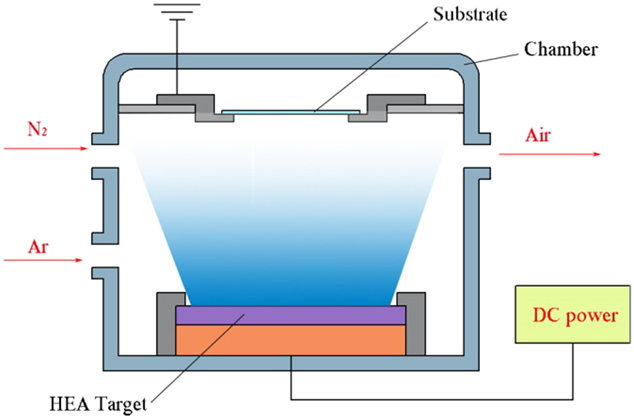
The target–substrate distance was 50 mm during the sputtering process. The target was presputtered at a direct current (DC) power of 60 W for 15 min with a background pressure below 1 × 10⁻³ Pa, to remove surface contaminants. Next, the working pressure was set to 0.6 Pa, and the sputtering power was 100 W during deposition. The total flow rate of nitrogen and argon was 24 standard cubic centimeters per minute (sccm), and the nitrogen flow rate of three samples was fixed at 0, 4, and 8 sccm, respectively. The sputtering time for each substrate was 40 min (see Fig. 1).
Schematic illustration of the applied sputtering technique.

The X-ray diffraction (XRD) analysis was conducted using a D/MAX-RB X-ray diffractometer (Rigaku, Tokyo, Japan) with Cu Kα (50 kV, 100 mA) undergrazing incidence geometry at a 1° angle. The electron back-scattered diffraction image cross sections of the films were observed using scanning electron microscopy (SEM) (Auriga Field Emission Scanning Electron Microscope, Carl Zeiss, Jena, Germany). The chemical compositions of the films were analyzed by using an energy dispersive X-ray spectrometer (EDS) operated at 15 kV. The hardness of the films was tested on a nanoindenter XP with a Berkovich triangular pyramid indenter (0.01 nm, 50 nN); the indentation depth was 500 nm.
III. RESULTS
A. Chemical composition analysis
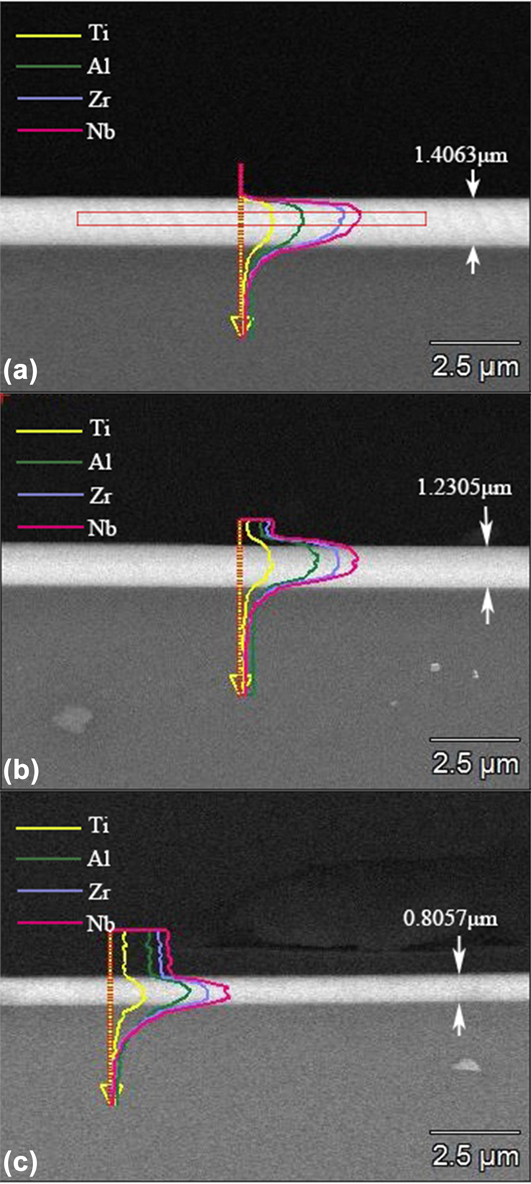
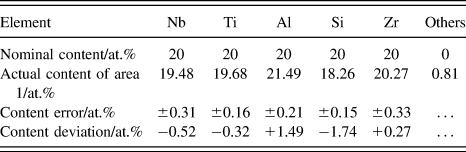
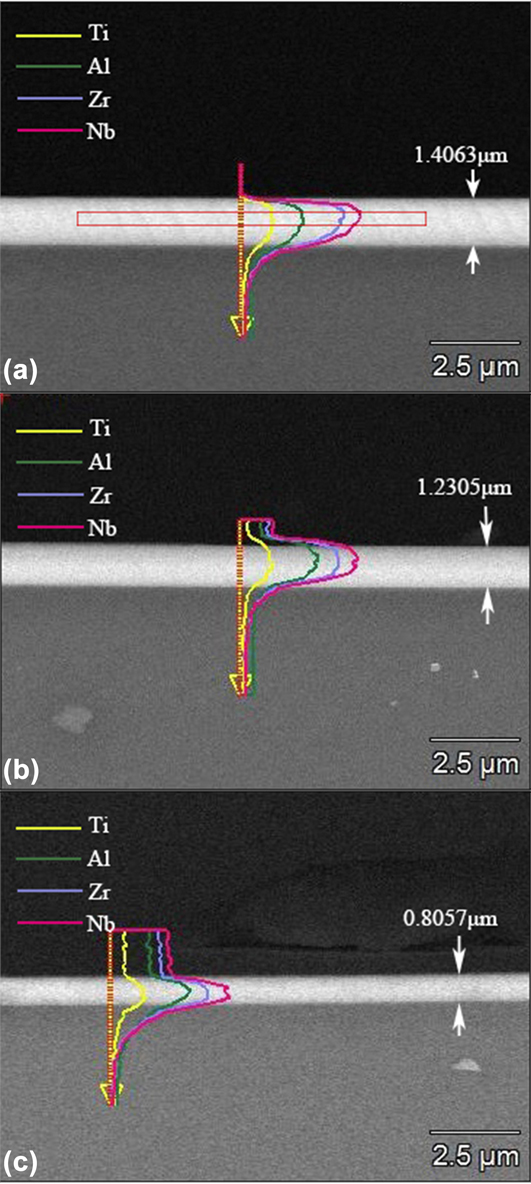
The HEA film deposited in a nitrogen-free atmosphere (HEA-0) exhibited a smooth surface with bright metallic luster, and the HEA nitride films deposited at nitrogen flow rates of 4 sccm (HEC-4) and 8 sccm (HEC-8) presented a black and shiny surface, respectively. Cross sections of three films were observed using SEM; back-scattered electron images of the cross sections are shown in Fig. 2. The thicknesses of the HEA-0, HEC-4, and HEA-8 films were 1.41 μm, 1.23 μm, and 0.81 μm, respectively, as indicated in Fig. 2. All the samples were deposited for the same sputtering time of 40 min, and the increasing nitrogen flow rate retarded the deposition rate of the NbTiAlSiZrNx HEC film. We used EDS to test a rectangular area of the central part of the cross section of the NbTiAlSiZr film to measure the concentration of each element [Fig. 2(a)]. The element content of the NbTiAlSiZr high-entropy film, content error, and content deviation to nominal content are listed in Table I. The content of each element was nearly equal, and the deviation of each element was less than 2%. Film compositions therefore fit the definition of HEA films.
Back-scattered electron images of cross sections of NbTiAlSiZrNx films and element content–depth curve from the upper surface to substrate. The red rectangular frame marks the testing area of Table I. Colored curves indicate content variations in Nb, Ti, Al, and Zr along the scanning trace. Curves were separated for easy distinction. N2 flow rate of three samples: (a) 0 sccm; (b) 4 sccm; (c) 8 sccm.
Chemical composition of the as-deposited NbTiAlSiZr HEA film analyzed by EDS.

The vertical dashed line to the upper surface of the films represents the EDS scanning trace. The content curves of Nb, Ti, Al, and Zr along the scanning trace were plotted using EDS and are marked in different colors in Fig. 2. The concentration curves were separated to make them easily distinguishable. Typical elements of the films were uniformly distributed within the films’ thickness range.Reference Zhang, Liaw and Zhang17
B. Mechanical properties and thermostability
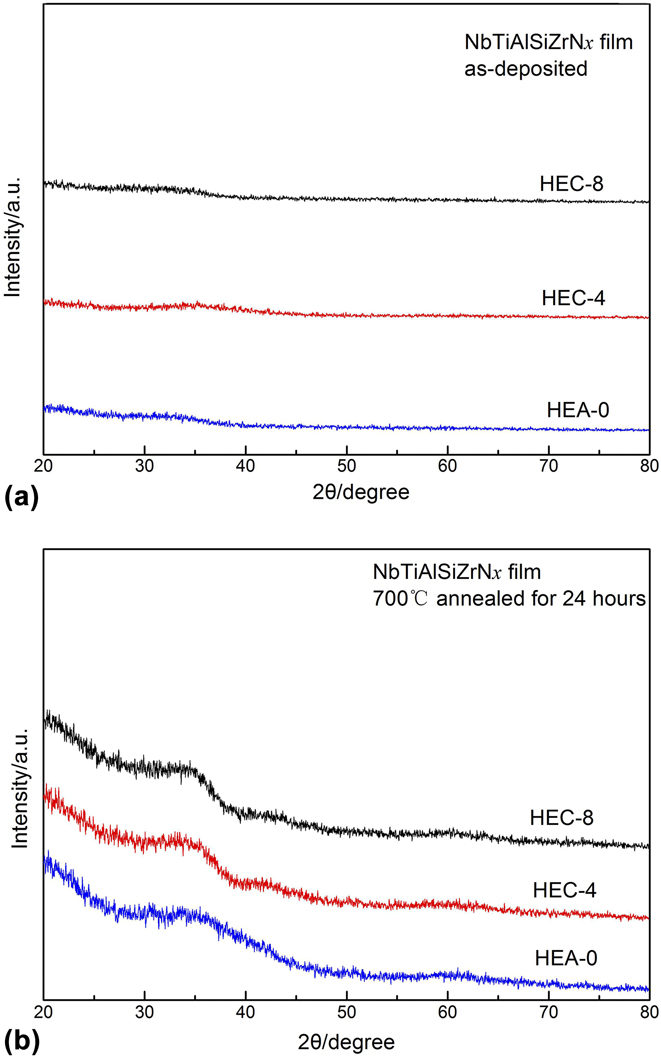
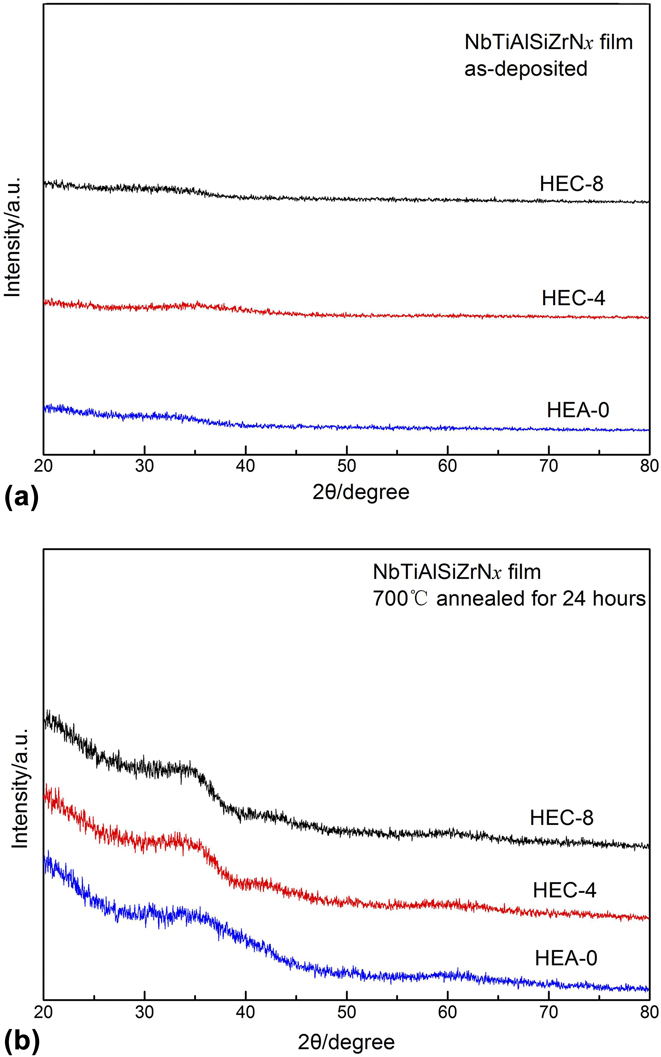
HEA films such as NbMoTaW have been found to exhibit excellent mechanical properties and thermostability at high temperatures due to the high-entropy effectReference Zou, Ma and Spolenak8; however, the mechanical properties and thermostability of HEC films warrant further study. The HEA-0, HEC-4, and HEC-8 films were annealed at 700 °C for 24 h (vacuum environment, background pressure below 1 × 10⁻⁴ Pa, argon protection) to assess their thermal properties and variations in mechanical properties. Figure 3 presents the XRD spectra of the three films before and after annealing. The XRD patterns of the as-deposited films were flat [Fig. 3(a)] with no notable contrast within the cross section [Fig. 2(a)]; the films possessed a completely amorphous structure. After annealing at 700 °C for 24 h, the patterns of three films exhibited a broad peak of amorphous phase at approximately 35°, intensity of which was clearly higher than for the as-deposited films [Fig. 3(b)].
XRD pattern of NbTiAlSiZrNx films (a) as-deposited; (b) annealed at 700 °C for 24 h.
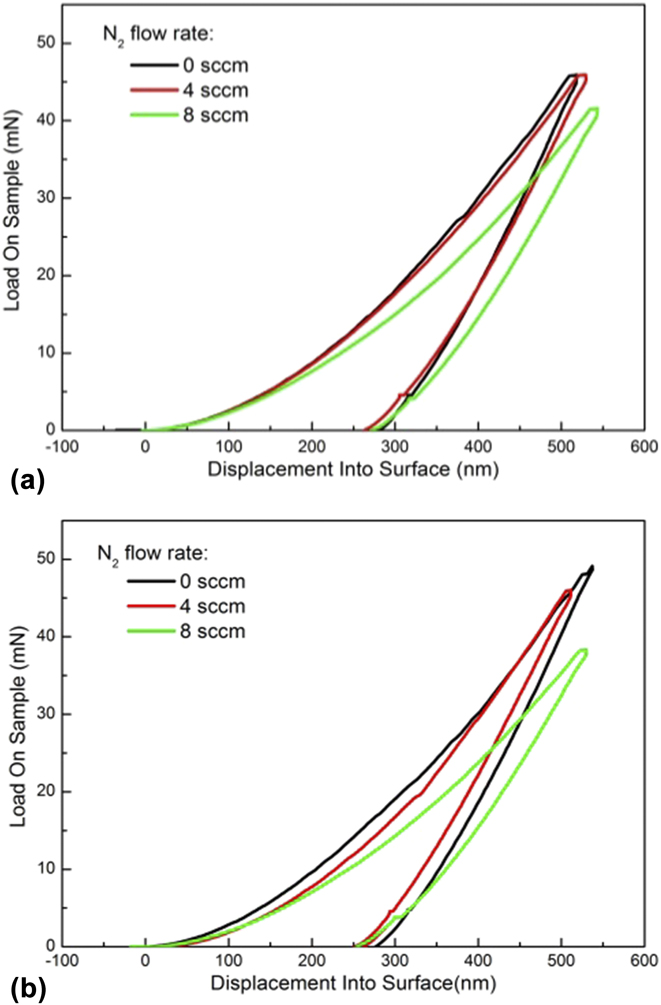
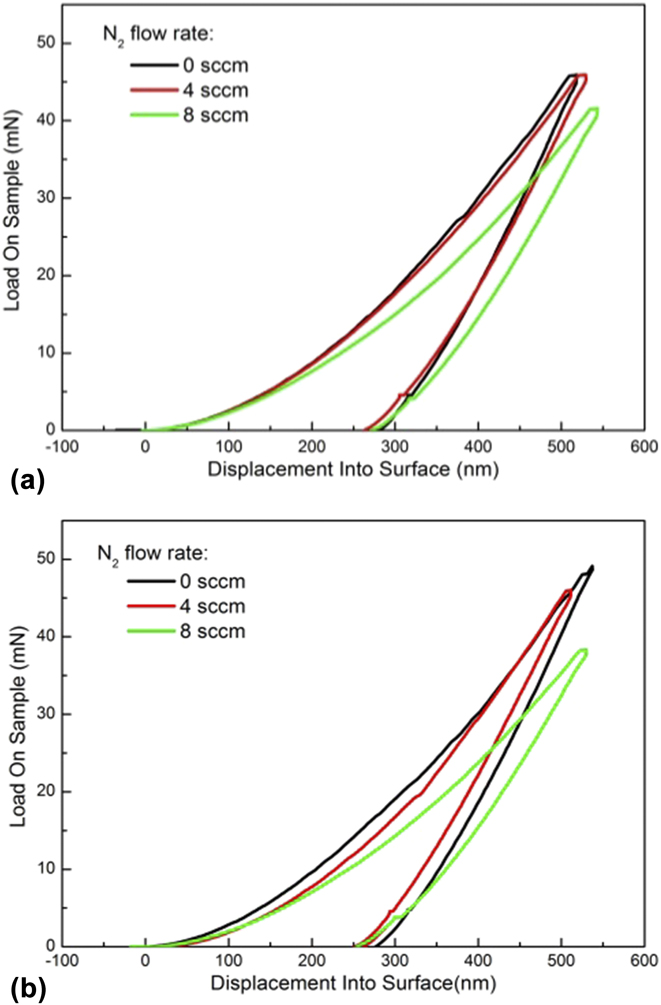
The continuous stiffness method was used to test the mechanical properties of the films using a nanoindenter after annealing at different temperatures. The loading–unloading curve of the NbTiAlSiZrNx films before and after annealing is shown in Fig. 4. The curves of film HEA-0 and HEC-4 were close to each other before and after annealing. The loading on the film showed a slight decline, whereas the nitrogen flow increased to 4 sccm. However, the loading–unloading curve of HEC-8 was well below that of the other two films. Excessive nitrogen in reactive sputtering decreased the mechanical properties of the films substantially.
Loading–unloading curve of NbTiAlSiZrNx films deposited at different N2 flow rates. (a) as-deposited; (b) annealed at 700 °C for 24 h.
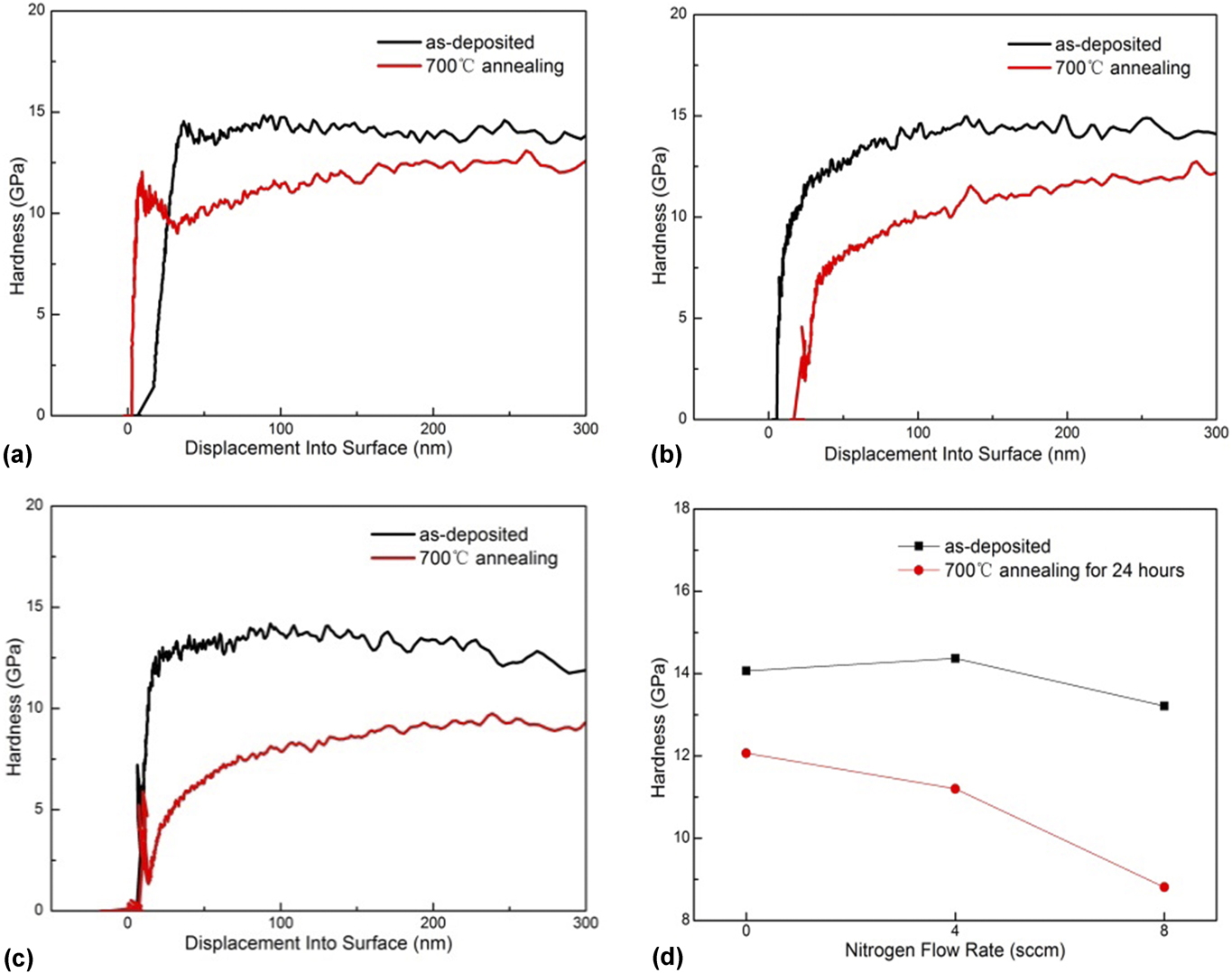
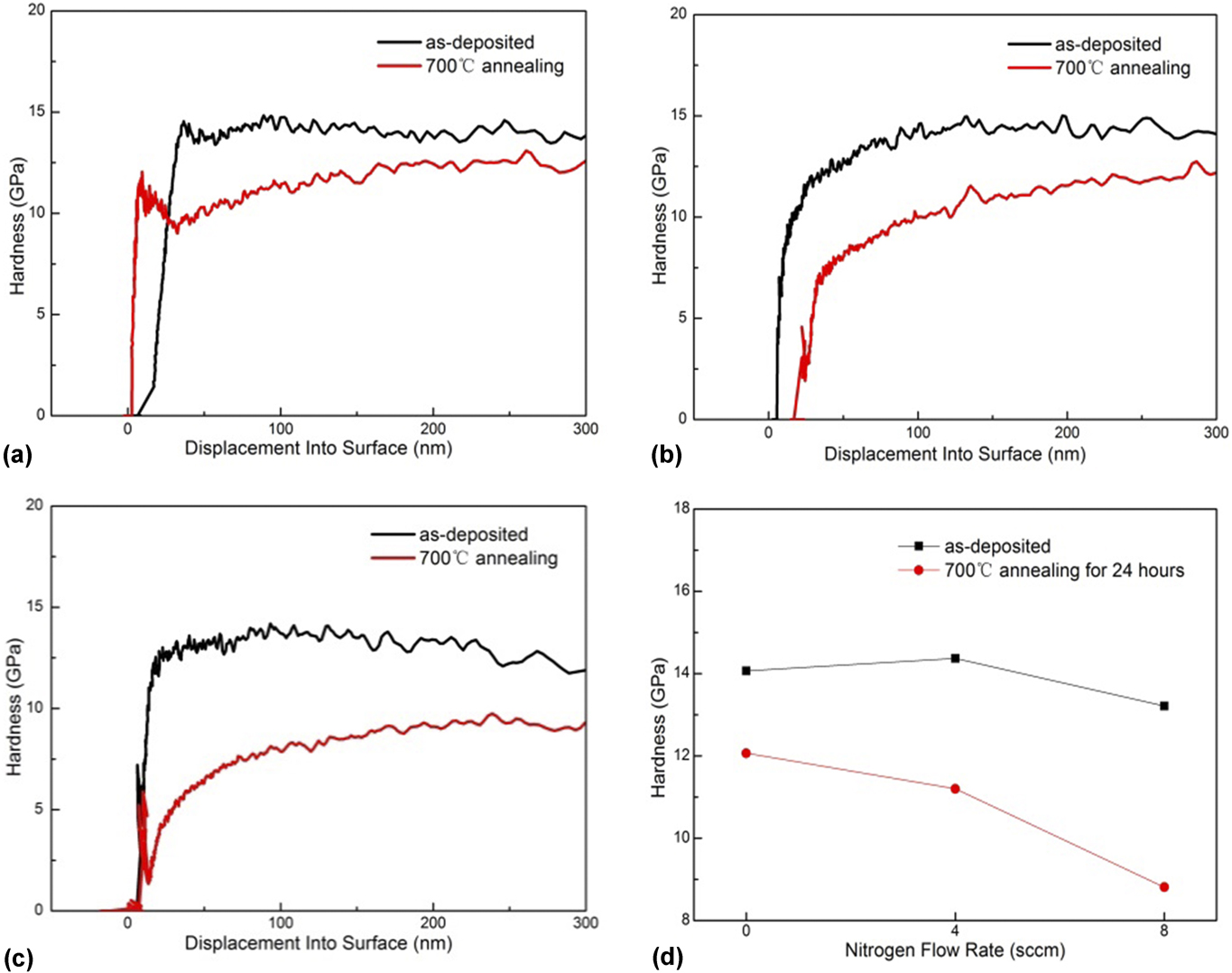
The hardness–displacement curves of NbTiAlSiZrNx films from the upper surface to 500 nm depth are illustrated in Fig. 5. The hardness of the films gradually became constant once the press depth exceeded 50 nm. After the steady stage appeared, the hardness increased slowly with increasing indentation depth. Film hardness was influenced by the substrate effect when the indenter displacement was more than 40% of the film thickness, and hardness was also affected by surface impurities when the testing distance was close to the upper surface. We chose hardness at depths ranging from 100 to 300 nm to characterize the mean hardness of the films. A comparison of hardness before and after annealing is presented in Fig. 5(d). The hardness of the HEA-0 and HEC-4 films was 14.067 GPa and 14.369 GPa, respectively, and did not vary substantially as the nitrogen flow rate R N changed from 0 to 4 sccm. However, the hardness of the HEC-8 film declined to 13.213 GPa when the nitrogen flow rate rose to 8 sccm. The hardness of HEA-0, HEC-4, and HEC-8 films declined to 12.067 GPa, 11.202 GPa, and 8.812 GPa, respectively, after annealing at 700 °C for 24 h. The hardness of the post-annealed films reduced with increasing nitrogen flow but gradually approached the hardness of as-deposited films as the displacement increased. Enhanced deformation was more obvious in NbTiAlSiZrNx films after annealing at 700 °C.
Hardness–displacement curves of NbTiAlSiZrNx films and compared hardness before and after annealing (a) nitrogen flow R N = 0 sccm; (b) nitrogen flow R N = 4 sccm; (c) the nitrogen flow R N = 8 sccm; (d) compared hardness before and after 700 °C annealing for 24 h.
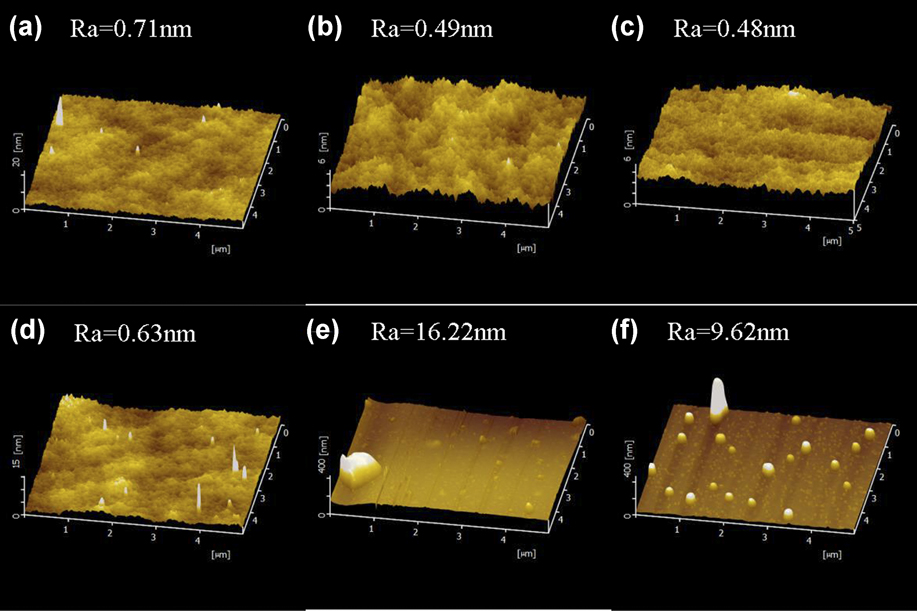
The surface topography can reflect phase formation and influence the mechanical properties of films. Three-dimensional film-surface morphology was characterized using an atomic force microscope, as shown in Fig. 6. The as-deposited NbTiAlSiZrNx films exhibited a dense and smooth surface. The surface roughness (R a) of the as-deposited HEA-0 film was 0.71 nm [Fig. 6(a)]. The surface roughness declined slightly to 0.49 nm at R N = 4 sccm [Fig. 6(b)] but was nearly constant (R a = 0.48 nm) at R N = 8 sccm [Fig. 6(c)]. After annealing at 700 °C for 24 h, the surface of the nitrogen free film, HEA-0, remained smooth with a surface roughness of 0.63 nm. The bugle is observed on the surface of the HEC-4 film [Fig. 6(e)]. Remarkably, the bugles multiplied and became uniformly distributed throughout the entire testing area at R N = 8 sccm. Different from impurities in the air environment, these bugles had a small size and cylindrical appearance due to atomic aggregation and cluster formation on the surface of the high-entropy film.
Three-dimensional image of the surface of high-entropy film (a) R N = 0 sccm, as-deposited; (b) R N = 4 sccm, as-deposited; (c) R N = 8 sccm, as-deposited; (d) R N = 0 sccm, after annealing at 700 °C for 24 h; (e) R N = 4 sccm, after annealing at 700 °C for 24 h; (f) R N = 8 sccm, after annealing at 700 °C for 24 h.

C. Nanocrystallization at high temperatures
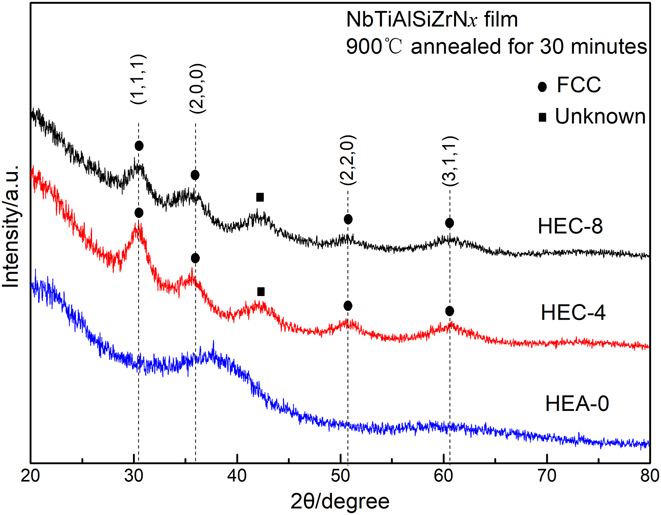
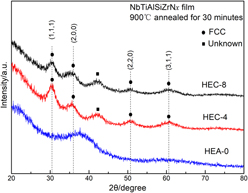
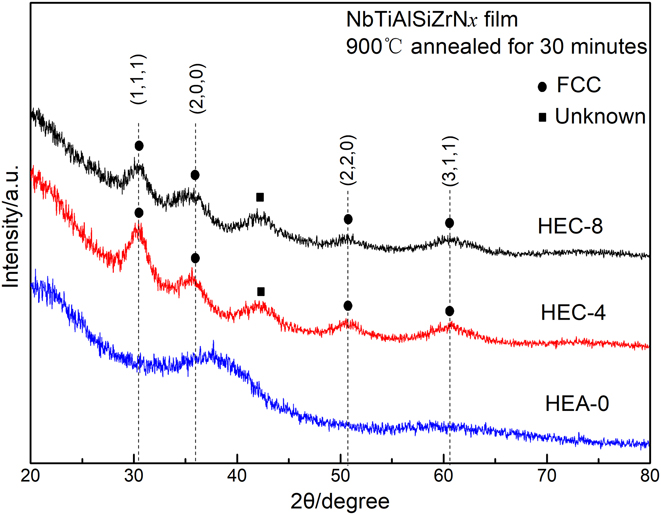
The three films each exhibited good anticrystallization at 700 °C. We further increased the annealing temperatures to 900 °C and held for 30 min to study nanocrystallization in the NbTiAlSiZrNx film. Nanocrystallization occurred in HEC-4 and HEC-8 films after this duration. A sharp diffusion peak appeared in the XRD patterns of the HEC-4 and HEC-8 films (Fig. 7), identified as a face-centered cubic (FCC) structure with (111), (200), (220), and (311) orientation, respectively. Notably, slight nanocrystallization had already occurred in 700 °C-annealed HEC films even though a sharp Bragg diffusion peak was not observed in the XRD pattern. The broad peaks observed on HEC-4 and HEC-8 exhibited different diffusion angles than HEA-0 and consisted of two weak peaks at (111) and (200) orientations which are caused by nanosized precipitation with the FCC structure.
XRD pattern of NbTiAlSiZrNx films annealed at 900 °C for 30 min.
IV. DISCUSSION
A. Thermostability of HEC films
The value of the mixing heat is generally large and negative between nonmetallic and metallic elements. After using nitrogen as a reaction gas, a stable nitrogen-metal covalent bond formed in the nitride alloy films during sputtering and greatly affected their phase structure. The high-entropy nitride films usually followed three directions of phase evolution with conducting nitridation: (i) the as-deposited films possessed an FCC structure, and then varied from an FCC to an amorphous structure as the nitrogen flow rate increased (e.g., Al0.5CoCrCuFeNiNx and Al2CoCrCuFeNiNx)Reference Chen, Wong, Shun and Yeh18; (ii) the structure of the as-deposited film was amorphous and varied from an amorphous structure to an FCC structure with further nitridation (e.g., AlCrTaTiZrNx,Reference Lai, Lin, Yeh and Chang19 AlCrTiSiVNx,Reference Lin, Duh and Yeh20 and AlMoNbSiTaTiVZrNx)Reference Tsai, Lai, Yeh and Gan21; and (iii) the as-deposited film had an amorphous structure, which was retained without clear phase variation when deposited under a high-nitrogen atmosphere (e.g., NbTiAlSiNx,Reference Sheng, Yang, Zhu, Wang and Zhang16 NbTiAlSiWNx,Reference Sheng, Yang, Zhu, Wang and Zhang16 NbTiAlSiZrNx, and AlCoCuFeNiVZrNx).Reference Liu, Zhu, Hou, Li and Jiang22 These results show that the phase formation of HEC films was quite different from the corresponding HEA films before nitridation.
The parameter Ω and atomic size difference δ are generally applied to predict amorphous phase formation in HEAsReference Yang and Zhang23 and HEA films,Reference Xie, Brault, Thomann, Yang, Zhang and Shang24 calculated by the following equation:
 $$\Omega = {{{T_{\rm{m}}}\Delta {S_{{\rm{mix}}}}} \over {\Delta {H_{{\rm{mix}}}}}}\quad ,$$
 $$\delta = \sqrt {\sum\limits_{i = 1}^n {{c_i}{{\left( {1 - {{{r_i}} \over {\Delta r}}} \right)}^2}} } \quad ,$$
 $$\Delta {S_{{\rm{mix}}}} = - R\sum\limits_{i = 1}^n {\left( {{c_i}\ln {c_i}} \right)} \quad ,$$
 $$\Delta {H_{{\rm{mix}}}} = \sum\limits_{i = 1,i \ne j}^n {4H_{{\rm{AB}}}^{{\rm{mix}}}{c_i}{c_j}} \quad ,$$
where  $H_{{\rm{AB}}}^{{\rm{mix}}}$ is the mixing enthalpy for the binary equal atomic AB alloys consisting of the ith and the jth componentReference Takeuchi and Inoue25; the melting point of the alloy can be estimated by the mixing rule
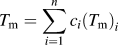 ${T_{\rm{m}}} = \sum\limits_{i = 1}^n {{c_i}{{\left( {{T_{\rm{m}}}} \right)}_i}}$; the average atomic radius
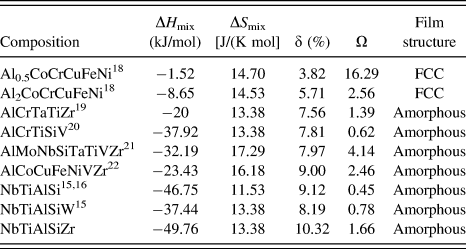
 $\Delta r = \sum\limits_{i = 1}^n {{c_i}{r_i}}$, c i and c j are the mole percent of the ith and jth components, respectively; r i is the atomic radius of the ith component; and R is the gas constant [R = 8.314 J/(K mol)]. According to Eqs. (1)–(4), we calculated the thermodynamic parameters of NbTiAlSi, NbTiAlSiW, and NbTiAlSiZr for comparison with other HEA films listed in Table II. The atomic radii and binary alloy mixing enthalpy data were taken from Ref. Reference Takeuchi and Inoue25. The mixing enthalpy value of NbTiAlSiZr was the most negative among the three kinds of films. The atomic size differences δ of the three HEAs were similar, but the mixing enthalpy ΔH mix of the NbTiAlSi alloy fell to −49.76 kJ/mol after adding Zr as indicated in Table II. The large and negative value of mixing enthalpy could raise the glass-forming ability of the HEA system.Reference Takeuchi and Inoue25 Moreover, the high mixing entropy ΔS mix was considered a contributor to the sluggish diffusion effect. The long-range atomic migration in thin-film material was meanly conducted in two dimensions and had more difficulty manifesting than in as-cast alloys. As a result, suppression of cooperative diffusion in the HEC films was magnified, and the HEC films usually demonstrated good thermal stability under high temperatures. Composition segregation appeared more readily in NbTiAlSiNx compared to NbTiAlSiWNx and NbTiAlSiZrNx HEC films because the mixing entropy of NbTiAlSiNx was less than that of the other two films. The parameter Ω of NbTiAlSiZr was largest among the three HEAs. When compared with other HEA films, although the Ω of AlCrTaTiZr, NbTiAlSiZr, AlCoCuFeNiVZr, and AlMoNbSiTaTiVZr was larger than 1.1, the films could exhibit an amorphous phase as well due to the high cooling rate during deposition.
Thermodynamic parameters of NbTiAlSi, NbTiAlSiW, NbTiAlSiZr, and some other HEAs.

The center of the amorphous diffraction peaks of the three films was found to shift from 33° to 35° after annealing at 700 °C. Incorporation of nitrogen usually increases the degree of disorder in the filmReference Tsai, Lai, Cheng, Tsai, Davison, Tsau and Yeh26; however, the binary nitrides of NbN, ZrN, and TiN possessed an NaCl-type FCC structure. The as-deposited HEC films thus showed an amorphous phase due to the high cooling rate and high-entropy effect. The disorder degree reduced with diffusion of nitrogen atoms after being annealed at an elevated temperature for a long time. Thus, the broad amorphous peak gradually shifted to a higher angle.Reference Ishii, Iwase, Fukumoto, Yokoyama, Konno and Hori27
The HEA-0 film retained an amorphous structure when the annealing temperatures increased to 900 °C. The broad peak on the XRD pattern shifted to 38°, and the degree of disorder was further reduced. The HEC-4 and HEC-8 films transformed into an FCC structure. NbN, ZrN, and TiN were not identified on the XRD pattern. The HEC films formed a single solid solution instead of a potential mixture of binary nitrides due to the entropy-stabilized effect. In the as-deposited films, nitrogen and metallic atoms exhibited a random distribution due to the high cooling rate, and the films presented an amorphous structure. However, the covalent bonds between nitrogen and metallic atoms had the chemical polarity. In addition, the nitrogen atoms were smaller (atomic radius = 74 pm) and lighter, making them easier to diffuse at high temperatures than other elements (approximate atomic radius of 140 pm) in the high-entropy film. Therefore, the addition of nitrogen atoms promoted structural relaxation under high temperatures.
Metal nitridation was synchronously conducted on the surface of the target and the substrate during the DC reactive sputtering process.Reference Berg, Blom, Larsson and Nender28 Part of the nitridation reaction must occur on the substrate to maintain conductivity of the target and avoid poisoning. Upon completion of sputtering, the metallic atoms pre-deposited on the substrate could not obtain sufficient energy to react with the nitrogen completely. The unreacted atoms resulted in micro-segregated spots on the surface of the HEC films. The increasing nitrogen content exacerbated the composition segregation and reduced the thermal stability of the high-entropy film.
B. Mechanical properties of HEC films
The hardness of thin film is affected by component elements, preferred orientation, residual stress, grain size, and atom packing. Residual stress is generally caused by varying degree of thermal expansivity and lattice misfit between the film and substrate. These issues can be alleviated to some extent after high-temperature annealing. The hardness of amorphous alloys usually declines after annealing below glass-transition temperatures due to the reduction in the free volume. Surprisingly, the hardness of the HEA-0 film declined after annealing at 700 °C. This phenomenon cannot simply be attributed to free volume; although the surface topography of the HEA-0 film was smooth, some clusters could form in the film after annealing, which is difficult to be observed by XRD. These structural variations could affect the hardness of the HEA film.Reference Van Steenberge, Concustell, Sort, Das, Mattern, Gebert, Suriñach, Eckert and Baró29,Reference Stoica, Van Steenberge, Bednarčik, Mattern, Franz and Eckert30
It is noteworthy that crystallization occurred in HEC-4 and HEC-8 after being annealed at 700 °C and crystalline phases were identified as possessing an FCC structure. The FCC structure can slide along the [110] direction and is more easily deformed than amorphous structure. Therefore, the hardness of two HEC films decreased substantially after annealing. However, the hardness of the HEA-0 film also declined even although its phase structure did not vary after annealing at 700 °C. The deformation mechanism of amorphous film is quite different from crystalline alloys; the compression deformation of the amorphous alloys greatly depends on the plastic flow of the shear band and is influenced by the density of shear transformation zones in the alloys.Reference Falk and Langer31 After annealing at elevated temperatures, structural fluctuations among atoms intensified and facilitated the formation of shear transformation zones in the film. Therefore, the hardness of the HEA-0 film also declined and the reduced amplitude was less than in HEC films after heat treatment.
V. CONCLUSION
In summary, NbTiAlSiZrNx HEC films were successfully fabricated with the additions of various nitrogen contents using DC magnetron reactive sputtering. The microstructures, thermal stability, and mechanical properties of the films were characterized. The main conclusions are as follows:
(1) The NbTiAlSiZr HEA film exhibited an amorphous structure after deposition. As the nitrogen flow rate increased to 8 sccm, the HEC nitride films retained an amorphous structure. NbTiAlSiZrNx films exhibited high anticrystallizing ability after annealing at 700 °C for 24 h.
(2) The hardness of the as-deposited HEA-0, HEC-4, and HEC-8 films declined from 14.067 GPa, 14.369 GPa, and 13.213 GPa to 12.067 GPa, 11.202 GPa, and 8.812 GPa, respectively, after annealing at 700 °C for 24 h. The increasing nitrogen flow rate led to an obvious decline in the hardness of the NbTiAlSiZrNx films.
(3) Crystallization occurred in the HEA-4 and HEC-8 films when the annealed temperature rose to 900 °C, and the precipitation possessed an FCC structure. The HEC-0 film still retained an amorphous phase, indicating that the thermal stability of the amorphous phase in the NbTiAlSiZrNx film declined with a higher nitrogen flow rate and tended to form a nitride mixture at high temperatures.
Overall, novel heat-resistant and hard ceramic films were effectively developed using the design strategy of HEAs for reference. The NbTiAlSiZrNx films exhibited high hardness at room temperature along with anticrystallization ability at 700 °C, demonstrating the potential to serve as candidates for hard coatings in the future.
ACKNOWLEDGMENT
The authors would like to thank financial support by the National Science Foundation of China (NSFC, Granted Nos. 51471025 and 51671020).