1. Introduction
Today, the notion of genes sending signals to other genes is as central as the notion of a genetic code was forty years ago.
(Maynard-Smith Reference Maynard-Smith2000, 187–88)When evolution (or learning) leads to a signaling system, information is created.
(Skyrms Reference Skyrms2010, 40)Most attempts to vindicate the idea of “genetic information” have focused on the coding of proteins (Godfrey-Smith Reference Godfrey-Smith2000; Maynard-Smith Reference Maynard-Smith2000; Griffiths Reference Griffiths2001; Godfrey-Smith and Sterelny Reference Godfrey-Smith, Sterelny and Zalta2012) or, more recently, on how information is passed between generations (Shea Reference Shea2007; Bergstrom and Rosvall Reference Bergstrom and Rosvall2011). In this paper I show how information is passed between genes and how evolution can both create and reuse this information.Footnote 1
I draw on recent work by Brian Skyrms, who argues that information is created when signaling systems evolve (Skyrms Reference Skyrms1996, Reference Skyrms2010). I apply Skyrms’s framework to gene regulatory networks, showing how the players in a signaling game can be mapped to the components of a gene regulatory network and how changes in player strategies can be mapped to mutations in the logic controlling gene regulation.
I then use this mapping to vindicate the idea of positional information in developmental biology (Wolpert Reference Wolpert1969, Reference Wolpert1994). To do this, I combine the information processing capacities of gene regulatory networks with the basic signaling framework. The combination provides a more complex example of signal evolution, where evolution creates computed information about states of the world.
I then argue that once evolution has created signals carrying such computed information, this information can be reused in novel tasks. This connects the signaling framework to ideas about evolvability and the evolution of novelties and suggests a straightforward way to think of evolution both creating and reusing information.
Finally, I discuss why this way of thinking of genetic information may be useful, and I suggest that reuse within signaling systems may have a broader application than just gene regulation.
2. Internal Signaling and Information
Before looking at gene regulatory networks, I want to outline a simple version of internal signaling. This will provide a useful guide when looking at more complex signaling in gene regulatory networks.
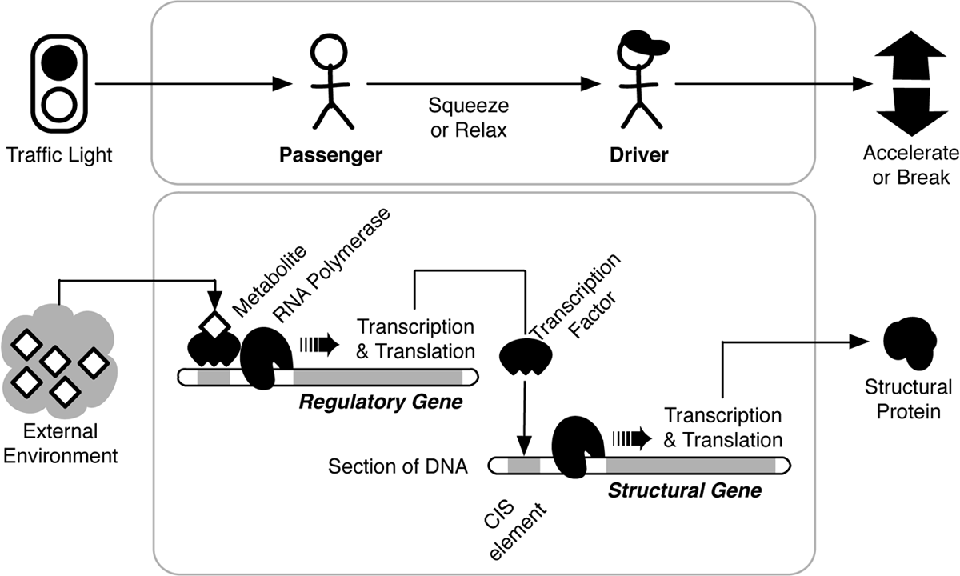
Here is a game I call “crosstown traffic.”Footnote 2 The goal of the game is to maneuver a car from one side of town to the other without crashing. A car contains a driver and a passenger. The driver operates the car normally in most respects but ignores the color of traffic lights. Instead, when the driver comes to a traffic light, he pays attention to the passenger, who has his hand on the driver’s knee. Upon seeing a red or green traffic light, the passenger either squeezes or relaxes his hand. The driver responds to this signal by either accelerating or braking (see fig. 1, top row).Footnote 3
Two types of internal signaling. Top: Signaling in the game “crosstown traffic.” Bottom: Signaling between genes.
The game has all the basic components of a Lewis/Skyrms signaling game (Lewis Reference Lewis1969; Skyrms Reference Skyrms2010). There are two states of the world (red/green), two signals (squeeze/relax), and two actions (accelerate/break). There is a signal sender (the passenger) and a signal receiver (the driver) who share in the success or failure of their interaction.
To do well in the game, a driver-passenger team needs to map the states of the world to the right actions: accelerate on green, and brake on red. Two things mediate the mapping between states and actions: how the passenger maps a state to a signal, and how the driver maps a signal to an action. If both driver and passenger always follow the same rules for how they do this mapping, then the best teams will follow one of these two rule sets:
• Rule set 1: The passenger squeezes on red and relaxes on green; the driver brakes on squeeze and accelerates on relax.
• Rule set 2: The passenger relaxes on red and squeezes on green; the driver accelerates on squeeze and brakes on relax.
Now imagine a fanciful scenario where selection plays a role in crosstown traffic. Cars with teams begin driving across town, and initially both driver and passenger follow a random rule set. Cars that crash are selected against. Cars making it to the other side of town inspire new teams to copy their rule set, making the occasional copying errors. The new teams then drive back across town, and the cycle repeats. Given enough teams and enough time, either rule set 1 or rule set 2 would predominate, as teams following any other rule set would have a far higher chance of crashing.
In this selective scenario, the car is an individual, reacting to the local state by modifying its behavior. The driver and passenger are internal parts producing the behavior and sharing the same evolutionary fate—crashing or surviving together. Selection acts on the behavior of the system as a whole (the car) and in doing so produces an internal signaling system between individual parts (the driver and passenger). This is why it is called internal signaling.
Information is created in the signals during this game. When a successful signaling system (rule set 1 or 2) is established between the internal parts, the signal (squeeze/relax) carries information, in the following way. Imagine being a second passenger sitting in the back seat of a car, whose driver and passenger play using one of the successful rule sets, and suppose you know the exact rule set they are using. Seeing a signal, such as the passenger squeezing the driver’s knee, provides information about two things. First, the signal tells you something about the state of the world (is the light green or red?). Second, the signal tells you something about what the driver will do next (will they accelerate or break?). An evolved signal inside the car thus carries information about both states of the world and about the actions of the driver, and hence about the actions of the car as a whole. Skyrms shows how information theory can be used to measure the amount of information in these signals (see Skyrms Reference Skyrms2010, chap. 3).
3. Gene Regulation
I show below that all the components of an internal signaling game are present in gene regulatory networks (see fig. 1, bottom row). First, I provide a brief overview of gene regulation.
Genes are transcribed into RNA by a molecule called RNA polymerase, which walks along the bases of a strand of DNA and produces a corresponding strand of RNA. This RNA is then used to produce a protein (I am ignoring a lot of complexity here; for more detail see Griffiths and Stotz Reference Griffiths and Stotz2013). To begin transcription, the RNA polymerase must first bind to a region called a promoter. The polymerase must stick to the promoter long enough to kick-start transcription, and this crucial moment can be either encouraged or prevented by a protein called a transcription factor.
Transcription factors bind to a short portion of the DNA strand called a cis regulatory element, or cis-element. They bind to cis-elements because the shape of the protein fits the shape of the short sequence of bases on the DNA, so specific transcription factors bind only to specific cis-elements. Many transcription factors exist in two different stable shapes, and the presence of a small molecule, such as a hormone, can switch them to their active shape, which is only then capable of binding to the cis-element. So the transcription of a gene can be sensitive to the local conditions in the cellular environment.
Once these transcription factors bind to the cis-elements, they do one of two things: they prevent the RNA polymerase from getting to the promoter and thus repress transcription, or they stick to the RNA polymerase and help stabilize it long enough to activate transcription (Ptashne and Gann Reference Ptashne and Gann2002). Several cis-elements may exist for a single gene, and they can act in concert, binding multiple transcription factors to repress or activate a gene. One transcription factor might activate a gene, while another represses activation. The transcription of a gene can thus be a function of the presence of several transcription factors.
We have part of the picture now. We have a gene, a promoter, and some cis-elements. Together, I refer to these as a genetic switch. A genetic switch can act by transcribing a protein that has some effect on fitness in the current environment—producing hemoglobin or muscle fiber, for example. A genetic switch can respond to some external state, as many transcription factors bind to DNA only in the presence of certain molecules from the environment. In addition, our switch can even do some basic information processing, responding to the combined presence and absence of transcription factors. What we do not have, yet, are signals.
4. Gene Regulation as Signaling
The genes that produce proteins like hemoglobin or muscle fiber play a direct role in the fitness of the individual. Genes like this are called structural genes. They contrast with regulatory genes, which produce the transcription factors that activate or repress the transcription of further genes. These are what Maynard-Smith had in mind when he talked of genes sending signals to other genes.
Like crosstown traffic, the final mapping from state to action in a gene regulatory network is determined by a series of intermediate mappings. Each genetic switch maps incoming information from the environment—or from the output of another genetic switch—by regulating the transcription of a protein. If the gene being transcribed is structural, the protein goes on to perform an action; a genetic switch like this is a receiver. If the genetic switch transcribes a regulatory gene, then the protein can signal further downstream genes; a genetic switch like this is a sender. Some genetic switches may act as both sender and receiver, for gene regulation can consist of chains of gene regulation, where genes regulate genes that regulate still more genes (see, e.g., Madan Babu and Teichmann Reference Madan Babu and Teichmann2003). The complex regulatory connections between genetic switches form a gene regulatory network.
Each individual mapping at a genetic switch is—like crosstown traffic—governed by a modifiable rule set. The rules are determined by the sequence of DNA composing the cis-element of the genetic switch and the DNA that is transcribed into a protein. These regions on the DNA, and hence the rule sets, can be modified in various ways by mutations.
One kind of modification changes the function governing the switch. Different proteins interact in different ways, so mutations affecting the region of DNA containing the cis-elements can affect the function controlling whether a gene is turned on or not. Mutations can thus affect the localized rules governing a single genetic switch.
Perhaps more importantly, mutations within the cis-element regions can affect which upstream signals the genetic switch responds to, and mutations within the trancribed DNA can change the shape of transcription factor produced, thus changing the signal being sent (Hsia and McGinnis Reference Hsia and McGinnis2003; Lynch and Wagner Reference Lynch and Wagner2008; Wagner and Lynch Reference Wagner and Lynch2008; Nowick and Stubbs Reference Nowick and Stubbs2010). Mutations that change the signals sent from and received at each genetic switch rewire the topology of the network, changing its global information processing capacity.
A final similarity is worth pointing out. In a signaling game, such as crosstown traffic, a number of different mappings can produce equivalent results (recall that both rule set 1 and rule set 2 did an equivalent job). So the particulars of an intermediary signal do not matter, as long as the state-action mapping produces a successful behavior. The signals are conventions, as they could have been otherwise. We see this conventional aspect in gene signaling too, for it is possible for different transcription factors to fulfill the same intermediary regulatory task in related species (see, e.g., Nowick and Stubbs Reference Nowick and Stubbs2010, 76).
Transcription factors are signals, and gene regulatory networks make up complex signaling networks. They produce actions in response to local states and use chains of intermediate signals to do so. Gene networks do not just relay information, however; they also process information. We can incorporate this idea into the signaling framework too.
5. Information Processing and Signaling
A genetic network is considerably more complex than a passenger-driver team, as many genetic switches can be wired together. A single genetic switch can already do some minimal processing, integrating information from several sources using a simple function. Wiring together several genetic switches makes a regulatory network capable of even more complex information processing.
Information processing in gene networks takes place at many levels. We find recognizable network motifs—small ensembles of two, three, or four genetic switches wired together—which can perform a recognizable logic function or signal processing of some kind (Alon Reference Alon2007). More complex subnetworks containing many genetic switches perform precise developmental tasks, such as maintaining boundaries between differentiating cells (Davidson Reference Davidson2010). The ensemble of genetic switches in a gene regulatory network is capable of using a broad range of complex inputs to control and organize many possible actions, much like an ensemble of neurons in the brain does.Footnote 4
We can incorporate information processing into the signaling framework in the following way. A sender may need to process information because they do not have the relevant state of world handed to them but must calculate it from a variety of cues. A receiver may need to process information because taking the appropriate action may depend on more than one signal.
My discussion of information processing here differs from what Skyrms does in his book Signals. Skyrms is interested in whether we can “get some logic out of information transfer in sender-receiver games” (Reference Davidson2010, 136). Genetic switches are already capable of approximating some simple logical operations (Istrail and Davidson Reference Istrail and Davidson2005). Here I focus on how genetic switches acting together can integrate information to map world states to signals and signals to actions.
A sender in a genetic network might be a gene or, if complex processing is required, a network of genes. A network could integrate upstream information from a series of cues to produce a single signal, or transcription factor. A receiver, equally, may be a gene or network of genes integrating signals to produce some action. An example where signaling and information processing are combined occurs in pattern formation of early multicellular development.
6. Multicellular Development and Positional Information
A gene network, like the car in crosstown traffic, is plastic: different environments produce a different response, and the response producing the most favorable result for the organism in that environment will be more likely to be selected. The plastic response of gene networks plays an essential role in the development of multicellular creatures like us. For although each cell contains a copy of the same genes, the cells in different parts of our bodies look and act very differently. Selection can thus act to produce a genetic network capable of a broad range of different actions, to produce a variety of cell types and context-sensitive cellular behavior.
But how does each cell decide which particular action to take? During development, this question is answered, at least in part, by looking to the spatial expression patterns of different transcription factors. Localized regions of cells switch on the same transcription factors, carving out a spatial landscape in a developing embryo that controls the behavior of cells in the respective regions.
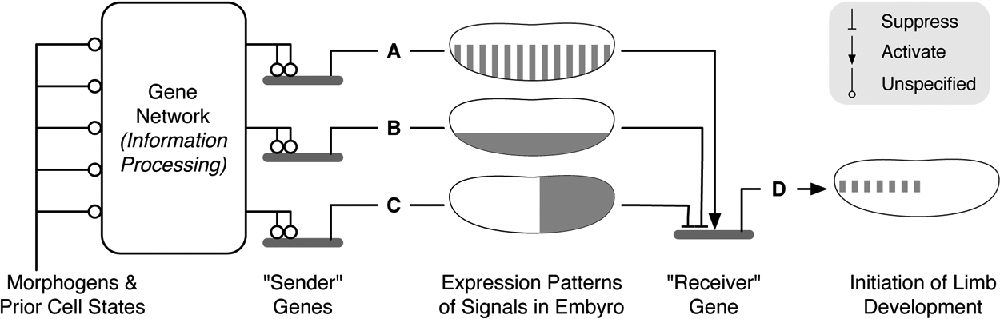
In the development of a fly, for example, the location of the limbs is specified by integrating three upstream transcription factors, each of which is expressed at overlapping locations in the embryo (see fig. 2). One protein is expressed in cells lying in a set of bands along the body axis (A), another is expressed in cells in the ventral region (B), and another in the posterior (C). These proteins bind to a further gene that integrates the expression of all three with a Boolean function (A and not (B or C)), resulting in the expression of a protein in a series of small regions along the body midline that initiates limb development (Carroll Reference Carroll2006, 116).
Positional information expressed by transcription factors in the fly embryo. Three upstream genes produce signals that carry positional information computed from a variety of inputs. These signals are integrated downstream to initiate an action: the production of limbs.
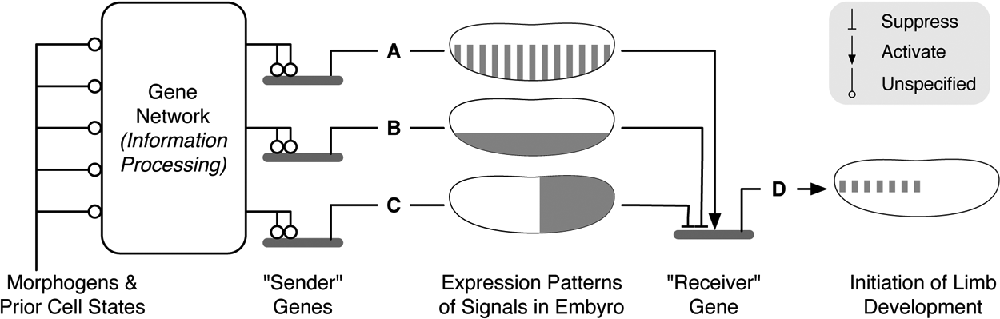
The three transcription factors themselves are produced from a variety of complex upstream inputs, including prior cell states and spatially localized concentrations of different substances called morphogens.
Transcription factors expressed in such spatial patterns are said to contain positional information (Wolpert Reference Wolpert1969). This use of informational language is thoroughly appropriate when viewed using the signaling framework. We can see that each role in a signaling system is filled out, as well as how this licenses talk of information, in the same way that it does in other signaling games:
• Each of the three transcription factors is expressed as the result of mapping a complex set of upstream cues from morphogens and prior cell states into a single transcription factor.
• These transcription factors induce a downstream genetic switch to act, and this switch maps the three incoming signals to another single protein that initiates limb development.
• The three transcription factors thus act as intermediaries, or signals, between incoming states and some further fitness-affecting downstream actions.
• Furthermore, each transcription factor expressed in the three different regions delivers a signal containing information. Just as seeing what the passenger does in crosstown traffic tells you about what color the lights are, seeing what regulatory genes are being expressed tells you about the location of the cell in the three-dimensional form that is developing.
7. Reusing Existing Information
Positional information presents a more complex picture of signaling systems than crosstown traffic. In the simple game, the relationship between states, signals, and actions was straightforward: a state mapped to a signal, and a signal mapped to an action. Here, however, signals are sandwiched between both upstream and downstream information processing. Upstream, a number of cues are integrated into a signal that indicates spatial position. Downstream, these signals may coordinate several different actions that affect fitness. The signal itself, though it carries information about spatial location, bears no simple one-to-one relationship to either the input (the incoming cues from morphogens or prior cell states) or the output (the resulting proteins that produce limb development).
The idea of processed information carrying internal signals has an important upshot. To evolve signals like this, the right configuration of genes must be selected so that they correctly process the multiple inputs into a single signal, ready to be passed downstream for further processing. The information carried by the signal obviously plays a role in the function it was directly selected for. But cells perform many simultaneous actions, so that same information may well prove useful for other downstream functions dependent on cell location. If so, evolution can co-opt the signal, rather than evolve the same information processing again.
Such changes in gene regulation are thought to be a key part of the evolution of complex animal form, as small changes in DNA can often wire together previously selected components to create new functions (Davidson Reference Davidson2010). One example where this has occurred is the gain of wing spots in the male fruit fly Drosophila biarmipes.
8. Wing Spots for Free
Gompel et al. (Reference Gompel, Prud’homme, Wittkopp, Kassner and Carroll2005) explain the rapid gain of wing spots in the male fruit fly D. biarmipes by showing how existing transcription factors are co-opted to control the expression of pigmentation in a specific wing location. We can use the signaling framework discussed in the previous section to interpret this change as the reuse of information that has been created by evolution.
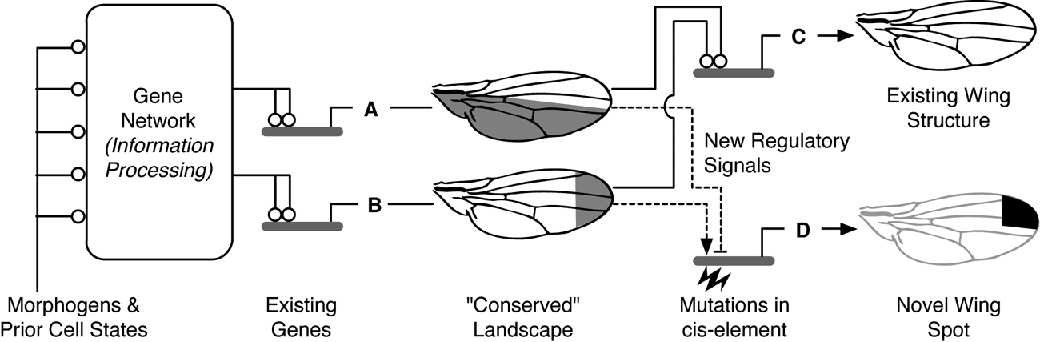
As with the specification of limb development in fruit flies, a number of regulatory genes are expressed in different locations in the wing (see fig. 3). One transcription factor (A) is expressed along the anterior of the wing, while another (B) is expressed along the tip of the wing. Gompel et al. refer to this as the conserved regulatory landscape, as these regulatory elements play a downstream role in the development of the existing architecture of the wing (C).
Random mutations co-opt upstream positional information to produce a novel wing spot in D. biarmipes.
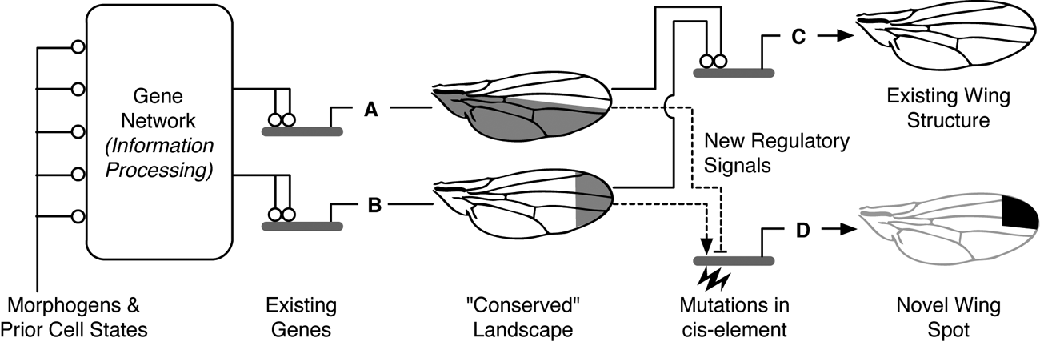
The mutations responsible for the rapid appearance of wing spots occur in a genetic switch controlling pigment expression. Mutations to the cis-element region enable existing transcription factors to bind upstream of this gene and hence control its transcription (see fig. 3, lower right). The incoming signals from the two regions are integrated, and the genetic switch turns on when the Boolean combination of upstream regulators (A and not B) is true. When the gene is turned on, it up-regulates pigmentation in the anterior distal position of the wing (D), producing the distinctive spot (Gompel et al. Reference Gompel, Prud’homme, Wittkopp, Kassner and Carroll2005; Wray Reference Wray2006). The spot is believed to confer some selective advantage through sexual signaling.
As I argued above, the transcription factors underlying the conserved wing architecture already carry positional information. Mutations permit signals already carrying information to be deployed in novel functions. They do this by attaching an already-existing network that computes cell position to existing downstream functionality that produces pigment.
We now have the following picture. For an organism to develop correctly, it is crucial that each cell does the right thing in the right place at the right time. Each cell has the same genetic network, so this network must be able to map complex upstream inputs to a broad range of cellular activities. To accomplish this, the network must integrate information from various sources, and, in the process, it creates internal signals that carry computed information. In some cases, a few mutations allow other genetic switches to make use of the already-existing information in these signals to perform a novel adaptive task. Hence, the evolution of signaling systems does not just create information; it also permits the reuse of information that has already been created.
9. Summary
The main purpose of this paper was to connect the signaling framework to gene regulation and show how this provides a different way to think about genetic information. I have shown that positional information is one example where informational concepts in signaling systems can be clearly applied, so the signaling framework can vindicate at least some information talk in developmental biology. But how is this different from other ways of thinking about genetic information?
Although information-theoretic measures can be brought to bear on many nongenetic factors in development (Griffiths and Gray Reference Griffiths and Gray1994), the picture I have presented suggests that the role information plays in gene regulatory networks has two important properties that distinguish it from just any developmental resource. First, the information is computed from a broad range of incoming cues, and this computation can be modified by mutations affecting the topology of the network and the genetic switches doing the processing. Thus, there is a great flexibility in the relation the information can bear to the environmental context that induces it, and this relation can be fine-tuned by natural selection. The ability for fine-grained tuning is one way of picking out some causes over others (Woodward Reference Woodward2010, Reference Woodward2013). Second, any information that is computed is available to be reused by the rest of the system if it has the right cis-element region. Cis-element regions are far less complex than the transcribed region of DNA and can arise through copying or independently through few mutations. These changes are common, and Gompel et al. suggest that their wing spot example may “suggest a general means by which novel expression patterns and characters can arise” (Reference Gompel, Prud’homme, Wittkopp, Kassner and Carroll2005, 486).
Together, these two properties provide a powerful means for natural selection to produce adaptive change: fine-tuning the plastic response of cellular activities to a variety of contexts, and reusing existing fine-tuned responses in new ways. The signaling framework thus provides a novel way to connect genetic information to the specific role genes play in development, but only when changing our perspective from considering solitary genes to looking at networks of interacting genes.
Finally, it is worth reflecting on how these ideas about reuse in signaling may be more widely applicable. The idea of internal signaling can also be applied to neural connectivity, and neural reuse appears to be one area where some formal foundation might clarify how exactly this reuse occurs (see Anderson Reference Anderson2010 and replies). The idea of signals carrying internal informational that is poised to be quickly redeployed in new circumstances also bears a striking resemblance to Sterelny’s notion of decoupled representations: “internal states that track aspects of our world, but which do not have the function of controlling particular behaviors” (2003, 29). A signaling framework that includes the creation of computed signals and their reuse may provide a general way of thinking about adaptive change in complex internal mechanisms.