Introduction and Background
The Centre for Research on the Epidemiology of Disasters (CRED; Brussels, Belgium) defines a disaster as “a situation or event which overwhelms local capacity, necessitating a request to a national or international level for external assistance; an unforeseen and often sudden event that causes great damage, destruction and human suffering.”Reference Guha-Sapir, Hoyois and Below 1 p7 With climate change, the rate of natural disasters, particularly those related to weather events, is expected to continue rising,Reference Leaning and Guha-Sapir 2 - 4 compounded by increased populations in high-risk zones. 4 - Reference Katoch 6
Countries the least equipped to prepare for, and deal with, natural disasters are often the ones worst hit.Reference Guha-Sapir, Hoyois and Below 1 What limited health services they have in place prior to the onset of the disaster are overwhelmed and often damaged, if not destroyed, by the event.
The global awareness and response to such disasters has also increased. In 2005, 41 health field units responded to the Pakistan earthquake.Reference Leaning and Guha-Sapir 2 By 2010, 390 Foreign Medical Teams (FMTs) were identified as having gone to Haiti following the earthquake.Reference Brolin, Hawajri and Schreeb von 7 These numbers do not reflect teams not registering with the World Health Organization (WHO; Geneva, Switzerland), or individuals who simply decided to arrive on their own.
Problems with large, unregulated responses have been well-documented. Unprepared responders not only fail to provide benefits for the affected community, but by consuming resources, they become a burden on already stressed populations.Reference Guha-Sapir, Hoyois and Below 1 When they do not coordinate with other teams providing care in the region, duplication and wastage of services results in one location, while other, difficult to access regions are left under-serviced.Reference de Ville de Goyet 8 - Reference Devi 10
There is evidence that physicians without a background in disaster response may also feel that doing anything is better than nothing, and that improvisation is acceptable, even if it does not meet standards they would expect in their home country.Reference Berger 11 , Reference Garner and Harrison 12 This too can translate into worse outcomes for patients.Reference Rosborough 13 Reports from the Haiti earthquake suggest international health workers were operating beyond their capabilities and scope of practice with negative consequences.Reference Cranmer and Biddinger 14
These issues have given rise to calls for an improvement in the health sector humanitarian response to natural disasters.
Progress has been made with development of Emergency Medical Team (EMT) Guidelines which provide a standardized classification, in terms of the number and type of personnel on teams, registration with the Health Cluster, the medical supplies and equipment they bring, and self-sufficiency. 15 Established teams can be “quality assured” by the WHO and become part of the EMT registry, allowing countries suffering from disasters to identify teams that can best help without delay.
This, however, does not address the individual, or group of individuals, who decide spontaneously to travel to the site of a disaster to “help out.” Suggestions for training to qualify individuals prior to deployment,Reference Johnson, Idzerda and Baras 16 - Reference Djalali, Ingrassia and Corte 18 and a “professionalization” of disaster response,Reference Cranmer and Biddinger 14 , Reference Carbonnier 19 have been made.
Before considering these strategies, it would be useful to know whether or not guidelines exist for these individuals and if their actions in the field suggest an awareness of any such guidelines.
In addition to looking at the literature to determine this, participation in the response to the 2015 Nepal earthquake can serve as an example of the current context. As a recent major natural disaster with over 8,000 lives lost and tens of thousands injured, it attracted global attention. 20 Understanding when and what the health sector responders explicitly knew regarding guidelines, as well as what their actions and observations in the field tell us, can better inform the discussion on this aspect of improving the health sector response in natural disasters.
This study was undertaken to determine if guidelines exist for international health sector responders to sudden onset natural disasters (SODs), if and how responders become aware of such guidelines, and whether there is evidence of guideline implementation in the field.
Methods
Both a literature review performed in a systematic fashion and grounded theory-based analysis of the experiences of foreign health workers (FHWs) involved in the 2015 Nepal earthquake response were used to address questions surrounding guidelines for medical responders to disasters.
Literature Review
The first part of the study was comprised of identifying existing guidelines or standards. Using the question “What are the current guidelines for FHWs wishing to provide services following a SOD in a low- to middle-income country (LMIC)?” a literature search was performed as described by Bown and SuttonReference Bown and Sutton 21 utilizing four peer-reviewed (Medline [US National Library of Medicine, National Institutes of Health; Bethesda, Maryland USA], Embase [Elsevier; Amsterdam, Netherlands], Web of Science [Thomson Reuters; New York, New York USA], and Global Health [EBSCO Information Services; Ipswich, Massachusetts USA]) and three grey literature (Open Grey [INIST-CNRS - Institut de l’Information Scientifique et Technique; Paris, France], Relief Web [UN Office for the Coordination of Humanitarian Affairs; Geneva, Switzerland], and Eldis [Institute of Development Studies, University of Sussex; Brighton, United Kingdom]) databases. Inclusion criteria consisted of:
-
∙ Articles referencing existing multinational, international, or global guidelines/recommendations/regulations relating to FHW response to a SOD occurring in a LMIC were examined;
-
∙ Particular focus was on the response to the 2015 Nepal earthquake; and
-
∙ Only those guidelines regarding personnel working directly in the health field were included.
Exclusion criteria included:
-
∙ Guidelines pertaining to conflict zones or complex disasters (emergencies occurring within the context of, or secondary to, conflict); and
-
∙ Literature examining other aspects of disaster relief (eg, water and sanitation), unless directly relating to the provision of health care.
Only English language literature pertaining to humans was assessed.
A combination of keywords and subject headings (MeSH and Emtree, as appropriate in peer-reviewed databases) were used to search for the concepts of “guidelines,” “foreign health workers,” “natural disaster,” and “LMIC” (Appendix A - details of terms used; available as supplementary material in the online version).
Truncation and adjacency terms were used to refine the search in the peer-reviewed literature. “Snowball methods,” including searching author names, reviewing relevant article reference lists, and in-journal searching, were used to increase the yield, as recommended by Greenhalgh and PeacockReference Greenhalgh and Peacock 22 for reviewing policy issues.
As grey literature is less amenable to systematic searching than peer-reviewed databases, informal approaches were used as well. Publications and web sites of the WHO, Organization for the Coordination of Humanitarian Affairs (OCHA; Geneva, Switzerland), other United Nations agencies, the International Federation of the Red Cross/Red Crescent Societies (IFRC; Geneva, Switzerland), the Sphere Project (Geneva, Switzerland), and those of nongovernmental organizations (NGOs) involved in the Nepal earthquake were examined in search of relevant guidelines.
Finally, both peer-reviewed and grey literature databases were searched using the phrase “Nepal earthquake” to ensure no relevant articles were missed. A modified Preferred Reporting Items for Systematic Reviews and Meta-Analysis (PRISMA) diagram was used for search tracking.
Data were extracted from relevant reports to determine if guidelines existed. Reports were also examined to determine if there were any descriptions of activities carried out in response to the Nepal earthquake suggesting implementation of guidelines.
Qualitative Study
The second part of the study, built on the findings of the literature review, looked at current experience and understanding among FHWs. A grounded theory approachReference Corbin and Strauss 23 - Reference Sbaraini, Carter, Evans and Blinkhorn 25 was used to identify recurring themes and concepts as related by people who were actually on site.
At the time of the study, the Nepal earthquake was the most recent major SOD. Studying what occurred on the ground, and what people knew and did, was felt to provide an up-to-date picture of the policy environment.
Subjects
English speaking personnel involved in the medical response to the 2015 Nepal earthquake, coming from high-income countries, were invited to participate. These were medical (physicians, nurses) as well as support (administrators/team leaders) personnel. Analysis of the initial interviews guided further sampling (theoretical sampling) and interviewing. Analysis of subsequent interviews refined domain characteristics until saturation was reached with no new themes identified.
Organizations involved in the earthquake response were identified through the Government of Nepal Ministry of Health and Populations (MoH; Kathmandu, Nepal) and WHO list of participating health agencies, 26 as well as an Internet search on Google (Google Inc.; Mountain View, California USA) for “medical response team Nepal earthquake.” A general recruitment letter was emailed to these organizations to identify potential candidates, who were then provided with information regarding the study.
Work by Guest, et alReference Guest, Bunce and Johnson 27 suggests that sufficient theoretical saturation occurs within 12 interviews. Thirteen subjects were interviewed for this study with saturation being reached.
Interviews
Initially, there were no preconceptions about the utility or use of guidelines. Semi-structured interviews using Skype audio, version 7.33 (Microsoft; Redmond, Washington USA), 45 to 90 minutes in length, were conducted by the author, in English, to assess experience with and perceptions of:
-
∙ Awareness of existing guidelines and their relevance;
-
∙ The need for guidelines;
-
∙ Coordination, distribution of services, and appropriateness of activities of FHWs; and
-
∙ Degree to which existing guidelines were observed as being followed in the field (Appendix B - interview guide; available as supplementary material in the online version).
As the interviews progressed, the questions were refined to focus on certain concepts but remained within the general domains as listed above.
Interviews were recorded using Callnote version 3.5.0 (Kanda Software; Newton, Massachusetts USA). Notes were taken at the same time. Transcription of audio recordings by the author took place within 72 hours of the interview. After confirmation of transcription completion, audio recordings were deleted.
The author performed open coding on the transcripts by hand in the method described by Corbin and Strauss.Reference Corbin and Strauss 23 After sorting and continuous comparison, concepts/themes were identified and developed, and an over-arching theory was built up. Saturation was felt to have occurred when all the data were accounted for by the emerging theory.
The theory thus developed was integrated with information gained from the literature search.
Ethical Considerations
Participation in the study was entirely voluntary and subjects knew they could withdraw at any time without prejudice. Written consent was obtained and reconfirmed verbally at the start of each interview. Transcripts were anonymized and subjects identified by a number. Information regarding the roles of participants was not included in the results to protect confidentiality. No financial or other incentives were provided for subjects.
Ethical approval for the protocol was obtained from the London School of Hygiene and Tropical Medicine (LSHTM; London, United Kingdom) ethics board and the Hamilton Integrated Research Ethics Board (HiREB; Hamilton, Ontario, Canada).
Results
Literature Review
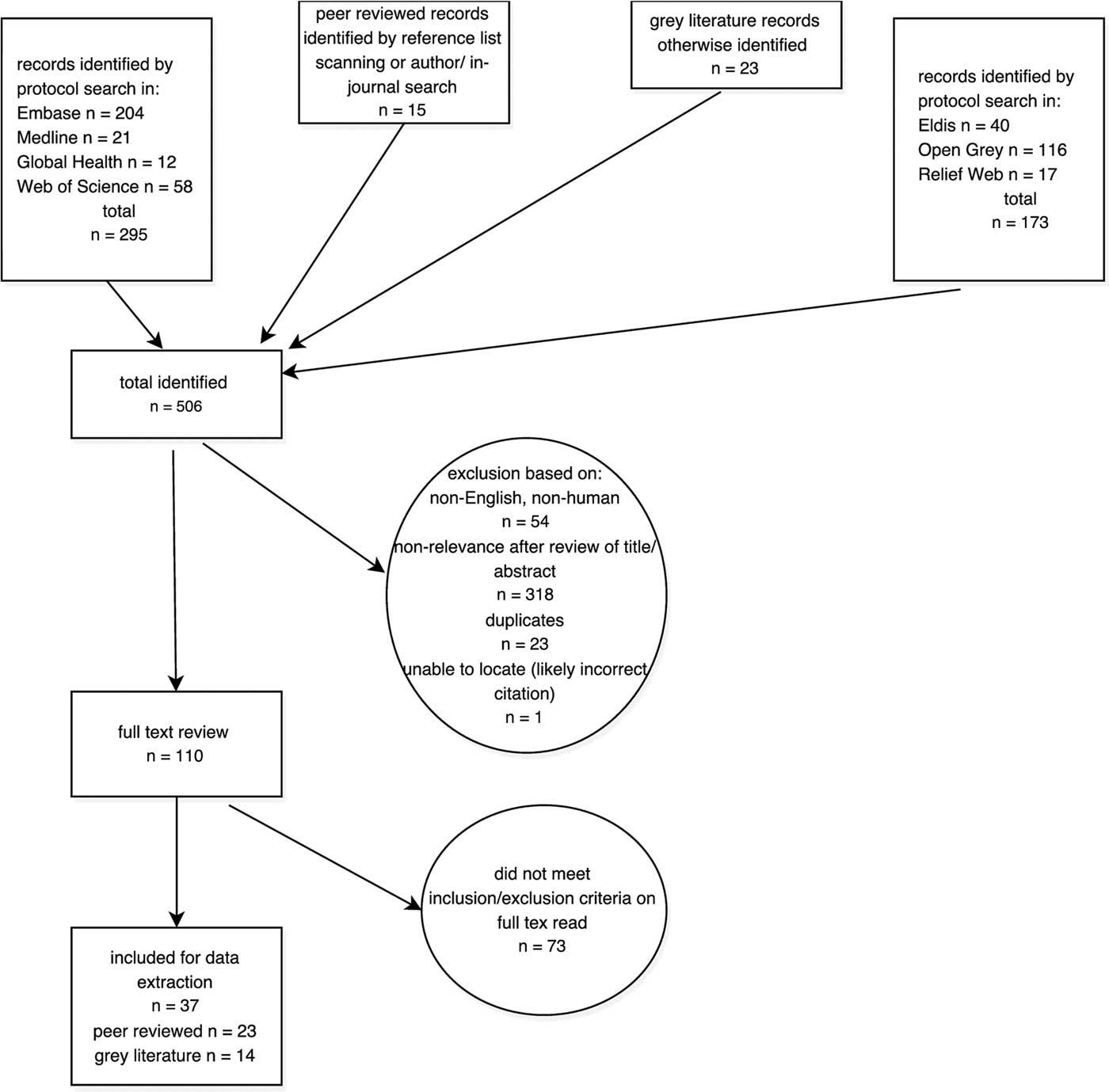
A total of 506 records were identified through searching, 310 in the peer-reviewed and 196 in the grey literature, as seen in the modified PRISMA flow chart (Figure 1).
PRISMA Flow Chart. Abbreviation: PRISMA, Preferred Reporting Items for Systematic Reviews and Meta-Analysis.

After exclusion based on screening title and abstract for previously mentioned criteria, duplicates, and inability to locate (one article), 110 full texts were examined for relevance. Thirty-seven articles, 23 peer-reviewed and 14 from grey literature, provided material for data extraction (Appendix C - data extraction chart; available as supplementary material in the online version).
Grey Literature
The grey literature was examined first as it was felt most likely to contain actual guideline documents. Eleven articles describing some type of guidelines for health sector humanitarian response were identified.
Of these, the Core Humanitarian Standards (CHS) 28 and the 2010 Humanitarian Accountability Partnership (HAP) 29 standards described accountability mechanisms and were directed at organizations involved in humanitarian work rather than individuals. These, as well as the Core Humanitarian Competencies Framework, 30 were general, not disaster-focused, and were felt not to be relevant to individual health providers determining whether or not they were qualified to respond to disasters.
Both the Sphere Project (Humanitarian Charter and Minimum Standards in Humanitarian Response) 31 and the Code of Conduct for the Red Cross Red Crescent movement and NGOs in Disaster Relief (CoC) 32 addressed the actions of personnel once in the field. Indirectly, they informed a prospective responder of expectations and the need to recognize that they must be prepared to fulfil these obligations, but they did not explicitly speak to potential responders regarding the skills they should have or the preparation required to be effective.
Emergency Medical Team guidelines, 15 as discussed earlier, did not address non-clinical training or preparation of the team members. This was the same for their precursor, the FMT guidelines.Reference Norton, Schreeb von, Aitken, Herard and Lajolo 33
Though not strictly speaking a guideline, the Health Cluster Guide 34 described how the Interagency Standing Committee (IASC) and WHO, through the Cluster system, play a critical coordination role in disasters. Medical responders to SODs are expected to register and coordinate their efforts through the Health Cluster.
Finally, the Oslo guidelines 35 specified the permissible role of the military in humanitarian relief as well as guiding military-civil coordination in disasters. Many of the principles included reflected those in the Sphere Project guidelines and CoC.
The remaining three articles found in the grey literature included a field handbook 36 with the CoC, Sphere Project guidelines, and CHS summarized, as well as an explanation of the Cluster system; a brief monograph on earthquake mitigation and response, 37 which touched on issues relating to guidelines for health response, but did not address them directly; and a manual,Reference Dominelli 38 which provided general principles for humanitarian actions in the post-disaster field.
No guidelines or standards directly relating to skills, qualifications, or preparation for FHWs considering responding to a SOD were identified within the grey literature.
Peer-Reviewed Literature
Within the peer-reviewed literature, 14 articles included mention of at least one of the previously described guidelines.Reference Johnson, Idzerda and Baras 16 , Reference Krin, Giannou and Seppelt 39 - Reference Dumont, Khanal, Thüring, Junod and Hagon 51 Six went into detail addressing utilization, relevance, or rationale for the guideline under discussion. One article provided suggestions for travel health preparation,Reference Costa 52 two for record keeping,Reference Jafar, Norton, Lecky and Redmond 48 , Reference Burkle, Nickerson and Schreeb von 53 one recommended the use of surgical checklists,Reference Chu, Stokes, Trelles and Ford 9 and two addressed issues individuals should consider prior to deployment.Reference Krin, Giannou and Seppelt 39 , Reference Cranmer, Aschkenasy and Wildes 54
No guidelines other than those identified in the grey literature search were mentioned. Although the importance of developing certain standards for those responding to SODs was stated in almost all articles, including suggestions, no existing guidelines or standards were referenced or identified.
Three records were found describing field activities in Nepal following the 2015 earthquake.Reference Alfa-Wali and Sritharan 40 , Reference Dumont, Khanal, Thüring, Junod and Hagon 51 , Reference Merin, Yitzhak and Bader 55 All three described large teams registered with the Health Cluster, having a clear mandate, and working in a coordinated fashion under the direction of the national government.
Qualitative Study
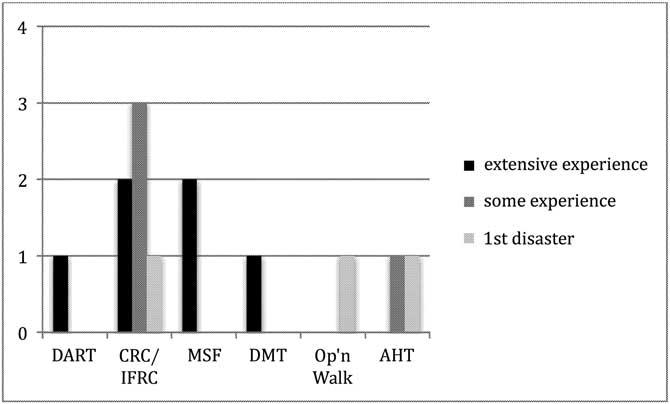
Thirteen participants in the health care sector response to the Nepal earthquake took part in recorded, semi-structured interviews. They included nurses, physician clinicians, and administrators/team leaders. There was a broad range of experience, from never having been to a disaster zone before to more than 25 years of experience in the field, as seen in Figure 2. Members of teams interviewed were from a broad variety of organizations, including:
-
∙ the Disaster Assistance Response Team (DART) of the Canadian Armed Forces;
-
∙ the Canadian Red Cross (CRC; Ottawa, Canada) Emergency Response Unit (ERU), part of the IFRC response;
-
∙ Médecins Sans Frontières (MSF; Geneva, Switzerland);
-
∙ a trained disaster medicine team (DMT) from a large US teaching institution;
-
∙ Operation Walk (Op’n Walk; Chicago, Illinois USA), an NGO with non-disaster international humanitarian experience; and
-
∙ an ad hoc team (AHT) from a large US teaching institution.
Foreign Health Worker Experience. Abbreviations: AHT, ad hoc team; CRC, Canadian Red Cross; DART, Disaster Assistance Response Team; DMT, disaster medicine team; IFRC, International Federation of the Red Cross/Red Crescent Societies; MSF, Médecins Sans Frontières; Op’n Walk, Operation Walk.

Their home countries were all in either North or South America.
Grounded theory analysis of the interviews revealed themes regarding: (1) the actors—individuals and organizations; (2) training and preparation; (3) activities reflecting knowledge, compliance with general humanitarian standards; and (4) needs, barriers, and gaps related to guidelines.
The Actors: Individuals and Organizations
Respondents generally described altruistic motivations, wanting to “give back” and utilizing their skills to help the most vulnerable, for responding to the Nepal earthquake. One individual also cited having a “life-changing experience” and a basis for public speaking as reasons for going.
Selection criteria for team members also varied between organizations, with members of established organizations describing screening and training for disaster mission deployment, while the members of the AHT stated that their team was pulled together following the onset of the disaster from people who were available and willing to travel to Nepal.
Institutional memory was another feature of organizations mentioned by a number of the respondents. This was felt to contribute to knowing what worked and what did not, understanding cultural context, developing effective referral mechanisms, and “speaking the same language” so that team members would know their roles and relationships, even if they had not worked directly with same group of people before.
In particular, an interest in disaster medicine, prompting activities to learn more prior to the occurrence of the Nepal earthquake, was expressed by those who worked with more established teams. In turn, established teams provided learning opportunities for their members.
Training and Preparation
Interviewees from MSF, CRC, DART, and the DMT all described training programs that took place prior to individuals deploying to the field for the first time, whereas those from the other two groups had none and had not sought out such training prior to the earthquake response deployment.
Those who received training saw it as valuable for preparing a person for what to expect, including reflection on ethical dilemmas that would be likely faced in a disaster situation. It was through this training they learned about humanitarian standards. Interviewees from both Op’n Walk and AHT were unaware of these standards, even when prompted with terms like “Sphere” or “Code of Conduct.”
Training was also viewed as a screening tool:
I’ve seen people actually do the ERU training and then after the mass casualty simulation exercise they say “You know, I don’t think I can do this. I can’t go into the field and do this kind of work.” So, they do a good job of getting some people to realize, ok, this isn’t for me, which is important to know too (interviewee 290611, CRC delegate describing disaster focused training for ERUs).
Preparation included the concept of self-sufficiency. Where members of the established teams described having equipment and supplies for complete self-sufficiency for a defined period of time, an AHT member described planning on “tapping into” a larger established team and their resources once in the affected country. A member of one of the larger teams described a similar scenario, when they were confronted by “Two paramedics and a surgeon of some sort, at least he said he was…. They carried these big duffle bags with all kinds of stuff they brought from their hospital in the US.” The three individuals described presented themselves at a remote temporary hospital established by the CRC, requesting to join the team and use their facilities, having none of their own.
Activities Reflecting Knowledge and Compliance with General Humanitarian Standards
The different responders described a number of activities for analysis. These were considered in how consistent they were with the general humanitarian standards identified in the literature search, particularly:
-
∙ Coordination and information sharing;
-
∙ Humanitarian action – needs-based, quality care;
-
∙ Building on local capacities; and
-
∙ Do no harm.
Coordination through the Health Cluster had been emphasized as a route to more efficient use of limited resources. The CRC, MSF, DART, and DMT all described attending the Cluster meetings and taking the direction of their deployment from the Nepal MoH. This allowed deployment to areas requiring service without duplication. Mobile clinics were a mechanism used by MSF, CRC, and DMT to reach vulnerable populations unable to make it to a hospital. These were typically coordinated with the local branch of the health ministry.
Op’n Walk had received a specific request for help from the major orthopedic hospital in Kathmandu and complied with that mandate but was unaware of the Health Cluster or their meetings.
The AHT arrived without a clear directive, did not attend Cluster meetings, drove to a number of locations without identifying a site where they were needed, and departed the country after one week. Where the first four teams had record keeping and reporting mechanisms, the AHT did not.
Working with the local population to build their capacity and resilience was recognized as an important role by interviewees of the established teams. For example, a member of the DMT described their experience with mobile clinics:
Our preference by far was to work with the local health care provider ... in one case she kind of took over. She was in charge. It was great actually. She organized how it was going to run, where people were going to go, and we saw patients with her (interviewee 020813).
Not all activities described adhered to humanitarian standards. One interviewee recounted having medical students appear at their clinic, offering their help as translators, only to be found later pretending to be doctors in order to practice their clinical skills.
Needs, Barriers, and Gaps Related to Guidelines
All participants agreed that guidelines are needed for those in the health field who wish to respond to disasters:
You don’t want people running in with their homeopathic cures for Ebola, or people doing amputations they’re not qualified to do, or medical students thinking that they’re doctors, you need to stop that happening… (experienced MSF worker, interviewee 210608).
There was no agreement, however, on what the guidelines should cover, how narrowly defined they should be, or how they should be developed.
Concerns were mentioned about regulations being too prescriptive and too cumbersome with the risk of slowing response further. An MSF participant pointed out that in order to comply with the FMT guidelines, some teams might be over-resourced for the actual needs.
Professionalization was seen by some as the answer:
We know that being a doctor is not enough to make you a good humanitarian. It is a profession in and of itself that has a separate skill set, separate requirements, separate standards (DMT delegate, interviewee 020813).
They went on to say,
There are ways that we function in the humanitarian space. You need to know about who these players are. You need to understand what the Clusters are and how they work, you need to understand the Sphere standards and how they work; you need to have some historical context; you need to understand how government plays a role in humanitarian response.
Among those who had worked longer in humanitarian relief, gaps in education, in standardization of training, and in dissemination of existing humanitarian standards were recognized as contributing to a weaker disaster response.
An issue brought up by members of both large and small groups was who should be responsible for developing such guidelines and possibly enforcing them. Compromise of neutrality, political influence, and lack of trust of large organizations, like the WHO, were highlighted as concerns.
Discussion
Concern regarding the qualifications of foreign health care responders following natural disasters is not new.Reference Fisher 43 Efforts have been made to improve the health sector response; however, a search of the literature failed to identify guidelines that address health sector workers who consider participating in disaster response, particularly to reference whether or not it is appropriate for them to go, how to prepare, or what are expectations on arrival.
The lack of awareness of any such guidelines was confirmed through the interviews.
The 2013 FMT, now EMT, guidelinesReference Norton, Schreeb von, Aitken, Herard and Lajolo 33 were utilized after the earthquake in Nepal. For the first time following a disaster, teams were refused entry to the country when they were felt to not meet quality standards (email from Dr. I. Norton, [nortoni@who.int]; April 17, 2016). Almost all teams that registered on entering the country participated in Cluster meetings.
In spite of this, individuals without a clear plan, with minimal resources, and who did not coordinate with the Health Cluster arrived in country. Whether or not some of these “ad hoc” foreign responders contributed in a positive way to the health recovery of the Nepali population is difficult to say, but seems unlikely, as seen in the case of the AHT.
This stood out in contrast to descriptions of actions by members of more established groups, where field activities were consistent with humanitarian principles, coordinated with other teams, and did not rely on resource support from the host country, while working with locals and strengthening their capacity was emphasized.
The interviews suggest that which organization, or form of organization, a health sector worker chooses as a vehicle may determine how much of the information they need to effectively respond to a major disaster is transmitted to them. Established disaster response organizations screened and trained their members. Those individuals who decided to participate in disaster response outside of established organization may not have had the opportunity to learn whether they were adequately prepared for what they would face. Being unaware of standards, such as Sphere Project or CoC, they may have been less likely to coordinate with other agencies or otherwise contribute to the optimization of the health sector response. Without exposure to scenarios prior to deploying to a disaster zone, there may be a misunderstanding of what “self-sufficiency” means, the various actors involved and what their roles are, and the ethical and practical challenges that must be navigated.
All those interviewed felt there should be guidelines for individuals considering going to another country following a disaster to participate in the health care response. This is distinct from both general humanitarian principles and minimum standards for EMTs. Furthermore, the evidence suggests that if an individual’s awareness of the unique demands of disaster response depends on a decision to join one organization versus another, the problem of unqualified, unprepared responders will continue.
In much the same way minimum standards for EMTs have been developed, guidelines or standards for the responders themselves should be developed, to include both professional skills as well as non-clinical skills. Making health professionals aware of such guidelines well before a SOD would be equally important and could be done either through academic programs at the undergraduate level for physicians, nurses, and allied health professions, or through their professional and credentialing bodies. These guidelines could be built on expert opinion, as well as further research in the field of disaster policy. Best practices need to be identified for individuals, not just teams, working in disaster situations.
Limitations
The literature search was limited by accessing only English language articles. This puts a particularly Euro-American-centric spin on what is a global issue. However, standards that are truly international should be identifiable through the English language literature.
The paucity of information on guidelines made it difficult to obtain a broad sense of expert opinion. It does indicate, however, the need to do further research in this policy field. Similarly, with the newness of the field, much of the language needed for descriptors and subject headings is not available, making effective searching more difficult. It is also likely, with regard to articles describing the quality of disaster response, only those familiar with guidelines and research are likely to publish narratives of their field activities, skewing what is available for review.
Regarding the qualitative portion, as with any work of grounded theory, the conclusions drawn are context-dependent.Reference Corbin and Strauss 23 In this case, interviewees had all participated in the response to the Nepal earthquake. Unlike Haiti, Nepal is far harder to access, thus fewer health teams and individuals responded. Many of those interviewed were located in remote areas, as it was the mountainous region north of the capital of Kathmandu that was most affected, leaving them somewhat disconnected from other teams and less able to observe the response broadly. The earthquake struck during Nepal’s busy spring trekking season for international tourism. This too may have played a role in what people experienced and who may have participated in the response.
Although all interviewees were from countries in North and South America, they worked within an international community of interest with exposure to the many nationalities involved in response, including within their own teams. English was the language used in interviews, but not necessarily the first language of the interviewees.
It was not possible to identify and reach FHWs participating outside of a formal organization, and not registering on entry as a foreign health team, as there was no record of these individuals. Their perspective could not be included and may have helped in understanding if these individuals have a positive contribution and what their view on guidelines may be. The closest approximations to such responders were the members of the AHT.
Beyond being bound by the context of Nepal, the interview process itself is not an objective extraction of information. Brinkmann and Kvale describe the “interviewer and interviewee as co-constructors of knowledge.”Reference Brinkmann and Kvale 56 p22 This was kept in mind throughout the process, particularly as the author worked with an established international organization in Nepal following the earthquake. The common themes that arose, through constant comparison typical of grounded theory, nevertheless, support the credibility of the findings.
In spite of these issues, qualitative research permits an understanding of perceptions and motivations, a view from the subject’s perspective, rather than a statistical summary. Although the context may change, there is some consistency in the international responders. Understanding motivations and relationships, leading to the “why” of events, allows development of policy that can effect change. In this case, identifying reasons that an individual is unaware of guidelines, or unwilling to follow them, may lead to better guidelines and better knowledge translation.
Conclusions
Although some progress has been made to improve the international community’s response to large-scale SODs, there are no existing standards to guide an individual as to whether or not they are qualified or prepared to be part of such a response in the health sector. Such guidelines are needed. It appears the opportunity to learn about disaster response is largely team-dependent. There is a need for dissemination of information regarding disaster response earlier in the experience of health professionals, prior to the occurrence of a disaster.
Supplementary Material
To view supplementary material for this article, please visit https://doi.org/10.1017/S1049023X18000146