


1 Introduction
Political parties in advanced democracies depend heavily on a large base of unpaid volunteers—usually drawn from their member base—to manage local party chapters, reach out to voters during campaigns, vote for candidates in nomination elections and become politicians themselves (e.g., Enos and Hersh Reference Enos and Hersh2015; Hersh Reference Hersh2015). Political volunteers thus play a crucial role in democracy, yet the percentage of citizens who volunteer for a party has declined over the past decades (e.g., Dalton and Wattenberg Reference Dalton and Wattenberg2002; Scarrow Reference Scarrow2014; Van Biezen, Mair, and Poguntke Reference Van Biezen, Mair and Poguntke2012). Aggravating matters, those active members that remain are rarely representative of the voters their party represents. For instance, data from six Western European countries (collected in 2023–2024) show that people under 28 are the least likely to report having donated to or worked for a political party or action group in the past year. Only 6.3% of them report volunteering, compared to 12.5% among those aged 58–67—the most active age group. Moreover, women are 18% less likely to report participation than men.Footnote 1
Declining membership numbers, fewer volunteers and a lack of diversity among those who remain pose three key problems. First, because volunteers play crucial roles in party operations, a decline in their numbers hampers key functions—for example, fewer active local chapters engaging with citizens and lower participation in internal party elections, which weakens parties’ democratic responsiveness. Second, unequal participation in party activities can lead to an imbalance in the candidate pipeline and political representation at later stages. Working for a party is often the first step toward becoming a local political candidate, and volunteers often participate in nomination elections (e.g., Moens Reference Moens2022; Thomsen and King Reference Thomsen and King2020). Women’s presence in local politics has, for example, been shown to influence party nomination decisions, reducing the gender gap in representation (Goyal Reference Goyal2023, Reference Goyal2024). Thus, having a diverse body of volunteers is crucial for ensuring fair and equal descriptive representation. Third, an unrepresentative body of volunteers can skew politicians’ perceptions of public opinion, as politicians more frequently interact with those active in politics. These interactions shape politicians’ preferences, and if volunteers do not reflect their constituents’ demographics, politicians may develop biased views of public opinion. These misperceptions can lead politicians to endorse policies that do not align with the majority of voters’ preferences (Broockman and Skovron Reference Broockman and Skovron2018).
One potential solution is for party leadership to actively recruit more volunteers, particularly from underrepresented groups. Given their substantial control over processes like candidate selection, party leaders may also have the capacity to influence who steps up to volunteer (Cohen et al. Reference Cohen, Karol, Noel and Zaller2009; Dancygier et al. Reference Dancygier, Lindgren, Oskarsson and Vernby2015). However, the extent to which party leadership can increase and diversify grassroots recruitment remains unclear for two reasons. First, existing evidence in this space is mixed, with some studies finding that party leadership can successfully mobilize members, while others show that leadership’s recruitment capacity is limited (cf. Gulzar et al. Reference Gulzar, Pathak, Thompson and Tóth2025; Hager Reference Hager2025; Hager et al. Reference Hager, Hermle, Hensel and Roth2021, Reference Hager, Hensel, Hermle and Roth2022, Reference Hager, Hensel, Roth and Stegmann2025; Neuenschwander and Foos Reference Neuenschwander and Foos2021). Second, answering this question is challenging because parties rarely grant access to internal data—let alone allow researchers to randomize outreach strategies (Enos and Hersh Reference Enos and Hersh2015). These issues make it difficult not only to identify effective strategies to mobilize volunteers, but also to build a coherent theory of when parties can mobilize them.
Here, we reconcile mixed evidence on whether parties can mobilize members by introducing a 2
$\times $
 2 framework and testing its predictions in two field experiments. The framework crosses (1) the presence of a “voice opportunity” in outreach efforts with (2) the “scope for effects.” By a voice opportunity, we mean, following Hager et al. (Reference Hager, Hensel, Roth and Stegmann2025), that the contact itself enables recipients to express their own views (e.g., a real-time conversation), thereby elevating perceived instrumentality and increasing participation. Hager et al. (Reference Hager, Hensel, Roth and Stegmann2025) show that inviting party members to share their thoughts about a campaign, especially when framed as instrumentally useful, increases subsequent volunteering. Scope for effects is high when baseline participation in the control group is limited (leaving room for growth) and low when participation is already substantial (imposing ceiling effects).
Synthesizing insights from political behavior, organizational theory and identity economics, we expect voice opportunities to activate both expressive (identity-affirming) and instrumental (influence-seeking) motives, particularly when scope is high (Akerlof and Kranton Reference Akerlof and Kranton2005; Ashraf and Bandiera Reference Ashraf and Bandiera2018; Enos and Hersh Reference Enos and Hersh2015; Restivo and Van De Rijt Reference Restivo and Van De Rijt2012; Willer Reference Willer2009). Our field experiment tests this prediction by contrasting calls, which inherently provide voice (members can discuss the party, campaign and volunteering), with emails, which do not, within the same party and period, in a context with ample scope (low control-group sign-up rates). This locates our treatments in the voice-present/high-scope versus voice-absent/high-scope cells of the 2
$\times $
 2 and helps explain why some studies find null or negative effects when either scope is low, or voice is absent, while others find gains when both conditions are met.
We test our theoretical argument by partnering with a major left-wing party in the Netherlands to evaluate two field experiments conducted on its full membership of over 35,000 members prior to the 2021 general election (Study 1, n = 35,348) and the 2022 municipal election (Study 2, n = 35,687). Crucially, in these studies, the party randomized members along what we hypothesize is a key dimension underlying contradictory findings in prior research: whether the treatment included an opportunity for members to voice their own thoughts and opinions about the party and its campaign. To be precise, the party randomized the recruitment strategies—only a call (studies 1 and 2), only an email (Study 2) or a call and an email (Study 2)—used to encourage party members to become volunteers. During the call, treated respondents had the opportunity to discuss the party, the campaign and volunteering more generally. The party’s recruitment campaign was implemented at virtually no cost: the entire program was managed by volunteers and required only two days of full-time effort from the party’s paid campaign manager to set up.
The main outcome in both studies is a pre-registered inverse-covariance-weighted (ICW) index that captures whether party members sign up for a variety of campaign events on the party’s website. Based on studies emphasizing that expressive and instrumental benefits are key motivators for volunteers (Bawn et al. Reference Bawn, Cohen, Karol, Masket, Noel and Zaller2012; Enos and Hersh Reference Enos and Hersh2015; Hersh Reference Hersh2015; Restivo and Van De Rijt Reference Restivo and Van De Rijt2012; Willer Reference Willer2009), we hypothesize that personal calls are more effective than emails because calls make it possible for those who are called to voice their own concerns and thoughts (H1). This opportunity may generate expressive benefits by allowing party members to signal their commitment to the party, as well as instrumental benefits by fostering the impression that their input can influence the campaign or their own position within the party.
Consistent with our theoretical argument, our findings indicate that phone calls to party members are highly effective in recruiting volunteers. Calling works regardless of gender and is especially effective among younger individuals. In contrast, we find no significant impact from emails—neither overall nor within age or gender subgroups. Anecdotal evidence from the calls with party members suggested they appreciated the call because it was often the first time the party had reached out to them. They mentioned that this made them feel heard and appreciated. These results suggest that giving potential volunteers an opportunity to voice their opinions is key and can serve as an effective mobilization strategy. Taken together, these findings suggest that political parties aiming to mobilize their base should prioritize personal contact as a recruitment strategy because it allows members to voice their opinions and feel valued. Moreover, personal contact can be an effective way to increase diversity within the activist pool by engaging individuals who may not respond to more impersonal outreach methods.
These results have important implications for three bodies of literature. First, our study helps make sense of mixed findings in the existing literature on mobilizing people to become active party volunteers, highlighting why some studies do and others do not find that it’s possible for party leadership to mobilize members (cf. Gulzar et al. Reference Gulzar, Pathak, Thompson and Tóth2025; Hager Reference Hager2025; Hager et al. Reference Hager, Hermle, Hensel and Roth2021, Reference Hager, Hensel, Hermle and Roth2022, Reference Hager, Hensel, Roth and Stegmann2025; Neuenschwander and Foos Reference Neuenschwander and Foos2021). Second, our results speak to a literature on volunteer-led grassroots mobilization and “Citizen Initiated Campaigning” (e.g., Gerber, Green, and Larimer Reference Gerber, Green and Larimer2008; Gibson Reference Gibson2015). We advance this literature by showing that volunteer-led campaigns are not only effective at mobilizing voters but also at recruiting political volunteers. Third, our results contribute to research on diversity in party organizations and the candidate pipeline (e.g., Goyal Reference Goyal2023, Reference Goyal2024; Moens Reference Moens2022). We show that personal outreach is effective among underrepresented groups, such as younger members and women, suggesting that party elites can take concrete steps to diversify the activist base. By identifying a scalable, low-cost strategy to engage underrepresented members, our findings provide actionable insights for parties seeking to build a more inclusive recruitment pipeline—one that better reflects the diversity of the electorate and can ultimately help address structural inequalities in political participation and representation.
2 Theory: Explaining party activism
Theories of what motivates people to become active in politics are generally grouped into “expressive” and “instrumental” motivators. Expressive motivators stem from the act of political participation itself, such as feeling pride in voting. Instrumental motivators, by contrast, are those gained from directly influencing the political process, such as participating to change an outcome or to gain personal benefits like building connections that support a political career. While there is extensive evidence comparing these theories with respect to what drives people to vote (e.g., Green and Gerber Reference Green and Gerber2019), evidence on what explains volunteering for a political party remains limited, largely due to the lack of researcher access to internal party volunteer recruitment processes.
Due to this lack of access, existing research on volunteering in politics is scarce and mainly descriptive. Based on survey data and interviews, we know that individuals who volunteer for party activities do so to derive expressive benefits by signaling solidarity to their community of volunteers and party members (Bawn et al. Reference Bawn, Cohen, Karol, Masket, Noel and Zaller2012; Enos and Hersh Reference Enos and Hersh2015; Hersh Reference Hersh2015). While informative, these descriptive studies do not employ a causal design, which is problematic because the correlation between valuing the community of volunteers and volunteering may result from reverse causation, that is, that people who become volunteers come to appreciate the community of volunteers.
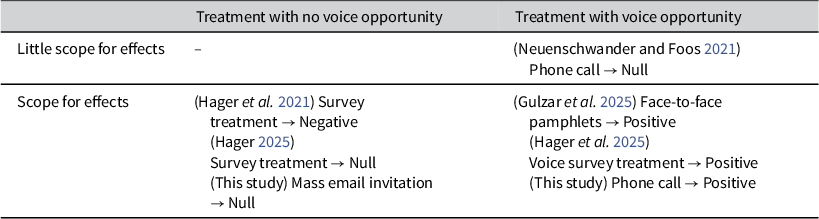
Causal evidence on what motivates political volunteers is mixed and, to the best of our knowledge, limited to five studies. As shown in Table 1, these studies vary along two key dimensions: (1) whether there is scope for treatment effects—defined by the extent of the baseline behavior (e.g., how common the outcome is in the control group)—and (2) whether the treatment includes an opportunity for participants to express their views, which we call “voice opportunity,” following Hager et al. (Reference Hager, Hensel, Roth and Stegmann2025). The first dimension matters because of ceiling effects: when volunteering is already widespread in the sample, for instance, because it is a sample of people who have volunteered in the past, due to the kind of behavior analyzed, or both, it becomes more difficult to induce and detect additional mobilization.
RCTs on becoming a party activist by scope for effect and degree of treatment voice opportunity.

Table 1 Long description
The table is organized into two columns: Treatment with no voice opportunity and Treatment with voice opportunity. It has two rows: Little scope for effects and Scope for effects.
* Little scope for effects with Treatment with no voice opportunity: This cell is empty.
* Little scope for effects with Treatment with voice opportunity: Neuenschwander and Foos 2021. Phone call yields Null.
* Scope for effects with Treatment with no voice opportunity: Hager et al. 2021. Survey treatment yields Negative. Hager 2024. Survey treatment yields Null. This study. Mass email invitation yields Null.
* Scope for effects with Treatment with voice opportunity: Gulzar et al. 2025. Face-to-face pamphlets yields Positive. Hager et al. 2025. Voice survey treatment yields Positive. This study. Phone call yields Positive.
Note: Treatments with voice opportunities allow respondents to give their own thoughts and opinions as part of receiving the treatment. Scope for effects is considered high when the outcome (e.g., canvassing) is rare in the control group, leaving room for upward movement.
The second dimension is whether the outreach gives potential volunteers an opportunity to express their views. Such voice opportunities may increase receptivity to the invitation and, in turn, raise the likelihood of volunteering (Hager et al. Reference Hager, Hensel, Roth and Stegmann2025). Several micro-level mechanisms from different literatures help explain why this might be the case. First, the “Get Out The Vote” literature shows that personal contact is more effective because it encourages people to articulate their views (Green and Gerber Reference Green and Gerber2019; Green, McGrath, and Aronow Reference Green, McGrath and Aronow2013; John and Brannan Reference John and Brannan2008; Nickerson Reference Nickerson2006; Nickerson, Friedrichs, and King Reference Nickerson, Friedrichs and King2006). When individuals can express their motivations and confirm their intention to participate, which they can when contacted in person, they are more likely to experience expressive benefits. In addition, such interactions may generate instrumental benefits by fostering a sense that their input can influence the campaign (Bawn et al. Reference Bawn, Cohen, Karol, Masket, Noel and Zaller2012; Enos and Hersh Reference Enos and Hersh2015; Hersh Reference Hersh2015; Restivo and Van De Rijt Reference Restivo and Van De Rijt2012; Willer Reference Willer2009). These mechanisms likely extend to political volunteers as well. Furthermore, research on social incentives in organizations finds that individuals are more willing to exert effort when they feel seen, heard and valued by those in positions of authority (Akerlof and Kranton Reference Akerlof and Kranton2005; Ashraf and Bandiera Reference Ashraf and Bandiera2018). This likely also applies to the political context, especially if the person reaching out to a potential volunteer is perceived as a party representative or leader. Additionally, personal contact makes it harder to not engage with the person contacting them, as it takes more effort to tell someone you don’t want to talk to them than to ignore an email. Taken together, and as argued by Hager et al. (Reference Hager, Hensel, Roth and Stegmann2025), there are compelling reasons to believe that personal forms of contact that invite recipients to share their views are more effective at mobilizing political volunteers.
Focusing on the studies in Table 1 that did not include a voice component, Hager et al. (Reference Hager, Hermle, Hensel and Roth2021) and Hager (Reference Hager2025) conduct field experiments among German party members who had opted into a survey. In Hager et al. (Reference Hager, Hermle, Hensel and Roth2021), participants were randomly assigned to a text treatment embedded in the survey that informed them their party’s rival was conducting an “exceptionally high” level of campaign activism. The main outcome—real-time data on canvassing behavior from the party’s app—is significantly lower in the treatment group, indicating a demobilizing effect when participants are presented with opponent activity. Meanwhile, Hager (Reference Hager2025) tested whether informing members that activism is either persuasive (their Study 1) or beneficial for career advancement (their Study 2) would increase mobilization. Across both studies, the treatments produced null effects on intended and actual campaign participation. At the same time, there was scope for effects, as only about 15% of control-group participants in both studies engaged in campaign activities. These results suggest that purely informational appeals, delivered without any opportunity for members to voice their views, may fail to activate the expressive or instrumental motivations required for meaningful mobilization.
Neuenschwander and Foos (Reference Neuenschwander and Foos2021) use a treatment where there is space for respondents to voice their own opinion: party members who opted in to do a survey are called by the party to ask whether they want to volunteer. However, they find that this treatment didn’t move self-reported campaign activism, including the number of relatives and friends contacted or persuaded to vote. This may be explained by the fact that there was not much scope for effects: in the control group, campaign activity was already quite common, with control group respondents reporting speaking to an average of 4.8 relatives and 22.7 friends, and persuading 3.6 relatives and 8 friends to vote for the party.
However, there are positive mobilization effects in studies with scope for effects and treatments that included opportunities for participants to voice their opinions. Hager et al. (Reference Hager, Hensel, Roth and Stegmann2025) randomly assigned German party members willing to take a survey to one of two open-ended questions—“Which issues matter most to you?” or “Which issues will make our campaign most effective?”—and then tracked subsequent canvassing. Because hardly anyone in the control group canvassed (about 0.1 doors were knocked on, on average, and virtually no members did any canvassing), there was scope for effects, and both voice prompts led members to knock on significantly more doors.
Gulzar et al. (Reference Gulzar, Pathak, Thompson and Tóth2025) provide further evidence from India, working with the Aam Aadmi Party. They randomized 150,000 recruitment pamphlets that either highlighted male volunteers and status-quo messaging or featured a female volunteer’s story and framed joining as a way to influence policy, advance a career or even become a candidate. Crucially, the pamphlets were handed out in person, and recipients had the opportunity to ask questions and voice their opinions. The study’s primary outcome is whether each pamphlet generated at least one new recruit who completed the party’s onboarding task. As the study targeted people who were not active in the party, there was also ample scope for effects on this outcome. Substantively, Aam Aadmi’s campaign recruited about 7.5 new members per 1,000 pamphlets, and gender-inclusive pamphlets increased onboarding by 19%, with some gains, especially among women, still detectable three years later.
These studies all make crucial contributions, yet further research remains important for four reasons. First, while our theoretical argument reconciles the mixed findings in the literature, it makes sense of studies that vary not only in treatments but also in contexts. The study presented here introduces, within a single context, variation on a key dimension: whether the treatment allows respondents to have their voice heard by including both a treatment that accommodates personalized responses and one that does not. Crucially, our study has ample scope for effects, as it is conducted with all party members, not only those previously active, which means the levels of the outcome variable in the control group are low. Introducing variation in the scope-for-effects dimension was not feasible in our context.
Second, in developing-country contexts, parties often face organizational and infrastructural constraints in reaching underrepresented groups—particularly women, who may have lower access to mobile phones or be harder to contact through existing party networks (Goyal Reference Goyal2023, Reference Goyal2024). In such settings, the central challenge is not only whether voice opportunities are effective, but whether they can be offered to these constituencies at all. Experiments in these contexts, therefore, must overcome both access and voice barriers simultaneously, even if they focus on studying one. Our context, by contrast, allows us to more cleanly isolate the role of voice, as access constraints are largely absent.
Third, while Gulzar et al. (Reference Gulzar, Pathak, Thompson and Tóth2025) find that it is possible to actively recruit women into becoming active, their in-person treatment may be too expensive to execute in more developed democracies where labor costs are higher. It is thus important to investigate whether voice-based results generalize when employing less expensive forms of voice treatments, such as phone calls, rather than in-person canvassing. Finally, none of the existing studies focus on mobilizing young people, a demographic where there is a significant gap between the general population and active party members in most advanced democracies.
This study aims to address these critical areas. Taken together, we have the following hypothesis about the recruitment of party members to become political volunteers:
H1: Treatments with voice opportunities, such as calling versus emailing, are more effective when there is scope for effects.
Beyond testing average treatment effects, we pay particular attention to heterogeneity by gender and age. Women and young people are underrepresented among party activists in developed democracies, while prior research suggests voice-based appeals may be especially effective for these groups in less developed democracies (Gulzar et al. Reference Gulzar, Pathak, Thompson and Tóth2025). While we do not formulate specific hypotheses, we conduct subgroup analyses to examine whether more inclusive forms of contact, such as phone calls, are particularly successful at mobilizing underrepresented members in developed democracies.
3 The context
Our field experiments are conducted in the Netherlands, home to one of the most proportional electoral systems globally: the entire country functions as a single district, resulting in a highly fragmented party system, typically with over 10 parties represented in parliament. Like many European democracies, the Netherlands has seen a substantial decline in party membership: between 1978 and 2010, membership fell by roughly one-third (from about 450,000 to 300,000), down to roughly 2.5% of the electorate by 2010 (van Schuur and Voerman Reference van Schuur, Voerman and Wejnert2010). Consistent with this context, the top panel of Figure 1 (European Social Survey 2023–2024) shows Dutch volunteering rates with pronounced differences across generations, based on whether respondents donated to or participated in a political party in the past year. Further, alongside generational gaps in volunteering, women are less likely than men to volunteer.
Proportion of people who volunteer for a party.
Note: Top panel: Netherlands (European Social Survey 2023–2024). Bottom panel: European Social Survey (2023–2024) for six Western European countries: CH, DE, FI, GB, NL and NO. Volunteering for a party is captured with the question: “Have you donated to or participated in a political party or pressure group in the last 12 months?”.

Figure 1. Long description
The figure consists of two horizontal panels, (a) Netherlands and (b) Western European countries. Each panel contains two bar charts.
Panel (a) Netherlands:
* Left chart: X-axis is Generation (Years of Birth) from Pre-1946 to Post-1995. Y-axis is Proportion from 0% to 15%. The highest volunteering rate is in the 1956-1965 cohort (approximately 15%), with the lowest in the Post-1995 cohort (approximately 5.5%).
* Right chart: X-axis is Gender (Male, Female). Y-axis is Proportion from 0% to 10%. Males show a higher proportion (approximately 10.5%) compared to females (approximately 8.5%).
Panel (b) Western European countries:
* Left chart: X-axis is Generation (Years of Birth). Y-axis is Proportion from 0% to 12%. Proportions peak for the 1956-1965 cohort (approximately 12.5%) and show a steady decline in younger generations, reaching approximately 6% for the Post-1995 cohort.
* Right chart: X-axis is Gender. Y-axis is Proportion from 0% to 12%. Males have a higher proportion (approximately 11%) than females (approximately 9%).
Across both panels, the 1956-1965 generation and males consistently show the highest proportions of political volunteering.
Because Dutch parties rely heavily on membership dues, contributing up to 50% of total revenue (Koole Reference Koole and Alexander1989), shrinking membership constrains finances and staffing, making volunteers essential for both campaign operations and grassroots organizing. Institutional features amplify these pressures: the Netherlands lacks decentralized state-level party infrastructure (state politicians are typically unpaid volunteers), and the rise of municipal-only parties has hollowed out local chapters of national parties (Brandsma and van der Schakel Reference Brandsma and van der Schakel2021; Fennema and Bolkestein Reference Fennema and Bolkestein2018). These features further limit the size of parties’ paid staff and increase dependence on volunteers.
Across Western Europe, patterns are similar. The bottom panel of Figure 1 presents descriptive evidence from six Western European countries on political volunteering. The results reveal substantial differences in participation by both gender and generation. Women are significantly less likely than men to report having worked for a political party in the past year. The generational divide is even more pronounced: while around 12% of the older cohorts (born before 1965) report party involvement, this figure drops steadily across later cohorts, reaching just above 6% among the youngest respondents (born after 1995). These descriptive trends underscore the importance of understanding how parties can better engage underrepresented groups.
4 Methods
We evaluate a novel, pre-registered experimental design across two studies in collaboration with a major Dutch party. In many ways, this political party represents one that has the most to gain from increasing engagement among, in particular, younger people and women, as the average age of party members is over 60, most volunteers are retirees, and more than half of the party members are men. Initially, only one study was planned, but the party could not send the planned treatment emails before the 2021 national campaign and could only call party members. As a result, the originally planned experimental design was implemented a second time ahead of the 2022 municipal election, including calls and emails, using the same sample.
4.1 Sample
The experiments covered the entire population of over 40,000 party members, so no sampling strategy was used. However, certain members were excluded for ethical, practical or party-imposed reasons. Specifically, we removed: members with neither an email address nor phone number (
$\sim $
 2,000) as they could not be contacted; members holding official party positions (e.g., MPs, mayors or local office holders;
$\sim $
 500) because the party did not want their contact details shared; members under 18 (
$\sim $
 200) for ethical reasons; members living outside the Netherlands; members without address information and members in households of more than two people (
$\sim $
 300 across these latter categories) to allow blocking by household size. After these exclusions, the final sample comprised approximately 38,000 party members.
4.2 Randomization and treatments
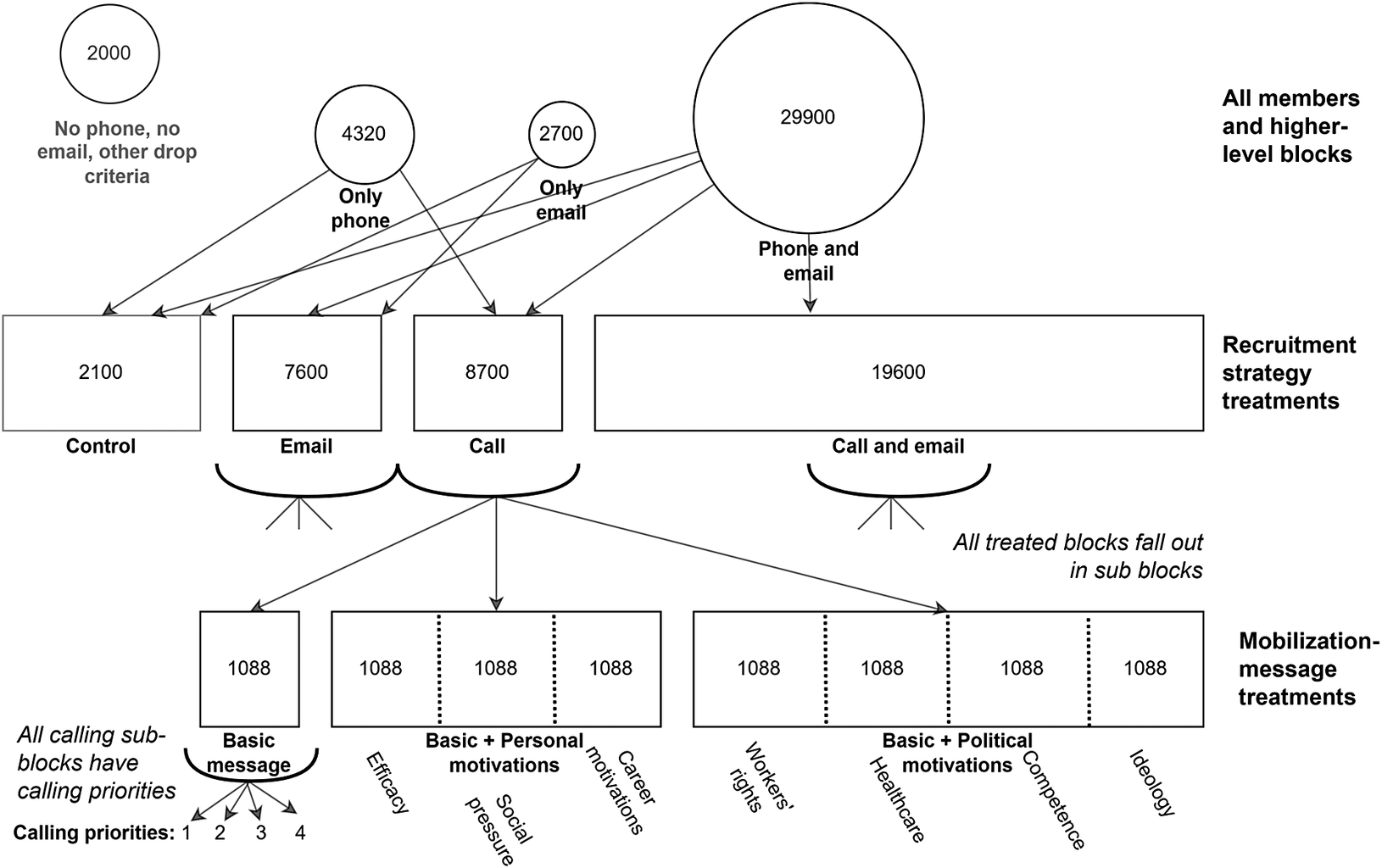
The full design used in Studies 1 and 2 is visualized in Figure 2. To prevent spillovers within households, both experiments were clustered at the household level since about 15% of party members live with another party member.Footnote 2 Households were assigned to treatment using two levels of blocking. At the highest level, we blocked on having a phone number, having an email address and whether the household had one or two members, resulting in six higher-level blocks. Given that it was not feasible to implement all treatments in all blocks, the probability of treatment assignment varied by higher-level block, which we account for in the estimation. Each higher-level block was further subdivided into lower-level blocks based on the Mahalanobis distance computed across gender, age, chapter size, municipality size and membership length.
Research design.
Note: The circles represent the three higher-level blocks. Respondents were randomized—as indicated by the arrows—into recruitment strategies (the middle row of blocks) and then further sub-randomized into specific mobilization messages (the bottom row).

Figure 2. Long description
The flowchart is organized into three horizontal rows.
Top Row: All members and higher-level blocks.
- A circle on the far left labeled 2000 represents No phone, no email, other drop criteria.
- A circle labeled 4320 represents Only phone.
- A circle labeled 2700 represents Only email.
- A large circle on the right labeled 29900 represents Phone and email.
Middle Row: Recruitment strategy treatments. Arrows from the top circles distribute participants into four rectangular blocks.
- Control: 2100 participants.
- Email: 7600 participants.
- Call: 8700 participants.
- Call and email: 19600 participants.
Bottom Row: Mobilization-message treatments. Brackets and arrows indicate sub-randomization from the treated blocks above into three main message categories.
- Basic message: A single block of 1088 participants. Below this, a bracket points to calling priorities 1, 2, 3, and 4.
- Basic plus Personal motivations: A block divided into three segments of 1088 each, labeled Efficacy, Social pressure, and Career motivations.
- Basic plus Political motivations: A block divided into four segments of 1088 each, labeled Workers’ rights, Healthcare, Competence, and Ideology.
Text notes indicate that all treated blocks fall out in sub blocks and all calling sub-blocks have calling priorities.
Within lower-level blocks, respondents were randomized with varying probabilities into a recruitment strategy treatment (receiving an email only, a call only, receiving a call and an email or being in the pure control group), which was constrained by their higher-level block. The design also included randomization into mobilization messages to inform what motivates people to volunteer. We found no significant differences across the messages, which we show in the Supplementary Material, and thus focus on the pooled results.
All respondents assigned to a treatment arm that received a call were further randomly subdivided into four sub-arms, determining the “calling priorities,” so that they could be reassigned to other groups if their sub-arm was not called, thereby avoiding power loss. The party started calling respondents in a given calling priority and moved to the next one after calling all members in that priority. The goal of dividing treatment arms into calling priorities was to ensure that, if the party failed to call respondents in all priorities, party members in unreached calling priorities could be reassigned to the email-only arm, or the control arm, and thereby avoid power loss without compromising the internal validity of the study. In total, about 38,000 party members were cluster-block randomized into 72 different experimental arms, once for the first study and once more for the second.
Both studies included two different methods of treatment delivery:
1. “Email”: The email treatments were included in the party’s regular email newsletter, which is sent out every two weeks. In the five newsletters sent before the election, treated respondents received a short message explaining why they should volunteer, followed by a link to the party’s website to sign up. Note that no emails were sent out in Study 1.
2. “Call”: The calling treatments were conducted by a team of 25 volunteers who were randomly assigned to call party members across treatment arms. Volunteers generally called on scheduled evenings, often meeting together on Zoom to call. At the start of each evening, volunteers were reminded to follow the calling script. On a given evening, each volunteer generally called using only one script. They were given the scripts and could also find them in the calling software (for Study 1) and in the calling sheets that contained the contact information (for Study 2).Footnote 3 During the call, party members were directly asked if they wanted to sign up for specific events, and the callers assisted them with signing up while on the phone on the party’s website.
In the “Call and email” treatment condition, these two recruitment strategies were combined. Control participants did receive the newsletter, but without any additional messages on why they should sign up. They were not called.
4.3 Outcomes
Our outcomes consist of various campaign activities advertised on the party’s website, for which members could sign up. People could sign up to (a) volunteer in the national campaigning team, (b) volunteer in the campaigning team of their local chapter, (c) become a “local organizer” for an online party training, and (d) participate in specific campaign events, for example, “delivering fliers in a neighborhood on a given day.” All these outcomes can be considered “behavioral,” as they consist of party members putting in the effort to sign up for events. During the two campaigns, the party’s website underwent continuous changes, so not all outcomes were available simultaneously (at least two options were always available). We combined these four binary outcomes using inverse covariance weighting, which was calculated separately for each study.
4.4 Research design adjustment
During the first study, the party was unable to send emails and managed to call only about 10% of the members on the calling list in the weeks leading up to the national election in March 2021. Despite this, the party was eager to continue the study. As a result, we split the study into two parts: the period before the general election in March 2021 (Study 1), and the period leading up to the municipal elections in March 2022 (Study 2).
By virtue of randomization and the flexibility of our design, we could reassign respondents across treatment arms in each study. For the national election analysis (Study 1), the party members who were supposed to receive both an email and a call were reassigned to the call-only group. Additionally, members in the calling priorities that the party failed to contact were reassigned to control. All members who were initially assigned to the email group were dropped from the analysis since there was no ultimate variation in treatment assignment within that higher block. In the local election (Study 2), the party also emailed respondents in addition to calling them. As a result, the number of treatment arms differs between the two studies because we test only one recruitment strategy (calls only) in the national election analysis.
All party members who had not been contacted prior to the national election campaign in Study 1 were re-randomized for the municipal election in Study 2.Footnote 4 In the municipal election, the party did not manage to call any of the members in the fourth calling priority. Those party members were then reassigned to the control or email-only groups, depending on their higher-level block. The final assignment in both studies, after reassigning respondents, is presented in Tables A1 and A2 in the Supplementary Material. Balance tests confirm randomization was successful, both before and after reassignment (see Section A.7 of the Supplementary Material and Pre-Analysis-Plan).
These design adjustments, along with changes to the outcome measures and the reframing of the main research question around recruitment strategies, constitute deviations from the pre-analysis plan. A full account of all deviations is provided in Section A.2 of the Supplementary Material.
4.5 Estimation
Our estimands of interest are the effects of the recruitment strategies and the different mobilization messages relative to the control group. We consider the intent-to-treat (ITT) effect, estimated through OLS:

where
$D_i$
 is coded according to the estimand of interest.
$\gamma _b$
 captures a party member’s lower-level block fixed effect
$b$
 ,Footnote 5 and
$\textbf {X}_i$
 is a vector of control variables, which include the variables we blocked on. We report cluster-robust standard errors at the treatment-assignment level and conduct two-sided hypothesis tests.
To estimate heterogeneous effects by party member age group and gender, we add interaction terms to the above equation. In addition, because we have detailed data on who was called in Study 1 given that the party used more advanced calling software (“Ecanvasser”) in the national campaign, we estimate a complier average causal effect (CACE) based on whether someone was called by one of our volunteers in that first study.
5 Results
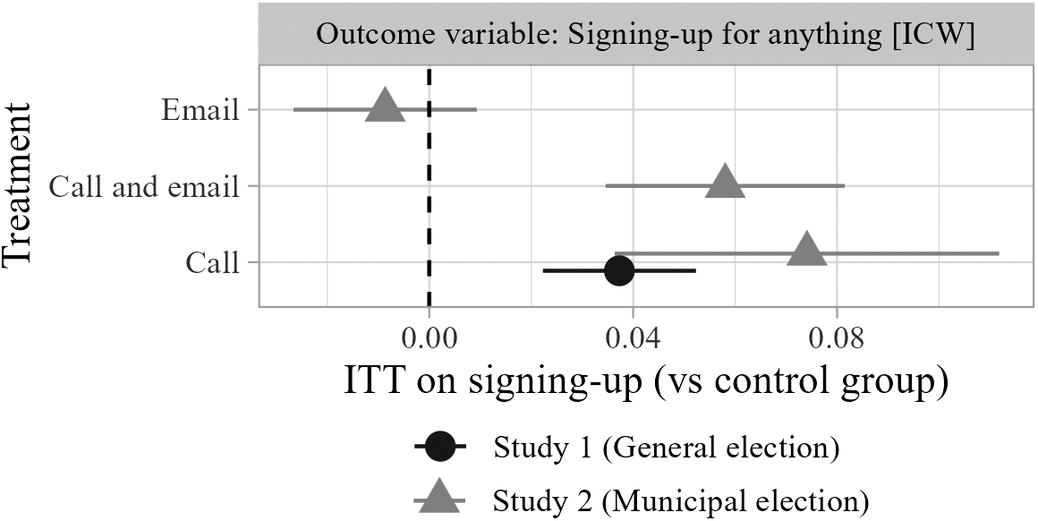
Moving to the field experimental results, baseline sign-up rates in the control group were low: 0.89% in Study 1 and 0.22% in Study 2. Calling raised the sign-up rate to approximately 1.6% in Study 1 (an 83% increase) and to approximately 1.0% in Study 2 (a 361% increase). Calling and emailing raised sign-ups to approximately 0.93% in Study 2. These patterns are confirmed by the pre-registered ITT estimates on the ICW index, shown in Figure 3 (Study 1:
$\beta $
 = 0.037, p
$<$
 0.001; Study 2 for calling:
$\beta $
 = 0.074, p
$<$
 0.001; and for calling and emailing,
$\beta $
 = 0.058, p
$<$
 0.001), corresponding to standardized effect sizes of 0.06, 0.10, and 0.08, respectively.Footnote 6
Main results for the recruitment strategies and 95% confidence intervals.
Note: The outcome is whether party members sign up for different types of activities on the party website, combined using inverse covariance weighting. Section 4 provides more details on the data and methodology, including the exact measurement of our dependent variables and the randomization process. The full regression results can be found in Table A3 in the Supplementary Material. Bayes factor analysis and minimum detectable effect sizes for the email treatment can be found in Tables A13 and A14 in the Supplementary Material.

Figure 3. Long description
The graph is titled Outcome variable: Signing-up for anything [I C W]. The Y-axis is labeled Treatment and lists three categories from top to bottom: Email, Call and email, and Call. The X-axis is labeled I T T on signing-up (vs control group) with numerical markers at 0.00, 0.04, and 0.08. A vertical dashed line indicates the zero effect baseline.
A legend at the bottom identifies two data markers: a black circle for Study 1 (General election) and a grey triangle for Study 2 (Municipal election). Each marker includes a horizontal line representing a 95 percent confidence interval.
Data points by treatment:
* Email: Study 2 (grey triangle) is positioned to the left of the zero line, approximately at -0.01.
* Call and email: Study 2 (grey triangle) is positioned to the right of the zero line, approximately at 0.06.
* Call: Study 1 (black circle) is positioned at approximately 0.038. Study 2 (grey triangle) is positioned further right at approximately 0.075.
All Study 2 effects for Call and Call and email are positive and statistically significant as their confidence intervals do not cross the zero line, while the Email treatment for Study 2 overlaps with zero.
These effects are substantively meaningful, especially given that the intervention was volunteer-led and cost the party almost nothing. To put the magnitude in context, the calling treatment increased sign-up rates by 0.7 percentage points in Study 1 and 0.8 percentage points in Study 2 relative to the control group. Although modest in absolute terms, these effects are large relative to the rarity of the behavior and meaningful when benchmarked against the descriptive differences between age groups shown in Figure 1. In the bottom panel of Figure 1, the gap in political volunteering between the youngest and most active older cohorts is about 6.2 percentage points (6.3% vs. 12.5%). Our treatment effects therefore correspond to roughly 11%–13% of that cross-generational participation gap.
For emails, we find precisely estimated null effects (
$\beta $
 =
$-0.009$
 , p
$=$
 0.35). In the Supplementary Material, we show that the data supported the null model over the alternative when using Bayes factors (Table A14 in the Supplementary Material). Further, the minimum detectable effect of emails at 80% power is 0.047 (Table A13 in the Supplementary Material), and thus our analysis is sufficiently powered to detect meaningful effects.
These results are consistent with the fact that only about 5% of people who receive an email click on any of the content. The contrast between calls and emails thus likely captures two distinct mechanisms through which voice opportunities may operate: calls are more likely to reach and engage recipients in the first place, and, conditional on engagement, they provide an opportunity for members to voice their views. Our design cannot fully separate these two channels, but two patterns suggest that the opportunity to express one’s thoughts, rather than mere engagement, is a primary driver. First, the call-and-email arm does not outperform the call-only arm, even though adding an email increases total exposure. If engagement alone were driving the effect, the additional contact should have amplified it. Second, if greater engagement were the mechanism, we would also expect the specific content of the mobilization messages to matter more in the call-and-email arm, where members receive the message through two channels. Yet we find no heterogeneous effects across message types for any recruitment strategy, including call-and-email (see Section A.5 of the Supplementary Material). Together, these patterns are consistent with the view that the opportunity to express one’s views is an important part of why calls are effective.
Next, we consider the CACE in Study 1 (where we can measure compliance). Compliers are the 995 members who answered the phone out of the 2,390 that the party called. The results indicate, as expected, a substantially stronger treatment effect for people who picked up the phone (
$\beta =1.234$
 , p
$<$
 0.001), translating into about a 22% higher incidence rate of signing up for campaign events among people who picked up the phone, as compared to the control group.
Results for recruitment strategies by gender and age groups.
Note: The outcome is whether party members sign up for different types of activities, combined using ICW. The full regression estimates are in Tables A4 and A5 in the Supplementary Material. Bayes factor analysis and minimum detectable effect sizes for the email treatment can be found in Tables A13 and A14 in the Supplementary Material.

Figure 4. Long description
Two vertically stacked coefficient plots. Both share the same Y-axis with three treatment categories: Email, Call and email, and Call. The X-axis represents I T T on signing-up versus control group. A vertical dashed line marks the zero point.
Top Panel: Results by Gender.
Legend: Study 1 General election Men (black circle), Study 1 General election Women (dark gray triangle), Study 2 Municipal election Men (medium gray square), Study 2 Municipal election Women (light gray plus sign).
- Email: Data points cluster near zero, with Study 2 Men slightly below zero.
- Call and email: All points are positive, ranging from approximately 0.04 to 0.07.
- Call: All points are positive, ranging from 0.03 to 0.08, with Study 2 Women showing the highest effect.
Bottom Panel: Results by Age Groups.
Legend: Study 1 General election <= 35 (black circle), 36 to 65 (dark gray triangle), 65 plus (medium gray square); Study 2 Municipal election <= 35 (light gray plus sign), 36 to 65 (medium gray square with X), 65 plus (light gray asterisk).
- Email: Most points are near zero, with the 65 plus group in Study 2 slightly negative.
- Call and email: Effects are positive, ranging from 0.05 to 0.22, with Study 2 <= 35 showing the largest effect.
- Call: Shows the widest variance. Effects range from 0.02 to 0.26. The Study 1 <= 35 group and Study 2 <= 35 group show the highest positive coefficients.
Figure 4 depicts the main result broken down by party members’ gender and age.Footnote 7 The result indicates that, for gender, the calling treatment works just as well for women as for men. The treatment is significantly more effective for younger party members (those 35 and under) than for older respondents (those between 36 and 65 and those over 65). In Study 1, for calls only, we find that p-values for subgroup differences are 0.011 for ages 36-to-65 versus 35-and-under and 0.002 for ages 65-plus versus 35-and-under. In Study 2, we find no significant differences between age groups for emails and calls only. For the call-and-email treatment, we find p-values of 0.023 for 36-to-65 versus 35-and-under, and 0.002 for 65-plus versus 35-and-under. Calling party members is thus particularly effective in recruiting parts of the member base that are otherwise underrepresented as political volunteers.
How do these effects compare to other successful “voice-present/high-scope” interventions? In Hager et al. (Reference Hager, Hensel, Roth and Stegmann2025), offering supporters a chance to voice increases canvassing by 2.6 percentage points from a control mean close to zero. Our absolute ITT effects on the dummy outcome are smaller—0.7–0.8 percentage points—but our control-group baselines are also considerably lower (0.22%–0.89%), yielding relative increases of 83%–361%, which are of a similar or larger order. In Gulzar et al. (Reference Gulzar, Pathak, Thompson and Tóth2025), pamphleting yields 7.5 recruits per 1,000 pamphlets, and gender-inclusive messaging increases onboarding by 19%. Our relative improvements, therefore, sit at the upper end, though outcomes and exposure units differ across studies. Taken together, the cross-study pattern is consistent: when voice is present and scope is high, interventions generate substantively meaningful increases in volunteer mobilization.
6 Discussion
While volunteers for political campaigns are key actors in the politics of advanced democracies (Enos and Hersh Reference Enos and Hersh2015; Hersh Reference Hersh2015), only a few studies have investigated how parties can effectively recruit more volunteers. This knowledge gap is particularly pressing concerning what parties can do to enhance diversity at the grassroots level. Using two field experiments conducted by a major left-wing Dutch party, we show that making personal calls to party members is highly effective at motivating them to volunteer, whereas sending mass emails is not. Calling works just as well for men as it does for women, and it’s especially effective for recruiting younger party members.
Notably, the fact that calling is equally effective for men and women speaks directly to how our findings complement work from developing-country contexts. Where prior research shows that organizational and access constraints limit parties’ ability to reach women in the first place (Goyal Reference Goyal2023, Reference Goyal2024; Gulzar et al. Reference Gulzar, Pathak, Thompson and Tóth2025), our setting largely removes these barriers—men and women are equally reachable by phone. The result that voice opportunities, when offered equally, mobilize men and women at similar rates suggests that voice is a powerful mechanism in its own right, once access constraints are overcome.
Our findings clarify why past studies have produced mixed results: within the same sample, interventions that give members space to voice their own opinions generate substantially higher mobilization than static messages. By directly comparing a “voice” treatment with a standard email-based outreach approach, we demonstrate that soliciting personal responses is itself a powerful mobilizer. This suggests that parties seeking to activate their base should prioritize opportunities for members to express their views, as these voice-based prompts tap into both expressive and instrumental motivations that static appeals cannot.
These findings have several limitations. First, while we find no differences across mobilization messages (see Section A.5 of the Supplementary Material), we cannot fully rule out that variation in script delivery attenuated differences between message arms. Second, our study does not imply that calling is an effective way to recruit volunteers for all parties, nor does it imply that the particular party we worked with is always this successful at mobilizing its party members. To test whether our results are generalizable to other contexts, such as parties or countries, further experimental research is needed. The large positive effects we find for calling, however, may imply that the specific treatment tested here translates to other contexts.
It is important for future work to consider why calling mobilizes underrepresented groups. There may be several mechanisms that could explain this finding, suggested by anecdotal evidence that emerged during fieldwork. During the phone calls, many young people indicated that they were motivated to become active but did not know how to do so. This might have to do with the fact that younger people today come from a generation born after the heyday of activist politics and have, therefore, experienced little socialization as party members. As a result, younger generations might know less about how to participate in politics, and a personal phone call can increase the political knowledge required to become active.
Our results have significant implications for the design of political campaigns. Unlike in the United States, personal contact is infrequent in European political campaigns due to smaller budgets. However, our results suggest that a volunteer-led calling campaign, emphasizing personal contact, can be an effective, cost-efficient strategy for parties seeking to enhance diversity among volunteers.
Acknowledgements
We are grateful for the help from several people at the party’s headquarters. We also thank Tarik Abou-Chadi, Shirin Abrishami Kashani, Elias Dinas, Arnout van de Rijt, Annabelle Wittels and Kees Kamphorst for their helpful comments and suggestions.
Funding statement
H.L. acknowledges funding from the French Agence Nationale de la Recherche under the Investissement d’Avenir Program (ANR-17-EURE-0010). J.K. acknowledges funding from the TRANSNATIONAL ERC Project (Grant No. 885026).
Data availability statement
A replication package is archived on Dataverse at https://doi.org/10.7910/DVN/NDTGKY (Kamphorst and Larreguy Reference Kamphorst and Larreguy2026). The Political Analysis replication team successfully reproduced the substantive results exactly using a subset of the data provided by the authors.
Competing interests
The authors declare none.
Ethical standards
The study obtained ethics approval from the European University Institute’s Institutional Review Board. The pre-registered pre-analysis plan for the study can be found here: https://osf.io/vs5m8.
Supplementary material
The supplementary material for this article can be found at https://doi.org/10.1017/pan.2026.10053.



 Open access

