The United States experienced 3 pandemic outbreaks during the 20th century (1918, 1957, and 1968) and health experts agree that future influenza pandemics are “not a matter of IF but WHEN.” 1 Children and young people have often been victims of pandemicsReference Hatchett, Mecher and Lipsitch 2 , Reference Markenson and Redlener 3 and remain a highly vulnerable population as evidenced during the H1N1 outbreak. 4
Disasters yield psychosocial distress for victims that can confound recovery from physical illness and interfere with efforts to contain the spread of disease.Reference Sprang, Clark and Silman 5 Psychological consequences ranging from difficulties adjusting to social and environmental changes to threshold-level psychiatric disorders may occur. Loss of social networks and changes in community following disaster can negatively impact functioning for children and families.Reference Koller, Nicholas and Goldie 6 Behavioral health reactions range from anxiety and depression to traumatic stress responses, including acute stress disorder and post-traumatic stress disorder (PTSD).Reference Norris, Friedman and Watson 7 , Reference Galea, Nandi and Vlahov 8 A systematic review of 10 disasters by North et alReference North, Oliver and Pandya 9 found that one-third of disaster survivors experienced post-disaster mental health disorders, with PTSD rates at 20%. Post-disaster studies of children have also found a range of responsesReference Vogel and Vernberg 10 including extremely high rates of PTSD immediately after the event, with lingering effects for victims of terrorism, earthquakes, and hurricanes and extensive ranges from 5% to 95% cited in the literature.Reference Gabbay, Oatis, Silva and Hirsch 11 The Centers for Disease Control and Prevention (CDC) recently acknowledged that “mental health is part of the mission” of addressing communicable disease.Reference Safran 12 Furthermore, recommendations from the National Biodefense Science Board state, “mental and behavioral health responses to H1N1 were vital to preserving safety and health for the country.”Reference Pfefferbaum, Schonfeld and Flynn 13
Clearly, behavioral health professionals serve a vital function in disaster preparedness and response to health-related disasters. Behavioral health professional organizations (BHPOs) are in the unique role of aggregating and disseminating information to their membership before, during, and after such events, to promote the integration of behavioral health services into the public health disaster response. This article provides a set of principles to direct this undertaking that are based on the current literature and a previous evaluation of the online guidance provided by 6 prominent BHPOs.
BACKGROUND
The need for behavioral health responses to be integrated into pandemic preparedness and response activities has been noted by several investigators.Reference Pfefferbaum, Schonfeld and Flynn 13 – Reference Murray 16 Serving children and families impacted by a pandemic requires strategies to alleviate anxiety that are evidence-informed, child-focused, and pandemic-specific and that coordinate with public health response approaches and one another. The effective delivery of services to minimize persistent negative effects and promote effective implementation of public health recommendations requires professional expertise and coordination of care across the multiple systems of protection and response during pandemic disaster.
Recent events have increased awareness of pediatric disaster and disaster behavioral health needs, but the 2 are rarely considered simultaneously. The 2010 report of the National Commission on Children and Disasters (NCCD) 4 articulates the unique needs of pediatric populations during such crises. In response, commissions, advisory groups, and conferences were convened including the National Advisory Committee on Children and Disasters created as part of the Pandemic and All-Hazards Preparedness Act Reauthorization (2013), the Children’s HHS Interagency Leadership on Disasters (CHILD) Working Group established by the Department of Health and Human Services, the Pediatric Disaster Preparedness Curriculum Development Conference as part of the National Center for Disaster Medicine and Public Health, and the Institute of Medicine Forum on Medical and Public Health Preparedness for Catastrophic Events workshop dedicated to addressing the needs of children and families in disasters. In addition, various state commissions and panels and professional literature on the topic proliferated. Attention has focused on topics such as surge capacity,Reference Goodhue, Lin and Burke 17 - 19 disaster training and preparedness education, 20 - 23 allocation of limited or scarce resources,Reference Galea, Nandi and Vlahov 8 and the unique needs of pregnancy. 23 However, there has been scant explication of pediatric behavioral health concerns beyond acknowledging they might exist.
Consideration of the behavioral health effects of disaster intensified following the Sandy Hook school shooting and Super Storm Sandy, with some increased attention to pediatric needs. For example, the revised Department of Health and Human Services Disaster Behavioral Health Concept of Operations 1 promotes the integration of behavioral health into public health preparedness and response and notes children as a particularly vulnerable population, provides numerous pediatric resources, and notes pandemics among its list of disasters. The SAMHSA Disaster Distress Helpline created in 2012 includes a texting option, although there is little else specific to the needs of children or adolescents. The National Institutes of Mental Health addresses pediatric behavioral health in its pamphlet Helping Children and Adolescents Cope with Violence and Disasters: What Parents Can Do, 24 but fails to mention health-related disasters. And the Missouri Pandemic Influenza Plan 20 specializing in Psychosocial Services Preparedness acknowledges that children may have mental health needs, but offers little actual guidance on pediatric services. The Institute of Medicine highlighted the unique concerns of children during a pandemic in a workshop convened in response to the NCCD: “Preparedness, Response, and Recovery Considerations for Children and Families”Reference Wizeman, Reeve and Altevogt 25 was intended to raise awareness, highlight best practices, promote applicable tools and frameworks, and identify resources to address the needs of children during catastrophic events and supported pandemic preparedness and response strategies to address pediatric behavioral health.
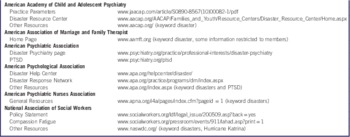
Professional organizations are charged with recommending and enacting procedures and protocols to guide members in the professional behavioral health response to psychosocial problems experienced during disasters. The breadth of professions providing behavioral services poses a challenge to developing a consistent response. Six national organizations provide this direction to the majority of behavioral health professionals who assist individuals affected by health-related disasters: the American Academy of Child and Adolescent Psychiatry (AACAP), the American Psychiatric Association, the American Psychological Association, the American Psychiatric Nurses Association (APNA), the American Association for Marriage and Family Therapists (AAMFT), and the National Association of Social Workers (NASW). Website links to resources provided by these 6 BHPOs are listed in Table 1. A systematic review of the 6 national BHPO websites and related linked documents at several points in time was completed as part of a comprehensive examination of the behavioral impact of pandemics on children and families.Reference Sprang, Clark and Silman 5 This international, multi-method study examined current practices and lessons learned by public health, health care, behavioral health, and affected children and families during SARS and H1N1 to develop best practice guidelines for disaster response and planning. The findings revealed significant mental health effects and found that public health, health, and behavioral health responders were ill-equipped to address the psychosocial needs of children and their families during pandemics, especially regarding disease containment strategies including isolation, quarantine, school closure, and risk management campaigns. The resulting recommendations, Evidence-Informed Guidelines for Pandemic Planning and Response,Reference Sprang, Clark and Silman 5 addressed the ongoing need to develop child-focused strategies to mitigate unintended consequences of disease management, specifically social distancing, isolation, and quarantine measures.
Links to Resources for the Six Identified Behavioral Health Professional OrganizationsFootnote a

a Abbreviation: PTSD, post-traumatic stress disorder.
Analysis of the online resources of the 6 identified professional organizations revealed that disaster response information is inconsistent and the focus and scope of the recommendations vary dramatically among organizations. This raises concern that initial responses to the behavioral health effects of pandemics and other disasters could be fragmented, uncoordinated, inconsistent, and potentially ineffective and indicates the need for a proactive approach as part of health-disaster preparedness. Limited recognition of the role of public health in the disaster responses promoted by these BHPOs is also of concern. Although attention to the needs for pediatric disaster response and disaster mental health increased in response to the NCCD report and a number of natural and manmade disasters since 2010, surveillance of the 6 professional associations’ websites and related resources since then finds minimal attention to the behavioral health needs of children during health disasters.
On the basis of findings from the initial review and subsequent monitoring, a set of principles is proposed to support a coordinated and effective pandemic response by the behavioral health disciplines in concert with public health pandemic response strategies. These principles were developed on the basis of a 5-step process adapted from an Institute of Medicine protocol for the development of practice guidelinesReference Graham, Mancher, Miller Wolman, Greenfield and Steinberg 26 that involves (1) identification of a problem (identified lack of coordination and collaboration across disciplinary groups responding to health-related disasters); (2) creation of a multidisciplinary team to develop guiding principles that would be expected to be affected by the proposed practice standard; (3) appraisal of existing evidence from the aforementioned study, expert opinion, and the disaster preparedness and response literature; (4) a process of group consensus regarding the key themes that would be used to ground the proposed principles; and (5) production and review of the final set of guidelines.
GUIDING PRINCIPLES
As a result of this process, a set of guiding principles was developed to assist BHPOs in providing discipline-specific guidance to their members to facilitate the most efficacious behavioral health response for children and families experiencing psychosocial distress following health-related disasters. Use of these principles is intended to enhance the competency of behavioral health professionals charged with pandemic response, to promote consistency and mitigate potential intergroup conflict, and to promote and facilitate coordination with public health preparedness at the local, state, and federal levels.
Principle 1: Employ the Language of Resilience
The disaster behavioral health response is often designed to prevent adverse outcomes: PTSD, anxiety, depression, adjustment disorder, and phobia. Each of these disorders reflects a condition in which an individual’s capacity to cope has been overwhelmed and functional impairment is evident. Consistently, there are excellent examples of good clinical guidance provided by professional organizations and groups to behavioral health professionals focused on the treatment of psychopathology and clinical disorders.Reference Foa, Keane, Friedman and Cohen 27 , Reference Cohen, Bukstein and Walter 28 Research in the area of resilience finds that initial symptomatic responses may not reach diagnostic threshold levels for most exposed persons and may actually be beneficial in assisting individuals to manage the emotional effects of adversity over the lifespan.Reference Masten 29 , Reference Coifman, Bonanno and Ray 30
Behavioral health professionals are challenged to develop a standard of care that employs the language of resilience and to promote strategies that build on strengths and existing capabilities, in addition to developing the skills to treat psychopathological responses should they arise. The AACAP “Frequently Asked Questions about Disaster” does so by focusing on existing parental strengths and knowledge as the basis for resilience-building in families. Listen, Protect, and Connect, available through the Trans-World Resource Network of the American Psychological Association, also focuses on parental assets and skills for healthy coping. The provision of support resources that couch strategies in positive terms and promote social competence, problem-solving, autonomy, and a sense of purpose and future is consistent with empirical literature documenting resilience in the aftermath of trauma exposure.Reference Bonanno 31
Building resilience demands that early intervention is incorporated into disaster response strategies. Professional behavioral health responses should capitalize on this opportunity and prepare to include preventive and early interventions to mitigate persistent negative responses. The Child and Family Traumatic Stress Intervention (CFTSI)Reference Berkowitz, Stover and Marans 32 , 33 is an evidence-based, brief, early intervention that has been shown to prevent the development of PTSD. The CFTSI is suitable for a pandemic situation where the lack of congregate sites may interfere with the delivery of other well-established early interventions such as psychological first aid. 34
Subclinical response patterns serve as important indicators of need and offer additional opportunities for nurturing resilience. Sprang and SilmanReference Sprang and Silman 14 note that although 25% of those children in quarantine or isolation had symptoms consistent with PTSD on the basis of parent report, a far greater number experienced an array of symptoms not meeting clinical cutoffs but still problematic: sleep disturbances, difficulty concentrating, isolation, intrusive thoughts, fear of recurrence, and avoidance. BHPOs should provide guidance to their members on methods to screen for and respond to these reported subthreshold symptoms to identify those with persistent responses and those who need intermediary services. For example, a number of short trauma screeners are available in the public domain that could easily be used by health care staff, disaster response workers, or other professionals on the front lines of the pandemic response. These include the 4-item Child Stress Disorders Checklist,Reference Saxe, Chawla and Stoddard 35 the 10-item Child Trauma Screening Questionnaire,Reference Kennardy, Spence and MacLeod 36 and the 8-item Child Revised Impact of Events Scale. 37
Knowledge has also been found to promote resilience and serves as an important component of preparedness for change.Reference Bonanno 31 BHPOs and their behavioral health professional members are advised to also collaborate with public health officials to provide health-disaster-specific psychoeducation materials aimed at building resilience in parents and children. Parents surveyed during H1N1 reported knowledge and understanding as significant means of coping with disaster-related problems in their children or themselves. Survivors of SARS participating in an online support group in Canada used the forum to solicit and secure information as well as emotional support.Reference Sprang, Clark and Silman 5 Resilient parents need accessible, user-friendly, timely, and accurate resources to successfully navigate a disaster and its aftermath. It is especially important for these materials to be updated regularly to include the latest scientific findings on resilience to facilitate just-in-time training and to ensure that the latest clinical technologies are being used by disaster professionals. Professional training, certification, and specialist programs like the one administered by the American Psychological Association through their Disaster Response Network provide an avenue and structure for ongoing skills development and technology transfer related to resilience from the field to the community.
BHPOs must recognize the value of building resilience in parents and children coping with health-related disaster. To this end, BHPOs must augment existing standards and develop, communicate, and promote strategies for building resilience, including preventive and early interventions, responding to subclinical responses and symptoms, and ensuring that current, timely, and accurate information is available to parents and children. The American Psychological Association fact sheet “Fostering Resilience in Response to Terrorism: A Fact Sheet for Psychologists Working with Adults” 38 and the online page The Road to Resilience 39 both provide excellent models of professional and consumer resources that could be adapted to address parent and child responses to health disasters.
Principle 2: Describe Response, Roles, and Responsibilities in Context
The nature of the disaster determines the type of system response, and different spheres of coordination may be necessary for diverse groups of behavioral health professionals. Natural and manmade disaster responses are facilitated by emergency and disaster management agencies and frequently depend upon the American Red Cross (ARC) to facilitate on-site response activities. Several BHPOs have agreements with the American Red Cross (NASW, American Psychological Association, and AAMFT), another suggests utilization of ARC resources (APNA), and several require ARC training (NASW, American Psychological Association, and AAMFT). Pandemic disasters are unique in that public health serves as the lead agency and service implementer at the local, state, and federal levels. Review of BHPO standards during H1N1 found no plan for coordinated systems of response between behavioral health and the public health system, yet public health served as the lead agency for pandemic response at all levels.Reference Sprang, Clark and Silman 5 BHPOs can enhance their guidance by apprising their membership of these distinctions, providing specific information regarding the role of public health in pandemic disasters, and modifying existing recommendations to articulate the differing roles and responsibilities of professionals in various disaster scenarios. Behavioral health professionals should be encouraged to develop, nurture, and maintain relationships with public health officials as part of disaster preparedness.
Effective collaboration with public health requires that behavioral health professionals understand and respect the public health priority of disease containment. Integration of behavioral health services into pandemic response strategies must be structured to minimize burden on public health and medical first responders and respect disease containment measures ranging from respiratory etiquette and use of personal protective equipment to social distancing measures including quarantine and isolation. The nature of pandemics limits opportunities for congregate response and requires the creative melding of technology and clinical content for delivery of psychosocial assessment and intervention. Behavioral health professionals surveyed during the H1N1 pandemic indicated a willingness to utilize alternative service delivery modalities such as telemedicine technology but reported that they were unable to do so because of limited access to the hardware, ethical concerns, or lack of reimbursement for the service.Reference Sprang, Clark and Silman 5 Although this can be a barrier to behavioral health professional involvement in the overall pandemic response, BHPOs can bridge this gap by providing guidance to their membership on maintaining privacy and confidentiality in these conditions, advocating for parity in reimbursement, and providing crisis standards of care guidance. BHPOs are strongly encouraged to work with public health to accomplish these tasks and to prevent an interruption of necessary services during pandemic disasters. In this way, the respective roles of public health and behavioral health can be enacted without conflict.
Disaster inevitably creates psychological stress for responders as well as primary survivors, and first responders not uncommonly experience secondary traumatic reactions.Reference Fullerton, Ursano and Wang 40 Disaster behavioral health organizations inherently assume responsibility for preparing and caring for the disaster response workforce in addition to primary disaster victims. The persistent threat posed by a pandemic event presents unique issues for all disaster responders: fear of contagion, potential for isolation and quarantine themselves, and concern about becoming a disease vector and infecting friends, family, and the community. Such issues can increase the potential for primary and secondary traumatic stress reactions in disaster responders. The SARS pandemic had a profound impact on the health care workers who served as first responders, with many exhibiting strong emotions and traumatic stress reactions as long as 7 years later.Reference Sprang, Clark and Silman 5 Even mild pandemics such as H1N1 can impact the workforce and create elevated levels of secondary traumatic stress and burnout among professionals delivering disaster response interventions.Reference Sprang, Clark and Silman 5 BHPOs are encouraged to provide materials explicating risk and protective factors for secondary traumatic stress and burnout, listing indicators of concern and offering resources to guide response strategies including peer and supervisory support and professional intervention. The AACAP presents a good start by acknowledging the potential for secondary traumatic stress responses and including materials on self-care. The American Psychological Association has some informative resources for members about secondary stress for professional psychologists, which could be expanded to address the range of potential sources of secondary stress and linked directly to disaster response information elsewhere on the site.
Principle 3: Promote Interdisciplinary Coordination and Collaboration During Planning
Disaster response is, by its very nature, interdisciplinary. Natural disasters may require organizations to provide diverse resources to meet medical, physical, and infrastructure needs, but pandemic disaster requires continuous interdisciplinary response from behavioral health providers, public health, governmental authorities, school systems, and law enforcement to craft and implement response strategies. This involves interdisciplinary coordination to facilitate melding nomenclature and theoretical, epistemological, and practice perspectives and standards. Effective relationships and collaboration during a crisis are highly dependent on the quality of those relationships and level of trust prior to the emergency situation. Twenty-five percent of behavioral health respondents indicated that during SARS or H1N1 they experienced conflicts with public health, other behavioral health professionals, or other health care response systems, which inhibited effective response activities during both pandemics.Reference Sprang, Clark and Silman 5 Such conflicts have been noted in other disasters, most notably after Hurricane Katrina,Reference Waugh and Streib 41 and the need for consensus specifically regarding mental health aspects of disaster recovery was noted by the World Health Organization nearly a decade ago.Reference Van Ommeren, Saxena and Saraceno 42 To avoid interdisciplinary conflicts and the resulting disruption in disaster response, BHPOs can encourage their membership to develop relationships and maintain communication with public health organizations at the community level during disaster planning stages. Several BHPOs (NASW, AACAP, American Psychological Association) have demonstrated leadership in this area with regard to natural and manmade disaster response, although the stakeholders and partners involved in a health-related crisis may differ and require a more nuanced approach.
Interdisciplinary collaboration is not limited to forging relationships with other systems of care. The AACAP suggests the importance of working with media to mitigate adverse outcomes for children exposed to graphic material, as well as to “extend the reach” of mental health providers by disseminating critical preventive information to large audiences.
Collaboration between behavioral health disciplines is equally important. Each discipline brings a specific skill set that is necessary for an overall effective disaster response. Discipline-specific training yields social workers who are particularly effective in cross-systems work. For example, psychiatrists and psychiatric nurses are adept at identifying comorbidity of psychiatric and medical conditions, psychologists have expertise in assessment and diagnosis, and marriage and family therapists may bring an important family systems perspective to the disaster preparedness and response discussion. Articulation of and appreciation for the various skill sets that each discipline brings to the disaster response scenario prior to the pandemic is necessary to enhance coordination and cooperation among groups during the pandemic disaster response.
Disasters have little regard for geographical boundaries, and BHPOs are advised to acknowledge and provide guidance to members about the legalities of service delivery across state borders. Behavioral health professionals living in border regions would benefit from developing interjurisdictional relationships to ensure that needed services will be able to be delivered, and state and local chapters can be encouraged to collaborate. Differing regulations for licensure, insurance coverage, reimbursement, and training will need to be addressed to make this type of interstate cooperation possible.
Boundary spanningReference Williams 43 serves as a model for how to develop and maintain critical interdisciplinary and multiagency relationships and clarify roles and responsibilities for disaster response. Employment of this public health boundary spanning model during pandemic planning and response would enhance coordination, clarify roles and responsibilities, and minimize unintended negative consequences that may result in psychological distress or lack of public cooperation. Several organizations (NASW, American Psychological Association, American Psychiatric Association) specify the role and responsibilities of their members and some particularly promote collaborative and interdisciplinary relationships. The AAMFT website explicitly acknowledges the importance of collaboration with disaster response providers and organizations, and the American Psychiatric Association addresses the importance of determining “clear leadership and role definition” as part of disaster preparedness. Structurally, however, information sharing and collaboration across BHPOs is infrequent in many areas and varies by state, though models of good collaboration occur at the national level via the Multi-State Disaster Behavioral Health Consortium, which is interdisciplinary in structure but does not include the professional organizations where scientific standards are set and promulgated.
Principle 4: Provide Focused Guidance on Pediatric Preparedness and Response
Children are 25% of the population and they have specific needs during disasters that ought to be distinctly recognized. 4 Young people may be particularly vulnerable to pandemics, as well as the potential adverse effects of social distancing measures, especially isolation and quarantine. Pandemics appear to produce traumatic stress responses in children and parents, who experience quarantine or isolation at the same rate as in other types of disasters.Reference Sprang and Silman 14 Behavioral health professionals and organizations are strongly encouraged to prioritize raising awareness about the distinctive elements of pediatric disaster and to include child-focused resources in disaster response materials. The American Psychological Association and the AACAP provide materials specifically addressing the needs of children and families during disaster, including the AACAP Facts for Families Sheet. The American Psychiatric Association provides tips for recognizing depression in children, whereas the AACAP includes specific pediatric practice parameters for addressing PTSD. NASW provides updates on chapter innovations in disaster response, some of which are child-focused, but none of the organizations posts specific guidance regarding the pediatric, pandemic response.
Principle 5: Facilitate Professional Awareness and Knowledge
BHPOs have a unique opportunity to disseminate and facilitate utilization of state-of-the-art approaches to disaster mental health professionals across the nation. Professional guidelines endorsing the use of evidence-informed practices are critical to effective psychosocial assessment, prevention, and intervention with children and families during a pandemic. Several already do so: The American Psychiatric Association’s Disaster Psychiatry Handbook Reference Hall, Ng and Norwood 44 provides comprehensive guidance for psychiatric roles and practice. The American Academy of Child and Adolescent Psychiatry provides a link to best-practice guidelines for the treatment of PTSD on its website.Reference Cohen, Bukstein and Walter 28 All the BHPOs canfacilitate the transmission of this information by highlighting state-of-the art, evidence-informed approaches and by updating these data regularly to ensure the empirical base is current. BHPOs are encouraged to identify and promote knowledge of pediatric-specific strategies and to remind membership of the applicability of these strategies to pandemics and other health-related disasters.
Opportunities for professional and discipline-specific advanced and just-in-time training for health-related disaster response may also be supported, promoted, and advertised through BHPO websites and disaster-preparedness guidelines. Training that addresses those areas, including prevention, screening and assessment, early intervention, and long-term treatment of subthreshold and traumatic stress responses of children and parents, is encouraged. Most of the BHPOs provide resources and recommendations for training for disasters. For example, the AACAP created a Disaster Resources Center with links to numerous resources. The AmericanPsychological Association has developed the Disaster Response Network, a cadre of trained disaster specialists, and the Trans-World Resource Network, clearinghouses of information intended for psychologists and other behavioral health professionals. Specific guidelines for emergency preparedness and disaster response are outlined by APNA, and AAMFT provides taped workshop sessions on disaster response topics. These examples are valuable models, materials, and networks that can be expanded to provide expertise and guidance on health-related disasters, with specific information regarding pediatric needs in such emergencies. A comprehensive repository of resources to address the needs of adults, children, families, and communities, or cross-linking of these resources across disciplines would allow for cross-fertilization of innovations and increased access to tools that may be useful to a diverse group of disaster mental health professionals.
Knowledge of the ethical issues in disaster planning and response is as critical as clinical knowledge for behavioral health responders. BHPOs are ideally suited to provide guidance to such membership on legal and ethics issues including licensure, liability, and ethics during disaster. The NASW added such resources following Hurricane Katrina and the AmericanPsychiatric Association addresses legal and ethical questions on its website. The specific legal and ethical challenges of working with children who are wards of the state should be specifically addressed, because this group may have preexisting vulnerabilities that make the risk for adverse outcomes high. Additionally, obtaining consent to treatment and interfacing with juvenile and family court may be problematic in pandemic situations that necessitate court closings and that interrupt service delivery. BHPOs are encouraged to provide guidance to their membership on how these issues may impact service delivery and appropriate legal and ethical resources and remedies that would be consistent with professional ethics and standards of care.
CONCLUSION
BHPOs should be credited with providing valuable resources to guide their membership in a multitude of clinical scenarios, including disaster preparedness and response. These resources would be strengthened if they included specific information about the needs of children and families and the unique needs of the community during health disasters such as pandemics. A focus on building resiliency and attending to the unique contextual elements are encouraged. Ensuring consistency, collaboration, and coordination among the behavioral health disciplines and other emergency responders will enhance disaster response strategies to minimize persistent negative effects in adults, children, and families.
Funding
Funding for this research was provided by the National Institute for Hometown Security via the US Department of Homeland Security NIHS KCI1505e.