1. Introduction
Granulites attest to high-temperature metamorphic conditions during orogeny (e.g. Harley, Reference Harley1989; Bohlen, Reference Bohlen1991), commonly corresponding to amalgamation of continental lithosphere into supercontinent. Granulite-facies rocks are common in most ancient orogenic belts of Archaean–Phanerozoic age (e.g. Harley, Reference Harley, Yoshida, Windley and Dasgupta2003; Brown, Reference Brown2007). Three main tectonothermal events in East Africa are described: the Palaeoproterozoic Usagaran–Ubendian event between c. 2.0 and 1.8 Ga (Lenoir et al. Reference Lenoir, Liégeois, Theunissen and Klerkx1994; Möller et al. Reference Möller, Appel, Mezger and Schenk1995; Vrána et al. Reference Vrána, Kachlík, Kröner, Marheine, Seifert, Žáček and Babůrek2004; Fritz et al. Reference Fritz, Tenczer, Hauzenberger, Wallbrecher, Hoinkes, Muhongo and Mogessie2005; Sommer et al. Reference Sommer, Kröner, Hauzenberger and Muhongo2005); the Mesoproterozoic–Neoproterozoic Kibaran–Irumidian–Namaquan–Mozambican event between c. 1.2 and 0.85 Ga (Pinna et al. Reference Pinna, Jourde, Calvez, Mroz and Marques1993; De Waele et al. Reference De Waele, Kampunza, Mapani and Tembo2006; Johnson, De Waele & Liyungu, Reference Johnson, De Waele and Liyungu2006); and the Neoproterozoic – early Palaeozoic Pan-African event between c. 800 and 470 Ma. The Pan-African divides into two specific orogenies in East Africa: the East African Orogeny peaking at c. 640 Ma; and the Kuunga (or Malagasy) Orogeny peaking at c. 550 Ma. The combination of the two resulted in the assembly of the Gondwana supercontinent (e.g. Unrug, Reference Unrug1997; Grantham, Maboko & Eglington, Reference Grantham, Maboko, Eglington, Yoshida, Windley and Dasgupta2003; Meert, Reference Meert2003; Collins & Pisarevsky, Reference Collins and Pisarevsky2005; Fritz et al. Reference Fritz, Abdelsalam, Ali, Bingen, Collins, Fowler, Ghebreab, Hauzenberger, Johnson, Kusky, Macey, Muhongo, Stern and Viola2013). Granulite-facies metamorphism is extensively reported during Gondwana assembly in East Africa from Tanzania and Kenya (Appel, Möller & Schenk, Reference Appel, Möller and Schenk1998; Möller, Mezger & Schenk, Reference Möller, Mezger and Schenk2000; Muhongo, Kröner & Nemchin, Reference Muhongo, Kröner and Nemchin2001; Sommer et al. Reference Sommer, Kröner, Hauzenberger, Muhongo and Wingate2003; Tenczer et al. Reference Tenczer, Hauzenberger, Fritz, Whitehouse, Mogessie, Wallbrecher, Muhongo and Hoinkes2006; Vogt et al. Reference Vogt, Kröner, Poller, Sommer, Muhongo and Wingate2006; Hauzenberger et al. Reference Hauzenberger, Sommer, Fritz, Bauerhofer, Kröner, Hoinkes, Wallbrecher and Thöni2007; Sommer & Kröner, Reference Sommer and Kröner2013), Mozambique (Pinna et al. Reference Pinna, Jourde, Calvez, Mroz and Marques1993; Kröner et al. Reference Kröner, Sacchi, Jaeckel and Costa1997; Engvik et al. Reference Engvik, Tveten, Bingen, Viola, Erambert, Feito and de Azavedo2007), Malawi (Andreoli & Hart, Reference Andreoli, Hart, Herbert and Ho1990; Kröner et al. Reference Kröner, Willner, Hegner, Jaeckel and Nemchin2001) and Madagascar (Markl, Bäuerle & Grujic, Reference Markl, Bäuerle and Grujic2000; Jöns et al. Reference Jöns, Schenk, Appel and Razakamanana2006). Related granulite-facies metamorphism is prominent in East Antarctica (e.g. Bucher-Nurminen & Ohta, Reference Bucher-Nurminen and Ohta1993; Thost, Hensen & Motoyoshi, Reference Thost, Hensen and Motoyoshi1994; Piazolo & Markl, Reference Piazolo and Markl1999; Engvik & Elvevold, Reference Engvik and Elvevold2004; Board, Frimmel & Armstrong, Reference Board, Frimmel and Armstrong2005; Fraser et al. Reference Fraser, McDougall, Ellis and Williams2000; Elvevold & Engvik, Reference Elvevold and Engvik2013), and is reported from India and Sri Lanka (e.g. Baur et al. Reference Baur, Kröner, Todt, Liew and Hofmann1991; Braun & Kriegsman, Reference Braun, Kriegsman, Yoshida, Windley and Dasgupta2003; Collins et al. Reference Collins, Clark, Sajeev, Santosh, Kelsey and Hand2007; Singh et al. Reference Singh, De Waele, Karmakar, Sarkar and Biswal2010). Also, in East Antarctica and India high-grade metamorphism can be traced back in time to Mesoproterozoic and Palaeoproterozoic ages (e.g. Grantham et al. Reference Grantham, Jackson, Moyes, Groenewald, Harris, Ferrar and Krynauw1995; Jacobs et al. Reference Jacobs, Fanning, Henjes-Kunst, Olesch and Paech1998; Harley, Reference Harley, Yoshida, Windley and Dasgupta2003; Singh et al. Reference Singh, De Waele, Karmakar, Sarkar and Biswal2010; Prakash & Sharma, Reference Prakash and Sharma2011). The Kuunga reworking is commonly overprinting earlier metamorphic events to such an extent that information on these events is fragmentary and difficult to retrieve.
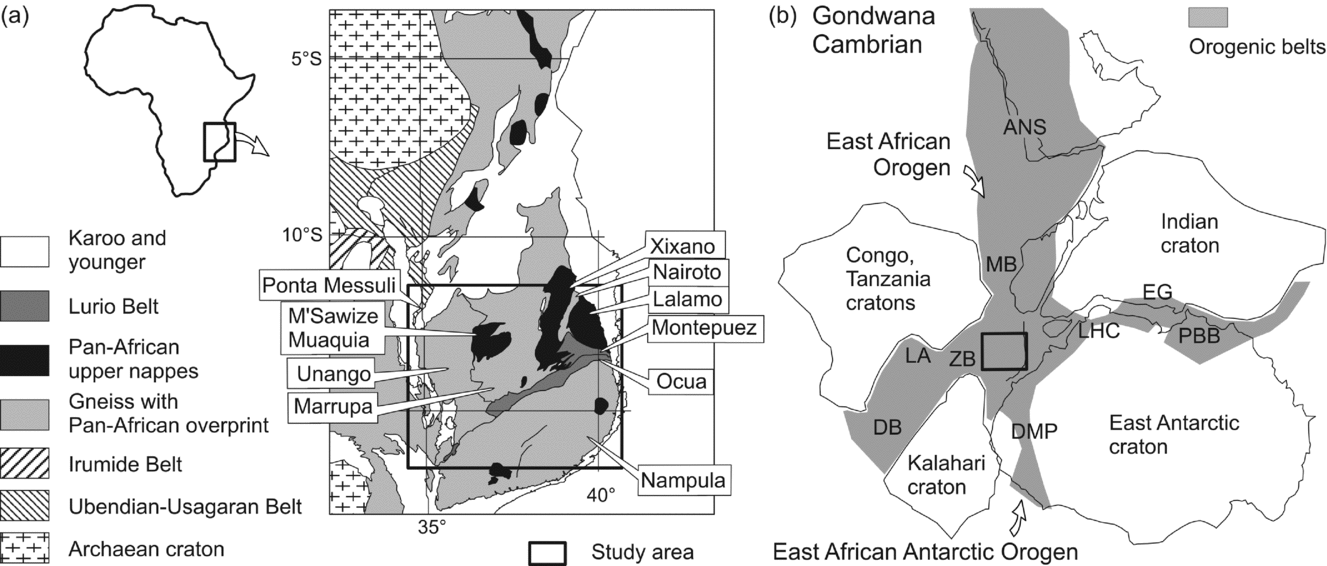
Reconnaissance geological mapping in NE Mozambique (280000 km2; Fig. 1; Norconsult Consortium, Reference Consortium2007) resulted in lithological and geochemical descriptions and a new tectonostratigraphy summarized in Boyd et al. (Reference Boyd, Nordgulen, Thomas, Bingen, Bjerkgård, Grenne, Henderson, Melezhik, Often, Sandstad, Solli, Tveten, Viola, Key, Smith, Gonzalez, Hollick, Jacobs, Jamal, Motuza, Bauer, Daudi, Feito, Manhica, Moniz and Rosse2010) and Macey et al. (Reference Macey, Thomas, Grantham, Ingram, Jacobs, Armstrong, Roberts, Bingen, Hollick, deKock, Viola, Bauer, Gonzales, Bjerkgård, Henderson, Sandstad, Cronwright, Harley, Solli, Nordgulen, Motuza, Daudi and Manhiça2010). The geochronological framework of the main magmatic and metamorphic events is presented by Jacobs et al. (Reference Jacobs, Bingen, Thomas, Bauer, Wingate, Feitio, Satish-Kumar, Motoyoshi, Osanai, Hiroi and Shiraishi2008), Melezhik et al. (Reference Melezhik, Bingen, Fallick, Gorokhov, Kuznetsov, Sandstad, Solli, Bjerkgård, Henderson, Boyd, Jamal and Moniz2008), Bingen et al. (Reference Bingen, Jacobs, Viola, Henderson, Skår, Boyd, Thomas, Solli, Key and Daudi2009), Thomas et al. (Reference Thomas, Jacobs, Horstwood, Ueda, Bingen and Matola2010) and Ueda et al. (Reference Ueda, Jacobs, Thomas, Kosler, Horstwood, Wartho, Jourdan, Emmel and Matola2012 a), and the tectonic architecture by Viola et al. (Reference Viola, Henderson, Bingen, Thomas, Smethurst and de Azavedo2008) and Ueda et al. (Reference Ueda, Jacobs, Thomas, Kosler, Horstwood, Wartho, Jourdan, Emmel and Matola2012 b).
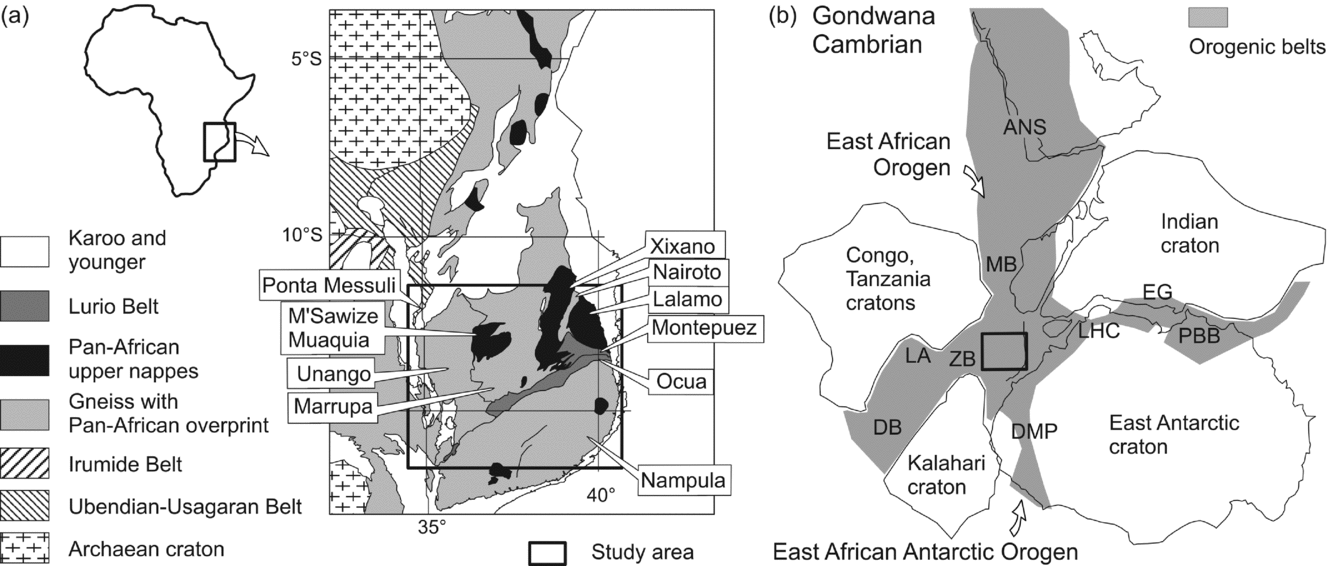
(a) Geological complex/terrane map of northeastern Mozambique (Norconsult Consortium, Reference Consortium2007). (b) Reconstruction of Gondwana at the end of the Ediacaran–Cambrian event, following Meert (Reference Meert2003). Shaded areas: East African and Kuunga orogenic belts. ANS – Arabian–Nubian Shield; DB – Damara Belt; DMP – Dronning Maud Province; EG – Eastern Ghats; LA – Lufilian Arc; LHC – Lützow–Holm Complex; MB – Mozambique Belt; PBB – Prydz Bay Belt; ZB – Zambezi Belt. The East African – Antarctic Orogen (EAAO) covers ANS, MB and DMP.
This paper documents the petrology of high-grade metamorphism in the gneiss complexes of NE Mozambique, which spreads in age from Palaeoproterozoic to late Neoproterozoic. The petrological investigation is based on petrographic, petrologic and mineral chemical data of granulites, metapelites and gneisses of the lithotectonic Ponta Messuli, Unango and Marrupa complexes. Thermobarometric calculations and calculations of pressure–temperature (P-T) pseudosections are used to quantify the metamorphic conditions and to interprete pressure–temperature paths. The petrological data contribute to our understanding of the tectonometamorphic processes that shaped this part of the Mozambique belt in East Africa. Knowledge and coverage of the bedrock of Mozambique is still very fragmentary today. Linking petrological and geochronological data into consistent pressure–temperature–time models is still speculative for parts of the area, but available data are integrated and discussed in a regional geological context.
2. Geological overview
Northeastern Mozambique is part of the Mozambique Belt, which is a segment of the East African Orogen, also referred to as the East African – Antarctic Orogen (Fig. 1; Stern, Reference Stern1994; Meert, Reference Meert2003; Jacobs & Thomas, Reference Jacobs and Thomas2004; Collins & Pisarevsky, Reference Collins and Pisarevsky2005; Fritz et al. Reference Fritz, Abdelsalam, Ali, Bingen, Collins, Fowler, Ghebreab, Hauzenberger, Johnson, Kusky, Macey, Muhongo, Stern and Viola2013). In Gondwana reconstructions, the investigated area of NE Mozambique is situated at the critical intersection of four Neoproterozoic – early Palaeozoic orogenic belts (Fig. 1): the N–S-trending East African Orogen including the Mozambique Belt and the Arabian–Nubian Shield (e.g. Holmes, Reference Holmes, Sandford and Blondel1951; Grantham, Maboko & Eglington, Reference Grantham, Maboko, Eglington, Yoshida, Windley and Dasgupta2003; Johnson et al. Reference Johnson, Andresen, Collins, Fowler, Fritz, Ghebreab, Kusky and Stern2011; Fritz et al. Reference Fritz, Abdelsalam, Ali, Bingen, Collins, Fowler, Ghebreab, Hauzenberger, Johnson, Kusky, Macey, Muhongo, Stern and Viola2013); the E–W-trending Zambezi Belt possibly linked to the Lufillian Arc and Damara Belt (Hanson et al. Reference Hanson, Wardlaw, Wilson and Mwale1993; Johnson et al. Reference Johnson, De Waele, Tembo, Katongo, Tani, Chang, Iizuka and Dunkley2007); the Dronning Maud Province in East Antarctica; and the Lützow–Holm Complex in Antarctica, possibly linked eastwards to the Prydz Bay Belt and to the Eastern Ghats in India (e.g. Grantham et al. Reference Grantham, Jackson, Moyes, Groenewald, Harris, Ferrar and Krynauw1995; Harley, Reference Harley, Yoshida, Windley and Dasgupta2003; Kelsey et al. Reference Kelsey, Wade, Collins, Hand, Sealing and Netting2008).
The geology of NE Mozambique is subdivided into a number of distinct lithological complexes belonging to five mega-tectonic units imbricated during the East African Orogeny (Viola et al. Reference Viola, Henderson, Bingen, Thomas, Smethurst and de Azavedo2008; Bingen et al. Reference Bingen, Jacobs, Viola, Henderson, Skår, Boyd, Thomas, Solli, Key and Daudi2009; Boyd et al. Reference Boyd, Nordgulen, Thomas, Bingen, Bjerkgård, Grenne, Henderson, Melezhik, Often, Sandstad, Solli, Tveten, Viola, Key, Smith, Gonzalez, Hollick, Jacobs, Jamal, Motuza, Bauer, Daudi, Feito, Manhica, Moniz and Rosse2010; Macey et al. Reference Macey, Thomas, Grantham, Ingram, Jacobs, Armstrong, Roberts, Bingen, Hollick, deKock, Viola, Bauer, Gonzales, Bjerkgård, Henderson, Sandstad, Cronwright, Harley, Solli, Nordgulen, Motuza, Daudi and Manhiça2010). The five mega-lithotectonic units are as follows.
(1) The Palaeoproterozoic Ponta Messuli Complex at the northwestern end of the study area forms the NW Ubendian–Usagaran foreland of the East African Orogen and represents the oldest unit in NE Mozambique.
(2) The extensive late Mesoproterozoic – early Neoproterozoic mainly felsic gneiss domain comprises the Nampula, Unango, Marrupa, Nairoto and Meluco complexes, and was reworked during both the Irumidian and the Pan-African orogenies.
(3) The Cabo Delgado Nappe Complex is a dominantly Neoproterozoic domain grouping the Xixano, Lalamo, Montepuez, M'Sawize and Muaquia complexes; it is interpreted as an allochthonous domain transported northwestwards. The Monapo and Mugabe klippen are also fragment of nappes overriding the Nampula complex. These different nappes carry evidence for the early Pan-African East African orogenic phase.
(4) Localized Neoproterozoic cover sequences of the Mecuburi and Alto Benfica groups overlie the Nampula Complex (Thomas et al. Reference Thomas, Jacobs, Horstwood, Ueda, Bingen and Matola2010; Ueda et al. Reference Ueda, Jacobs, Thomas, Kosler, Horstwood, Wartho, Jourdan, Emmel and Matola2012 a, b), the Geci Group (Melezhik et al. Reference Melezhik, Kuznetsov, Fallick, Smith, Gorokhov, Jamal and Catuane2006) overlies the Unango Complex and the Txitonga Group overlies the Ponta Messuli Complex (Bjerkgård et al. Reference Bjerkgård, Stein, Bingen, Henderson, Sandstad and Moniz2009).
(5) The Lurio (shear) Belt is the prominent ENE–WSW-trending structure crossing the entire study area (Engvik et al. Reference Engvik, Tveten, Bingen, Viola, Erambert, Feito and de Azavedo2007; Viola et al. Reference Viola, Henderson, Bingen, Thomas, Smethurst and de Azavedo2008; Boyd et al. Reference Boyd, Nordgulen, Thomas, Bingen, Bjerkgård, Grenne, Henderson, Melezhik, Often, Sandstad, Solli, Tveten, Viola, Key, Smith, Gonzalez, Hollick, Jacobs, Jamal, Motuza, Bauer, Daudi, Feito, Manhica, Moniz and Rosse2010), reworking lithologies from megaunits 2 and 3. The Lurio Belt specifically includes the Ocua Complex, made up of strongly deformed granulites forming the centre of the shear belt.
This study describes the granulite facies metamorphism of the Palaeoproterozoic Ponta Messuli Complex and the late Mesoproterozoic – early Neoproterozoic gneiss domains of the Unango and Marrupa complexes.
3. Sampling and analytical methods
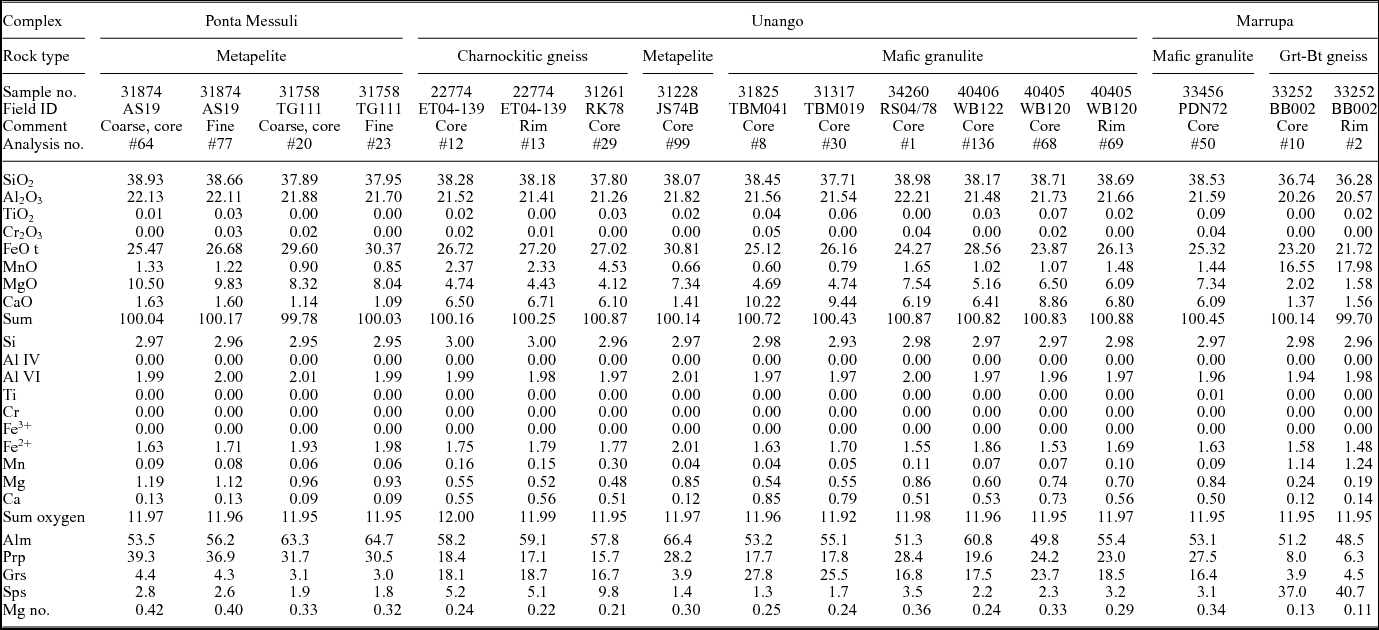
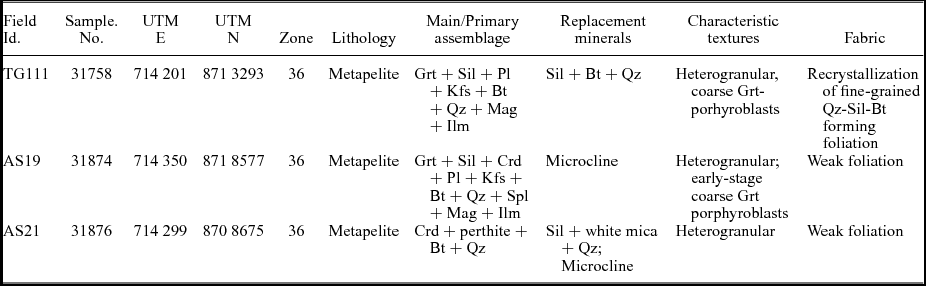
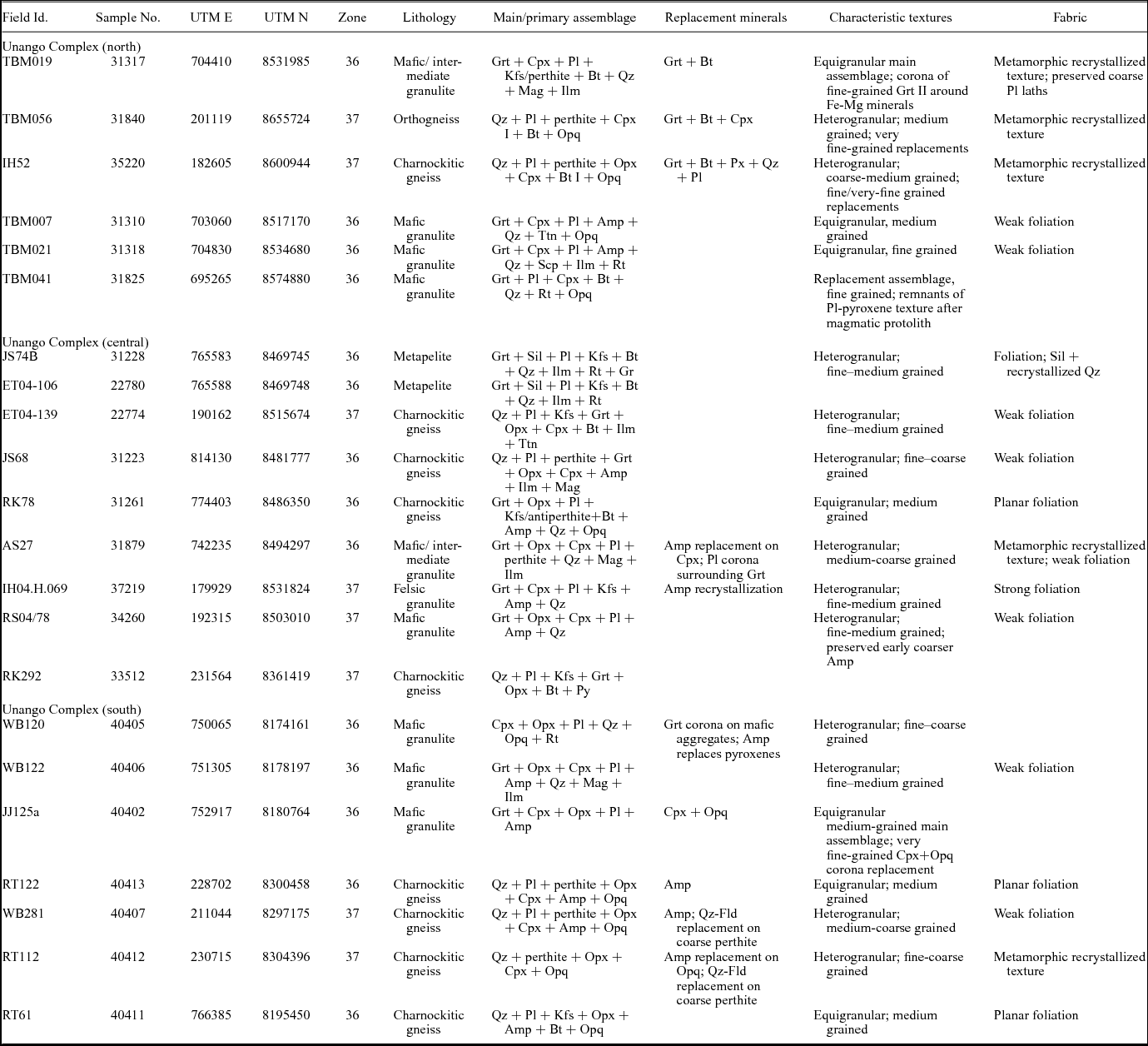
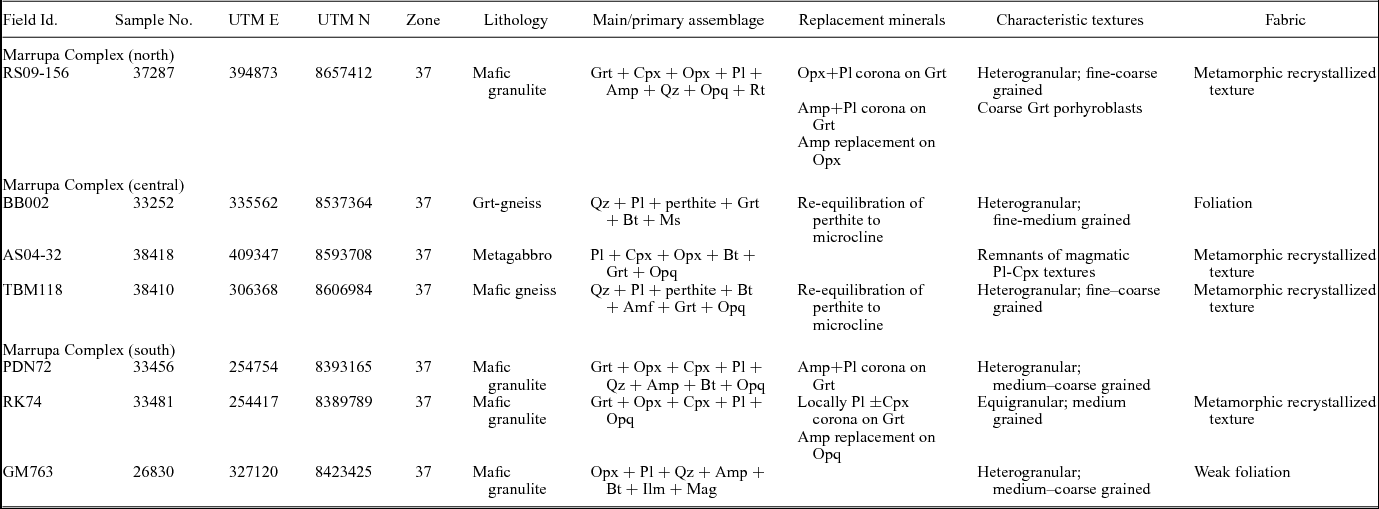
Access conditions and outcrop density are poor in NE Mozambique. Representative sampling was performed during the mapping program in order to define the lithotypes and tectonostratigraphy of the area (Norconsult Consortium, Reference Consortium2007). Samples containing mineral assemblages and textures useful for characterization of high-grade metamorphism were extracted from the collection for this study. These include mainly mafic to felsic granulites, charnockitic gneisses and metapelitic lithologies. About 160 samples were selected, among which 30 key samples are listed in Tables 1–3.
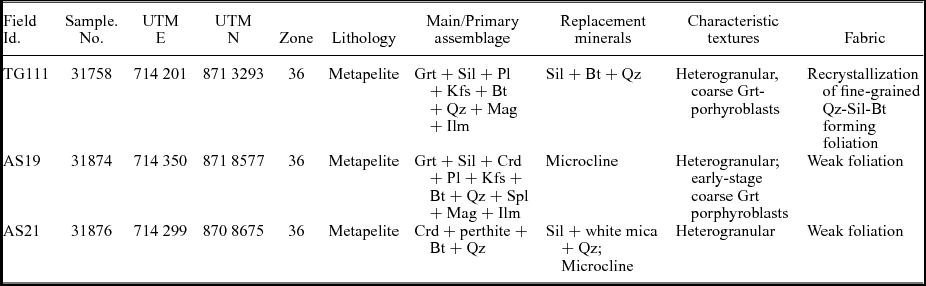
Ponta Messuli Complex: list of key samples including petrographic characteristics.
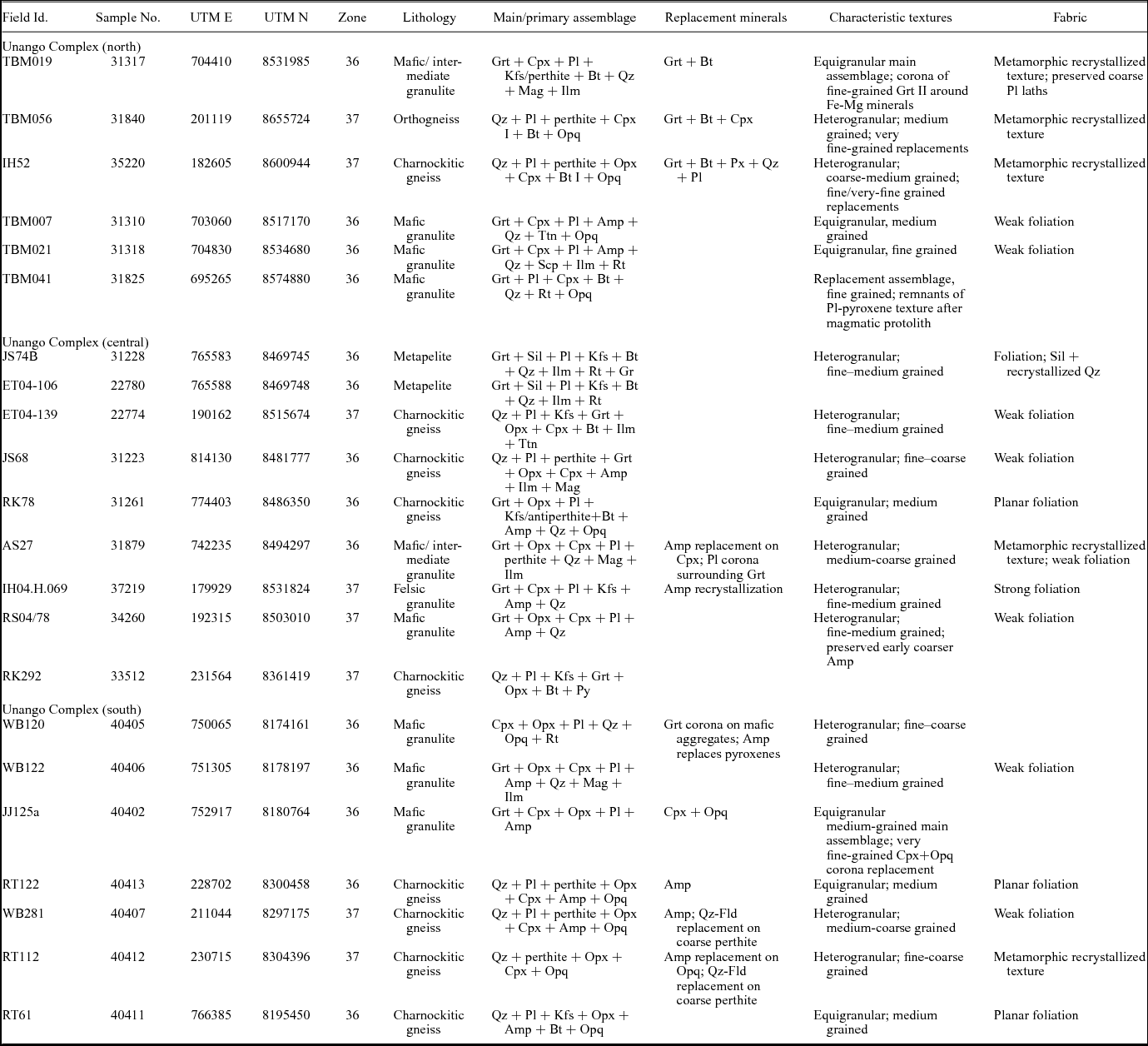
Unango Complex: list of key samples including petrographic characteristics.
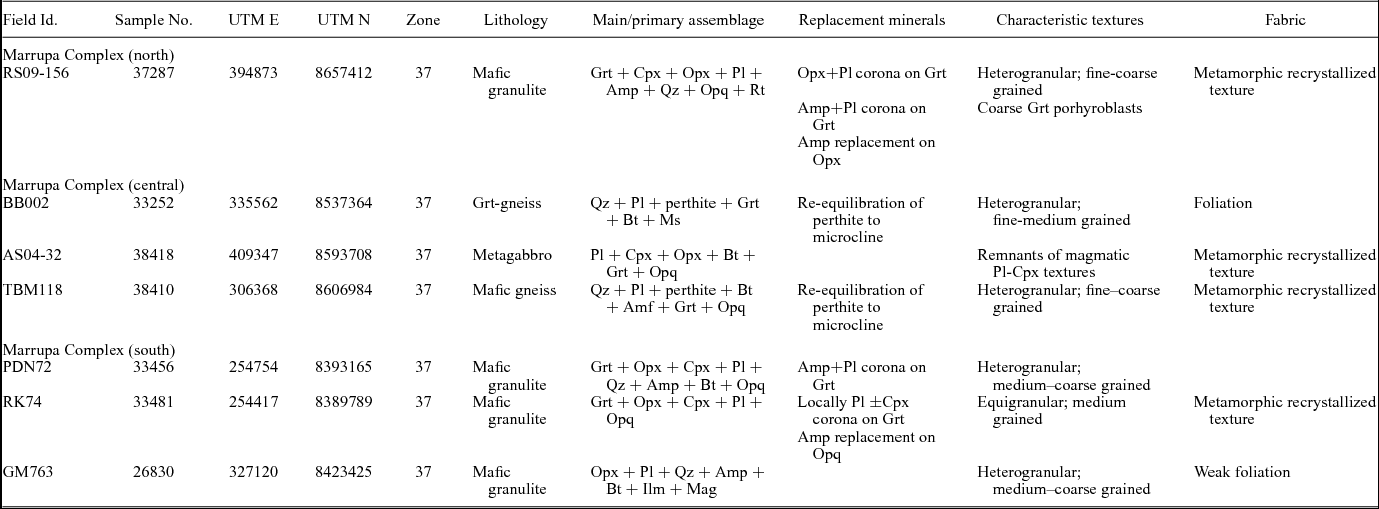
Marrupa Complex: list of key samples including petrographic characteristics.
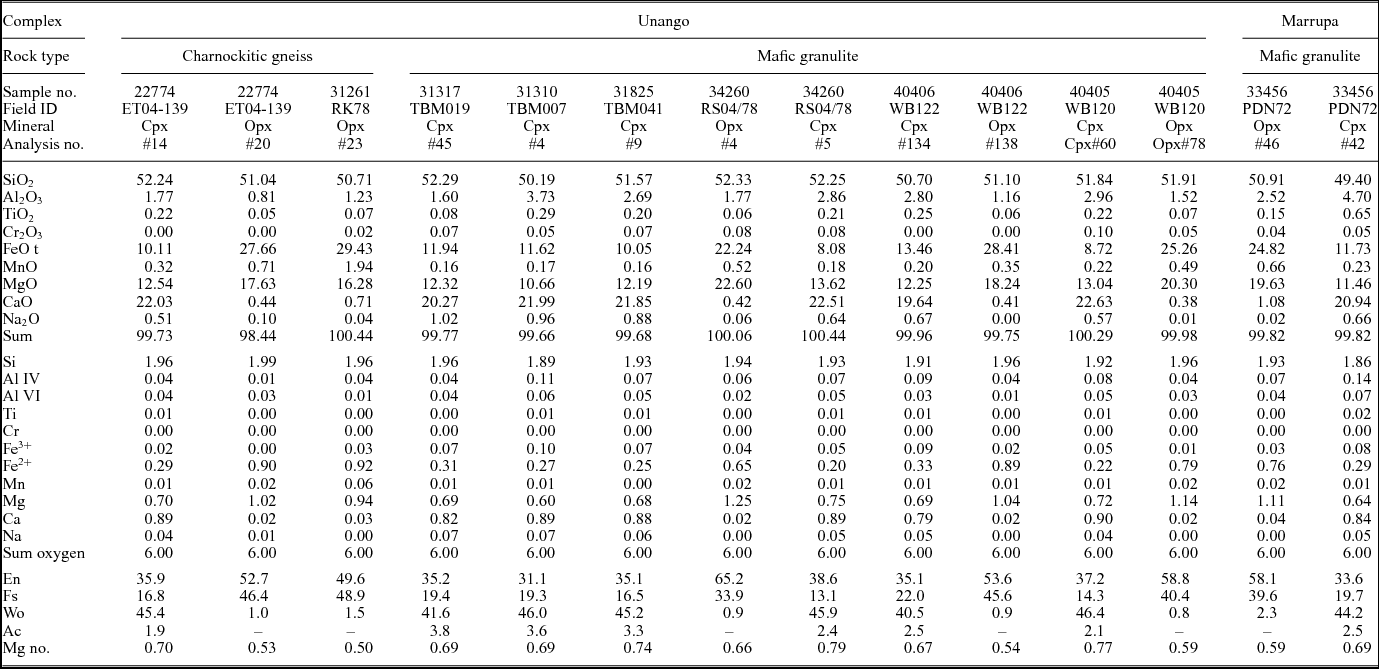
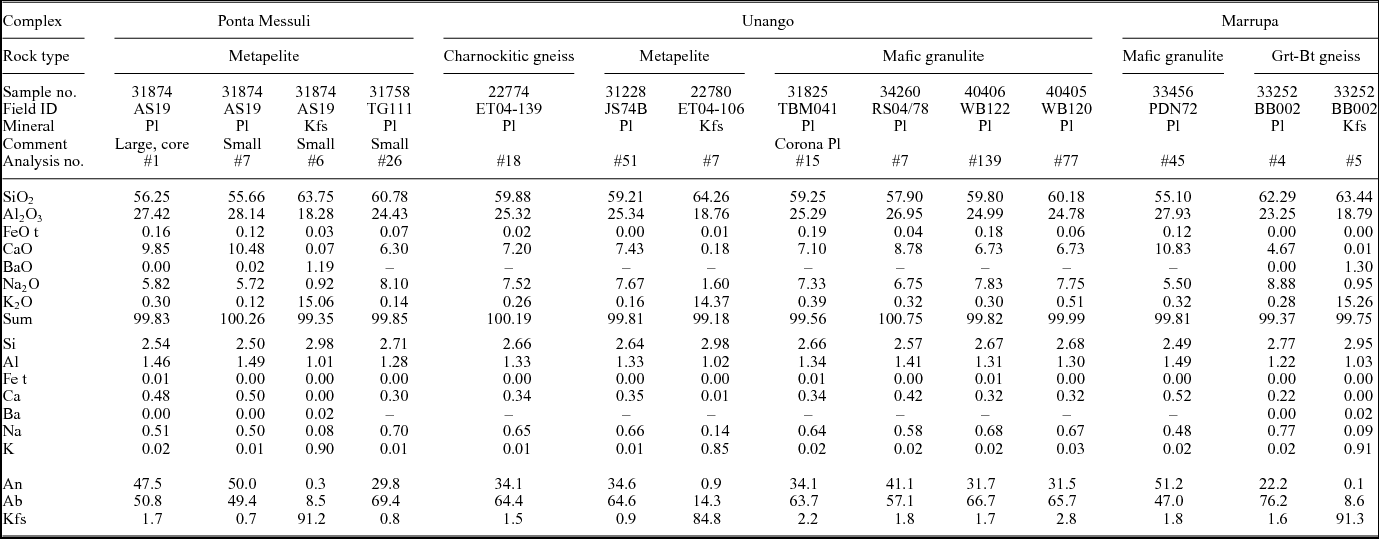
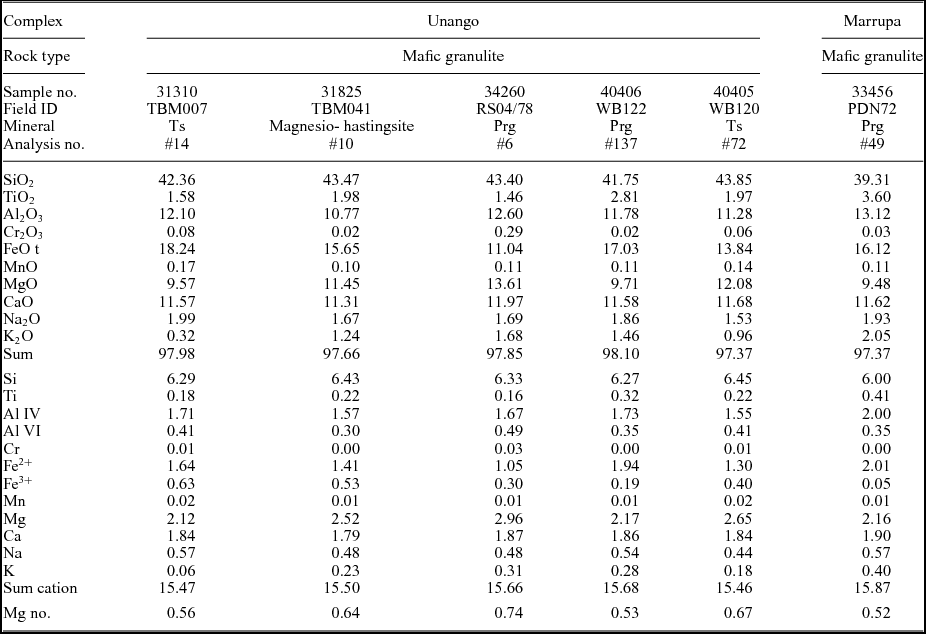
The petrography of the samples was studied on polished thin-sections with both optical and scanning electron microscopy (SEM) using a LEO 1450 VP instrument at the Geological Survey of Norway. Quantitative mineral chemical data collected along selected linear profiles through garnet crystals were obtained using an energy-dispersive spectrometer (EDS) mounted on the SEM. These analyses were performed at 10 nA sample current and 15 kV acceleration voltage. Counting times were 80 seconds live time. For the purpose of thermobarometry, quantitative microanalyses of minerals were performed using a Cameca SX100 electron microprobe equipped with five wavelength-dispersive spectrometers (WDS) at the Institute of Geosciences, University of Oslo (Tables 4–8). The accelerating voltage was 15 kV and the counting time 10 s on peak. Garnet, pyroxene and amphibole were analysed at 15 nA with a focused beam and sheet silicates with a defocused beam (10 µm in diameter). Detection limit varies over the range 0.02–0.06 wt%. Feldspars were analysed with a defocused beam (10 μm) at 10 nA; Na and K were analysed first. Detection limit varies over the range 0.03–0.10 wt%. Standardization was performed on a selection of synthetic and natural minerals and oxides. Data reduction was carried out using the PAP program (Pouchou & Pichoir, Reference Pouchou and Pichoir1984).
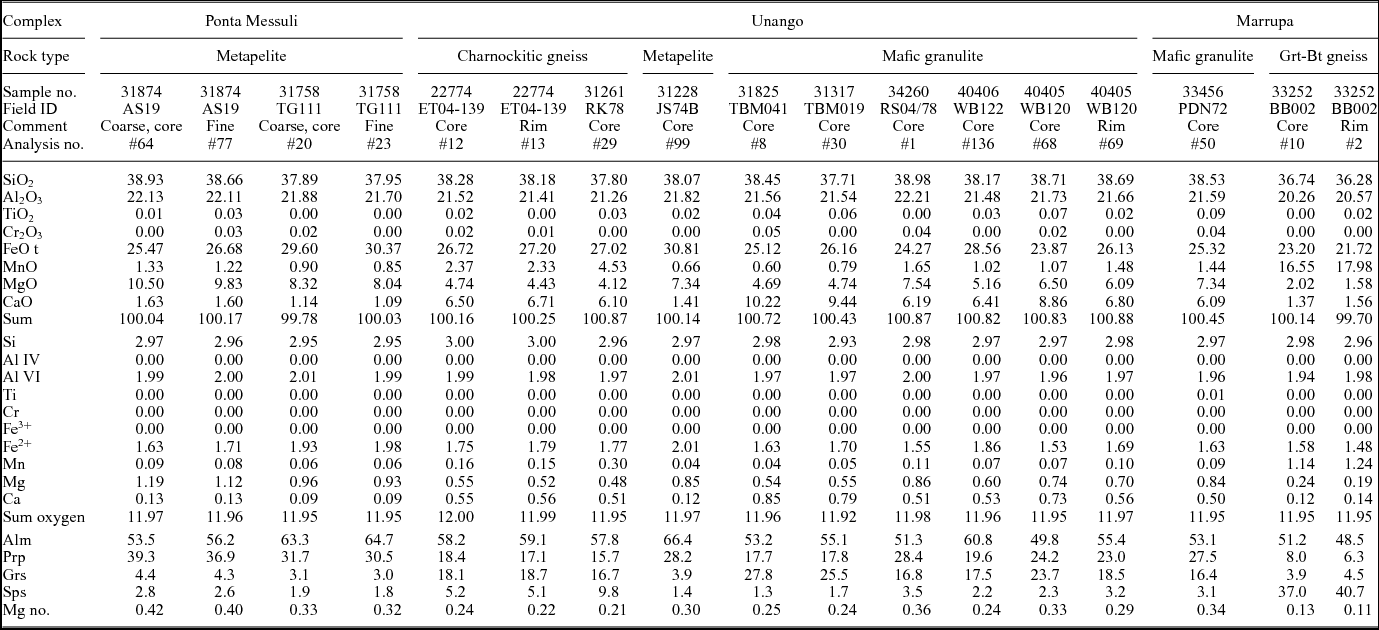
Representative chemical data of garnet, calculated on the basis of eight cations.
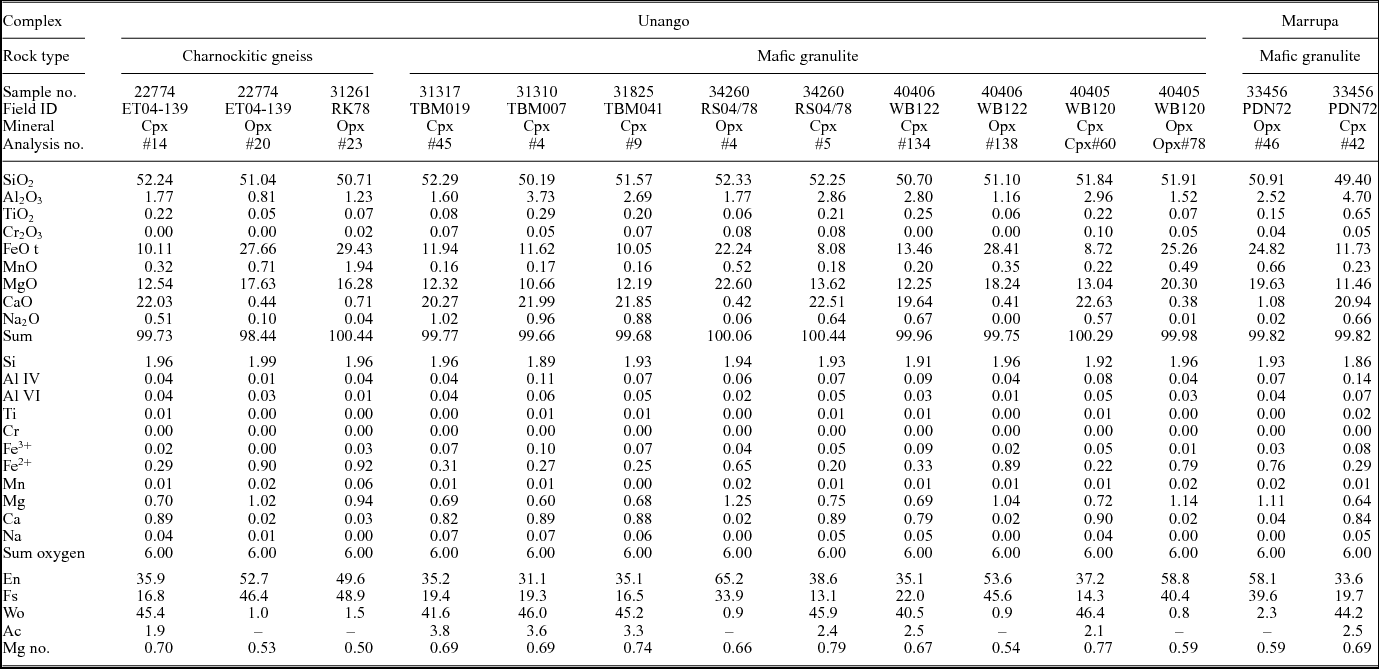
Representative chemical data of pyroxene, calculated on the basis of four cations.
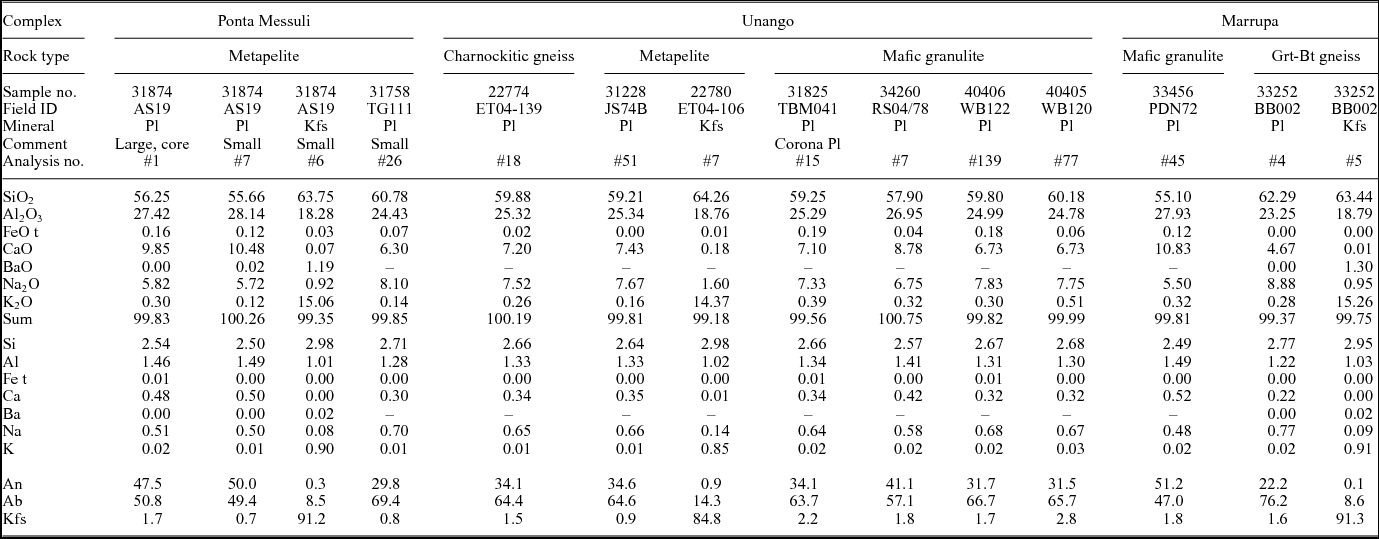
Representative chemical data of feldspars, calculated on the basis of five cations.
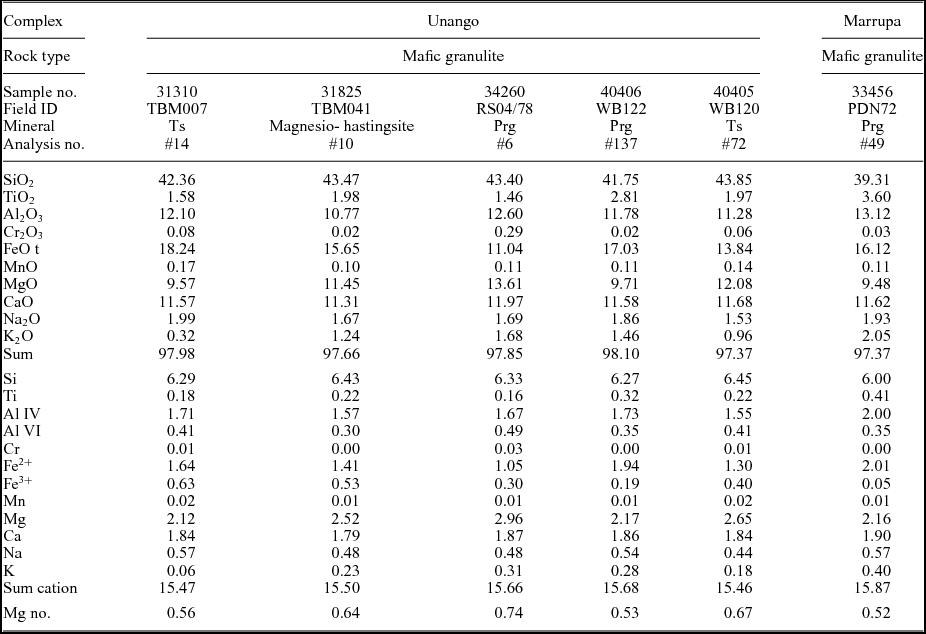
Representative chemical data of amphiboles, calculated on the basis of Sum – (Ca,Na,K) = 13.
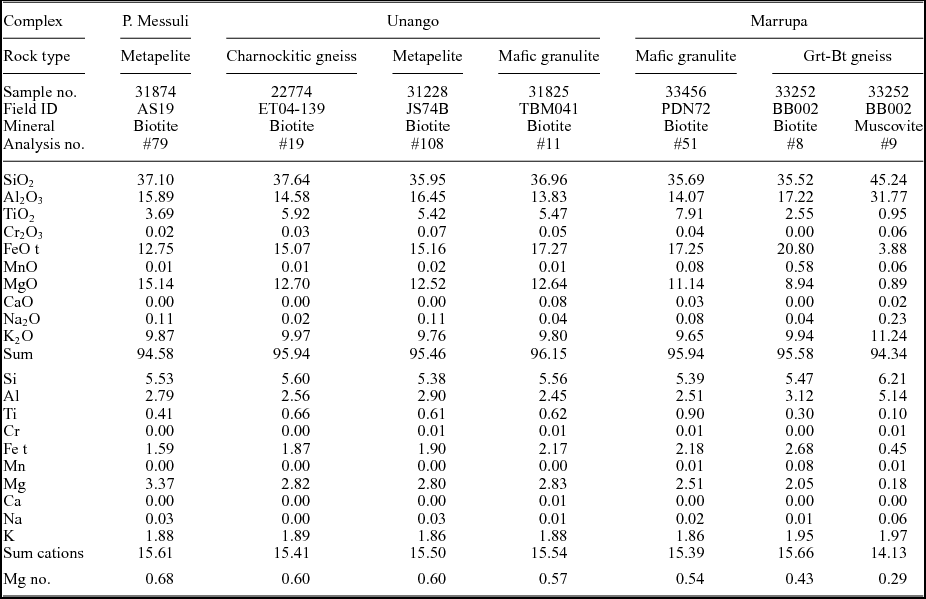
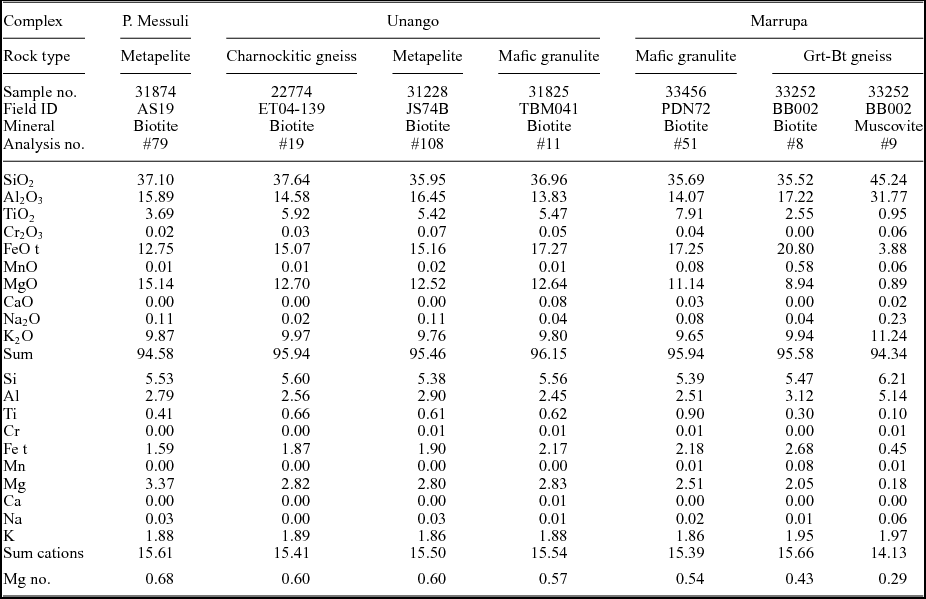
Representative chemical data of micas, calculated on the basis of 22 oxygen.
Calculations of P-T pseudosections uses bulk-rock composition (major elements) analysed at the Geological Survey of Norway (NGU), measured on fused glass beads prepared by 1:7 dilution with lithiumtetraborate. The samples were analysed on a PANalytical Axios X-ray fluorescence (XRF) spectrometer equipped with a 4 kW Rh X-ray end-window tube, using common international standards for calibration.
4. Petrography and mineral chemistry
4.a. Ponta Messuli Complex
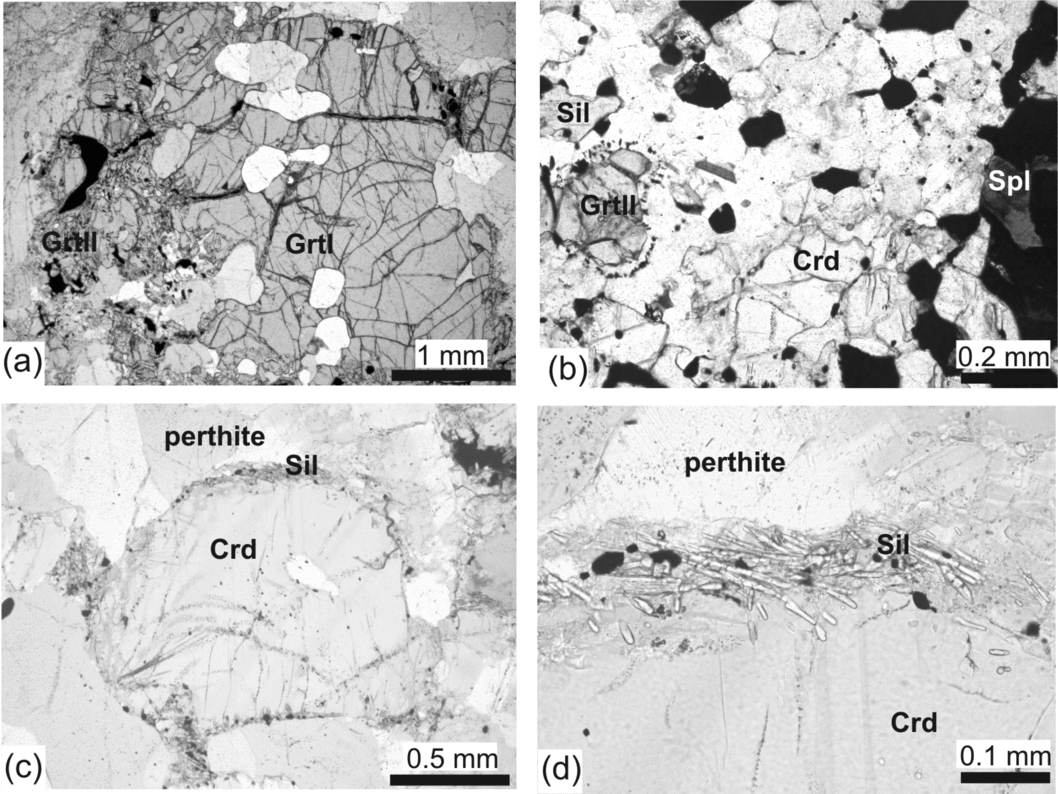
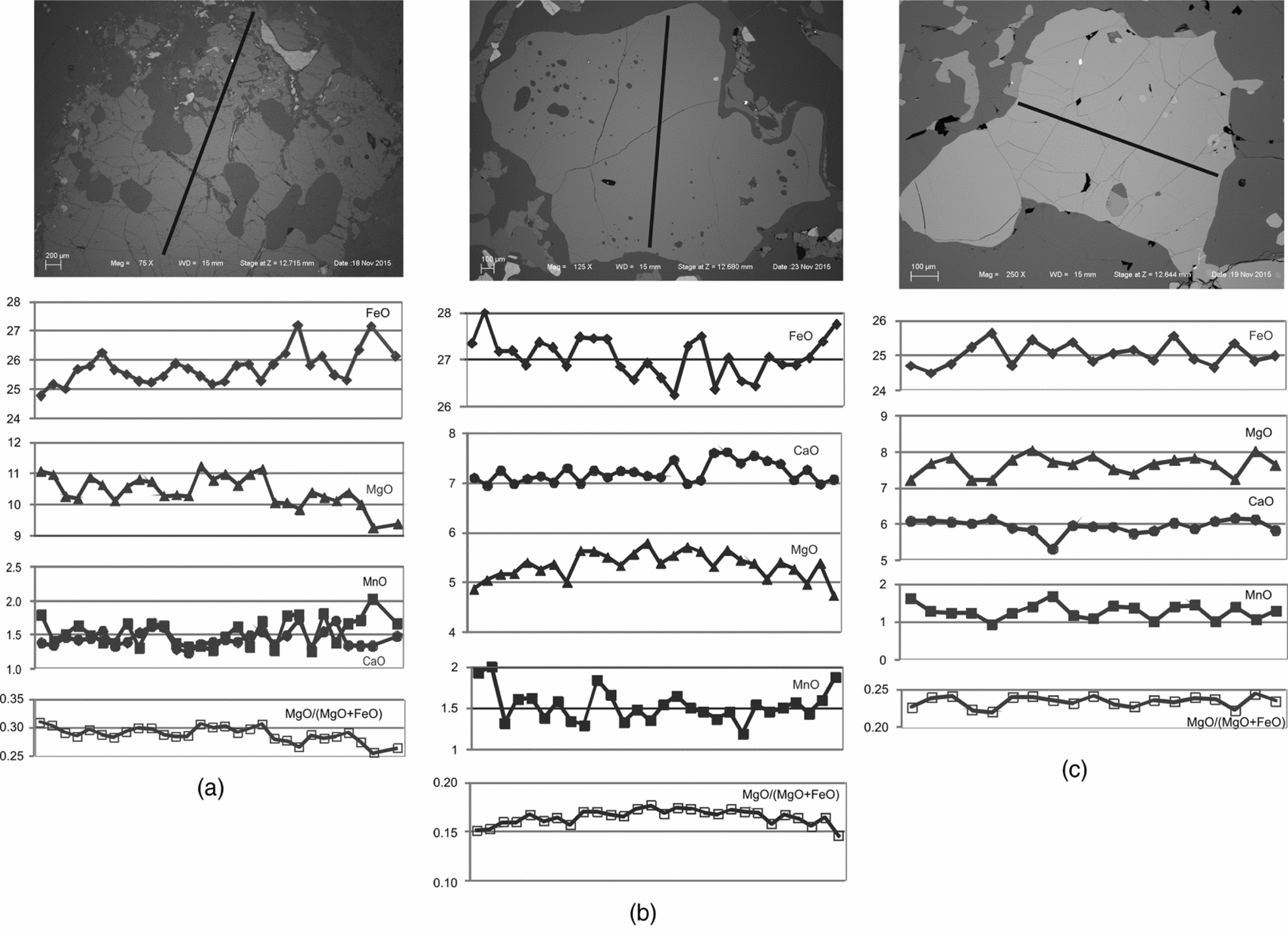
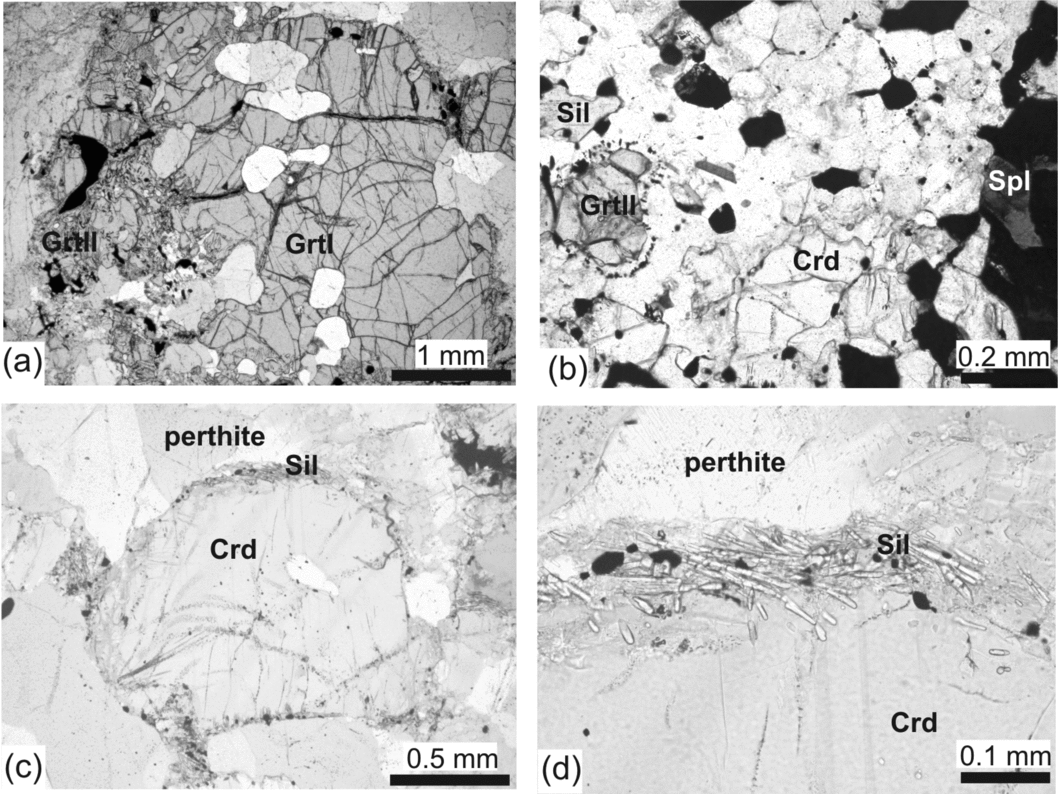
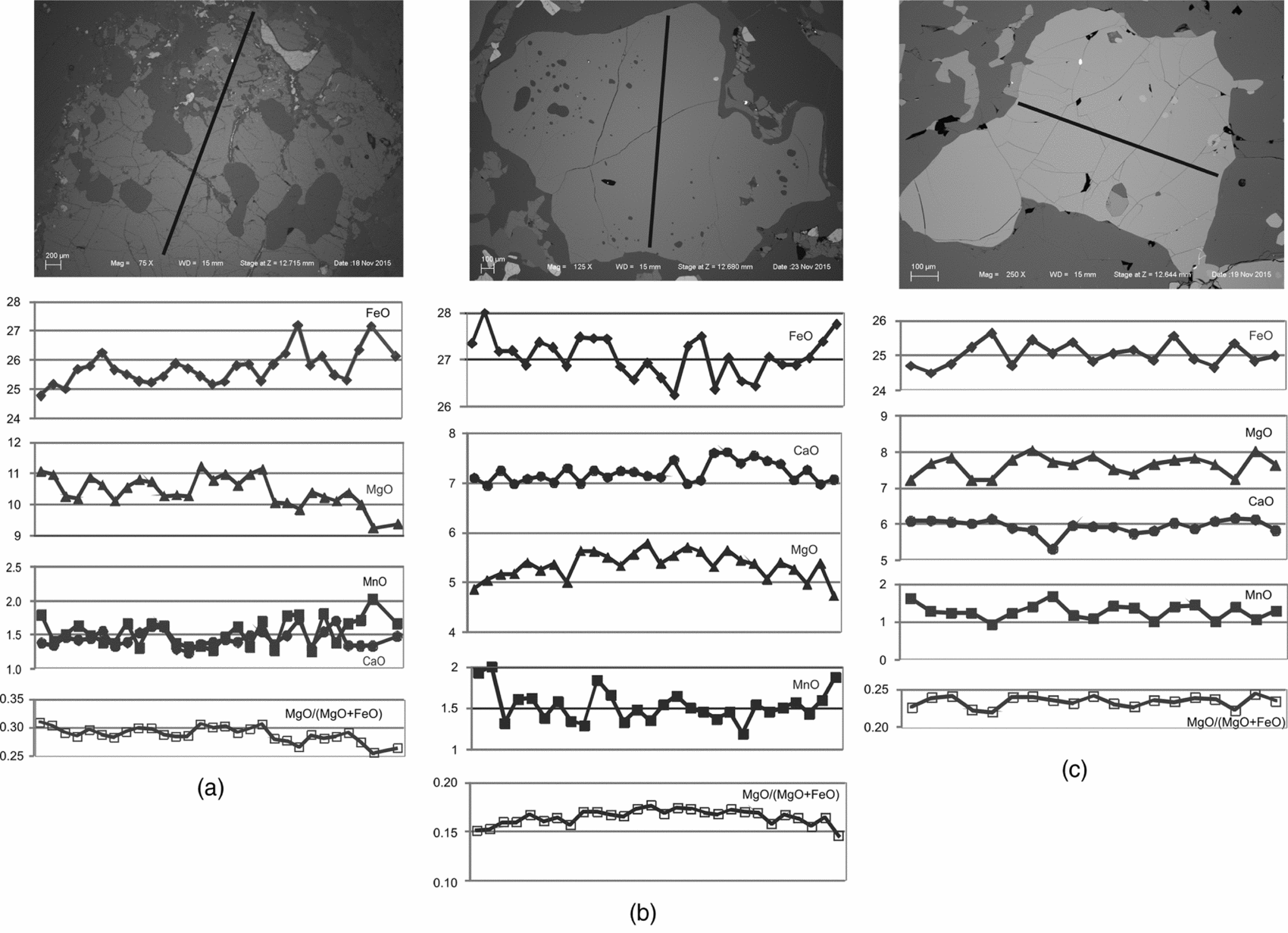
The northwesternmost Ponta Messuli Complex consists of partly migmatitic orthogneiss with minor metapelite and amphibolite. Migmatitic gneiss of pelitic composition contains a granulite-facies assemblage of Grt+Sil+Crd+Kfs+Pl+Qz+Bt+Zn-Spl+ oxides (abbreviations after Whitney & Evans, Reference Whitney and Evans2010). K-feldspar occurs as perthite, but often shows re-equilibration to microcline. Biotite chemistry has Ti c. 0.41 atoms per formula unit (apfu) and Mg no. 0.68, and cordierite Mg no. 0.83 (Mg no. = Mg/(Mg+Fe)). The oxide phases are magnetite and ilmenite, locally composite with exsolved lamellas. Two petrographic domains are observed in the metapelites: (1) coarse crystals of anhedral garnet (GrtI; Fig. 2a), plagioclase, K-feldspar and quartz; and (2) fine-grained GrtII+Sil+Crd+Kfs+Bt+Pl+Zn–Fe–Spl+Ilm+Mg (Fig. 2a, b). The coarse garnet porphyroblasts (GrtI) are Alm53–54Py39–40Grs4Sps3 (sample AS19) and Alm63–64Py31–32Grs3Sps2 (sample 31758). In the fine-grained domains, garnet (GrtII) is present as anhedral grains but also as inclusion-rich overgrowth on the coarse garnet porphyroblasts. The outer fine-grained garnet (GrtII) shows irregular compositional variations and, in general, a small increase of FeO and MnO and decrease in MgO and MgO/(MgO+FeO) compared to core composition of the coarse crystals (GrtI; Fig. 3a). Plagioclase is An48–50Ab49–51 and shows no zoning (sample 31874). Sample 31758 shows higher Ab-content with chemistry about An30Ab70. In sample 31876, coarse cordierite shows replacement to very fine-grained sillimanite along the grain boundaries (Fig. 2c, d). In addition white mica and quartz is present in these very fine-grained replacement aggregates. The replacement textures illustrate the reaction Cdr+Kfsp = Sil+white mica + Qz + Fe-oxide (mineral reaction not in balance).
Photomicrographs of characteristic metamorphic textures from the metapelitic rocks of the Palaeoproterzoic Ponta Messuli Complex. (a) Coarse GrtI with inclusion-rich GrtII ongrowth (sample 31874). (b) Fine-grained domains including GrtII, sillimanite, cordierite, spinel and magnetite/ilmenite (sample 31874). (c) Coarse cordierite with very fine-grained sillimanite crystals growing crystal rim (sample 31876). (d) Close-up of (c).
Garnet chemical profiles (wt% oxide, normalized data) and backscattered electron (BSE) images indicating position of profile. (a) Profile of 30 points run from core of GrtI to rim of GrtII. The profile shows irregular variations in composition in Grt II, but also a small increase of FeO and MnO and decrease in MgO and MgO/(MgO+FeO) compared to GrtI. Sample 31874, metapelite, Ponta Messuli Complex. (b) Profile of 29 points run across garnet from rim to rim. The profile shows an increase in FeO and MnO, a decrease in MgO and MgO/(MgO+FeO) towards the rim and a slight decrease of CaO. Sample 31879, mafic/intermediate granulite, Unango Complex. (c) Profile of 19 points run across garnet from rim to rim. The profile shows a relatively stable composition of the major elements. Sample 33456, mafic granulite, Marrupa Complex.
4.b. Unango Complex
The Unango Complex is dominated by intermediate to felsic late Mesoproterozoic – early Neoproterozoic orthogneisses, with minor mafic bodies. Quartz-mangeritic to charnockitic orthogneisses occur in the northern part and paragneisses predominate locally in the west. In general, the rocks show granulite- to amphibolite-facies grade and extensive migmatitization. The central to southern parts of the Unango Complex are dominated by migmatitized felsic to intermediate orthogneisses. Charnockitic rocks are frequent towards to the south in the vicinity to the Ocua Complex. The following metamorphic characterization of the Unango Complex is based on the study of mafic granulites, charnockitic gneisses and metapelites.
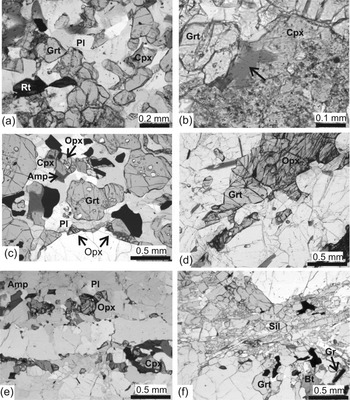
In the northwestern part of the Unango Complex (north of 14°S), mafic granulites consist of medium-grained and equigranular rocks dominated by garnet, clinopyroxene, plagioclase, calcic amphibole with minor amounts of quartz, and variably the presence of accessory rutile, titanite, ilmenite and magnetite (samples 31310, 31317, 31318, 31825; Fig. 4a). The primary magmatic mineralogy of the gabbros is partly preserved, and incipiently replaced by garnet and clinopyroxene. Garnet composition is around Alm53Prp15–18Grs28Sps1–3 with minor zoning. Clinopyroxene is En31–35Fs17–19Ac3–4 with Mg no. 0.69–0.74. Plagioclase is An31–34Ab64–69. Amphibole (tschermakite and magnesiohastingsite) replaces clinopyroxene in the granulite mineral assemblage (Fig. 4b). Biotite occurs in minor amounts and has Ti up to 0.62 apfu and Mg no. c. 0.57. The granulites show a weak foliation or a metamorphic replacement texture. The replacement minerals are fine- to medium–grained, causing a hetrogranular occurrence of the rocks.
Photomicrographs of characteristic metamorphic textures from the Unango Complex. (a) Mafic granulite with assemblage of Grt+Cpx+Pl+Rt. Sample 31318, NW part of Unango Complex. (b) Replacement of clinopyroxene to calcic amphibole in the mafic granulite. Sample 31318. (c) Subhedral garnet porphyroblast in finer grained matrix of orthopyroxene, clinopyroxene, plagioclase and quartz, in mafic granulite in the central part of Unango Complex. Sample 31879. Garnet is surrounded by coronas of plagioclase and orthopyroxene. Clinopyroxene show replacement to amphibole. (d) Orthopyroxene and garnet in charnokitic gneiss. Sample 33512. (e) Orthopyroxene, clinopyroxene and amphibole assembled in layers defining foliation in charnockitic gneiss. Sample 31223. (f) Cluster of sillimanite with garnet and biotite in quartzite. Graphite spreads as fine flakes. Sample 31228.

In the central to southern part of the Unango Complex (south of 13°S), mafic granulites are Grt+Opx+Cpx-bearing (samples 31879, 34260, 40405, 40406; Fig. 4c). Garnet core chemistry varies around Alm50–61Prp20–28Grs17–24Sps2–4. Figure 3b illustrates the chemical zoning of garnet which shows an increase of FeO and MnO and decrease of MgO and MgO/(MgO+FeO) towards the rim. Clinopyroxene is En35–39Fs13–22Ac2 with Mg no. 0.67–0.79. Orthopyroxene is En54–65Fs34–46. Plagioclase chemistry varies as An32–41Ab57–67. It is unzoned or shows a small rimwards increase of CaO. Garnet porphyroblasts are observed with coronas of plagioclase and locally orthopyroxene (Fig. 4c). Amphibole shows locally replacement on pyroxene.
Garnet- and pyroxene-bearing orthogneisses, mostly charnockitic, are widespread throughout the Unango Complex (samples 22774, 35220, 31223, 31261). The charnockitic gneisses have the mineral assemblage Qz + Pl + perthite + Grt + Opx ± Cpx ± Bt ± Amp (Fig. 4d, e). They are typically heterogranular and petrographically variable; grain size of quartz, perthite and plagioclase varies from medium- to coarse-grained while the mafic phases (garnet, pyroxenes, biotite and amphibole) are normally fine-grained. Foliation of the charnockitic gneisses is defined by the mafic phases, pyroxene, biotite and amphibole occurring in layers (Fig. 4e). The degree of strain varies from only metamorphic recrystallization of quartz-feldspar along coarser perthite to development of a stronger planar foliation. Amphibole, although locally stable in the main assemblage, also shows secondary growth at the expense of pyroxene and opaque phases. Garnet chemistry varies around Alm57–59Prp15–18Grs16–19Sps5–10, and shows some chemical zoning as evident by an increase of FeO at the rim. Orthopyroxene chemistry is En49–53Fs46–49, and clinopyroxene En36Fs17Ac2 with Mg no. 0.7. Plagioclase is around An34Ab64, and shows no systematic zoning. K-feldspar is perthitic. Biotite shows Ti up to 0.66 apfu and Mg no. c. 0.60. Investigated charnockitic gneisses in the vicinity of the Ocua Complex are garnet-free, and contain quartz, perthite, plagioclase, orthopyroxene and variable amounts of clinopyroxene, biotite and amphibole (samples 40413, 40407, 40411, 40412, 33512).
Metapelitic to quartzitic paragneisses in the central part of the Unango Complex are garnet- and sillimanite-bearing with variable amounts of plagioclase, K-feldspar, biotite and graphite, and with accessory rutile and ilmenite (samples 31228, 22780). The quartzites are heterogranular; sillimanite occurs in clusters (Fig. 4f) with garnet and biotite. Garnet is subhedral with chemistry around Alm66Prp28Grs4Sps1. Plagioclase is around An35Ab65 and shows no systematic zoning. K-feldspar has Kfs 84. Biotite shows Ti up to 0.61 apfu and Mg no. c. 0.60. Graphite spreads as thin flakes (Fig. 4f).
4.c. Marrupa Complex
The Marrupa Complex is dominated by felsic to intermediate orthogneisses, with subordinate mafic orthogneisses and migmatitic paragneisses. Amphibolite facies assemblages dominate, but a metamorphic granulite facies assemblage including Grt + Opx + Cpx is locally found in mafic orthogneisses.
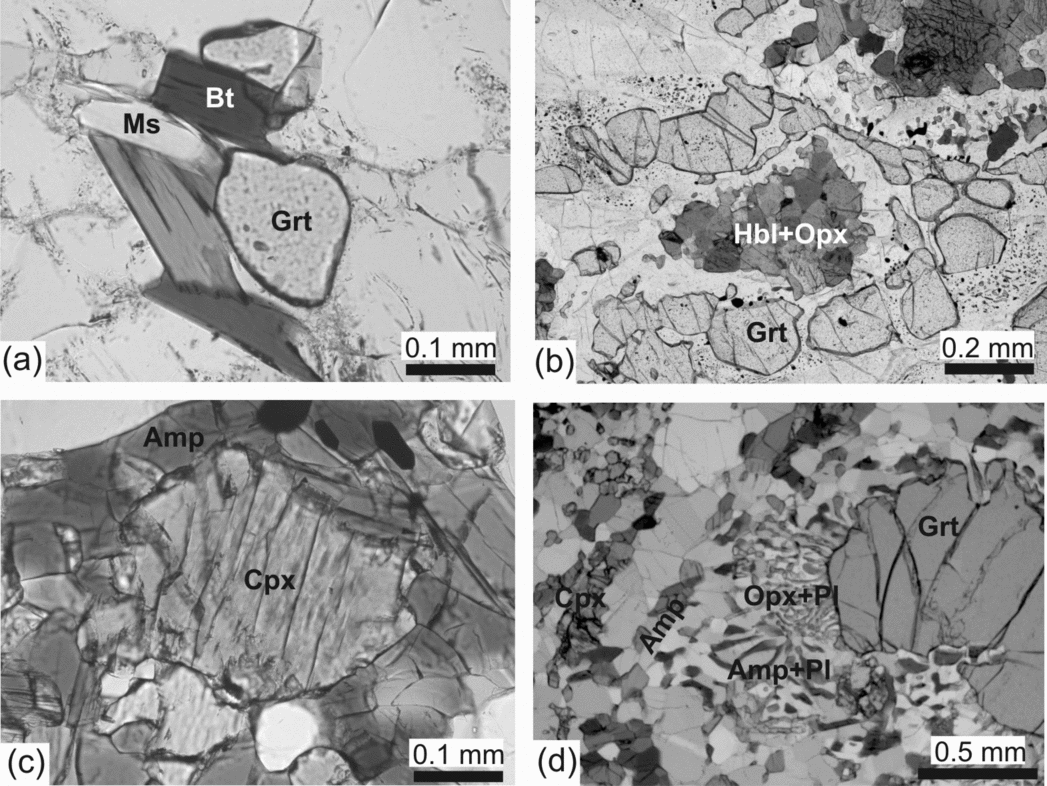
The amphibolite-facies metamorphism is evident from both felsic to mafic gneisses with Bt ± Grt ± Amp-assemblage and common migmatitization. Granitic gneiss sample 33252 from the central part of the Marrupa Complex shows euhedral fine-grained garnet in a heterogranular biotite and muscovite-bearing gneiss (Fig. 5a). Garnet is extremely spessartine-rich with a composition of Alm51Prp8Grs4Sps37, and shows a small rimwards increase in MnO and CaO and decrease in FeO and MgO to Alm48Prp6Grs5Sps41. Plagioclase chemistry is around An22Ab76 and K-feldspar occurs as perthite showing re-equilibration to microcline. A metagabbro sample shows garnet corona around mafic phases in addition to pyroxene and biotite growth, indicating that the amphibolites facies metamorphism progrades into the granulite facies stability field (samples 38418; Fig. 5b).
Photomicrographs of characteristic metamorphic textures from the Marrupa Complex. (a) Garnet, biotite and muscovite in the amphibolite facies gneiss in the central part of Marrupa Complex. Sample 33252. (b) Garnet corona around a symplectite of hornblende and orthopyroxene in metagabbro. Sample 38418. (c) Secondary replacement of amphibole around clinopyroxene, sample 37287, mafic granulite. (d) A complex symplectite of Opx + Pl and Amp + Pl, respectively, around garnet in mafic granulite. Sample 37287.
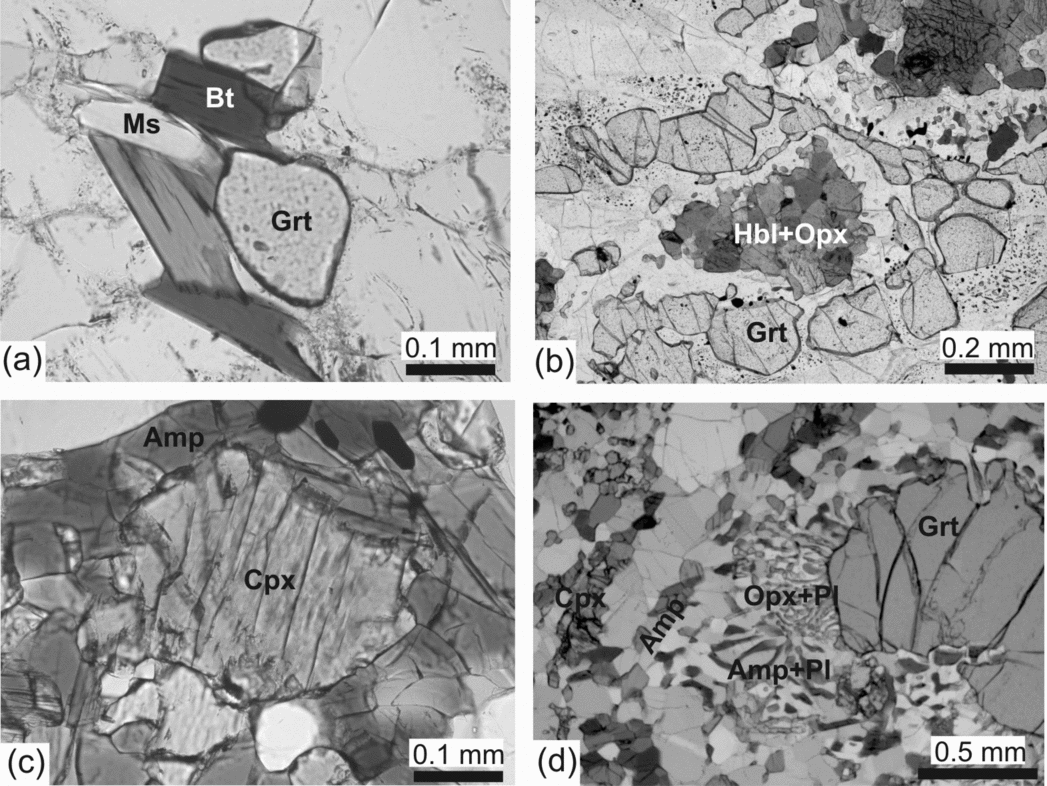
A granulite-facies assemblage of Grt + Opx + Cpx + Pl ± Amp ± Qz is found in mafic orthogneisses both in the SW and NE part of the Marrupa Complex (samples 37287, 33456, 33481, 26830). Garnet is anhedral with chemistry varying around Alm53Prp28Grs16Sps3 (sample 33456). A chemical zoning profile shows a relatively stable composition of the major elements. Orthopyroxene chemistry shows smaller variations around En58Fs40 and clinopyroxene En34Fs20Ac3 with Mg no. c. 0.69. Plagioclase has no systematic zoning and varies around An51Ab47. Perthite locally shows a late re-equilibration to microcline. Amphibole (pargasite) occurs texturally around pyroxenes (Fig. 5c) or on opaque phases, indicating replacement. Biotite occurs only locally and shows a high Ti up to 0.90 apfu and Mg no. c. 0.54. Anhedral garnet often develops a corona of Pl ± Opx ± Cpx ± Amp. In sample 37287, anhedral garnet shows an extensive corona made of symplectite of Opx + Pl or Amp + Pl (Fig. 5d). In the southern part of Marrupa Complex, migmatitic mafic gneiss shows granulite facies assemblage of Opx (En64Fs35) + Pl + Amp with minor biotite (sample 26830).
5. Pressure–temperature modelling
5.a. Thermobarometry
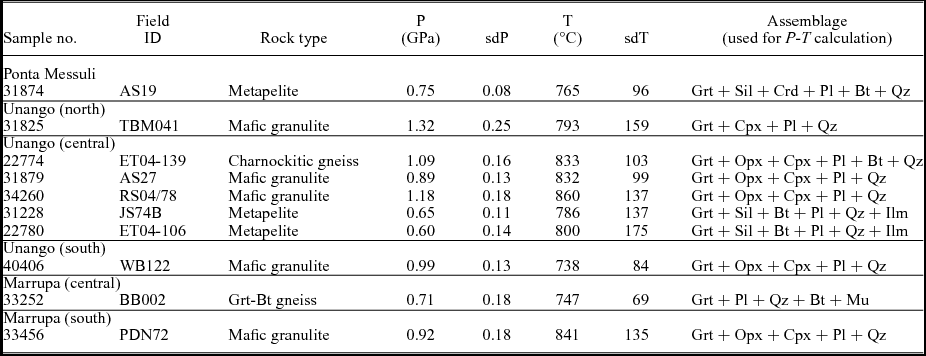
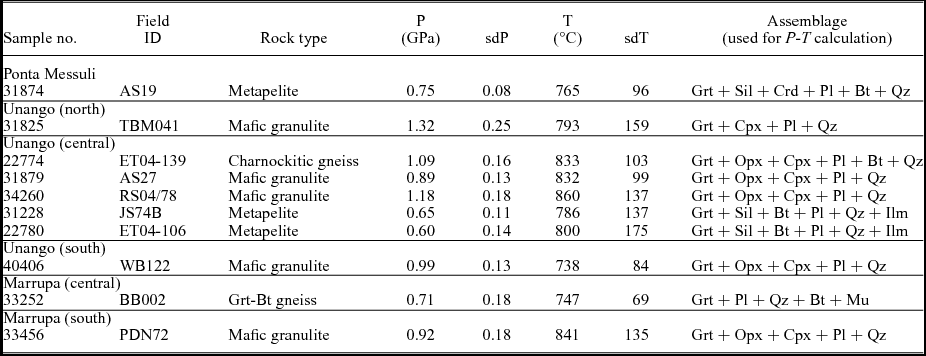
Pressure and temperature estimates were obtained using the program Thermocalc, version 333 (Powell & Holland, Reference Powell and Holland1988) on samples of mafic, charnockitic and metapelitic composition. Mineral chemistry is described above and analyses presented in Tables 4–8. Mineral end-member activities were calculated by the AX program (Holland & Powell, Reference Holland and Powell1998). Study and interpretation of petrography and chemical zoning were performed to ascertain that analysed minerals used in calculations are in equilibrium. To produce estimates as close as possible to peak metamorphic conditions, chemical analyses from mineral cores are used in order to minimize effects of chemical diffusion during retrogression of the granulites (Spear, Reference Spear1993). The results are summarized below, in Table 9 and in Figures 6 and 7.
Results of thermobarometric calculations.
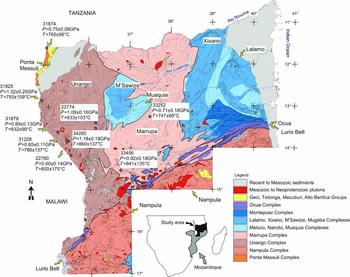
Simplified geological map of NE Mozambique (Norconsult Consortium, Reference Consortium2007; Boyd et al. Reference Boyd, Nordgulen, Thomas, Bingen, Bjerkgård, Grenne, Henderson, Melezhik, Often, Sandstad, Solli, Tveten, Viola, Key, Smith, Gonzalez, Hollick, Jacobs, Jamal, Motuza, Bauer, Daudi, Feito, Manhica, Moniz and Rosse2010) with samples and results of thermobarometric calculations.

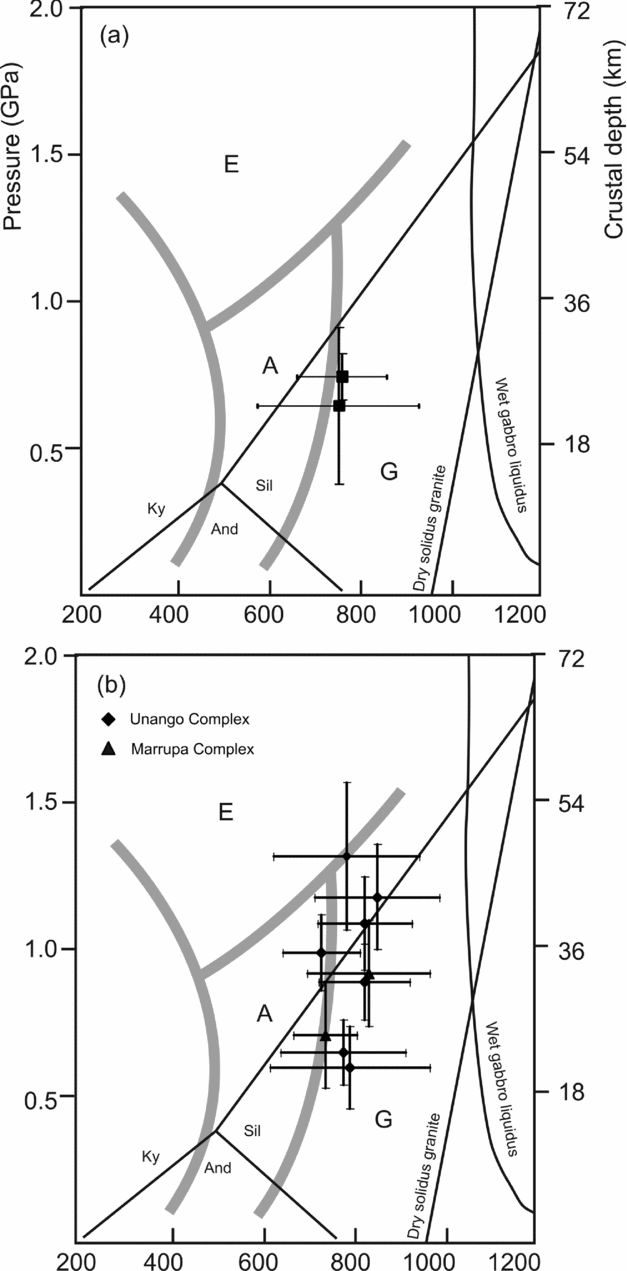
Results of thermobarometric calculations (Thermocalc v. 333), plot of average P-T with error bars, as summarized in Table 9. (P-T grid based on Spear, Reference Spear1993; Johannes & Holtz, Reference Johannes and Holtz1996; A – amphibolite facies; G – granulite facies; E – eclogite facies). (a) Estimated conditions for Palaeoproterozoic metamorphism of Ponta Messuli Complex. (b) Estimated metamorphic conditions for Mesoproterozoic and early Palaeozoic metamorphism in the Mesoproterozoic Unango and Marrupa complexes.
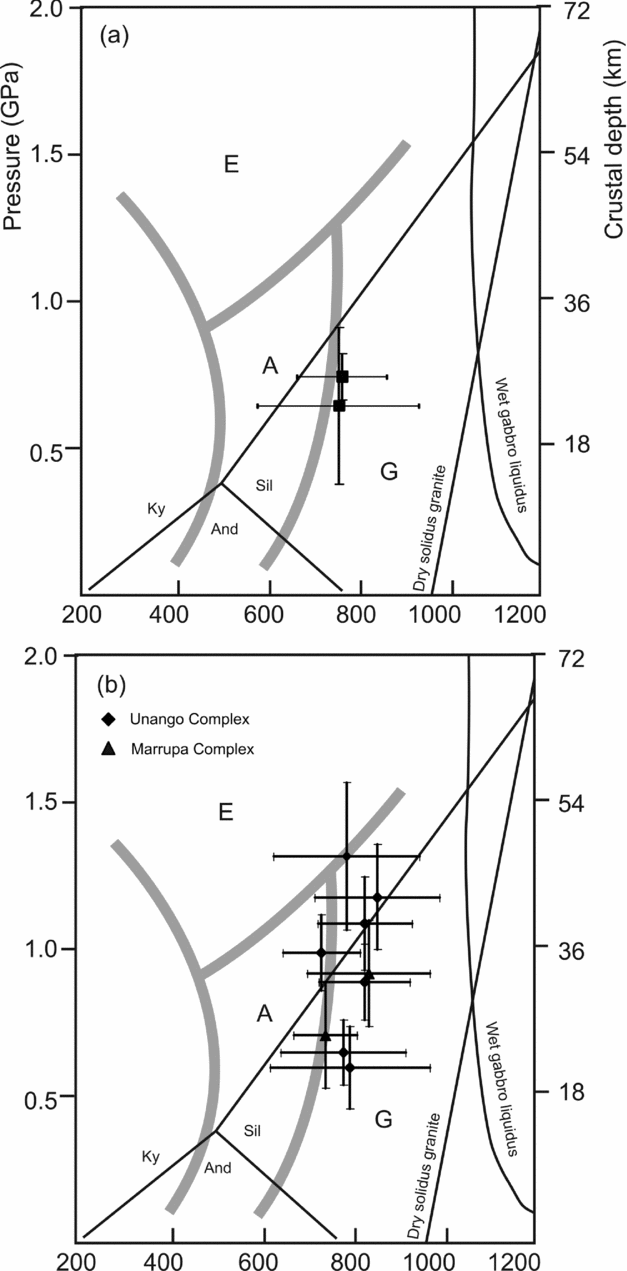
In the Ponta Messuli Complex, metapelitic sample 31874 yields estimates up to P = 0.75 ± 0.08 GPa and T = 765 ± 96°C based on the mineral assemblage Grt + Sil + Crd + Pl + Bt + Qz. The garnetII is used for thermobarometric calculation as it is a part of the main fine-grained equilibrium assemblage, as described above in Section 4.a.
In the Unango Complex, P-T estimates are run for mafic to intermediate granulites, charnockitic gneisses and metapelitic rocks. The highest pressures are retrieved from the assemblage Grt + Cpx + Pl + Qz from mafic granulites in the NW part of the complex, with P up to 1.32 ± 0.25 GPa at T = 793 ± 159°C (sample 31825). Although the calculation of this sample yields a large uncertainity, it is in agreement of the defined high-pressure granulite field (Pattison, Reference Pattison2003). In the central part of the Unango Complex, Grt–Opx–Cpx-bearing mafic granulites show P up to 1.18 ± 0.18 GPa and T = 860 ± 137°C based on the Grt + Opx + Cpx + Pl + Qz-assemblage (sample 34260). Charnokitic gneisses with a Grt + Opx + Cpx assemblage yield P up to 1.09 ± 0.16 GPa and T = 833 ± 103°C. The presence of metamorphic orthopyroxene as the defining granulite facies constrains T to at least 800°C (e.g. Harley, Reference Harley1989). The Grt + Opx + Cpx assemblage is consistent with medium-pressure granulite facies conditions (e.g. O'Brien & Rötzler, Reference O'Brien and Rötzler2003). Sillimanite-bearing metapelitic rocks generally reflect lower P-T conditions of 0.65 ± 0.11 GPa and 786 ± 137°C, relying on the assemblage Grt + Sil + Bt + Pl + Qz + Ilm + Rt. For the estimated P, biotite is stable up to 800°C for a pelitic assemblage (Le Breton & Thompson, Reference Le Breton and Thompson1988; Spear, Reference Spear1993), restricting the wide T estimate to this upper limit. In the vicinity of the Ocua Complex, mafic granulites of the Unango Complex yield P = 0.99 ± 0.13 GPa and T = 738 ± 84°C, based on rocks with the assemblage of Grt + Opx + Cpx + Pl + Qz (sample 40406).
The amphibolite-facies metamorphism in the Marrupa Complex is estimated using the assemblage Grt + Bt + Ms + Pl + Qz in Grt-Bt-gneiss. It gives P = 0.71 ± 0.18 GPa and T = 747 ± 69°C (sample 33252). The granulite-facies metamorphism locally recorded in the southwestern part of the Marrupa Complex is estimated from mafic granulite to be 0.92 ± 0.18 GPa and 841 ± 135°C, based on Grt + Opx + Cpx + Pl + Qz assemblage (sample 33456).
5.b. P-T pseudosections
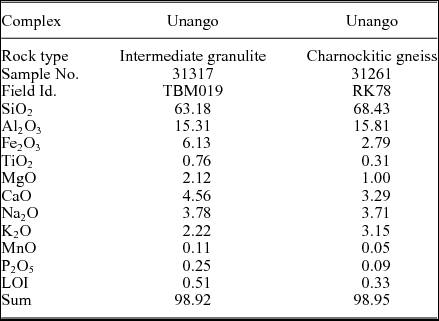
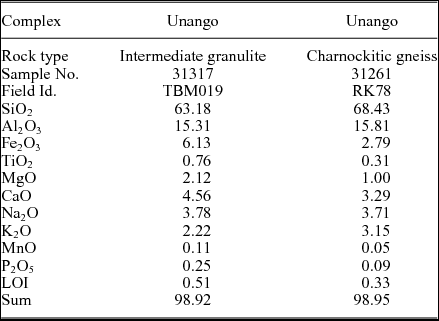
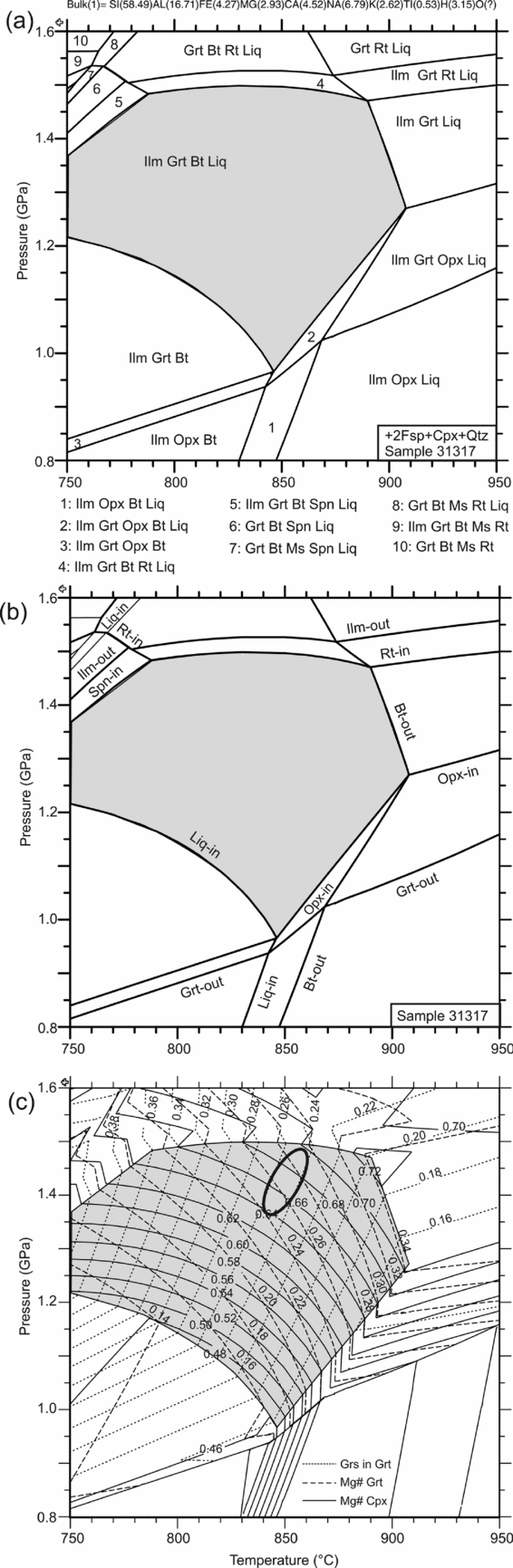
To achieve a better documentation of the metamorphic relations at peak metamorphic conditions, equilibrium assemblage diagrams were calculated. Pseudosections are presented for two representative samples of a mafic to intermediate granulite of the northern part of Unango Complex (sample 31317) and a charnockitic gneiss of the central part of the complex (sample 31261). The calculations were performed by the computer program Theriak–Domino software (de Capitani & Petrakakis, Reference de Capitani and Petrakakis2010; domino version 03.01.2012), based on bulk-rock compositions of major-element XRF analyses (Table 10) and using the internally consistent thermodynamic dataset of Holland & Powell (Reference Holland and Powell1998; Theriak–Domino filename tcdb55c2d.txt). The mineral activity models are those of Newton, Charlu & Kleppa (Reference Newton, Charlu and Kleppa1980) and Baldwin et al. (Reference Baldwin, Powell, Brown, Moraes and Fuck2005) for feldspar; White, Powell & Holland (Reference White, Powell and Holland2007) for garnet, biotite, ilmenite, orthopyroxene and liquid; Holland & Powell (Reference Holland and Powell1996) and Green, Holland & Powell (Reference Green, Holland and Powell2007) for clinopyroxene; Holland & Powell (Reference Holland and Powell1998) for epidote; and Coggon & Holland (Reference Coggon and Holland2002) for white mica. The calculations were run in the NCKFMASH-TO (Na2O-CaO-K2O-FeO-MgO-SiO2-H2O-TiO2-O) system. H2O values were based on loss on ignition (LOI).
Whole-rock geochemical data (wt%).
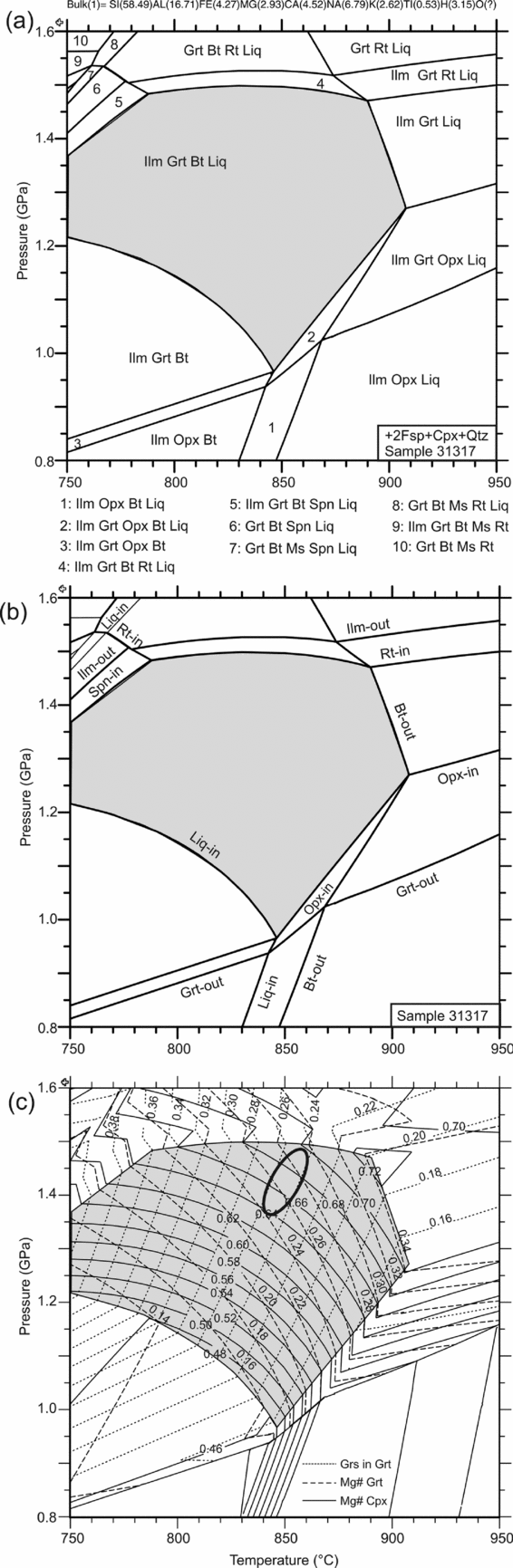
The mafic to intermediate granulite sample 31317 from the northern part of the Unango Complex shows an assemblage of Grt + Cpx + Kfs + Pl + Qz + Bt + Ilm + Mag. The calculated pseudosection (Fig. 8) is characterized by stability of clinopyroxene and two feldspars over the whole investigated P-T range (0.80–1.60 GPa, 750–950°C). Garnet is stable above 0.80–1.15 GPa and biotite up to 850–900°C. Orthopyroxene, which is not present in the sample, breaks down above 0.85–1.20 GPa. Ilmenite shows a transition to rutile above 1.45 GPa. The stability of melt is inferred from petrography, namely biotite-quartz symplectites and very fine quartz blubs along grain boundaries. Calculated isopleths of Mg no. ratio in clinopyroxene and both grossular-content and Mg no. ratio in garnet constrain the P-T stability of peak metamorphism of the granulite to P-T around 1.35–1.50 GPa and 825–875°C (Fig. 8c). The pressure is further constrained to be lower than 1.45 GPa by the lack of rutile. This is in accordance with the calculation result of stability of the present peak mineral assemblage of Grt + Cpx + feldspars + Qz + Ilm (Fig. 8a).
P-T pseudosection for the mafic-intermediate granulite, sample 31317, from the northern part of the Unango Complex. See text for discussion. (a) Stability of phases. The grey-shaded area represents interpreted peak assemblage. (b) Simplified diagram illustrating phase transitions. (c) Plot of isopleths representing Mg no. ratio of clinopyroxene, and Mg no. ratio and Grs-content of garnet.
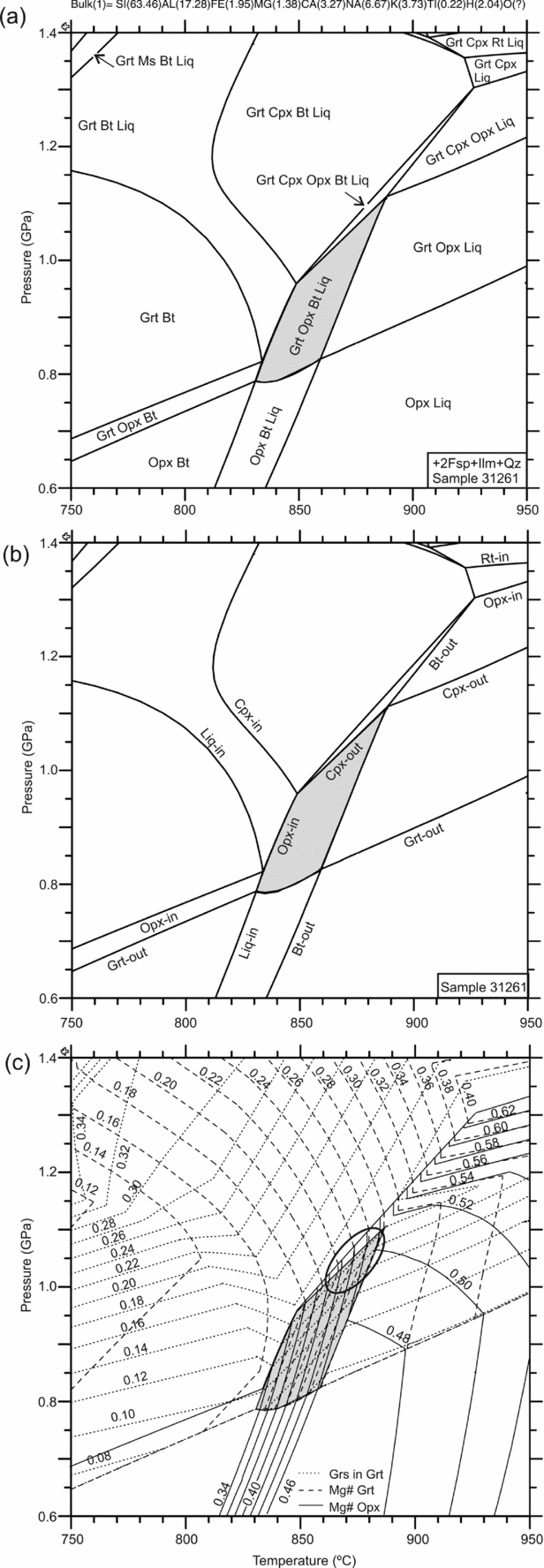
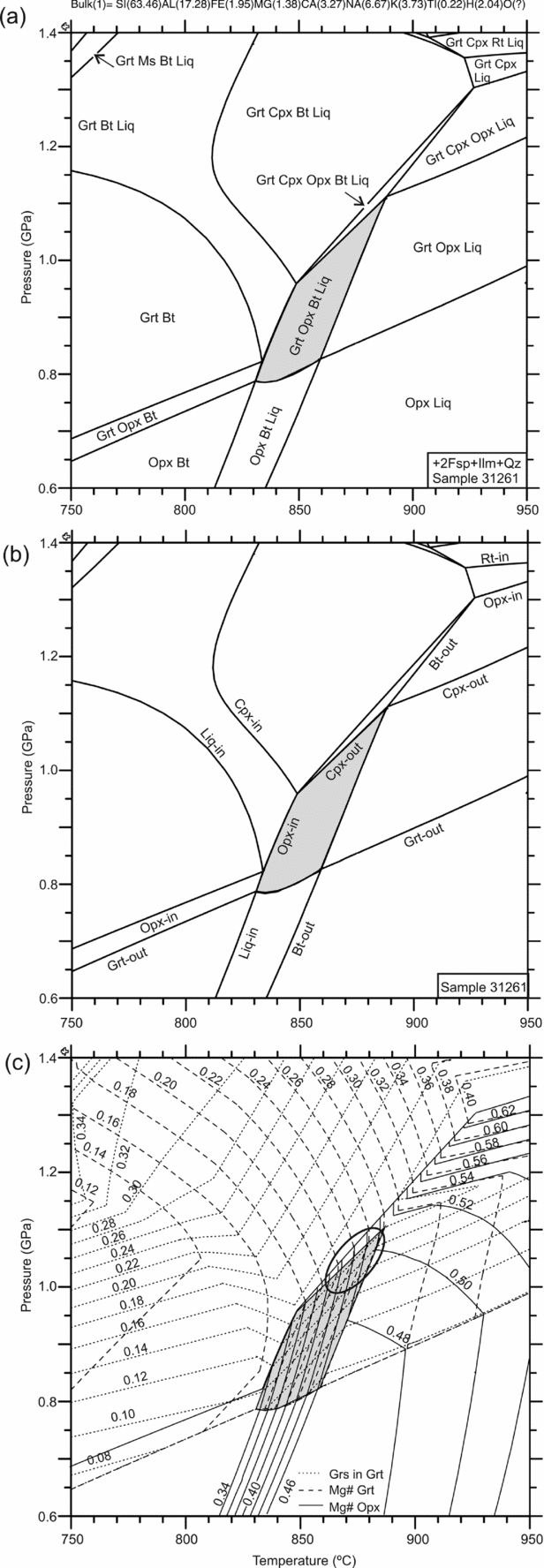
Sample 31261 represents a garnet-bearing charnokitic gneiss from the central part of the Unango Complex. The pseudosection topology shows that both feldspars and quartz are present in the whole investigated P-T range (0.60–1.40 GPa, 750–950°C; Fig. 9). For this charnockitic composition, garnet is stable above 0.65–1.00 GPa. Orthopyroxene's stability field is below 0.70 GPa at 750°C and below 1.30 GPa at 950°C. Biotite breaks down above 840–920°C. Clinopyroxene, which is not present in this sample, shows a restriction in its stability field above P = 0.95 GPa and T = 810°C. Melt is present above 820°C and, for the present assemblage, only preserved petrographically as very fine quartz blubs on grain boundaries. Isopleths are calculated for Mg no. ratio of orthopyroxene and both Mg no. ratio and grossular-content of garnet (Fig. 9c). The present composition of orthopyroxene (Mg no. 0.50) and garnet (Mg no. 0.21, Grs 0.17) restricts the metamorphic conditions to be P of c. 1.15 GPa at T of c. 875°C. This is in accordance with the restricted field of the present mineral assemblage of Grt + Opx + feldspars + Bt + Qz, and bounded by the Opx-in, Cpx-out and Bt-out reactions (Fig. 9a).
P-T pseudosection for the garnet-bearing charnockitic gneiss, sample 31261, from southern part of the Unango Complex. See text for discussion. (a) Stability of phases. The grey-shaded area represents interpreted peak assemblage. (b) Simplified diagram illustrating phase transitions. (c) Plot of isopleths representing Mg no. ratio of orthopyroxene, and Mg no. ratio and Grs-content of garnet.
6. Discussion
6.a. Ubendian high-grade metamorphism
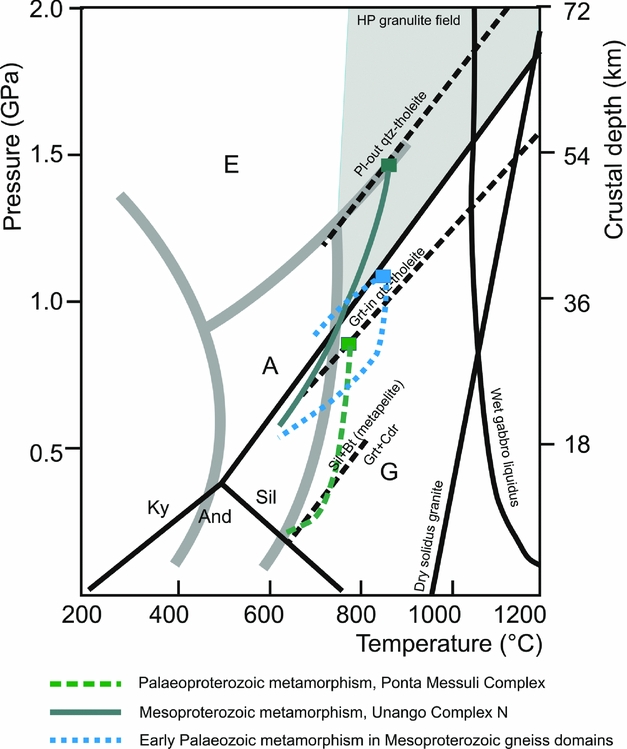
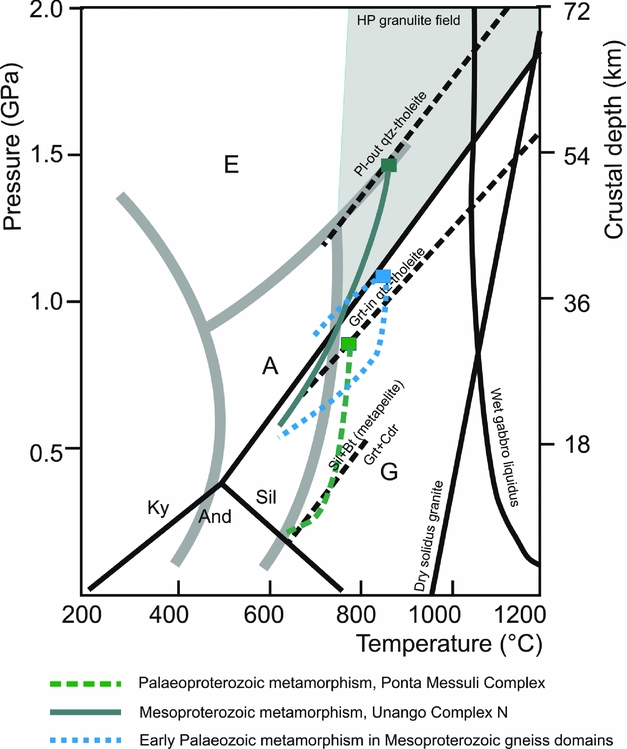
The Ponta Messuli Complex represents the oldest unit in NE Mozambique and is of Palaeoproterozoic age. One of the Grt–Sil–Crd-bearing metapelite samples selected in this study (sample 31874; Fig. 2b) is characterized by the presence of detrital zircons older than 2074 ± 11 Ma (Bingen et al. Reference Bingen, Jacobs, Viola, Henderson, Skår, Boyd, Thomas, Solli, Key and Daudi2009, fig. 4b, c). Metamorphism is dated to 1950 ± 15 Ma by means of zircon or 1946 ± 11 Ma by means of monazite. The recorded metamorphic peak of P = 0.75 ± 0.08 GPa at T = 765 ± 96°C is in accordance with the extensive migmatitization and the occurrence of perthitic feldspar. The chemical composition of garnet (Fig. 3a) is interpreted as the product of diffusion along grain boundaries during cooling. In this case peak conditions must have been higher than the estimated temperature, which is calculated with the composition of the fine-grained garnet. The stability field of the observed mineral assemblage of Bt + Sil + Grt + Crd in the KFMASH-system (Spear & Cheney, Reference Spear and Cheney1989; Spear, Reference Spear1993) is in accordance with these estimated P and T. The reaction Bt + Sil = Grt + Crd + H2O has a gentle positive slope in the KFMASH-system. The presence of these phases together can be explained by the higher MnO component in garnet (Spear & Cheney, Reference Spear and Cheney1989), while the reaction forming garnet and cordierite from the biotite and sillimanite-assemblage indicates a decompression (Holdaway & Lee Reference Holdaway and Lee1977; Spear, Reference Spear1993). Secondary textures of sillimanite replacement on cordierite rims (Fig. 2c, d) can be explained by near-isobaric retrogression in the same system. This leads to the interpretation of a clockwise P-T path following the peak granulite facies metamorphism as an initial decompression followed by a secondary near-isobaric cooling (Fig. 10).
Interpreted P-T paths of Palaeoproterozoic, Mesoproterozoic, Neoproterozoic and early Palaeoproterozoic high-grade metamorphism in NE Mozambique. (P-T grid after O'Brien & Rötzler, Reference O'Brien and Rötzler2003; based on Green & Ringwood, Reference Green and Ringwood1967; Ito & Kennedy, Reference Ito, Kennedy and Heacock1971; Hansen, Reference Hansen1981; Spear, Reference Spear1993; Johannes & Holtz, Reference Johannes and Holtz1996). A – amphibolite facies; G – granulite facies; E – eclogite facies. Sil + Bt = Grt + Cdr stability in metapelite after Spear & Cheney (Reference Spear and Cheney1989).
The Ponta Messuli Complex is interpreted as a part of the Usagaran and Ubendian basement, forming the NW foreland to the East African Orogen along the Congo–Tanzania Craton (e.g. Lenoir et al. Reference Lenoir, Liégeois, Theunissen and Klerkx1994; Johnson, Rivers & De Waele, Reference Johnson, Rivers and De Waele2005; De Waele et al. Reference De Waele, Kampunza, Mapani and Tembo2006; Viola et al. Reference Viola, Henderson, Bingen, Thomas, Smethurst and de Azavedo2008; Bingen et al. Reference Bingen, Jacobs, Viola, Henderson, Skår, Boyd, Thomas, Solli, Key and Daudi2009). In northern Malawi and Zambia, the Usagaran and Ubendian basement is known to consist of orthogneisses associated with cordierite-garnet granulites (Ring, Kröner & Toulkeridis, Reference Ring, Kröner and Toulkeridis1997; Vrána et al. Reference Vrána, Kachlík, Kröner, Marheine, Seifert, Žáček and Babůrek2004). The new petrologic data reporting garnet-sillimanite-cordierite granulite-facies metapelites in the Ponta Messuli Complex therefore corroborate this large-scale correlation and the low- to medium-pressure signature of the Palaeoproterozoic metamorphism. However, in the Ubendian and Usagaran Belt of Tanzania, eclogite-facies rocks dated at 2010 ± 12 Ma (Usagaran; Möller et al. Reference Möller, Appel, Mezger and Schenk1995; Reddy, Collins & Mruma, Reference Reddy, Collins and Mruma2003; Collins et al. Reference Collins, Reddy, Buchan and Mruma2004) and 1886 ± 6 and 1866 ± 14 Ma (Ubendian; Boniface, Schenk & Appel, Reference Boniface, Schenk and Appel2012) demonstrate rare preservation of high-pressure metamorphic assemblages during Palaeoproterozoic time.
6.b. Irumidian medium- to high-pressure granulite-facies metamorphism
The Unango and Marrupa complexes consist of late Mesoproterozoic – early Neoproterozoic orthogneisses dated between 1062 ± 13 Ma and 949 ± 11 Ma for the Unango Complex and between 1026 ± 9 Ma and 946 ± 11 Ma for the Marrupa Complex (Bingen et al. Reference Bingen, Jacobs, Viola, Henderson, Skår, Boyd, Thomas, Solli, Key and Daudi2009). In the southern part of the Unango and Marrupa complexes (south of 14°S), metamorphic zircon rims unambiguously indicate that high-grade metamorphism towards the Lurio Belt is late Neoproterozoic in age (Bingen et al. Reference Bingen, Jacobs, Viola, Henderson, Skår, Boyd, Thomas, Solli, Key and Daudi2009). In the central and northernwestern part of the Unango complex (north of 14°S), metamorphic zircon rims in eight samples of orthogneiss provide an average value of 955 ± 9 Ma and one sample of the Marrupa complex at 942 ± 21 Ma (Bingen et al. Reference Bingen, Jacobs, Viola, Henderson, Skår, Boyd, Thomas, Solli, Key and Daudi2009). These samples include two granulites, especially the garnet-orthopyroxene granulite 31261 analysed in this study (Fig. 9). In this sample, oscillatory zoned magmatic zircon cores yield an age of 1037 ± 10 Ma for the magmatic protolith while metamorphic zircon rims yield an age of 957 ± 27 Ma (Bingen et al. Reference Bingen, Jacobs, Viola, Henderson, Skår, Boyd, Thomas, Solli, Key and Daudi2009, fig. 4e). Metamorphic rims are interpreted to be related to granulite-facies metamorphism. These data therefore firmly establish that the high-grade metamorphism in the central and northern part of the Unango and Marrupa complexes is related to the Irumide Orogeny. The lack of late Neoproterozoic – Cambrian penetrative high-grade metamorphism in the northern part of the Unango Complex is supported by titanite U–Pb data (interpreted as cooling ages) in two samples giving dates older than 920 Ma (Ueda et al. Reference Ueda, Jacobs, Thomas, Kosler, Horstwood, Wartho, Jourdan, Emmel and Matola2012 a), and also by the fact that the Neoproterozoic Geci Group deposited during 630–585 Ma is not affected by high-grade metamorphism (Melezhik et al. Reference Melezhik, Kuznetsov, Fallick, Smith, Gorokhov, Jamal and Catuane2006). The geochronological and petrological data coverage around 14°S is not dense enough to allow the transition between Stenian–Tonian and Ediacaran–Cambrian metamorphism to be characterized. For example, metapelite sample 22780 (Fig. 6) contains two generations of monazite, one at c. 946 Ma and the other at 529 ± 10 Ma (Bingen et al. Reference Bingen, Jacobs, Viola, Henderson, Skår, Boyd, Thomas, Solli, Key and Daudi2009, fig. 7d,e). It is therefore not possible to attribute the mineral assemblage and the estimate of pressure–temperature conditions from this sample to any of the two metamorphic events.
In the northwestern part of the Unango Complex (north of 14°S), mafic granulites are characterized by a Grt + Cpx + Pl + Qz + Rt assemblage, diagnostic of high-pressure granulite facies (Pattison, Reference Pattison2003). Geothermobarometric estimates for peak metamorphism at P = 1.32 ± 0.25 GPa and T = 793 ± 159°C for sample 31825, and the P-T stability field shown by the pseudosection calculation for sample 31317 in Figure 8 indicating pressures up to 1.5 GPa and temperatures of c. 850°C, are both consistent with this diagnosis. A secondary replacement of the clinopyroxene to amphibole represents the retrogression into amphibolite facies (Figs 4b, 8). No direct age estimate could be retrieved from these high-pressure mafic granulites. However, available geochronological data summarized here suggest that this high-pressure metamorphism is Irumidian.
The central part of the Unango Complex is characterized by a medium-pressure granulite assemblage consisting of Grt + Opx + Cpx + Pl in both mafic granulites and charnockitic gneisses. The medium-pressure granulite-facies metamorphism in this area shows a peak estimate of P = 1.18 ± 0.18 GPa at T = 860 ± 137°C (sample 34260), in accordance with the observed mineral assemblage. This is also consistent with the calculated P-T pseudosection indicating conditions around P = 1.15 GPa and T = 875°C for the Grt-bearing charnockitic gneiss (sample 31261; Fig. 9). Corona growth as replacement of garnet to plagioclase and locally orthopyroxene (Fig. 4c) is described as decompression at elevated temperatures in the granulite facies (Elvevold, Thrane & Gilotti, Reference Elvevold, Thrane and Gilotti2003). The granulite-facies metamorphism is typically followed by amphibolitization represented by replacement of clinopyroxene by amphibole (Fig. 4c; Pattison, Reference Pattison2003; Engvik et al. Reference Engvik, Tveten, Bingen, Viola, Erambert, Feito and de Azavedo2007). Homogenous chemistry of garnet crystals is typical for granulite facies, for which high-temperature conditions promoted rapid equilibration of the elements through the crystal (Spear, Reference Spear1993). A locally recorded rimwards increase in FeO content in the garnet (Fig. 3b) is interpreted as diffusion zoning during retrogression (Jiang & Lasaga, Reference Jiang and Lasaga1990; Spear & Florence, Reference Spear and Florence1992).
The Mesoproterozoic rocks of the Unango and Marrupa complexes are interpreted as a part of the southern Irumide Belt which can be followed westwards into Zambia and Malawi (Kröner et al. Reference Kröner, Willner, Hegner, Jaeckel and Nemchin2001; Johnson, De Waele & Liyungu, Reference Johnson, De Waele and Liyungu2006; Johnson et al. Reference Johnson, De Waele, Tembo, Katongo, Tani, Chang, Iizuka and Dunkley2007; Bingen et al. Reference Bingen, Jacobs, Viola, Henderson, Skår, Boyd, Thomas, Solli, Key and Daudi2009). The southern Irumide Belt shows evidence for high-temperature–low-pressure granulite-facies metamorphism in Zambia, dated to 1047 ± 20 Ma (Johnson, De Waele & Liyungu, Reference Johnson, De Waele and Liyungu2006). This metamorphism overlaps widespread magmatism in the southern Irumide Belt dated between 1094 ± 2 and 1023 ± 12 Ma (Kröner et al. Reference Kröner, Willner, Hegner, Jaeckel and Nemchin2001; Johnson, De Waele & Liyungu, Reference Johnson, De Waele and Liyungu2006; Johnson et al. Reference Johnson, De Waele, Tembo, Katongo, Tani, Chang, Iizuka and Dunkley2007; Mänttäri, Reference Mänttäri, Pekkala, Lehto and Mäkitie2008). It has therefore been interpreted as heating and loading in the middle crust as a consequence of voluminous magma intrusion. A continental arc setting has been proposed for this magmatism and metamorphism (Johnson, De Waele & Liyungu, Reference Johnson, De Waele and Liyungu2006). The metamorphism dated in the northern part of the Unango and Marrupa complexes similarly overlaps with voluminous magmatism; both are significantly younger than in the southern Irumide Belt in Zambia with magmatism in the range 1062–946 Ma and high-grade metamorphism at 955 ± 9 Ma (Bingen et al. Reference Bingen, Jacobs, Viola, Henderson, Skår, Boyd, Thomas, Solli, Key and Daudi2009). The main new feature highlighted in this study is the occurrence of high-pressure granulite-facies metamorphism in the Unango Complex at c. 955 Ma, peaking at c. 1.5 GPa, 850°C. This result complicates the continental volcanic arc interpretation (Johnson, De Waele & Liyungu, Reference Johnson, De Waele and Liyungu2006). The new result suggests a continent collision at the margin of the Congo Craton at c. 955 Ma. The number of unknown geological variables in East Africa precludes any reliable large-scale geotectonic model for the Irumidian Orogeny, however (De Waele, Johnson & Pisarevsky, Reference De Waele, Johnson and Pisarevsky2008). Recently, evidence for ultra-high-temperature granulite-facies metamorphism has been provided in Mesoproterozoic protoliths (1158–1028 Ma) for the Songea area in Tanzania just north of the Unango and Marrupa complexes (Sommer & Kröner, Reference Sommer and Kröner2013). However, the timing of this event is unconstrained and its geotectonic significance is therefore unclear.
6.c. The late Neoproterozoic event: medium-pressure metamorphism in the Mesoproterozoic gneiss complexes
The East African Orogen in Mozambique was formed in three main phases. The first phase took place during c. 750–620 Ma and is called the East African Orogeny (Stern, Reference Stern1994; Meert, Reference Meert2003). Geographically, it is mainly recorded between the Arabian Nubian Shield and Tanzania in the East African Orogen (Fig. 1b). It is interpreted as progressive accretion of microcontinents during closure of the Mozambique Ocean. The second and most widespread phase, called the Kuunga or Malagasy Orogeny, took place during 570–530 Ma (Meert, Reference Meert2003; Collins & Pisarevsky, Reference Collins and Pisarevsky2005). It corresponds to the final assembly of Gondwana along a series of suture zones (Fig. 1b). A third phase of post-collisional delamination took place after 530 Ma (Jacobs et al. Reference Jacobs, Bingen, Thomas, Bauer, Wingate, Feitio, Satish-Kumar, Motoyoshi, Osanai, Hiroi and Shiraishi2008; Viola et al. Reference Viola, Henderson, Bingen, Thomas, Smethurst and de Azavedo2008; Ueda et al. Reference Ueda, Jacobs, Thomas, Kosler, Horstwood, Wartho, Jourdan, Emmel and Matola2012 a, b).
The Ediacaran–Cambrian high-grade metamorphism is increasingly penetrative southwards and eastwards in the Unango and Marrupa complexes. It is dated between 569 ± 9 and 527 ± 8 Ma by U–Pb on zircon and monazite and therefore corresponds to the Kuunga Orogeny (Bingen et al. Reference Bingen, Jacobs, Viola, Henderson, Skår, Boyd, Thomas, Solli, Key and Daudi2009). In the Marrupa Complex, common migmatitization (Boyd et al. Reference Boyd, Nordgulen, Thomas, Bingen, Bjerkgård, Grenne, Henderson, Melezhik, Often, Sandstad, Solli, Tveten, Viola, Key, Smith, Gonzalez, Hollick, Jacobs, Jamal, Motuza, Bauer, Daudi, Feito, Manhica, Moniz and Rosse2010) is dated by the means of a leucosome at 549 ± 13 Ma (Bingen et al. Reference Bingen, Jacobs, Viola, Henderson, Skår, Boyd, Thomas, Solli, Key and Daudi2009, their sample 33406 and fig. 8a). The conditions of the prevailing garnet-grade amphibole-facies metamorphism are estimated as P = 0.71 ± 0.18 GPa at T = 747 ± 69°C using a representative garnet-bearing granitic gneiss (sample 33252; Fig. 5a). This sample contains monazite dated at 547 ± 16 Ma (Bingen et al. Reference Bingen, Jacobs, Viola, Henderson, Skår, Boyd, Thomas, Solli, Key and Daudi2009, fig. 6g). A prograde garnet growth is evident by corona overgrowth on the magmatic phases in metagabbro (Figs 5b, 10).
In the southernmost part of the Unango Complex in the vicinity of the Lurio Belt, mafic granulites contain the Grt + Opx + Cpx + Pl assemblage while charnockitic gneisses have an Opx + Cpx + Pl assemblage. The estimated peak pressure is P = 0.99 ± 0.13 GPa at T = 738 ± 84°C (sample 40406). In the Marrupa Complex, also approaching the Lurio Belt, the local occurrence of mafic granulites gives a peak estimate of P = 0.92 ± 0.18 GPa at T = 841 ± 135°C (sample 33456), in accordance with the Grt + Opx + Cpx + Pl + Qz assemblage. These document medium-pressure granulite-facies metamorphism (Fig. 9; Pattison, Reference Pattison2003). The retrograde P-T path can be interpreted from symplectitic corona textures around coarse garnet porphyroblasts in the mafic granulites: a decompression in the granulite facies is indicated by Pl + Opx-symplectite, followed by a cooling into the amphibolites facies as documented by Pl + Amp symplectite (Fig. 5d; Elvevold, Thrane & Gilotti, Reference Elvevold, Thrane and Gilotti2003). Symplectite of Opx + Pl in mafic granulites has also been attributed to ultra-high-temperature metamorphism (Kelsey et al. Reference Kelsey, Wade, Collins, Hand, Sealing and Netting2008). The amphibolitization of the mafic granulites is also illustrated by the replacement of clinopyroxene by amphibole (Fig. 5c).
The medium-pressure amphibolites- to granulite-facies metamorphism in the Unango and Marrupa complexes is attributed to crustal thickening related to overriding of the Cabo Delgado Nappe Complex and to shortening (pure shear) along the Lurio Belt during the Ediacaran–Cambrian Kuunga Orogeny. The Cabo Delgado Nappe complexes are regarded as outboard volcanic arcs formed in the Mozambique Ocean and assembled into the Congo Craton during the Kuunga Orogeny.
While the different complexes in NE Mozambique are characterized by granulite facies metamorphism, prevailing at different time and different crustal levels, all crustal segment underwent retrogression into the amphibolite facies (Fig. 10). The amphibolitization is evident by Pl + Amp symplectitic coronas around garnet and by the replacement of clinopyroxene to amphibole. The post-peak amphibolitization is common for all the high-grade complexes in NE Mozambique, which indicate that the retrogression occurred by uplift after juxtaposition of the megatectonic units. Ueda et al. (Reference Ueda, Jacobs, Thomas, Kosler, Horstwood, Wartho, Jourdan, Emmel and Matola2012 a) document a differential cooling of the crust across the Lurio Belt, with titanite U–Pb and amphibole and mica 40Ar/39Ar cooling ages consistently c. 30–70 Ma younger to the south of the Lurio Belt (Nampula Complex) compared to the north. For example, titanite cooling ages in the Mesoproterozoic basement north of the Lurio Belt have a median value of c. 530 Ma, compared with c. 480 Ma south of the Lurio Belt (Ueda et al. Reference Ueda, Jacobs, Thomas, Kosler, Horstwood, Wartho, Jourdan, Emmel and Matola2012 a).
7. Conclusions
Widespread granulite-facies lithologies are exposed in NE Mozambique, a deeply eroded high-grade segment of the East African Orogen. This work characterizes metamorphism in the Ponta Messuli, Unango and Marrupa gneiss complexes through a 1400 Ma period during Palaeoproterozoic – Neoproterozoic – early Palaeozoic time, recording the three Ubendian–Usagaran, Irumidian and Kuunga orogenies.
(1) Ubendian c. 1950 Ma high-grade metamorphism is documented in the Ponta Messuli Complex by Grt–Sil–Crd-bearing metapelites. It estimates peak conditions as P = 0.75 ± 0.08 GPa and T = 765 ± 96°C. The post-peak P-T path is characterized by decompression followed by a near-isobaric cooling. This high-grade metamorphism represents the oldest recorded tectonothermal event in the region and is of Palaeoproterozoic age.
(2) Irumidian c. 950 Ma medium- to high-pressure granulite-facies metamorphism is evident in the late Mesoproterozoic – early Neoproterozoic Unango and Marrupa complexes. High-pressure granulite-facies is documented by Grt + Cpx + Pl ± Rt -bearing mafic granulites in the northwestern part of the Unango Complex, with peak conditions up to P = 1.5 GPa and T = 850°C. Medium-pressure granulite-facies conditions at about P = 1.15 GPa and T = 875°C are reported by the Grt + Opx + Cpx + Pl-assemblage in mafic granulites and charnockitic gneisses in the central part of the Unango Complex.
(3) In the southern part of the Mesoproterozoic Unango and Marrupa gneiss complexes, c. 550 Ma Ediacaran–Cambrian amphibolite-facies to medium-pressure granulite-facies metamorphism is documented by Grt–Opx–Cpx–Pl-bearing mafic granulites and charnockitic gneisses. These yield P = 0.99 ± 0.13 GPa at T = 738 ± 84°C in the Unango Complex and P = 0.92 ± 0.18 GPa at T = 841 ± 135°C in the Marrupa Complex. This metamorphism is attributed to crustal thickening related to overriding of the Cabo Delgado Nappe Complex, and shortening along the Lurio Belt during the Ediacaran–Cambrian Kuunga Orogeny.
(4) Post-peak amphibolitization is common for all the high-grade complexes in NE Mozambique, which indicate that the retrogression occurred by uplift after juxtaposition of the megatectonic units. The amphibolitization is evident by Pl + Amp symplectitic coronas around garnet and by replacement of clinopyroxene to amphibole.
Acknowledgements
This study is a follow up of the Mineral Resources Management Capacity Building Project in Mozambique conducted by Norconsult Consortium between 2002 and 2007 and funded by the Nordic Development Fund and the World Bank. We thank the geoscientists from Geological Survey of Norway, the British Geological Survey, the National Directorate of Geology of Mozambique and University Eduardo Mondlane, Maputo for their participation in mapping, sample collection and data acquisition and R. Boyd for its management. This study was specifically funded by Norges Forskningsråd and managed by J. Jacobs (177514/V30) and by the Geological Survey of Norway. We thank M. Erambert for running the microprobe analyses at the Institute of Geosciences, University of Oslo, B. Willesmoes-Wissing at the SEM laboratory at NGU, and J. Jacobs for organizing seminars at the University of Bergen. We are grateful to two anonymous referees for their helpful comments.