Introduction
In low and middle income countries (LAMICs), as a consequence of the demographic and epidemiologic transitions, chronic diseases are fast replacing communicable diseases and maternal conditions as the leading causes of disability and premature death (Mathers and Loncar, Reference Mathers and Loncar2006). while cancer and heart disease are the main contributors to mortality among older people in these regions, dementia, stroke, limb weakness and depression are the leading causes of disability (Sousa et al., Reference Sousa2009).
Much of the literature on the impact of chronic diseases upon other family members has focused upon carers. Psychological, social and financial problems reflect both subjective and objective aspects of the impact of providing care. While there is evidence of adverse effects on carers’ physical health (Schulz and Beach, Reference Schulz and Beach1999; Schulz and Martire, Reference Schulz and Martire2004), the effect on psychological well-being is the most frequently studied aspect (Pinquart and Sorensen, Reference Pinquart and Sorensen2003). Ninety-three studies comparing depression symptoms between carers and non-carers have been meta-analyzed, and show a fairly consistent and significant tendency towards higher symptom levels among carers, the difference being larger for the 63% of studies focusing on dementia carers compared with the 32% of studies of mixed groups or the 5% of studies of people caring for those with specified physical disorders (Pinquart and Sorensen, Reference Pinquart and Sorensen2003). A recent systematic review identified ten studies assessing the prevalence of major depressive disorder among carers of people with dementia using structured clinical interviews, which varied between 15% and 32%, 2.8 to 38.7 times higher than in control samples (Cuijpers, Reference Cuijpers2005).
There are four main limitations to this body of literature:
1. The onset of caring is hard to define; it tends to emerge naturally from customary support provided before the onset of chronic disease and disability. A proper understanding of the population impact of chronic diseases among older people can only be gleaned from a broad analysis including family members, whether or not formally identified as providing care. Adverse effects of chronic diseases in older people on the mental health of others may not be confined to carers or fully mediated through the demands of caregiving.
2. Most studies have used convenience samples. Carers selected through carer associations and service contacts may have experienced atypically high levels of strain. The extent of the excess psychological morbidity seen in carers may have been overestimated in convenience as compared with representative samples (Pinquart and Sorensen, Reference Pinquart and Sorensen2003).
3. Dependence is typically characterized by high levels of comorbidity between cognitive, psychological and physical disorders (Acosta et al., Reference Acosta, Rottbeck, Rodriguez, Ferri and Prince2008; Uwakwe et al., Reference Uwakwe2009). The comparison of the impact of different chronic diseases has been compromised by a hierarchical approach in which carers of people with dementia are compared with carers of those with other chronic diseases, free of dementia. The individual impact of conditions such as stroke and depression that make an important contribution to disability (Sousa et al., Reference Sousa2009) has rarely been considered.
4. Very little research has been conducted in LAMIC, where the reliability, universality and coping capacity of the family care system is often overestimated (Tout, Reference Tout1989; Prince et al., Reference Prince2008).The 10/66 Dementia Research Group's (DRG) 24-center pilot study included 706 carers of people with dementia in Latin America, India and China (10/66 Dementia Research Group, 2004), and findings could be compared directly with those from the EUROCARE study of 280 spouse carers from 14 European countries (Schneider et al., Reference Schneider, Murray, Banerjee and Mann1999). In the 10/66 DRG pilot studies, while being part of a large household attenuated slightly the strain experienced by the carer, levels of carer strain and psychological morbidity were, in general, still as high as those seen in the EUROCARE project (Schneider et al., Reference Schneider, Murray, Banerjee and Mann1999).
In this analysis of data from population-based surveys in Latin America, India and China, we set out to test the hypotheses that:
(a) dementia, stroke, depression and limiting physical impairments among older people were each independently associated with psychological morbidity among their co-resident informants;
(b) there would be an additional independent effect of disability and dependence;
(c) the effects of chronic diseases on co-resident psychological morbidity would be substantially mediated through disability and, in particular, dependence.
Our secondary aim was to quantify the proportion of prevalent psychological morbidity among co-residents, individually and collectively attributable to dementia, stroke, depression and limiting physical impairments in the older person.
Methods
Study design
Cross-sectional comprehensive one-phase surveys were conducted of all residents aged 65 years and over in geographically defined catchment areas. Sample sizes ranged between 2000 and 3000 in each of seven LAMICs (Cuba, Dominican Republic, Peru, Venezuela, Mexico, China and India). Centers in Peru, Mexico, China and India recruited from separate urban and rural catchment areas. The protocol is described in detail in an open access publication (Prince et al., Reference Prince2007). For each participant, a key informant was also sought and interviewed.
Procedures
Participants were recruited following informed consent or on the basis of a relative's agreement in case of lacking capacity to consent due to dementia. Interviews, lasting 2–3 hours, were carried out in the participants’ own homes. In selecting the most appropriate key informant, interviewers were instructed to recruit the person who knew the older person best and could give the clearest and most detailed account of their current circumstances. Co-residents and family members were prioritized unless others were clearly better qualified. Time spent with the older person was the main criterion if there were several co-resident family members. Where the older person needed care, then the main carer was selected. However, if the main carer was paid, the main organizational carer was selected instead. Studies were approved by local ethics committees as well as by the ethics committee of the Institute of Psychiatry, King's College London.
Measures
Information was obtained on the age, sex, marital status and educational level of the index older person and the co-resident, and their relationship was determined. The economic status of the dyad was assessed using a household assets index.
Chronic health conditions in the older participant
The ascertainment of previous episodes of stroke was based on self-report (“have you ever been told by a doctor that you had a stroke?”). Dementia was ascertained according to the cross-culturally validated 10/66 dementia diagnosis algorithm (Prince et al., Reference Prince, Acosta, Chiu, Scazufca and Varghese2003) and the DSM-IV dementia criterion (American Psychiatric Association, 1994), with those meeting either criterion considered as cases. ICD-10 depressive episodes (mild, moderate or severe), during the last month were ascertained by applying a computerized algorithm to the Geriatric Mental State examination (GMS) fully structured clinical interview (Copeland et al., Reference Copeland, Prince, Wilson, Dewey, Payne and Gurland2002). Physical impairments, self-reported limb weakness, eyesight problems, gastrointestinal problems, arthritis, heart problems, hypertension, hearing difficulties, respiratory problems, fainting or blackouts, skin disorders and persistent cough were rated as present if they interfered with activities “a little” or “a lot” (George and Fillenbaum, Reference George and Fillenbaum1985). These were summed and re-coded as an ordinal scale, grouping those with (i) none, one or two, or (ii) three or more limiting physical impairments.
Dependence and disability
Dependence: the interviewer administered open-ended questions to an informant to ascertain care needs. Then, the interviewer coded participants in the following categories: no need for care; need care some of the time; need care much of the time.
Disability: activity limitation and participation restriction were measured by the 12-item version of the WHODAS 2.0 (World Health Organization, 2010). WHODAS was specifically developed for use in cross-cultural comparative epidemiological and health services research. It covers function for six domains: communication, mobility, self-care, interpersonal life, life activities, and participation. Cross-cultural measurement invariance has been established for this sample (Sousa et al., Reference Sousa2010). Severe disability was defined as a score above the 90th percentile for that site (von Korff et al., Reference von Korff2008).
Co-resident informant psychological morbidity
The Self Reporting Questionaire-20 (SRQ-20) was developed by the World Health Organization for use in diverse cultural contexts as a screen for common mental disorders, particularly in developing countries with low prevailing levels of education and literacy. It has been validated in many of these settings (Beusenberg and Orley, Reference Beusenberg and Orley1994; Harpham et al., Reference Harpham2003) The 20 negatively worded items cover symptoms of depression, anxiety and somatization, and refer to the past 30 days. Recommended cut-points vary between settings from >3 to >11 (Beusenberg and Orley, Reference Beusenberg and Orley1994), but cluster around >7 (Harpham et al., Reference Harpham2003). Therefore, this cut-point was used to identify those with significant psychological morbidity.
Analysis
All analyses were carried out using STATA (version10.1) and 10/66 data archive 2.0. To maximize internal validity, participants and informants were restricted to co-resident pairs. For every site we described participants’ and co-resident informants’ age, sex, education, marital status, economic status and relationship. Prevalence of dementia, stroke, depression and physical impairments was shown for each site.
Poisson regression working models were used to estimate prevalence ratios (PRs) for the associations between chronic health conditions, dependence and disability, and co-resident informant psychological morbidity in each site, adjusting for potential confounders. Robust 95% confidence intervals (CIs) were calculated, taking account of household clustering. These models were then extended to include the effects of dependence and disability. We then used a fixed effects meta-analysis to combine PRs for each health condition, with Higgins’ I2 to estimate the degree of heterogeneity with approximate 95% CIs (Higgins and Thompson, Reference Higgins and Thompson2002). Mediation of the effects of chronic conditions (the exposure) upon co-resident psychological morbidity (the outcome) by dependence and disability was assessed according to the criteria that (a) the exposure was associated with the mediator, (b) the exposure was associated with the outcome in the absence of the mediator, (c) the mediator had a significant unique effect on the outcome, and (d) the effect of the exposure on the outcome was attenuated upon the addition of the mediator to the model. Sobel-Goodman tests were used to quantify the degree of mediation and to test for statistical significance. Finally, we calculated a population attributable prevalence fraction (PAPF) for the association between co-resident psychological morbidity and each of the health conditions using the STATA aflogit command, which estimates the attributable fraction from within the Poisson regression framework, thus enabling confounders to be taken into account. Population attributable prevalence fractions when calculated from prevalence ratios in cross-sectional studies represent the proportion of prevalent severe dependence that could theoretically be avoided if the exposure could be removed from the population, taking into account the effect of the exposure on both incidence and duration of the severe dependent state, assuming a causal relationship estimated free of confounding.
Results
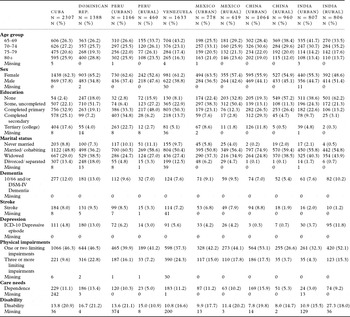
The participants by site (Table 1)
Overall 15,022 interviews were completed, with a response rate of 86%, varying between 72% and 98% by site. Informant interviews could not be completed for 50 participants (0.3%). For 2,984 participants (19.9%) the selected informant was not co-resident, leaving 11,988 participants (79.8% of the full sample) with completed co-resident informant interviews. The proportion of informants who were not co-resident varied significantly (p<0.001) between sites with relatively low proportions in urban China (8.3%) and rural China (4.2%), and high proportions in the Dominican Republic (30.9%) and rural Mexico (38.1%). The main characteristics of eligible participants are described in Table 1. The prevalence of dementia varied between 5.4% (rural China) and 13.0% (Dominican Republic). The prevalence of stroke (self-reported diagnosis) varied between 6.8% and 9.5% in most sites with lower prevalences in rural Peru (3.3%), rural China (1.9%), urban (2.0%) and rural (1.2%) India. The prevalence of ICD-10 depression varied between 3.0% and 6.2% in most sites, with higher prevalences in the Dominican Republic (13.0%) and rural India (11.8%) and much lower prevalences in urban (0.3%) and rural (0.7%) China. The prevalence of one or more physical impairments varied between 48.4% and 70.6% in most sites, with lower prevalences in rural China (30.3%) and urban India (36.6%). The prevalence of dependence varied between 9.2% and 15.9% in most sites with lower prevalences in rural Peru (5.0%), rural China (5.3%) and urban India (3.0%). Mean WHODAS 2.0 disability scores varied between 8.0 and 16.7 in most sites, but were substantially higher in rural India (27.3).
Participants’ sociodemographic status and the prevalence of chronic health conditions, dependency and disability by site

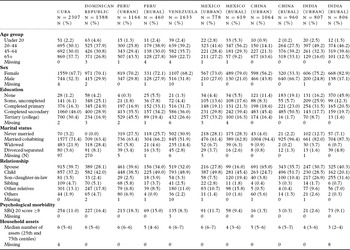
The co-resident informants by site (Table 2)
The characteristics of the 11,988 co-resident informants are provided in Table 2. In all sites other than urban China, where 65.8% of co-residents were aged 65 years or over, the majority of co-resident informants were younger than this, with around one third to one half aged 44 years or under. Informants were mainly children or children-in-law (40.7% to 64.8%) or spouses (16.0% to 40.3%) of the older participants, except in urban China (64.9% spouses and 28.5% children). Again with the sole exception of urban China, most informants were women. In most sites, the prevalence of co-resident informant psychological morbidity varied between 8.3% and 18.3%, with much lower prevalences in urban (1.5%) and rural (0.3%) China and urban India (2.6%). Rural China was excluded from further analysis because there were too few outcome cases.
Co-resident informant's sociodemographic and economic status, relationship and prevalence of psychological morbidity by site

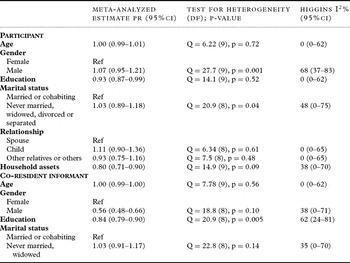
Co-resident informant psychological morbidity and other factors (Table 3)
After meta-analysis of estimates from multivariable Poisson working models, adjusting for chronic conditions in the older participant (dementia, stroke, depression and physical impairments), the prevalence of co-resident informant psychological morbidity was positively associated with female co-resident informant sex (PR 0.56; 95% CI 0.48–0.66), and inversely associated with household assets (PR 0.80; 95% CI 0.71–0.90), participant's education (PR 0.93; 95% CI 0.87–0.99) and co-resident's education (PR 0.84; 95% CI 0.79–0.90). There were no associations between co-resident psychological morbidity and participant's age, sex or marital status, co-resident's age or marital status, or the relationship between co-resident and older participant.
Meta-analyzed estimates PR (95% CI) of associations between co-resident informant psychological morbidity and the other factors

Associations between chronic conditions and co-resident informant depression
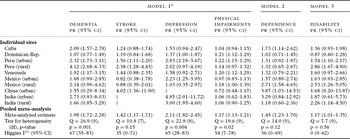
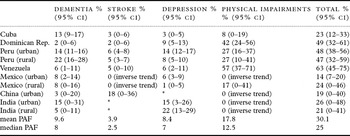
PRs for associations in each site are described in Table 4. When the adjusted PRs were meta-analyzed, the results clearly indicated that chronic health conditions among older participants were independently associated with co-resident informant psychological morbidity, with the highest pooled estimates for depression (PR 2.11; 95% CI 1.82–2.45) followed by dementia (PR 1.98; 95% CI 1.72–2.28), stroke (PR 1.42; 95% CI 1.17–1.71) and physical impairments (PR 1.17; 95% CI 1.13–1.21). Dependence (PR 1.45; 95% CI 1.23–1.70) and disability (PR 1.17; 95% CI 1.01–1.35) were also each independently associated with co-resident informant psychological morbidity, adjusting for all health conditions in the older participant, and participant and informant sociodemographic characteristics. Heterogeneity was significant for the associations with dementia and depression (Cochran's Q-test; P < 0.01). Higgins I2 values indicated high levels of heterogeneity of effect sizes between sites for dementia (67%) and depression (65%), moderate heterogeneity for physical impairments (54%), stroke (35%) and dependency (36%) and negligible heterogeneity for disability (0%). When PAFs were calculated between chronic health conditions and co-resident informant depression (Table 5), the mean PAPF for all chronic health conditions combined was 30.1%. The highest individual and independent contribution was that of physical impairments (17.8%), followed by dementia (9.6%), depression (8.4%) and stroke (3.9%).
Adjusted PRs (95% CI) for the associations between chronic health conditions and co-resident informant psychological morbidity

* Adjusted for participants’ and co-residents’ age, sex, education, marital status, relationship, and number of assets, other health conditions (Model 1) or all health conditions (Models 2 and 3)
†Too few participants exposed to estimate the effect
PAFs (95% CIs) of chronic health conditions to co-resident informant psychological morbidity by site

*Too few participants exposed to estimate the effect
PAF = population attributable fraction
Mediation of effects through dependence and disability
Associations between chronic health conditions and co-resident informant depression were reduced but remained significant when dependence or disability was included in the adjusted models. Adjusting for dependence, the meta-analyzed effect size (PR) for dementia reduced from 1.98 to 1.63, that for stroke from 1.43 to 1.28, that for depression from 2.11 to 1.97 and that for physical impairments from 1.17 to 1.16. Adjusting for disability, the effect size (PR) for dementia fell to 1.63, that for stroke to 1.22, that for depression to 1.94 and that for physical impairments to 1.13. Using the full pooled dataset, all criteria for mediation were met, and Sobel-Goodman mediation tests were statistically significant at p < 0.001 for the mediation effects of both dependence and disability on all four health conditions. Disability mediated 11.6% of the effect of dementia on co-resident psychological morbidity, 15.0% of the effect of stroke, 3.2% of the effect of depression and 9.9% of the effect of physical impairment. Dependence mediated 18.0% of the effect of dementia, 17.2% of the effect of stroke, 2.3% of the effect of depression and 6.7% of the effect of physical impairment.
Discussion
In this study, we found evidence, after meta-analysis, of strong and independent associations between chronic conditions in older people (dementia, stroke, depression, physical impairments) and psychological morbidity in co-resident key informants selected on the basis of their close contact with the older participant. Overall, these chronic conditions accounted for a mean of 30% of the prevalence of co-resident psychological morbidity, with the largest individual contributions arising from physical impairment, followed by dementia, depression and stroke. The effects of each of the health conditions were modestly but statistically significantly mediated by disability and dependence. The extent of the mediation was generally greater for dependence than for disability, and for the effects of dementia and stroke. Very little of the effect of depression was mediated in this way.
Our studies were population-based, minimizing selection bias and increasing generalizability as compared with previous studies which used convenience samples. The relatively large sample sizes allowed quite precise estimations of effect sizes, particularly where pooled meta-analysis was feasible. The proportion of non-response was low. The same standardized protocol was used across the sites. We obtained detailed information on cognitive, psychological and physical morbidities, disability and care needs, and were able to adjust for relevant confounders including the relationship between the older participant and the co-resident informant, the sociodemographic and socioeconomic circumstances of the older person and the co-resident informant.
Many of the limitations of this study relate to the measures used. The outcome for co-residents, the SRQ-20, is a self-report measure of psychological symptoms, and does not purport to provide clinical diagnoses of depressive episode. Furthermore, validations across cultures have suggested differing cut-points – the most commonly identified cut-point of 8 or more was used across all 11 sites in our study. With this cut-point, strikingly low prevalences of co-resident psychological morbidity were seen in the Chinese catchment areas, and in urban India. In the absence of local validation of the instrument, we do not know if this reflects a true low prevalence of the psychological morbidity or is a measurement artifact. However, the low prevalence is consistent with that observed for the older participants in this site using the full GMS clinical interview, and, for China, with low prevalences observed in the World Mental Health Survey (Demyttenaere et al., Reference Demyttenaere2004). Different approaches were used to assess the different chronic health conditions. Dementia and depression were diagnosed on the basis of comprehensive structured clinical interviews, and, for dementia, cognitive tests and informant reports. Stroke was ascertained using self-reported diagnosis, while other physical conditions were ascertained only at the level of self-reported impairments. One might therefore expect a greater degree of misclassification for the physical health conditions, with a tendency towards under-ascertainment. If random, this misclassification would have led to an underestimation of the strength of any genuine association between the health state of the older person, and the co-resident's psychological comorbidity. Thus, PAPFs may also have been underestimated, compounded by any underestimate of true population prevalence. The relatively weak mediation of the effects of health conditions through dependence may also have been accounted for, in part, by random misclassification error. In the absence of any structured assessment with demonstrable cross-cultural reliability and validity, we used a pragmatic approach for identifying those with care needs based on open-ended probing questions and the interviewer's judgment at the end of an extensive assessment of the older person and the informant. The WHODAS 2.0 disability assessment is less likely to be limited in this way, given extensive evidence for cross-cultural measurement validity (Sousa et al., Reference Sousa2010).
Our findings are not easily compared with previous research, which has tended to focus on carers and to apply a hierarchical approach to considering and comparing the effects of different chronic morbidities on carer mental health. For these reasons, it is also not possible to make meaningful comparisons between the extent of psychological morbidity among co-residents in our studies with that recorded in research in high income countries. However, our pilot study data indicated that levels of carer strain, measured using the Zarit Burden Interview, were at least as high (10/66 Dementia Research Group, 2004). Our data suggest that the negative impact of chronic disease is not limited to those requiring care, given that associations were observed among the base population of all co-residents, and the mediating effects of dependence were relatively modest. Other mechanisms must also be in play. Neither do our data support the notion that the effect of dementia on co-resident psychological morbidity is particularly prominent compared with that of other chronic diseases. Indeed, at the population level, once the higher prevalence of physical impairments is taken into account in the estimation of the PAPF, the impact of physical impairments is larger. The important independent effect of depression in the older person on co-resident psychological morbidity is consistent with the previous very limited data on this topic (Rosenvinge et al., Reference Rosenvinge, Jones, Judge and Martin1998).
A UK national survey provides strong evidence for a clustering of psychological morbidity within households (Weich et al., Reference Weich, Holt, Twigg, Jones and Lewis2003), Mechanisms are unclear, and direct causality cannot be presumed. Shared genetic predisposition among co-residents who are blood relatives is one possibility. However, depression symptoms also correlate among older spouses (Dufouil and Alperovitch, Reference Dufouil and Alperovitch2000). Assortative mating may be implicated. However, important environmental risk factors; for example socioeconomic position, household overcrowding, adverse life events and impoverished social networks might affect older index participants and co-resident informants equally. There is also some evidence for clustering of chronic diseases (Stimpson and Peek, Reference Stimpson and Peek2005) and chronic disease risk factors (Stimpson et al., Reference Stimpson, Masel, Rudkin and Peek2006) among older spouses. Hence chronic disease among co-residents, which was not assessed in our study, may confound the associations between chronic physical impairments among older people and psychological morbidity in co-residents. There is also evidence from two longitudinal studies in the USA that increases in spousal depression symptoms (Tower and Kasl, Reference Tower and Kasl1996; Siegel et al., Reference Siegel, Bradley, Gallo and Kasl2004), and in physical disability, are independently associated with higher depression symptom scores in the index older person at follow-up (Siegel et al., Reference Siegel, Bradley, Gallo and Kasl2004). Demonstration of such longitudinal relationships suggests the possibility of a direct causal relationship, sometimes referred to as emotional contagion. The emotional contagion hypothesis is favored by the observation that associations are stronger among those with stronger spousal relationships (Tower and Kasl, Reference Tower and Kasl1996).
The prevalence of co-resident psychological morbidity is higher among co-residents of older people with chronic conditions. This effect was prominent for, but not confined to, depression and dementia. It is likely that the stress of living with and caring for elderly people with chronic conditions will be magnified in LAMIC where demographic aging is occurring rapidly and most of the care is provided by family members. Health services for the elderly in LAMIC will need to be configured to meet the needs of the elderly and to offer appropriate support to their co-residents.
Conflict of interest
None.
Description of authors' roles
All of the authors worked collectively to develop the protocols and methods described in this paper. MP leads the 10/66 Dementia Research Group and CPF acts as study co-ordinator. JJLR (Cuba), DA (Dominican Republic), MG (Peru), AS (Venezuela), ALS (Mexico), KSJ (Vellore, India), JW (Chennai, India), and YH (China) are principal investigators responsible for the field work in their countries. MH and CPF wrote the first draft of this manuscript and carried out the analyses. This was revised by MP. All other authors reviewed the manuscript, provided further contributions and suggestions, and approved the version submitted.
Acknowledgments
The 10/66 Dementia Research Group's research has been funded by the Wellcome Trust Health Consequences of Population Change Program (GR066133 – Prevalence phase in Cuba and Brazil; GR08002 – Incidence phase in Peru, Mexico, Argentina, Cuba, Dominican Republic, Venezuela and China), the World Health Organization (India, Dominican Republic and China), the US Alzheimer's Association (IIRG–04–1286-Peru, Mexico and Argentina), and FONACIT/CDCH/UCV (Venezuela). The Rockefeller Foundation supported our dissemination meeting at their Bellagio Centre. Alzheimer's Disease International has provided support for networking and infrastructure.
The 10/66 Dementia Research Group works closely with ADI, the nonprofit federation of 77 Alzheimer's associations around the world. ADI is committed to strengthening Alzheimer's associations worldwide, raising awareness regarding dementia and Alzheimer's disease, and advocating for more and better services for people with dementia and their carers. ADI is supported in part by grants from GlaxoSmithKline, Novartis, Lundbeck, Pfizer, and Eisai.