INTRODUCTION
European hake Merluccius merluccius (Linnaeus, 1758) (Merluccidae) occurs in the north-east Atlantic from Norway and Iceland to Mauritania, including the Mediterranean Sea (Froese & Pauly, Reference Froese and Pauly2014). The species is distributed over a wide depth range from only several metres along the coastline to 1000 m depth (Philips, Reference Philips2012) and is generally found on muddy bottoms (Froese & Pauly, Reference Froese and Pauly2014). European hake has historically been an important food for the population of western Europe (FAO, 2014) where it is mainly caught by demersal trawls, long lines and bottom-set gillnets. European hake has been reported as one of the most important target species for trawlers in the Ionian and Aegean Seas (Katsanevakis et al., Reference Katsanevakis, Maravelias and Vassilopoulou2010). Global capture production of European hake was almost 100,000 t in 2010 (FAO, 2014), with 892 t reported by Turkey (TUIK, 2012). There is a minimum landing size (MLS) of 27 cm total length (TL) in the European Union (EU, 2011) in order to protect juveniles of the species, with a 25 cm MLS for Turkish seas (Anonymous, 2012). Casey & Pereiro (Reference Casey, Pereiro, Alheit and Pitcher1995) reported that European hake is one of the most heavily exploited fish species in western European demersal fisheries and it is taken as part of mixed-species fisheries in the north-east Atlantic. European hake is also an important predator of deeper shelf-upper slope Mediterranean communities (Carpentieri et al., Reference Carpentieri, Colloca, Cardinalle, Belluscio and Ardizzone2005). Therefore, information on age, growth and reproduction of hake is of crucial importance for sustainable stock management. All these factors make the species valuable both ecologically and commercially.
There has been a large number of scientific studies on the biology and fisheries of European hake. Growth of European hake is included in many scientific papers (Alegria & Jukic, Reference Alegria and Jukic1990; Erzini, Reference Erzini1991; Campillo, Reference Campillo1992; Abella et al., Reference Abella, Auteri and Serena1995; Aldebert & Recasens, Reference Aldebert and Recasens1995; Alemany & Oliver, Reference Alemany and Oliver1995; D'Onghia et al., Reference D'onghia, Tursi, Matarrese and Sion1995; Stergiou et al., Reference Stergiou, Christou, Georgopoulous, Zenetos, Souvermezoglou, Ansell, Gibson and Barnes1997; Bouaziz et al., Reference Bouaziz, Bennoui, Djabali and Maurin1998; Uçkun et al., Reference Uçkun, Toğulga and Taşkavak2000; Zoubi, Reference Zoubi2001; Garcia-Rodriquez & Esteban, Reference Garcia-Rodriquez and Esteban2002; Pineiro & Sainza, Reference Pineiro and Sainza2003; Randall, Reference Randall2003; Mellon-Duval et al., Reference Mellon-Duval, Pontual, Metral and Quemener2010). Reproduction of the species was a focus of many researchers (Cohen et al., Reference Cohen, Inada, Iwamoto and Scialabba1990; Muus & Nielsen, Reference Muus, Nielsen, Dahlstrom and Nystrom1999; Akalın, Reference Akalın2004; Murua & Motos, Reference Murua and Motos2006; Khoufi et al., Reference Khoufi, Ferreri, Jaziri, El Fehri, Gargano, Mangano, Meriem, Romdhane, Bonanno, Aronica, Genovese, Mazzola and Basilone2014). Feeding habits of European hake were reported by Carpentieri et al. (Reference Carpentieri, Colloca, Cardinalle, Belluscio and Ardizzone2005), Cartes et al. (Reference Cartes, Hidalgo, Papiol, Massutí and Moranta2009) and Philips (Reference Philips2012).
The current study reports the first reproduction length and age, mortality and exploitation ratios for European hake for the first time from the central Aegean Sea. These data are lacking in the scientific literature for the central Agean region, and this study is the first to address this deficiency.
MATERIALS AND METHODS
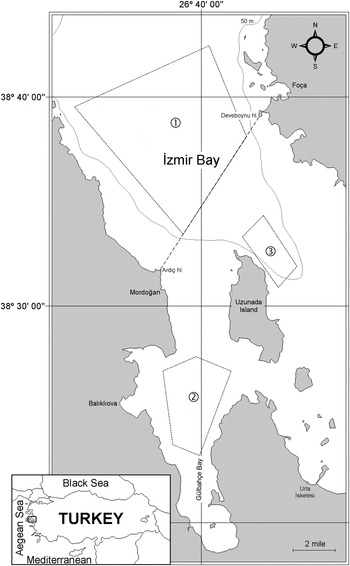
Fish samples (n = 2108) were collected between July 2004 and June 2007 by the RV ‘Egesüf’ which belongs to Ege University Faculty of Fisheries from İzmir Bay. The study area involved three sub-areas: Sub-area 1: opened for all commercial fishing activities; sub-area 2: opened only for small-scale fisheries (gillnets and long lines etc.) but closed for trawlers and purse seiners; sub-area 3: military zone, which is opened only for scientific studies but prohibited for all commercial fishing activities (Figure 1). Demersal trawl gear used was a traditional trawl net with a 5 m codend (600 meshes at the circumference of the codend), made of knotted polyethylene material with 40 mm mesh size netting, with a codend liner of 8 m length made of knotless polyamide material with 22 mm mesh size netting in order to capture smaller individuals (Tosunoğlu et al., Reference Tosunoğlu, Kaykaç, Aydın and Tokaç1996). Hauling time was determined as the time between the end of steel rope release and the start of haul back. Each of the operations took 1 h and hauling speed was 2.2–2.4 nautical miles/h.
The study area.

Total length (TL) was measured in the natural body position to the nearest millimetre. Total weight (W) and gonad weight (W g ) were measured to the nearest 0.01 g, and sex was recorded. Because hake is a relatively large species, lengths of the individuals were classified in 2 cm group intervals. Pooled data were used to draw annual length frequency diagrams. Sagittal otoliths were removed for each length group, cleaned, and stored dry in containers.
Studies regarding sex and maturity were carried out by macroscopic analysis of the gonads. Maturity stages were assigned in a 5-stage classification scheme: stage I immature, stage II resting, stage III developing, stage IV ripe and stage V spent (Gunderson, Reference Gunderson1993). The female to male (F:M) ratio was calculated using only mature individuals, and a chi-square (χ2) test was applied for determining the significance of the male to female ratio.
The length–weight relationship was calculated with the formula W = aL b , where W refers to total body weight (g), L is total length (cm) and a and b are coefficients (Ricker, Reference Ricker1973). The parameters (a and b) of the length–weight relationship were estimated according to linear regression analysis of log-transformed data. The degree of association between variables was calculated by the correlation coefficient (R 2).
Individuals (N = 698) only captured from the sub-area 1 were taken for age estimations. Because age data were used to calculate the fishing and total mortality and also exploitation ratios, data obtained from entirely or partially prohibited areas (sub-areas 2 and 3) were excluded to determine the actual circumstances of the stock. This dataset also included the minimum and the maximum individual including all size classes. Age estimations were made by two experienced independent readers who had not had prior access to information on size, sex or date of capture while they were counting growth increments. The dataset which was agreed by the independent readers was considered for the estimations. If the readings did not coincide, the otolith was rejected. Therefore otoliths of 409 individuals, covering all size classes, were used for determining the age. Some otoliths, which were hard to observe because of calcium accumulation on their surfaces, were prepared for age readings by sectioning, rubbing and polishing. They were embedded in polyester moulds, cut by an Isomet lowspeed saw, polished with sandpaper (types 400, 800 and 1200), finally polished with 3, 1 and ¼ μ particulate alumina (Metin & Kınacıgil, Reference Metin and Kınacıgil2001) and determination was performed on these sections. This process was performed by using a stereoscopic zoom microscope under reflected light against a black background. Opaque and transparent rings were counted; 1 opaque zone together with 1 translucent zone was considered as the annual growth indicator.
Standard non-linear optimization methods (Sparre & Venema, Reference Sparre and Venema1998) were used for estimating the growth and von Bertalanffy growth function was applied to size-at-age data. The function L t = L ∞ [1 − e−k(t−to)] was fitted to the data, where L t is the fish length (cm) at time t (year), L ∞ is the asymptotic length (cm), k is the growth coefficient (year−1), and t o (year) is the hypothetical time at which the length is equal to zero. In addition, accuracy of the growth parameters was examined using Munro's growth performance index (φ′ = log(k) + 2log(L ∞ )) and the t-test (Pauly & Munro, Reference Pauly and Munro1984).
The spawning period was established based on monthly variation in the gonadosomatic index (GSI, %) using the equation GSI = [W g /(W − W g )] × 100, where W g is the gonad weight (g) and W is the total weight (g) of the fish (Ricker, Reference Ricker1975). Length at first maturity (Lm) was defined as the length at which 50% of the population investigated was near spawning (King, Reference King1996). The length at 50% maturity was determined with the L50 computer program logit function (İlkyaz et al., Reference İlkyaz, Metin and Kınacıgil1998). The equations r(l) = exp(a + bl)/(1 + exp(a + bl)) and L m = −a/b were applied, where r(l) is the proportion of matures in each length class (%), l is the fish length (cm), a is intercept and b is slope.
The instantaneous rate of total mortality (Z = −ln(S)) was estimated by fitting the survivors ratio (S) between N t +1 and N t (Ricker, Reference Ricker1975). Equation M = β× k was used to estimate the natural mortality rate (M), where β varied from 1.3 to 2.1, and k is the growth coefficient (Jensen, Reference Jensen1996). β was estimated from the equation β = (3 − 3ω)/ω, where ω is the mean critical length to asymptotic length ratio according to fish family (for all species ω = 0.620) (Cubillos, Reference Cubillos2003). The fishing mortality rate (F) was calculated from F = Z–M, and the exploitation ratio (E) from E = F/Z.
RESULTS
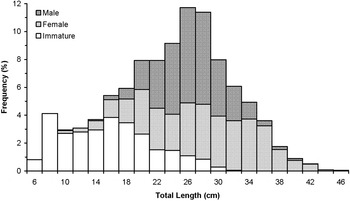
A total of 2108 European hake individuals were sampled during the study, including 792 mature females, 707 mature males and 609 immature individuals that were excluded from the sex ratio determination. Female:male ratio was calculated as 1:0.89. Chi-square analysis indicated a significant difference between number of males and females (χ2, P < 0.05). The lengths of fish ranged from 5.2 cm (April) to 45.5 cm TL (Figure 2). Males ranged from 10.4 to 40.1 cm and females varied from 9.0 to 45.5 cm. The mean length of the whole sample was 23.8 ± 0.2 cm, while 26.3 ± 0.2 and 27.7 ± 0.2 cm were determined for males and females respectively. It was also found that number of males decreased after a certain length (Figures 2 & 3). Furthermore the mean weight of all samples was found as 136.3 ± 2.6 g, while 150.1 ± 2.6 g was obtained for males and 195.6 ± 4.9 for females.
Length–frequency graph of European hake.

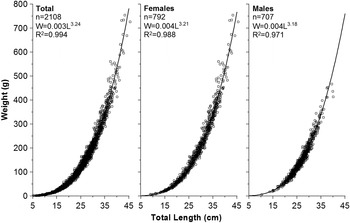
Length–weight graph of European hake for total, female and male individuals studied.

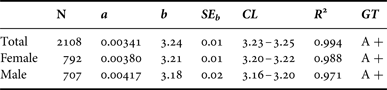
The length–weight relationship was W = 0.00341L 3.24 (R 2 = 0.994) for all individuals (Figure 3), with positive allometric growth observed for females, males and all individuals (t-test, P < 0.05; Table 1).
Length-weight relationship of European hake.

N, number of individuals; a and b, intercept and slope of the relationship; R 2, coefficient of determination; SE b , standard error of slope; CL, 95% confidence limits; GT, growth type (A + : positive allometry).
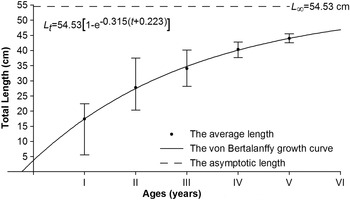
It was determined that age of the stock ranged from 1 to 5 years. Length of the individuals taken for age estimations ranged from 5.6 to 45.5 cm TL with a mean length of 23.8 ± 0.3 cm. The growth, length and weight at infinity were calculated as L ∞ = 54.53 cm and W ∞ = 1455.77 g respectively. In addition, growth coefficient was found to be k = 0.315 y−1 and t o = −0.223 y (a = 14.735, b = 0.730, R 2 = 0.991) (Figure 4) is the value calculated for the age before birth. The last finding for the stock concerning growth was the growth performance index which was determined as φ′ = 2.972.
The von Bertalanffy growth curve with maximum and minimum length of the European hake in the central Aegean Sea.

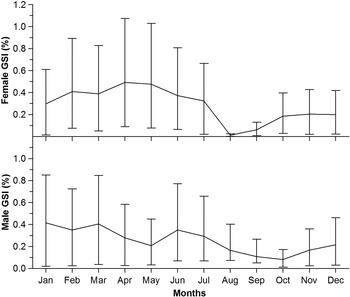
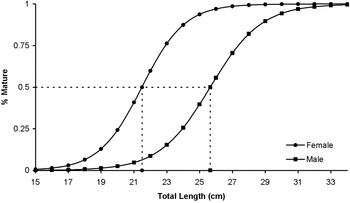
High GSI values were detected over most of the year, but were at a minimum from August to October, whilst individuals ready for spawning were observed mostly between December and May, peaking in April (Figure 5). Monthly changes in confidence intervals, straightening during resting period and widening during spawning, support the determined spawning period of the species. While gonad formation occurred at 10.4 cm in males and 9.0 cm for females, mature gonads were detected at 15.0 and 9.0 cm for males and females respectively. Moreover, length and age at first reproduction were: L m = 21.49 ± 0.58 cm and 1 year (a = −16.517, b = 0.769, R 2 = 0.907) for females, L m = 25.65 ± 0.80 cm and 2 years (a = −16.543, b = 0.645, R 2 = 0.833) for males (Figure 6).
Monthly average gonadosomatic index (GSI) values (%) with standard error for females and males of the European hake in the central Aegean Sea.

First reproduction length of European hake according to sex.

We estimated total mortality Z = 1.539 y−1 and natural mortality M = 0.579 y−1. This resulted in an estimated rate of fishing mortality F = 0.959 y−1. Finally, we estimated exploitation rate E = 0.624.
DISCUSSION
A total of 2108 individual European hake were examined during the study. Total number of captured specimens and the range of minimum and maximum lengths (TLmin = 5.2, TLmax = 45.5 cm) indicate an efficient and effective sampling. Our data indicated that females dominated the stock in terms of number. Similarly, Akalın (Reference Akalın2004) reported the female to male ratio as 1:0.31 from Edremit Bay, North Aegean Sea. Length–weight relationship of the stock led us to conclude there was positive allometric growth for both sexes separately and combined. There have been many studies reporting the length–weight relation of the species (Table 2). Parameters from the numerous studies show minor variations related to study area, year, sampling period, physical and environmental conditions faced by the different stocks. While most parameters from the published studies are comparable, Özaydın et al.'s (Reference Özaydın, Uçkun, Akalın, Leblebici and Tosunoğlu2007) value for the intercept parameter is two orders of magnitude larger than all other studies. We feel this must be attributable to a typographical error.
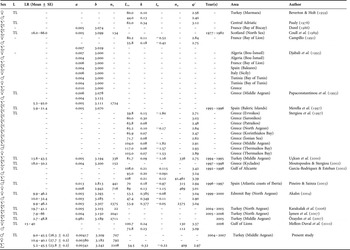
Length-weight relationship and the growth parameters of previous studies for European hake.

–, not given; ♂, ♀ and ∑, male, female and total; L, length type (TL: total length); LR, length range (cm); SE, standard error of mean length (cm); a, b and n 1, intercept and slope of the length-weight relationship, and sample size; L ∞, k, t o, n 2 and φ′, asymptotic length (cm), growth coefficient (y−1), hypothetical time at which the length is equal to zero (y), sample size and Munro's phi prime index value; Year(s), sampling year/years.
Even though macroscopic analysis is not satisfactory for distinguishing between immature, maturing and resting females (Murua et al., Reference Murua, Kraus, Saborido-Rey, Witthames, Thorsen and Junquera2003; Vitale et al., Reference Vitale, Svedang and Cardinale2006; Domínguez-Petit, Reference Domínguez-Petit2007; Recasens et al., Reference Recasens, Chiericoni and Belcari2008; Ferreri et al., Reference Ferreri, Basilone, D'Elia, Traina, Saborido-Rey and Mazzola2009), Khoufi et al. (Reference Khoufi, Ferreri, Jaziri, El Fehri, Gargano, Mangano, Meriem, Romdhane, Bonanno, Aronica, Genovese, Mazzola and Basilone2014) stated a good correspondence of immature females between macroscopic and histological reproductive phase identification, confirming the skill of the operators. Although we did not perform histological reproductive analysis in our study, our results concerning GSI values are similar with those of Khoufi et al. (Reference Khoufi, Ferreri, Jaziri, El Fehri, Gargano, Mangano, Meriem, Romdhane, Bonanno, Aronica, Genovese, Mazzola and Basilone2014), both indicating a protracted spawning season throughout the year peaking in April. Moreover, previous histological investigation of ovaries showed that European hake exhibits indeterminate fecundity and spawns year-round with peak spawning occurring in January–March (Murua & Motos, Reference Murua and Motos2006). Likewise, Akalın (Reference Akalın2004) stated that reproductive activity of European hake occurred throughout the year with peak reproduction from December to March in Edremit Bay. Reproductive period of the species was given in January–June for Mediterranean and February–May for Bay of Biscay by Cohen et al. (Reference Cohen, Inada, Iwamoto and Scialabba1990). Muus et al. (Reference Muus, Nielsen, Dahlstrom and Nystrom1999) reported that reproduction of European hake occurred from January to June for Mediterranean, North Sea, Scotland and West of Iceland. April–June was determined as the reproductive period of European hake for Ireland, January–March for Morocco and May–August for Scotland by Svetovidov (Reference Svetovidov, Whitehead, Bauchot, Hureau, Nielsen and Tortonese1986). Pineiro & Sainza (Reference Pineiro and Sainza2003) found the timing of European hake reproduction in Spain ranged from December to May. Variation in reproductive period of European hake from the above listed studies likely is attributable to regional discrepancies.
Hake ageing is often viewed as problematic and more studies are required for further information. In this study agreement of the independent age readers on the same data et was considered to confirm the age estimations. Moreover otoliths were also sectioned in order to make a accurate estimation when too much calcium accumulation was observed on the surface of the otolith. We determined the age range of the samples was 1–5 years old. This agrees with Akalın (Reference Akalın2004), who reported individuals from 0–5 years old. Garcia-Rodriguez & Esteban (Reference Garcia-Rodriquez and Esteban2002) mentioned a high correlation between the rings counted in the otoliths and the length of the individual in cm. They also reported that sex did not affect the relationship between the counted rings and the length unless the unsexed individuals were included. There have been a large number of scientific studies on the growth of the species (Table 2). L ∞ and k were found to be 54.53 cm and 0.32 y−1 in the present study, values that are relatively different from many estimated from the eastern Mediterranean and other studied areas. L ∞ were reported as varying between 44–108 cm for males and 53.5–108 cm for females. Similarly, other studies reported k values varying between 0.06–0.385 y−1. We believe this variation is due to the different growing rates of female and male individuals, and environmental factors closely affecting growth as well as fishing activity selecting the larger individuals. In addition, depth of the sampling area also influences the growth as larger individuals migrate to deeper waters. Another point of this discrepancy may be attributed to variation in growth across years. However, our results on growth parameters are in accordance with the studies conducted in Edremit Bay and Sea of Marmara. Phi-prime index values of the published studies calculated using reported parameters ranged between 2.40 and 3.12. This compared with our study's phi-prime index value of 2.97. No statistically significant difference has been determined between the growth performance index values of our study and the published studies.
Mellon-Duval et al. (Reference Mellon-Duval, Pontual, Metral and Quemener2010) reported from a tagging experiment that growth rate in hake varied with size and sex. The estimated growth parameter (von Bertalanffy k) was estimated as double previously published values based on size frequency distribution in the Gulf of Lions. They also mentioned that male and female growth rates clearly differ in the Gulf of Lions from the second year of life, when the fish first matures and growth rate by sex decreased to a similar level once fish had attained sexual maturity. Furthermore, growth rate of European hake was reported by Arneri & Morales-Nin (Reference Arneri and Morales-Nin2000) from the central Adriatic. They reported that juveniles reached 15 cm TL in 1 year which corresponds to 1.6 cm growth per month. This result differs from Mellon-Duval et al. (Reference Mellon-Duval, Pontual, Metral and Quemener2010) who determined the monthly growth rate as 1.1 cm for combined sexes, 1.2 and 0.9 cm for females and males respectively.
Formation of gonads in females and males was determined to occur at 9.0 and 10.4 cm total length respectively. Moreover, 21.5 cm (females) and 25.7 cm (males) total length values were found to be length at first reproduction. These values differ from those reported by Akalın (Reference Akalın2004) of 33.6 cm for females and 27.8 cm for males. While the difference for males is relatively small, there appears to be a considerable discrepancy in the length of first reproduction for females between the two studies. The reason for this marked difference may be attributed to sampling procedures, geographical disparity and the sampling year of the studies. For the present work, it was also determined that the age at first reproduction was 2 years in males and 1 year in females. Similarly, Mellon-Duval et al. (Reference Mellon-Duval, Pontual, Metral and Quemener2010) reported that European hake grows rapidly and hake would mature earlier than previously thought: at age 2 for both sexes, instead of at age 3 or 4 as currently accepted for the Mediterranean. Nevertheless Pineiro & Sainza (Reference Pineiro and Sainza2003) reported the first reproduction length and age of males as 32.8 cm total length and 2–3 years while these parameters were 45.4 cm and 4–5 years for females in Spain-Iberia. Disparity between these findings is considered to be grounded on regional discrepancies and sampling procedure as well as the genetic variations. Total mortality ratio of the stock was calculated as Z = 1.539 y−1, while natural and fishing based mortality ratio were M = 0.579 y−1 and F = 0.959 y−1 respectively. Exploitation ratio (E) of the stock was also calculated and found to be 0.624 as a result of high fishing base mortality ratio in the total mortality ratio. Consequently, high catch pressure was determined on the species when calculated exploitation ratio of the stock is taken into consideration.
The goal of the present study was to investigate the length distribution, length-weight relationship, age, growth, spawning period, first maturity age and length of European hake in the central Aegean Sea and to compare these results with those of previous studies. As known so far, fishing fleets have been targeting this valuable species for many years, especially in the Mediterranean. Therefore, additional research is required in order to expand our knowledge of the biology, ecology and fisheries on this species.
ACKNOWLEDGEMENTS
We would like to thank Marga McElroy for revising the English text.
FINANCIAL SUPPORT
The present study was carried out with financial support from The Scientific and Technological Research Council of Turkey (TUBITAK) project 103Y132 and Ege University Science and Technology Center (EBİLTEM) project 2005/BİL/003.