Introduction
Substance dependence and pathological gambling (PG) have similarities at the phenotypcial and endophenotypical level (Tamminga & Nestler, Reference Tamminga and Nestler2006). At the phenotypical level, both PG and substance dependence are disorders characterized by a lack of self-regulation (Goldstein et al. Reference Goldstein, Volkow, Wang, Fowler and Rajaram2001; Goldstein & Volkow, Reference Goldstein and Volkow2002). Although classified as an impulse control disorder, PG is regarded as a ‘behavioral addiction’ by some researchers (Marks, Reference Marks1990; Blanco et al. Reference Blanco, Moreyra, Nunes, Saiz-Ruiz and Ibanez2001), and several PG criteria in the Diagnostic and Statistical Manual of Mental Disorders (DSM-IV-TR) resemble those of substance dependence, such as loss of control, tolerance, withdrawal, and the experience of negative consequences due to gambling-related behavior (APA, 1994). Diminished self-regulation is displayed when an addicted person is not able to inhibit the urge for a desired drug or behavior, and to shift his or her behavior from the addictive reinforcement to a less self-destructive reinforcement. At the endophenotypical level, diminished neurocognitive self-regulatory functions have been found in substance dependence and PG (Horner et al. Reference Horner, Waid, Johnson, Latham and Anton1999; Paraherakis et al. Reference Paraherakis, Charney and Gill2001; Bechara & Damasio, Reference Bechara and Damasio2002; Bolla et al. Reference Bolla, Eldreth, London, Kiehl, Mouratidis, Contoreggi, Matochik, Kurian, Cadet, Kimes, Funderburk and Ernst2003; Goudriaan et al. Reference Goudriaan, Oosterlaan, De Beurs and van den Brink2006), and recent neuroimaging studies show abnormalities in the brain reward circuitry in substance dependence and PG (Kubota et al. Reference Kubota, Nakazaki, Hirai, Saeki, Yamaura and Kusaka2001; O'Neill et al. Reference O'Neill, Cardenas and Meyerhoff2001; Bolla et al. Reference Bolla, Eldreth, London, Kiehl, Mouratidis, Contoreggi, Matochik, Kurian, Cadet, Kimes, Funderburk and Ernst2003; Potenza et al. Reference Potenza, Leung, Blumberg, Peterson, Fulbright, Lacadie, Skudlarski and Gore2003; Reuter et al. Reference Reuter, Raedler, Rose, Hand, Glascher and Buchel2005).
Alcohol and drug dependence are disorders with a chronic course, and periods of remission are often followed by relapse (APA, 1994; Hser et al. Reference Hser, Hoffman, Grella and Anglin2001; Delucchi et al. Reference Delucchi, Matzger and Weisner2004). Understanding relapse and the predictors of relapse is of scientific interest in the study of the long-term course of addictive behaviors, and of practical relevance for the planning and evaluation of treatment. Although the DSM-IV-TR characterizes PG as a progressive and chronic disorder, and relapse is considered an important issue in the study of PG, research into this topic is scarce (Blaszczynski et al. Reference Blaszczynski, McConaghy and Frankova1991; National Research Council, 1999; Ledgerwood & Petry, Reference Ledgerwood and Petry2006).
In substance dependence research, factors affecting relapse and treatment outcome have been studied quite extensively. Several studies reported that a higher severity of dependence was predictive of relapse (Babor et al. Reference Babor, Cooney and Lauerman1987; Langenbucher et al. Reference Langenbucher, Sulesund, Chung and Morgenstern1996; Simpson et al. Reference Simpson, Joe, Fletcher, Hubbard and Anglin1999; but see: Allsop et al. Reference Allsop, Saunders and Phillips2000; Bottlender & Soyka, Reference Bottlender and Soyka2005). Higher levels of self-reported impulsivity are also found to be predictive of relapse and early treatment drop-out in substance dependence (Moeller et al. Reference Moeller, Dougherty, Barratt, Schmitz, Swann and Grabowski2001; Doran et al. Reference Doran, Spring, McChargue, Pergadia and Richmond2004). Other studies in substance-dependent populations indicate that deficiencies in neurocognitive functions have a negative effect on the outcome of interventions such as early drop-out (Teichner et al. Reference Teichner, Horner, Roitzsch, Herron and Thevos2002; Aharonovich et al. Reference Aharonovich, Nunes and Hasin2003), shorter length of treatment adherence (Fals-Stewart & Schafer, Reference Fals-Stewart and Schafer1992; Fals-Stewart, Reference Fals-Stewart1993), smaller benefits of treatment interventions (Smith & McCrady, Reference Smith and McCrady1991; Teichner et al. Reference Teichner, Horner and Harvey2001), and higher relapse rates (Tapert et al. Reference Tapert, Brown, Myers and Granholm1999; Allsop et al. Reference Allsop, Saunders and Phillips2000; Bowden-Jones et al. Reference Bowden-Jones, McPhillips, Rogers, Hutton and Joyce2005). A recent fMRI study indicated that relapse in a group of metamphetamine-dependent patients was associated with less activation in the dorsolateral prefrontal cortex, temporal cortex, as well as less activation in the anterior cingulate cortex, brain areas important for functions such as inhibitory control and decision-making processes (Paulus et al. Reference Paulus, Tapert and Schuckit2005).
Given the findings in alcohol and drug dependence relapse studies, this study will focus on impulsivity and disinhibition as a factor in the relapse of PG. From a theoretical point of view, the ability to refrain from gambling, and not to give in to impulses, can be viewed as a cardinal feature influencing the course of PG. In the field of neuropsychology, the tendency to act upon acute impulses is referred to as disinhibition, whereas in personality theories it is referred to as impulsivity (Bachorowski & Newman, Reference Bachorowski and Newman1990; Zuckerman et al. Reference Zuckerman, Kuhlman, Joireman, Teta and Kraft1993). In the remainder of this paper, the term disinhibition will be used to refer to both processes.
The second neurocognitive factor included in this study as a predictor of relapse in PG is decision-making under conflicting contingencies. A large body of research indicates that in substance dependence and in PG abnormalities exist in the ‘reward circuitry’ of the brain (e.g. Kambouropoulos & Staiger, Reference Kambouropoulos and Staiger2001; Martin-Soelch et al. Reference Martin-Soelch, Leenders, Chevalley, Missimer, Kunig, Magyar, Mino and Schultz2001; Volkow et al. Reference Volkow, Wang, Maynard, Fowler, Jayne, Telang, Logan, Ding, Gatley, Hitzemann, Wong and Pappas2002b; Reuter et al. Reference Reuter, Raedler, Rose, Hand, Glascher and Buchel2005), and in neurocognitive tasks tapping into decision-making with conflicting reward and punishment contingencies, in which short-term and long-term rewards and punishments have to be weighed (e.g. Monterosso et al. Reference Monterosso, Ehrman, Napier, O'Brien and Childress2001; Bechara et al. Reference Bechara, Dolan and Hindes2002; Goudriaan et al. Reference Goudriaan, Oosterlaan, de Beurs and van den Brink2005). Specifically, neurobiological studies indicate that diminished dopamine receptor availability (due to substance dependence or as a pre-existing vulnerability) causes a chronic reward deficiency in the brain, resulting in a vulnerability to engaging excessively in rewarding behaviors to normalize this deficient state (Goldstein & Volkow, Reference Goldstein and Volkow2002; Volkow et al. Reference Volkow, Fowler, Wang and Goldstein2002a). In neurocognitive studies of decision-making, substance-dependent and PG groups show a preference for immediate smaller rewards at the expense of delayed bigger rewards, or display behavioral strategies that lead to short-term rewards but long-term losses (Monterosso et al. Reference Monterosso, Ehrman, Napier, O'Brien and Childress2001; Bechara et al. Reference Bechara, Dolan and Hindes2002; Goudriaan et al. Reference Goudriaan, Oosterlaan, de Beurs and van den Brink2005). It can be argued that the ‘reward deficiency syndrome’ will also result in a vulnerability to relapse, since the reward deficiency will lead treated patients to seek behaviors that normalize this deficient state, such as using drugs, or gambling (Volkow et al. Reference Volkow, Fowler, Wang and Goldstein2002a). Empirical evidence for this argument comes from a study that showed that diminished performance on a decision-making task that involves the weighing of short-term rewards against long-term losses, was related to relapse in a group of alcohol-dependent patients (Bowden-Jones et al. Reference Bowden-Jones, McPhillips, Rogers, Hutton and Joyce2005). Another study indicated that lower dopamine receptor responsivity after treatment for alcohol dependence was a predictor for relapse (Markianos et al. Reference Markianos, Lykouras, Moussas and Hatzimanolis2001). Thus, both neurocognitive and neurobiological indicators of decision-making and reward-processing are predictors of relapse in alcohol dependence. In this study, therefore, we focused on decision-making with conflicting reward and punishment contingencies as a second predictor of relapse in PG.
In the literature, a distinction is often made between phenotypes (the disorder as it appears) and endophenotypes (functions that underlie a disorder). In general, self-report measures are viewed as indicators of the phenotype of the disorder, whereas neurocognitive, and neurobiological dispositions, are viewed as endophenotypical indicators of the disorder. Other examples of endophenotypical indicators are electroencephalogram measures of attentional bias (Waters et al. Reference Waters, Shiffman, Sayette, Paty, Gwaltney and Balabanis2003), and the neuropharmacological effects on craving (Monti et al. Reference Monti, Rohsenow, Hutchison, Swift, Mueller, Colby, Brown, Gulliver, Gordon and Abrams1999). Reviews suggest that endophenotypes may have a stronger prognostic value for the course of addictions and other mental health problems than phenotypical indicators (Gottesman & Gould, Reference Gottesman and Gould2003; Ooteman et al. Reference Ooteman, Verheul, Naasila, Daoust, Schippers, Koeter and van den Brink2005). In the current study, both endophenotypical (neurocognitive: inhibition and decision-making under conflicting contingencies) and phenotypical (self-report measures on impulsivity and reward sensitivity) concepts were studied.
In this naturalistic follow-up study, the presence or absence of relapse was investigated in a PG group, 1 year after treatment. Logistic regression analysis was performed, to investigate the predictive value of self-reported and neurocognitive measures of inhibition and decision-making on relapse in PG. Duration of disorder was included as a third predictor, since this factor has consistently been found to be associated with relapse (Langenbucher et al. Reference Langenbucher, Sulesund, Chung and Morgenstern1996; Simpson et al. Reference Simpson, Joe, Fletcher, Hubbard and Anglin1999), and since a chronic course of the disorder is likely to be related to the future course of the disorder.
Method
Participants
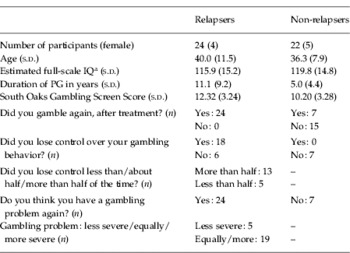
The participants in this study were adult out-patient pathological gamblers (n=46) who, at baseline, were abstinent from gambling for less than 3 months. Sample characteristics are displayed in Table 1. No significant differences in demographical data were observed between the relapsed and non-relapsed patients (age, p=0.18; gender, p=0.64; estimated IQ, p=0.27). All of the pathological gamblers received an intake in an out-patient addiction treatment center, in Amsterdam, The Netherlands, and were enrolled in cognitive behavioral treatment for pathological gambling. The neurocognitive assessments were made during the first 2 weeks of cognitive behavioral treatment. Of the 53 pathological gamblers tested, 46 were reached for the follow-up assessment (87%). The seven participants who could not be traced did not differ from those who were retested in terms of age, estimated IQ, and length of PG in years (two-tailed Mann–Whitney U tests, significance values 0.46, 0.87, and 0.18, respectively).
Sample characteristics (n=46)

IQ, Intelligence quotient; s.d., standard deviation; PG, pathological gambling.
a The estimated IQ was based on two subtests of the Wechsler Adult Intelligence Scale (Vocabulary and Block Design). These two subscale scores correlate in the 0.90s with the full-scale WAIS score (Groth-Marnat, Reference Groth-Marnat1997).
This paper is part of a larger study into neurocognitive functions in PG, in comparison to normal controls, alcohol dependents, and Tourette syndrome patients. A paper regarding neurocognitive deficits in PG compared with these groups was published elsewhere (Goudriaan et al. Reference Goudriaan, Oosterlaan, De Beurs and van den Brink2006). The current study focused on follow-up data of the PG group.
Recruitment and screening methods
The participants were diagnosed according to DSM-IV PG criteria, using the Dutch version of section T of the DSM-IV Diagnostic Interview Schedule (Robins et al. Reference Robins, Cottler, Bucholz and Compton1998). Co-morbid lifetime substance abuse or dependence was diagnosed with section L of the Composite International Diagnostic Interview (WHO, 1997). Since substance abuse and dependence could influence neurocognitive functions, these conditions were exclusion criteria in this study. Further exclusion criteria were: (1) a history of major psychiatric disorders (schizophrenia, psychotic episodes, bipolar depressive disorder, and hospitalization for psychiatric disorders), (2) physical conditions known to influence cognition or motor performance, and (3) the use of psychotropic medication which could not be discontinued.
Relapse
The PG treatment consisted of 10 sessions of 2 hours including cognitive behavioral group therapy, focusing on motivations for stopping gambling, strategy development to cope with the urge to gamble, evaluation of risk situations and coping strategies, and explanation of randomness of chance. Relapse was assessed through telephone interviews held approximately 1 year after baseline assessment (mean 14.2 months; range 11–14 months). Four questions pertaining to relapse into gambling were asked:
(1) After being treated for gambling problems, did you gamble again? (Yes/No);
(2) Did you experience a loss of control over gambling, when you engaged in gambling again? (Yes/No).
When answering in the affirmative, the person was asked:
(3) whether this occurred: (a) only a few times, (b) about half of the time they gambled, or (c) most of the times they gambled;
(4) Do you think that you have a gambling problem again? (Yes/No).
When answering in the affirmative, the person was questioned as to whether they experienced:
(a) a less severe gambling problem, (b) a similar gambling problem, or (c) a more severe gambling problem, compared with the time that they sought help for their gambling problem.
Persons who answered ‘Yes’ to the question, ‘Do you think that you have a gambling problem again?’ (question 4) were categorized as relapsers (n=24), whereas those who indicated that they had no problems with gambling were categorized as non-relapsers (n=22). Answers to these questions for the relapsed and non-relapsed group are included in Table 1. These data indicate that the division in the two groups has high face validity, since the relapsers and the non-relapsers differed also in aspects such as loss of control, and severity of subjectively experienced gambling problems.
Neurocognitive measures
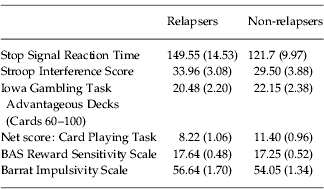
Means and standard errors of all predictors are depicted in Table 2.
Scores on neurocognitive and self-report measures of disinhibition and decision-making under conflicting contingencies
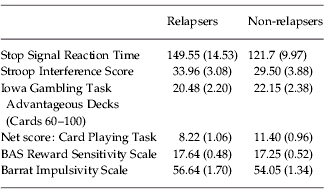
BAS, Behavioral activation scale.
Values are mean (s.e.).
Disinhibition
The measurement of disinhibition consisted of two tasks: Stop Signal Task and Stroop Color-Word task.
A measure of prepotent response inhibition, the Stop Signal Reaction Time (SSRT) is derived from the Stop Signal Task and described more elaborately in Logan et al. (Reference Logan, Cowan and Davis1984) and Scheres et al. (Reference Scheres, Oosterlaan and Sergeant2001). Six blocks of 64 trials were administered: the first block consisted of only Go trials; subsequent blocks comprised both Go trials (75%) and Stop trials (25%). Go trials required the subjects to perform a two-choice reaction time task in which subjects had to react as quickly as possible to an airplane appearing on the screen by a right button press (airplane flying to the right) or a left button press (airplane to the left). Stop trials were identical to Go trials but in addition an auditory stop signal was presented requiring subjects to inhibit their response. Stop signals were presented using a tracking algorithm which accomplished 50% successful inhibition for each subject by varying the delay between presentation of the airplane and the stop signal. The dependent measure was the SSRT, which measures the latency of the inhibitory response. Higher SSRTs reflect worse inhibitory control (slower inhibitory processes).
A measure of interference control, the Stroop Color-Word Task (Stroop, Reference Stroop1935; Hammes, Reference Hammes1971) consists of three cards which are presented consecutively. On the first card color words are printed in black. The subject has to name the words as quickly as possible. The second card consists of colored rectangles, and the colors have to be named. The last card consists of color words which are printed in an ink color differing from the name of the color word. In this last condition, the automatic process of reading has to be inhibited, and the ink color in which the words are printed has to be named. The dependent variable of this task was the interference score: time in seconds needed to read the third card minus time needed to read the second card.
Decision-making under conflicting contingencies
Decision-making abilities were measured with two tasks: The Iowa Gambling Task and the Card Playing Task.
The total number of cards picked from the advantageous decks during the last stages (last 40 cards), of a computerized Iowa Gambling Task (IGT), was taken as a measure of decision-making under conflicting contingencies (Bechara et al. Reference Bechara, Damasio, Damasio and Anderson1994). In the IGT, subjects had to choose between four decks of cards. Unbeknownst to the participant, two decks gave high rewards, but also resulted in high losses, and were disadvantageous in the long run. The other two piles gave lower rewards, but also lower losses, and resulted in a net gain in the long run. Respondents had to discover which decks were advantageous in the long run, and learn to select cards from the advantageous decks instead of choosing the more risky, disadvantageous decks.
The Card Playing Task was included as a measure of perseveration for reward (Newman et al. Reference Newman, Patterson and Kosson1987). In this task, a stack of cards was displayed on a computer screen. Number cards resulted in a loss of 50 eurocents. Face cards resulted in winning 50 eurocents. Participants could choose to play a card (response button 1) or choose to quit the task (response button 2). The task consisted of 10 blocks of 10 cards. In each block of cards, the ratio of wins to losses changed; the number of cards increased with one loss card in each block and decreased with one win card; in the first block the ratio of wins to losses was 9 to 1, in the second block 8 to 2, and so on. The net result when quitting the task was used as the dependent variable. The measures of decision-making are described more elaborately in Goudriaan et al. (Reference Goudriaan, Oosterlaan, de Beurs and van den Brink2005).
Self-report measures
Disinhibition
A Dutch version of the Barratt Impulsiveness Scale-11 (Patton et al. Reference Patton, Stanford and Barratt1995; Dutch version not published), of this 30-item scale (4-choice Likert-type) consists of three subscales: motor impulsiveness, attentional impulsiveness, and non-planning impulsiveness. Higher scores indicate higher disinhibition. Adequate reliability has been established for the Barratt Impulsivity Scale-11, with Cronbach's α between 0.79 and 0.83 (Patton et al. Reference Patton, Stanford and Barratt1995). For the purposes of this study, the full-scale score was used (Cronbach's α=0.81, in the current study).
Reward sensitivity
The BIS/BAS self-report scale was administered (Carver & White, Reference Carver and White1994; Dutch version: Putman et al. Reference Putman, Hermans and van Honk2004). This scale measures affective responses to impending rewards (BAS) or punishments (BIS) and contains 20 items, scored on a 4-point Likert scale. The BAS items are divided into three subcategories: BAS drive, BAS reward sensitivity, and BAS fun-seeking. The BAS reward sensitivity subscale (five items) was used in this study, because our primary research goal was to measure the influence of decision-making with conflicting contingencies on relapse, and the reward sensitivity subscale seemed to approach this concept most closely. Higher scores indicate higher reward sensitivity. Adequate reliability for the BAS reward sensitivity subscale (Cronbach's α=0.74) was established in this study.
Estimated IQ
The estimated IQ was based on two subtests of the Wechsler Adult Intelligence Scale (Vocabulary and Block Design), which correlate >0.90 with the full-scale IQ (Groth-Marnat, Reference Groth-Marnat1997). A minimum estimated IQ of 80 was used as an inclusion criterion.
PG duration
The number of years of PG as reported in the Diagnostic Interview Schedule was taken as an indication of PG duration.
Statistics
Logistic regression analysis was conducted to assess the extent to which the predictor variables were related to relapse. In the multivariate logistic regression model, duration of PG was entered first. After that, the self-report and neurocognitive measures were entered in order to estimate the additive predictive value of these measures on relapse. Effect estimates with two-tailed Wald-statistic p values were used. In the stepwise regression, the p value to enter was set at 0.05, and the p value to remove was set at 0.10 (Hosmer & Lemeshow, Reference Hosmer and Lemeshow2000).
To investigate whether multi-collinearity of the neurocognitive and the self-report measures could obscure the findings, correlations between these predictors were studied. The only significant correlations that were found were those between the two neurocognitive measures of disinhibition (r=0.36, p<0.01) and between the two neurocognitive decision-making measures (r=0.42, p<0.01). Multi-collinearity diagnostic statistics for the logistic model (tolerance values) were examined to exclude multi-collinearity due to interdependency between the neurocognitive predictor variables. High tolerance values may signal problematic multi-collinearity, which poses a threat to the validity of the logistic regression model. Collinearity statistics yielded tolerance values between 0.87 and 0.98, indicating that the validity of the regression model was not threatened by multi-collinearity. Therefore, the neurocognitive measures were entered separately in the logistic regression, instead of aggregating them into a single score for ‘disinhibition’ or ‘decision-making’.
Results
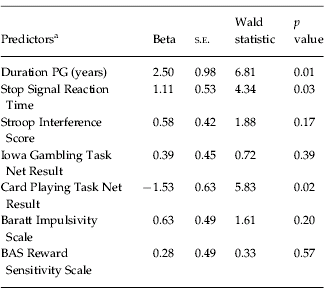
A test of the multivariate regression model with all predictors against a constant-only model was significant. Duration of the disorder significantly predicted relapse, χ2 (1, n=46)=8.73, p<0.01. The percentage explained variance with duration of PG as the only predictor was 24% (Nagelkerke R 2). In the next step, the disinhibition (SSRT, Stroop Color-Word Task) and decision-making (IGT, Card Playing Task) variables, and the self-report measures (Barratt Impulsivity Scale, and BAS-reward sensitivity subscale) were entered. These variables added significantly to the prediction of relapse, χ2 (6, n=46)=15.1, p<0.05, and added 31% explained variance to the model. The betas indicated that a longer duration of PG, higher SSRT scores (indicating higher disinhibition) and worse performance on the Card Playing Task resulted in a higher likelihood of relapse. The self-reported measures did not predict relapse significantly, nor did the Stroop interference score, or IGT performance. The standardized beta-coefficients, Wald statistics and significance levels for the predictors included in the model are displayed in Table 3. The percentage explained variance of the full model was 55%. The overall classification accuracy was 76%, with a positive predictive accuracy of 76% (relapsers correctly classified in the relapse group) and a negative predictive accuracy of 75% (non-relapsers correctly classified in the non-relapse group).
Multivariate prediction of relapse in pathological gambling (PG) with a logistic regression model
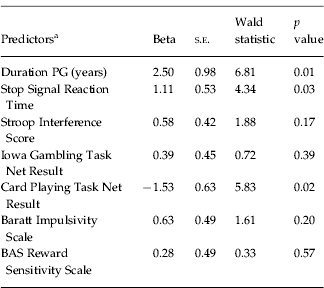
BAS, Behavioral activation scale.
a All predictors were converted to z scores, to allow for comparison of the beta values.
Discussion
This study is the first that simultaneously examined the influence of phenotypical and endophenotypical measures of disinhibition and decision-making under conflicting contingencies on relapse in PG. Results from the current study indicated that two endophenotypical measures of disinhibition and abnormal decision-making under conflicting contingencies were predictive of relapse in PG, whereas phenotypical (self-report) measures did not predict relapse.
Our finding, that decision-making abilities were predictive of relapse, is consistent with a study using the same Card Playing task in adolescents, which found that diminished performance on this task (lower net scores) was related to the development of PG (Vitaro et al. Reference Vitaro, Arseneault and Tremblay1999). Thus, disadvantageous decision-making strategies in the Card Playing Task seem to be a vulnerability factor involved in development as well as in relapse of PG. The finding that neurocognitive disinhibition is predictive of relapse is consistent with studies indicating that impairments in self-regulatory neurocognitive functions influence relapse in substance dependence (Tapert et al. Reference Tapert, Brown, Myers and Granholm1999; Allsop et al. Reference Allsop, Saunders and Phillips2000; Bowden-Jones et al. Reference Bowden-Jones, McPhillips, Rogers, Hutton and Joyce2005). Not all of the neurocognitive variables predicted relapse: a measure of prepotent response inhibition predicted relapse, whereas the Stroop Interference score did not. Likewise, the Card Playing Task was a significant predictor, whereas performance on the IGT was not. This may be explained by the complexity of the factors that are tested in the tasks that did not predict relapse. In the Stroop Color-Word Task, inhibiting an automatic response while reading is required, but only simple inhibition of a motor response in the Stop Signal Task is necessary. The four-deck IGT is a complex task in which several cognitive and motivational processes influence performance, such as memory and contingency learning (Busemeyer & Stout, Reference Busemeyer and Stout2002), whereas the choice to play or quit on the one-deck Card Playing Task, is much simpler. Thus, the more simple tasks may have tapped certain aspects of executive functions more clearly, whereas the mix of cognitive demands in the more complex tasks may have diluted the predicting power of an aspect such as ‘disinhibition’. However, larger samples are needed to detect differential predictive power of neurocognitive tasks tapping self-regulatory functions.
In this study, all predictors together explained 55% of the variance of relapse. The variance not accounted for could be lowered in future studies by the inclusion of factors such as treatment adherence, recent life events precipitating relapse, and co-morbid psychopathology. It is likely that these factors independently explain some variance in relapse (Gottlieb et al. Reference Gottlieb, Horwitz, Kraus, Segal and Viscoli1994; Bottlender & Soyka, Reference Bottlender and Soyka2005). Bates and colleagues (Reference Bates, Bowden and Barry2002) argued that the influence of neurocognitive impairment on relapse in substance dependence can be both direct and indirect, with neurocognitive impairment interacting with other intrapersonal and interpersonal capabilities and contextual factors. For instance, diminished neurocognitive functioning could lead to a diminished ability to implement coping skills when confronted with situations which create the urge to gamble (Tapert et al. Reference Tapert, Brown, Myers and Granholm1999). Living close to a gambling establishment in combination with being disinhibited could lead to a diminished ability to inhibit the urge to enter a gambling establishment. Studies on relapse in patients with substance use disorders indeed indicate that neurocognitive abilities interact with intrapersonal and environmental factors in the prediction of relapse (Tapert et al. Reference Tapert, Brown, Myers and Granholm1999; Latimer et al. Reference Latimer, Winters, Stinchfield and Traver2000; Bauer, Reference Bauer2001; Bates et al. Reference Bates, Barry, Labouvie, Fals-Stewart, Voelbel and Buckman2004). Therefore, it is likely that interactions between neurocognitive deficits and factors such as coping skills, gambling behavior of relatives and friends, and proximity to gambling opportunities influence relapse in PG in a similar way. Data on these factors were not available in our study, and future research should address these issues.
Our finding that neurocognitive factors predict relapse in PG is also important from an etiological point of view. Neurocognitive dysfunctions, and more particularly diminished executive functions and disadvantageous decision-making skills in tasks including rewards and losses, are likely to be important endophenotypic markers, influencing the development of both chemical and non-chemical addictions (Blum et al. Reference Blum, Braverman, Holder, Lubar, Monastra, Miller, Lubar, Chen and Comings2000; Goldstein & Volkow, Reference Goldstein and Volkow2002). Recently, neurocognitive disinhibition was found to be associated with the development of substance use disorders as well (Tarter et al. Reference Tarter, Kirisci, Habeych, Reynolds and Vanyukov2004). Thus, similar neurocognitive etiologies may be involved in the development as well as the progression of and relapse in PG and substance dependence (Tapert et al. Reference Tapert, Brown, Myers and Granholm1999; Allsop et al. Reference Allsop, Saunders and Phillips2000).
Self-reported personality variables of disinhibition or reward sensitivity did not predict relapse in PG. The only other study on the role of personality factors on relapse in PG showed negative results, except for a trend for sensation-seeking (Blaszczynski et al. Reference Blaszczynski, McConaghy and Frankova1991). Similarly, phenotypic indicators of treatment success in alcohol dependence also generate inconsistent results (Ooteman et al. Reference Ooteman, Verheul, Naasila, Daoust, Schippers, Koeter and van den Brink2005). Neurocognitive functioning has been reported as an endophenotypical marker in developmental models of alcohol and drug dependence (Deckel et al. Reference Deckel, Bauer and Hesselbrock1995; Giancola & Moss, Reference Giancola and Moss1998; Hesselbrock et al. Reference Hesselbrock, Begleiter, Porjesz, O'Connor and Bauer2001; Tarter et al. Reference Tarter, Kirisci, Habeych, Reynolds and Vanyukov2004). It is argued that research on endophenotypes may clarify the classification and diagnosis of complex psychiatric disorders – such as PG – and may ultimately provide a link between genotypes and phenotypes of these disorders (Gottesman & Gould, Reference Gottesman and Gould2003). Our finding that only neurocognitive measures of disinhibition and decision-making were predictive of relapse suggests that future research on the course of pathological gambling and related disorders will benefit more from the inclusion of endophenotypic indicators, such as neuropsychological, neurophysiological, neuroimaging, and biochemical functions than from self-report personality measures.
We did not study whether performance on the neurocognitive tasks also was predictive of treatment success. Studies in alcohol dependence indicate that there is a relation between neurocognitive function and treatment adherence in alcohol-dependent patients (for a review see Bates et al. Reference Bates, Bowden and Barry2002). Future research could shed light on the question of whether a similar relation would be revealed in pathological gamblers.
Some limitations of this study should be noted. The sample size was rather small, which limited the number of predictors that could be studied, in order to diminish the possibility of type II errors. The above-mentioned intrapersonal factors such as coping skills, and environmental factors such as gambling in relatives and friends, should be implemented in future studies, in order to extend the findings of this study. The limitation of this study to an out-patient PG group without other substance dependence or major psychiatric diagnoses increases the internal validity of this study, but restricts generalization of the findings to this particular group. It is likely that the presence of substance dependence or other psychiatric co-morbidity will result in a higher chance of relapse. In subgroups of PG with serious psychopathology these factors may have a stronger effect on relapse than neurocognitive functions per se. With the current sample, this question could not be answered, and future relapse studies should address this issue.
Assessing duration of PG and neurocognitive functions in pathological gamblers seems a valuable addition to assessing the risk of relapse in PG. Scores on neurocognitive functions could be used as indicators for the need for extra interventions, such as assignment to more intense treatment programs that include learning strategies to cope with diminished inhibition and disadvantageous decision-making strategies, or the implementation of booster sessions in the post-treatment period. In a review on effects of diminished neurocognitive functions on treatment in alcohol dependence, it is argued that diminished planning abilities and higher impulsivity could result in lower treatment compliance and retention (Bates et al. Reference Bates, Bowden and Barry2002). Diminished neurocognitive functioning in PG may also lead to lower effectiveness of treatment interventions. Structuring treatment interventions, promoting treatment adherence, and helping pathological gamblers in identifying personal risk situations may therefore improve the effect of treatment interventions in persons with neurocognitive impairments. Thus, the assessment of neurocognitive functions may be useful not only for identifying and targeting pathological gamblers at risk for relapse, but may also help in improving the effect of treatment in those with neurocognitive deficits.
Acknowledgements
This study was funded by the Netherlands Organisation for Scientific Research – Health Research and Development (NWO – ZonMw, Grant #96040000-4), and by a New Investigator grant (Veni-grant #91676084) of the Netherlands Organisation for Scientific Research (NWO) to Anna E. Goudriaan. We thank Henry Nelissen for his help in the recruitment of participants.
Declaration of Interest
None.