


Domestic unrest can make states appealing targets for opportunistic foreign attack. When governments face internal crises, they often redirect attention and resources inward, weakening their ability to defend against external threats. Yet these periods of weakness are often temporary. Once unrest subsides and the winning faction consolidates power, war-fighting capacity recovers and security forces can refocus on external threats. One state’s unrest therefore creates a temporary window of opportunity that foreign adversaries can exploit to secure goods such as territory, spheres of influence, or the elimination of cross-border threats that would otherwise be out of reach. In a classic account, Blainey labels these “death-watch” wars, a term inspired by the political instability surrounding the death of a monarch.Footnote 1
Foreign attack during domestic unrest is also a modern phenomenon. Japan’s invasions of Russia in 1918 and China in 1931, the opening of the Iran–Iraq War in 1980, and, more recently, Russia’s 2014 seizure of Crimea all occurred while targeted states suffered significant internal unrest. In some cases, like Russia in 1918, China in 1931, and Ukraine in 2014, foreign armies even found willing supporters among competing factions seeking their own domestic-political advantage. In other cases, like the American occupation of Veracruz in 1914, foreign-favored factions opposed the incursions.
However, not all states that experience domestic unrest are attacked by a foreign power. Indeed, the empirical record reveals considerable variation in whether domestic unrest triggers external attack. After World War II, roughly 40 percent of the countries that experienced civil war were never attacked by a foreign power at any point, and about 70 percent of civil conflict years do not coincide with a foreign attack.Footnote 2 But if domestic strife not only weakens a rival but can also encourage local factions to bandwagon with the invader, why do foreign states attack some victims of unrest but not others?
Answering this question requires decomposing domestic unrest into two distinct problems—shifting power (temporary weakness) and shifting preferences (factional competition)—both of which can be shaped by foreign attack and how domestic factions respond to it. Temporary weakness can be linked to international conflict through the familiar mechanism of the commitment problem. If a state’s military strength will recover once unrest subsides, a foreign power may attack while the state is weak rather than negotiate later under less favorable conditions. Domestic unrest, however, entails not only a temporary shift in power but also a potential change in the preferences that govern foreign policy.Footnote 3 Depending on who prevails in the domestic competition, the resulting foreign policy may be more or less favorable to a foreign power. The incentive to attack therefore depends not only on the size of the power shift but also on expectations about the foreign policy orientation of the faction that will ultimately control the state—that is, the rate and direction of shifting preferences. Explaining when unrest encourages foreign attack requires relaxing the assumption that preferences are fixed while power shifts.Footnote 4
We introduce factional competition to a model of shifting power and war in which a foreign state contends with a domestic state rendered temporarily weak by political unrest. The model has three key features. First, domestic unrest entails competition between a favored faction with preferences more aligned with the foreign state and a disfavored faction with preferences less aligned with the foreign state. Neither faction can credibly commit not to pursue its ideal foreign policy if it wins the domestic competition, and as factions’ preferences diverge, we say that domestic politics is increasingly polarized.Footnote 5 Second, attack gives the foreign state an opportunity to seize policy control as insurance against an unfavorable domestic outcome, but military failure may alter the likely outcome of domestic political competition without preventing the domestic state’s recovery. Finally, the favored faction may bandwagon with the invader, tying its domestic prospects to the success of the attack and boosting the foreign power’s chances of victory. Therefore, the extent of temporary weakness depends on the availability of local collaborators. Other work represents temporary weakness, factional competition, or local alignment with foreign interveners, but to our knowledge no other model incorporates all three.
Our model clarifies how domestic unrest shapes foreign states’ incentives for opportunistic attack and local factions’ incentives to bandwagon with them. When considering an attack, the foreign state trades off a temporary military advantage created by domestic unrest against the risk that its disfavored faction seizes power. When considering whether to bandwagon with the foreign power, the favored faction trades off improved domestic prospects against the risk of losing power to the disfavored faction. Several implications follow.
First, whether unrest encourages attack depends on the rate and direction of shifting preferences. When the favored faction is unlikely to prevail domestically, temporary weakness incentivizes an attack as it does in standard models of commitment problems and war.Footnote 6 By contrast, when the favored faction is likely to win the domestic competition, an attack is less attractive to a foreign power. If the foreign state expects to bargain with a less hostile government, it will forgo the potential benefits of a preventive attack and avoid the costs of war. In other words, when preferences in the state experiencing unrest are expected to shift in a more favorable direction, the foreign state forgoes the opportunistic attack predicted by models that consider only shifts in relative power.
Second, increasing factional polarization can encourage or discourage local support for a foreign attacker. When the favored faction is likely to win the domestic competition, increasing polarization discourages support because the downsides—the rival faction winning both contests and setting policy—loom larger. By contrast, when the favored faction is unlikely to win the domestic competition, increasing polarization encourages bandwagoning with the attacker because the favored faction is increasingly willing to yield policy control to a friendly foreign state rather than risk its local rival’s victory. A favored faction’s bandwagoning, however, raises the stakes for the foreign state and feeds back to its calculus when considering attack.
Third, whether increasing factional polarization encourages attack—and the resulting larger policy differences with the disfavored faction—depends on whether the favored faction will bandwagon. When both factions oppose invasion, increasing polarization straightforwardly encourages attack: military failure has no bearing on the outcome of unrest, so the foreign state is increasingly willing to bear the costs of war to secure policy control against the potential rise of the disfavored faction. Local support by the favored faction, however, sharpens the foreign state’s trade-off by ensuring that a failed attack brings to power the disfavored faction. In this case, if the favored faction’s chances of winning the domestic competition are sufficiently high, increasing polarization directly increases the downsides of failure and discourages attack. Unlike standard treatments where power shifts and policy differences track together, increasing potential policy losses can discourage war.
Fourth, we show that the promise of bandwagoning can deter an attack when it offers an insufficient military boost. Military failure with local support only removes a bulwark against the disfavored faction, and the foreign state passes on periods of unrest it would otherwise exploit. Tragically, the favored faction’s eagerness to support invasion as a means of boosting its political prospects can discourage the very invasion that might otherwise ease its path to power. This highlights how expectations of military support can, under certain conditions, actually deter intervention.Footnote 7
Fifth, contra Blainey’s conjecture that relatively stronger states should be more prone to death-watch attacks than weaker states, there is no consistent relationship between relative power and foreign attack.Footnote 8 When the foreign power is relatively stronger, states experiencing unrest become more attractive targets if local factions will not support an attack. However, when local factions support an attack, relative power can raise or lower the attractiveness of attack by altering the intensity of the foreign state’s trade-off between preventing and abetting the rise of the disfavored faction. Local bandwagoning is also more likely in relatively weaker states because powerful states can rely on defeating an invader rather than tying their fortunes to its success.
We also analyze two extensions, the first of which shows that the chance to exploit government weakness can induce domestic unrest even when it has the secondary effect of creating temporary international weakness and foreign attack. Therefore, we provide an account of how domestic political competition can explain why states find themselves unable to limit the shifts in power that cause preventive war.Footnote 9 In our second extension, the foreign state can also give aid designed to boost its favored faction’s prospects. However, variation in the costs and effectiveness of foreign influence ensure that it’s not a perfect substitute for invasion, and when attack occurs in equilibrium, it does so for the same reasons it does in the baseline—to exploit a temporary military advantage and seize policy control against the rise of a disfavored faction.
Finally, we the use the model to shed light on the timing of several attacks during periods of domestic unrest, including Japan’s invasions of Russia in 1918 and China in 1931, as well as Iraq’s invasion of Iran in 1980. We also show that it can explain within-case variation, accounting for why Russia seized the Crimean Peninsula during Ukraine’s Maidan Revolution in 2014 yet stood aside during the Orange Revolution in 2004 to 2005, which pitted similar factions against one another and opened a similar window of military opportunity. We conclude by highlighting the value of decomposing the commitment problem into processes of shifting power and shifting preferences, identifying additional testable hypotheses over both war and local bandwagoning, and discussing our relaxation of the unitary-actor assumption.
Domestic Unrest and International Conflict
Scholars typically link domestic unrest to international conflict through the pursuit of political survival or foreign opportunism. The former, its variants often (if not always accurately) collected under the heading of “diversionary war,” has received the lion’s share of scholarly attention. Diversionary war logic suggests that leaders experiencing unrest have incentives to instigate wars with foreign adversaries, which can improve a leader’s chances of holding on to power by either rallying or demonstrating competence to domestic audiences.Footnote 10 Diversionary war hypotheses have been tested extensively yet receive mixed support despite the argument’s rhetorical allure.Footnote 11
Domestic unrest may also create periods of temporary weakness that encourage foreign states to attack. TheoreticalFootnote 12 and empirical researchFootnote 13 alike suggest that temporary weakness can motivate states to attack while their opponent is weak rather than wait for power to shift and bargain with them once their strength has recovered. We contend that domestic unrest is an under-appreciated source of such temporary weakness. Unrest can erode government authority, consume military resources, exacerbate factional differences, and, as a result, make it harder to defend against external enemies. Rivals may exploit these windows of opportunity in pursuit of relatively easy military victories.
In contrast to diversionary accounts, domestic unrest prompts a foreign power to initiate hostilities. Blainey highlights how multiple eighteenth- and nineteenth-century wars followed the death of a monarch, when rival factions competed for power or influence with (or over) the new ruler. As such, he labels these “death-watch” wars and notes that
the kingdom with the new ruler was usually judged to be temporarily too weak to resist the plundering of part of its territory. The plunderers usually believed that they could snatch territory without provoking a war or that if war erupted, the campaign would be swift and victorious.Footnote 14
Blainey adds that other destabilizing factors, such as revolutions and civil strife more broadly, can also trigger death-watch wars, identifying more than thirty such conflicts between 1815 and 1939. Subsequent scholarship has identified additional wars that appear to fit this pattern, many of which occurred after 1945.Footnote 15 Blainey concludes by contending that death-watch wars are more common than diversionary or, in his terms, “scapegoat” wars.
The death-watch account has received less attention than the diversionary account, yet empirical work suggests its plausibility. DaviesFootnote 16 finds that violent strife increases a state’s probability of being attacked by 12 percent, and DaxeckerFootnote 17 finds that a civil war increases the probability of being attacked by a rival by 32 percent.Footnote 18 Other studies show that the United States is more likely to be the target of disputes during periods of political weakness.Footnote 19 Thus there is some evidence that foreign powers exploit periods of domestic unrest that occurs in other states.
Examining episodes of civil conflict after 1945, we come to a similar conclusion. A simple comparison of country-years with and without civil conflict illustrates the heightened probability of being attacked during civil conflict. We identify country-years with civil conflict using the years UCDP designates as experiencing an intrastate conflict or internationalized intrastate conflict, and attacks as MIDs in Maoz’s dyadic data in which a state was the primary target of a use of force.Footnote 20 These data show that 30 percent of country-years with civil conflict experience an attack, compared to only 10 percent of country-years without civil conflict. Periods of relatively intense domestic unrest are associated with a substantially higher likelihood of being attacked by a foreign state.
Yet 40 percent of states that experience civil conflict are never targeted with an attack. One might argue that this is because these states lacked ongoing tensions with foreign powers, so their temporary weakness went unexploited. Additional analyses suggest that this explanation does not apply to most of the states that were not attacked. Nearly 80 percent of civil conflict-years without an attack involved a government with either an ongoing rivalry or territorial dispute.Footnote 21 Thus, a large majority of the states experiencing unrest that were not attacked had foreign adversaries with incentives to exploit the moment of weakness, but other factors deterred them from doing so.Footnote 22
What an exclusive focus on shifting power overlooks, we argue, is that domestic unrest involves not just temporary weakness but also competition between factions with different foreign policy preferences, some of whom may choose to side with the attacker. At the extreme end, the Chinese and Russian Civil Wars pitted Communist factions committed to global revolution against more traditionally nationalist factions like the Kuomintang (KMT) and the Whites.Footnote 23 Korea’s Donghak Rebellion entailed competition between pro-Japan and pro-China factions, pushing the competing imperial powers to war in 1894.Footnote 24 Uruguay’s 1860s civil war also crystallized into a competition over alignment with the Empire of Brazil, and even smaller-scale unrest like Ukraine’s Orange and Maidan Revolutions—about which more to follow—saw pro-Russian and Ukrainian nationalist factions compete for control over foreign policy.Footnote 25
Death-watch accounts have it right that China, Russia, Korea, Uruguay, and Ukraine were all temporarily weakened by domestic unrest. But the attendant factional competitions also had implications for both the extent of temporary weakness and future foreign policy. Power was shifting, but so were the preferences that could govern the state, and in some cases—like Russian and Chinese factions willing to make common cause with Japan against domestic rivals—foreign intervention could win local support. Yet most models of shifting power and war assume constant preferences across domestic factions,Footnote 26 while most models of factional competition and war fix the international distribution of powerFootnote 27 and assume rather than derive local alignment with foreign intervention.Footnote 28 Understanding the relationship between domestic unrest and international conflict requires a theory that analyzes two dimensions of the commitment problem: shifting power and shifting preferences.
Model
Suppose that two states, foreign (F) and domestic (D), dispute a unidimensional policy
 $X\geq0$
, like the location of a border, spheres of influence, cross-border exchange, basing rights, the treatment of cross-border minorities, etc. Play begins during domestic unrest in state D, where two factions
 $J=\{A,B\}$
compete over who rules and, thus, who sets policy X. By “unrest” we mean extra-institutional competition for political power, like large-scale protests, elite infighting, or civil conflict, that diverts resources or attention sufficiently to weaken the state militarily. This unrest arose unexpectedly,Footnote
29
precluding the ruling faction—A, B, or some now-eliminated player—from suppressing it,Footnote
30
bargaining with the opposition to avoid unrest,Footnote
31
or setting foreign policy to discourage foreign attack.Footnote
32
If D’s unrest resolves, whatever faction survives uses recovered national strength to pursue its ideal policy in international bargaining. F can also attack in a bid to seize policy control before power can shift against it, but intervention may alter the process of shifting preferences: F’s favored faction (A) may support invasion, lashing its political fate to the success of the war and ensuring that, should F’s attack fail, the disfavored faction (B) seizes power.
The foreign state pursues the most favorable policy at the lowest cost, and it cares about which faction rules D only to the extent that who rules influences policy X. To exclude other motives for war, like ensuring one faction’s victory independent of policy, we also assume that if F seizes policy control, it’s indifferent over who rules D. For example, Japan’s 1931 seizure of Manchuria weakened a favored faction (the Guangxi Group) in China’s civil war and saved a disfavored faction (the Communists) from destruction at the hands of the Kuomintang.Footnote
33
Yet Japan’s success made the KMT’s improved military prospects in the civil war irrelevant for the time being. Domestic factions, on the other hand, care about both policy (X), valued at
 $\lambda\gt 0$
, and winning the domestic competition, which yields
 $\eta\gt 0$
, representing ideological and material benefits, as well as (non-X) policy prerogatives, enjoyed by factions in power.Footnote
34
Each player
 $i=\{F,A,B\}$
has an ideal policy at which its payoffs over X, represented by risk-neutral loss functions
 $u_i(x)$
, are maximized at 0.Footnote
35
Ideal points are
 $f=0$
,
 $a\gt 0$
, and
 $b\gt a$
for F, A, and B, respectively. Figure 1 shows that, for policy
 $x\in X$
, players receive
 $${u_i}(x) = \left\{ {\matrix{ { - x} \hfill & {{\rm{if}}\,i = F\,} \hfill \cr { - \lambda {\rm{|}}a - x|} \hfill & {{\rm{if}}\,i = A\,} \hfill \cr { - \lambda |b - x|} \hfill & {{\rm{if}}\,i = B\,,} \hfill \cr } } \right.$$
where A’s ideal policy is closer to F’s than B’s (
 $b \gt a$
). Therefore, A is F’s relatively favored faction, and B is relatively disfavored. “Relatively” is key: both factions’ ideal points can be far from or close to F’s, but F prefers A’s ideal policy to B’s. Ideal points also describe the extent of political disagreement, or polarization, between D’s factions.Footnote
36
We say “polarization” because the existence of factions implies groups collected around each pole, not simply that preferences are heterogeneous or high-variance.Footnote
37
As the distance
 $(b-a)$
grows, each faction increasingly dislikes the other’s ideal policy, and A’s policy preferences grow closer to F’s. Policy is set peacefully, which yields Equation (1)’s payoffs at no cost, or by the costly lottery of war, after which the winning side is free to set its ideal policy, which anchors outcomes at f, a, or b.
Ideal policies and payoffs for policy
 $x\in X$

Domestic unrest and international conflict

Relative power (
 ${CINC}_D/({CINC}_D+{CINC}_F)$
) across death-watch attacks

Figure 2 shows that the foreign state begins play by passing or attacking. If F passes, Nature chooses the winner of the domestic competition, A with probability
 $\phi\in(0,1)$
and B with probability
 $1-\phi$
, where a faction’s chances of success depend on its domestic support, military capacity, and access to capital and resources. We often refer to
 $\phi$
as A’s baseline prospects for winning, or surviving, the domestic competition; and as it departs from
 $\phi=1/2$
, it also represents the direction and rate of shifting preferences. Surviving faction
 $J=\{A,B\}$
then wields consolidated national strength in bargaining with F, who proposes a policy
 $x_J\geq0$
. If J accepts,
 $${u_i}({\rm{accept \;}}{x_J}) = \left\{ {\matrix{ { - {x_J}} \hfill & {{\rm{if}}\,i = F\,} \hfill \cr {\eta - \lambda {\rm{|}}{x_J} - j{\rm{|}}} \hfill & {{\rm{if}}\,i = J\,} \hfill \cr { - \lambda {\rm{|}}{x_J} - (\neg j){\rm{|}}} \hfill & {{\rm{if}}\,i = \neg J\,,} \hfill \cr } } \right.$$
where
 $\neg J$
describes the faction out of power, and if J rejects,
 $${u_i}({\rm{reject \;}}{x_J}) = \left\{ {\matrix{ { - (1 - {p_l})j - c} \hfill & {{\rm{if}}\,i = F\,} \hfill \cr {\eta - {p_l}\lambda j - c} \hfill & {{\rm{if}}\,i = J\,} \hfill \cr { - {p_l}\lambda (\neg j) - (1 - {p_l})\lambda {\rm{|}}j - (\neg j)| - c} \hfill & {{\rm{if}}\,i = \neg J\,,} \hfill \cr } } \right.$$
where F wins policy control with probability
 $p_l$
, J wins with probability
 $1-p_l$
, and all players pay
 $c\gt 0$
in death, destruction, and displacement.Footnote
38
Military success, which can result from imposing a new border, establishing a sphere of influence, eliminating cross-border groups, destroying capabilities or fortifications, or coercing concessions in return for withdrawal, allows F to set its ideal policy
 $x=0$
. Should F fail militarily, J sets its ideal policy
 $x=j$
.
Now suppose that F attacks in its first move. Consistent with temporary weakness accounts, its chances of military success are higher than if it passes. For example, the Iraqi leadership in 1980 viewed Iran as weak in the aftermath of the 1979 revolution. “For once Baghdad felt that in its long tussle with Tehran the military and diplomatic balance was in its favour,”Footnote 39 with “the Iranian Army, in disarray following the Revolution … no more than a shadow of its former self.”Footnote 40 Iraq also expected that weakness to be temporary:
The current confusion and division among Iranian leaders was bound to end, with the Islamic regime establishing itself and reconstructing Iran’s superior military and economic might.Footnote 41
Attack gives F a chance to exploit this temporary weakness, but it also gives faction A the opportunity to support (
 $s=1$
) or oppose (
 $s=0$
) attack, which influences both the scale of the power shift and the stakes of domestic competition. Support is similar to bandwagoning in interstate conflict,Footnote
42
in which one player sides with another’s attacker, but where Schweller focuses on the upside of siding with aggressors, we give equal weight to the downside: when the attacker loses the international war, its supporter also loses the domestic competition for power.Footnote
43
Suppose first that A opposes F’s attack (
 $s=0$
). A’s probability of surviving unrest is
 $\phi$
, just as if F had passed, which is consistent with domestic audiences drawing no distinction between factions that oppose invasion. F succeeds with probability
 $p_m\gt p_l$
, such that
 $${u_i}({\rm{oppose}}) = \left\{ {\matrix{ { - (1 - {p_m})(\phi a + (1 - \phi )b) - c} \hfill & {{\rm{if}}\,i = F} \hfill \cr {\phi \eta - {p_m}\lambda a - (1 - {p_m})(1 - \phi )\lambda (b - a)} \hfill & {{\rm{if}}\,i = A} \hfill \cr {(1 - \phi )\eta - {p_m}\lambda b - (1 - {p_m})\phi \lambda (b - a)} \hfill & {{\rm{if}}\,i = B,} \hfill \cr } } \right.$$
where success again yields 0, and failure means that F’s chances of facing each faction are the same as after passing, yielding
 $x=j$
. A survives unrest with probability
 $\phi$
, securing
 $\eta$
whether or not F succeeds. A wins
 $\lambda x=0$
on policy if F fails, loses
 $\lambda a$
if F wins, and loses
 $(b-a)$
if F loses and B defeats A domestically. Factions’ payoffs are symmetrical, in that B survives unrest with the complementary probability (
 $1-\phi$
) and suffers policy losses (b) and
 $(b-a)$
from F’s and A’s success, respectively.
Now suppose that A supports (
 $s=1$
) or bandwagons with F, which can include passivity, like those elements of the French Right that eased Nazi conquest in 1940,Footnote
44
or the Ukrainians that welcomed Russia’s de facto annexation of Crimea in 2014; accepting money, intelligence, or resources for use against B, like factions in China’s civil war during the interwar years;Footnote
45
or, at the extreme, actively cooperating with F to engage B in battle, like White Army forces, which also received material support,Footnote
46
helping Japan take Vladivostok, Chita, and Khabarovsk during the Russian Civil War.Footnote
47
A’s support boosts F’s probability of military success to
 $p_h\gt p_m$
, such that F’s military prospects are best when it attacks with A’s support, middling when A opposes, and worst once unrest ends, or
 $p_h\gt p_m \gt p_l$
. Bandwagoning with the invader, however, ties A’s political fortunes to F’s war. If F wins, A defeats or fatally undermines B. But if F loses, B defeats an A now tarnished by having collaborated with foreign forces.Footnote
48
The Russian Civil War is a useful example: whether foreign states intervened to keep Russia in World War I (Britain) or to secure exclusive economic interests (Japan), the rhetoric of resisting foreign intervention bolstered the Bolsheviks over the foreign-favored Whites.Footnote
49
If F attacks and A supports,
 $${u_i}({\rm{support}}) = \left\{ {\matrix{ { - (1 - {p_h})b - c} \hfill & {{\rm{if}}\,i = F} \hfill \cr {{p_h}(\eta - \lambda a) - (1 - {p_h})\lambda (b - a)} \hfill & {{\rm{if}}\,i = A} \hfill \cr { - {p_h}\lambda b + (1 - {p_h})\eta } \hfill & {{\rm{if}}\,i = B,} \hfill \cr } } \right.$$
where F’s failure to seize policy control lets B set
 $x=b$
. Factional payoffs reflect the fact that, if F wins, A seizes power (
 $\eta$
) but loses
 $\lambda \vert 0-a \vert=\lambda a$
on policy, while B loses both the domestic contest and
 $\lambda b$
. If F’s attack fails, A loses the domestic contest and suffers B’s ideal policy by paying
 $\lambda(b-a)$
, while B secures power (
 $\eta$
) and sets
 $x=b$
.Footnote
50
Local support thus increases F’s temporary advantage but also raises the stakes of failure by ensuring that F’s disfavored faction comes to power.
Domestic unrest decomposes the commitment problem into two parts—shifting power and shifting preferences—each of which is endogenous to the behavior of a faction in the rising state. First, relative power shifts against F unless it wins a preventive war, but the size of the shift depends on whether it secures A’s support. Letting
 $\Delta p(s)$
indicate the shift in power entailed by D’s recovery,
 $$\Delta p(s) = \left\{ {\matrix{ {{p_m} - {p_l}} \hfill & {{\rm{if}}\,s = 0} \hfill \cr {{p_h} - {p_l}} \hfill & {{\rm{if}}\,s = 1,} \hfill \cr } } \right.$$
where F’s military advantage is greater when A supports foreign invasion, such that
 $p_h-p_l \gt p_m-p_l$
. Power shifts against A as it does in the standard account, but domestic politics may deepen the rising power’s temporary weakness. Second, preferences shift alongside power because unrest ends with one faction in charge of policy, which we can express in terms of expected differences from F’s ideal policy (
 $f=0$
). If A passes, D’s expected ideal policy is
 $\phi a+(1-\phi)b=b-\phi(b-a)$
. If A attacks, victory eliminates policy losses, while defeat leads to either the same distribution of preferences if A opposes or
 $j=b$
if A supports.Footnote
51
Subtracting the former from the latter, F’s net averted policy losses by attacking are
 $$\Delta j(s) = \left\{ {\matrix{ {{p_m}\left( {b - \phi (b - a)} \right)} \hfill & {{\rm{if}}\,s = 0} \hfill \cr {{p_h}b - \phi (b - a)} \hfill & {{\rm{if}}\,s = 1,} \hfill \cr } } \right.$$
or the difference between J’s expected ideal point given attacking and passing. War reduces policy losses in expectation, but A’s support raises the risks of F’s worst possible outcome: B seizing power and setting its ideal policy.
There are several nearby models. Shifting power appears in treatments of the commitment problem with unitary states, whose preferences are fixed over the course of the interaction.Footnote 52 We introduce shifting preferences via uncertainty over which faction ultimately rules the rising state, a feature whose closest analogue is leader change in models with fixed distributions of power.Footnote 53 Other models represent probabilstically shifting power under fixed preferences, but in our model power is sure to shift and preferences shift probabilistically.Footnote 54 Turning to models of domestic competition Chyzh and Labzina give a third party preferences over the outcome of domestic unrest, but (1) factional policy differences are fixed and (2) the third party prefers the incumbent faction.Footnote 55 Di Lonardo, Sun, and Tyson allow a foreign state to depose a country’s leadership following unrest, with similarly unpredictable consequences, though like us they allow factional differences—in particular the opposition’s alignment with the foreign state—to vary.Footnote 56 Finally, Langø constrains the intervener to prefer the faction out of power, whose choice to decline foreign intervention is sufficient to stop it; for us, support decisions come after an invasion.Footnote 57
Analysis
Our solution concept is Subgame Perfect Equilibrium (SPE), at which strategy profiles constitute Nash Equilibria in every proper subgame. Factions can’t promise not to pursue ideal policies if given a chance, nor can they promse to abstain from using recovered national strength in international bargaining or to use foreign attack for their own domestic ends. The twin problems of factional competition and temporary weakness in D define F’s strategic problem. A can commit to a policy that F finds relatively attractive, rendering D’s recovery less threatening; and A may even exacerbate temporary weakness by supporting foreign attack. Yet F’s military victory over D isn’t assured, and defeat alters the course of domestic competition. Attacking may secure the policy for F, but the upfront costs of war will be compounded should failure boost B’s chances of surviving domestic unrest to set its preferred policy.
Two substantive assumptions help isolate our causal story. First, we assume that
 $b\lt 2a$
, ruling out equilibria in which factions are so polarized that A bandwagons with F regardless of the value of the disputed policy. In other words, politics in D aren’t so polarized that any foreign invasion is worth supporting, ensuring that A faces a meaningful trade-off between success in domestic competition and maintaining policy control.Footnote
58
Second, we fix
 $p_h\gt\phi$
, such that bandwagoning gives A a boost over its unaided domestic prospects. A has no incentive to support F otherwise, so this restriction ensures that, should A decline to oppose an invader, it does so because of the downsides, not the absence of any domestic-political benefits.
We establish the existence of the commitment problem in Lemma 1, describing what deals F strikes with surviving factions after unrest. Lemma 2 characterizes the conditions under which A supports foreign attack. Propositions 1 and 2 use these results to describe when F attacks and when it passes, conditional on whether it receives local support. Corollaries 1 to 3, spread throughout the analysis, describe how factional policy differences—both directly and indirectly via A’s willingness to support invasion—influence our outcomes of interest: A’s decision to bandwagon and F’s decision to attack in the first place.
The International Politics of Domestic Unrest
Post-unrest bargaining and potential bandwagoning shape F’s initial decision over attacking or passing, so we follow the logic of backward induction. Suppose first that F has passed. D’s domestic unrest resolves, with faction J surviving and states returning to the pre-unrest distribution of power, where F’s chances of military victory are at their lowest (
 $p_l$
).
Lemma 1 If F passes, it proposes
 $$x_J^ * = (1 - {p_l})j - {c \over \lambda },$$
which faction J accepts on the path of play.
At its final move, J accepts
 $x_J$
only when it can do no better by fighting, or when
 $${x_J} \ge j(1 - {p_l}) - {c \over \lambda } = {\underline x _{\,J}}.$$
Fighting is costly and power has stabilized, so F proposes
 $x_J^\ast=\underline{x}_J$
, avoiding war by leaving J just indifferent over accepting and rejecting. F secures peace with the surviving faction, but polarization means that the bargain is either
 $${{\underline{x}}_A} = a(1 - {p_l}) - {c \over \lambda }\, \,\,{\rm{or}}\, \,\,{{\underline{x}}_B} = b(1 - {p_l}) - {c \over \lambda },$$
where F is strictly better off with its favored faction (A) in power because
 $a \lt b$
. Factional policy differences notwithstanding, F retains the bargaining surplus (2c). Preventive attack, however, forfeits the surplus to exploit a temporarily favorable distribution of power, potentially buttressed by A’s support.
Moving to Figure 2’s other terminal choice, suppose that F has attacked. If A supports, F’s chances of military success increase by
 $\Delta p(1)$
, in which case A also defeats B for domestic control. Should F’s attack fail, so does A’s bid for domestic power. Opposing F, on the other hand, limits the shift in power to
 $\Delta p(0)$
and preserves for A some chance of retaining domestic policy control.
Lemma 2 When
 $${\eta \over \lambda } \gt {{\left( {b - a} \right)\,\phi \,\left( {1 - {p_m}} \right) + [a - (b - a)]\,\left( {{p_h} - {p_m}} \right)} \over {\left( {{p_h} - \phi } \right)}}$$
A supports F. Otherwise, A opposes.
Lemma 2 states that A supports attack when
 $\eta/\lambda$
, the ratio of the gains from domestic rule to the value of the disputed policy, is greater than the ratio of the net expected policy losses from supporting F to the direct survival boost from support (
 $p_h-\phi$
). The net expected policy losses from supporting F include
 $(b-a)\,\phi\,(1-p_m)$
, the foregone policy benefits of opposing and defeating F before winning the contest for power, and
 $[a-(b-a)]\,(p_h-p_m)$
, the net losses associated with ceding policy control to F (a) over B (
 $b-a$
), weighted by the difference in F’s chances of victory across support and opposition. As domestic polarization increases, the direct benefits of securing power loom less large. In other words, A supports F when doing so offers a sufficient advantage in domestic political competition and when winning that competition is sufficiently valuable in light of the attendant policy trades. But if A’s unaided prospects are favorable enough (high
 $\phi$
) or if the policy is too valuable (high
 $\lambda$
), as it was for Mexico’s Constitutionalists opposing the American occupation of Veracruz in 1914 despite the fact that it targeted their rival Victoriano Huerta,Footnote
59
A opposes F to position itself for continuing contestation against B.
Corollary 1 An increase in b encourages A to support F when
 $$\phi \lt {{{p_h} - {p_m}} \over {1 - {p_m}}} = {\phi _F}$$
and weakly discourages support otherwise.
Corollary 1 describes the relationship between polarization and bandwagoning. Holding A’s ideal policy fixed, we trace changes in its willingness to bandwagon as B’s ideal policy moves farther away, which makes F’s ideal policy relatively attractive. Returning to the numerator on Equation (3)’s right side, polarization works through two channels. First, it loosens the constraint through
 $(b-a)\,\phi\,(1-p_m)$
. As b increases, siding with F becomes less attractive because failure means that A loses power and B sets a distant
 $x=b$
. Polarization tightens the constraint through the second term, however, because an increase in b increases A’s relative affinity with F, encouraging it to gamble on supporting invasion, tolerating policy set by a relatively benign F rather than cede control to B. Equation (4) states that which channel dominates depends on the direction in which preferences are shifting. When A is unlikely to survive at the baseline (
 $\phi\lt\phi_F$
), factional policy differences encourage it to tie its fortunes to F. But when
 $\phi\geq\phi_F$
, A anticipates a sufficient chance of both surviving unrest and defeating F that polarization discourages bandwagoning, lest B win the linked conflicts and deny A both policy control and the benefits of political power.
Our account is consistent with several notable cases. In 2014, some Ukrainians sided, passively or actively, with Russia’s annexation of Crimea and instigation of civil conflict in the Donbas, because domestic politics were headed in a Ukrainian nationalist direction. Policy differences (
 $b-a$
) were large and Russia was likely to win (high
 $p_h$
), and in the shadow of the Maidan protests, the prospects (
 $\phi$
) for Russia’s favored faction (A) were low; support made sense as a means of accepting Russian control over losing in domestic politics. Likewise, Kocher, Lawrence, and Monteiro argue that the French right collaborated with Nazi invasion and occupation because it presented an opportunity to crush the French left, which was both strong and growing in electoral power during the Third Republic.Footnote
60
In the model’s terms,
 $p_h-p_m$
was high (Germany was winning and opposition would have little effect),
 $\phi$
was low (Left parties were electorally popular), and
 $\eta$
(the Right’s value of securing political power over the left) was high relative to the ostensibly limited policy losses imposed by the Nazis (low
 $\lambda$
, low a), which entailed Vichy control over occupied France and the nominal retention of the Empire.
These are modern manifestations of an ancient tradition. Domestic factions open the city gates—Athens or Sparta, Macedon or Rome—to invading forces, trading control over foreign policy for help in local political competition. Centuries later, conflict among French elites saw the Burgundian faction open Paris to the invading English in 1419, eliminating their Armagnac rivals for the relatively modest price of a marriage alliance that made Henry V the heir to a French throne controlled by a council of nobles.Footnote 61 Likewise, Machiavelli recognized that Italian city-states riven by factional conflict often saw disaffected groups not merely seek support but invite invasion.Footnote 62 In the modern era, Norway’s Vidkun Quisling explicitly called for a Nazi invasion in hopes of defeating domestic rivals, which he did, if temporarily; lashing his fate to the Nazis made immediate political sense, but the ultimate failure of the Nazi project also meant failure for Quisling. Historical and recent prominence notwithstanding, most political science on interstate war still has politics “stopping at the water’s edge,” with political competition represented mostly by legislative opposition,Footnote 63 or taking place after invasion in the form of collaboration with occupiers.Footnote 64 We show, however, that willing collaborators can sharpen F’s trade-off between exploiting temporary weakness and waiting for domestic unrest to resolve—and not always in a direction that F likes.
Factional Competition and Foreign Attack
Moving back up the tree, we complete the characterization of equilibria by establishing when F attacks and when it passes. Proposition 1 describes F’s attack decision when A opposes it, which isolates the effect of shifting power. Proposition 2 describes F’s attack decision when A supports invasion, boosting F’s prospects but guaranteeing that, should F fail, the disfavored faction secures policy control. Corollary 2 shows that the effect of factional polarization on attack depends on the direction of shifting preferences, and Corollary 3 identifies conditions under which attack is less likely with local support than without it.
Proposition 1 Let
 $${\eta \over \lambda } \le {{\left( {b - a} \right)\,\phi\, \left( {1 - {p_m}} \right) + [a - (b - a)]\,\left( {{p_h} - {p_m}} \right)} \over {\left( {{p_h} - \phi } \right)}}$$
such that A opposes attack. F attacks when
 $$c \lt \Delta p(0)\,\left( {a\phi + b(1 - \phi )} \right){\lambda \over {1 + \lambda }} = {c_0}$$
and passes when
 $c\geq c_0$
.
When A will oppose attack, F’s decision turns on war costs and the extent of D’s temporary weakness, as it does in standard shifting-power accounts. It also depends on how attack shapes the outcome of domestic unrest. Rearranging
 $c \lt c_0$
yields
 $$\Delta p(0)\,\left( {a\phi + b(1 - \phi )} \right) \gt c\left( {{{1 + \lambda } \over \lambda }} \right),$$
with the net benefits of attack at left and its total costs at right, weighted by policy valuations, 1 for F and
 $\lambda$
for D’s factions. Next, note that setting
 $a=b$
eliminates policy differences and
 $\lambda=1$
equalizes policy valuations, isolating the role of temporary weakness to yield
 $\Delta p(0)\gt2c$
, or
 $$p_m-p_l\gt2c,$$
a special case of Powell’s inefficiency condition for stochastic games with shifting power.Footnote 65 War occurs when the expected shift in power, or the extent of D’s temporary weakness, is larger than the bargaining surplus.
Equation (5)’s attack constraint, though, shows that whether shifting power leads to war depends on how preferences are shifting. The mere fact of factional policy differences ensures that an increase in A’s unaided prospects (
 $\phi$
) discourages attack because it reduces the downside risk of passing. Why invade if preferences are shifting such that A is likely to survive in any case, especially as b increases over a and factional policy differences grow? All else equal, temporary weakness encourages preventive attack. But when a favored faction is sufficiently likely to survive whether F passes or its attack fails (high
 $\phi$
), F may forgo a war it would have otherwise fought, saving the up-front costs and tolerating the possibility of a less-than-ideal post-unrest policy in the form of
 $x=\underline{x}_{\,A}$
.
Returning to Iraq’s invasion of Iran, the latter’s temporary weakness following the 1979 revolution was an important factor, but it was not the only consideration. Iraqi leaders were also concerned that Iran’s foreign policy was shifting in an increasingly unfavorable direction. By 1980, after the new Iranian regime successfully thwarted a potential coup d’état, it had become apparent that a more favorable faction was unlikely to return to power,Footnote 66 and
the Iraqi president realized it was illusory to hope for a military coup d’état to wipe out the Islamic Revolution. He understood that despite the CIA’s active support, the Iranian opposition no longer stood a chance.Footnote 67
Iraq’s decision to go to war was motivated not only by Iran’s temporary weakness but also by the expectation that the disfavored Ayatollah Khomeni regime was likely to consolidate power. Had Iraqi leaders been more confident that the Islamic Republic was likely to collapse or be replaced by a more favorable government, the incentives for an attack would have been much weaker and war may have not occurred.
Japan’s interwar march to empire offers two other examples of the exploitation of a rival’s temporary weakness, each mounted with the goal of securing gains against a disfavored faction’s victory. The first such opportunity arose in 1918.
The political vacuum in Siberia which was created by … the [Russian] Revolution stimulated the long-cherished ambition of Japan to have political and economic control over the [Asian] Continent,Footnote 68
particularly in the face of a potential Bolshevik victory. As such, Japan intervened in the Russian Civil War with the aim of “establishing a buffer state in Eastern Siberia”Footnote 69 for which it received active support from White armies fighting the Bolsheviks.Footnote 70 And in 1931, after Chiang Kai-Shek’s success in the Northern Expedition, which brought Manchuria’s warlord government nominally under the sway of KMT foreign policy, Japan invaded to pre-empt “growing Nationalist influence … and erosion of Japanese privileges” that would follow a KMT victory in China’s long-running series of civil wars.Footnote 71 Japan’s invasion did nothing to bolster friendly warlord factions, but it yielded a buffer state, Manchukuo, that would insure Japanese investments against continued unrest in China and a potential KMT victory.
Proposition 2 Let
 $${\eta \over \lambda } \gt {{\left( {b - a} \right)\;\phi \;\left( {1 - {p_m}} \right) + [a - (b - a)]\left( {{p_h} - {p_m}} \right)} \over {\left( {{p_h} - \phi } \right)}}$$
such that A supports attack. F attacks when
 $$c \lt \left( {b\Delta p(1) - (b - a)\phi (1 - {p_l})} \right){\lambda \over {1 + \lambda }} = {c_1}\quad {\rm{and \quad}}{p_l} \lt {{\Delta j(1)} \over {a\phi + b(1 - \phi )}} = {\hat p_l}$$
and passes when either
 $c\geq c_1$
or
 $p_l\geq\hat{p}_l$
.
Now suppose that A will support foreign attack, sharpening F’s trade-off by increasing its chances of military success but guaranteeing that, should the attack fail, the disfavored faction seizes power. Proposition 2 states that F attacks when the costs of war are sufficiently low (
 $c \lt c_1$
) and, given the trade-off between improved military prospects and the downside of failure, only when power will shift substantially in D’s favor. Formally,
 $p_l\lt\hat{p}_l$
describes a shift in power large enough for attack’s benefits to outweigh its costs (
 $c_1\gt0$
), which is made more difficult by the increased downside of failure. Rearranging
 $c \lt c_1$
, we again collect the net benefits of attack at left and the total costs at right, yielding
 $$b\Delta p(1) - (b - a)\phi (1 - {p_l}) \gt c\left( {{{1 + \lambda } \over \lambda }} \right).$$
Shifting power encourages attack because the left side of Equation (6) increases in
 $p_h$
and decreases in
 $p_l$
.Footnote
72
But in contrast to equilibria at which A opposes invasion, Corollary 2 states that increasing factional polarization can encourage or, when preferences are shifting favorably enough, discourage attack.
Corollary 2 If A supports F and
 $$\phi \gt {{\Delta p(1)} \over {1 - {p_l}}} = {\phi _1},$$
an increase in b discourages attack; when
 $\phi\leq\phi_1$
, it encourages attack.
Shifting preferences can increase or decrease the chances of war, depending on the direction of the shift. Decreasing a makes attack less attractive, just like when A opposes invasion, but increasing b works through two different channels. In the first term on the left side of Equation (6), increasing b makes attack more attractive, given F’s temporary military advantage (
 $\Delta p(1)$
). But in the second term, increasing b makes attack less attractive given the chances of military failure and A’s unaided survival prospects. Which channel dominates depends on A’s baseline survival prospects. When preferences are shifting unfavorably because A is unlikely to survive unaided (
 $\phi\lt\phi_1$
), increasing policy disagreements with B render F more willing to attack, just as in Proposition 1’s equilibrium; there are fewer downsides of losing despite A’s support, given that A is unlikely to survive anyway. However, when
 $\phi\gt\phi_1$
, A is likely enough to survive unaided that the prospect of hastening B’s rise via military failure is enough to discourage F from attacking, all the more so as B’s ideal policy moves farther away from A’s. Therefore, increasingly adverse policy shifts can decrease the chances of war. Contrary to models of commitment problems and war that focus exclusively on shifting power, we show that when the commitment problem is decomposed into shifting power and shifting preferences, a more severe commitment problem can, under some conditions, make war less—not more—likely.
Next, we can use the model to help explain Russo–Ukrainian relations in the early twenty-first century, leveraging within-case variation that corresponds to our peaceful and violent equilibria. In 2014, during a moment of significant upheaval in Ukraine caused by a popular uprising against a pro-Russian government that declined to sign an association agreement with the European Union, Russia seized the Crimean Peninsula rather than lose its lease to the naval base at Sevastopol to increasingly pro-Western Ukrainian politics.Footnote
73
Ukraine was temporarily weak, its government “unwilling to risk war in a country still divided by … political turmoil,” and the commonly known bases of military power were overwhelmingly in Russia’s favor.Footnote
74
Recent factional change had brought to power Western-inclined leaders that had already promised to revisit the treaty confirming the Russian presence even had they won an elusive parliamentary majority in 2012.Footnote
75
That threat didn’t come to pass, but by the time of 2014’s Maidan Revolution, the policy consequences of an anti-Russian faction seizing power and wielding recovered national strength, combined with Viktor Yanukovych’s newly weak domestic position—exiled after losing the support of the state apparatusFootnote
76
—were sufficient to motivate Russian invasion, which was actively supported by pro-Russian locals in Crimea.Footnote
77
Formally,
 $s=1$
and
 $\Delta p(1)$
was large, but
 $\phi$
was low, which prompted Russia to attack.
Yet 2014 wasn’t the first time Ukraine’s attention was turned inward by domestic unrest pitting the same factional interests against one another. Yanukovych’s bid to rig the 2004 presidential election against pro-Western Ukrainian nationalists touched off the Orange Revolution, which saw the Constitutional Court order a new election that brought Viktor Yushchenko to power.Footnote
78
Ukraine was rocked by protests and temporarily weak—weaker indeed than it would be in 2014—and Russia’s designs on recovering its imperium were well established. Why not seize Crimea back then, when a similar opportunity presented itself? Factional politics in Ukraine, not just temporary weakness, suggests an answer. First, the pro-Western faction was not as far from Russia’s ideal policy as it would be in 2014, after years of frustrated ambitions for closer ties to Europe. And second, the pro-Russian faction remained electorally competitive;Footnote
79
its unaided prospects were sufficiently favorable even when out of power, as attested by Victor Yanukovych’s return to the presidency in 2010, to make the continuation of the Sevastopol lease more attractive than costly annexation.Footnote
80
Formally,
 $s=1$
and
 $\Delta p(1)$
was large, but so was
 $\phi$
, which encouraged Russia to stand aside and wait for its client’s return to power. Only once the favored faction’s political fortunes cratered (low
 $\phi$
), boosting a now much less favored rival faction (larger b), did Russia judge the costs of attack, which came with a sufficiently large
 $p_h$
to overcome the risks of failure, worth shouldering to retain the Crimean Peninsula.
Local Support and Foreign Attack
That the expectation of assistance, in the form of coalition partners, allies, or local collaborators, should increase the attractiveness of attack is common in the literatures on interstate warFootnote 81 and intervention into civil conflict.Footnote 82 Yet when war outcomes influence not just future power, as it does when states choose whether to balance against future threats by siding with today’s target, but also future preferences, even the promise of eager military support can discourage preventive attacks.
Corollary 3
When
 $\Delta j(0)\gt\Delta j(1)$
,
 $c_1 \lt c_0$
, such that A’s support deters attacks that would occur without support; and
 $c_1\geq c_0$
when
 $\Delta j(0)\leq\Delta j(1)$
.
Comparing the conditions supporting attack across sets of equilibria in which A supports (
 $s=1$
) and opposes invasion (
 $s=0$
), we can explore differences in the attractiveness of attack across cases with and without the promise of support.Footnote
83
Corollary 3 states that the answer turns on the policy losses averted by war with (
 $\Delta j(1)$
) and without (
 $\Delta j(0)$
) support. When F attacks without support, power is shifting moderately (
 $\Delta p(0)$
), and while failure forfeits policy control, there remains a chance that the favored faction survives unrest. When A attacks with support, D’s temporary weakness is exacerbated (
 $\Delta p(1)$
), but that boost in the chances of victory comes with an increased downside of failure, that is, bringing faction B to power. Therefore, attack is more attractive in equilibria without support, such that
 $c_1 \lt c_0$
, when
 $$\Delta j(0)\gt\Delta j(1)\Leftrightarrow p_m\left(b-\phi(b-a)\right)\gt p_hb-\phi(b-a).$$
Substantively, equilibria with support see less attack when the military boost offered by A’s support,
 $p_h-p_m$
, isn’t large enough to offset the policy losses of bringing the disfavored faction to power.
Therefore, the promise of local support should increase the chances of death-watch attacks only when the military boost is large enough to overcome the fact that failure results in the favored group’s failure. In other words, the potential for altering the course of domestic political competition in potential target states, even when local factions promise support, can induce caution in potential interveners—not because of any inherent risk aversion but because favored domestic factions themselves, who can’t promise not to bandwagon with a foreign invader, create risks that can undermine the attractiveness of death-watch attacks.
Relative Power, Unrest, and War
In this section, we connect both F’s decision to launch a death-watch attack and A’s decision to support it to one of international relations’ enduring concerns: the international distribution of power. Blainey holds that domestic unrest is most likely to invite foreign attack when it occurs in relatively strong states, opening temporary windows of opportunity for states otherwise too weak to challenge the status quo:
Civil strife in the stronger nation was more likely to disturb the peace because it muffled the hierarchy of power and lowered the stronger nation’s apparent margin of superiority. On the other hand civil strife in the weaker of two nations was more likely to preserve the peace, because it confirmed the accepted assessment of their relative power.Footnote 84
Blainey links temporary weakness to optimism in the state choosing to attack, but he elides the potential for power to shift back in the domestic state’s favor, which need not be related to optimism. To be sure, the accession of new leadership associated with leader change can create information problems, but (1) they need not be associated with domestic unrest and (2) wars caused by asymmetric information can break out at any distribution of power.Footnote 85 In fact, uncertainty over power can discourage preventive attack under some conditions.Footnote 86 Yet even if we ground the death-watch story strictly in shifting power and commitment problems, Blainey’s claim is too strong: whether it implies temporary weakness alone or partisan competition as well, domestic unrest can prompt foreign attack at many distributions of power, including those at which the domestic state is already weak.
To explore the effects of D’s prewar relative power, we fix
 $$p_l=1-q,$$
where
 $q\in(0,1)$
is D’s probability of defeating F before and after a period of temporary weakness. When q is high, D is relatively powerful, and when q is low, D is relatively weak. We represent temporary weakness with
 $${p_m} = 1 - {q \over {1 + \underline r }}\,{\mkern 1mu} \quad{\rm{and}} \quad {\mkern 1mu} \; {p_h} = 1 - {q \over {1 + \bar r}},$$
where
 $0\lt\underline{r}\lt\overline{r}$
represent, respectively, the extent of D’s temporary weakness if A opposes (
 $\underline{r}$
) and supports (
 $\overline{r}$
). This ensures that shifts in power exhibit diminishing returns relative to a baseline at q and that, consistent with our main model’s assumptions,
 $0 \lt p_l \lt p_m \lt p_h\lt 1$
. We then substitute these war outcome functions into equilibrium constraints and take comparative statics with respect to q.
Corollary 4 A is less likely to support F as q increases.
First, how does relative power shape local support for foreign invasion? Corollary 4 states that factions in relatively strong states are less willing to bandwagon with invaders than factions in relatively weak states. By resisting, factions in strong states are likely enough to defeat F and still have a chance (
 $\phi$
) of winning the domestic contest for power; the trade-off between survival and policy control isn’t severe. But when q is low, D is less likely to defeat invasion, and supporting F can at least swing outcomes toward securing domestic power, rendering A more willing to make substantial domestic policy trades to tie its fate to a foreign invader’s success. Therefore, we should see less cooperation with foreign invasion during unrest in relatively strong states than in relatively weak states.
Corollary 5 When A opposes, F is more likely to attack as q increases. When A supports, F is less likely to attack as q increases when
 $$\bar r \lt {{\phi (b - a)} \over {a\phi + b(1 - \phi )}} = {\bar r_o},$$
and less likely as q increases when
 $\overline{r}\gt\overline{r}_o$
.
Increasing relative power discourages domestic factions from supporting foreign attack, but how does it shape the prospects of attack in the first place? Corollary 5 states first that, when A will oppose F, attack is more attractive when D is more powerful. F stands more to lose by waiting for unrest to resolve in a powerful state because any given shift (
 $\overline{r}$
) has a larger impact on the distribution of power—and therefore on the distributive consequences of post-shift deals—when q is larger.Footnote
87
This is consistent with Blainey’s conjecture about strong states being more likely than weak states to suffer death-watch attacks, but generalizing it requires assuming that (1) domestic factional competition has no bearing on foreign policy and (2) attackers don’t weigh the consequences of failure.
When A will support F, the attractiveness of attack can increase or decrease in D’s relative power. Attack becomes more attractive in q when
 $\overline{r}$
is high enough to outweigh the risks of bringing B directly to power; the trade-off created by A’s support has little bite. But when
 $\overline{r}$
is low, attack becomes less attractive in q because any given shift is less advantageous, and the downside risk of losing to B and hastening its rise looms ever larger. What’s more, the conditions under which D’s strength discourages death-watch attacks expand in factional policy differences, with
 $\overline{r}_o$
increasing in b and decreasing in a.Footnote
88
As the distance between the two grows, whether A leans closer to F or B leans farther from A, F’s trade-off sharpens, and the fear of handing B a victory thanks to A’s support makes F less likely to launch a death-watch attack. Therefore, both weaker and stronger states may take advantage of a rival’s temporary weakness, provided that military failure won’t seriously undermine a favored faction’s chances of seizing policy control. Russia, for example, had no problem seizing Crimea in 2014, with a favored faction’s support to boot, notwithstanding the preservation of a “neat ladder of power.”Footnote
89
We can contrast this with Tarar’s model of diversionary war, where leaders attack targets of middling power, strong enough that defeating them demonstrates competence but not so strong that success is unlikely.Footnote
90
Death-watch wars should exhibit no clear relationship with the observable preconflict distribution of power. Empirically, this appears to be the case. Measuring military power using COW’s composite index of national capabilities (CINC) for the cases of death-watch attacks described earlier, we find that in nearly 60 percent of cases, the state experiencing civil conflict was weaker than the foreign power that used force against it, cutting against Blainey’s claim that death-watch wars are triggered by civil conflict in a relatively stronger state.Footnote
91
Moreover, Figure 3 shows that death-watch attacks occur across the entire distribution of relative power: if anything, death-watch attacks happen more often when the state experiencing unrest is relatively weak.Footnote
92
In a sample of potential death-watch wars, the correlation between the relative power of the domestic unrest state and being targeted with a use of force by a foreign power is negligible (
 $\rho=-.024$
).Footnote
93
There is no consistent bivariate relationship between relative power and death-watch attacks. While this is not a direct test of our model, it does suggest that one of the key factors thought to shape whether unrest will trigger a death-watch attack is not borne out in the data. Our model and several historical cases suggest that death-watch attacks may be driven more by features of domestic political competition than by relative power alone, highlighting a potentially promising avenue for future empirical research on the topic.
Model Extensions
In our baseline model, power shifts exogenously in D’s favor when it recovers from domestic unrest. To the extent that players have any influence over that shift, A can enhance F’s temporary advantage by supporting attack. Yet shifts in power are often manipulable in other ways, and when states can negotiate over or control shifting power, they may avert costly conflict.Footnote 94 In this section, we extend the model to consider two such opportunities to influence the scale of the commitment problem. First, we endogenize the occurrence of unrest, giving an opposition the choice to initiate unrest in the first place given a temporary shock to government strength. When domestic power is shifting far enough, the opposition can still find unrest attractive even when it entails weakening the state internationally and inviting foreign attack. Second, we give the foreign state a richer set of choices, allowing it to support a favored faction rather than launch a direct attack, attempting to manipulate the extent to which preferences are shifting. We then show that in such a model death-watch attacks occur under similar conditions and for the same reasons as in our main model.
In many cases, unrest arises unexpectedly or for reasons unrelated to potential foreign attack. The Russian Civil War, for example, didn’t need the promise of pro-White intervention to kick off after the Bolshevik coup of 1917, and Japan’s 1931 seizure of Manchuria exploited unrest and civil conflict in China that began two decades before. But it’s also worth considering how the same thing that motivates F to attack—temporary state weakness—can motivate unrest in the first place.
For this extension, we add a prior move to the game in Figure 2, giving one faction an explicit choice to initiate unrest given a temporarily weakened government that will be tempted to renege on whatever it offers the opposition to stave off unrest. Setting aside which faction is the government and which the opposition, suppose that there’s been a shock to government capabilities, resources, or legitimacy, which an opposition faction can exploit by challenging the government with mass protests, a coup d’état, or civil conflict.Footnote
95
If the opposition declines to exploit the opportunity, there’s no unrest for F to exploit; the government continues to set policy
 $x\in X$
from a position of strength and enjoying the rents of power (
 $\eta$
). If the opposition challenges the government at cost
 $w\gt0$
, we then have the open, extra-institutional contest for power with which our main model begins.
Proposition 3
When
 $\eta$
is large enough, unrest occurs on the path of play given any equilibrium of the subgame beginning with F’s choice of attack.
Proposition 3, whose claims hold regardless of whether A or B begins in opposition, states that the chance to exploit domestic weakness can induce unrest, just as it does in similar, purely domestic models, even when it has the secondary effect of creating temporary international weakness.Footnote
96
A temporarily weak government can renege tomorrow on whatever promises it makes today, and when that commitment problem looms large enough—here, when
 $\eta$
is large—the opposition makes its move, whether that entails flooding the streets, mounting a coup, or attacking government installations. Notably, even when the disfavored faction is the opposition and expects a governing A to cooperate with the attacker, like the Mexican government’s early toleration of the American pursuit of Pancho Villa, it may still find the window of opportunity wide enough to challenge the government. Like Langø’s analysis of how uncertainty about government strength and lead to civil war, intervention, and interstate war, we show that temporary shocks to government strength can lead to domestic unrest, foreign attack, and collusion with the invader.Footnote
97
Domestic bargaining frictions can prevent states from smoothing out international bargaining frictions, ensuring that even then factions are aware of the implications for foreign attack, they may still exploit opportunities to challenge the government.
Next, in our baseline model F has only a limited choice set: attacking to seize policy control or passing in hopes that its favored faction survives. Yet states use a variety of strategies to bolster favored factions in power, including concessions on international issues, and, as we explore here, actions short of war designed to influence the outcome of political competition in state D.Footnote 98 Just as they try to slow shifts in power, foreign states may also try to limit shifts in preferences as a substitute for preventive attack.Footnote 99 It’s natural to ask whether and how different policy alternatives might influence the conclusions we draw about the conditions under which death-watch attacks occur.
Suppose that F has a third option in its initial move, such that it can grant some form of aid like arms transfers, intelligence, funding, and even propaganda that, at some cost to F, improves A’s chances of winning the domestic contest. Letting
 $\phi^\prime\gt\phi$
represent A’s improved prospects and
 $k\gt0$
represent the costs of sending aid,
 $$u_F(\text{aid})= \it -k-\phi^\prime\underline{x}_{\,A}-\left(1-\phi^\prime\right)\underline{x}_{\,B},$$
since by Lemma 1 F wins surviving faction J’s acceptance of
 $x^\ast_J=\underline{x}_J$
on the path of play. A thus attacks in equilibrium when
 $u_A(\text{attack}\mid s)\gt\max\{{\it u_A}(\text{aid}),{\it u_A}(\text{pass})\}$
, as described in Proposition 4.Footnote
100
Proposition 4
Suppose
 $k\lt(b-a)(\phi^\prime-\phi)(1-p_l)$
such that
 $u_A(\text{aid})\geq {\it u_A}(\text{pass})$
. A attacks if
 $s=0$
when
 $$b\Delta p(0) - (b - a)\left( {{\phi ^\prime }(1 - {p_l}) - \phi (1 - {p_m})} \right) \gt c\left( {{{1 + \lambda } \over \lambda }} \right) - k,$$
and it attacks if
 $s=1$
when
 $$b\Delta p(1) - (b - a){\phi ^\prime }(1 - {p_l}) \gt c\left( {{{1 + \lambda } \over \lambda }} \right) - k,$$
and sends aid to A otherwise.
We first isolate cases where F prefers sending aid to passing, which requires only that the costs of doing so aren’t too large. Then, Equations (7) and (8) characterize F’s attack constraints when it lacks (
 $s=0$
) and expects (
 $s=1$
) local support. Just as it does when comparing attack to passing, F attacks when the net benefits at left outweigh the net costs at right, represented by the difference between the total costs of war and the costs of sending aid. Without support, A weighs its ability to boost A’s chances with aid against the benefits of exploiting the shift in power by attacking, just as it does with support when the trade-off between shifting power and shifting preferences is sharpened by local support. Sending aid lowers the net benefits of attack by boosting A’s prospects from
 $\phi$
to
 $\phi^\prime$
, but it also lowers the net costs of war; as such, it’s not a clear substitute for war. Regardless, F may still find attack attractive if support can’t sufficiently boost A’s prospects. Attack, which offers the opportunity to bite, hold, and fortify, may be more effective than support, especially when the latter is unlikely to alter the terms of domestic competition. Support may substitute for war under some conditions, but F would still attack for the same reason it does before: to seize what it can today, while D is weak, lest the disfavored faction survive and set post-unrest policy. Therefore, our limited choice space does not interfere with our interpretation of why attack occurs in equilibrium.
Conclusion
Domestic unrest entails both shifting power and shifting preferences, and we show that their interaction can help explain why some states in turmoil experience foreign invasion, why some domestic factions support invaders, and how the two decisions affect each other. We argue that to understand these “death-watch” wars, we should consider the politics of foreign intervention and domestic unrest in which factions with different foreign policy preferences compete for power and may even side with invaders for advantage in the domestic contest. We analyze a game-theoretic model in which a foreign power may attack a state experiencing domestic unrest involving a disfavored faction with preferences distant from the foreign adversary’s and a favored faction with more aligned preferences, as well as the option to support the invasion and tie its political fate to the outcome of the interstate war.
Shifting power and shifting preferences can both motivate preventive attack, but these familiar incentives interact with how far and in what direction preferences are shifting, and with a favored faction’s willingness to support invasion. The foreign power is less likely to attack as the favored faction’s baseline prospects improve. However, when the favored faction supports invasion, it sharpens the foreign state’s trade-off, since defeat brings the disfavored faction to power. As a result, increasing factional polarization—that is, a more severe commitment problem—can discourage war because attack reshapes the domestic conflict in ways that compound the costs of an unsuccessful attack. We also show that factional polarization can encourage or discourage local support for foreign invasion, and the promise of bandwagoning can encourage or discourage invasion in the first place. Extensions show that (1) death-watch attacks are possible at any distribution of power, Blainey’s statement of the problem notwithstanding; (2) the threat of attack may not be sufficient to discourage domestic factions from exploiting government weakness, explaining why some power shifts occur despite international incentives to limit them; and (3) foreign states can find attack profitable even when less costly means of supporting favored factions are available.Footnote 101 We also use the model to explain why two episodes of Ukrainian domestic unrest, the Orange and Maidan Revolutions, produced different international outcomes: a passive Russia in 2004 and an active Russia in 2014, which invaded Ukraine with a favored domestic faction’s assistance.
The model also offers guidance for empirical research on domestic politics and international conflict. Most studies are motivated by diversionary theory and focus on how domestic unrest leads governments facing unrest to initiate conflict. We identify conditions under which domestic unrest leads states not to attack others but to be attacked themselves. Our findings suggest that future empirical work should consider how foreign states strategically exploit domestic unrest in adversaries. Moreover, research on death-watch wars should account for two key factors: how the competing factions’ foreign policy preferences compare to those of any potential attackers and how an attack could reshape the domestic balance of power. Both factors influence the onset of death-watch wars, and neglecting them may explain why statistical evidence consistent with death-watch logic remains limited.
Finally, we show that relaxing the assumption that states are unitary actors involves more than leader removal,Footnote 102 leaderFootnote 103 and factionalFootnote 104 turnover, or legislative,Footnote 105 public,Footnote 106 and eliteFootnote 107 politics, where domestic politics represent constraints or inducements on an essentially unitary decision over war or peace. In our model, domestic factions don’t simply disagree on the wisdom of war; they bring invaders directly into local contests for political power, which has implications for when invasions occur. Political scientists often study postconflict collaboration or local support for counterinsurgents, but we show that the potential for gaining support during the conflict, a modern variation on the classical trope of opening the city gates to invaders, may not only encourage invasion but, under certain conditions, make foreign states wary of exploiting their rivals’ unrest.Footnote 108 It’s one thing to say that politics doesn’t stop at the water’s edge; it’s quite another, and at odds with how IR scholars typically model the state, to show that some domestic factions, even in the modern era, may be tempted to merge interstate war with domestic politics.Footnote 109
Acknowledgments
Thanks to Tiffany Barnes, Brenton Kenkel, Ashley Leeds, Toby Rider, Brad Smith, and William Spaniel for helpful comments and suggestions, and Sarah Adams for research assistance. We also thank Clayton Thyne for his contributions to the early stages of this project. Previous versions were presented at the annual meeting of the International Studies Association, 1 April 2022, Vanderbilt University, 21 February 2023, and the University of Pittsburgh, 24 March 2023.
Appendix
Proof of Lemma 1. Surviving faction J accepts
 $x_J$
iff
 $$ - \! \lambda ({x_J} - j){\rm{ }} \ge \! - \! {p_l}\,j\lambda - c\, \Leftrightarrow {x_J} \ge (1 - {p_l})j - {c \over \lambda } = {\underline x _J}.$$
If F wishes to induce acceptance, it sets
 $x^\ast_J=\underline{x}_J$
rather than some more generous offer that J accepts. Finally, it chooses
 $x^\ast_J=\underline{x}_J$
over some
 $x_J\lt\underline{x}_J$
that induces rejection, because
 $$-\! \underline{x}_J\geq-(1-p_l)j-c$$
is sure to be true given
 $c,\lambda\gt0$
. □
Proof of Lemma 2. Suppose that F has attacked. A supports when
 $$p_h(\eta-\lambda a)-(1-p_h)\lambda(b-a)\geq p_m(\phi\eta-\lambda a)+(1-p_m)(\phi\eta-(1-\phi)\lambda(b-a))$$
or when
 $${\eta \over \lambda } \gt {{\left( {b - a} \right)\phi \left( {1 - {p_m}} \right) + [a - (b - a)]\left( {{p_h} - {p_m}} \right)} \over {\left( {{p_h} - \phi } \right)}}$$
as stated in Equation (3), and opposes otherwise. □
Proof of Corollary 1. The first partial derivative of the right side of Equation (3) with respect to b is
 $${{\phi (1 - {p_m}) - ({p_h} - {p_m})} \over {{p_h} - \phi }}.$$
This is negative when
 $\phi(1-p_m)-(p_h-p_m)\lt 0$
, or when
 $$\phi \lt {{{p_h} - {p_m}} \over {1 - {p_m}}},$$
and positive otherwise; both signs are feasible, since
 $0\lt p_m\lt p_h\lt 1$
ensures
 $p_h-p_m\lt 1-p_m$
.□
Proof of Proposition 1. Anticipating A’s opposition, F attacks when
 $$-\! (1-p_m)(\phi a+(1-\phi)b)-c \gt \! \! - \phi\underline{x}_{\, A}-(1-\phi)\underline{x}_B$$
or, after substituting equilibrium offers into the right-hand side, when
 $$ - \! (1 - {p_m})(\phi a + (1 - \phi )b) - c \gt \! \! - (1 - {p_l})(\phi a + (1 - \phi )b) + {c \over \lambda }.$$
Solving for c yields
 $$c \lt {{\lambda ({p_m} - {p_l})(a\phi + b(1 - \phi ))} \over {1 + \lambda }} = {c_0},$$
which is sure to be positive given allowable values of the parameters. Therefore, F attacks when
 $c\lt c_0$
and passes otherwise. □
Proof of Proposition 2. Anticipating F’s support, F attacks when
 $$- \! (1-p_h)b-c\gt \! \! -\phi\underline{x}_A-(1-\phi)\underline{x}_B$$
or, after substituting equilibrium offers into the right-hand side, when
 $$ - \! (1 - {p_h})b - c \gt \! \! - (1 - {p_l})(\phi a + (1 - \phi )b) + {c \over \lambda }.$$
Solving for c yields
 $$c \lt {{\lambda (b({p_h} - {p_l}) - (b - a)\phi (1 - {p_l}))} \over {1 + \lambda }} = {c_1},$$
which is positive (and therefore feasible) when
 $${p_l} \lt {{{p_h}b - \phi (b - a)} \over {a\phi + b(1 - \phi )}} = {\hat p_l},$$
where
 $0\lt a \lt b$
and
 $0\lt \phi\lt p_h\lt 1$
ensures that
 $\hat{p}_l\in(0,1)$
. Therefore, F attacks when
 $c\lt c_1$
and
 $p_l\lt\hat{p}_l$
and passes if at least one condition fails. □
Proof of Corollary 2. Suppose that A supports, and let
 $\Delta=u_F(\text{attack})-{\it u_F}(\text{pass})$
, such that
 $$\Delta = b({p_h} - {p_l}) - (b - a)\phi (1 - {p_l}) - c\left( {{{1 + \lambda } \over \lambda }} \right).$$
Then,
 $\partial\Delta/\partial a=\phi(1-p_l)$
, which is strictly positive given
 $\phi,p_l\in(0,1)$
, and
 $\partial\Delta/\partial b=(p_h-p_l)-\phi(1-p_l)$
, which is negative when
 $$\phi \gt {{{p_h} - {p_l}} \over {1 - {p_l}}} = {\phi _1},$$
where
 $0\lt p_l\lt p_h\lt 1$
ensures that
 $(p_h-p_l)/(1-p_l)\in(0,1)$
, and positive when
 $\phi\leq\phi_1$
. □
Proof of Corollary 3. First, recall that
 $p_l\lt\hat{p}_l$
ensures
 $c_1\gt0$
but that
 $c_0\gt0$
is true for all permissible parameter values. Therefore,
 $c_0 \gt c_1$
will be true for any permissible
 $p_l$
. We then solve
 $c_0\gt c_1$
to yield
 $$p_m\left(b-\phi(b-a)\right)\gt bp_h-\phi(b-a),$$
which we can re-express as
 $\Delta j(0)\gt\Delta j(1)$
. Next,
 $c_1\geq c_0$
when
 $\Delta j(0)\leq\Delta j(1)$
, where
 $p_l\geq\hat{p}$
is ensured by transitivity given
 $c_1\geq c_0 \gt 0$
. □
Proof of Corollary 4. Let
 $\Delta=u_A(\text{support})-{\it u_A}(\text{oppose})$
, such that
 $$\Delta = \eta (1 - \phi ) - q\left( {{{\eta - \lambda (2a - b)} \over {1 + \bar r}} + {{\lambda \left( {\phi (b - a) + \left( {2a - b} \right)} \right)} \over {1 + \underline r }}} \right).$$
Then,
 $${{\partial \Delta } \over {\partial q}} = - {{\eta - \lambda (2a - b)} \over {1 + \bar r}} - {{\lambda \left( {\phi (b - a) + (2a - b)} \right)} \over {1 + \underline r }},$$
which after after setting
 $\partial \Delta/\partial q\lt 0$
and rearranging yields
 $$ - {\eta \over {1 + \bar r}} - \lambda \left( {{{\phi (b - a)} \over {1 + \underline r }}} \right) - \lambda \left( {{{2(a - b)(\bar r - \underline r )} \over {(1 - \underline r )(1 + \bar r)}}} \right) \lt 0,$$
which is strictly negative given
 $\eta,\lambda\gt0$
,
 $\phi\in(0,1)$
,
 $0\lt a \lt b\lt 2a$
, and
 $0\lt\underline{r}\lt\overline{r}$
. □
Proof of Corollary 5. Suppose that A opposes, and let
 $\Delta^o=u_F(\text{attack})-{\it u_F}(\text{pass})$
, such that
 $$\Delta _{}^o = q\left( {a\phi + b(1 - \phi )} \right)\left( {{{\underline r } \over {1 + \underline r }}} \right) - c\left( {{{1 + \lambda } \over \lambda }} \right).$$
Then, we have
 $${{\partial \Delta _{}^o} \over {\partial q}} = \left( {a\phi + b(1 - \phi )} \right)\left( {{{\underline r } \over {1 + \underline r }}} \right),$$
which is sure to be positive given
 $0\lt a \lt b$
,
 $\phi\in(0,1)$
, and
 $\underline{r}\gt0$
.
Now suppose that A supports, and let
 $\Delta^s=u_F(\text{attack})-{\it u_F}(\text{pass})$
, such that
 $$\Delta _{}^s = qb\left( {{{\bar r} \over {1 + \bar r}}} \right) - q\phi (b - a) - c\left( {{{1 + \lambda } \over \lambda }} \right).$$
Then, we have
 $${{\partial \Delta _{}^s} \over {\partial q}} = b\left( {{{\bar r} \over {1 + \bar r}}} \right) - \phi (b - a),$$
which is negative when
 $$\bar r \lt {{\phi (b - a)} \over {a\phi + b(1 - \phi )}}$$
and weakly positive otherwise. The right side is sure to be positive, ensuring that the above constraint is feasible given
 $0\lt a \lt b$
and
 $\phi\in(0,1)$
. □
Proof of Proposition 3. Begin with B in government and A in opposition. If A passes, B retains power and sets policy freely, which by Lemma 1 means
 $x^\ast=\underline{x}_B$
. Therefore,
 $u_A(\text{pass})=-\lambda\vert {\it a}-\underline{\it x}_{\it B}\vert$
. There are three equilibria of the subgame beginning with F’s decision. First, if F passes, A challenges when
 $$\phi\left(\eta-\lambda\left(a-\underline{x}_A\right)\right)-(1-\phi)\lambda\vert a-\underline{x}_B\vert-w\gt \!\! -\! \lambda\vert a-\underline{x}_B\vert,$$
or when
 $$w\lt\phi\left(\eta-\lambda\left(a-\underline{x}_A\right)-\vert a-\underline{x}_B\vert\right),$$
which is feasible for sufficiently large
 $\eta$
. Second, if F attacks and A opposes, A challenges when
 $$\phi\eta-p_m\lambda a-(1-p_m)(1-\phi)\lambda(b-a)-w\gt \!\! -\! \lambda\vert a-\underline{x}_B\vert,$$
or when
 $$w\lt\phi\eta-\lambda\left(p_m a+(1-p-m)(1-\phi)(b-a)-\vert a-\underline{x}_B\vert\right),$$
which is feasible for sufficiently large
 $\eta$
. Finally, if F attacks and A supports, A challenges when
 $$p_h(\eta-\lambda a)-(1-p_h)\lambda(b-a)-w\gt \! - \! \lambda\vert a-\underline{x}_B\vert,$$
or when
 $$w\lt p_h\eta-\lambda\left(p_h a+(1-p_h)(b-a)-\vert a-\underline{x}_B\vert\right),$$
which is feasible for sufficiently large
 $\eta$
.
Now suppose that A is in government and B is in opposition, such that
 $u_B(\text{pass})=-\lambda\left({\it b}-\underline{\it x}_{\it A}\right)$
, where we dispense with absolute policy loss because
 $b\gt\underline{x}_A$
. First, if F passes, B challenges when
 $$-\! \phi\lambda\left(b-\underline{x}_A\right)+(1-\phi)\left(\eta-\lambda\left(b-\underline{x}_B\right)\right)-w\gt \!\! - \! \lambda\left(b-\underline{x}_A\right),$$
or when
 $$w\lt(1-\phi)\left(\eta+\left(\underline{x}_B-\underline{x}_A\right)\right),$$
which is feasible for all parameter values. Second, if F attacks and A opposes, B challenges when
 $$(1-\phi)\eta-p_m\lambda b-(1-p_m)\phi\lambda(b-a)-w\gt \!\! -\! \lambda\left(b-\underline{x}_A\right),$$
or when
 $$w\lt(1-\phi)\eta-\lambda\left(\underline{x}_A+(\phi(b-a)-b)(1-p_m)\right),$$
which is feasible for sufficiently large
 $\eta$
. Finally, if F attacks and A supports, B challenges when
 $$-p_h\lambda(b-a)+(1-p_h)\eta-w\gt \! - \! \lambda\left(b-\underline{x}_A\right),$$
or when
 $$\eta(1-p_h)+\lambda\left(b-\underline{x}_A-p_h(b-a)\right),$$
which is feasible for sufficiently large
 $\eta$
. □
Proof of Proposition 4. First, note that A prefers sending aid to passing when
 $$-\! k-\phi^\prime\underline{x}_A-\left(1-\phi^\prime\right)\underline{x}_B\gt \! - \! \phi\underline{x}_A-\left(1-\phi\right)\underline{x}_B,$$
or, after substituting equilibrium offers into the right-hand side, when
 $$k\lt(b-a)(\phi^\prime-\phi)(1-p_l).$$
Second, suppose that
 $s=0$
. F attacks when
 $$-\! c-(1-p_m)\left(\phi a+(1-\phi)b\right)\gt \! - \! k-\phi^\prime\underline{x}_A-\left(1-\phi^\prime\right)\underline{x}_B$$
or, after rearranging, when
 $$b\Delta p(0) - (b - a)\left( {{\phi ^\prime }(1 - {p_l}) - \phi (1 - {p_m})} \right) \gt c\left( {{{1 + \lambda } \over \lambda }} \right) - k,$$
where the left-hand side is positive, making the constraint feasible, when
 $\phi^\prime$
isn’t too large. Finally, suppose that
 $s=1$
. F attacks when
 $$-\! c-(1-p_h)b\gt \! - \! k-\phi^\prime\underline{x}_A-\left(1-\phi^\prime\right)\underline{x}_B$$
or, after rearranging, when
 $$b\Delta p(1) - (b - a){\phi ^\prime }(1 - {p_l}) \gt c\left( {{{1 + \lambda } \over \lambda }} \right) - k,$$
where the left-hand side is positive when
 $\phi^\prime$
isn’t too large. □
Authors
Jesse Johnson is Associate Professor of Government at the University of Texas at Austin. He can be reached at jesse.johnson@utexas.edu.
Scott Wolford is Professor of Government at the University of Texas at Austin and Co-Director of the Correlates of War Project. He can be reached at swolford@austin.utexas.edu.


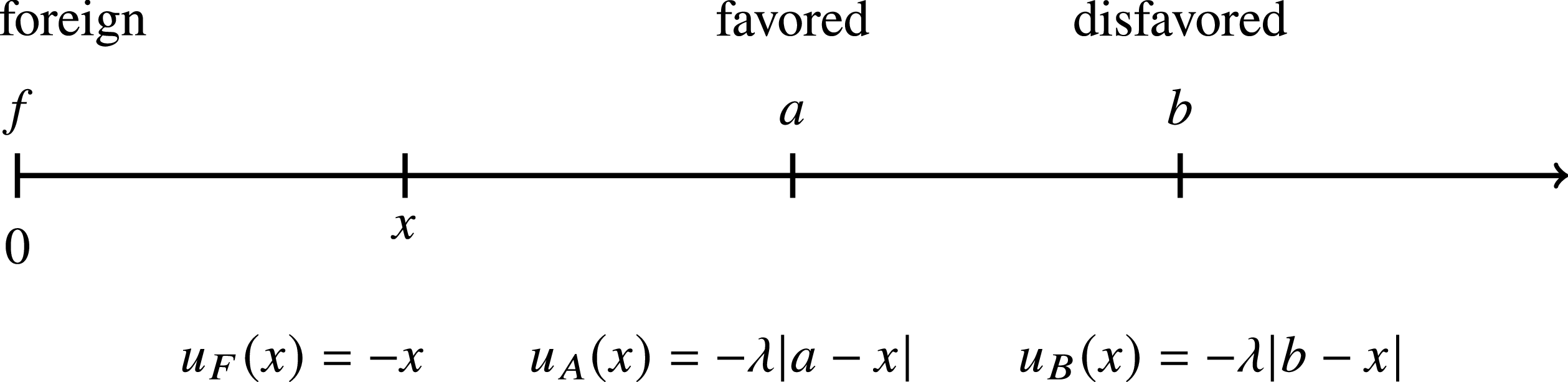
 x∈X
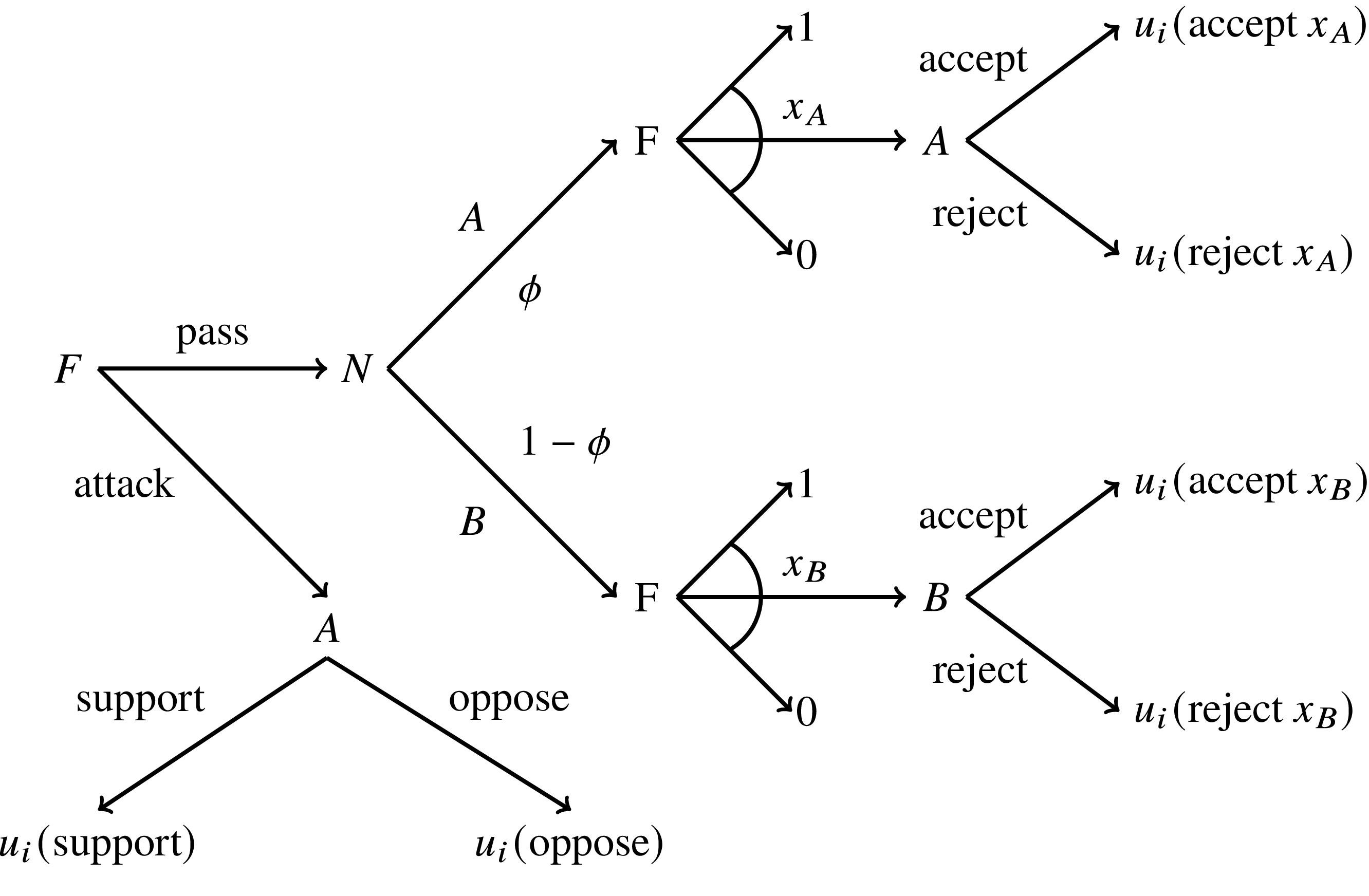
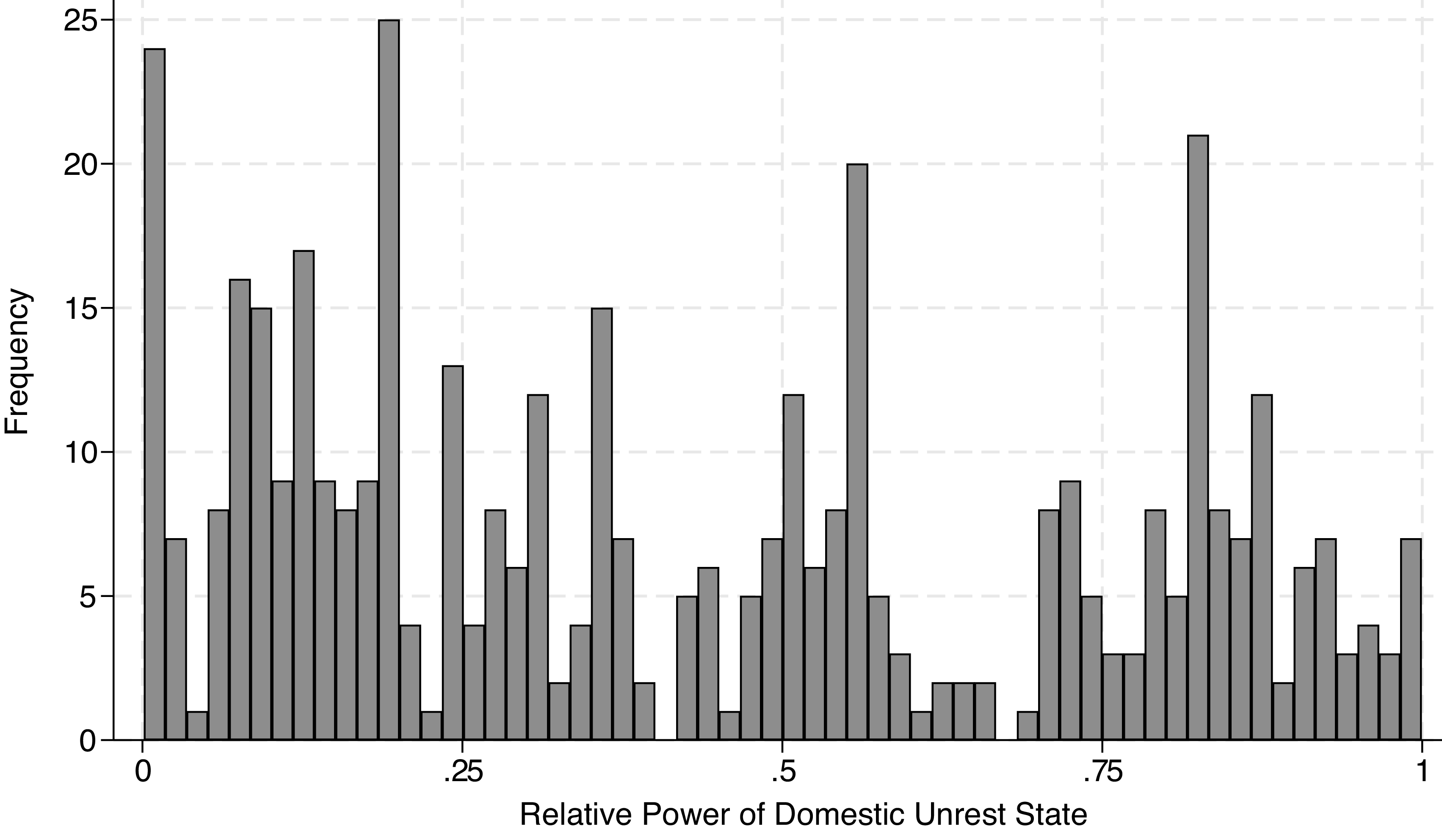
 CINCD/(CINCD+CINCF)

 Open access

