The most recent manifestations of racialization target Muslims in the United States. Government policies that profile Muslims, anti-Muslim public sentiment, and hate crimes have escalated in recent years, serving as a salient part of the Muslim experience in the United States (Beydoun Reference Beydoun2018; Cainkar and Selod Reference Cainkar and Selod2018; Lajevardi and Oskooii Reference Lajevardi and Oskooii2018). Given this escalation, how do Muslims reconcile these forms of racialization? Although we have knowledge of the effects of Latinos’ and Black Americans’ racialization in the United States, our understanding of the impact that the racialization of Muslims has on their identity development and behavior is limited.
This study addresses the gaps in extant research by examining the role that stigma and awareness of that stigma (i.e., stigma consciousness) have in affecting Muslims’ identity development in the United States. The way that Muslims connect discriminatory experiences to their stigmatized group identity reveals an important understanding of how people may distance their connection with other identities—namely, dominant group identity. This article focuses on “American” as the superordinate group identity. Being American, as current literature finds, is not simply a national identity; it has racial meaning connected to it in which being “American” is synonymous to whiteness (Devos and Banaji Reference Devos and Banaji2005). This may create barriers for racialized minorities, and for Muslims in this instance, to connect to their American identity (Ahmad-Sediqe Reference Sediqe and Harris2019).
This article introduces the concept of stigma consciousness from social psychology to clarify the relationship between discrimination and group-identity attachment (Pinel Reference Pinel1999). Stigma consciousness refers to the process wherein people are explicitly aware that they are being targeted because of an identity that is devalued in a specific social context (Pinel Reference Pinel1999; Reference Pinel2004). This theory is introduced to better understand the identity-to-discrimination link.
Drawing on a 2010 survey of Muslims in southeast Michigan, this study explores two major questions: Which factors influence Muslims to adopt a sense of stigma consciousness? Does having a higher sense of stigma consciousness detract from Muslims adopting a superordinate identity, such as being American? Examining the relationship between stigma consciousness and discrimination, this study finds that experiences of discrimination are a significant predictor of Muslims holding a higher sense of stigma consciousness. In particular, Muslim women who wear the hijab have higher levels of stigma consciousness, illustrating the gendered ways that racialization affects Muslims. Finally, the findings show that Muslims who have high levels of stigma consciousness are less likely to adopt an American identity. These results reveal important consequences of racialization by highlighting the potential isolation people may feel when they are aware that they are discriminated against because of the group with which they associate.
IDENTITY TO POLITICS
An individual’s connection to group identity is defined as the psychological attachment to a group to which one belongs (Lien, Conway, and Wong Reference Lien, Conway and Wong2003; Watts Smith Reference Smith and Candis2013). Given the history and current presence of structural racism in the United States, individuals affected by processes of racism are constantly reminded of which stigmatized group they belong to through discriminatory experiences, interactions with law enforcement, and so forth. As a result, manifestations of racism—perception and experiences of discrimination—are associated with Black Americans, Asian Americans, and Latinos having a stronger attachment to their racialized group identity. Similarly, Muslims increase their attachment to group identity with higher exposure to experiences of discrimination (Jamal Reference Jamal2005; Sediqe Reference Sediqe and Harris2019).
Identity attachment is consequential and the traditional “next step” turns to the theory of group consciousness. Group consciousness builds on group identity and is multidimensional in nature. It argues that people who hold a sense of group identity—that is, recognition that the group they identify with holds a disadvantaged status—are motivated to engage in collective action to improve group status (McClain et al. Reference McClain, Carew, Walton and Watts2009). Group consciousness highlights how identity can motivate political engagement for racialized communities.
STIGMA CONSCIOUSNESS
Given how politically meaningful group consciousness can be, understanding the distinct dimensions clarify how individuals are moved to action. The dimension of group consciousness that this article focuses on is people’s awareness that their group’s social standing is subordinate. In previous work, researchers asked respondents about their relative position in society to measure subordination in different ways, such as with questions regarding their perception of discrimination (Sanchez and Vargas Reference Sanchez and Vargas2016). One commonly asked question is, “How much discrimination or unfair treatment do you think different groups face in the United States?” What researchers do not explicitly ask respondents is which factors contribute to a person connecting discrimination to their group affiliation.
The linkage that the respondents make when attributing discrimination to their group identity is addressed by the theory of stigma consciousness. Does attribution of stigma to people’s identity make them aware of their group’s relative positioning in society? If so, how does that influence identity attachment?
As illustrated in figure 1, stigma consciousness is an antecedent to what influences respondents’ awareness of their subordinate-group status. It draws further insight to this dimension of group consciousness and how, in turn, it may influence people’s attachment to identity. Stigma consciousness is a distinct process from group consciousness because it focuses on people being aware that their subordination is occurring due to their belonging to a specific group (Pinel Reference Pinel1999; Reference Pinel2004). This negotiation of stereotypes, which stigma consciousness explicitly discusses, is related to subordination. It provides insight to the process before we consider people’s awareness of a subordinated status in conversation with other dimensions of group consciousness.
The Connection Between the Different Identity-to-Politics Processes

Stigma consciousness refers to the notion that people are aware that they are being targeted because of an identity that is stigmatized (Pinel Reference Pinel1999). Stigma refers to the process whereby “some attribute or characteristic conveys a social identity that is devalued in a particular social context” (Crocker and Major Reference Goffman1998, 505). These marks of stigma can be linked to visible things such as a physical condition or a group membership (e.g., being Muslim). Stigma diminishes one “…from a whole and usual person to a tainted, discounted one” (Goffman Reference Goffman1963, 3). By virtue of cultural markers such as language and dress, Muslims hold many markers that have stigma (Dana et al. Reference Dana, Lajevardi, Oskooii and Walker2018). What becomes important for the purpose of understanding its relationship with identity is the consciousness of this process—“stigma consciousness”—which highlights a process in which people expect that they will be judged based on their group membership.Footnote 1
DISCRIMINATION AND STIGMA CONSCIOUSNESS
Discrimination, specifically, is one of the key elements that comprise stigma consciousness. Incidences of discriminatory experience have increased for Muslims and affected them across levels of religious practice. Because discriminatory experiences occur regularly for Muslims, it is expected that they attribute the motive for the experience of discrimination to their being Muslim. If stigma consciousness exists among Muslims, then discrimination is expected to be predictive of stigma.
Thus, the more one experiences daily instances of discrimination, the more they are likely to have a higher sense of stigma consciousness (H1).
Moreover, people with highly visible markers of being Muslim have been targeted with hate crimes, so it is probable that they will have a higher sense of stigma consciousness. One of the most visible markers for Muslims are women who wear the hijab.
Therefore, it is expected that Muslim women who wear the hijab will have a higher sense of stigma consciousness than those who do not. (H2).
STIGMA AND AMERICAN IDENTITY
Of central importance to this analysis is the extent to which having a sense of stigma consciousness influences an individual’s attachment to being “American.” American identity is important to understand because of the frequency that this identity and its negotiation arise for Muslims (Ahmad-Sediqe Reference Sediqe and Harris2019). For Muslims, being American is not simply a national identity; it has more meaning—specifically, racial meaning—connected to it rather than simply being descriptive of a nation-state.
In a series of six experiments, Devos and Banaji (Reference Devos and Banaji2005) found that American identity is linked to whiteness. They stated: “…these studies provide evidence that to be American is implicitly synonymous with being White” (Devos and Banaji Reference Devos and Banaji2005, 450). They asked the question: “Who is American?” and determined that “The conclusion that can be drawn on the basis of the six studies presented here is unambiguous. To be American is to be White” (Devos and Banaji Reference Devos and Banaji2005, 450) This declaration highlights how racial identity is associated with being American.
Therefore, being American should be seen as a dominant, superordinate identity that is also racialized. Because Muslims are part of a racialized religious group that currently holds a subordinate position, it is expected that they will be reminded by others that they are not American enough, thereby distancing themselves from identifying as American.
Specifically, it is expected that Muslims who hold a higher sense of stigma consciousness are less likely to adopt an American identity (H3).
METHODS
These three hypotheses were tested by drawing on 2009–2010 survey data from the University of Michigan’s study of religion in southeast Michigan (Nguyen et al. Reference Nguyen, Taylor, Chatters, Ahuvia, Izberk-Bilgin and Lee2013). The survey included 1,141 respondents, 231 of whom were Muslim students ages 18 to 23. Although this was a nonprobability convenience-based sample, it provides important insights into Muslim Americans that merit further exploration. Muslims comprise an estimated 3% of the US population from diverse backgrounds; this sample overrepresents students within the study.
VARIABLE MEASUREMENT
Two main models were used to test the hypotheses. The first dependent variable is stigma consciousness, which is operationalized based on 10 questions adapted from Pinel’s (1999) questionnaire. The scale has a Cronbach’s alpha of 0.80. Questions included, “My being Muslim does not influence how people interact with me.” Regarding the hijab, Muslim women were asked how frequently they wear it. Regarding discrimination, a scale (i.e., Cronbach’s alpha of 0.87) was created based on 10 questions including whether respondents have been called names or otherwise insulted, physically threatened, or harassed. The full battery of questions is available in the online appendix.
The independent variables used to test the first model included income to measure socioeconomic status and measurements controlling for the effects of age, political orientation, race, and gender. Age was a continuous variable and race was binary (i.e., Arab or non-Arab). For religious observance, the survey relied on four questions: how often respondents attend religious services, how many prayers they participate in, whether they fast during the Muslim holy month of Ramadan, and how involved they are in their religious congregation.
The second model tested closeness to American identity. Respondents rated (from one to six) the strength of their identification with American identity. The independent variables used were similar to the first model, with the addition of stigma consciousness as an explanatory variable.
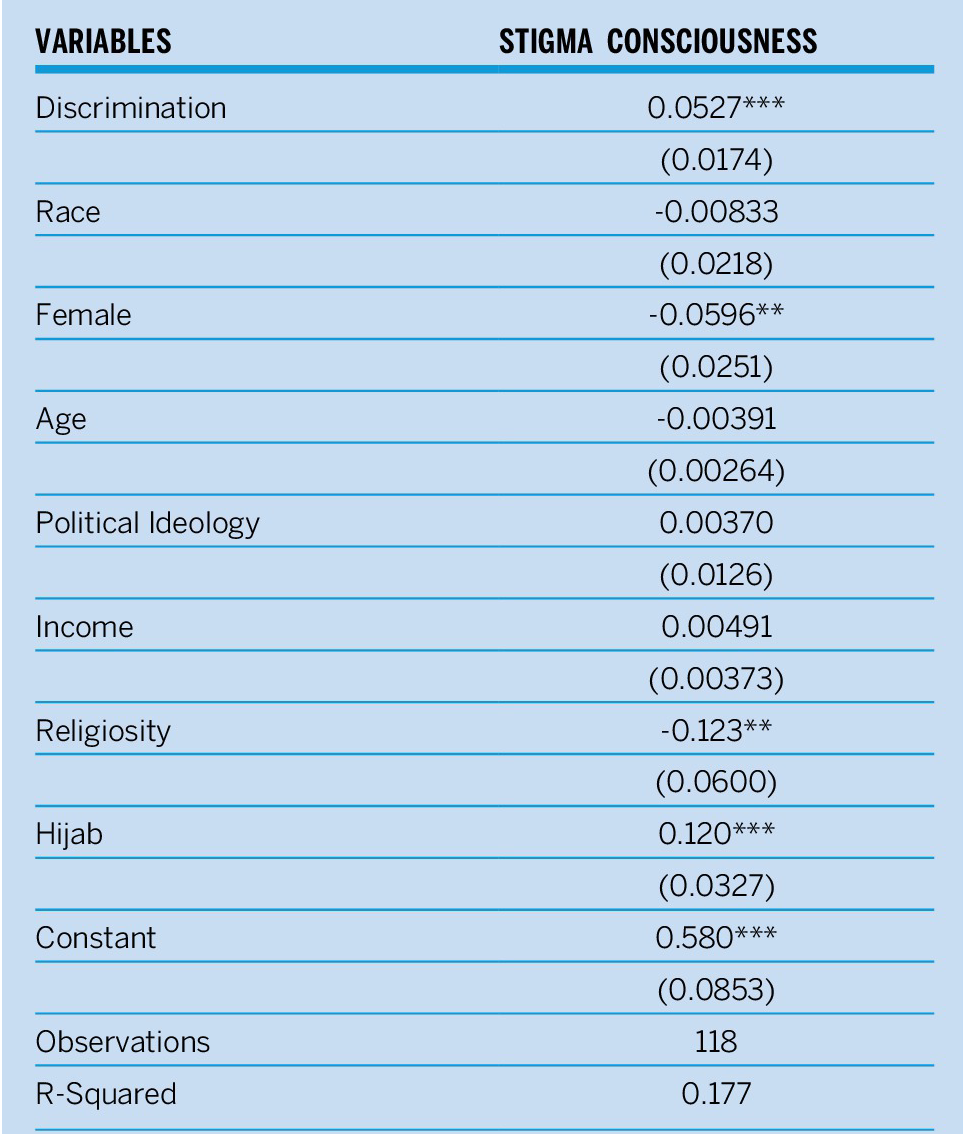
Stigma Consciousness Predictors for Muslim RespondentsFootnote 2

Notes: Standard errors are in parentheses. ***p<0.01, **p<0.05, *p<0.1.
RESULTS
Tables 1 and 2 illustrate key findings of this study. Looking at stigma consciousness as the outcome variable in the first model, I find that discrimination has a statistically significant relationship with it. The more often that respondents experience discrimination, the more likely they are to have a sense of stigma consciousness—that is, an awareness that these experiences are connected to their identity as a Muslim. This is consistent with the first hypothesis. Women are less likely to have a sense of stigma consciousness in comparison to men, yet this result differs when we consider women who wear the Muslim hijab. Respondents in the sample who wear the hijab were more likely to have a higher sense of stigma consciousness than those who do not, which is consistent with the second hypothesis.
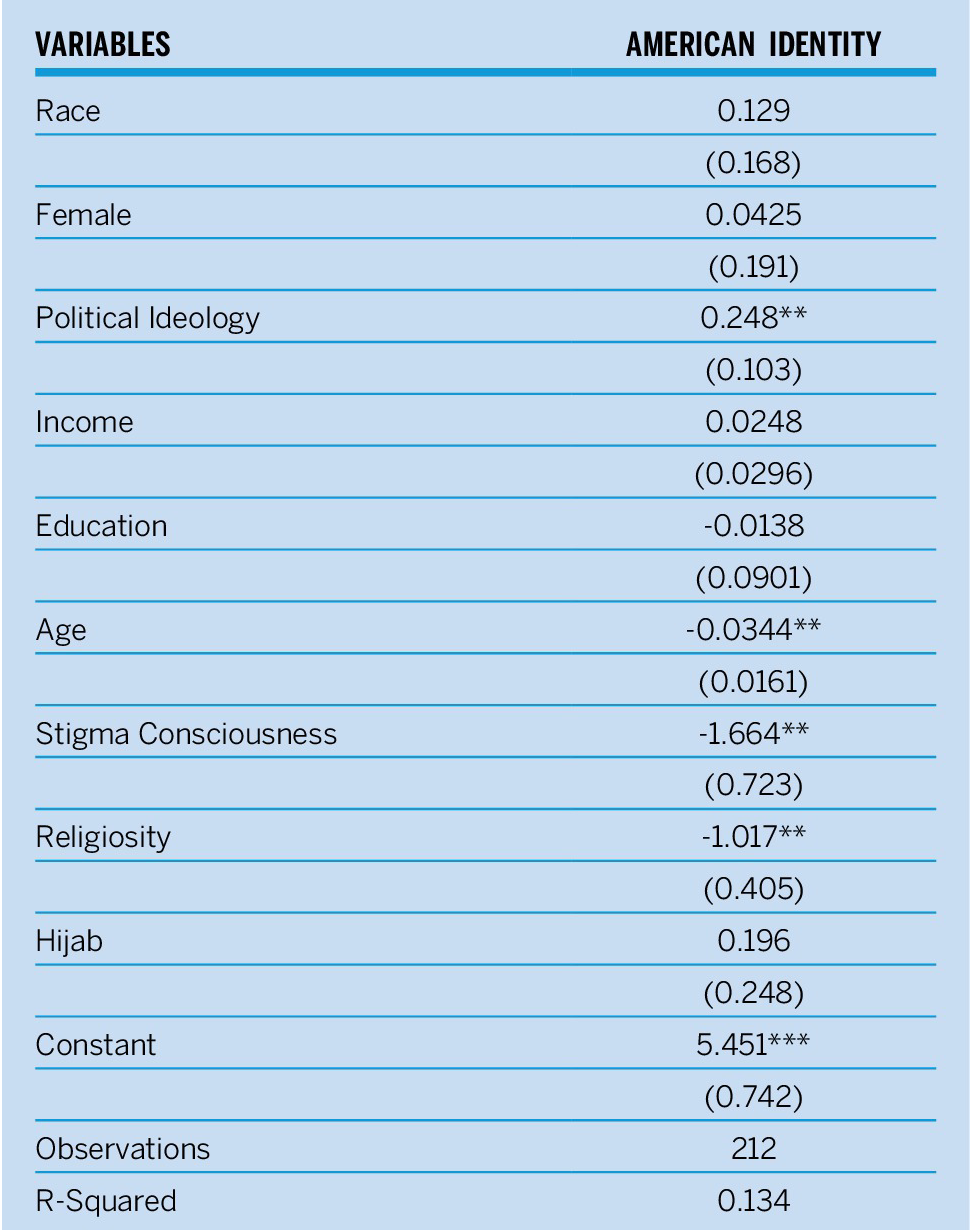
American Identity Attachment for Muslim Respondents

Notes: Standard errors are in parentheses. ***p<0.01, **p<0.05, *p<0.1.
Turning to American identity, results for American identity are statistically significant and consistent with the third hypothesis. Muslims who have a sense of stigma consciousness reported a decreased likelihood of considering their American identity important. The higher the respondents’ sense of stigma consciousness, the less likely they are to identify as American. This association is an important finding, showing how respondents distance themselves from American identity when they have a sense of stigma consciousness. The findings suggest that these Muslims are less likely to identify with being American. These results provide an interesting contribution to the existing literature, which suggests that newly racialized groups seek to assimilate into a superordinate identity in such circumstances.
DISCUSSION
This study sheds light on the relationship between discrimination and Muslims’ stigma consciousness (i.e., the awareness that stigma is attached to one’s identity) as well as the extent that stigma consciousness shapes Muslims’ adoption of an American identity.
The results from this analysis indicate that Muslims do hold higher levels of stigma consciousness when they experience discrimination.
The results from this analysis indicate that Muslims do hold higher levels of stigma consciousness when they experience discrimination.
The second analysis reveals that Muslims with higher levels of stigma consciousness are less likely to identify as American. Because being American is synonymous with whiteness, it is interesting to see how Muslims distance themselves from that identity when they have higher levels of stigma consciousness. Much of the literature on boundary negotiation for Muslims focuses on the effect it has on their attachment to a Muslim group identity (Chouhoud, Dana, and Barreto Reference Chouhoud, Dana and Barreto2019; Jamal Reference Jamal2005). The contours of how this affects other identities—namely, attachment to American identity—have received minimal attention. The findings of this study suggest that it is equally important to examine how respondents negotiate their attachment and boundaries with the notion of being American, a superordinate identity. These results are consistent with expectations that a relationship exists and spurs further questions of what the implications are when individuals distance from their superordinate identity.
The findings also demonstrate that the existing racial climate may influence Muslims in a way distinct from what may be occurring for people from other faith-based backgrounds. It is this distinction that makes Muslims behave more like racialized communities, similar to the experiences of Asian, Latino, and Black Americans in the United States.
Finally, the data used in this study were collected during the Obama era. The racial climate during the Trump administration has further marginalized Muslims; therefore, the effects among the variables would be stronger if the study were conducted today. Relative to the political climate during the Obama presidency, the current climate includes more exclusionary laws targeting Muslims and more hate crimes affecting them. To effectively understand how marginalized groups negotiate their identity, it is essential to consider the way that they negotiate their connection to their superordinate identity. Doing so helps us to better understand the different identity negotiations they must make. Future studies exploring the linkage of Muslims’ identity negotiations to policy preferences and voting behavior can help us consider the political consequences of the current racial climate for marginalized groups most targeted by current sociopolitical events.
Supplementary Materials
To view supplementary material for this article, please visit http://dx.doi.org/10.1017/S104909652000075X.