Introduction
Over the past two decades, an extensive body of research has explored the determinants of government spending. Considerable agreement has emerged that small countries tend to have larger public sectors, but analysis of this empirical regularity has been largely subsumed under the prolonged debate over the impact of globalization. On the one hand, scholars have argued that globalization generates incentives for governments to spend at higher levels to insulate their populations from external economic shocks. The tendency for small countries to have large public sectors is thus attributed to their relatively high level of economic openness and related exposure to fluctuations in international trade and capital flows. On the other hand, those invoking the ‘efficiency hypothesis’ have argued that globalization works against government expansion by creating pressures for increased economic competitiveness and lower taxation. Within this second theoretical framework, the relationship between population size and government spending tends to be written off as a function of the economies of scale in the provision of public goods enjoyed by larger countries.
Deliberately sidestepping the debate over the impact of globalization on cross-national performance, this article attempts to shed new light on the consequences of political scale by exploring the determinants of government spending at the subnational level of analysis. Does spending on government vary with the size of political units operating within a common framework of policies regarding international trade and capital flows? If so, to what extent can these spending patterns be attributed to the economies of scale in the provision of public goods rather than political pressures for higher spending? How, in particular, does democratic competition condition the impact of political scale? Are the political incentives for increased government spending stronger in small political units where voters can more readily contact public officials and monitor their behavior?
Such questions are of importance not only for the study of public spending and democratic policy formation, but also for an improved understanding of the role of political scale. While a central issue in ancient and enlightenment accounts of republican governance, the tradition of exploring the consequences of political scale has all but vanished from contemporary political analysis, arguably diminishing our ability to address outstanding research puzzles. Largeness has been linked with increased heterogeneity and smallness with homogeneity (Dahl and Tufte, Reference Dahl and Tufte1973; Bailey and Hickman, Reference Bailey and Hickman2005); but the consequences of political scale for the representation of citizen interests, democratic governance, and policy choice remain very much open to question.
Theoretical perspectives on size and spending
The relationship between country size and public spending first achieved widespread recognition in the comparative politics literature as a result of Cameron’s (Reference Cameron1978) and Katzenstein’s (Reference Katzenstein1985) works on Western Europe. Both emphasized the tendency of the continent’s smaller democracies to spend more on government in response to the strength of left-wing parties, powerful union movements, and centralized systems of interest group representation – all seen as characteristics of small countries with high levels of trade dependence. Scholars of globalization have, since then, extended this line of analysis to other political contexts, arguing that economic openness strengthens pressures for government spending to shelter citizens from the risks posed by international economic exposure (Quinn, Reference Quinn1997; Rodrik, Reference Rodrik1998). Recent contributions, however, have challenged this ‘compensation hypothesis’, arguing that exposure to the international economy either has little impact on government spending (Hallerberg and Basinger, Reference Hallerberg and Basinger1998; Iversen and Cusack, Reference Iversen and Cusack2000; Molana et al., Reference Molana, Montagna and Violato2004) or exerts a negative effect by eroding the revenue-raising capacities of governments (Garrett, Reference Garrett2001; Liberati, Reference Liberati2007), especially outside the Organization for Economic Co-operation and Development (OECD), where openness is associated with procyclical fiscal policy responses to income shocks (Kaufman and Segura-Ubiergo, Reference Kaufman and Segura-Ubiergo2001; Wibbels, Reference Wibbels2006).
Within the framework of this prolonged and as yet unresolved debate, two major points of consensus have emerged: (1) small countries tend to be more open to the international economy, and (2) small countries tend to spend more on government. The reasons for the first tendency are reasonably well understood: through free trade, small polities can realize the same economies of scale as larger ones. To the extent that productivity revolves around market size, small countries therefore have stronger incentives for openness than larger countries. What remain less clear are the causal linkages between country size and government spending. In their exploration of this issue, Alesina and Wacziarg (Reference Alesina and Wacziarg1998) suggest that the answer may involve the economies of scale in the provision of public goods that can be achieved by larger states. Largely unexamined are ‘political’ connections between political scale and higher spending. Hence, although population size is often utilized as a control variable in models of government spending (e.g., Persson and Tabellini, Reference Persson and Tabellini1999; Garrett, Reference Garrett2001; Annett, Reference Annett2002), the literature basically suggests that fiscal policy choice is driven by other sets of variables. In addition to international economic openness, significant attention has been devoted to political institutions (Persson and Tabellini, Reference Persson and Tabellini1999), partisan control (Husted and Kenny, Reference Husted and Kenny1997; Caplan, Reference Caplan2001), voter registration and turnout (Husted and Kenny, Reference Husted and Kenny1997), legislative size (Weingast et al., Reference Weingast, Shepsle and Johnsen1981; Thornton and Ulrich, Reference Thornton and Ulrich1999; Bradbury and Crain, Reference Bradbury and Crain2001; Gilligan and Matsusaka, Reference Gilligan and Matsusaka2001; Fiorino and Ricciuti, Reference Fiorino and Ricciuti2007), electoral competition (Rogers and Rogers, Reference Rogers and Rogers2000; Caplan, Reference Caplan2001; Campbell et al., 2007), ‘fiscal illusion’ (Wagner, Reference Wagner1976; Goetz, Reference Goetz1977), redistributional pressures (Meltzer and Richard, Reference Meltzer and Richard1981; Ferris and West, Reference Ferris and West1996), electoral budget cycles (Petry et al., Reference Petry, Imbeau, Crete and Clavet2000), intergovernmental grants (Garand, Reference Garand1988), and economic development (Abizadeh and Gray, Reference Abizadeh and Gray1985).
Despite the relative lack of theoretical interest in the impact of political scale, the public choice literature nevertheless suggests three basic channels through which variations in the size of political units may influence public spending. The first channel is electoral competition, which theoretically rises in larger and more heterogeneous political units. Facing the prospect of strong electoral opposition, politicians attempt to maximize votes by promising citizens more governmental goods and services, thus increasing the incentives for government spending (Buchanan and Wagner, Reference Buchanan and Wagner1977). Drawing upon a different set of assumptions about the sources of spending pressures, a second strand of public choice literature suggests that the main channel through which political scale influences spending is interest group competition, which also is presumed to be higher in larger and more heterogeneous political units. According to Mueller and Murrell (Reference Mueller and Murrell1986: 131), ‘The greater the number of interest groups in a country, the greater will be the number of programs arising as a result of bargains between government and special interests’. In a complementary line of argument, McCormick and Tollison (Reference McCormick and Tollison1981) hypothesize that size increases the incentives for free riding, reducing citizen monitoring of government in favor of increased transfers to organized interests. This suggests a third channel through which size shapes spending. It may be presumed that monitoring costs are higher in larger political units in which voters are less likely to know their representatives or have direct information about their behavior (Thornton and Ulrich, Reference Thornton and Ulrich1999: 591). In summary, the central expectation that may be derived from several strands of the public choice literature is that largeness creates pressures and opportunities for government growth – an expectation that runs up against the available empirical evidence.
Less widely entertained by the literature on public finance is the possibility of a negative relationship between political scale and public spending resulting from the political pressures of citizens. Nevertheless, there are several reasons to anticipate such a result. First, citizen preferences for increased government goods and services are likely to be higher in smaller and more homogeneous political units in accordance with the logic advanced by Oates (Reference Oates1985), Mueller and Murrell (Reference Mueller and Murrell1986), and Alesina et al., (Reference Alesina, Baqir and Easterly1999). The basic presumption is that in homogeneous jurisdictions, citizens are more likely to expect public resources to be expended in accordance with their preferences, creating a stronger base of support for increased public spending. Second, in small political units, where citizens can readily communicate their preferences to politicians and monitor the latter’s behavior, individual influence on political outcomes is likely to be greater than in larger jurisdictions. Thinking of the nexus between citizens and politicians as a transaction in which politicians promise government goods and services to citizens in exchange for their support, the logical conclusion is that the per capita cost of government will tend to increase as political scale declines. To the extent that electoral competition varies directly with size, a third logical possibility is that democratic accountability mechanisms work less, rather than more, effectively in small political units, leaving politicians free to engage in rent-seeking behavior or otherwise pursue their own goals at the expense of the private sector. Finally, as suggested by the work of Olson (Reference Olson1971), political scale is likely to shape the costs and benefits of collective action, with size acting as an impediment to effective interest group organization. Political leaders in smaller political units are thus likely to be more buffeted by the demands of organized interests.
All four causal mechanisms may be assumed to operate more effectively under democracy than authoritarianism. Whereas electoral competition, representative legislative bodies, and political liberties create avenues for citizens to organize, express their preferences, and pressure public officials, authoritarianism reduces the incentives for government officials to obtain citizen support. Thus, the relationship between size and spending is expected to be magnified by democracy. The argument does not assume that authoritarian rulers are necessarily more fiscally conservative, but merely that their spending patterns are less responsive to variations in unit size.
These theoretical considerations suggest three related research hypotheses. First, the smaller the population of a political unit, the greater is the tendency toward increased government spending. Second, the relationship between size and spending is conditioned by regime type, leading size to exercise a stronger influence on public sector expansion under democratic than authoritarianism rule. This second hypothesis is designed to differentiate the effects of political pressures for government spending from those involving economies of scale in the provision of public goods. To the extent that the impact of size revolves solely around the latter, no significant differences should exist between spending trends under authoritarian and elected governments: smallness would instead be consistently associated with larger government. The third hypothesis is designed to address variations in spending under democracy; namely, even after controlling for variations in citizen preferences, political institutions, electoral competitiveness, and economic performance, all which may be presumed to shape spending levels, size is a significant determinant of democratic fiscal policy.
Research design and empirical evidence
Data for the subsequent empirical analysis are drawn from the study of provincial spending in Argentina over the 1960–2001 time period. The theoretical and methodological advantages of this focus are several. First, moving outside the OECD makes it easier to distinguish between the effects of size and trade openness. As documented by prior research, pressures for fiscal balance, limited access to capital markets in economic downturns, and the sheer magnitude of economic shocks mean that trade openness in Latin America tends to be associated with pro- rather than countercyclical spending (Kaufman and Segura-Ubiergo, Reference Kaufman and Segura-Ubiergo2001; Wibbels, Reference Wibbels2006). In this context, openness and size may thus be expected to have diametrically opposite rather than mutually reinforcing effects on spending.
Second, focusing on subnational instead of cross-national data makes it possible to control for a number of variables of potential relevance for explaining government spending, including political culture, the ideology and class linkages of major political parties, and many important rules of the electoral game conditioning the nexus between citizens and politicians. All of the Argentine provinces have elected legislatures and governors, except during periods of military rule or federal intervention, when provincial governments are appointed. Politicians in the provinces also share the political incentives generated by national electoral rules, which provide for automatic electoral registration, compulsory voting, and the election of national deputies by closed list proportional representation. Also of relevance are the commonalities generated by national policies governing trade openness, capital flows, and the revenue and expenditure responsibilities of provincial governments.
Third, the Argentine provinces constitute a nearly ideal comparative setting for the study of the impact of political scale on government spending. Not only is the delivery of public goods and services highly decentralized in Argentina, but fiscal policy has also varied significantly across the provinces. In 2001, for example, mean spending relative to provincial gross domestic product (GDP) equaled 20.2% but ranged from a low of 9.7% in Chubut to 42.8% in Formosa (Universidad Nacional de La Plata, 2003). Likewise, in per capita terms, spending in 2001 ranged from a low of $795 in Buenos Aires to $4366 in Tierra del Fuego (Universidad Nacional de La Plata, 2003). The provinces also differ significantly in terms of size, with populations varying from 97,241 to 13,641,138 in 2000 – differences that, as at cross-national level, are reflected in trade openness.Footnote 1 To add to these important variations, over the past 40 years, Argentina has experienced multiple transitions between military and civilian governance. Hence, unlike the advanced industrial nations upon which most prior research has concentrated, the Argentine case creates opportunities for separating the impact of economies of scale on spending from those arising from democratic political pressures.
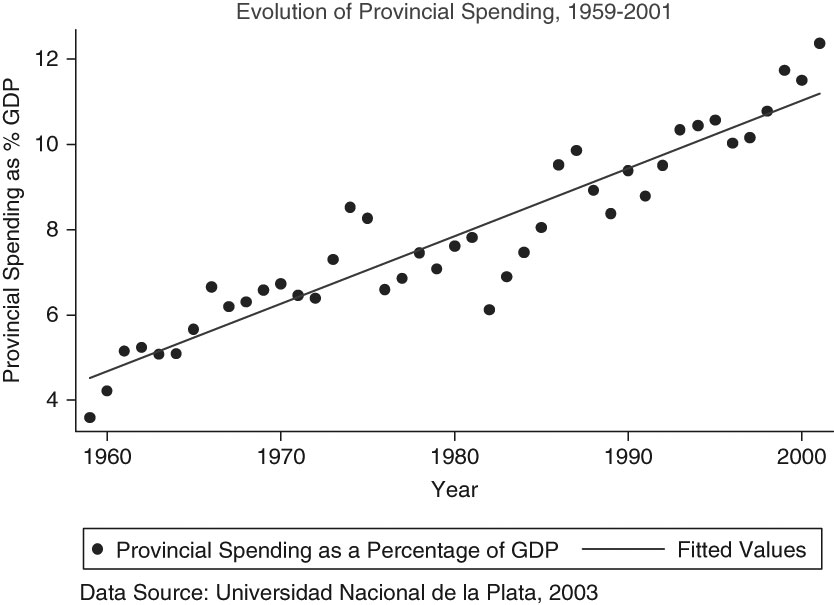
Fourth, subnational fiscal performance is intrinsically important due to its impact on the growth, size, and solvency of the overall public sector. In the Argentine case, provincial spending has been growing more rapidly than national spending over a period of several decades, rising from 21.5% of total spending in 1959 to 36.7% in 2001 (Porto, Reference Porto2004: 116). As suggested by Figure 1, this growth has boosted overall public sector expenditures from 30.1% to 38.0% of the GDP over the same time period (Porto, Reference Porto2004: 116). Particularly notable as well as consistent with theoretical expectation are the increases registered in the wake of transitions to civilian governments, which held power in 1958–62, 1963–66, 1973–76, and 1983 till present. Since provincial spending has been financed partly by the accumulation of debt, its growth has seriously undermined efforts at national fiscal adjustment, contributing to the Argentine economic crisis of 2001 and the largest sovereign debt default in world history. Subnational fiscal policy is thus key for understanding the recurrent economic failures and associated political crises that have shaken the political economy of Argentina over the past 40 years.
Evolution of provincial spending, 1959–2001.

Finally, due to the research efforts of the Economics Department of the Universidad Nacional de La Plata, a comparatively long, complete, and consistent set of data on subnational spending exists for Argentina (Universidad Nacional de La Plata, 2003), making it possible to explore the impact of size on spending on the basis of cross-sectional time series analysis. Extensive data are also available on revenue generation, partisan control, electoral cycles, political institutions, electoral outcomes, and per capita income. The latter data are of particular significance because they make it possible to control directly for the effects of economic shocks on spending rather than assume their presence from evidence of trade exposure. Practical considerations, thus, reinforce the theoretical and methodological advantages of focusing upon the Argentine case.
The extent to which findings based on the experience of a single nation or even region allow for broader theoretical generalization is inevitably open to further comparative investigation. Nevertheless, systematic analysis of variations across 23 political units covering a 40-year time period establishes a reasonable basis for assessing competing models of government growth. By focusing on a less industrialized nation, we also expand our research horizons outside of the OECD, creating opportunities for exploring the broader theoretical relevance of existing research in the field of public finance. The central contributions of this study thus revolve around its capacity to marshal subnational data covering an extended time period to analyze the sources of government growth in a less industrialized setting.
Subnational fiscal policy formation
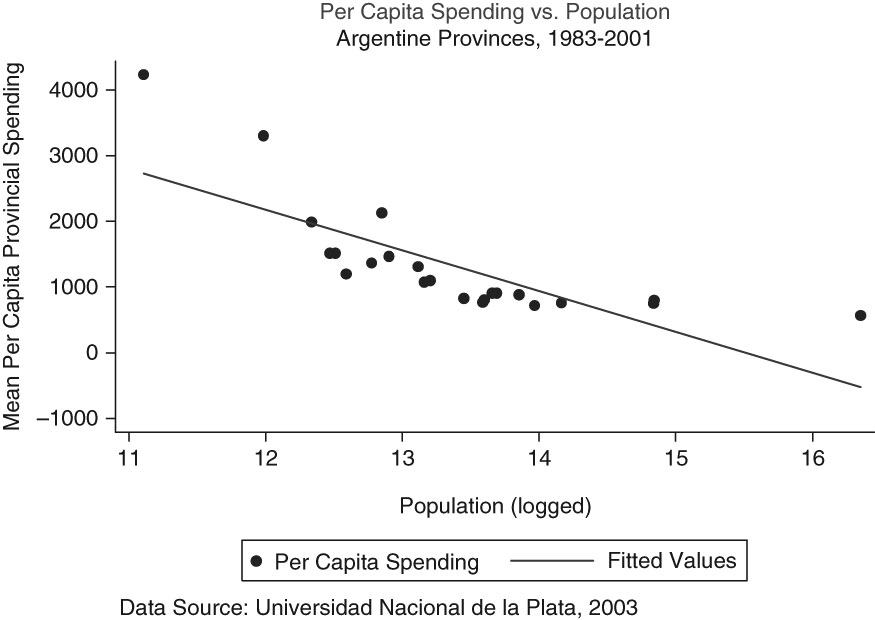
To explore the impact of political scale on government spending, we begin by tracing the simple bivariate relationship between population sizes and spending levels across the 23 Argentine provinces since the return to democracy in 1983. The vertical axis in Figure 2 represents constant per capita provincial government spending, averaged over the 1983–2001 time period. The horizontal axis measures logged population, averaged over the same years. Consistent with the argument linking size with spending, the figure clearly indicates that smaller provinces tend to spend more money per citizen, with the bivariate correlation between size and spending statistically significant at the 0.0001 level.
Per capita spending vs. population.

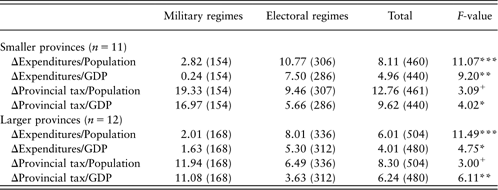
A key question is the extent to which these variations in fiscal performance reflect economies of scale in the provision of public goods rather than citizen pressures on politicians for government growth. The descriptive evidence presented in Table 1 points to the importance of the latter. Drawing upon data for the 1959–2001 period as a whole, the table highlights major differences between elected and military governments in fiscal policy choice. The dichotomous classification of regimes is based on the democracy scores of Polity IV (Marshall and Jaggers, Reference Marshall and Jaggers2006) and is designed to assess the impact of elections on government growth. Included in the electoral category are years receiving a positive rating on the Polity IV annual measure of institutionalized democracy, all of which were years of elected rather than military governance in Argentina. Comparing across these two categories, per capita provincial spending measured in constant peso values clearly grew more rapidly under elected than military authorities, both in large and small provinces. These differences do not reflect variations in tax collection effort: the growth of provincial tax revenues under military rule significantly outstripped that of elected provincial governments. Nevertheless, government growth was far more pronounced under elected politicians. Comparing data on levels of spending relative to provincial GDP yields the same result: provincial spending grew significantly more rapidly under elected governments. Also suggestive with respect to the causal mechanism linking size and spending are the differences between small and large provinces. The former, whose populations averaged approximately 450,000 over the time period in question, had larger public sectors under both military and elected governance. Elected governments, however, increased spending more rapidly in smaller provinces, particularly those with populations under 300,000 inhabitants. In contrast, no consistent differences separate government growth in small and large provinces under military rule.
Comparisons between the mean fiscal performance of small and large provinces by regime type, 1960–2001

Source: Universidad Nacional de La Plata, 2003.
GDP = gross domestic product.
+Significant at 0.10%; *significant at 0.05%; **significant at 0.01%; ***significant at 0.001%.
To shed more systematic light on the responsiveness of public spending to political scale and electoral governance, the subsequent analysis draws upon a cross-sectional time series analysis of Argentine provincial spending patterns over the 1960–2001 period. The main dependent variable is the growth of provincial government spending, which is measured on the basis of two indicators: the ratio of government spending to provincial GDP and per capita spending in constant peso values of 2001. While the two indicators capture differing conceptions of government size, the shifts in their relative magnitude are highly correlated over time (r = 0.888).
The independent variables of central theoretical interest are size, which is measured on the basis of provincial population (logged) and drawn from the same source as the fiscal data; regime type, which is measured on the basis of the continuous Polity IV combined regime scores, which range from −10 to +10; and the interaction between these two variables. The remaining variables included in the statistical analysis are designed to control for other potential influences on government spending. First, we control for per capita provincial GDP to address the potential impact of economic development on the size of the public sector, as suggested by ‘Wagner’s Law’, as well as to assess directly the consequences of fluctuations in economic performance rather than assume their presence or absence on the basis of data on trade openness. In accordance with the literature on fiscal policy outside the OECD, we expect to find that government spending is procyclical rather than countercyclical, leading economic setbacks to exert a negative rather than positive effect on spending.
To address the effects of national government transfers on provincial spending, the analysis also controls for total national revenue transfers. In federal systems in which political representation is based both on population and territory, smaller political units tend to be systematically overrepresented, gaining opportunities to bolster subnational spending by extracting a disproportionate share of financial resources from the center (Gordin, Reference Gordin2007). Controlling for federal revenue flows makes it possible to distinguish between the posited effects of size on the political preferences and power of citizens at the provincial level and those related to the political leverage of overrepresented provinces in national politics. The third control variable is provincial taxation, which may be presumed to reflect the political preferences of citizens for higher spending as well as to condition opportunities for spending growth. Finally, we include a time counter to capture major shifts occurring in the structure of the economy over time, including economic openness.
The statistical estimations rely upon an error-correction model, which has been widely utilized in prior research on government finance (Iversen and Cusack, Reference Iversen and Cusack2000; Beck, Reference Beck2001; Kaufman and Segura-Ubiergo, Reference Kaufman and Segura-Ubiergo2001; Rodden, Reference Rodden2003; Wibbels, Reference Wibbels2006). Specifically, we draw on the following model:

in which Yi ,t measures government spending in province i at time t and X represents a vector of independent variables. The dependent variable is thus the annual change in provincial spending, measured alternatively as spending as a percentage of GDP and per capita spending. The independent variables include the lagged value of government expenditures, the annual rate of change in each of the independent variables, and the lagged value of the independent variables. The underlying theoretical assumption is that the dependent variable not only fluctuates in response to short run shifts in the independent variables but also assumes over the long run levels consistent with those of the independent variables. Rewritten in the form in which it is actually estimated, the model reads as follows:

in which β 2 measures the transitory relationship between size and spending and β 3 the longer-term effect, which is the coefficient of central theoretical importance.
To address problems of heteroskedasticity and contemporaneous correlation of errors across units, which are characteristics of cross-sectional time series analyses, the model is estimated on the basis of ordinary least squares (OLS) with panel-corrected standard errors (see Beck and Katz, Reference Beck and Katz1995). The estimates have also been adjusted to control for panel-specific first-order serial auto-correlation. Deliberately excluded from the model are provincial fixed effects because of the limited variability over time of provincial population. The results obtained via alternative methods are discussed below, along with the estimates obtained by alterations to the base model. Although the relative strength of the coefficients varies with estimation technique and model specification, the political scale variable and its interactions, which are the variables of central theoretical interest, retain a consistently negative and statistically significant relationship to spending.
Empirical results
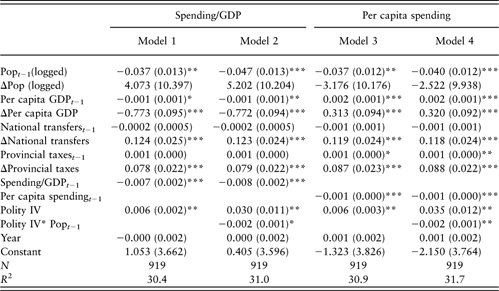
The estimates for changes in aggregate provincial spending are presented in Table 2. Columns 1 and 3 of the table provide the results for a linear-additive version of the base model, while columns 2 and 4 include interaction terms designed to assess the hypothesis that democracy magnifies the impact of size. Overall, the models explain slightly more than 30% of variance in provincial spending, which is reasonably compelling given that the goal is to explain patterns of change rather than levels of spending. The four models consequently do not include a lagged dependent variable. If they were rewritten solely to address variations in spending levels, the R 2 would be inflated well above 90%.
Effects of provincial size on the expansion of government, 1960–2001

GDP = gross domestic product.
*Significant at 5%; **significant at 1%; ***significant at 0.01%.
Note: Table entries are ordinary least squares estimates corrected for panel-specific autocorrelation. Panel-corrected standard errors are presented in the parentheses.
Looking first at the linear-additive models, the estimates are largely consistent with theoretical expectation. As indicated by the statistically significant coefficient for lagged population, the effects of provincial size on spending are negative, suggesting the existence of a long-term equilibrium relationship between population size and government spending. The positive and statistically significant coefficient for the Polity IV regime score also accords with expectation, indicating that democratic governance creates pressures for government expansion. Interpreting the results for population and regime in the two models that include interaction terms is more complicated, as the coefficients for lagged population only capture the effect of size on spending when the Polity IV indicator equals zero – a value not actually represented in the data set for Argentina. Likewise the Polity IV variable only assesses the impact of regime when provincial population is zero – a logical impossibility. Accordingly, the relevant coefficients in Models 2 and 4 are those for the interactions between democracy and population, which point to a significant conditioning effect of regime on the relationship between political unit size and government spending growth.
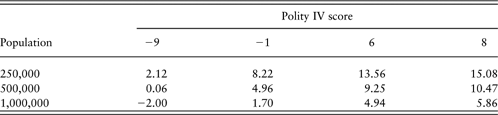
Drawing on these estimates for the growth of per capita spending, Table 3 illustrates the magnitude of this conditioning effect with respect to substantively relevant values of Polity IV. Under the repressive regimes that governed Argentina in the 1966–73 and 1976–83 periods, which receive Polity IV ratings of −9, per capita spending in a province with 250,000 inhabitants could be expected to grow at an annual rate of 2.12%. In contrast, at relatively high levels of democracy (such as those prevailing in Argentina in the wake of the 1983 democratic transition) per capita spending can be predicted to increase at a rate of more than 15% per annum. Assuming limited population change, these figures imply that real per capita spending would increase 50% in 3 years of democratic rule as compared to only 6% under repressive military rule.
Marginal effect of population on change in per capita spending as Polity IV score increases

Note: Marginal effects computed on the basis of Model 2 in Table 2.
Also evident from Table 3 is the significance of political scale for changes in spending. For years of highly democratic rule, we see that as provincial size increases from 250,000 to 500,000 inhabitants (approximately the size of the Provinces of La Rioja and Rio Negro, respectively, in the mid-1990s), the predicted rate of spending growth would drop from 15% to 10.5%. For a province of 1,000,000, which would be roughly equal to the size of Salta in the mid-1990s, the estimated growth rate would only approximate 6%. These differences clearly imply major variations in the cost of government over the long run. Perhaps, not surprisingly, the available data show per capita spending levels of $2128, $1457, and $874 pesos in 1995 for La Rioja, Rio Negro, and Salta, respectively.
Assessing the conditional impact of size on the basis of the ratio of spending to provincial GDP yields similar results. Again drawing on the estimates presented in Table 2, it can be predicted that as the population of a province increases from 250,000 to 1,000,000 under repressive military rule, the rate of change in spending to GDP would fall from 0.84 to −3.42 per annum. By way of contrast, under a regime with a Polity IV score of 8, the rate of increase in the ratio of spending to GDP in provinces of these same sizes would be 13.47% and 4.98%, respectively. These disparities are reflected in changes in real spending levels for the 1983–2001 period of continuous democracy. Whereas government spending as a percentage of GDP grew at an average annual rate of 13.8% in the smallest Argentine province, Tierra del Fuego, in the largest province, Buenos Aires, the ratio of spending to GDP increased by an average rate of 4.6%. At both extremes of the spectrum, however, spending growth far outstripped real economic growth.
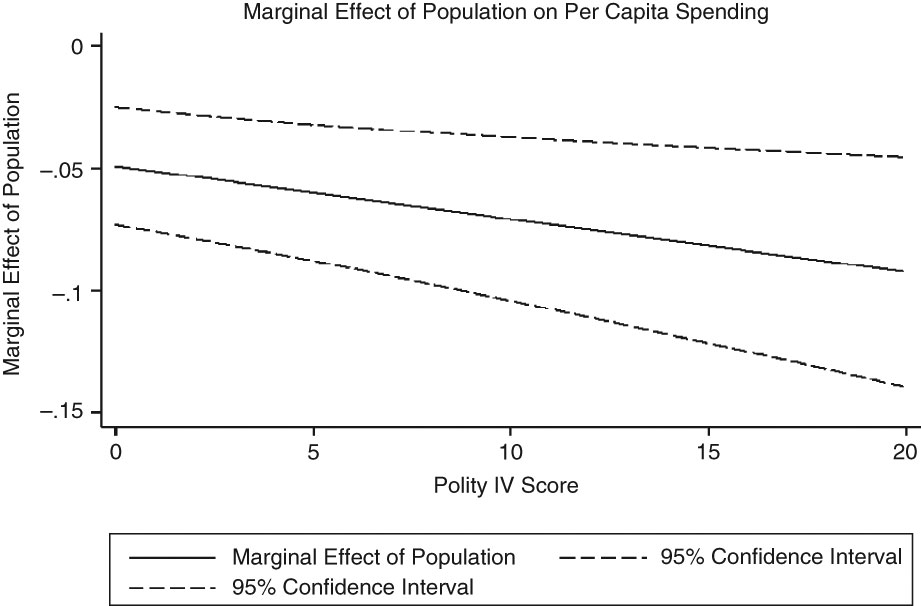
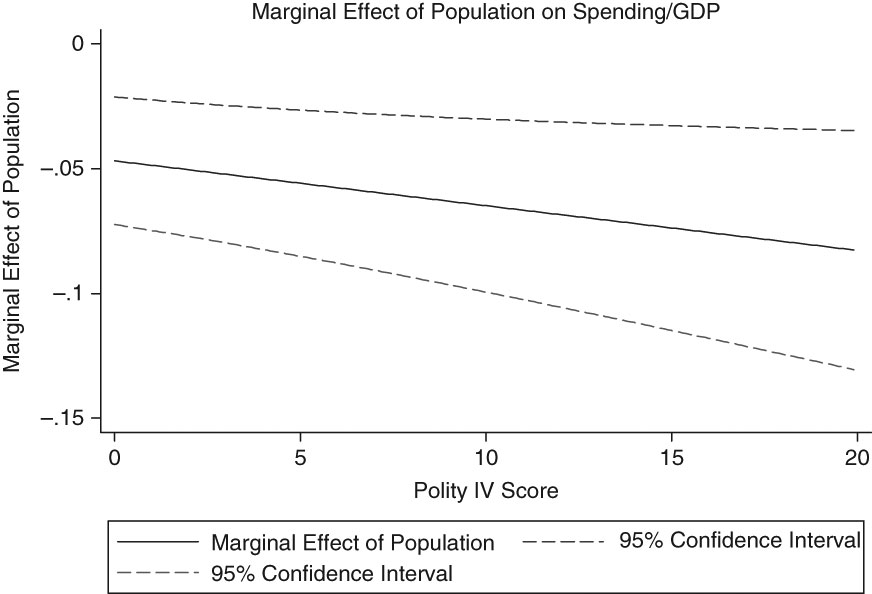
Figures 3 and 4 graphically illustrate the marginal effect of population changes across the full range of Polity IV scores for per capita spending and spending relative to GDP. The solid sloping lines show how the marginal effect of population on spending changes with democracy, augmenting the impact of size in accordance with theoretical expectation. The central implication is that the tendency for small political units to spend more on government is not merely a reflection of economies of scale in the provision of public goods but a consequence of electoral incentives.
Marginal effect of population on per capita spending.

Marginal effect of population on spending/GDP.

With respect to the other findings presented in Table 2, the results largely conform to theoretical expectation. Changes in the availability of major sources of revenue made a major difference to government spending under both military and civilian regimes, with positive shifts in provincial taxation and national revenue transfers significantly fuelling higher spending. As predicted by Wagner’s Law as well as by literature on the procyclical pattern of government spending outside the OECD, also significant for understanding variations in government growth are lagged levels and changes in per capita GDP, both of which were positively related to higher per capita spending. Because of the nature of the ratio, changes in government spending relative to GDP evince just the opposite tendency, suggesting a tendency for shifts in spending to lag behind income changes. Analyzing changes in absolute spending levels over the 1960–2001 period yields results that conform with the per capita findings: improvements in per capita income significantly boost total spending. Thus the impact of economic shocks is precisely the opposite of that posited by the literature on trade openness and government spending in the OECD, making it possible to tease out the separate effects of negative shocks and size.
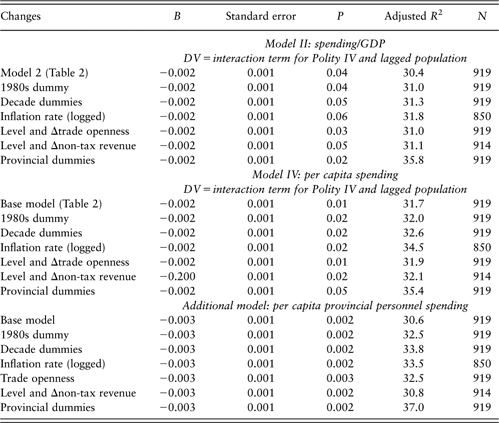
How robust are these findings? To address this question, Table 4 presents a set of revised statistical estimates drawing upon a series of alterations to the multiplicative interaction models. To the extent that the coefficient of central theoretical interest, namely lagged population interacted with regime type, remains negative and statistically significant in the presence of these alterations, confidence in the robustness of the statistical results reported above is obviously strengthened. The goal of the exercise is less to develop a more complete model of government spending than to explore how the estimations presented in Table 2 stand up to a series of modifications that prior research suggests may be relevant to the analysis of government growth.
Robustness results for the coefficients estimating the interaction between population size and Polity IV score

During the time period in question, the Argentine economy experienced a series of economic shocks. Perhaps the most notable of these was the outbreak of the regional debt crisis of the early 1980s, which created strong pressures for economic stabilization and budgetary austerity. To control for the potential impact of these pressures on spending growth, we re-estimated all four base models with a dummy variable for the 1980s as well as with a series of decade dummy variables to address variations in the regional and international context over the time period in question. As Argentina also experienced repeated bouts of high inflation in the 1960–2001 period, which can dramatically undermine fiscal performance, we also re-estimated our interactive base models by including the logged rate of inflation. We further assess the robustness of the results on the basis of a conventional measure of trade openness: the ratio between trade and GDP as reported in World Bank (2008). In the 1960–2001 period, the Argentine economy underwent major shifts in its international exposure, with trade as a percentage of GDP increasing from a low of 10.34% in 1970 to 23.32% in 1998. Prior literature suggests that these shifts might significantly affect government spending, potentially diluting the effects of size and democracy. Accordingly, we control for both the change in the trade to GDP ratio and the lagged level of trade openness. We do the same for the percentage change and lagged level of non-tax revenue, which might be expected to fuel spending. Finally, to assess the impact of unspecified factors that might lead to significant variations in provincial spending patterns, such as long-term political history or settlement patterns, we include provincial dummies in both specifications of the model.
To summarize briefly, what we find is that the coefficients for the interaction of democracy and population in Models 2 and 4 do not undergo any major alteration with the addition of other potentially relevant control variables. The size and statistical significance of these coefficients of central theoretical interest remains largely unchanged, as does the explanatory power of the models. The main exception revolves around the inclusion of the rate of inflation, which slightly dilutes the statistical significance of the interaction term in the estimates for spending to GDP. Perhaps more interesting are the results for trade openness, which has virtually no impact on the growth of provincial spending.
As a further check on the robustness of the results, provincial spending was disaggregated, making it possible to re-estimate the base models with personnel spending as the dependent variable. Prior research on Argentine politics emphasizes the central importance of public sector employment for rewarding political supporters and building political machines (Calvo and Murillo, Reference Calvo and Murillo2004). To the extent that policy makers are responding to electoral incentives, we might therefore expect them to prioritize the expansion of personnel spending. On the assumption that the price that politicians pay for support varies with the size of the political unit, we further expect that electoral pressures will lead to higher personnel spending in small political units. As evidenced by the robustness results presented at the bottom of Table 4, these expectations accord with the available evidence. After controlling for the same variables incorporated in the other multiplicative interaction models, democracy and size jointly and significantly influence the rate of growth of personnel spending. Again subjecting the model to a series of alterations leaves the coefficient for the interaction between population and regime as well as the explanatory strength of the model largely unchanged. Also interesting is the impact of changes in per capita wealth in these estimates: although weaker than in Table 3, the relationship between changes in income and spending is negative, again underlining the procyclical nature of provincial spending.
Finally, the results also remain robust to alternative estimation techniques. OLS with robust standard errors clustered by province yields very similar findings. The interaction term remains negative and statistically significant at the 0.01 level. Generalized least squares with a panel-specific first-order autoregressive structure also leave the significant results unchanged. Estimating the results separately for democratic and authoritarian regimes (coded on the basis of Polity IV democracy scores) also yields results consistent with those reported above. The lagged population variable is negative and statistically significant in the estimations for years of democratic rule but not for authoritarianism.
Electoral competition, partisanship, and political institutions
The propensity for government spending to grow more rapidly in small democratic political units has traditionally been attributed to trade exposure and/or economies of scale in the provision of public goods. The preceding analysis points to the potential limitations of both lines of analysis. The economic advantages of size are not automatically translated into lower spending but are conditioned by democratic politics. Differences in the spending patterns of small and large political units also remain significant after controlling for longitudinal variations in economic openness and income growth. Under both closed and open trade regimes, government grew more rapidly in small provinces than in large ones. And contrary to the idea that openness fuels spending by exposing citizens to economic shocks, the results indicate that economic setbacks reduce spending.
Several different explanations for the tendency of elected governments to expand at a faster pace in smaller political units may be derived from the fiscal policy literature. Electoral competition is theoretically greater in larger and more heterogeneous political units, enhancing democratic accountability and thereby potentially curbing the propensity of public officials to engage in self-serving expenditure. Citizens in smaller and more homogeneous districts may also be more likely to support government growth, expecting that public resources will be spent in accordance with their preferences. Alternatively, by facilitating the organization of social interests, citizen contacts with public officials, and/or the monitoring of elected representatives, smallness may strengthen the influence of citizens, placing politicians under greater pressure to accede to demands for targeted transfers, local public goods, or other spending.
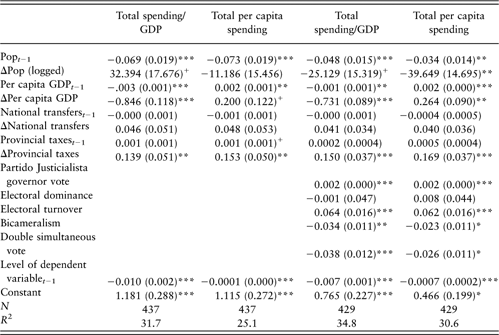
To assess the plausibility of these differing accounts, we focus our analysis more narrowly on the post-1982 period – the only extended period of full democracy experienced by Argentina since the early twentieth century. Drawing again upon an error-correction model that addresses the growth of government expenditure, the goal is to assess the impact of size after controlling for the effects of citizen preferences, electoral competition, and institutional variations on spending. To assess electoral competitiveness, we create two indicators: the margin separating the percentage vote received by the winner and runner up in the most recent gubernatorial election and a dummy variable for partisan turnover in the most recent gubernatorial election. For electoral preferences, we rely on the level of electoral support received by the Partido Justicialista (PJ) in the most recent gubernatorial election. The PJ is the Argentine party historically most closely identified with state expansion, and in the post-1982 period it has relied heavily on clientelistic distributions and the expansion of provincial government employment to mobilize electoral support (Levitsky, Reference Levitsky2003; Calvo and Murillo, Reference Calvo and Murillo2004).Footnote 2 To the extent that competitiveness and/or voter preferences account for the linkage between size and spending, it may be expected that the inclusion of these variables will significantly reduce the impact of size variations.
In addition, we include in the estimates two dummy variables to control for significant institutional differences among the provinces. The first is a dummy variable for bicameralism. Following the logic elaborated by Tsebelis (Reference Tsebelis2002) and prior empirical research on subnational government (e.g., Thornton and Ulrich, Reference Thornton and Ulrich1999; Bradbury and Crain, Reference Bradbury and Crain2001; Bercoff and Nougués, Reference Bercoff and Nougués2005), the central expectation is that an upper house represents an additional political veto point that will tend to curb the expansion of government spending, blunting the impact of citizen pressures on politicians. Ten of the 23 provinces had an upper chamber during at least part of the 1983–2001 time period. A second major institutional difference among the provinces resulted from constitutional reforms leading to the adoption of the double simultaneous vote (DSV or ‘Ley de Lemas’), which allows different factions of the same party to run rival lists of candidates in the same election. Although theoretically a major obstacle to democratic accountability, 11 provinces employed this electoral system in gubernatorial elections for one or more elections between 1983 and 2001. Years are coded according to the electoral system prevailing in the most recent gubernatorial election on the basis of data collected by Reynoso (Reference Reynoso2004) with the expectation that the reduced accountability resulting from the adoption of DSV will be translated into lower spending.
The results of the analysis for the expansion of both the ratio of spending to GDP and per capita spending are presented in Table 5. Looking first at the estimates presented in the first two rows of the table, we again observe a strong tendency for government growth to decline with provincial population levels. This influence remains significant after controlling for variations in partisan preferences and electoral competition, implying that the linkage between size and spending is less a product of the reduced competition and/or higher spending preferences that are presumed to characterize smaller and more homogeneous political units than of heightened citizen influence and activity. Nevertheless, the third and fourth columns of the table indicate that political variables do influence spending levels. While the results for electoral dominance are consistently weak, executive turnover has a very significant impact on government growth. With no executive turnover and all other variables set at their mean, per capita spending across the provinces may be estimated to increase at an average rate of 2.9%. With the success of an opposition challenger in gubernatorial elections, on the other hand, spending increases at an estimated rate of 9.3% per annum over the succeeding 4 years. Since turnover virtually defines the difference between dictatorship and democracy, these results underline the important effects of regime. As Przeworski (Reference Przeworski1991: 10) has argued, ‘Democracy is a system in which parties lose elections’. The statistical results also cut directly against the argument that positive linkages between size and electoral competitiveness account for lower spending in large political units. To the extent competitiveness mattered to fiscal outcomes, its effects worked in favor of higher spending.
Provincial size and the expansion of democratic governments, 1983–2001

GDP = gross domestic product.
+Significant at 10%; *significant at 5%; **significant at 1%; ***significant at 0.01%.
Note: Table entries are OLS estimates corrected for panel-specific autocorrelation. Panel-corrected standard errors are presented in the parentheses.
The effects of the remaining political variables are all significant in the expected direction. Strong electoral support for PJ gubernatorial candidates is associated with increased spending, whereas bicameralism and DSV electoral systems have the opposite impact. With no bicameralism or DSV system and all other variables set at their mean, provincial spending can be predicted to increase at an annual rate of 7.1%. Shifting to bicameralism and a DSV system, on the other hand, leads to an annual change in spending of −0.15. All of the remaining coefficients are consistent with the results for the 1960–2001 period as a whole, except that national transfers exert a less significant impact on the growth of provincial government in the period since 1983. Adding a dummy variable for gubernatorial election years to capture potential business cycle effects does not alter these findings, nor does controlling for the effective number of parties competing in gubernatorial elections. Finally, re-estimating the results with personnel spending as the dependent variable leads to virtually identical results, except that the impact of bicameralism is not statistically significant in the estimates for the ratio of spending to GDP.
Conclusion
Prior research has documented the relationship between political scale and government size but left open to further debate the nature and significance of the causal connection between the two. Drawing principally upon the study of public finance in the advanced industrial nations, the available literature has alternatively emphasized the importance of economic openness and economies of scale in the provision of public goods. Taking as its point of departure the literature on public choice, this study develops and tests a third perspective stressing the impact of political scale on the incentives and opportunities facing elected leaders. Focusing upon subnational variations in spending in a non-OECD country that has experienced the alternation of military and elected governments over a period of several decades, the study highlights the conditional impact of size, showing (a) that spending in small political units grows significantly more rapidly under elected governments than under authoritarianism and (b) that the same remains true after controlling for variations in trade openness and economic performance. Economies of scale and/or exposure to economic shocks therefore offer potentially important but incomplete explanations for the nexus between size and government growth. The impact of size is conditioned by regime type and the related strength of citizen pressures on politicians.
Examining variations in subnational fiscal performance solely under elected governments strengthens this conclusion. Even after controlling for variations in electoral competitiveness, partisan preferences, per capita income, revenues, and political institutions that significantly effect government growth, provincial size remains an important determinant of spending in Argentina. Moreover, successful opposition challenges to incumbent parties – virtually a sine qua non of democratic governance – provided a major impetus to government growth over the course of the 1983–2001 period, further emphasizing the relevance of regime characteristics. No less telling with respect to the impact of democratic accountability are the results for institutional variations during periods of democratic rule. In accordance with theoretical expectation, bicameralism and DSV electoral systems that attenuate democratic accountability and/or check popular pressures on representatives were associated with less spending growth.
While further comparative research is needed to assess the broader relevance of these findings, they have three important theoretical implications for the study of comparative politics. First, scholars need to begin taking the impact of political scale on fiscal policy more seriously. Size cannot be regarded merely as a control or background variable whose impact can be understood in terms of economies of scale, economic openness, or other relatively mechanical effects. The evidence presented in this study indicates that size also influences spending via political channels, shaping the relative capacity of citizens to organize, monitor, contact, or otherwise influence elected politicians.
The second and closely related theoretical implication is that regime matters. Democracy significantly enhances the impact of political scale by creating electoral incentives for politicians to accede to pressures for increased spending. These incentives are strongest in small political units, where the per capita cost of exchanging electoral support for government financed goods and services is highest. Inter alia, this finding suggests that the challenges of achieving a balanced budget may vary significantly across regime types as well as across differently sized countries or subnational political units. Also interesting, particularly from a policy perspective, are the implications for the study of political decentralization. Although widely heralded for its capacity to deliver both more efficient and responsive public policies, this study suggests that decentralization may well achieve greater political accountability but at the expense of raising the overall cost of government.
Third, and most important, by providing evidence that politicians elected in smaller political units face greater incentives and/or opportunities to expand the public sector, this study suggests that the linkage between citizens and the state is size-sensitive. The implications for the study of political democracy are profound. Presumably if size operates as a major determinant of public policy in a realm characterized by relatively hard economic constraints on decision-making, it would make sense for future research on political democracy to explore more systematically its broader consequences for political participation, representation, and policy formation.