Introduction
Female sexual dysfunctions are classified by DSM-IV (APA, 2000) into four categories: desire, arousal, orgasm, and pain disorders. According to published epidemiological studies, approximately 40% of adult women have at least one sexual dysfunction (Laumann et al. Reference Laumann, Paik and Rosen1999; Fugl-Meyer & Fugl-Meyer, Reference Fugl-Meyer and Fugl-Meyer2002; Lewis et al. Reference Lewis, Fugl-Meyer, Bosch, Fugl-Meyer, Laumann, Lizza and Martin-Morales2004) These problems are prevalent worldwide (Fugl-Meyer & Fugl-Meyer, Reference Fugl-Meyer, Fugl-Meyer, Goldstein, Meston, Davis and Traish2006; Kang et al. Reference Kang, Laumann, Glasser, Paik, Goldstein, Meston, Davis and Traish2006; Paik & Laumann, Reference Paik, Laumann, Goldstein, Meston, Davis and Traish2006), with low sexual desire (Laumann et al. Reference Laumann, Paik and Rosen1999; Kadri et al. Reference Kadri, Alami and Tahiri2002; Abdo et al. Reference Abdo, Oliviera, Moreira and Fittipaldi2004; Nobre et al. Reference Nobre, Pinto-Gouveia and Gomes2006) and orgasmic problems (Shokrollahi et al. Reference Shokrollahi, Mirmohamadi, Mehrabi and Babaei1999; Ponholzer et al. Reference Ponholzer, Roehlich, Racz, Temml and Madersbacher2005) being the most common types of sexual dysfunction.
There is debate on how sexual dysfunctions should be defined, along with recommendations that current definitions of sexual dysfunctions require improvement (e.g. Basson, Reference Basson2002; Basson et al. Reference Basson, Leiblum, Brotto, Derogatis, Fourcroy, Fugl-Meyer, Graziottin, Heiman, Laan, Meston, Schover, van Lankveld and Schultz2003; Althof et al. Reference Althof, Rosen, Derogatis, Corty, Quirk and Symonds2005; Binik, Reference Binik2005; Meston & Bradford, Reference Meston and Bradford2007). Among the issues discussed are the conceptualization of pain disorders (Binik et al. Reference Binik, Reissing, Pukall, Flory, Payne and Khalifé2002; Binik, Reference Binik2005; Schultz et al. Reference Schultz, Basson, Binik, Eschenbach, Wesselmann and Van Lankveld2005), the suggested division of arousal into subjective and physiological (Basson et al. Reference Basson, Brotto, Laan, Redmond and Utian2005; Rellini et al. Reference Rellini, McCall, Randall and Meston2005), and whether sexual (dis)satisfaction should be included in DSM-IV (McCabe, Reference McCabe2001).
To improve diagnostic classifications and create effective interventions for treating sexual dysfunctions, more knowledge about the underlying risk factors is needed. Several factors, including interpersonal, psychological, physiological, medical, social and cultural variables, have been shown to correlate with sexual dysfunctions (Salonia et al. Reference Salonia, Munarriz, Naspro, Nappi, Briganti, Chionna, Federghini, Mirone, Rigatti, Goldstein and Montorsi2004; Basson, Reference Basson2005; Meston & Bradford, Reference Meston and Bradford2007; Witting et al. Reference Witting, Santtila, Jern, Varjonen, Wager, Höglund, Johansson, Vikström and Sandnabbain press). Sexual functioning may also vary with age (for a review see Hayes & Dennerstein, Reference Hayes and Dennerstein2005).
Using quantitative genetic analyses, two twin studies found that individual differences in female orgasm function are moderately heritable (Dawood et al. Reference Dawood, Kirk, Bailey, Andrews and Martin2005; Dunn et al. Reference Dunn, Cherkas and Spector2005). Dawood et al. (Reference Dawood, Kirk, Bailey, Andrews and Martin2005) found heritability estimates that varied from 20% to 40% depending on whether orgasm was measured during sexual intercourse, during other sexual contact with a partner or during masturbation. However, the confidence intervals were wide. The heritability estimates from Dunn et al. (Reference Dunn, Cherkas and Spector2005) were 34% and 45% for orgasm during intercourse and masturbation respectively.
Some molecular genetic research has been conducted into sexual dysfunctions and related phenotypes. Polymorphisms in the dopamine D4 receptor gene have been associated with variation in desire, arousal and sexual function (Ben Zion et al. Reference Ben Zion, Tessler, Cohen, Lerer, Raz, Bachner-Melman, Gritsenko, Nemanov, Zohar, Belmaker, Benjamin and Ebstein2006), with variation in age at first sexual experience (Miller et al. Reference Miller, Pasta, Macmurray, Chiu, Wu and Comings1999; Guo & Tong, Reference Guo and Tong2006) and with variation in self-reported number of sex partners over the past 12 months (Halpern et al. Reference Halpern, Kaestle, Guo and Hallfors2007).
Nevertheless, quantitative and molecular genetic research on female sexual functions and dysfunctions is sparse and has failed to consider the various types of sexual dysfunctions that may be experienced. The reasons for the overlap of different sexual behaviour variables have also not been examined using multivariate quantitative genetics designs that could estimate the extent to which the same genetic or environmental effects underlie the covariance between two or more phenotypic traits (Plomin et al. Reference Plomin, DeFries, Craig and McGuffin2001). As for most complex behavioural traits, sexual functions are probably influenced by multiple genes as well as by multiple environmental influences (Plomin et al. Reference Plomin, DeFries, Craig and McGuffin2001, Reference Plomin, DeFries, McClearn, McGuffin, Plomin, DeFries, McClearn and McGuffin2003; Hamer, Reference Hamer, Benjamin, Ebstein and Belmaker2005). Considering that sexual functioning to some extent is affected by age, there might also be different heritability in different age groups.
The present study had three objectives. The first was to investigate the influence of genetic, shared and non-shared environmental factors on female sexual function problems as measured by the Female Sexual Function Index (FSFI; Rosen et al. Reference Rosen, Brown, Heiman, Leiblum, Meston, Shabsig, Ferguson and D'Agostino2000). Second, we examined the effects of age on the genetic and environmental influences of the FSFI subdomains. Third, we wanted to explore whether and to what extent the same genetic or environmental factors underlie these sexual function problems.
Method
The sample consisted of 6446 female twin individuals and 1994 female siblings. Of these, 575 females who reported no sexual activity during the past 4 weeks were excluded from the analyses. In addition, 55 females with more than five of the 19 items in the FSFI missing were also excluded from the analyses. For the rest, missing values were replaced with means, separately calculated for four different age groups: 18–25, 26–33, 34–41 and 42–49 years.
The participants were a subset from the Genetics of Sex and Aggression (GSA) sample. The main GSA sample consists of two data collections. The first data collection was carried out in 2005 and targeted 33–43-year-old twins. Questionnaires followed by a reminder letter and later a new questionnaire were sent to these individuals and finally returned by 2267 females, resulting in a response rate of 45% (for more information, see Witting et al. Reference Witting, Santtila, Alanko, Harlaar, Jern, Johansson, von der Pahlen, Varjonen, Ålgars and Sandnabba2008).
The second data collection was carried out in 2006 (there was no overlap between the data collections) and targeted twins aged 18–33 years and their >18-year-old siblings. A total of 23 577 individuals, 7680 of them female twins and 3983 female siblings, were contacted by post and asked if they would be interested in completing a sexuality-related questionnaire. Participants who consented to participate were given the option of completing the questionnaire by post or online through a secure webpage. Next, the questionnaire was sent, followed by a reminder letter. A separate simultaneous longitudinal twin study was being conducted, including some of the targeted individuals. Therefore, the reminder letters were only sent to individuals unique for the present study. A total of 6601 females responded to the survey. The response rates were 56.2% for the female twins (n=4425) and 54.6% for the female siblings (n=2176); of these, 6.4% (n=428) had incomplete data. When both data collections were combined, a total response rate of 52.9% (n=8868) was achieved. For both data collections, the participants' addresses were obtained from the Finnish population registry. In the information sent to the participants, the purpose of the study was described in detail and the voluntary and anonymous nature of the participation was explained.
Pairing of the twins during the first data collection is described in Varjonen et al. (Reference Varjonen, Santtila, Höglund, Jern, Johansson, Wager, Witting, Ålgars and Sandnabba2007). During the second data collection random codes were used to connect members of the same family. Zygosity was determined using questionnaire items completed by the twins (Sarna et al. Reference Sarna, Kaprio, Sistonen and Koskenvuo1978). Previous studies have shown that this method of zygosity determination is 95% accurate when compared with blood typing analyses (Eisen et al. Reference Eisen, Neuman, Goldberg, Rice and True1989). The research plan for the first data collection was approved by the Ethics Committee of the Department of Psychology at Åbo Akademi University and for the second data collection by the Ethics Committee of Åbo Akademi University.
Measures
The FSFI (Rosen et al. Reference Rosen, Brown, Heiman, Leiblum, Meston, Shabsig, Ferguson and D'Agostino2000) was used to investigate problems with sexual functioning during the past 4 weeks. The FSFI is a 19-item self-report questionnaire that measures six dimensions of female sexual functioning: desire, arousal, lubrication, orgasm, satisfaction, and pain. Response options were on a Likert-type scale ranging from 1 to 5 for items 1, 2, 15 and 16. For all other items, the range was from 0 to 5 with the supplementary option ‘no sexual activity’. The instrument has been shown to have good psychometric properties (Rosen et al. Reference Rosen, Brown, Heiman, Leiblum, Meston, Shabsig, Ferguson and D'Agostino2000; Meston, Reference Meston2003; Masheb et al. Reference Masheb, Lozano-Blanco, Kohorn, Minkin and Kerns2004; Wiegel et al. Reference Wiegel, Meston and Rosen2005). Low scores on the FSFI indicate more problems with sexual functioning and high scores indicate fewer problems. We added the response option ‘no partner’ to question 15 (‘Over the past 4 weeks, how satisfied have you been with your sexual relationship with your partner?’), which, analogous with the response options of other questions, was given the value of zero.
Statistical analyses
Exploratory (EFA) and confirmatory factor analyses (CFA) were performed on the 19 items of the FSFI. EFAs were conducted using SPSS version 13.0 (SPSS Inc., Chicago, IL, USA). The CFA with multiple groups was performed using Amos 7.0 (SPSS Inc.). The hypothesized model was compared with the observed data. Because of the fairly large sample and given the potential limitations of the χ2 test (Mulaik et al. Reference Mulaik, James, Van Alstine, Bennett, Lind and Stilwell1989; Thompson, Reference Thompson2004), we chose to report and consider four additional measures of model fit: the normed-fit index (NFI), the goodness-of-fit index (GFI), the root-mean-square error of approximation (RMSEA), and Hoelter's ‘critical N’. The fit of the model was considered to be supported if the NFI was >0.95 (Thompson, Reference Thompson2004), GFI was >0.90 (Arbuckle & Wothke, Reference Arbuckle and Wothke1999), RMSEA was approximately ⩽0.06 (Thompson, Reference Thompson2004) with PCLOSE non-significant (Arbuckle & Wothke, Reference Arbuckle and Wothke1999) and Hoelter's ‘critical N’ was >200 (Arbuckle & Wothke, Reference Arbuckle and Wothke1999).
For phenotypic analyses, the Complex Samples General Linear Model (CSGLM) in SPSS version 14.0 was used. This procedure adjusts the estimates of standard errors for the correlation between members of the same family. Analyses concerning means, variances and twin correlations were conducted with the Mx statistical package (Neale et al. Reference Neale, Boker, Xie and Maes2003).
Genetic analyses were conducted using Mx (Neale et al. Reference Neale, Boker, Xie and Maes2003). Genetic and environmental influences can be separated in the twin design because genetic resemblance varies as a function of zygosity, whereas familial resemblance due to shared environmental influences does not. Specifically, monozygotic (MZ) twins are genetically identical, whereas dizygotic (DZ) twins on average share 50% of their segregating genes. By contrast, environmental influences that contribute to familial resemblance are assumed to affect MZ and DZ twins equally (Plomin et al. Reference Plomin, DeFries, Craig and McGuffin2001). This model is based on the understanding that the observed (phenotypic) variance (Vp) in a trait is a linear function of additive genetic influences (A), non-additive genetic influences (D), shared environmental influences (C), and non-shared environmental influences (E) (i.e. Vp=A+D+C+E). However, dominant genetic effects and shared environmental effects cannot be estimated simultaneously with twin data only. Depending on the correlations between the MZ and the DZ twins, either an ACE or an ADE model is fitted. In the present study, for the univariate models, an ACE model was applied when DZ correlations were ⩾half the MZ correlations. When the DZ correlations were <half the MZ correlations, both ACE and ADE models were estimated for comparative purposes (Martin et al. Reference Martin, Eaves, Kearsey and Davies1978). Raw variables regressed for age were used in all model-fitting scripts, using Mx with maximum likelihood estimation. This method allows inclusion of singletons (i.e. when only information from one twin of a twin pair is available), as well as the siblings of twins, thereby increasing the power in the analysis. The fit of the different models was compared by taking the fit function [−2×log-likelihood (−2LL) of data] and the degrees of freedom (df) of the full model and subtracting it from the fit function and the df of the nested restricted models. The subtraction gives a χ2 value and associated df that can be tested for significance. In addition, the Akaike Information Criteria (AIC=χ2−2df) was considered, with lower values indicating better fit. Detailed descriptions of twin modelling analyses can be found in Posthuma et al. (Reference Posthuma, Beem, de Geus, van Baal, von Hjelmborg, Iachine and Boomsma2003). The assumptions of twin modelling analyses are detailed in full in Plomin et al. (Reference Plomin, DeFries, Craig and McGuffin2001).
To explore the intercorrelations between the sexual dysfunctions, we tested, on the basis of the univariate analyses, three multivariate ADE models: a correlated factors model, an independent pathway, and a common pathway model. The correlated factors model, which uses Cholesky decomposition (Loehlin, Reference Loehlin1996), gives the correlation between the A, D (C) and E factors and also decomposes the variance for a trait into additive and non-additive genetic, and non-shared environmental effects. The independent pathway model tests whether the covariance between the traits is due to shared and non-shared genetic, and non-shared environmental, effects. The common pathway model, however, suggests a latent factor underlying all sexual dysfunctions. Both the independent and the common pathway models also include specific genetic and environmental factors for each trait.
Results
The phenotypic analyses included 7569 females, 5791 twin individuals and 1778 siblings. Their mean age was 29.3 (s.d.=6.8, range 18–49) years. There were 1971 MZ twin individuals, 1923 DZ twin individuals with a female co-twin (DZF), 1535 DZ twin individuals with a male co-twin (DZO), and 362 twin individuals whose zygosity could not be determined unequivocally. There were 712 full MZ pairs, 559 full DZF pairs, 1050 twin–sibling pairs, and 344 sibling–sibling pairs. All of these were included in the MX analyses except the 362 twin individuals whose zygosity could not be determined unequivocally. The siblings of these twins with unknown zygosity were, however, included in all analyses, except the genetic analyses with two age groups.
Factor analysis of the FSFI
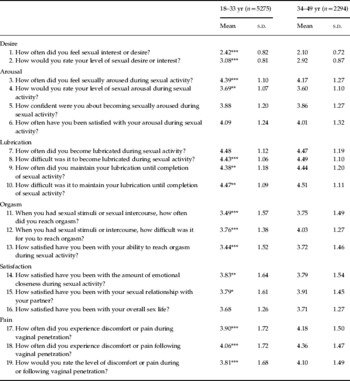
For the factor analyses the females were divided into two age groups, (1) 18–33 and (2) 34–49 years, to test for equality of factor structure in younger and older women. The means and standard deviations for the 19 items in the FSFI for the two groups are shown in Table 1 (for the response frequencies for the items see Appendix, Tables A1 and A2). Only one randomly chosen member per family was included in the factor analyses to avoid statistical dependence. This resulted in 3469 females in age group 1 and 1748 females in age group 2. The normality of the observed variables was assessed through visual examination of the histograms. Because of the skewness of the distributions, 18 of the 19 items (item 2 was normally distributed and was therefore not transformed) were either log- or square-root transformed.
Means and standard deviations (s.d.s) for the Female Sexual Function Index (FSFI) for younger and older women

A higher value on the FSFI indicates fewer problems with sexual function.
The absolute range was 1–5 for items 1, 2 and 16 and 0–5 for all other items. Total score ranges from 2 to 36.
* p<0.05, ** p<0.01, *** p<0.001.
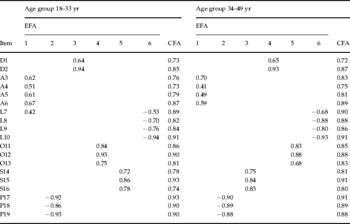
EFAs were conducted with maximum likelihood and oblimin rotation on the 19 items comprising the FSFI, separately for age groups 1 and 2. The factor loadings are presented in Table 2. Even though not more than four factors reached an eigenvalue >1, the clearest factor structure was reached with a six-factor solution for both age groups. The only item with complex loadings was item 7 in age group 1.
Factor loadings from the exploratory factor analysis (EFA) and regression weights from the confirmatory factor analysis (CFA) for the 19 items in the Female Sexual Function Index (FSFI)

A CFA was performed for multiple groups (age groups 1 and 2). Based on the EFA and the findings and clinical considerations presented in previous reports (Rosen et al. Reference Rosen, Brown, Heiman, Leiblum, Meston, Shabsig, Ferguson and D'Agostino2000; Meston, Reference Meston2003; Wiegel et al. Reference Wiegel, Meston and Rosen2005), a six-factor model was hypothesized, with the factors: desire (Q1, Q2), arousal (Q3–Q6), lubrication (Q7–Q10), orgasm (Q11–Q13), satisfaction (Q14–Q16), and pain (Q17–Q19). The factors were allowed to correlate. The fit of the model was good: χ2(274)=3152.820, p<0.001, GFI=0.940, NFI=0.957, RMSEA=0.045, PCLOSE=1.000 and Hoelter's critical N=520. However, based on the modification indices and the complexity of item 7 in the EFA, a correlation was allowed between error terms for items 7 and 10. This improved the fit of the model: χ2(272)=2607.218, p<0.001, GFI=0.949, NFI=0.964, RMSEA=0.041, PCLOSE=1.000 and Hoelter's critical N=625. Thus, the same factor model fitted both the younger and the older women. The regression weights for this model are shown in Table 2.
Composite scores for the six dysfunctions were then computed using non-transformed data according to the formula provided in Rosen et al. (Reference Rosen, Brown, Heiman, Leiblum, Meston, Shabsig, Ferguson and D'Agostino2000). The internal consistencies were acceptable to excellent for both age groups (Cronbach's α for age group 2 in parentheses): desire Cronbach's α=0.76 (0.75), arousal α=0.90 (0.92), lubrication α=0.94 (0.96), orgasm α=0.91 (0.90), satisfaction α=0.86 (0.88), and pain α=0.97 (0.96). All scales, except desire, were skewed and therefore log transformed for further analyses.
Preliminary analyses
The effect of age was tested for using complex samples in SPSS, and this was significant for desire (R 2=0.04), arousal (R 2=0.00), lubrication (R 2=0.00), orgasm (R 2=0.02) and pain (R 2=0.02). The variation explained was, however, small. Lubrication, orgasm and pain problems showed a decline with age whereas desire and arousal problems increased. The composite variables were regressed for age prior to further analyses.
No differences in sexual function were observed between women whose co-twin participated (n=3779) and women whose co-twin did not participate (n=2012).
Next, we tested for equality of means and variances between MZ twins, DZF twins, DZO twins and siblings using MX. In these models, means and variances were equated across groups in consecutive steps. There was a decrease in model fit when constraining the means between MZ twins, DZF twins, DZO twins and siblings for desire [Δχ2(2)=8.99, p<0.05], arousal [Δχ2(2)=9.81, p<0.01] and lubrication [Δχ2(2)=8.75, p<0.05]. The MZ twins had the lowest mean followed by DZO twins, DZF twins and siblings. When equating variances between MZ, DZF and DZO twins, there was a decrease in model fit for orgasm [Δχ2(2)=8.15, p<0.05] and pain [Δχ2(2)=9.71, p<0.01], and when equating the variances between all four groups there was a decrease in model fit for arousal [Δχ2(3)=10.15, p<0.05], lubrication [Δχ2(3)=24.64, p<0.001], orgasm [Δχ2(3)=8.46, p<0.05], and pain [Δχ2(3)=11.87, p<0.01]. The variances for the siblings were largest for every sexual function problem. However, when adjusting for multiple testing by using Bonferroni-adjusted α levels, the only significant decrease in model fit was when equating the variances across all four groups for lubrication. As there were no significant differences in reported sexual function problems between DZF and DZO twins, all DZ twins were included in the genetic analyses.
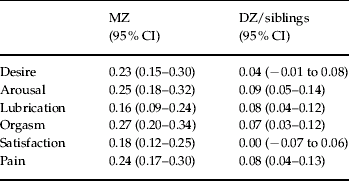
Correlations between twins and siblings were modelled in Mx. The correlations for twin–sibling pairs could be equated with the correlation for sibling–sibling pairs for all sexual function problems except desire [Δχ2(1)=584.58, p<0.001]. However, when equating the correlations for DZ twin pairs with the correlation for twin–sibling pairs and sibling–sibling pairs, there was a significant decrease in model fit only for pain [Δχ2(2)=8.47, p<0.05], but on adjusting for multiple testing by using Bonferroni-adjusted α levels, this was no longer significant. The reported correlations in Table 3 are therefore for all DZ twins and siblings combined together. The MZ twin correlations were consistently higher than same-sex DZ twin correlations, indicating that genetic influences contribute to the variance in these measures. However, they were all modest in magnitude, pointing to the influence of unique environmental effects. For all phenotypes except lubrication, the DZ correlations were less than half the MZ correlations implying that non-additive genetic influences could be involved.
Phenotypical correlations for monozygotic (MZ) and dizygotic (DZ) twins/siblings
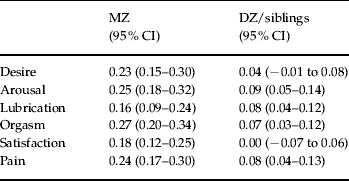
CI, Confidence interval.
Model fitting
To investigate possible differences in genetic and environmental influences at different ages, univariate models were fitted to the data with the twins and their siblings divided into two age categories: (1) 18–33 and (2) 34–49 years. The analyses included twins and their siblings belonging to the same age group (age group 1: n=2863; age group 2: n=1295). There was no significant decrease in model fit statistics when constraining the additive genetic parameters to be equal in the two age groups, suggesting that the genetic influences were independent of age (all p's >0.091). There was also no decrease in model fit when constraining shared environmental influences (all p's >0.141).
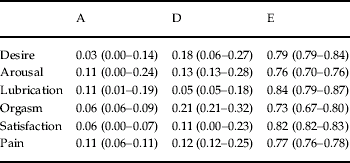
Univariate models were also fitted, including participants of all ages. Based on the intra-class correlations, ACE models were fitted for all phenotypes and ADE models for every dysfunction except for lubrication. First, ACE models were fitted to the data. For desire, arousal, orgasm, satisfaction and pain, the best-fitting model was an AE model. According to the χ2 test, the source of familial resemblance could not be distinguished between A and C for lubrication but when comparing the AIC values, an AE model had better fit. Second, ADE models were fitted to the data. For desire and orgasm, the non-additive genetic effect was significant. The ACE univariate models did not show any significant shared environmental influences. In addition, the AIC was lower for all univariate ADE models when compared to the AIC for the univariate ACE models, except for lubrication. For these reasons, we decided to fit only ADE multivariate models. According to the univariate ADE models, most of the variance was due to non-shared environmental influences. The genetic effects were modest, being in the range 0–15% for additive and 0–24% for non-additive genetic effects.
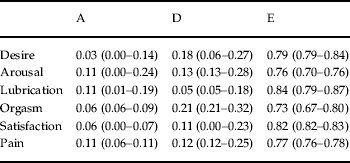
In addition, we tested three different ADE multivariate models (Table 4), starting with a correlated factors model (−2LL=154650.645, df=43 173, AIC=68304.645), followed by an independent pathway model (−2LL=155308.687, df=43 200, AIC=68908.687, compared to the correlated factors model: Δχ2=658.042, Δdf=27, p<0.001) and a common pathway model (−2LL=156698.718, df=43 210, AIC=70278.718, compared to the correlated factors model: Δχ2=2048.073, Δdf=37, p<0.001). The ADE correlated factors model provided the best fit to the data. The additive and non-additive genetic effects were modest, 3–11% and 5–18% respectively, in accordance with the results from the univariate models. The additive genetic correlations, ranging between 0.12 and 0.94, were all significant with the exceptions of the following: desire–arousal, pain–lubrication, pain–orgasm, and pain–satisfaction. The non-additive genetic correlations were in the range 0.09–0.88, of which the following were significant: desire–arousal, desire–lubrication, desire–orgasm, arousal–orgasm, arousal–satisfaction, lubrication–orgasm, orgasm–pain, and satisfaction–pain. The non-shared environmental correlations were all significant, ranging between 0.17 and 0.65. The highest non-shared environmental correlation was between arousal and lubrication.
Results of ADE multivariate correlated factors solution modelling with 95% confidence intervals
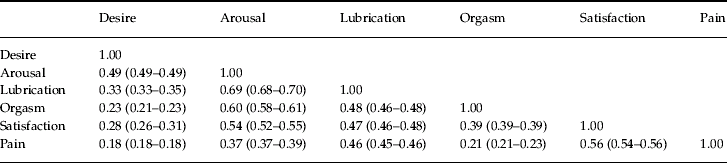
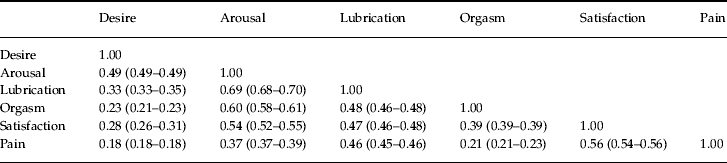
The phenotypical correlations between the sexual dysfunctions were all significant, ranging from 0.18 to 0.69, with the highest correlation being between arousal and lubrication and the lowest between pain and desire (Table 5).
Phenotypical correlations for sexual dysfunctions with 95% confidence intervals
Discussion
According to the univariate analyses, there were significant genetic influences on each of the sexual functions, whereas shared environmental influences were not significant. An ADE correlated factors model provided the best fit to the data obtained. All correlations between the non-shared environmental factors were significant. Looking at the combined genetic correlations between the additive and non-additive genetic latent factors, all genetic correlations were significant with the exception of the one between lubrication and pain. One caveat in interpreting the results is that, for one of the six phenotypes, namely lubrication, an ACE model would have fitted better than an ADE model, raising questions about the appropriateness of the multivariate model we used. However, as the non-additive genetic effects were significant for two of the phenotypes and one of the objectives was to look at the genetic correlations between the phenotypes, we suggest that this approach was suitable.
Nevertheless, the significant genetic effects should not divert attention from the fact that the individual differences on all six subdomains of the FSFI were primarily due to non-shared environmental influences. Several candidates for non-shared environmental factors that affect female sexual function have been reported in the literature. For example, it has been shown that sexual dysfunctions in partners are associated with elevated levels of sexual function problems in women (Çayan et al. Reference Çayan, Bozlu, Canpolat and Akbay2004; Fisher et al. Reference Fisher, Rosen, Eardley, Sand and Goldstein2005; Goldstein et al. Reference Goldstein, Fisher, Sand, Rosen, Mollen, Brock, Gary, Pommerville, Bangerter, Bandel and Derogatis2005; Heiman et al. Reference Heiman, Talley, Bailen, Oskin, Rosenberg, Pace, Creanga and Bavendam2007). Other factors include relationship satisfaction (Witting et al. Reference Witting, Santtila, Alanko, Harlaar, Jern, Johansson, von der Pahlen, Varjonen, Ålgars and Sandnabba2008), psychiatric problems such as depression (Dunn et al. Reference Dunn, Croft and Hackett1999; Frohlich & Meston, Reference Frohlich and Meston2002; Abdo et al. Reference Abdo, Oliviera, Moreira and Fittipaldi2004; Witting et al., Reference Witting, Santtila, Jern, Varjonen, Wager, Höglund, Johansson, Vikström and Sandnabbain press), and also different medical conditions (Salonia et al. Reference Salonia, Briganti, Rigatti, Montorsi, Goldstein, Meston, Davis and Traish2006).
The multivariate analyses showed that there is a substantial overlap in additive and non-additive genetic and non-shared environmental influences between the dysfunctions, which explains the co-occurrence of the sexual function problems. However, there is also heterogeneity, which suggests that the six subdomains are distinct. Furthermore, the fact that a common pathway model did not fit the observed data as well as the correlated factor model suggests that it is not appropriate to conceptualize sexual dysfunctions as a single entity.
These findings have important implications for the diagnosis of sexual dysfunctions. Our results strongly imply that female sexual dysfunctions should be seen as multi-dimensional, including them all as separate diagnoses, even for subjective arousal and lubrication. The International Consensus Panel suggested that Female Sexual Arousal Disorder (FSAD) should include subjective sexual arousal and genital sexual arousal disorders as separate subtypes (Basson et al. Reference Basson, Leiblum, Brotto, Derogatis, Fourcroy, Fugl-Meyer, Graziottin, Heiman, Laan, Meston, Schover, van Lankveld and Schultz2003), and our results support this suggestion. In the present study, there was no objective measure of lubrication, but the results show that subjective arousal and lubrication as reported by the women themselves differed in aetiology to some extent. In addition, the phenotypical correlation between arousal and lubrication was not higher than 0.69; that is, women reporting lubrication problems could still feel aroused, or vice versa. Pain was significantly correlated with all other FSFI subdomains, supporting the inclusion of pain in sexual disorders. As already noted, there was also significant shared genetic aetiology with the other sexual function problems, except for lubrication.
For interventions, our results suggest that it is important that they address female sexual dysfunctions as separate, rather than treating sexual dysfunctions as some common underlying factor (Jang, Reference Jang2005).
The 95% confidence interval for genetic effects on orgasm function during sexual activity or intercourse was 0.20–0.33. These intervals overlap with the 95% confidence intervals for genetic effects on orgasm during intercourse, with partner other than intercourse, and masturbation reported by Dawood et al. (Reference Dawood, Kirk, Bailey, Andrews and Martin2005), as well as with the genetic effects for orgasm during intercourse reported by Dunn et al. (Reference Dunn, Cherkas and Spector2005). Dunn et al. (Reference Dunn, Cherkas and Spector2005), however, reported higher estimates for orgasm during masturbation. The present study extends the previous studies in two ways: we used a composite variable composed of three questions for the orgasm function whereas the prior studies used single items (Dawood et al. Reference Dawood, Kirk, Bailey, Andrews and Martin2005; Dunn et al. Reference Dunn, Cherkas and Spector2005), and our study was conducted with a larger sample. However, the studies are not entirely comparable because, as shown by Dawood et al. (Reference Dawood, Kirk, Bailey, Andrews and Martin2005), the female orgasm may be dependent on the context and thereby affected by different genes. In addition, the age range of the participants differed.
The findings should be considered in light of the limitations of this study. We did not test for gene–environment interactions or correlations. Both of these might, however, be involved. Some women may be more vulnerable to stressful life events that may affect sexual functioning negatively. Furthermore, the type of experience might affect which sexual dysfunction becomes manifest.
A limitation of the study is the lack of information about the women's menopause status. However, considering their age, it is reasonable to assume that the majority were premenopausal. Age was found to have a negative effect on desire and a positive effect on lubrication, orgasm and pain. In the literature, findings concerning age effects are inconsistent, but there is some general agreement that desire problems increase whereas pain problems remain constant or decline with increasing age (Hayes & Dennerstein, Reference Hayes and Dennerstein2005). It is reasonable to assume that the age effect would have been larger if postmenopausal women had also been included. As sexual function is dynamic and changes throughout the lifespan, the generalization of the present results to other age groups could be limited.
Other limitations were the time period during which the women reported their sexual functioning. For those being singles, a time period of 4 weeks may affect the results negatively. However, as only females who reported some sexual activity during that time period were included in the analysis, the effect of being single was minimized. In addition, the FSFI has been shown to be an instrument with good reliability and validity (Rosen et al. Reference Rosen, Brown, Heiman, Leiblum, Meston, Shabsig, Ferguson and D'Agostino2000; Meston, Reference Meston2003; Masheb et al. Reference Masheb, Lozano-Blanco, Kohorn, Minkin and Kerns2004; Wiegel et al. Reference Wiegel, Meston and Rosen2005).
The total response rate of 52.9% may appear rather low at first glance. However, when taking into account the extensiveness of the questionnaire, which covered a large range of instruments on sensitive topics, the response rate can be considered as surprisingly good. Furthermore, it is highly comparable with prior sexuality-related mail survey studies both nationally (Haavio-Mannila & Kontula, Reference Haavio-Mannila and Kontula2003; Ojanlatva et al. Reference Ojanlatva, Helenius, Rautava, Ahvenainen and Koskenvuo2003) and internationally (Bailey et al. Reference Bailey, Dunne and Martin2000; Långström & Zucker, Reference Långström and Zucker2005; Hayes et al. Reference Hayes, Bennett, Dennerstein, Gurrin and Fairley2007). In addition, the present sample is comparable with other representative samples of the Finnish population with respect to important sexuality-related characteristics, such as mean age at first sexual intercourse (Mustanski et al. Reference Mustanski, Viken, Kaprio, Winter and Rose2007) and rates of sexual abuse (Sariola & Uutela, Reference Sariola and Uutela1994).
Comparisons with other studies (Sariola & Uutela, Reference Sariola and Uutela1994; Helweg-Larsen & Bøving Larsen, Reference Helweg-Larsen and Bøving Larsen2002) indicate that the generalizability of the results should not be limited only to twins. Several studies have shown that twins do not differ from singletons either on sociodemographic and lifestyle characteristics or on behavioural characteristics or in psychiatric morbidity such as depression, somatization and insomnia (Kendler et al. Reference Kendler, Martin, Heath and Eaves1995; Andrew et al. Reference Andrew, Hart, Snieder, de Lange, Spector and MacGregor2001; Johnson et al. Reference Johnson, Krueger, Bouchard and McGue2002; Pulkkinen et al. Reference Pulkkinen, Vaalamo, Hietala, Kaprio and Rose2003).
In conclusion, this study is, to the best of our knowledge, the first to explore genetic and environmental influences and their contribution to the co-morbidity of several sexual function problems. The research needs replication with other populations, including clinical ones, but provides a rationale for further seeking genes and unique environmental influences that underlie sexual functioning, as well as for looking into gene–environment correlations and interactions.
Acknowledgements
This work was supported by Grant No. 210298 from the Academy of Finland and a Centre of Excellence Grant from the Stiftelsen för Åbo Akademi Foundation and a personal grant from the Finnish National Graduate School of Psychology to K. W. We thank the participating twins and their siblings.
Declaration of Interest
None.
Appendix
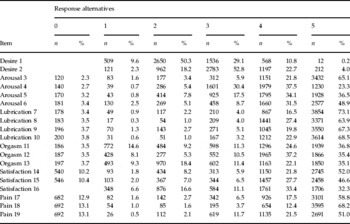
Response frequencies for the 19 items in the Female Sexual Function Index (FSFI) for women aged 18–33 years

Response alternatives: 0=no sexual activity for items A3–S14, no partner for item S15, and ‘did not attempt intercourse’ for items P17–P19. A higher value on the FSFI indicates fewer problems with sexual function.
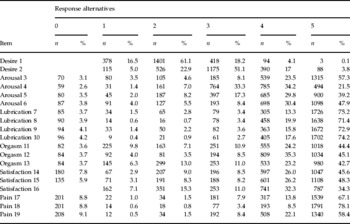
Response frequencies for the 19 items in the Female Sexual Function Index (FSFI) for women aged 34–49 years

Response alternatives: 0=no sexual activity for items A3–S14, no partner for item S15, and ‘did not attempt intercourse’ for items P17–P19. A higher value on the FSFI indicates fewer problems with sexual function.