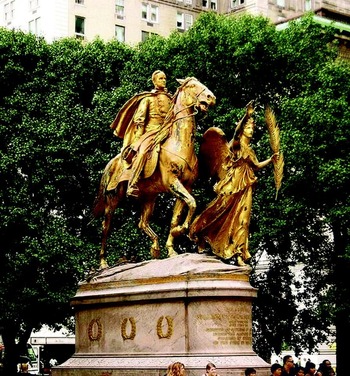
The power of a public monument is often measured by the way it upholds, amidst its surroundings, an expository or commemorative image of a society's values, its forms of communal belief or censure, before which the responsive onlooker may consider his or her own kinds of participation in a larger social narrative. While recounting an experience of his 1905 New York visit Henry James thus remarks how the “golden elegance” of Augustus Saint-Gaudens's statue of General Sherman (Figure 1), situated at the entrance to Central Park, preserves its “dauntless refinement” despite “the comparative vulgarity of the environment drinking it up,” and keeps its “virtue” amidst the clamorous distractions of “electric car cross-currents” and “the loose distributions” of crowding adjacent buildings. James had reservations about the monument's success. He perceived its confusion of “destroyers with benefactors,” the presentation of Sherman, merciless warrior on his charger, with the peaceful image of an attendant angel, as confounding the clarity of meaning that, in this same passage, he professes monuments should embody. He was suspicious of a Sherman “irradiating benevolence,” and imagined the greater truthfulness of a composition able to represent “the misery, the ruin and the vengeance of his tract.”Footnote 1 Yet the series of questions this public statue defines, amidst and partially owing to its volatile surroundings, creates a space of imaginative meditation for James. As he ponders the degree to which past violence should or should not be subdued by a culture's progressive narratives, he fashions a more intricate monument of his own, a personal contribution to the complex history the statue makes visible but also threatens to erase by its aesthetic sublimity. His critique explicitly questions whether the devastation wrought by Sherman's infamous march should be suppressed by triumphant glorification of the Union cause; implicitly, it calls into being that shadowy history of forgotten suffering and the particularity of human experience to which the exalted golden figure stands oblivious. This reflective moment, in The American Scene, reanimates the historical processes generating the statue's presence, engendering a dense interweaving of contemporary and past events. Simultaneously, it establishes an individual's private temporal space amidst historical flux, a moment in which reflection resistant to the simplification inherent in epic stylization can occur. By so doing, it evokes a parallel narrative that measures a solitary story against a grander public account, one witness against a collective image, or the lyric voice against the monumental.
Augustus Saint-Gaudens, William Tecumseh Sherman, New York City, 1903.
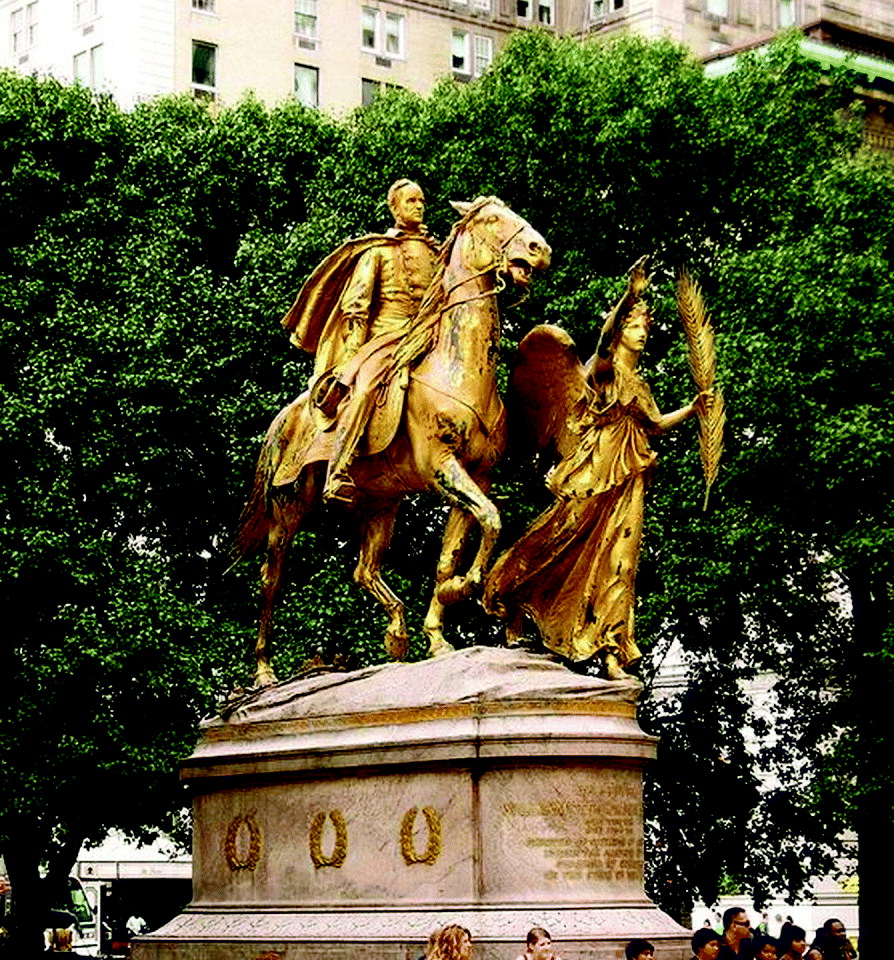
Half a century later, in this same location, Frank O'Hara does something of the same. In his poem “Music” he weighs the effect of resting “for a moment near The Equestrian/pausing for a liver sausage sandwich.” Visceral satisfaction encourages fanciful reflection: a whimsical vision in which “that angel seems to be leading the horse into Bergdorfs,” and by which the heroic grandeur of the statue is fleetingly reduced, almost debased, and historical solemnity is mockingly overturned. Yet as the poet's imagination miraculously breathes life into celestial and equine figures, nonchalant fantasy is replaced by agitation, and the speaker, no longer at ease, is reduced to shivering, “naked as a tablecloth, [his] nerves humming. /Close to the fear of war.”Footnote 2 O'Hara's lines seemingly acknowledge generative power in both the poetic voice and the historical forces the statue embodies. They call to mind a contest of authority, one unleashed by his initially casual speculation, and in which the lyric voice is first creator, then witness and potential victim, of the imaginative action described. The figure of active, not static, equine strength, which disallows any complacent assumption of the monument as powerless, evokes both the assault on civilian space perpetrated by Sherman and a more abstract violence moving through history and affecting daily rituals in the poet's contemporary life. In the sudden dramatic escalation of these opening lines, the speaker's desire for unhampered, self-governing movement appears endangered by social and historical determinants. As the pleasures of immediate corporeal experience come into tension with an unsubdued past and uncertain future, the freedom of the poem's imaginative play itself seems under siege.
If monuments speak often to writers and poets, they in turn speak back to them, entangling the lyric voice and their vulnerable, mortal flesh with the seeming solidity and permanence of bronze and marble, weighing the fragility or imperishable quality of each. When James returned to America in 1904–5 after an absence of over two decades he encountered a society in the midst of an economic, cultural expansion that was self-consciously defining itself through its public buildings and monuments. Devoted to addressing the “features of the human scene,” these sites often served to ignite James's reflections. As manifestations of the culture's historical narratives and future aspirations, civic buildings, art museums, public libraries, and a variety of memorials are the points around which James repeatedly organizes his memories of the American past and his critique of the American present. I would like to suggest that his thoughts before the Sherman monument, however, can be distinguished as part of a highly personal meditation. At the time of the memorial's dedication ceremony, in 1903, the consensual view of leading civic and artistic figures judged the statue to be a masterpiece that could be placed alongside the greatest monumental sculptures. In publicly addressing Saint-Gaudens's Sherman statue, James can therefore be seen to be injecting a sceptical voice into an admiring chorus, although his doubts have less to do with the artistic accomplishment of the monument than with its wider social implications. Saint-Gaudens's biographer has suggested that the number of monuments erected at this period that celebrated mounted commanders may have been influenced by an increasingly imperialistic policy in America at the end of the nineteenth century. Simultaneously, political articulations of that policy often evoked Civil War experience, especially as reflected in numerous memoirs that were being published at this time, as inspiration for emerging forms of vigorous masculine identity.Footnote 3 Given these associations, James's suspicion of monumental glorification of military figures can be taken as having substantial political reference.Footnote 4 Yet his anxiety about the monument's seeming erasure or transformation of martial violence may have equally to do with his own private relation to the American Civil War, the most momentous historical event of his youth, and the writer he came to associate most intimately with that conflict, Walt Whitman.
James's understanding of Whitman is explicitly documented through several publications written at distinct moments in his career: his hostile review of Drum-Taps, in 1865, which he later effectively disowned; his 1898 notices of two volumes of Whitman's correspondence, published as Calamus (1897) and The Wound Dresser (1898); and his evocation of Whitman as spiritual comrade when recalling his own memories of the war in Notes of a Son and Brother, in 1914.Footnote 5 Yet Whitman is also present for James as he reencounters America in 1904 and especially when he contemplates civic memorials, which had proliferated during the period of James's twenty-one year absence, and considers the invitations they make to an individual's private self and national identity.Footnote 6 Civic monuments serve social narratives in a number of ways: they celebrate events, and define the values to be derived from them, which a society claims as vital to its history; they shape what has been described as “collective memory” so as to influence social unity, and sometimes simultaneously affect kinds of social exclusion; they may attempt to impose resolution on chaotic events so as to propel a society toward future achievement. War monuments in particular have been considered essential for these purposes: viewed sceptically, they have been constructed as a way of coopting the dead for political purposes; approached in more spiritual terms, they become sacred sites that function to assuage an individual's or a society's need for mourning while attempting to overcome loss through locating it within grander national frameworks.Footnote 7 Seen in this light, Civil War monuments in particular may have reminded James of the personal conflict vividly documented in Whitman's letters, which he had been profoundly moved by a few years prior to his American sojourn. Whitman's correspondence with his mother in The Wound Dresser touchingly records his struggles with the relation between individual suffering and national ideals as he witnesses the devastation wreaked on the bodies of soldiers as a result of the Union cause that he fervently endorsed. These struggles, in turn, may have shaped James's responses as he contemplated monuments created in memory of that cause and its participants. Each may be said to reflect on the other and to become entangled with James's meditations on his own relation to the war and his American past. This essay considers how James's reading of Whitman's correspondence in his 1898 reviews contributes to his reevaluation of Whitman's achievement and may be seen to be exerting pressure in The American Scene. Although he makes no explicit comment about Whitman there, the poet's influence can be felt in the way James writes about America and its memorials, and in the stylistic memorial that James, in this work, builds for him.
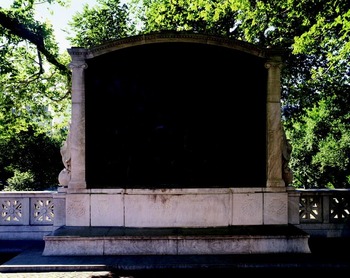
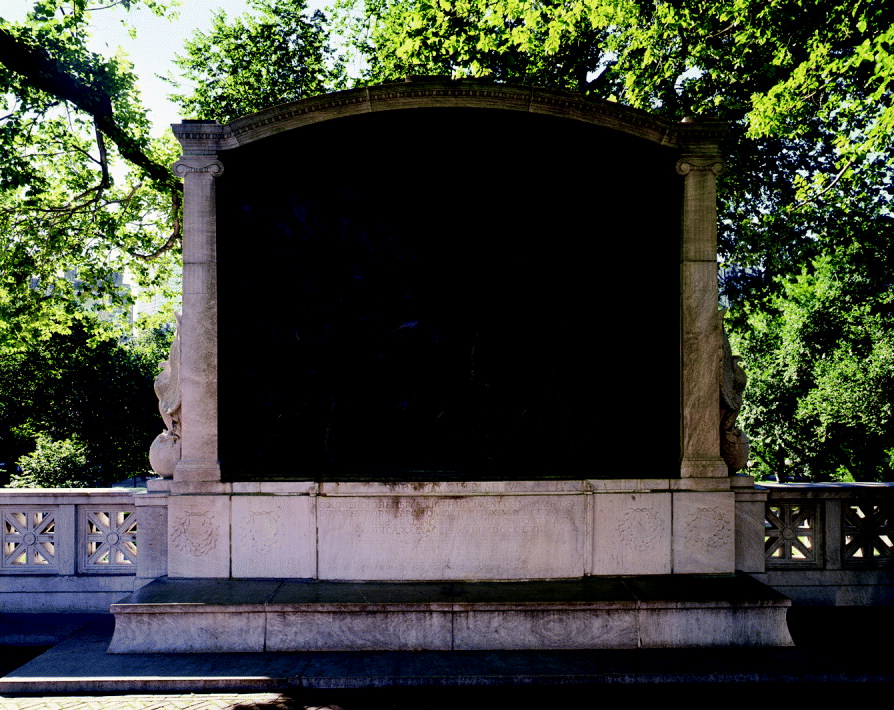
The impact of reading The Wound Dresser may have been accentuated for James by his fervent response, a year previously, to another Saint-Gaudens Civil War memorial: the bronze relief, standing on Boston Common, fashioned to commemorate Robert Gould Shaw, commander of the Fifty-Fourth Massachusetts Regiment, the first regiment of free northern blacks, and his troops (Figure 2). The monument was unveiled in 1897 at an elaborate dedication ceremony fourteen years after Saint-Gaudens began work on it.Footnote 8 Several years later, following his 1903 Boston visit, James described it, in The American Scene, briefly but admiringly as “noble and exquisite” (AS 561). Unlike his engaged response to the statue of Sherman, however, before this work he maintained a public reserve, making reference to it, in his chapter on Boston, only while contemplating the memorial to Civil War dead in the city's recently built public library. When the library opened in February 1895, it proudly displayed two massive, reclining lions flanking the central staircase. Designed by Louis Saint-Gaudens, brother of Augustus, the marble statues are dedicated to the 2nd Massachusetts Infantry and the 20th Volunteer Infantry, also known as the Harvard Regiment, whose battles and campaigns are carved on the pedestals. James admits the memorial's effect in “bribing the restored absentee to emotion” and how “such couchant lions and recorded names and stirred memories … colour an impression,” noting the capacity of the monumental to infuse this enclosed space with an atmosphere of remembrance, as if a tomb or sepulchre. Yet he also marks even this brief admission as “the limit of [the] breach of the silence in which, for persons of the generation of the author … appreciation of them can best take refuge” (AS 560–61, original emphasis). Such refuge also serves him when, in the same sentence, he recalls being in the presence of Saint-Gaudens's monument to Robert Gould Shaw and the Fifty-Fourth: there are “works of memorial art that may suddenly place themselves, by their operation in a given case, outside articulate criticism.” James's restraint certainly had much to do with the near-mythological status of Shaw, as well as the James family's own connections with his regiment and the statue dedicated to him. His brother Wilky had been Shaw's adjutant and was grievously wounded during the regiment's tragic assault on Fort Wagner. William James was a prominent speaker at the monument's dedication. The aura surrounding Shaw, his regiment, and the manner of his death undoubtedly tempered James's willingness to comment more extensively.
Augustus Saint-Gaudens, Robert Gould Shaw Memorial, Boston Common, 1897. Photograph courtesy of Jeffrey Nintzel.
Yet his silence may suggest further recesses of private memory and an ongoing reflection, as a noncombatant during the Civil War, on the relation between the kinds of knowledge accessible through imaginative sympathy and those that can be derived only from immediate experience. Shades of such a meditation may be discernible in a strikingly effusive letter James wrote to William, on 25 February 1897, upon hearing that William had accepted the invitation to speak at the Shaw memorial dedication ceremony. Ecstatic in his support, he affirmed his desire to transcend geographical, temporal, and corporeal obstacles of separation: “I vibrate intensely to the 31st May. I don't know what I wouldn't give to be there. But even poor dear, dead Wilkie will be more there than I. He will be very much there.” James acknowledges his brother's priority, seemingly as a result of his direct participation in Shaw's regiment, while simultaneously recognizing that his emotional participation in the ceremony would be enhanced by a substitute for direct witness, a photograph: “If it were possible … that would help me to see you and hear you.” He then went on to confirm his imaginative participation in tones of religious, near-prophetic zeal: “I jubilate, in fine, that you accepted; and I jubilate, above all, with the conviction that you will be triumphantly uplifted. Glory to the Highest!”Footnote 9 James's fervent reaction not only suggests a deep reservoir of feeling about the events this ceremony would commemorate, but may have to do with the fact that the Saint-Gaudens bronze gave material substance to an event that he had never observed directly. When the Fifty-Fourth Regiment paraded through Boston as they left for active service, James was not present, a disappointment he later recalled, in Notes of a Son and Brother, as his
hour of a felt rage of repining at my doomed absence from the sight of that march of the 54th Massachusetts out of Boston, “Bob” Shaw at its head and our exalted Wilky among its officers, of which a great sculptor was, on the spot of their vividest passing, to set the image aloft forever.Footnote 10
An artistic sensitivity to the emotional and epistemological gulf between direct witness of a historical event and the kinds of imaginative sympathy that may affect contemporary spectators, as well as those contemplating a monument years afterwards, is a powerful dimension of the Saint-Gaudens relief. The figures of Shaw and his troops are fashioned so as to recall the Fifty-Fourth Regiment on the march, commemorating the day on which, cheered by Boston crowds, they paraded out of Boston toward the Navy vessels that carried them to South Carolina. The colonel and each of his men are represented in profile. Their gaze is directed forward, at an angle at which we are unable to meet their eyes or share their vision. The distinctiveness of these figures, their diversity of physical characteristics, vividly convey the particularity of individuals engaged in the war and evoke unique personal dramas, but they are united by the fact that each man is looking at something that can no longer be seen, at experience that remains their own privilege. A space is opened between the knowledge of individuals so portrayed and any artistic agency which attempts to negotiate or eradicate that gap. What the monument seems to recognize is that what happened to these men is beyond its powers of representation or recuperation.
When William devoted one portion of his address at the Shaw Memorial dedication to a eulogistic retelling of the events at Fort Wagner, he was in part acknowledging that, by 1897, this story for many in his audience, those who belonged to “this possibly too forgetful generation,” was only dimly remembered or even relatively unknown.Footnote 11 His narrative thus reflects how, in the social atmosphere of 1890s America, forgetfulness and remembrance of the Civil War coexisted with equal force and generations of the war's participants and witnesses could still experience acute recollection alongside those for whom the terrible events of 1861–65 had only muted resonance. This tension is also alluded to in Edith Wharton's Civil War story “The Spark,” in which the narrator, retrospectively describing his youthful friendship with one of the war's veterans in the 1890s, describes the decade as “the dark time of our national indifference.”Footnote 12 Yet publishing records of this period reveal the appearance of numerous volumes of fictionalized, historical, and personal accounts of Civil War experience, and while reminiscences of the war, in particular, were comparatively scarce until 1880, they proliferated in the following several years and continued to be highly popular until the end of the century. The gap between war's end and this retrospective renewal thus approximates the so-called “seasons of memory” that have been observed to distinguish the temporal cycles according to which societies mark vital collective experiences.Footnote 13 It also suggests the period in which traumatic events of the war gradually assumed forms of imaginative or intellectual coherence. As David W. Blight proposes in regard to autobiographical volumes, the period between 1865 and 1880 may be considered one of “hibernation” or “incubation,” in which “ex-soldiers groped for ways to express the trauma of their personal experiences,” while by 1880 American culture and an ever-increasing readership began to appreciate the retrospective drama such accounts could provide. He also observes that witnesses may have been moved to record testimonies in antipathy to commercial forces that were increasingly dominating American life and replacing former social or spiritual idealism. Similarly, commemorative addresses of the 1890s frequently applauded self-sacrifice and courageous devotion to a higher moral cause, exemplified by individual and collective action during the war, as a way of denouncing and counteracting the materialistic creed of late nineteenth-century America.Footnote 14 William James's address at the dedication of the Shaw memorial, for example, challenged his audience to embrace, through Shaw's example, “a kind of valor” or “civic courage” at a time when democracy was “still upon its trial.”Footnote 15
One record of the variety of works that were published during this period, and that may have been motivated by such factors, is preserved in the books that Henry James reviewed between March and July 1898 in a series entitled “American Letters” for the periodical Literature. These include Life and Letters of Harriet Beecher Stowe; a collection of Ulysses S. Grant's correspondence; a work by a Columbia law professor entitled Essays on the Civil War and Reconstruction; a volume of fiction, Southern Soldier Stories by George Cary Eggleston; and a novel, The General's Double, about whose “want of art” James is frank but which inspires him with a “lively sympathy” that he is “at a loss” to explain.Footnote 16 A suspension of critical judgement in favour of subjective or sentimental response marks a number of these notices. James admits, for instance, that W. A. Dunning's Essays on the legal dimension of the southern secession frequently emit only a “mere dry light,” but he pictures himself as an awestruck reader “holding [his] breath” before the extraordinary events detailed, while the historical record of the Army of the Potomac, in The General's Double, is “full of the stirring and the touching” for “readers who, in the American phrase, go back” (LC 666, 681). James was also pulled back by two other volumes of letters that he reviewed in this series: the first was Walt Whitman's Calamus, his loving correspondence with Peter Doyle, a notice of which appeared in the 16 April 1898 issue of Literature; the second, which was published three weeks later, on 7 May, Whitman's The Wound Dresser, a volume composed mainly of the letters that Whitman addressed to his mother between 1862 and 1864 during his time in Washington.
James's impassioned reading of works concerning Civil War experience speaks of a personal fascination possibly renewed, the previous year, by events surrounding the Shaw memorial, and one which recognizes the advantages of temporal distance for a deeper intellectual grasp of the conflict's immensity. In his 23 April 1898 “Letter,” noting the civic and legal consequences of the war brought to light by Dunning's Essays, he observes how “[a]s the great war recedes the whole drama more and more rounds and composes itself, with its huge complexities falling into place and perspective” (LC 666). Yet James's reviews of Civil War literature might also be read as evidence of another emerging narrative: an extensive, although partially concealed, story of self-introspection in which he evaluated his private memories and emotional responses to the most far-reaching historical drama of his youth.Footnote 17 If such is the case, it is likely that in doing so he addressed his own involvement in the war in light of questions concerning the relation between individual experience and national events, and the distinct kinds of knowledge acquired through immediacy and distance, participation and witness. Events surrounding the Shaw memorial may have provoked this meditation, but his reviews of the 1890s imply that the figure who most sustained and complicated it was Walt Whitman.
James's relation to Whitman is in great part a hidden one, a trail that surfaces only fitfully following his 1865 dismissive review of Drum-Taps and until his late autobiographical writings, where Whitman is repositioned, through James's retrospective acrobatics, as hallowed exemplar authoring and authorizing James's own kinds of sympathetic witness during the war. When James details his visit to a military camp at Portsmith Grove, in Notes of a Son and Brother, he introduces his “sole vision of the American soldier in his multitude,” with the confession that the effect of this figure “corresponds for memory … with the tender elegiac tone in which Walt Whitman was later on so admirably to commemorate him.” Although James's visit took place several years prior to his reading of Drum-Taps, his retrospective account fuses Whitman's role and vision with his own, and establishes kinship with these men even while admitting separation.Footnote 18 As he affirms bonds of sympathy “over such gulfs of dissociation” with soldiers who spoke “the very poetry of the esoteric vernacular,” he comes close to claiming the compassionate near-habitation of the combatants' bodies and fates that is the imaginative feat of Drum-Taps. Indeed, James admits that if Whitman's poetry was inspired by “his participating in the common Americanism of his hospital friends,” he, too, was “victim to a like moving force,” and is thrilled “in having to such an extent coincided with, not to say perhaps positively anticipated, dear old Walt.” The tentative manner in which James advances this comparison, which momentarily flirts with a transgressive reversal of roles in imagining himself Whitman's predecessor, acknowledges that he is on tenuous ground: the memory of his ministrations to the soldiers, so infused by associations with Whitman's own actions, is one in which he admittedly “indulge[s]”; their supposed simultaneity is a coincidence he “feel[s] that [he] might if pushed a little rejoice in.”Footnote 19 Whatever emotions attended this incident at the time, James is consciously speaking here within the romance of autobiographical self-fashioning, a process for which Whitman is vital.Footnote 20 It may not be an overstatement to propose that it is only through Whitman that James's participation in the war becomes endowed with a degree of profundity sufficient to assuage the desire of his imaginative reengagement. Although the role of sympathetic observer, for James, is always intimate with a kind of active involvement, Whitman is here summoned to amplify it, to stand alongside James's own wartime experience, and imbue it with an intensity serving to transform these brief hours at Portsmith Grove into a capacious resource for knowledge, insight, and perhaps a kind of self-validation as well.
This suggestion becomes more justifiable in view of James's hostile reading of Drum-Taps in 1865, a critical dismissal that is without signs of communality or recognition of the poet's experimentation with “the poetry of the esoteric vernacular.” Amongst the notices he published at this time, the savageness of James's review is comparable only to his overconfident disparagement of Our Mutual Friend, published five weeks later, and by far exceeds it in his invective's unrelenting ferocity. In these brief pages James articulates with impatient superiority many of the most negative judgements which were made about Whitman at the time, and which reverberate in subsequent critical appraisals over the next several decades, while disallowing him the very claim to the role of a poet. Whitman is an example of “an essentially prosaic mind [attempting] to lift itself, by a prolonged muscular strain, into poetry,” and someone who dwells upon the surface of the tragic with a temper that is “the reverse of the poetic”; his volume is an “offense against art,” which “pretends to persuade the soul while it slights the intellect” in “a medley of extravagances and commonplaces” and excess of the “egotistical.” Even Whitman's hospital service is judged as no mitigation for the “aggressively careless, inelegant, and ignorant” qualities of his verse. In 1865, James did not hear the “tender elegiac tone” that his autobiographical memory defines as a prominent characteristic of Whitman's war poetry; rather, he maintained that Whitman's voice spoke only in an assertive, repetitive “ore rotundo” (LC 629, 632–34).Footnote 21
Nearly two decades later, James's correspondence reveals little explicit sign of any revised understanding of Whitman, although his tone modulates to condescending mockery. In an undated letter, likely to have been sent in 1883, to his boyhood friend, Thomas Sergeant Perry, James again voiced reservations about Whitman's poetry, rejecting arguments which served to defend it as the essence of a democratic spirit constructively challenging traditional literary canons of taste or aesthetic refinement. Humorously protesting Perry's championing of Whitman in such terms in an article his friend had published in the St. James's Gazette, James patronizingly questioned Perry's literary categories and preferences in his “little article” and declared a passage he had quoted from Whitman to be “mere drivel.”Footnote 22
In the course of James's 1904–5 visit to America, during which he was a guest at Edith Wharton's New England home, such “drivel” became the stuff of a well-known anecdote: Wharton's provocative account of James lending his own voice to “the mysterious music” of Whitman's verses as he read aloud, in the course of a long evening, from Leaves of Grass, and the “mood of subdued ecstasy” with which he “croon[ed]” “Out of the Cradle Endlessly Rocking.”Footnote 23 This performance of profound intimacy with Whitman gives extra weight to a damning self-judgement, on James's part, in a letter of the previous year. To Manton Marble, proprietor and editor of the New York World during the Civil War, James had declared his review of Drum-Taps to be a “little atrocity … perpetrated … in the gross impudence of youth,” one of the accursed “abominations of [his] early innocence” whose whereabouts he refused to disclose and whose disgraceful opinions he was unable to confront.Footnote 24 Placed against the judgements of 1865 and 1883, then, these later affirmations of an affinity with Whitman suggest an unseen process of shamed self-interrogation, an undocumented imaginative reengagement with Whitman, of indeterminate temporal length or location, issuing in a dramatically revised appreciation of his work and authorial persona. James's reviews of Whitman's correspondence in 1898, in close proximity to his heightened retrospection about the war occasioned by the Shaw memorial, suggest a key period in the late 1890s in which part of this transformation may have occurred.
The first of James's reviews, which appeared on 16 April 1898, gives one clue for such altered understanding. James's remarks on Whitman's Calamus letters are flanked by notices of Ulysses S. Grant's correspondence and A Year from a Correspondent's Note-Book by Richard Harding Davis, a grouping that could be taken as representing, for James, a trio of possibilities for mid- and late nineteenth-century American masculine identity. When addressing Grant and Davis, James is on confident ground. Grant is an example of “the discouraging impunity” and “almost unfair advantage enjoyed in literature by the man who has played a great part out it,” yet whose expression is none the less an attaching example of “the ‘hard’ life and the plain speech” of a particular kind of American sensibility. Harding's tone, by contrast, has nothing of Grant's “austerity” and is “the last word of alert, familiar journalism,” but has a brash cosmopolitanism that kindles James's reservations: “I seem to recognize in it a freedom of consumption that may soon throw one back on all one's instincts of thrift” (LC 660–61, 663). Neither can approach Whitman's tone of “intimacy,” before which James describes himself as a grateful, wondrous listener: “What sense shall I speak of as affected by [this] series of letters … ?” (LC 661). James answers his question by defining the correspondence as “an illustration of democratic social conditions,” but goes on to praise Whitman in terms which ponder the mysterious effect of his “flat, familiar, affectionate, illiterate colloquy,” or what he terms the “absolute natural.” Whitman's expression is presented as a marvellous riddle, an illustration of how the “natural” may become “the supreme merit of letters” when it is associated with a transformative power acting upon everyday life: “The beauty of the natural is, here, the beauty of the particular nature, the man's own overflow in the deadly dry setting, the personal passion, the love of life plucked like a flower in a desert of innocent, unconscious ugliness” (LC 662). This “ugliness” may refer to what James characteristically saw as the barren conditions of American life for the encouragement of literary sensibility; it may also imply the restrictions amidst which “personal passion,” especially of a homoerotic nature, could be enacted within that society. He may thus be nominating Whitman as “a successful original” (Whitman's emphasis) in terms of how he performs a more flexible, capacious kind of masculinity than that offered by Grant or Davis, and as someone whose sexuality provides James with profound emotional sustenance.Footnote 25 Yet “originality” may have a further resonance in this context, one related to the way James ponders Whitman's command of the “absolute natural” as a literary achievement. Geoffrey Hill has spoken of Whitman's “indifferency” to traditional forms of American identity and mores while also perceiving the latter quality as “vital to the experiment [he] was conducting on the relationship of language to democratic self-realization.”Footnote 26 James's review hints at a similar apprehension of how Whitman's unconventional self and expression are fused. By understanding Whitman less as an exemplar of nationalistic spirit than as a poet occupying a space outside orthodox social identities, James comes closer to perceiving the experimental nature of Whitman's poetry and his transformative artistic trick of making the “familiar” into a linguistic register of passionately rich strangeness. An echo of this understanding of Whitman appears once more in James's criticism: in his 1916 Preface to Rupert Brooke's Letters from America he places Whitman among a group of poets who had suffered adverse circumstances and all of whom persisted in their work while “fighting for their life and insisting on their range of expression, amid doubts and derisions and buffets, even sometimes amid stones of stumbling quite self-invited, that might at any moment have made the loss of the precious clue really irremediable” (LC 748).
Sympathy for such a position, as well as identification with Whitman's desire for intimacy, as inscribed in the Calamus letters, may have been especially accessible to James at a period when his own career was faltering – a response likely to have contributed to his feeling review of The Wound Dresser a few weeks later. Confined to a brief notice, the review is yet infused with signs of deep engagement with the powerful immediacy of Whitman's testimony. The pages, he writes, in a warning to the unwary, “give out to such readers as can bear it the very breath of the terrible conditions,” his phrase recalling how often breath is extinguished in the moments recorded by these letters. Tellingly, his reading ignores the occasional outbursts of Whitman's excitement before martial display, instead extolling the volume as a kind of antiwar literature, and all the more worthy in its failure “to fire the blood.” Especially vivid to James is how the letters reveal “the dreadful back side of the tapestry, the price paid on the spot, the immediate heritage of woe,” as if the devastatingly affective particularity and simplicity of Whitman's portraits of dying men live, and die, for James, too, in glimpses of individual histories preserved through the poet's “own admirable, original gift of sympathy, his homely, racy, yet extraordinarily delicate personal devotion.” One aspect of this dedication especially moves James: how it is without “a single bid for publicity” and involves a remarkable self-effacement, a posture which James figures in two notable images. In the first, Whitman becomes a “jagged morsel of spotted looking-glass to the innumerable nameless of the troublous years,” as if the poet, in his attempt at self-denying witness, is reduced to uneven and broken reflection by the magnitude of the task, and becomes the site of shared wounding, breakage, his own physical dismemberment, as if what Whitman has seen has indeed been inflicted on his body and incorporated into his psyche. If the image consciously makes reference to one frequently used in the period to describe a writer committed to realism, James's sense of the “jagged morsel” serves less to diminish a facility for witness than to emphasize the vulnerability of the office, the “price paid” for intimate knowledge of the war. Notable, too, is James's perception of Whitman's role as one defined by service to “the innumerable nameless” without any association of that task with a questionable appropriation of these lives for imaginative or patriotic designs; the phrase may acknowledge Whitman's observation, in many of these letters, of the boundaries of factual or imaginative description as he confronts the mysteriousness of extinguished lives whose prior histories remain blank.Footnote 27 In the second image, Whitman is likened to a mother consumed by a wailing voice full of “pity and horror and helplessness,” an image which again figures his experience as collapsing personal or creative distance, as eliminating protective self-enclosure, while disallowing any resort to transcendent forms of poetic sublimity or patriotic fervour or historical explanation. In this reading, Whitman appears “quite wofully [sic], almost abjectly familiar and undressed,” not the poet of what James terms sometimes “unhappy verbiage or luckless barbarism” but a grief-stricken protester of the war's voiceless victims and one whose own speech, stripped, denuded of any linguistic crudity or excess, itself risks extinction (LC 671–72).Footnote 28 The anguished voice that James hears also recognizes a quality crucial to the unsettling impact of this correspondence: its proximity to the inarticulate and incoherent before the agony witnessed. In the very act of description, Whitman repeatedly makes his reader aware of a realm of experience, his own and that of the wounded, which frustrates notation, refuses eloquence, impedes textualization. The letters enact a perilous balance, as they strive to pay homage to the suffering, often anonymous, wounded while weary of perpetuating a further violation of the physical and spiritual body, or of perpetuating violence, in his own mind and in that of his reader, by the articulation of suffering.
The impact of The Wound Dresser letters, and equally of the most profound achievements of Drum-Taps, resides in the mournful immediacy with which they return to corporeal frailty, to the injured body as the site of the war's destruction. Although on one level intended as faithful epistles of daily activities written out of filial affection to a distant mother, whose tone, diction, and grammatical simplicity reflect a son's tender anticipation of the recipient's needs, these letters are also a series of portraits of the soldiers Whitman encounters and befriends, whose lives flicker briefly in his lines. And as they record how Whitman comprehended the complexity of the war through the essential site of the war's violence, the soldier's body, they also document Whitman's own suffering as he becomes increasingly vulnerable to physical depletion and emotional weakness. As such a record, these letters provoke further questions about how James may have read them in 1898. What emotional and aesthetic responses might James have had to Whitman's troubled epistolary witness of the ravages, the almost unspeakable dimensions of this war's carnage, with memories reawakened by the Shaw memorial so intensely present to his mind? What feelings would have attended the juxtaposition of those perfect bronze bodies, vigorous and upright in their belief, with images of the shattered, wasted, recumbent forms of the soldiers to whom Whitman pays homage?Footnote 29 How would he have heard Whitman's voice, shaped by considerations of a son reassuring and consoling his mother, as, letter by letter, he is drained by his efforts as sympathetic ministrant to the mangled bodies to whose side he returned untiringly in daily vigils? The Wound Dresser, for all the simplicity of prose style that Whitman adopts, makes immense demands on its reader, especially in regard to the ineffaceable images of physical suffering it contains and when experienced as a record of traumatic witness: “It is curious,” Whitman writes on 6 October 1863,
when I am present at the most appalling things – deaths, operations, sickening wounds (perhaps full of maggots) – I do not fail … but often hours afterward, perhaps when I am home or out walking alone, I feel sick and actually tremble when I recall the thing and have it in my mind again before me.Footnote 30
These “appalling things” remain in the mind of the reader as well – as do Whitman's struggles with his belief in the war's perpetuation, his reflections on his relation to the wounded, and his fluctuating emotions, ranging from patriotic excitement to confessions of ever-weakening fortitude, in response to the spectacles he confronts.
As The Wound Dresser letters proceed and record the gradual, devastating effects of the war on Whitman's psychological stability, they become ever less mediated by the writer's epistolary self-control than by the events he witnesses, thus documenting both the increasingly brutal dimensions of the war and Whitman's susceptibility to its violence. Early in the 1862–63 series, on 13 May 1863, Whitman records the altered perspective his daily hospital visits create – “how contemptible all the usual little worldly prides and vanities … in the midst of such scenes as these” – but he retains the power of choice and selection: “I have written you so much about cases, etc., I will not write you any more on that subject this time” (26 May, WD 74, 80). Yet a month later the availability of experience other than the hospital visits that consume him begins to fall away: “I have nothing particular to write about – I see and hear nothing but new and old cases of my poor suffering boys in hospitals, and I dare say you have had enough of such things” (22 June, WD 86). Whitman's own sense of self-composure is steadily eroded, his own mental equanimity broken and dispersed by the “strange and terrible times” and grotesque sights. On 15 July 1863 he confesses how “one is pulled a dozen different ways in his mind, and hardly knows what to think or do,” the third-person pronoun perhaps registering an attempt at protective distance that will allow him to continue his work, even while he admits that he “see[s] so much of butcher sights, so much sickness and suffering, [he] must get away a while … for self-preservation” (WD 94, 96). Fluctuations between heartsickness at the realization of war, “when you see what it really is … like a great slaughter-house” (8 September 1863, WD 111) and efforts to believe in the saving effects of his own attentions to dying soldiers shape the correspondence as it continues, and sharp contrasts between confidence in his strength and admissions of weakness document the emotional extremes amidst which Whitman is tossed. Even his time away from the hospitals becomes populated by nightmarish visions of what he has witnessed, so that while acknowledging that he could not “stand it if it was not counterbalanced outside,” his next sentence admits of the horrendous visions that return to him “hours afterward,” in the letter of 6 October quoted earlier (WD 123). Similarly, in the 1864 letters, temporal separation collapses into an undifferentiated, prolonged experience of witness. In one of the most moving of Whitman's letters, he records watching the ominous preparation for another battle in “all the little signs, getting ready in the hospitals,” and wonders that “we are to have here soon what I have seen so many times” (22 March 1864, WD 156). Anticipation of a further inexorable manifestation of the “awful thing war” makes his experience both vividly concrete and hallucinatory: “I sometimes think over the sights I have myself seen … and I can hardly believe my own recollections” (WD 156). The unending sameness of the war's devastation, its savage repetitiousness, threatens Whitman's ability to distinguish the actual from the imagined, and, as is common to traumatic experience, prevents the events surrounding him from being subject to the diminishing effects of time. As his letters proceed, the act of correspondence, with its formal notation of dates, seems almost a way to record temporal movement when the scenes he witnesses deny it, and to create a path of communication in a world of which he is “almost frightened” even while his prose itself becomes stalled in misery: “Oh, it is terrible, and getting worse, worse, worse” (29 March, 5 April 1864, WD 159, 161).
It has been argued that the similarity and proliferation of Civil War “standing-soldier” monuments that used the form of a single figure, in full military dress but at ease, and physically youthful but seemingly untouched by combat, was one way communities sought to mitigate divisions between civilian and army life. Such unblemished figures can be understood as creating distance between the war's traumatic violence, especially the unexpected devastation of modern warfare, and everyday work and professional activity resumed at the war's end; they may have also served to simplify the Civil War's ideological struggles though an image of an ordinary soldier loyal to local community and national ideals. That which threatened the familiar and recognizable could be erased or subdued by the identifiable sameness of a generic image whose unaggressive, relaxed pose allowed onlookers to avoid or forget the most brutalizing, alienating aspects of military experience or to create relatively acceptable terms for it.Footnote 31 By contrast, the power of The Wound Dresser letters has little to do with the perfect forms often celebrated by Civil War statuary, either in relatively modest “standing-solider” monuments or in more exalted statues, such as those of Sherman and Shaw. Although Whitman repeatedly eulogizes the ordinariness of the soldiers he tends, while praising the self-sacrificing humility of American manhood, he makes of the wounded body an image almost sacred in its intensity. His descriptions work to consecrate bodies like those “an old man bending” – as the persona of the poem “The Wound-Dresser” is described – vividly remembers to have resignedly knelt beside. To make use of the poem's specificities, these are forms with “crush'd head,” “breathing rattles,” “glazed … eye.”Footnote 32 As the celebrant of the body, the writer for whom poetry is almost literally the manifestation of breath and words the signs of touch, Whitman's unwillingness to turn away from the corporal wreckage the war inflicted has been read as an indication of his troubled doubt not only about the war's ideals, but about the ideals of his imaginative endeavour as well, his own endorsement of forms of democratic union or spiritual communality.Footnote 33 Yet the profundity of that struggle, which manifests itself particularly in the dialogue between epistolary record and the poetry written simultaneously with it, tests any reading of this poetry in the terms James used to dismiss it in 1865, as prosaic, egotistical effusions, violating the canons of poetic expression with “brute sublimity” (LC 633). James's 1898 review, however, suggests a dramatically revised, almost penitential appreciation of the commemorative endeavour and personal cost of Drum-Taps. Indeed, his comments, whose brevity may reflect the reviewer's own humility, seem consciously to be remedying the most arrogant judgements of his own youthful egotism, in particular the earlier, unimaginative reading of the poetry as “merely reiterate[ing] … plain facts of war ore rotundo” and the embarrassingly conventional notion that war poetry can only be sung “worthily … from a height” (LC 629).
If criticism of Drum-Taps in 1865 was itself something of a battleground, it has to some extent remained so, but interpretations frequently align themselves along two broadly oppositional perspectives. One of these appreciates the compassion of the poetic voice as it tries to transform human suffering into artistic meaning, but nonetheless emphasizes Whitman's supposed reaffirmation of the war's destruction through his own “egotistical sublime,” the surety with which he puts forth his “power of parental generation and divine regeneration.”Footnote 34 A contrary perspective accentuates Whitman's mastery of egotistical denial and sacrifice of transcendent distance as the lyric voice collapses into the bodily anguish of the subject described, or remains reticent and passive before it, sometimes offering starkly documented visual experience, sometimes speaking in private spaces in search of intimacy.Footnote 35 James's mature sense of Whitman, of which the 1898 reviews give some indication, would seem to gravitate to this latter appreciation. Such an understanding may account in part for his unease before the “golden elegance” of General Sherman and the sculpture's own kind of egotistical sublimity, its obliteration, from its towering “height,” of evidence of the war's cost in human suffering. Listening to Whitman's voice at the end of the century and measuring its experience against his own may have also caused James soberly to confront what his own lack of participation in the war had cost him: access to kinds of knowledge that remained the privilege only of the war's closer witnesses, and, more particularly, its participants. In a densely worded passage from Notes of a Son and Brother, in which he describes his brother Wilky's return to the family home following his wounding at Fort Wagner, James expresses an unceasing desire to hallow the war's victims. He may have been remembering the many Civil War monuments he saw in 1903–4, imagining for himself a sculptor's power, when he speaks of “wanting, never ceasing to want, to ‘do’ something for them, set as upright and clear-faced as may be, each in his sacred niche.” Yet these forms of homage, he acknowledges, would serve simultaneously to define an ineradicable division: “They have each … the strange property or privilege – one scarce knows what to call it – of exquisitely, for all our time, facing us out, quite blandly ignoring us, looking through us or straight over us at something they partake of together but that we mayn't pretend to know.”Footnote 36
The power of the Shaw memorial partially resides in its figuration of a similar understanding, as do many of the most profoundly moving poems in Drum-Taps. Poetry and bronze relief both vivify the limits of artistic knowledge and challenge that of reader or spectator: knowledge of emotions attending a march into battle, of the ferocity of the battle itself, and the wounded soldier's experience of suffering and death. In Whitman's poetry, despite the speaker's anguished effort to achieve sympathetic identification with dying men, he frequently encounters a threshold beyond which compassionate witness cannot pass, as in “Vigil Strange I Kept on the Field One Night.” This poem is another speaking monument, although occurring in an arena far removed from public commemoration and not admitting sentimental consolations or patriotic justifications for death into the speaker's experience of mourning.Footnote 37 Indeed, the quality of “strangeness” that attends the vigil has to do with an unmediated confrontation with abrupt, violent death, and with the wholly private serenity the speaker sometimes achieves as he lies beside his “dearest comrade,” “[p]assing sweet hours, immortal and mystic hours,” with him. Calm communion establishes unexpected, almost unnatural, equilibrium, but is thrice destabilized by parenthetical phrases of admitted helplessness, “(I could not save you …),” and finality, “(never again on earth responding).” Such moments sever the fragile bond between the living and dead soldier, threaten the sober recital of the night's events and the quiet procession of lines that move gradually forward, “As onward silently stars aloft.” They figure a baffling dimension or dislocating agitation to the experience for which the witness cannot discover satisfactory resolution or a recurrent anguish that attempts self-consolation – “(… I think we shall surely meet again)” – only to meet the resistant fact of death. Even as the speaker, in the poem's closing five lines, affirms the constancy of his vigil, the word echoing in equal number through these lines, he cannot exclude shock and desolation as he recognizes his comrade in terms that no longer have anything to do with him: “(never again on earth responding).”Footnote 38 In the poem's fluctuations between naturalistic detail and heightened emotion, between austerely factual and highly affecting tones, “Vigil Strange” dramatizes the speaker's need for the security of relation that his live comrade incarnated amidst the destruction of epistemological certainty visited on him by the war's chaos.
There is no record of James's late understanding of Whitman's war poetry. Even Wharton's account does not provide particulars of the range of work to which James gave voice during his reading at the Mount.Footnote 39 Yet a passage in The American Scene, set at a richly historical and literary locus, the New York harbour, encourages the speculation that during his return to America James may have heard Whitman's voice as an intimate one seeking communion and was moved to commune with him. James's attempts to encompass New York, and to test the agility and resources of his own imaginative style against the vitality of the city, echo the creative excitement and rhapsodic sensuous pleasure that Whitman often experienced in the city and expressed in ecstatic exploration of syntactic possibility. A reverberation of his predecessor's linguistic tones and grammatical extravagance is perhaps nowhere seen so explicitly, however, as when James approaches the New York harbour, in rapt contemplation of the city's explosive vigour and the crowded waterside scene. As James celebrates “the ease, the energy, the quantity and number … [of] white-winged images of the spirit, of the restless freedom of the Bay,” and “the fine exhilaration with which, in this free wayfaring relation to them, the wide waters of New York inspire [him],” fill him with dense imaginative “vibration” (AS 416–17), his prose resonates with the voice that, in “Crossing Brooklyn Ferry,” had also extolled “[t]he glories strung like beads on my smallest sights and hearings,” the “sea-gulls … high in the air floating … the white sails of schooners and sloops … The scallop-edged waves.”Footnote 40 He quietly establishes a kinship with Whitman as having a like kind of silken sensibility, one as acutely conscious of physical, material presence as it was susceptible to the unseen and invisible, and perpetuates Whitman's comprehension of the sacred through the physical as he transforms sails and waves into “white-winged images of the spirit.” Glorying in and reflecting the spectacle of the bay's extravagant energy by syntactical elongation which strives to relate, or string, “like beads,” one sensation after another, holding all in a powerful simultaneity of perception, James makes his crossing of the bay, similar to Whitman's, an experience that expands in an ever-growing present, that achieves a kind of perceptive mass transcending the temporal limitation of the journey itself. James writes, it might be said, as if Whitman is one of his readers or listeners, acutely conscious of the contractual nature of Whitman's work, and implicitly identifying himself as that figure whom Whitman's poem foresees: “you that shall cross from shore to shore years hence.”Footnote 41 Whitman published his lines in 1856, envisioning the “[o]thers [who] will watch the run of the flood-tide … see the islands large and small; /Fifty years hence … see them as they cross.” Forty-nine years later, contemplating the scene of Whitman's poem, Henry James answered the poet's question, “What is it then between us?”, by adding his own voice to the riotous seascape. As he ecstatically responded to “the motion and expression of every floating, hurrying, panting thing, to the throb of ferries and tugs, to the plash of waves and the play of winds and the glint of lights and the shrill of whistles and the quality and authority of breeze-borne cries” (AS 418), in a breathless, rhapsodic continuation of his predecessor's lines, mingling his voice and vision with his own and, like him, “crossing from shore to shore,” James created another speaking monument, this one dedicated to Whitman.