“Greece has a role model and that role model is Ireland” Footnote 1
—Jean Claude-Trichet, as President of the European Central Bank (2010)
The fury of the 2008 housing and financial crisis struck few places harder than the countries of the Eurozone periphery. Massive shocks to growth, employment, and public finance plunged Portugal, Greece, and Ireland into international bailouts and brought Spain and Italy to the brink of that shared fate. Financial markets, seizing on the long tradition of considering the poorer-performing Southern European countries as “Club Med,” quickly brought Ireland into the group, with the now-infamous political re-branding using the inflammatory moniker “PIIGS,” a heuristic that became synonymous with the banking cum sovereign debt crisis in the Eurozone. Footnote 2
The 2008 crisis represented an existential moment for neoliberal economics, predicated on open markets and light-touch regulation from the state, with notable economists such as Joseph Stiglitz going so far as to declare that “neoliberalism is dead.” Footnote 3 Yet despite well-reasoned arguments that financial deregulation and speculative international capital flows were at the heart of the problem, the international institutions tasked with responding to the crisis doubled-down on the same besieged ideology. Footnote 4 Accordingly, the PIIGS’ common entry into crisis led to a common policy response of “austerity.” These austere adjustments included public sector cuts and supply-side structural reforms aimed at an internal devaluation, coordinated by the so-called “Troika” of international institutions: the European Commission (EC), the European Central Bank (ECB), and the International Monetary Fund (IMF). Footnote 5 The policy prescription for recovery was less state, more market. Footnote 6 Hence, whilst Stiglitz may have declared “neoliberalism dead” in the economics profession, it remained very much alive in European policymaking circles, leading some scholars, such as Colin Crouch, to lament the “strange non-death of neoliberalism.” Footnote 7
As detailed by Mark Blyth, the imposition of austerity has led to massive social and political upheaval across the Euro periphery, with consequences ranging from unemployment and growing inequalities, Footnote 8 to massive cuts to healthcare and education services, and increased mortality rates. Footnote 9 Contrary to the assumptions of “growth friendly fiscal contractions,” Footnote 10 there have been no electoral rewards for imposing “tough reforms.” Fiscal consolidations and supply-side structural reforms aimed at liberalizing the welfare state, reducing public services, cutting wages, and limiting collective bargaining are perceived by electorates as being imposed from outside, and thereby lacking the necessary legitimacy to win popular support. Footnote 11 Hence, the external imposition of austerity by the Troika has crippled all elected governments. Since 2008, no government in Ireland or Southern Europe has managed to return a governing majority.
Further, the imposition of austerity has led to increased fragmentation of parliaments; new radical left parties, social movements, violent street protests, populist parties, Footnote 12 and in some countries, the rise of xenophobic far-right parties. Footnote 13 Regardless of the electoral rejection of austerity, the core economic idea shaping the adjustment, both within the technocratic EU Commission, and the intergovernmental arena of the European Council, remains steadfast: if member-states want to retain the euro currency then they must commit to austerity, reduce public debt, stimulate an internal devaluation, and force a convergence with the German growth model. Footnote 14 Hence, at the behest of the unelected Troika, member-states of the Euro have been effectively reduced to democracies without choice. Footnote 15 Or, as Wolfgang Streeck has put it, in rather stark terms, “in order to save the euro,” European elites have had to “abandon democracy.” Footnote 16
As suggested by our epigraph, a significant portion of the remaining support for the contention that austerity “works” revolves around the perceived success of the policies in Ireland. The European Central Bank, the European Commission, Footnote 17 and the German government Footnote 18 have all argued that Ireland’s political commitment to austerity has been central to its recovery. Indeed, after implementing an internal adjustment equivalent to 26 percent of gross domestic product (GDP), Ireland has become one of the fastest growing economies in Europe, exceeding the other PIIGS and the aggregate EU growth rate since 2011, leading the OECD to celebrate Ireland as the “comeback kid” of the Euro periphery. Footnote 19 Others, such Paul Krugman, offer a note of caution, describing the inflated headline GDP figures as a case of “leprechaun economics.” Footnote 20 All of this makes Ireland a “crucial” case in the study of European political economy. Footnote 21
Drawing upon theories from the study of comparative capitalism, we challenge the Troika’s analysis of the Irish case. Our core claim is that the Ireland’s economic recovery has little, if anything, to do with austerity-induced cost competitiveness. Rather it is the outcome of an activist state-led enterprise policy aimed at “picking winners” from Silicon Valley. This state-led enterprise policy of attracting Foreign Direct Investment (FDI) is coordinated by business-state elites via the Industrial Development Authority (IDA), and long preceded the economic crisis. Contrary to the assumptions of the austerity hawks, it is a case of state-led development, not free markets. Of the crisis-afflicted countries in the Eurozone, only Ireland trades in high-tech exports, as evidenced by the rapid growth of internationally traded service exports since 2008. Footnote 22 Underpinning this growth is the high-tech, high-wage Internet sector, built around large U.S. multinational corporations. The important question, then, is how did the Irish state develop the conditions for the emergence of this FDI-led growth regime in a period of austerity and contracting domestic demand, while the rest of the Euro periphery could not?
Our analysis suggests that while low corporate taxes and a flexible labor market are clearly important in attracting U.S. FDI, it is the activist role of state elites that ultimately determines the success of Ireland’s FDI growth model. In developing these findings, we make three contributions to the study of political science. First, we show that variation in FDI, not austerity, or cost competitiveness, explains the divergent recovery among the Euro periphery. Second, we demonstrate that Ireland’s FDI-growth regime can be traced to the activist role of state elites, nurturing a closed-door relationship with corporate capital, not the market or the electorate. Third, we suggest that the strategies of business-state elites, and not simply the workings of electoral coalitions, explains the politics of diversity among advanced capitalist societies. These findings complement the work of Hacker and Pierson, Footnote 23 who have long argued that economic policy is more a function of corporate influence over politics than electoral competition.
In what follows we draw on existing political science debates to challenge widespread misunderstandings about the politics of austerity and the importance of neoliberal reforms. We begin by outlining the state of the art in the study of comparative capitalism, highlighting the limitations of electoral and macroeconomic approaches in explaining national varieties of capitalism, and arguing that both perspectives underestimate the role of the corporate-state elites in shaping the politics of advanced capitalism. We then substantiate our theoretical argument in two ways. First, we pursue a within-case study analysis of Ireland’s “Silicon Docks” to demonstrate that Ireland’s FDI growth regime is due to its specific role as a U.S. tech hub, and that the emergence of this sector is a direct result of the actions of state elites via the IDA. Second, we conduct a comparative quantitative analysis of foreign investment decisions in the PIIGS countries in the runup to, and during, the Euro crisis, to further substantiate the importance of FDI in explaining divergent recovery in Europe. We conclude by returning to a broader discussion on the politics of capitalist diversity, suggesting that the neoliberal attempt to impose a one-size-fits-all adjustment on heterogeneous political economies in the EU is only likely to exacerbate the growing crisis of “democracy without choice” in Europe.
Framing the Puzzle of Ireland’s Recovery from the Euro Crisis
Many commentators consider Ireland to be a textbook case of successful economic recovery due to neoliberal reforms. Testifying before the Irish Parliament in October 2015, Marco Buti, Director General of Economic and Financial Affairs at the European Commission noted: “Most importantly, the EU–IMF financial assistance programme achieved its main objectives. Ireland implemented substantial financial sector repair and fiscal consolidation, regained market access, returned to sustainable economic growth and started to create jobs again.” In responding to a question from the Chair that suggested the EC were “too severe in its austerity approach,” Mr. Buti replied. “I would not subscribe to that statement.” Footnote 24 Similarly, an OECD report stated that “determined policy efforts have boosted confidence and underpinned the robust, broad-based recovery now underway in Ireland. Unemployment is falling steadily, the budget deficit is declining, public debt has peaked and international credibility has been strengthened.” Footnote 25 For the OECD and the European Commission, Ireland’s economic recovery is synonymous with the successful imposition of austerity. Footnote 26
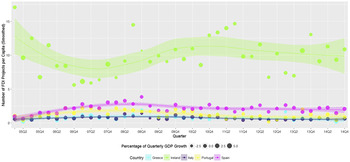
Yet this interpretation by the Troika and the OECD cannot account for the fact that other crisis-afflicted Euro countries who have adopted similar measures to an equal or greater extent have struggled to generate substantial and sustained economic growth. We contend that a “growth models” perspective, which takes seriously the political underpinnings of national varieties of capitalism, better explains the divergent recoveries between Ireland and Southern Europe. This divergence can be illuminated via two stark descriptive statistics. First, as figure 1 demonstrates, Ireland attracts significantly more FDI per capita when compared to Portugal, Italy, Greece, and Spain. Hence, unlike Southern Europe, and more like Eastern and Central Europe, Ireland can be described as having an “FDI-led growth model.” Footnote 27 Further, FDI into Ireland increased significantly after 2008 and during the period of the Troika austerity adjustment.
Lowess-smoothed measures of FDI projects per capita with 95 percent confidence interval. The location of the data points reflects the number of FDI projects per capita while the size reflects the quarterly GDP growth
Source: fDi Markets Database, OECD, Eurostat, authors’ calculations.

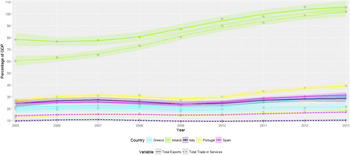
Second, as figure 2 shows, international trade, as a percentage of GDP, is significantly higher in Ireland when compared to the other PIIGS countries. Total exports accounted for 113 percent of Irish GDP in 2015, and almost 90 per cent of this comes from foreign owned global U.S. multinationals. Footnote 28 In particular, total service exports account for approximately €90 billion of Irish exports (over 100 percent of GDP), with Silicon Valley firms accounting for around €40 billion of this. Footnote 29 Indeed in 2015 Ireland was the largest exporter of computer and information services in the world. Footnote 30 While these figures are undoubtedly distorted by the corporate tax avoidance strategies of U.S. firms, Footnote 31 such as Apple, for the most part, as we demonstrate in the case study, it is real investment leading to real jobs. It is this high-tech FDI-led export growth model that accounts for Ireland’s recovery from crisis.
Lowess-smoothed measures of Total Exports and Total Trade in Services with 95 percent confidence interval
Source: World Bank, World Development Indicators, Authors’ calculations.

The other PIIGS countries, whose trade portfolios are more dominated by low-tech manufactured goods, saw significant downturns in exports in 2009 as global demand fell. As figure 2 demonstrates, exports have only ever accounted for between 20–25 percent of GDP in Greece, and between 25–35 percent in Portugal, Spain, and Italy. Put simply, Southern European countries do not have an export-sector large enough to offset the worst effects of austerity on domestic demand. These countries rely almost entirely on domestic consumption to generate growth. It is this basic observation that has been almost entirely lost on the Troika. The question then is how did Ireland manage to carve out a high-tech, export-oriented FDI growth model in a period of austerity whilst the other PIIGS could not? By drawing on perspectives from the study of comparative capitalism, we suggest the answer lies in the political sources of a state-led strategy based on a coalition of business-oriented elites.
Varieties of Capitalism, Growth Models and Elite Politics
As suggested by Peter Hall, comparative political economy has been slow to consider how the revolution in ICT and internationally traded services might be changing the nature of economic growth and employment in developed democracies. Footnote 32 Given that comparative political economy emerged when manufacturing dominated the growth engine of capitalist development, political science research remained fixated on producer-group politics. The core finding was that the variation in organization of employers and unions tended to explain the variation in economic performance among advanced industrial societies. Capitalist diversity was an outcome of the path-dependent effect of domestic institutions, which shaped the cross-national variation in the behavior of government, unions, and employer associations. The structural decline of manufacturing has changed all of this. In response, the study of comparative capitalism has taken two distinct turns: electoral and macroeconomic.
The “electoral perspective” Footnote 33 focuses on the supply (parties) and demand (electorate) of politics, and is best articulated in the recently published book by Pablo Beramendi, Silja Häusermann, Herbert Kitschelt, and Hanspeter Kriesi: The Politics of Advanced Capitalism. These scholars argue that the economic policies that governments pursue, and the cross-national variance in economic performance, is not so much shaped by the dominant producer–group interests of a given society but the changing nature of electoral cleavages, and the path-dependent effect of previous policy choices. These new electoral cleavages have been transformed by the radical transformation of economic change, which has uprooted the labor movement and occupational structures, with the implication that there is increased job polarization (and educational attainment) among low- and high-skilled workers. Footnote 34
This electoral approach is particularly useful in explaining social policy. That is, it works best when the dependent variable is the welfare state or the different components of public expenditure. Some voters want income replacement; others want social investment. In the context of the Euro crisis, this implies that governments will implement different fiscal adjustments, depending on the dominant electoral cleavages in society. Footnote 35 Few would disagree with the observation that governments must sustain the support of voters to get re-elected. But do the electorate really shape the trajectory and dynamics of a country’s capitalist economy and national growth regime? Surely, it is an empirical question whether national governments primarily respond to organized business interests or the electorate.
We tend to agree that producer-group politics, and in particular, the role of manufacturing, matter much less in explaining the politics of advanced capitalism. But the weakened nature of trade unions and employer associations does not imply that corporate interests matter less in shaping policy outcomes. Nor does it imply that public opinion and electorates determine economic policy. We tend to agree with Pepper Culpepper that the politics of capitalist diversity is best conceived “as a set of mutual dependencies between business and the state.” Footnote 36 This suggests that any analysis on divergent recovery in the Euro periphery needs to analyze cross-country variation in the business-state relationship, rather than electoral coalitions per se. It is also where questions of power and state capture come into play, which is particularly important in trying to explain how party linkages shape austerity politics. Footnote 37
The second big turn in comparative political economy is a renewed focus on national growth regimes and macroeconomics. Footnote 38 Unlike the “electoral turn” the dependent variable in this approach is not the welfare state; it is rather the determinants of aggregate demand and economic growth. For Lucio Baccaro and Jonas Pontusson, the cross-national variation in economic and employment performance is explained less by variation in electoral coalitions or institutional complementarities, but “the extent to which economic growth is shaped by export-orientation or domestic consumption.” The question as to whether a country is export-led or consumption-led, in turn, depends on the politics of “distributive conflict” among different “social coalitions” in a given society. Footnote 39
This political perspective differs fundamentally from mainstream neoliberal economics in that it prioritizes the role of conflict. Countries with export-led growth, such as Germany, must repress wages, and hold down domestic demand. John Miller calls this German wage repression a “beggaring (of) its own people” that has meant “consumption stagnated” and corporations have “hoarded their profits.” Footnote 40 Countries with consumption-led growth, such as the UK, must allow wages or credit to expand. Countries with a balanced growth path, such as Sweden, allow wages and profits to grow simultaneously. The growth-model perspective is particularly important in the context of the Euro crisis. It implies that countries with manufacturing-led growth models that are based on cost competitiveness (i.e., price sensitivity) must politically simulate a German-style variant of austerity and internal devaluation, if they are to generate the conditions for economic recovery. Footnote 41
In this perspective, the politics of export growth depends upon the tacit support of employers and unions to hold down unit labor costs. These countries tend to cluster around the “coordinated market economies” (CMEs) of Northwest Europe, and therefore the “growth model” perspective complements the classic varieties of capitalism typology (“liberal market economies” [LMEs] versus CMEs). Export growth is made possible not because of neoliberal markets; rather it is the presence of a set of domestic political institutions that ensure that profits grow at the expense of wages. Footnote 42 Cost competitiveness is identified with unit labor costs. Hence, unlike the electoral turn in comparative capitalism, which takes the revolution in services and information technology seriously, Footnote 43 the varieties of capitalism “growth models” perspective, we contend, remains wedded to an understanding of the political economy that is based on manufacturing, and in particular, the German manufacturing growth model.
Both the “electoral” and “growth models” perspectives in the study of comparative capitalism have given rise to a fruitful literature on the origins and consequences of the Eurozone crisis. Footnote 44 These perspectives, however, suffer from one major shortcoming: neither pays sufficient attention to elite politics, the mutual dependency between business interests and the state, and the extent to which state elites and large corporate firms are key political actors in shaping the dynamics of capitalist development. This is surprising given that classic studies in comparative capitalism identified an activist role for state-business elites, particularly the capacity to engage in industrial policy, as the central factor in explaining cross-national variation in economic and employment performance among advanced industrial societies. Footnote 45
The Politics of a State-led FDI Growth Model in Europe
We concur with the “electoral” perspective that the structural transformation brought about by the shift from manufacturing to service-based economies has led to a qualitative change in the politics of advanced capitalism Footnote 46 . However, we suggest that to explain country-specific models of capitalism, such as Ireland’s high-tech FDI growth model, requires an examination of elite state-business politics. Likewise, we agree with the “growth models” perspective that the difference between consumption and export-led growth is crucial to explain post-crisis recovery in the Euro periphery. However, this perspective remains wedded to an understanding of the political economy of producer-group politics and cost competitiveness. Neither takes the political role of the state and the strategies of corporate firms seriously. Footnote 47
New political perspectives on the role of the state in shaping high-tech growth suggests a much more activist role for politics. Footnote 48 Mariana Mazzucato, in particular, convincingly argues that entrepreneurial states can and do “pick winners” by actively “fostering entrepreneurial growth and development.” However, while her analysis has traction for large federal states, such as the USA, which can afford many “failures” in waiting for a “winner,” it is less applicable to those states operating within the constraints of the EU. In this regard, we argue that the state can play an active role in shaping the growth model of European political economies, less through entrepreneurial policy, but through enterprise policy, which is distinct from social policy (i.e., it is specifically aimed at generating economic growth, and therefore intimately related to country-specific models of capitalist development).
In the Irish case, enterprise policy is an approach by state elites to create the institutional conditions necessary to attract leading-edge production from global multinationals. It is specifically focused on winning FDI from high-tech, high-wage firms from Silicon Valley. Crucially, the strategies underpinning Irish enterprise policy are coordinated by a public sector agent who are independent of the electoral cycle: the IDA. Their task is to identify and attract corporate leaders in emergent innovative sectors (such as born on the Internet firms) with the explicit intention of building a high-tech business cluster. Footnote 49 Hence, it is not about picking firms randomly. Rather it is aimed at winning the investment of a global multinational in a high-growth sector on the assumption that their presence will generate a sectoral cluster effect (or what Irish elites call a competitive “eco-system”).
Irish political elites in the IDA work from the assumption that the spillovers in the high-tech computer and information service sector are high, so the presence of a major multinational in the sector will increase the likelihood of attracting other firms. Over time, the presence of a global leader in an emergent growth sector, such as Apple, Google or Microsoft facilitates the emergence of a high-tech business cluster. Footnote 50 We contend that the cost competitiveness argument underpinning austerity policies in Europe, which are built on the German manufacturing model, apply to low-tech manufacturing production, but not to high-tech globally-traded services. In the latter, labor costs account for less than 10 percent of total costs, with the implication that price-based wage competitiveness is not a determinant of economic growth in internationally traded services. Footnote 51
There can be no doubt that Silicon Valley firms who invest in Ireland have a preference for low taxes and flexible labor markets, and that Ireland is a variant of a “liberal market economy” (LME). But what’s often missed in this observation is that Ireland’s “neoliberal economy” is a state-led model of capitalist development. While any state can set a low corporate tax rate, building a credible commitment to that tax rate takes years, if not decades, where the state demonstrates its fortitude through government changes and crisis (such as the troika adjustment). Further, while low taxes may be necessary in enticing corporate firms in high-value traded services, these conditions are not sufficient as multiple states can and do offer very similar structures (using legal tax avoidance strategies, multinationals can effectively get the same corporate tax rate in the Netherlands, Switzerland, Luxembourg, and most Eastern and Central European states). To put it another way, it is not as simple as the government turning down the corporate tax dial, liberalizing the labor market, and then watching high-tech FDI grow in response. The political role of the state is far more hands-on.
Our argument is that the presence of an activist state agent tasked with coordinating enterprise policy is also necessary. Beyond acting as a transmittal mechanism for credible institutional commitments, state elites in the IDA serve as a shepherd through the regulatory and financial transaction costs that face any firm when establishing a part of its global supply chain in a new location, activities such as sourcing office space, recruiting staff, and linking into domestic supply-chains. As we will now evidence in the case study, the role of state elites in Ireland’s model of capitalist development goes far beyond offering low corporate taxes. It involves long-term political strategies explicitly aimed at building high-tech sectoral clusters. In the classic CMEs of northern Europe, this coordination among firms occurs through sophisticated employer and trade union associations. In the world of internationally traded services, it requires a much more direct role for the public sector.
Case Study: How Irish State Elites Built the “Silicon Docks”
To substantiate that it was a state-led FDI growth model, coordinated by elites in the IDA, rather than austerity, which explains Ireland’s economic recovery from the Euro crisis Footnote 52 we now turn to a within-case study analysis of Ireland’s “Silicon Docks.” The case study, which draws upon over twenty-five semi-structured elite interviews, traces the origins of Ireland’s information- and computer-services sector to the role of the publi-sector agent, the IDA. We outline three distinct waves of high-tech investment from Silicon Valley, putting particular emphasis on the third wave of investment that emerged with Google, and the Internet sector.
The strategy of the IDA, since they became an autonomous state-sponsored body (ASSB) in the 1970s, has been consistent: identify an industry leader in a high-growth sector; encourage them to locate their European headquarters in Ireland; bank on the cluster effect that this will create; and work closely with these firms to ensure their expansion. The core objective is to “attract those firms in a high-growth sector that are at the leading edge of technological change.” Footnote 53 Hence, it’s about building a high-wage technology cluster.
The strategy of the IDA starts with a “detailed investigation of a Silicon Valley firm, particularly those in receipt of venture capital funding.” Footnote 54 Once they target a firm, these public sector agents then try to “convince the executive managers to visit Ireland,” making clear that there are no strings attached. As part of this site visit, the IDA introduces the executives to other IDA client firms working in the same sector. The purpose of these site visits is “to allow executives to network and to discuss their experience of working in Ireland.” The executives are then introduced to “university leaders and any other firms with whom they may need to develop supplier relationships.” Meetings are also organized with “banking and finance officials, in addition to recruitment specialists, and if need be, government ministries.” Footnote 55 For the IDA, the site visit is a marketing exercise. To quote a senior manager at an IDA client firm, it is a “networking opportunity, whereby the IDA makes it clear that the Irish state is open for international business.” Footnote 56
ICT Manufacturing—Intel
The first wave of Silicon Valley investment started in 1989 when the IDA “convinced Intel to establish their European micro-processing plant in Ireland.” Footnote 57 The core problem facing Intel in their investment decision “was recruiting high-skilled engineers.” In response, the IDA directly commissioned a consultancy group to recruit 300 Irish expatriates from California, to return to Ireland to work for the company. Footnote 58 Further, the IDA “offered a generous financial package” worth IR£87 million, equal to 80 percent of their annual budget. Intel’s presence as an industry leader quickly attracted other leading-edge firms in the same sector. IBM, Apple, Dell, and other manufacturers either established or expanded their operations during this emergent period. Employment in the sector doubled during the 1990s with Apple and Intel each employing over 4,000 people by 2014. Footnote 59
Software Development—Microsoft
As computer manufacturing became commoditized during the mid-1990s many ICT firms “began to move their hardware manufacturing operations outside Ireland to low-wage, low-cost economies.” Rather than attempt to convince these firms to keep these now comparatively low-value activities in Ireland “either through subsidies, or otherwise, we (the IDA) shifted strategy, and began to target new software companies.” Footnote 60,Footnote 61 This led to the second wave of inward investment, particularly from those ICT firms “seeking to cluster around the externalities created by Microsoft.” Footnote 62 By the early 2000s, Ireland was the second largest exporter of software in the world. Footnote 63
A central strategy of the IDA is to “maintain a close relationship” with the senior executives of their client firms after they establish their operations in Ireland. The purpose of this is to “monitor change and to be prepared to assist and facilitate the transformation of their business model.” A large part of the IDA’s strategy is to “get information and then feed it back to policy makers,” particularly if job retention becomes an issue. For example, IBM employed 4,000 workers in manufacturing in Ireland in the early 2000s. In 2015, they continued to employ 4,000 people, but none of whom worked in manufacturing. Footnote 64 IDA officials “worked closely with IBM during this transition process,” and “ensured that a direct line of contact existed between the firm and policymakers outside the formal bureaucracy.” Footnote 65
During this second wave of investment the IDA also began to target new Silicon Valley firms, luring emergent California-based software companies such as Oracle, AOL, and one of the world’s first Internet browsers, Netscape. Footnote 66 While some of these firms were unsuccessful, “their presence ensured that there was a growing cluster of senior managers with U.S. corporate experience in the new Internet tech sector.” Crucially, some of the investment during this period led to the construction of IDA sponsored data storage labs, that “went unused for over a decade.” These data centers would subsequently “prove to be a crucial incentive to attract and win the investment of Google,” Footnote 67 given the importance of data security and data storage to Internet firms operating in the online digital economy.
Born on the Internet—Google
In response to the dot.com stock market crash in the early 2000s many “state development agencies pulled out of Silicon Valley, on the assumption that Internet firms would never go global.” However, the IDA “stayed the course and remained in Silicon Valley, and began to actively nurture a close relationship with web companies that nobody had yet heard, such as PayPal, Overture and Google.” It was this third wave of investment from “born on the Internet” firms that is central to explaining Ireland’s economic recovery from 2009 onwards. But it’s important to note that public sector agents working for the IDA in California had been building these networks and relationships for over a decade. Or to quote a senior manager at an Irish-based tech firm, “they persevered, kept knocking on doors, and became real experts in those emerging markets that they were trying to attract.” Footnote 68
The critical juncture that changed everything for the IDA can be traced to winning the investment of Google, who established their European HQ in Dublin in 2004, which was followed by Facebook in 2008. Footnote 69 This “Google Effect” was equivalent to the earlier “Intel effect” in that it “effectively launched a new technology sector in Ireland.” Or, as stated by an IDA official interviewed for this project “it promoted Ireland to the Premier league of Internet tech investment.” Footnote 70 Google employed less than 70 employees when they established their operations in 2003–2004. Footnote 71 By 2015, they employed 5,700 permanent and contract workers. Footnote 72 Google, Twitter, and Facebook all “worked out of IDA offices until they sourced commercial office space in Dublin’s Docklands,” a run-down area of Dublin’s inner city, which was regenerated under a state-led development project, “of which the IDA was central.” The very fact that the IDA lends out their own office space to global corporates should be indicative of the “hands on” business-state relationship in Ireland.
The Google Effect
The arrival of Google was a “direct outcome of a five-year campaign by the IDA to secure their investment, ahead of Switzerland.” Based on the IDA’s previous experience of luring INTEL, the IDA strategy was “to market Ireland as a place where Google could establish large data centers,” which, it was argued, would “sink their costs and embed their presence” in the economy. This strategy was based on the assumption that if “Google established their European HQ in Dublin it would facilitate a new wave of additional investment,” from a whole host of companies in receipt of venture capital funding, seeking to cluster around the Internet giant. The strategy, therefore, was to focus all of the IDA’s resources on winning the investment of Google in expectation that their presence would “generate a high-growth cluster” of web-based firms in Silicon Valley seeking to grow their European markets. Footnote 73
This has proven to be correct. During the period of austerity (2009–2014) the IDA secured the inward investment of Zynga, Twitter, Amazon, DropBox, LinkedIn, Hubspot, Trip Advisor, AirBnB, Square Space, Sales-force and Engine Yard, to name but a few. We have identified an additional 80 IDA sponsored firms that have invested in Ireland during this same time period, listed in Appendix IV. Footnote 74 Within the space of ten years, and despite comparatively high labor costs, “the IDA won sufficient investment from Silicon Valley to turn Dublin into a European digital tech hub.” By 2016, Ireland hosted nine out of ten of the top global U.S. technology firms, employing 24,000 people and generating €16bn in annual exports. Footnote 75 This is the FDI cluster effect, which economic scholars such as Enrico Moretti argue, is causally connected to the expansion and human capital externalities of “thick labor markets.”
Much like Intel, the primary concern for Google when they opened their Dublin office was “sourcing the right kind of human capital.” Google, initially, never intended their Dublin office to “industrialize the digital service sector.” This occurred because of the “rapid inflow of young European workers.” The IDA facilitated this process by “acting as point of contact to ensure that Google did not face any restrictions when seeking work permits for talented overseas workers.” Further, the IDA actively supported “a wider recruitment campaign” to facilitate Google-Ireland’s strategy to “industrialize the digital economy,” through “marketing Ireland as a place to work.” This was the dominant theme that emerged from the interviews carried out for this project. All tech firms want a competitive corporate tax rate. But a more important factor determining investment choice is the labor market. It is the “human capital externalities” that emerge from thick labor markets that attracts investment into an emerging high-tech business cluster. Further, U.S. firms do not necessarily want access to Irish workers; rather, they want direct access to the labor market of the EU28.
Human Capital Externalities
The global presence of Google and Facebook, among others, has created a large internal labor market in the tech sector now colloquially called the “Silicon Docks.” The 80 web-based IDA client firms that invested in Ireland effectively “feed off Google’s labor market.” These firms require “graduates with multi-lingual proficiency,” and although this locks out many Irish graduates from working in the tech sector, this does not matter as long as these firms have access to the labor supply of the member states of the European Union (EU). In the United States, a core part of the IDA strategy is to actively market “the beneficial effects of the openness of the Irish labor market within the Eurozone.” Footnote 76 In this regard, Ireland’s economic recovery can be traced to the positive effects of free movement and internal EU labor mobility, rather than the benefits of cheap labor costs.
During the period of the troika adjustment, the IDA dedicated almost “three-quarters of their annual budget to marketing,” and launched a massive business advertising campaign in the United States. This strategy was specifically targeted at technology investors and included slogans such as “Facebook found a place for people who think a certain way: it is called Ireland,” and “Google searched the planet for a place to do business: they choose Ireland,” and “hire the young Europeans before they hire you.” While it is tempting to dismiss these “sales strategies” as anecdotal, they provide important evidence to corroborate the claim that the IDA was using the presence of global tech firms to lure other Silicon Valley-based firms, in receipt of venture capital funding, to expand their European operations and invest in Ireland. Footnote 77
It is not easy to precisely measure the effect of state elites in winning FDI from Silicon Valley, and their central role in shaping Irelands high-tech export growth regime. But to quote a corporate executive interviewed for this project, and who was a core actor in the expansion of Google Ireland: “the IDA is the catalyst. It’s a bit like chemistry. . . . difficult to measure, but without the catalyst, nothing happens, they bring it all together.” It is perhaps also important to note that the IDA is not the only actor responsible for Ireland’s state-led enterprise policy, which involves a large network of administrative and business elites. “Enterprise Ireland” is specifically tasked with developing indigenous export-firms. Since 2008, the fastest growing indigenous export growth sector is also computer services, which would suggest that the cluster effect is impacting on Irish-based firms.
Alternative Explanations
According to a senior manager interviewed for this project, “the only time we (tech) experienced austerity was when we walked through the streets after leaving the office.” The information and computer services sector, in addition to financial services, were the only sectors of the Irish economy that experienced increased wages during the period of the troika adjustment. The computer and information services sector was actively expanding employment and recruiting high-skilled workers, not just within Ireland, but from across the EU. Simply put, cutting wages via austerity had nothing to do with attracting the FDI that led to Ireland’s economic recovery. Rather the fiscal adjustment was a strategy pursued by the state to retain membership of the Eurozone. But it is worth asking whether the political commitment to fiscal austerity may have improved investor confidence?
This was never mentioned by anyone interviewed for this project. However, concerns about “government stability,” a commitment to “the corporate tax rate,” and “declining public infrastructure” were all mentioned. Many interviewees were highly critical of the “inflexible nature of EU fiscal rules,” particularly when it comes to capital investment. On this front, it is worth noting that no Irish government has succeeded in being re-elected since 2008. This is a consequence of imposing austerity, not least the implementation of what is perceived to be an arbitrary water tax, which was introduced as part of the troika adjustment. In this regard, and in agreement with Beramendi et al, electoral politics clearly do matter, particularly for government stability. Since the 2016 election, the Irish parliament has never been more fragmented. But this electoral dynamic is distinct from the elite business-state coalition that shapes the dynamics of Ireland’s growth model of capitalist development. We now test our claim that wage competitiveness had little to do with attracting FDI through a comparative quantitative analysis with the other PIIGS countries.
Expanding a High-Tech Business Cluster through Wage Cuts or FDI? A Quantitative Test
Our case-study analysis demonstrates how the Irish economy was differentially situated from its peers on the Euro periphery, and deeply problematizes the assumption that export-growth in high-value services was a causal outcome of austerity induced cost competitiveness. This recognition forms the basis of our expectation for why Ireland has experienced such a dramatic divergence in its recovery from the 2008 financial crisis vis-à-vis the rest of the Euro periphery. Due to its decades-long, state-directed enterprise policy, which is aimed at nurturing a close relationship with corporate capital, Ireland was well primed to receive inflows of FDI. As suggested by the “growth model” perspective in the study of comparative capitalism, the rest of Euro periphery relied on a political economy model driven, to a large extent, by domestic consumption.
We contend that the presence of a high-tech business cluster, not cost competitiveness, make the PIIGS more or less attractive as FDI destinations. In Ireland, the central strategy of state elites is to build a high-tech, high-wage business cluster, as most high-tech firms want to locate around other high-tech firms, Footnote 78 If Ireland’s state-led FDI policy was working as we contend, then inward investment during the crisis came not from austerity-induced wage competitiveness, but from the business cluster effect that this policy created. Note that this is different from the argument that Ireland’s growth model is nothing other than a function of low corporate taxes. This is clearly part of the arsenal of state policy, but our contention is that the pull effect of a high-tech cluster ultimately draws in additional FDI. Footnote 79
While our argument here centers on the process-tracing and qualitative analysis offered in the case study, we look to further support our claims via a statistical analysis. If our argument is correct, we would expect to observe a comparative increase in FDI in response to a common, positive, exogenous credit shock in global finance. This would then serve as an observable empirical implication that Ireland’s FDI-led export growth model is at work. Fortunately, we have just such a shock with the U.S. quantitative easing (QE) program, which ran from December 2008 to December 2013. Footnote 80 If our logic is correct, then as a result of this shock, we should see increased FDI into Ireland both in absolute terms and vis-à-vis the rest of the periphery. Likewise, if we are correct that wage-cost competitiveness does not explain the Irish recovery, we should see no relationship between decreased wages and increased FDI.
To test this claim we focused on the relationship between the number of FDI Projects as the dependent variable and expansions in the U.S. Federal Reserve’s Treasuries Holdings, QE_∆, during quantitative easing and the percent change in wages, Wages_%∆, as the main independent variables, in each of the Euro crisis afflicted countries, from January 2003 to December 2014. We also included a number of standard control variables included in the literature on QE and FDI and we ran a number of robustness checks to consider different wage categories, variable timing (lags), and alternative estimation methods. Substantive details on the data, specification and model choices, and the full regression results can be found in Appendices I and II. We present limited regression output on the main variables of interest in table 1 and discuss the substantive findings here.
FDI projects and QE

Absolute value of z score in parentheses.
** Significant at 1% level, * Significant at 5% level, † Significant at 10% level
The findings in table 1 provide substantial support for our argument. Increased credit is associated with more FDI projects in Ireland in the models that consider Ireland alone (QE_∆ in models I–IV, which use different measures of wages) and in comparison to the other PIIGS (QE_∆*Ireland in models VII–VIII which use two alternative measures of wages). Substantively these models suggest that over the period of U.S. quantitative easing, Ireland received an additional 30 to 81 FDI projects, ceteris paribus, and 66 to 121 more FDI projects vis-à-vis the other PIIGS. Footnote 81 Further, and more important for the argument being developed here, in models I–IV and VII–VIII, decreased wages, Wages_%∆ and Wages_%∆*Ireland, respectively, have no statistically significant relationship with more FDI projects Footnote 82 . All of this would suggest that the early actions of the U.S. central bank had a more significant impact on Ireland’s FDI-led recovery than the Troika austerity program.
Conversely, when considering the other PIIGS either collectively (Model V) or individually (Appendix II, table II.4), we see no relationship between increased credit, QE_∆, and FDI projects and, if anything, we see a direct relationship between wages and FDI project announcements. We suspect this latter result is largely driven by the coincidence of a lower number of FDI project announcements combined with lower wages from 2009. While we would not contend that this is a causal relationship, lower (higher) wages do not lead to a lower (higher) number of FDI projects, we do take it as strong evidence that the causal mechanism of cost competitiveness is in no way at work in the Eurozone, at least when it came to attracting FDI. We suggest that this finding points to a reality that pursuing wage-competiveness is simply not a viable growth strategy for Euro countries. Taken collectively, the results are supportive of our contention that Ireland’s high-tech cluster, not decreased wages, led to the upswing in tech investment that fueled Ireland’s recovery from the crisis, both in absolute terms and in comparison to its Euro periphery neighbors.
Conclusion: The Politics of Advanced Capitalism in Europe
The politics of adjustment in Europe as prescribed by the Troika, and heavily influenced by Germany, is premised on the manufacturing model of cost competitiveness, whereby a reduction in relative unit labor costs is assumed to correlate with an expansion of net exports. In the EMU, where countries cannot improve competitiveness via their external exchange rate, this internal devaluation has become a core part of the EU’s response to crisis. Ireland’s recovery (much like Germany’s) continues to be regularly cited as a successful example of this. Our analysis shows that this policy prescription is fundamentally misplaced. The high-tech sector from Silicon Valley that has driven Ireland’s recovery is largely indifferent to austerity-induced cost competitiveness. Conversely, low-skilled manufacturing is so cost competitive that Southern European countries are not likely to compete with wages in non-OECD countries, such as China. As argued by Peter Hall, this does not bode well for the growth models of Southern Europe, which are reliant upon domestic consumption to generate growth. Footnote 83 Economic growth might only be stimulated by pursuing high-wage production, or through increasing domestic demand. Austerity is conducive to neither of these.
On the one hand, our analysis supports the political perspective in the study of comparative capitalism that neoliberal oriented economies are better placed to develop comparative advantage in high tech sectors, given the highly flexible nature of their labor markets. Footnote 84 It is therefore unsurprising that policy makers in the EU promote labor market flexibility and “supply side structural reform” as a strategy for growth in Southern Europe. As argued by Mark Blyth, this conception of the state assumes that the only role for government is to impose fiscal rules, reduce budget deficits, and then “step out of the way” of the market. The Irish case demonstrates that the role of the state is far more active, and much more hands on. It is built around a forward-looking enterprise policy with the explicit intention of building a high-tech and high-wage business cluster. This requires state elites nurturing a close relationship with corporate capital. Hence, if there is a policy inference from our study, it is that a state-led strategy to nurture high-tech growth is far more preferable to a neoliberal strategy of shrinking the state. This is our core contribution to the political science debate: Ireland’s FDI growth model can be traced to the activist role of state elites, not the market or the electorate. Similar to the policy-focused perspective of Jacob Hacker and Paul Pierson, we contend that the politics of advanced capitalism is intimately connected to the economic development strategies of business-state elites. And this, rather than electoral coalitions, is the principal determinant of policy variation among developed democracies.
This is not to suggest that electoral politics do not matter in shaping the politics of adjustment in Europe. As argued by Wolfgang Streeck, faced with popular reactions to austerity, electoral coalitions in all member-states of the EU have become highly unstable, with some member-states having been effectively reduced to “democracies without choice.” Footnote 85 Even in Ireland, despite an economic recovery and declining unemployment, the 2016 election witnessed a near-complete destabilization of the party system. The three main traditional parties had their worst electoral outcome in the history of the state, with the main beneficiary being a loose coalition of populist independents. As David Farrell and Jane Suiter note, “the election marked an historic low point for the traditional parties . . . it was the election that nobody won.” Footnote 86 Likewise, Michael Marsh and Gail McElroy discuss how the 2016 election saw “limited” economic voting given that the economic recovery “is not widely felt.” Footnote 87 Notably, the election was heavily influenced by the introduction of “water charges,” which was perceived by large parts of the electorate as an arbitrary tax imposed by the government as part of the EU troika austerity program. What this suggests is that an electoral approach to explaining the politics of advanced capitalism is particularly important for understanding the consequences of austerity, but not the political determinants for economic recovery, and it is understanding the pre-conditions for growth that is currently lacking in the study of comparative capitalism.
Ireland’s FDI growth model of capitalist development, as we have demonstrated, is an outcome of elite politics, and built around a close relationship between state elites and corporate capital from Silicon Valley. It works precisely because, historically, it has not been an electoral issue. Much like in Eastern and Central Europe, corporate tax and access to the wider EU market is a core part of the state’s strategy to lure this investment. It generates high-levels of productivity, and high-levels of economic growth, which in turn contributes toward state revenues and public expenditure. But regardless of these economic benefits, the median voter in Ireland is not a business-finance professional, and does not directly benefit from this high-tech sector. Further, this sector is geographically concentrated in Dublin city, which is used by U.S. firms as a platform to access the wider EU labor market. As the recent Brexit vote demonstrates, electorates can quickly turn against the free movement of peoples within the European Union. Hence, the 2016 election result shines a light on the political fragility of Ireland’s FDI-led growth model, making the domestic electoral sustainability of the approach highly questionable.
More generally, the political fallout from the Euro crisis begs the question as to whether diverse varieties of capitalism can continue to co-exist within the constraints of increased European integration. It is therefore worth concluding with a brief discussion on the European Commission’s controversial ruling against Apple’s corporate tax affairs in Ireland. The Commission found that the Irish state provided a specific tax ruling to Apple that enabled them to avoid paying taxes on the sales of their products in other EU jurisdictions. Ireland allowed Apple to create a subsidiary within a subsidiary of an Irish-based firm that was not tax resident anywhere. The Commission found that this “tax ruling” was a form of “illegal state aid” and broke EU “competition law.” In effect, with this decision, the Commission has directly challenged the close relationship between the Irish state elites and Silicon Valley, whilst opening political conflict between the U.S. government and the EU, given that the U.S. government, much like Ireland, has turned a blind eye to corporate tax avoidance.
The use of EU competition law to intervene in tax-setting sovereignty has caused uproar among Irish political-business elites. They argue that the Commission is illegally interfering in Irish sovereignty. Recent public opinion data would suggest that the Irish electorate agree.88 But from the Commission’s perspective, Ireland is undermining the monetary union by encouraging corporate tax competition among the EU’s member-states. All of this highlights the core problem of capitalist diversity in Europe today: in order for the Eurozone to survive, member-states must transfer more fiscal sovereignty to the EU. But nation-states and electorates are increasingly opposed to transferring more policy sovereignty to Europe. The implication is that whilst the Commission and the ECB continue to intervene in what domestic elites and public opinion consider to be sovereign policy choices, electorates increasingly perceive the EU to be undermining national democratic politics. In light of this, European policymakers would do well to acknowledge the core inference from the study of comparative capitalism, which is that there are multiple pathways to economic and employment growth, and that the attempt to impose a one-size-fits-all adjustment on institutionally-diverse political economies is only likely to exacerbate the growing political and economic divergence between the north and south of Europe. Unless member-states are given the political and fiscal flexibility to pursue their own economic and employment growth paths, then the future of the EU may well be a politics of disintegration.
Supplementary Material
-
Appendix I: Data sources and summary statistics
-
Appendix II: Model details, robustness tests
-
Tables II:1-5
-
Appendix III: List of interviewees
-
Appendix IV: Selected tech firms