Introduction
Delirium is an acute neuropsychiatric disorder characterized by inattention, global cognitive dysfunction, and disturbances in consciousness (American Psychiatric Association, 1994), commonly afflicting hospitalized elderly patients (Inouye, Reference Inouye1999; Khan et al., Reference Khan2012) and contributing to adverse clinical outcomes (Witlox et al., Reference Witlox, Eurelings, de Jonghe, Kalisvaart, Eikelenboom and van Gool2010). Among the numerous pre-disposing and precipitating factors of delirium, dementia features prominently as a major predisposing factor (Inouye, Reference Inouye1999; Ahmed et al., Reference Ahmed, Leurent and Sampson2014). Indeed, the prevalence of delirium superimposed on dementia (DSD) ranges from 22% to 89% among hospitalized and community-dwelling older population (Fick et al., Reference Fick, Agostini and Inouye2002).
Despite being highly inter-related, delirium developing in the older adult with pre-existing dementia remains under-diagnosed in the acute hospital setting (Fick et al., Reference Fick, Agostini and Inouye2002; Martins and Fernandes, Reference Martins and Fernandes2012). The challenge in DSD recognition is differentiating signs of delirium from the cognitive impairment and behavioral disturbances of dementia. Behavioral and Psychological Symptoms of Dementia (BPSD) is a term coined during the 1999 Update Consensus Conference held by the International Psychogeriatric Association (IPA) to designate the following: (1) behavioral symptoms, which are observable and include physical aggression, screaming, restlessness, agitation, wandering, culturally inappropriate behavior, sexual disinhibition, hoarding, cursing and shadowing; (2) psychological symptoms, which are evident through history-taking, manifesting as anxiety, depressive mood, hallucinations, and delusions (IPA, 2002). Motoric subtypes of delirium have been previously recognized (Lipowski, Reference Lipowski1989) with the hyperactive form manifesting similarly as BPSD (increased psychomotor activity, restlessness, and irritability, etc.), and the hypoactive subtype being largely under-recognized due to subtlety of symptoms. Both these subtypes along with the mixed form may be mistaken as diurnal variations of the dementia symptoms leading to a missed DSD diagnosis. The poor prognostic implications of DSD, including slower cognitive symptom recovery (Chong et al., Reference Chong, Tay and Chong2015), as well as accelerated cognitive and functional decline, institutionalization and mortality (Fick et al., Reference Fick, Agostini and Inouye2002), necessitate urgent measures to improve its detection and surveillance.
To date, literature associating BPSD and delirium remains scarce, with most studies emphasizing behavioral and neuropsychiatric differences between DSD versus dementia and/or delirium (Landreville et al., Reference Landreville, Voyer and Carmichael2013; Chong et al., Reference Chong, Tay and Chong2015; Leonard et al., Reference Leonard2016). The potential role of delirium in exacerbating BPSD among dementia patients has been studied as well (Tanaka, Reference Tanaka2016), but none, thus far, have looked into the role of BPSD in affecting delirium presentation and recovery.
The primary objective of this study was to examine phenomenological differences in delirium presentation and recovery between DSD patients with and without premorbid BPSD. Our second objective was to compare in-hospital morbidity (i.e. pressure ulcer formation, nosocomial infection, and inpatient falls) as well as major outcomes of mortality and incident institutionalization between BPSD and non-BPSD groups.
Methods
Participants and setting
This was a prospective observational study of patients aged 65 years and above with DSD, admitted to the Geriatric Monitoring Unit (GMU) of the Department of Geriatric Medicine, Tan Tock Seng Hospital in Singapore between December 2010 to August 2012.
The GMU is a 5-bed unit with specific elder-friendly room design and higher nursing ratio of 1 trained nursing staff to 2.5 patients. It incorporated specific measures that have been deemed beneficial to delirium care, namely (i) delirium room (Flaherty et al., Reference Flaherty, Tariq, Raghavan, Bakshi, Moinuddin and Morley2003); (ii) core interventions adopted from the Hospital Elder Life Program (Inouye et al., Reference Inouye, Bogardus, Baker, Leo-Summers and Cooney2000); (iii) bright light therapy (2,000–3,000 lux) via lights installed in the ceiling and turned on from 6 to 10 pm daily (Chong et al., Reference Chong, Tan, Tay, Wong and Ancoli-Israel2013). All interventions were adhered to via a semi-structured protocol by trained geriatric nurses. There is a dynamic system for GMU transfers (akin to an intensive care unit), whereby patient flow is effected once they are assessed to have met entry or discharge criteria. Description of the GMU as a new model of delirium care as well as its clinical efficacy has been previously published (Chong et al., Reference Chong, Chan, Kang, Han, Ding and Tan2011; 2014; Tay et al., Reference Tay, Mark Chan and Chong2012).
Ethics approval for the study was obtained from the National Healthcare Group (NHG), Domain Specific Review Board (DSRB), and written consent obtained for all patients either from the primary caregiver or a legally acceptable representative.
Eligibility criteria for GMU admission
Patients aged 65 years or above, admitted under Geriatric Medicine, who were determined by their primary geriatrician to have definite delirium using the Confusion Assessment Method (CAM) (Inouye et al., Reference Inouye, Van Dyck, Alessi, Balkin, Siegal and Horwitz1990), either on admission or incident delirium during the course of hospitalization, were considered for GMU admission. A study coordinator (trained in administration and interpretation of CAM) would further screen all referred patients for eligibility.
Patients excluded from GMU admission include those with the following conditions: medical illnesses requiring special monitoring or respiratory and/or contact precautions, assessed to be dangerously ill or have terminal illness, uncommunicative or with severe aphasia, severely combative behavior with high risk of harm to self and others, and contra-indications to bright light therapy. Patients with verbal refusal to GMU admission by self/ family/ physician-in-charge were likewise excluded. Finally, patients who were prematurely transferred out of GMU and those admitted from a long-term care facility (who may not have reliable historians to provide cognitive history) were excluded from subsequent analyses for the purpose of this study.
Data collection
We collected data on patient demographics (age, gender, and race), medical comorbidities and severity of illness using modified Charlson's comorbidity index (Charlson et al., Reference Charlson, Pompei, Ales and MacKenzie1987) and severity of illness index, and precipitating causes of delirium. Cognitive performance was assessed using locally validated Chinese Mini-Mental State Examination (CMMSE) (Sahadevan et al., Reference Sahadevan, Lim, Tan and Chan2000) and functional status scored using Modified Barthel Index (MBI) (Mahoney and Barthel, Reference Mahoney and Barthel1965), both administered by a trained assessor during the initial and predischarge phase of the patient's admission. Being a mechanical restraint-free unit, none of the patients in GMU had been subject to physical restraint. The frequency and dose of chemical restraint use, however, were documented. To adjust for the different antipsychotics prescribed, we used chlorpromazine equivalence (Atkins et al., Reference Atkins, Burgess, Bottomley and Riccio1997; Woods, Reference Woods2003) to assess total antipsychotic usage during admission.
Baseline cognitive and behavior assessment
All patients underwent detailed cognitive evaluation by a consultant geriatrician (subspecialty interest in cognition/memory disorders) upon admission to GMU. Determination of underlying dementia among admitted patients in GMU has been previously described (Chong et al., Reference Chong, Chan, Kang, Han, Ding and Tan2011), and involved interview of family members and/or designated caregivers regarding baseline cognitive functioning prior to current admission as well as extensive review of medical records to ascertain whether a diagnosis of dementia has already been established. It follows a standardized process for cognitive evaluation (Chong and Sahadevan, Reference Chong and Sahadevan2003), whereby diagnosis of dementia is made in the current admission if the corroborative history is suggestive of dementia as indicated in the Diagnostic and Statistical Manual of Mental Disorders, 4th Edition (DSM-IV) criteria for dementia (APA, 1994). As this study sought to compare DSD patients with and without underlying BPSD, we excluded from further analysis patients for whom a diagnosis of dementia had been ruled out.
We further categorized all diagnosed dementia patients as exhibiting behavioral and psychological symptoms of dementia based on behavioral disturbances elicited from reliable family members or designated caregivers, with emphasis on baseline behavior (baseline being defined as behavior displayed persistently as to be described as chronic, and almost predictably at the patient's own home) to differentiate from acute behavioral changes (either as new presentation or sudden change in severity of usual behavior) that may be associated with delirium. For the purpose of this study, we only identified presence and absence of BPSD to facilitate comparison.
Delirium assessment
Delirium presence and severity was assessed daily in GMU, represented by Confusion Assessment Method severity or CAM-sev (Inouye et al., Reference Inouye, Van Dyck, Alessi, Balkin, Siegal and Horwitz1990) and Delirium Rating Scale Revised-98 (DRS-R-98) severity (Trzepacz et al., Reference Trzepacz, Mittal, Torres, Kanary, Norton and Jimerson2001) scores. The CAM criterion was utilized to identify patients with DSD, as this was found to have high specificity (96%–100%) and moderate sensitivity (77%) for the diagnosis of DSD in a systematic review made by Morandi et al. (Reference Morandi2012).
DRS-R-98, a 16-item scale with 13 severity items and 3 diagnostic items, is a well-validated tool for rating severity of delirium (Trzepacz et al., Reference Trzepacz, Mittal, Torres, Kanary, Norton and Jimerson2001). The 13-item severity scale of DRS-R-98 has been designed to enable serial assessments of delirium severity, with emphasis on gradations of symptom severity, and items capturing cognitive and behavioral domains of delirium. The severity items of DRS-R-98 were employed in this study to compare phenomenological differences between DSD patients with and without BPSD. Serial testing was conducted during the patient's length of stay while in delirium at GMU.
Delirium subtype classification (hyperactive, hypoactive, and mixed) was documented during the first day of admission to GMU. This was based on the patient's psychomotor activity as personally observed and documented by the clinician or reported by the nursing staff during the 24 hours following delirium onset, which is then compared to the patient's presumed baseline profile as elicited during careful history-taking upon admission.
All patients underwent daily cognitive status evaluation using the locally validated Abbreviated Mental Test (AMT) and CMMSE as part of assessment for delirium progression and recovery, with higher scores reflecting better performance (Sahadevan et al., Reference Sahadevan, Lim, Tan and Chan2000).
A patient was deemed to have recovered from delirium and discharged from GMU, once the CAM criterion for definite delirium was no longer met, with diagnosis of recovery being supported by improvement in cognitive and/or delirium severity scores as well as input from the multidisciplinary team. The duration (days) of patient's delirium while in GMU is then recorded for comparison.
Outcomes
We collected data on delirium duration, length of hospital stay (LOS), pressure ulcer rate, nosocomial infection, fall incidence, and major outcomes, which were identified as inpatient mortality and incident nursing home (NH) discharge.
Statistical analyses
Descriptive data are presented as means (±SD) or median (interquartile range, IQR) for quantitative variables and as absolute and relative frequencies for categorical variables. We performed univariate analyses comparing DSD patients with and without pre-morbid BPSD. Mann–Whitney U-test was employed to compare cognitive, delirium severity, and functional scores between DSD patients with (DSD–BPSD+) and without (DSD–BPSD−) BPSD at presentation and resolution of delirium, with Wilcoxon-signed rank test for within-group analyses. To compare rate of cognitive recovery, we first computed the rate of improvement (change per day) in the cognitive and delirium severity scores on admission versus discharge for each patient, dividing the difference by delirium duration.
We compared frequencies of DRS-R-98 symptoms between groups using χ 2 test and performed McNemar test for within-group analysis of the individual DRS-R-98 severity items on presentation versus resolution of delirium. Improvement in individual DRS-R-98 symptoms was signified by a decline in the severity score at discharge compared with admission. Each severity item was rated from 0 to 3 points with a maximum severity score of 39 points, thus a lower score for each item as well as overall severity point toward improvement.
Using multiple linear regression, we examined the independent effect of BPSD on delirium duration and rate of recovery from delirium, adjusting for a priori predictors of age, gender, illness severity, and any significant baseline variables on univariate analyses.
Statistical analyses were performed using SPSS software (Version 19.0; SPSS, Inc., Chicago, IL, USA). Statistical significance was taken to be two-tailed with p value <0.05.
Results
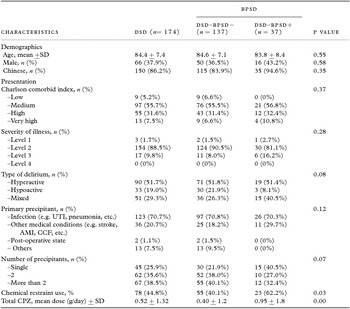
Baseline patient characteristics (Table 1)
Two hundred and seventy-seven (n = 277) patients with delirium were admitted to GMU during the study period. Forty-three patients were excluded from the study: forty-one patients were prematurely transferred out of GMU due to change in their medical condition; one was transferred after family's request; one was transferred early due to extremely combative behavior. Of the remaining two hundred and thirty-four patients (n = 234), one hundred and seventy-four (n = 174) were diagnosed to have underlying dementia DSD, and were included in subsequent analysis.
Baseline characteristics of study cohort

AMI = Acute Myocardial Infarction; BPSD = Behavior and Psychological Symptoms of Dementia; CCF = Congestive Cardiac Failure; CPZ = Chlorpromazine; DSD = Delirium superimposed on Dementia; SD = Standard Deviation.
Mean age of the 174 patients included in the study was 84.4 ± 7.4 years, with female predominance (62.1%) and majority of Chinese ethnicity (86.2%). Hyperactive delirium was the most common presentation (51.7%), followed by mixed (29.3%) and hypoactive (19%) delirium. Infection, mostly urinary tract infection and pneumonia, was the primary precipitant for delirium in majority of the patients (70.7%).
Thirty-seven (21.3%) patients in our DSD cohort had pre-existing BPSD. There were no significant differences between BPSD and non-BPSD groups in terms of age, gender, and ethnicity. Likewise, co-morbidity index, severity of illness, and primary precipitants were similar.
While hyperactive delirium remained the most frequent presentation in both groups, non-BPSD (DSD–BPSD−) patients demonstrated a trend for more hypoactive delirium compared with their BPSD counterparts (21.9% vs. 8.1%, p = 0.08), although this was not statistically significant. Similarly, DSD patients with BPSD (DSD–BPSD+) appeared more likely to require only a single precipitant for delirium (40.5% vs. 21.9%, p = 0.07), which was also not statistically significant. Nonetheless, there was significantly higher frequency of chemical restraint use in patients with BPSD (62.2% vs. 40.1%, p = 0.03), and at significantly higher doses of antipsychotics (chlorpromazine equivalence: 0.95 ± 1.8 vs. 0.40 ± 1.2, p < 0.01) compared to patients without BPSD.
Cognitive and functional progress (Table 2)
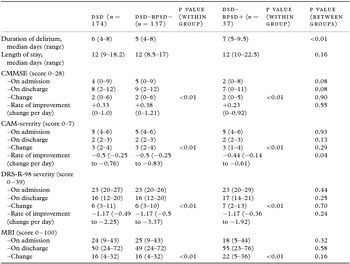
Median duration of delirium for DSD patients was six days (IQR 4.0–8.0), with median LOS being 12 days (IQR 9.0–18.25). Delirium duration was significantly longer in DSD–BPSD+ (7.0 (IQR 5.0–9.5) vs. 5.0 (IQR 4.0–8.0) days, p < 0.01), although LOS was similar between the two groups.
Cognitive and functional progress of DSD patients

BPSD = Behavior and Psychological Symptoms of Dementia; CAM-sev = Confusion Assessment Method severity; CMMSE = Chinese Mini-Mental State Examination; DRS-R-98 = Delirium Rating Scale-Revised 98; DSD = Delirium superimposed on Dementia; IQR = Interquartile range; MBI = Modified Barthel Index.
Delirium severity on admission to GMU was similar between DSD–BPSD+ and DSD–BPSD−. Both groups exhibited similar magnitude of improvement in delirium severity scores upon delirium resolution, but DSD–BPSD− exhibited significantly faster improvement in CAM-severity scores (−0.5 (IQR −0.25 to −0.83) vs. −0.44 (IQR −0.14 to −0.61), p = 0.04).
There was significant cognitive improvement with recovery from delirium in our cohort of DSD patients (CMMSE: 4 (IQR 0–9) vs. 8 (IQR 2–12) on admission and discharge respectively, p < 0.01), with both groups exhibiting significantly improved CMMSE scores at discharge. Although DSD–BPSD+ exhibited a trend for poorer cognitive performance on admission (2 (IQR 0–8) vs. 5 (IQR 0–9), p = 0.08) and upon discharge (7 (IQR 0–11) vs. 9 (IQR 2–12), p = 0.08) as compared to the non-BPSD group, the rate and magnitude of improvement in CMMSE scores were similar between the two groups.
Both BPSD and non-BPSD groups achieved significant functional recovery upon delirium resolution, with no significant difference in the extent of functional improvement (MBI gain: 22 (IQR 5–36) vs. 16 (IQR 4–32), p = 0.16).
Progression of delirium symptomatology (Table 3)
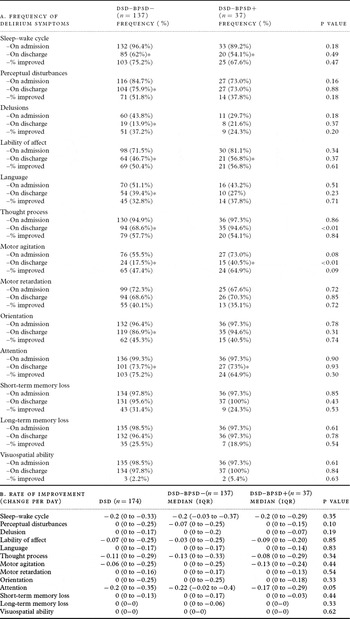
With the exception of a trend for more frequent motor agitation in DSD–BPSD+ albeit not statistically significant (73.0% vs. 55.5%, p = 0.08), no relevant difference was found between the two groups at delirium presentation. Upon delirium resolution, however, disturbance in thought process (94.6% vs. 68.6%, p < 0.01) and motor agitation (40.5% vs. 17.5%, p < 0.01) were significantly more prevalent in DSD–BPSD+.
DRS-R-98 severity items: frequency of symptoms and rate of improvement

For Table 3A: Asterisk (*) denotes p < 0.05 on McNemar test for within group analysis.
BPSD = Behavior and Psychological Symptoms of Dementia; DRS-R-98 = Delirium Rating Scale-Revised 98; DSD = Delirium superimposed on Dementia; IQR = Interquartile range.
In examining the frequency of individual symptoms on DRS-R-98 at discharge versus admission for each of the study group, McNemar test revealed statistically significant decline in the proportion of DSD–BPSD+ patients exhibiting the following neuropsychiatric symptoms upon delirium resolution: sleep–wake disturbances (89.2% vs. 54.1%, p < 0.01), lability of affect (81.1% vs. 56.8%, p = 0.05), and motor agitation (73% vs. 40.5%, p < 0.01), with significantly less DSD–BPSD+ patients having attention deficits (97.3% vs. 73%, p = 0.01). In contrast, significant decline in the proportion of DSD–BPSD− patients manifesting each of the neuropsychiatric symptoms were achieved upon delirium resolution except for motor retardation. This was accompanied by significant decline in proportion of non-BPSD patients having orientation and attention deficits. Short- and long-term memory as well as visuospatial ability did not improve despite delirium resolution regardless of pre-existing BPSD diagnosis.
Although there was no difference in the proportion of patients exhibiting improvement in severity scores for individual DRS-R98 subscales between the two groups, patients with BPSD demonstrated a trend for greater likelihood of achieving improvement in motor agitation at discharge compared with their non-BPSD counterparts (64.9% vs. 47.4%, p = 0.09).
In comparing rate of improvement on individual DRS-R98 items, only attention exhibited significant difference with faster improvement in the non-BPSD subjects (median improvement per day: −0.22 (IQR −0.02 to −0.4) vs. –0.17 (IQR 0 to −0.29), p = 0.05).
Predictor of delirium duration and rate of recovery (Table 4)
Although delirium duration differed significantly between BPSD and non-BPSD groups on univariate analysis, pre-existing BPSD no longer exerted a significant influence on delirium duration in multiple regressions adjusting for age, gender, and illness severity. However, the presence of pre-existing BPSD independently predicted rate of improvement in CAM-severity scores (β = −0.17, p = 0.03).
Predictor of delirium duration and rate of recovery

*Adjusted for age, gender, and illness severity.
CAM-sev = Confusion Assessment Method severity.
Short-term outcomes during hospitalization (Table 5)
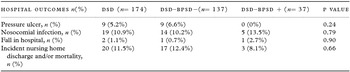
The overall incidence of pressure ulcers among DSD patients admitted to GMU was low (5.2%) and all new cases occurred in the group without BPSD (6.6% vs. 0%, p = 0.24). The rate of nosocomial infection was similar between DSD patients with and without BPSD (13.5% vs. 10.2%, p = 0.79). Only one patient in each group had fallen during their GMU stay. We found no significant difference for major outcomes of mortality and incident institutionalization between DSD–BPSD+ and DSD–BPSD−.
Short-term outcomes during hospitalization

BPSD = Behavior and Psychological Symptoms of Dementia; DSD = Delirium superimposed on Dementia.
Discussion
In our cohort of dementia patients with superimposed delirium, pre-existing BPSD had significant influence on the course of delirium, contributing independently to its slower rate of recovery. We had previously evidenced the impact of underlying dementia on the recovery trajectory of delirium, which is said to be predictive of residual subsyndromal delirium (Lam et al., Reference Lam, Tay, Chan, Ding and Chong2014). Findings of this study suggest a potential mediating role of BPSD. The detrimental effect of pre-existing BPSD on attention, a core aspect of delirium, among patients with DSD is evident from the significantly slower improvement in attention deficits on DRS-R-98, contributing toward slower recovery in overall delirium severity.
The etiology of delirium is complex, representing an interaction between baseline patient vulnerability and exposure to noxious insults (Inouye, Reference Inouye1999). While dementia patients represent a highly vulnerable group for incident delirium, we observed a trend for those with BPSD requiring only a single precipitant for delirium, suggesting additional vulnerability conferred by the presence of neuropsychological disturbances, which aggravates already reduced cognitive reserves. The latter is supported by the worse cognitive performance at presentation and resolution of delirium in the BPSD group.
The diagnostic dilemma of recognizing DSD is particularly pronounced when behavioral disturbances already prevail at baseline, compounded by still limited understanding of the natural history and course of delirium in the presence of BPSD (Hölttä et al., Reference Hölttä2011). The improvement in non-cognitive symptoms (with the exception of motor retardation) with delirium resolution in the non-BPSD group attests to the acutely negative impact of delirium on the behavior of dementia patients. Meanwhile, for patients with underlying BPSD, emergence or aggravation of disturbances in sleep–wake cycle, affect lability, and motor agitation warrant heightened suspicion for delirium onset, given that these neuropsychiatric symptoms significantly resolved with recovery. Our findings are consistent with a recent study reporting improved delirium detection in hospitalized dementia patients following addition of psychomotor change to the CAM diagnostic algorithm (Thomas et al., Reference Thomas, Kreisel, Oster, Driessen, Arolt and Inouye2012).
Not unexpectedly, deficits in the DRS-R-98 cognitive symptoms persisted in both groups despite delirium resolution, even though significant improvements were achieved on CMMSE. This lends credence to the accelerated cognitive decline found following delirium in dementia patients. A rehabilitation program incorporating cognitive stimulation beyond focus on functional performance, therefore, may enhance overall recovery through reinforcement of cognitive reserve in DSD patients (Fong et al., Reference Fong2009). Improving our non-pharmacological armamentarium will also be relevant for dementia patients with pre-existing BPSD, in view of the significantly higher rate and doses of chemical restraint prescription in this group.
This study is the first to explore the impact of BPSD on the presentation, progress, and outcome of DSD. The strength of the study lies in the availability of daily serial cognitive and delirium severity assessments, providing objective evidence that enabled confident diagnosis of delirium resolution in our cohort of dementia patients. However, we acknowledge the timing of dementia assessment in the study for some of the undiagnosed cases cast uncertainty on the diagnoses, although utmost efforts were made to ensure fulfillment of the dementia criteria. Furthermore, we recognize the lack of data on baseline dementia severity between BPSD and non-BPSD groups as well as lack of standardized instruments to quantify the severity of underlying BPSD, which could have potential influence on delirium severity and its recovery. These are the areas of improvement that can be addressed in future studies.
In conclusion, we have seen the negative impact of pre-existing BPSD on delirium recovery when superimposed on dementia. The reversibility of non-cognitive behavioral symptoms in DRS-R-98 with delirium resolution in dementia patients, especially in the absence of pre-existing BPSD, supports the need for vigilance for developing delirium to ensure optimal recovery. An increase in motor agitation along with sleep–wake disturbance and lability of affect should heighten the index of suspicion for delirium in dementia patients with BPSD. Future studies should consider examining the impact of BPSD on longer term cognitive and functional recovery in patients with delirium as this may facilitate discharge planning and resource allocation.
Conflicts of interest
None.
Description of authors’ roles
Dr. J. Abengaña performed the statistical analyses and wrote the manuscript. Dr. M.S. Chong and Dr. L. Tay designed the study, supervised the data collection, and contributed to writing the manuscript.
Acknowledgments
We would like to thank Wong Yoke Moi, RN Jasmine Kang (APN), the Geriatric Monitoring Unit (GMU) nurses, and multidisciplinary team. This study was funded by FY2010 Ministry of Health Quality Improvement Funding (MOH HQIF) “Optimizing Acute Delirium Care in Tan Tock Seng Hospital” (HQIF 2010/17), Singapore. Dr. Mei Sian Chong is supported by the National Healthcare Group Clinician Scientist Career Scheme (NHG CSCS) 2012/12002, whereas Dr. Laura Tay is supported by the NHG CSCS 2013/13001.