In the 1700s and 1800s, the imaginations of Dutch and British settlers at the southern tip of Africa in what was to become the Cape Colony fell captive to reports of enormous roving herds of a small gazelle-like antelope, the springbok Antidorcas marsupialis. Descriptions of herds, estimated at hundreds of thousands or even millions of animals, periodically sweeping across the then mostly unknown interior of the sub-continent, laying waste vast swathes of grazing and pasture and disrupting any attempt at profitable pastoralism, both concerned and fascinated the colonists and were featured with some fanfare and excitement in the local press. Known as the trekbokken or trekbokke (migrating antelope), by the Dutch, these swarms of small antelope and their apparently random comings and goings were wrapped in myth and mystery. It was not known precisely where the large herds came from, what drove their movements, where they disappeared to, and why and when they would return. The vast flat interior beyond the Cape Fold Mountain, a harsh and largely unsettled scrub-covered desert known as the Karoo, was the area most associated with their incursions, however, and all manner of theory and conjecture accompanied the veritable war waged against them by the colonists.
Over the latter half of the nineteenth century, while outright hunting and shooting was generally seen as the only means of staunching the periodic onslaughts, media and municipality urged multiple methods of protecting stock and grazing against the springbok treks if any progress was to be made in taming and settling the interior. Indeed, after a protracted and dramatic inundation of springbok in a concentrated area of the north-eastern Karoo in 1896 and 1897, the treks suddenly ceased and the principal mammal migration of the Karoo became extinct, so removing an important impediment to settlement and agriculture.
The cessation of springbok treks coincided with the arrival in the colony of the rinderpest epizootic: a ‘cattle plague’ that over the preceding five years had raced the length of Africa and decimated cattle populations from Uganda to the Transvaal and finally the Cape Colony (Henning Reference Henning1956: 828–33). Given its apparent coincidence in both space and time with the last great springbok trek in 1896 and 1897, rinderpest has long been claimed as the root cause of the extinction of springbok treks (Skinner Reference Phoofolo1993: 302; Skinner and Louw Reference Skinner and Louw1996: 7). There is no hard evidence to support this conclusion, however, and there are more plausible explanations.
After first examining the basic ecology of the species and the important role of trekbokke in the Karoo ecosystem, this article investigates any potential relationship between rinderpest and the cessation of springbok treks. Having discovered no more than a circumstantial link, a combination of anthropogenic influences is introduced as the primary causative complex in the extinction of this phenomenon. The loss of the treks robbed the Karoo of a cornerstone of its ecosystem and severely disrupted the natural processes of the area.
KAROO CORNERSTONE: THE ROLE OF SPRINGBOK IN AN ARID ECOSYSTEM
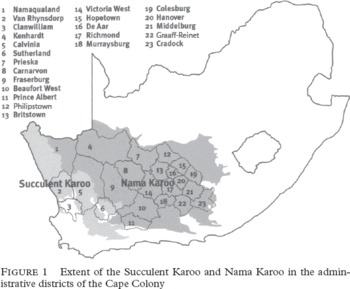
The broader Karoo is in fact comprised of two distinct biomes, the Succulent Karoo in the west (winter rainfall) and the (summer rainfall) Nama Karoo in the central and eastern reaches (see Figure 1). Over the past 50 years the state of this semi-desert environment has provided much fuel for an extended and ongoing debate about environmental degradation in the region and the extent of man's influence on this apparent decline (Acocks Reference van Sittert1953: 1–92; Hoffman and Cowling Reference Hoffman and Cowling1990: 286–94; Dean and Roche Reference Dean, Roche, Milton and Aronson2007: 57–63). Much of this debate has centred on the composition of available vegetation (both grasses and shrubs and the ratio between them) and what this make-up indicates as to past agricultural and pastoral practices. Certainly it is clear from agricultural censuses conducted by the colonial administration that sheep densities in particular have at times been damagingly high and that as a result the productivity of the system and its ability to sustain high stock populations have declined over time (Dean and MacDonald Reference Dean and MacDonald1994: 281–98; Beinart Reference Beinart2003: 1–27). These trends were already recognizable in some areas of the Karoo, and its earlier settled fringe, by the late nineteenth century. It is here that the foundations of the debate lie (Shaw Reference Shaw1875: 202–8; Graaff-Reinet Advertiser 13 February 1899, 2 February 1900).
While this discussion continues unabated today it is nonetheless indisputable that the natural processes of the Karoo are now largely or, in some cases, entirely disrupted. The first fifty years of the twentieth century exerted considerable impact, of course, but this massive disruption began to occur primarily in the late nineteenth century during a period when anthropogenic impacts on then extant natural processes were spectacular.
By 1878 the quagga Equus quagga quagga was extinct (Skinner and Smithers Reference Skinner and Smithers1990: 720). Eland Tragelaphus oryx had been extirpated from the Karoo even earlier (Bryden Reference Bryden1889: 291), and formerly characteristic species such as black wildebeest Connochaetes gnou, red hartebeest Alcephalus buselaphus, blesbok Damaliscus dorcas phillipsi and gemsbok Oryx gazella occurred only at negligible densities (C. Roche, unpublished data). Of the larger herbivores, only springbok still occurred in significant numbers. Most importantly, however, springbok, and specifically the enormous herds of so-called trekbokke, continued to exhibit irruption and nomadism in sync with the cyclical fluctuations and functioning of the Karoo ecosystem (Roche Reference Phoofolo2004: 110–54). Irruption, an arid ecosystem survival strategy that sees population explosions during times of plenty and subsequent crashes or out-migration in the harder times that follow, is today well known in certain bird species occurring in the Karoo (Dean and Siegfried Reference Dean and W. R.1997: 11–21; Milton, Davies and Kerley Reference Milton, Davies, Kerley, Dean and Milton1999: 183–207; Dean and Milton Reference Dean and S. J.2001: 101–21) and other arid areas (Davies Reference Davies1984: 183–4) but was not recognized during the colonial period. Nonetheless we know from ethnographic and archaeological records of the hunter-gatherer/Xam and Swyèi (Bushman clans that inhabited this forbidding desert before the arrival of Europeans) that the movements of trekbokke and their cyclical abundance were a cornerstone of survival in the Karoo, and an aspect of the natural process around which much else revolved (Roche Reference Phoofolo2004: 45–64; Roche Reference Roche2005: 1–22). The other large herbivores such as the quagga and eland had in all likelihood also exhibited similar movements, albeit on a significantly smaller scale and as a result of slightly different stimuli, but by the latter half of the nineteenth century occurred at such low densities that the exact nature of these movements is not known.
Endowed with exceptional fecundity, springbok in the central parts of the Nama Karoo displayed a cyclical build-up of numbers and ensuing emigration to neighbouring areas in both the Succulent Karoo to the west (with its winter rainfall) and the higher-rainfall areas of the eastern Nama Karoo to the east. This cyclical build-up was naturally allied to rainfall and the response of both grass and shrubs; it did not take place every year, but rather in tandem with what has been termed a ‘quasi-periodic rainfall oscillation’. This oscillation sees an average 18-year cycle of two consecutive nine-year periods of above- and below-average rainfall (Tyson and Preston-Whyte Reference Tyson and Preston-Whyte2000: 322; Roche Reference Phoofolo2004: 83–90). During extended periods of high rainfall, springbok numbers grew exponentially, particularly in normally marginal areas with low productivity in normal or dry years but high fertility during wet years. During the inevitable droughts that followed, these swollen herds migrated at random to whatever grazing remained, usually in adjacent higher-rainfall areas of the Karoo that may not necessarily have seen a dramatic local increase in springbok numbers. As the cycle progressed, with droughts increasing in duration and forage availability decreasing, springbok numbers declined and even crashed. This biome-wide process, although also exploited by them, was generally compatible with the initial transhumance of settlers of the region, who were themselves partly nomadic with their herds and flocks of cattle, sheep and goats. Later, however, the springbok trek phenomenon was inevitably disruptive of attempts at organized stock farming and increasingly came into conflict with this evolving land use.
While early settlers in the region were initially forced by dependence on the vagaries of weather patterns to mimic natural nomadic processes – such as those of the springbok – increasing numbers of people, allied with advances in technology and infrastructure, meant that transhumance evolved into farming practices characterized by greater permanency. Windmills and boreholes allowed the invasion of the previously inhospitable Karoo by permanent stock farmers, their flocks and their rifles, and the ensuing enclosure with wire fencing increasingly prevented free movement of wild ungulates such as the trekbokke, at least into the most productive areas integral to both stock and game. These changes in the Karoo landscape were censused on a regular basis by the colonial administration and can be mapped at the relatively coarse resolution of districts, the colonial units of administration (see Figure 1).
While rinderpest, the so-called ‘cattle plague’, was previously believed to have been the primary cause of the demise of the springbok treks, this article establishes that a combination of anthropogenic factors – and most importantly enclosure and hunting – were in fact responsible, and that rinderpest played little or no role in the demise of the phenomenon. The dramatic extinction of this phenomenon allowed the replacement of the Karoo's fundamental, and essential, boom and bust cycle – and its most apparent exponent, the trekbokke – with an artificial system regulated more by market demand than environmental cycles. The eclipse of the trekbokke symbolized the triumph of human economies over undesirable ecological processes and the beginning of a long process of environmental degradation.
‘THE DAYS OF THE GREAT “TREKS” ARE OVER’ – REASONS FOR THE END
As a number of authors have noted, 1896–7 witnessed the last ‘mega-trek’ of springbok in the Karoo. This trek, the result of several years of good rainfall followed by a devastating drought, was concentrated in the Britstown district. The trekbokke remained clustered here for several months before favourable rains further west caused their dispersal. Due to the unusually concentrated nature of the trek, springbok suffered enormous and previously unsustained mortalities at the hands of settlers, many of whom had travelled to the area specifically to hunt the trekbokke. Vosburg became known as a ‘springbuck town’ (De Britstowner 21 October 1896) and various lurid descriptions of veld strewn with offal and abandoned carcasses and the massive trade in ammunition and springbok skins and biltong appeared in both the local and British press (Roche Reference van Sittert2004: 110–54).
Thereafter, dramatically reduced springbok numbers, scattered across the remaining unfenced areas of the Karoo, continued to exhibit some limited localized movement in response to rain, but not on a scale that could be considered treks. Rather these movements might be better understood as seasonal concentrations and the trekbok population in fact never recovered. Explanations for the disappearance of the mass migrations remain wholly unsatisfactory, often being based on nothing more than conjecture and coincidence. Skinner, and subsequently Skinner and Louw, attempted to provide a more reasoned explanation. Skinner was initially dismissive of fencing as a cause, claiming, on the basis of a single oral source, that enclosure began only twenty years after treks had ended. While conceding that hunting may have played a role in reducing numbers, he contended that the rinderpest epidemic, which spread rapidly in the Cape from 1896, was ‘almost certainly’ the overriding cause (Skinner Reference Phoofolo1993: 302). Skinner and Louw (1996: 7) were more circumspect, concluding that the treks had probably been terminated by a combination of factors such as increases and advances in stock farming, fencing and hunting techniques, but still singled out rinderpest as the single most important cause. While this latter combination has the ring of common sense to it, it has not been substantiated to any significant extent and even the passage of the rinderpest epidemic through the Cape Colony, although tracked with regard to social impact and veterinary science (van Onselen Reference van Onselen1972: 473–88; Phoofolo Reference Phoofolo1993: 112–43; Gilfoyle Reference Gilfoyle2002: 161–200; Gilfoyle Reference Gilfoyle2003: 133–54; Phoofolo Reference Phoofolo2004: 94–177), has yet to be plotted chronologically or quantitatively in any great detail. Skinner and Louw's claims therefore remain based on intuitive logic, not empirical evidence, and can at best be regarded as a provisional hypothesis.
‘THE FEARFUL PEST’: THE SPREAD AND IMPACT OF RINDERPEST IN THE CAPE COLONY, 1896–8
Rinderpest, endemic in Europe and Asia, reached northern Africa in the area of Eritrea in 1889 and spread southwards via the transport oxen of the Italian army in 1890 (Henning Reference Henning1956: 829). As an airborne viral disease attacking both domesticated and wild ruminants in the form of cattle and various ungulate species, and causing fatalities in less than 14 days in over 90 per cent of infected animals, it spread rapidly southwards (Jacobs Reference Jacobs, Dovers, Edgecombe and Guest2002: 29). Rinderpest reached the Cape Colony in 1896, leaving a swathe of dead livestock in its wake (Henning Reference Henning1956: 829–31; Jacobs Reference Jacobs, Dovers, Edgecombe and Guest2002: 29; Bengis et al. 2003: 260).
Skinner's conclusion that rinderpest was the primary cause of the termination of springbok treks appears to be based on two pieces of circumstantial evidence. First, the epidemic coincided roughly with the end of springbok treks; second, springbok treks typically originated in the Kalahari and moved south across the Orange River into the Cape Colony and the Karoo – a path that would have exposed the trekbokke to rinderpest as the plague swept down through Botswana from Zimbabwe and into the area north of the Orange River. Skinner's contention that springbok treks originated north of the Orange River and not to the south (Skinner Reference Phoofolo1993: 298) appears, however, to be a misinterpretation of Andries Stockenstrom's analysis of the phenomenon. Stockenstrom was in fact adamant that the treks originated between the colonial border and the River itself; in other words, south of the Orange River and thus outside of the Kalahari (Hutton Reference Hutton1887: 37–9).
Although springbok apparently did trek south across the Orange River from the Kalahari into the Karoo in 1896 (Roche Reference Phoofolo2004: 129–45), these animals did not comprise a significant portion of the last mega-trek and, contrary to Skinner's supposition, would appear to have constituted only a very minor fraction of it (Roche Reference Phoofolo2004: 144). Indeed, this is the only period during which a springbok trek crossed the Orange River from the Kalahari into the Karoo in the nineteenth century that could be discerned in a thorough reading of the Karoo colonial press and numerous other sources (Roche Reference Phoofolo2004: 13–152). Such movements cannot therefore be considered to have been the norm. The overwhelming majority of the springbok involved in the trek of 1896 would therefore not have been exposed to rinderpest. This does not exclude the possibility that a small minority introduced rinderpest at a later stage, subsequently decimating the tightly massed population south of the Orange River, but it does cast some doubt on one premise of Skinner's explanation.
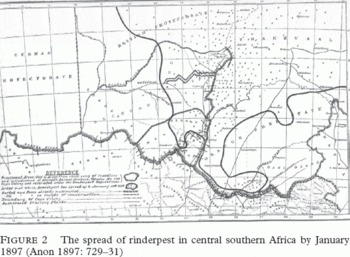
As far as the other coincidence is concerned, the rinderpest epidemic was closely tracked by the colonial administration. The path and timing of its entry into both the area immediately north of the Orange River and the Cape, as well as its impact on livestock in border districts from Hope Town through to Namaqualand, were documented in considerable detail (see Figure 2). This fact makes a comparison of the spread of rinderpest with the movements of the trekbokke possible.
From its first recorded occurrence in southern Africa on 5 March 1896 in Bulawayo, rinderpest spread rapidly. As early as that same month a cordon of Cape Mounted Police had been established along the northern and eastern border of the Colony to prevent the epizootic crossing from Rhodesia and the Bechuanaland Protectorate (Courier 26 March 1896). By May this cordon had been breached and hastily redeployed further south (Graaff Reinet Advertiser 15 June 1896). By June the Kalahari was described as ‘swept clean by rinderpest’ rendering it ‘hoofless’ (Graaff Reinet Advertiser 15 June 1896). Nothing but dead cattle were apparently to be seen along the Molopo River, with massive losses of both revenue and animals recorded: the Protectorate estimated a loss of £4,000,000 while the Bechuana under Khama were said to have lost 600,000 head of stock (Courier 25 June 1896). In the Transvaal any hope of stamping out the disease outside the cordon (see Figure 2) was surrendered by July when the veld was said to be ‘simply rotten with disease stricken game, koedoe, gemsbok, duiker &c. being in such a condition that policemen simply ride up and shoot them down with revolvers’ (Graaff Reinet Advertiser 6 July 1896). Further south similar fatalism prevailed. Contrary to Skinner's claim that rinderpest had broken out in Vryburg in May (Skinner Reference van Sittert1993: 302), it is only two months later in July that this is in fact the case (Courier 16 July 1896). By September it had reached Herbert on the northern bank of the Orange River, leading to the feeling that ‘the fearful pest …[was] most likely to find its way eventually to the coast’ (Courier 10 September 1896).
Attitudes towards rinderpest within the Colony itself varied, however. There was the inevitable panic-tinged response that regarded any unusual cattle death as evidence of the epidemic and imagined the disease to be advancing far more quickly than it was. This was counter-balanced by sceptics who believed the threat to be exaggerated. For example, an outbreak of rinderpest was prematurely reported for Kenhardt in September, having to be corrected the following week as a mistake (Courier 28 September 1896; 1 October 1896), and the same process occurred in Prieska the following July (De Britstowner 14 July 1897; 28 July 1897). Conversely some farmers of the Prieska district felt that, in the light of the rinderpest fence that prevented access to the Orange River, it was ‘better to have rinderpest than fence, as the latter will mean death to all river farm cattle and stock generally, as no other water is available owing to the drought’ (Courier 8 October 1896).
Rinderpest duly spread from Vryburg and Herbert to Kimberley by October 1896 (Skinner Reference Phoofolo1993: 302) and thereafter broke out in the Free State, being well established along its southern and eastern borders by January 1897 (see Figure 2). From here it crossed to the Colony in March that year (Courier 30 March 1897; see also Phoofolo Reference Phoofolo1993: 114). Although rinderpest penetrated the eastern districts, its route from the Kalahari into the northern districts of the Karoo continued to be obstructed: the double barbed wire fence along the Orange River from Hopetown to Prieska was guarded by 50 special police and their supervisors. From Prieska to the Kenhardt boundary another 160 ‘specials’ were present and from here to Zeekoestreek a further 230. Protection along the remaining 300 miles to the west coast was considered ‘exceedingly unsatisfactory’ and this section was thought to represent the greatest danger of infection to the northern districts (De Britstowner 5 May 1897). As an added precaution, and to create a buffer zone, Gordonia was declared an infected district prior to any documented rinderpest outbreak (De Britstowner 19 May 1897) and by May, despite appearing on the borders, the disease had yet to enter the district (Anon 1897: 729–31).
Partly in anticipation of a rinderpest outbreak expected to decimate domestic stock and render the carcasses unfit for human consumption, meat prices in Kenhardt had been on the increase since February (De Britstowner 10 February 1897) and in October rinderpest did finally reach the district (Victoria West Messenger 8 October 1897). The disease had advanced from Hopetown via Britstown in September, and then on to Victoria West (Victoria West Messenger 1 October 1897) and Prieska. As a result of limited inoculation the cattle population in Britstown was ‘devastated’ (De Britstowner 1 September 1897; 15 September 1897). The interior and extreme north-western districts were not affected, however, and by August 1898 the Civil Commissioner believed that rinderpest had ‘entirely disappeared’ from Kenhardt (Anon 1898a: 237–43). There was a risk of reintroduction from Gordonia where it still existed, but, despite fears that it would remain for ‘some time’ (Anon 1898a: 237–43), by October it had been eradicated from this district as well (Anon 1898c: 493–502).
Rinderpest, although relatively short-lived in the Colony, had a massive impact and, writing towards the end of 1897, a correspondent to the Victoria West Messenger summed up the devastating dual effects of drought and rinderpest as a pivotal moment in South African history:
Ja als er ooit iets belangryks was om opgestekend te worden in de geschiednis van Zuid Afrika, dan is het de gebeurtenissen van 1896 en 1897, de zware droogten, sterven van duizenden van groot en klein vee, door droogte en rinderpest. (Yes, if ever there was something important to emphasize in the history of South Africa, it is the events of 1896 and 1897, the severe drought, the deaths of thousands of large and small stock as a result of drought and rinderpest.) (Victoria West Messenger 22 October 1897)
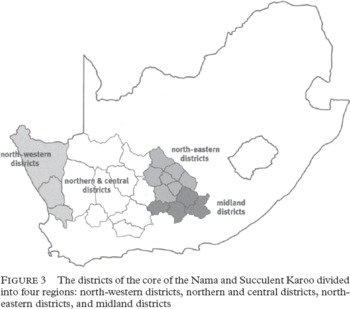
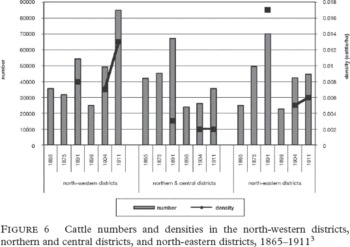
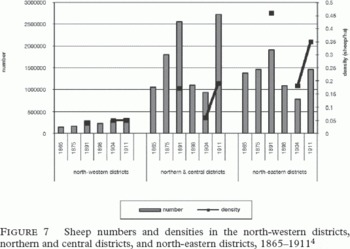
As will be seen in Figure 6 and Figure 7, the impact of rinderpest on settler cattle and sheep holdings is easily quantifiable. For the purposes of this argument, and because the colonial administrative districts regularly changed boundaries and size, the core of the Succulent and Nama Karoo can be divided into four regions (see Figure 3), allowing a spatial analysis of the impact of rinderpest and other factors. The four regions are roughly aligned to certain characteristics such as geographic location and dominant habitat and rainfall patterns. The north-western districts (Namaqualand, Van Rhynsdorp and Clanwilliam), for example, are comprised mainly of Succulent Karoo in a winter rainfall area, while the midland districts (Murraysburg, Graaff-Reinet, Middelburg, Cradock) are comprised of mountainous Nama Karoo and grassland in the highest rainfall region under discussion, with precipitation occurring mainly in summer. The northern and central districts (Kenhardt, Calvinia, Fraserburg, Carnarvon, Prieska, Victoria West) and the north-eastern districts (Hopetown, Britstown, Richmond, Hanover, De Aar, Philipstown, Colesberg) comprise the bulk of the Nama Karoo and can be separated on the basis of rainfall and vegetation. The north-eastern districts experience significantly higher and more reliable rainfall, and as a consequence feature more extensive grass cover.
The north-eastern districts were worst hit in terms of cattle numbers, suffering a decrease of almost 68 per cent between 1891 and 1898, with only minor recovery demonstrated by 1911. Similarly, the northern and central region lost over 64 per cent of cattle between 1891 and 1898 and numbers rose only slightly by 1911. An analysis of the effect of rinderpest on cattle density, rather than absolute numbers, is even more revealing: the number of cattle per hectare in the very large geographic area of the northern and central districts fell by only a third between 1891 and 1904, while in the comparatively much smaller north-eastern districts this figure was over 70 per cent, indicating just how hard hit this part of the Colony was by the disease. That these losses were driven by rinderpest and not drought is supported by the fact that the north-western districts, which suffered an even worse period of drought in the mid-1890s, show a loss of 53 per cent between 1891 and 1898 and a decline in density between 1891 and 1904 of only 12.5 per cent. Furthermore, this region reflected a significant increase by 1911. An analysis of sheep numbers shows a similar trend over 1891 to 1898, with the northern and central districts and those of the north-east suffering losses of 57.3 per cent and 43.1 per cent respectively, while over the same period the sheep population of the north-western districts declined by only 22.9 per cent. A comparison of densities once again offers more insight: it shows a decrease in the number of sheep per hectare in the northern/central districts and the north-eastern districts of almost 65 per cent and 59 per cent respectively between 1891 and 1904. Sheep proved more resilient to rinderpest than cattle and, particularly in these two regions, numbers grew significantly following recovery from both this disease and drought.
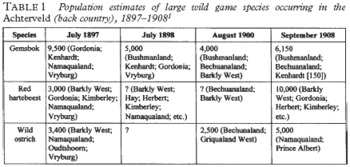
The impact of rinderpest on wild ungulates is not so easily quantified. The estimates of game numbers in the Colony provided by the Agricultural Department and published by the Western Districts Game Protection Association (WDGPA) (see Table 1) suggest a slight decrease in numbers of key species occurring in the northern districts of the Colony after July 1897. It is difficult, however, to draw any firm conclusions from the impressionistic estimates provided by Civil Commissioners, which do not, for the most part, differentiate between districts. Indeed, although it was reported that some game, such as common duiker Sylvicapra grimmia and grey rhebok Pelea capreolus near East London (De Britstowner 13 October 1897) and eland, kudu Tragelaphus strepsiceros, red hartebeest, klipspringer Oreotragus oreotragus, steenbok Raphicerus campestris and an ‘antelope’ at Rhodes's Groote Schuur Estate in Cape Town (De Britstowner 1 December 1897), had succumbed to rinderpest, it was admitted that ‘the amount of loss from this cause cannot be accurately ascertained’ (Graaff Reinet Advertiser 24 August 1898). Nonetheless the WDGPA warned that: ‘The effect of rinderpest on large game has been disastrous in several tracts of country …. From the best information available it would appear that kudu, eland and buffalo suffered most; but hartebeest, the other antelope, were affected only to a slight extent’ (Pringle Reference Pringle1982: 69). This latter suggestion would seem to be supported by the fact the Kalahari was reported to be ‘teeming with vast herds of gruisbok [gemsbok], hartebeest, wildebeest and wild ostriches’ in 1899 (Anon 1899: 477–80) and that red hartebeest occurred in sufficient numbers to trek out of the Kalahari to Upington towards the end of 1903. Even a single blue wildebeest appeared at the same time (Victoria West Messenger 16 October 1903; 4 December 1903).
Modern knowledge of the disease would indeed suggest that while bovids, such as buffalo Syncerus caffer, tragelaphids, such as kudu, and suids, such as warthog Phacochoerus africanus, were heavily impacted by rinderpest (Henning Reference Henning1956: 840–1; Bengis et al. 2003: 360), other species may not have suffered declines on the same dramatic scale.
The omission of springbok from any description in the colonial press of the devastation of rinderpest on wild game suggests they were not obviously devastated by the disease. In addition the persistence of gemsbok in Kenhardt and the fact that the ostrich Struthio camelus population, a species not known to be susceptible to rinderpest, showed similar trends to those of gemsbok and red hartebeest would seem to indicate that the rinderpest did not completely obliterate wild game populations in the northern districts and that some other factor, such as the protracted drought or illegal hunting during this period, is likely to have been the primary driver of these fluctuations.
In addition, farmers' inherent fear of the transmission of disease from wild animals to livestock should also be borne in mind. This fear is clearly evident in the northern districts of the Colony in the case of another disease, scab, which was endemic in sheep and goats as well as springbok. Springbok suffering from scab were blamed for the spread of the disease (Victoria West Messenger, 26 October 1894) and the restrictions placed on the movement of stock (but not on springbok) under the Scab Act attacked (De Britstowner, 29 November 1895). A springbok skin infected with scab was eventually sent to Hutcheon, the Colonial Veterinary Surgeon for confirmation. He found that a different species of sarcoptes mite was involved, however, and that, although it might possibly affect non-fleeced animals such as the boer goat, its transmission to sheep was very unlikely (De Graaff Reinetter, 16 August 1894; Anon 1895: 113–18).
The obsession with disease transmission between wild and domesticated ungulates suggests that any hint of rinderpest in the springbok herds would have sparked vigorous calls for their complete extermination; at the very least, if the plague had affected springbok numbers, this would have been noted. No mention whatsoever of rinderpest affecting springbok appears in the contemporary press, however.
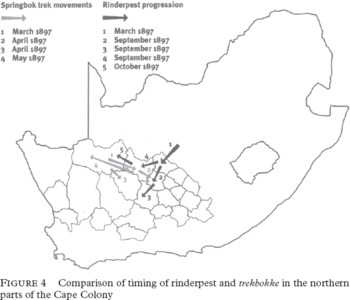
Rinderpest, then, did penetrate the districts of the northern and north-eastern Karoo and inevitably had a dramatic impact on stock numbers. However, as can be seen in Figure 4 and in the discussion that follows, the progression of the plague followed in the wake of the springbok dispersal, and rinderpest and springbok treks did not at any point coincide.
Over the course of 1896 the overwhelming bulk of the trekbokke had concentrated in the Britstown district. The springbok had moved into this area from the Kenhardt, Prieska and Victoria West districts in January of that year and, aside from some movements back and forth between Britstown and the neighbouring areas of Prieska and Victoria West, stayed concentrated there until November and December, when they dispersed westwards. January 1897 saw good concentrations in Kenhardt, but March saw the beginnings of a movement east in Prieska and then east and south east from there in April into both Britstown and the vicinity of Van Wyk's Vley in the northern parts of the Carnarvon district (Roche Reference Roche2004: 136–48). By March rinderpest had been recorded in the nearby district of Hopetown, but the disease was contained there for some months and did not spread further west. The trekbokke, meanwhile, did not penetrate as far as Hopetown during 1897. Indeed, by May 1897 the springbok had moved west into the Kenhardt district and from there seem to have dispersed both north and south, with no further records of concentrations anywhere in the Karoo that year.
By contrast, it was only in September that year that rinderpest moved into the districts of Britstown, Prieska and Victoria West (Courier 30 March 1897; Phoofolo Reference Phoofolo1993: 114), four months after the springbok had dispersed from the former two districts and a full ten months after they had left Victoria West. The movement of the disease westwards was also several months behind that of the springbok, arriving as it did in Kenhardt in October (Victoria West Messenger 1 October 1897; 8 October 1897), at least four months after the apparent dispersal of springbok. In addition, the disease did not penetrate as far west as Namaqualand or as far south as Fraserburg and Sutherland (Anon 1898b: 301–10).
It can safely be said, then, that rinderpest was not the primary cause of the cessation of springbok treks, and that, although the possibility of a limited role cannot be completely discounted, there is no contemporary evidence to suggest this. Other potential causes of the demise of the springbok treks therefore need to be examined.
‘THEY DROVE THE SPRINGBOKS AWAY’–THE INCREASE IN LIVESTOCK AND HUMAN POPULATIONS, 1865–1911
In 1867, in reply to a question as to whether illegal hunting had been the cause of the demise of the great game herds of the Colony, the Auditor General replied that this was not altogether the case and that: ‘When I first came out to the Colony in 1830, there were very few flocks of sheep in the district I lived in; as the sheep increased they drove the springboks away. The quantity of game has diminished quite as much by the increase of sheep as by other causes’ (Cape of Good Hope 1867: 11).
This increase in livestock numbers in the Colony as a whole and in the Karoo has been noted by a number of scholars (Christopher Reference A. J.1976: 55–86; Dean and MacDonald Reference Dean and MacDonald1994: 281–98; Beinart Reference Beinart2003: 1–27), mostly with regard to its contribution to the Cape economy and impact on grazing conditions and carrying capacities. The latter theme in particular was already well developed by the end of the nineteenth century. The Zwarte Ruggens Farmers' Association, for example, decried the replacement of the natural rotation system of herds of wild game with overstocking, overgrazing, erosion, increased stock mortality and lowered output. Their fear was that if this system continued the Karoo would become ‘a region of emptiness, howling and drear – Which man has abandoned from famine and fear’ (Graaff Reinet Advertiser 2 February 1900). MacKenzie is another who has noted the increase in livestock numbers and concomitant decrease in game numbers in the Cape Colony (MacKenzie Reference MacKenzie1988: 92).
Contrary to contemporary opinion, however, springbok and sheep do not under normal circumstances compete for the same food resources in the Karoo (Davies and Skinner Reference R. A. G. and Skinner1986a: 115–32; Davies and Skinner Reference R. A. G. and Skinner1986b: 133–47; Davies, Botha and Skinner Reference R. A. G. and Skinner1986: 165–76). It was not direct competition between the two species, therefore, that pushed the indigenous springbok back. Rather, disturbance and an increasingly impoverished ecosystem, resulting from overstocking and overgrazing, had this effect. Perhaps even more important was the settler farmer perception of direct competition, and reaction to it through hunting and driving springbok away, along with the steady settlement of previously unoccupied land. The human advance moved in tandem with an increase in sheep and other livestock numbers and it is useful, despite some doubt in official statistics (Nell Reference Nell1998), to track the increase in numbers and densities of all these species over the period 1865 to 1911.
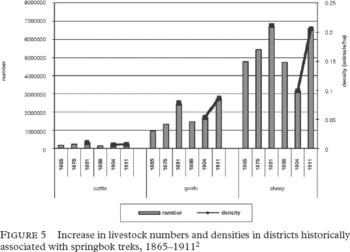
Figure 5 clearly shows an increase in livestock (cattle, sheep and goats) numbers and densities in those parts of the Karoo historically associated with springbok treks over the course of the final few decades of the nineteenth century. Prior to the 1898 census a steady increase in livestock is apparent across the rural districts of the Cape Colony. The census in 1898, however, revealed a dramatic and obvious decline that can be attributed primarily to rinderpest. This general increase, followed by the rinderpest effect, is even more marked when broken down into the regions previously considered in discussing the impact of rinderpest. The north-western districts, the northern and central districts, and the north-eastern districts all showed an increase in cattle numbers up until 1891, with this growth persisting only in the north-western districts thereafter. Sheep numbers also showed consistent growth across the board between 1865 and 1891, and post-rinderpest growth continued to a limited degree in both the north-western and northern and central districts. It is possible that the better-watered north-eastern districts, having been the target of the earlier thrust of commercial pastoral expansion, had already reached and even exceeded their carrying capacity by 1891.
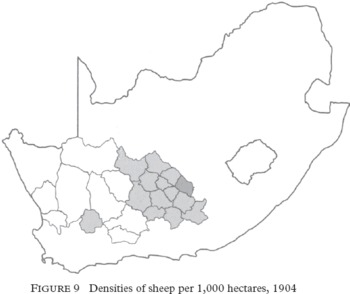
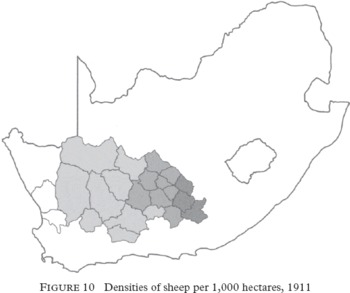
It is clear that, aside from the mortalities caused by rinderpest, there was a general increase in both cattle and sheep numbers in all the regions prior to the springbok trek of 1895–6. The general upward trend in sheep numbers is most marked, with sustained growth occurring in the north-western and northern and central districts, notwithstanding the impact of the rinderpest, drought and indiscriminate stock theft during the Anglo-Boer War (Constantine Reference Constantine1996: 20–44; 133–49; 165–75). These regions were essential to the phenomenon of springbok treks, providing, as they did, the space for population growth during favourable climatic conditions. The increase in livestock numbers here cannot have boded well for the antelope and its natural population fluctuations. Equally importantly, stock densities remained highest in the north-eastern districts and continued to prevent the overflow of trekbokke from the northern and central districts into this area. Although, as can be seen from figures 8–10, sheep densities fell slightly across the board between 1891 and 1904, the trend for greater densities to persist in the eastern districts, and effectively exclude trekbokke, continued.
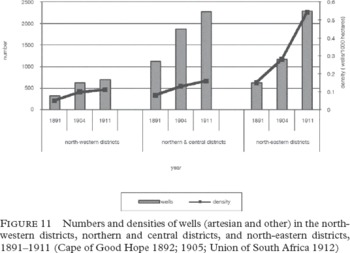
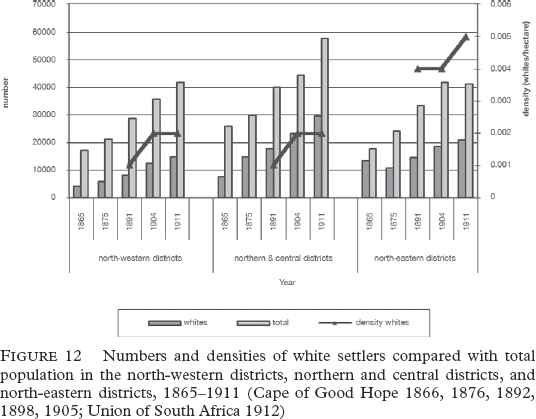
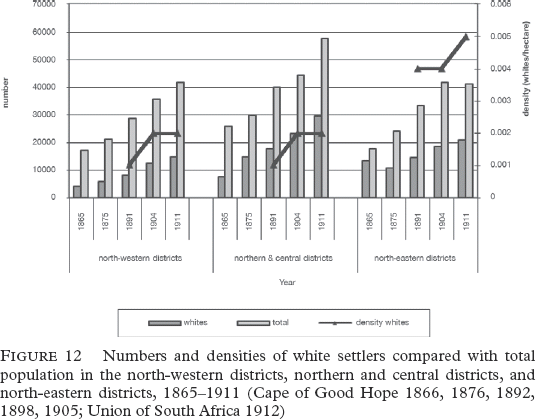
The colonization of the Achterveld by both humans and livestock was of course facilitated by the provision of water; an analysis of the increase in boreholes and wells thus provides an insight into this process. Figure 11 reflects the significant increase in artificial sources of permanent water over the period 1891 to 1911. This development was instrumental in enabling extensive and permanent pastoralism in the previously seasonally utilized northern Cape Colony. Perhaps more important than the increase in livestock numbers however, was the associated growth in the human population, and more specifically that of white settlers (see Figure 12).
Settlers brought with them their own need for protein. Wild game, such as springbok, provided an important part of this, with domestic stock such as woolled sheep being preserved for the value of their wool on the market rather than consumed for sustenance. Even more importantly springbok, especially the trekbokke, did massive damage with their myriad hooves to the pasture and gardens maintained by farmers. Even when the veld was not trampled to dust by the passage of large herds of springbok, it was said that sheep would not graze where the antelope had cropped the grass (Courier 12 August 1880). This damage, both real and imagined, encouraged the indiscriminate slaughter of springbok. Stockenstrom, in 1824, had identified the arid areas of the northern and central districts, and the absence of a permanent settler presence, as the key to the springbok treks (Hutton Reference Hutton1887: 37–9). With this refuge increasingly penetrated and ultimately lost to settlement and livestock, the Karoo springbok treks were seriously imperilled.
‘SECURING HIS ACRES’: THE EFFECTS OF FENCING
Another innovation brought by settlers to the springbok range was fencing. This development was integral to both control and ownership of the landscape (van Sittert Reference van Sittert2002) and in one case the process of fencing or enclosure was described as a farmer ‘securing his acres’ (Victoria West Messenger 4 October 1880). As early as 1880 the Victoria West Messenger argued for wide-scale fencing of farms to protect both stock and grazing against the invasion of springbok herds (Victoria West Messenger 4 October 1880) and it is clear that as wire fencing spread it proved effective against invasion by trekbokke. Springbok did occasionally damage and tear down small stretches of fence (De Britstowner 10 April 1896; Cronwright-Schreiner 1899: 45; Green Reference Green1955: 39) but the confidence with which the Colesberg Advertiser could refute claims of a trek in the area in 1893 by citing the fact that the whole country was ‘traversed by a network of wire fences’ (Colesberg Advertiser 21 July 1893) suggests that this generally proved an efficient method of exclusion. The fact that in 1893 only about 17 per cent of the Colesberg district was enclosed indicates the extent to which even limited enclosure effectively curtailed springbok movements.
Similarly, in Graaff-Reinet the initial decline in springbok numbers in the 1850s was blamed on fencing and the end of the age of the trekbokke locally was widely ascribed to enclosure. Ironically, however, this fencing process was driven by the economic boom in ostrich feathers, which also allowed the recovery of the local springbok population because landowners ‘jealously protected’ their encamped populations of trekbokke in order to allow hunts with family, friends and neighbours (Roche Reference Gilfoyle2003: 86–108). This transformation in the nature of springbok populations from nomadic to sedentary was an irrevocable one that was to follow in the wake of fencing's advance across the Colony.
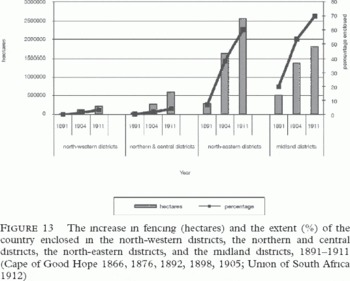
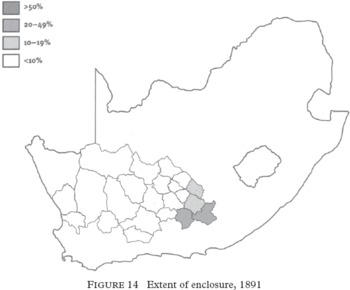
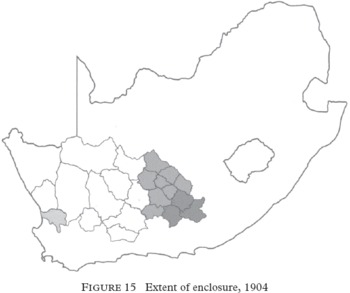
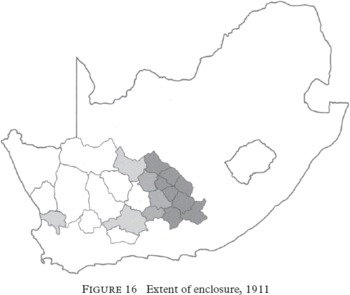
Fencing was initially most concentrated in the midland divisions of the Cape Colony (van Sittert Reference van Sittert2002), where long-established and settled districts such as Graaff-Reinet (78 per cent), Cradock (79 per cent) and Colesberg (90 per cent) were almost completely enclosed by 1911. Districts such as Middelburg (75 per cent), Philipstown (72 per cent) and Hope Town (82 per cent) were not far behind, and in some cases even overtook their predecessors. The more remote and less densely populated districts such as Namaqualand and Kenhardt were much slower to follow: both were still less than 1 per cent enclosed by 1911. The proclamation of the Fencing Act (No. 30 1883) spread the practice steadily across the Karoo and, as can be seen in figures 13–16, fencing flourished first in the older, more densely settled eastern districts, only spreading very gradually into the lower-rainfall districts of the interior where population densities were lower, farms larger and farming methods more extensive.
While the eastern districts were increasingly covered with a ‘network of wire fences’ that, despite not enclosing all available land, effectively prevented the invasion of trekbokke into these better-watered areas, the Achterveld remained relatively unenclosed. Between 1904 and 1911, however, key districts such as Calvinia, Fraserburg and Carnarvon increased the area fenced by 54 per cent, 61 per cent and 68 per cent respectively. Ultimately, between 1891 and 1911, ‘the fertile brain and inventive power of man’ invoked by the Victoria West Messenger in 1880 (Victoria West Messenger 4 October 1880) had triumphed and the ‘gigantic scheme’ of fencing the perimeter of every farm began to gain momentum.
Skinner's original contention (1993) that fencing began only twenty years after treks had already ceased is patently incorrect. Instead the opportunistic movement of springbok in response to rain, integral to both population fluctuations and treks, was significantly curtailed. The trek overflow areas of the better-watered eastern Karoo districts were the first to be enclosed by a moving wire fencing front advancing gradually westward. The increasing fencing out of springbok from the districts of Hopetown, Philipstown, De Aar, Hanover and Colesberg by the mid-1890s resulted in the build-up and concentration of trekbok numbers in the unenclosed triangle between the towns of Britstown, Vosburg and Victoria West in 1896. Exacerbating this cul-de-sac was the effect of drought in the districts to the north, south and west, suggesting that the natural mortality of the 1896 trek was considerably higher than in earlier, more dispersed, mass movements.
‘DE KLACHT VAN DEN DAG IS DER VERSCHRIKKELYKE DROOGTE’ – THE TWIN EFFECTS OF DROUGHT AND HUNTING, 1895–1908
Perhaps the most important impact on the 1896/7 trek was hunting. The unnatural concentration of springbok in the Britstown-Vosburg-Victoria West triangle allowed for a more focused and sustained exploitation, and ultimately decimation, of the trekbokke. Whereas earlier ‘mega-treks’ such as those of 1861–2, 1872–3, 1877–8 and 1880 had followed the same pattern and build-up as that of 1896–7, their movements were far less restricted. The result of this was that concentrations were not as marked or as prolonged, and the human-induced impact on mortality therefore significantly less, permitting the natural ‘boom and bust’ springbok population cycle to continue in subsequent years (Roche Reference Phoofolo2004: 72–109).
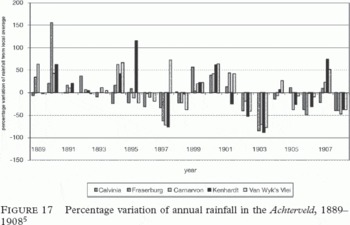
The effects of both prolonged hunting and drought on the 1896/7 trek (Roche Reference Phoofolo2004: 110–54) produced an unprecedented mortality of trekbokke. The continuing drought of 1897 and 1898 only exacerbated the initial impact and ensured that there was no immediate recovery in the population. Rather, instead of an expected wet cycle, the wet years of 1899–1901 gave way to a decade that, with the exception of 1907, was significantly drier than even the mid-1890s (see Figure 17). With the exception of a few districts in 1904 and 1907, for example, rainfall received across the Karoo during this period was dramatically below average and in harsh contrast to the above average years 1889 to 1895 and 1899 to 1901.
In Upington during 1903 ‘de klacht van den dag [was] der verschrikkelyke droogte’ (Victoria West Messenger 16 October 1903) (‘the complaint of the day was the terrible drought’) and the same was true of most of the districts south of the Orange River. Complaints of drought in districts such as Kenhardt and Prieska filled the local press (see, for example: Victoria West Messenger 24 February 1905; Cape Archives Depot 1902–3) and in Beaufort West the proverbial ‘oldest farmers in the district’ held that it was ‘by far the severest drought that has been known here’ (Courier 26 March 1903). By July 1903 Kenhardt was described as devoid of people or stock, the inhabitants having trekked north of the Orange River in search of pasture (Courier 23 July 1903). By year's end it was accepted that the districts worst affected were Fraserburg, Carnarvon, Victoria West and Beaufort West (Courier 19 November 1903). Public prayers for rain were held in Beaufort West in early 1904 (Courier 7 January 1904) and although the drought conditions in the interior lifted somewhat during 1904 and 1905 (see Figure 17), as a result of exhausted local grazing the trekboere (migrating farmers) of the Fraserburg district were said to ‘rond maal soo’s spring-bokke, en weet ni waarheen ni' (Victoria West Messenger 24 February 1905) (‘mill around like springbok and not know what direction to go in’). Even in the regions of much higher rainfall such as Graaff-Reinet, the drought took its toll, and as a result even the local springbok, which were known as a species to be more drought-resistant that domestic stock, were ‘so ma’er [thin] that they die easily from fright' (Victoria West Messenger 20 May 1905) and hundreds reportedly perished during the drought (Graaff Reinet Advertiser 28 June 1905). By 1908 the persistent drought led to widespread speculation that ‘South Africa [was] becoming parched up’ due to the ‘decreasing African rainfall’ (Victoria West Messenger 6 February 1908; 13 August 1908).
This extended drought precluded a recovery in springbok numbers, a fact borne out by the complete lack of reported treks during this period. Hunting continued, of course. This was not on the scale of 1896, but in the Achterveld surviving springbok were still regarded as vermin and a threat to what was essentially a marginal agrarian economy under massive pressure from drought (Victoria West Messenger 5 July 1906).
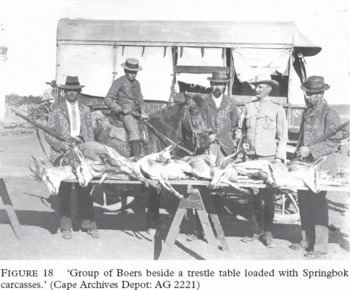
In addition to hunting organized either for sport or for vermin extermination, springbok were also important as a source of protein during both the 1899–1902 Anglo-Boer War (see Figure 18). Aside from farmers embattled by the drought and forced to rely on wild sources of protein such as springbok, Boer guerrillas operated throughout the districts discussed here and themselves relied to a large extent on what the veld could provide in the way of sustenance (Constantine Reference Constantine1996: 20–44; 133–49; 165–75).
In Victoria West during 1903, to the great relief of the population, the Game Law Amendment Act (No. 36 of 1886) was suspended, ‘not so much to serve sportsmen, but to enable the poorer class to eke out their meagre food supply with game’ (Victoria West Messenger 18 December 1903). The similar importance of springbok to households in the Kenhardt district was noted the following year by a correspondent of the Victoria West Messenger (18 November 1904), and even ostrich, during the open season, were hunted for biltong and to protect the pasture (Victoria West Messenger 27 September 1906). Kimberley, although beyond the range of the trekbokke and a substantially larger town than those within the Achterveld, serves as a vivid example of the importance of ‘game’ to sustenance during this time. Accounts of life on the diamond fields record how an industry developed to meet the demand of the diggings for meat, ‘many men [spending] their morning in the veld, shooting whatever they came across, and trekking towards the diggings in the afternoon to sell what they shot on the early morning market’ (McNish Reference McNish1968: 261–2) and there is no doubt that this parallel ‘extractive industry’ was both burgeoning and profitable. In the 1904 hunting season, for example, 12,975 ‘head of game’, realizing £2,752, were sold on the Kimberley market. In 1905 this figure was 29,119 at £4,667, and in 1906, 40,933 at £4,829. Springbok were not the only target of market hunting, however, and in 1906 the composition of the trade was: Springbok 4,025; Duiker 174; Steenbok 1,415; Hares 5,131; Korhaan 3,565; Redwing Francolin 2,957; Guineafowl 818; Bustards 59; Wild Duck 130; Geese 33; small birds 22,626 (Horsbrugh Reference Horsbrugh1912: 26).
In short, the twin effects of drought and hunting first ensured abnormal mortality during the 1895–6 trek and then, together with a range steadily shrunken by fencing and expanding permanent settlement and agriculture, effectively prevented any recovery in the population over the ensuing decade, thus accounting for the mass mortality that precipitated the disappearance of springbok treks and which previously has been ascribed to rinderpest.
CONCLUSIONS
That springbok treks in the Karoo ended with the 1896–7 trek is obvious and indisputable. A modern ecological understanding of the cyclical and nomadic pattern of these treks helps to make it equally clear that the replacement of this phenomenon with sedentary small stock farming has had a dramatic impact on the ecological state of the Karoo. Previously the abrupt end of the springbok treks has been attributed directly to the rinderpest epidemic that swept through southern Africa at roughly the same time. It is apparent, however, that the closeness in time of the two events is purely coincidental and that rinderpest had little or no influence on the Karoo springbok population and the trekbok phenomenon. This is clear for a number of reasons. First, the two events did not coincide exactly, with at least four months between the dispersal of the trekbokke and the arrival of rinderpest in any of the Karoo districts affected in 1897. Second, the spatial overlap of the trekbok movements in 1897 and the path of infection taken by rinderpest is not convincing. Third, given that colonial farmers were obsessive about disease in their stock and the role wild game played as a reservoir and transmitter of such disease, the fact that there is no contemporary report of rinderpest in springbok (in most cases the only large wild mammal surviving in any appreciable number) is persuasive evidence that springbok did not in fact suffer dramatic impact from the disease, if indeed it affected the population at all.
It is important, however, to discern the causes of the obvious demise of the trekbok phenomenon in such an abrupt and absolute fashion. First, it is clear that the advent of widespread settlement of the Karoo during the last quarter of the nineteenth century exerted considerable pressure on natural resources, including local extinctions of large mammal species and subspecies. Increasing enclosure through wire fencing, the establishment of villages, towns and permanent farm settlements, and the growing human and livestock population densities began the process of circumscribing springbok treks. Increased competition for space, the introduction of a new super predator in the form of colonial man and his firearms, the need for protein in a growing human population and the perception amongst farmers that springbok and livestock competed for forage drove a decline in the overall springbok population.
Crowding out of the springbok was gradual at first, but increasingly access of the trekbokke from the Achterveld to the higher-rainfall districts of the eastern Karoo was restricted. Initially this resulted in ever more concentrated treks as springbok were forced to gather in bottlenecks of good unenclosed grazing surrounded by established farmland and towns. The process had been noted by Scully in explaining the destructive impact of the 1892 trek in Namaqualand: ‘as the area over which the bucks range becomes more and more circumscribed, the trek, although the numbers of bucks is rapidly diminishing, becomes more and more destructive owing to its greater concentration’ (Scully Reference Scully1898: 104–5). The highly concentrated nature of the springbok treks combined with dramatically increased resident human populations and the infrastructure in the form of rail links meant that springbok mortality was enormous, with large numbers being commercially harvested and others shot for sport. This increasing mortality culminated in 1896 when the trekbokke spent the bulk of the year focused on the area around Vosburg – a cul-de-sac caused by colonial expansion (a significant aspect of which was fencing) and drought, and which resulted in an unusually concentrated, sustained and severe impact on pasture. Abnormal mortalities followed, and, combined with the devastating impacts of equally unprecedented hunting, effectively reduced the trekbokke to numbers below a population threshold from which early recovery was possible.
There is no doubt, therefore, that the unprecedented number of springbok killed during this time, enabled by the factors described above, dealt a mortal blow to the overall springbok population of the Karoo and thus the ability of this population to recover.
While hunting might have been the proximate cause of the demise of the springbok treks, recovery of the overall springbok population and the re-establishment of the trek phenomenon in the decade after 1897 was prevented by ever-increasing enclosure, a severe and prolonged drought and continued hunting of the surviving springbok. Hence, not only was the overall springbok population decimated but the conditions essential for the maintenance of treks were destroyed, thus ensuring the extinction of a unique phenomenon.
Skinner and Louw's conclusion that rinderpest was the main cause of the demise of the springbok treks is thus clearly wrong, the disease playing little or no role in the 1896–7 trek or in springbok mortality in the years thereafter. In much the same way as an amalgam of environmental and anthropogenic factors are considered to have caused the destruction of the bison (Isenberg Reference Isenberg2000: 123–63), the end of springbok treks in the Karoo can instead be attributed to a complex combination of factors including the increase in livestock and human populations, the spread of fencing and increasing enclosure, drought and hunting. The combined effect of all these factors ensured that the conditions necessary to sustain cyclical springbok treks in the Karoo were completely eroded and the advent of the Game Law Amendment Act No. 11 in August 1908, for all its good intentions to include the trekbokke as ‘game’, was a clear case of closing the stable door after the horse had bolted.
The impact of the disappearance of springbok treks and replacement thereof with livestock and human settlement must be seen from two perspectives. In the first case the trekbokke ceased to exist because the ecosystem and conditions needed to sustain such enormous population growth and movement ceased to exist. In the second case the removal from the ecosystem of such an important component must have had far-reaching consequences which at this stage are unfathomable. Both perspectives hint at the massive anthropogenic impact on the Karoo. The replacement of a system of irruption and nomadism adapted to Karoo fluctuations with a static and artificially manipulated one that sought to overcome Karoo ecological cycles, rather than to respond to them, has resulted in the continuing degradation of Karoo pasture.
Extent of the Succulent Karoo and Nama Karoo in the administrative districts of the Cape Colony

The spread of rinderpest in central southern Africa by January 1897 (Anon 1897: 729–31)

The districts of the core of the Nama and Succulent Karoo divided into four regions: north-western districts, northern and central districts, north-eastern districts, and midland districts

Comparison of timing of rinderpest and trekbokke in the northern parts of the Cape Colony

Increase in livestock numbers and densities in districts historically associated with springbok treks, 1865–19112

Cattle numbers and densities in the north-western districts, northern and central districts, and north-eastern districts, 1865–19113

Sheep numbers and densities in the north-western districts, northern and central districts, and north-eastern districts, 1865–19114

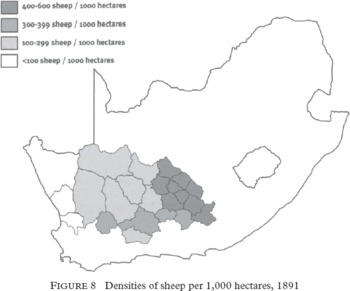
Densities of sheep per 1,000 hectares, 1891

Densities of sheep per 1,000 hectares, 1904

Densities of sheep per 1,000 hectares, 1911

Numbers and densities of wells (artesian and other) in the north-western districts, northern and central districts, and north-eastern districts, 1891–1911 (Cape of Good Hope 1892; 1905; Union of South Africa 1912)

Numbers and densities of white settlers compared with total population in the north-western districts, northern and central districts, and north-eastern districts, 1865–1911 (Cape of Good Hope 1866, 1876, 1892, 1898, 1905; Union of South Africa 1912)
The increase in fencing (hectares) and the extent (%) of the country enclosed in the north-western districts, the northern and central districts, the north-eastern districts, and the midland districts, 1891–1911 (Cape of Good Hope 1866, 1876, 1892, 1898, 1905; Union of South Africa 1912)

Extent of enclosure, 1891.

Extent of enclosure, 1904

Extent of enclosure, 1911

Percentage variation of annual rainfall in the Achterveld, 1889–19085

‘Group of Boers beside a trestle table loaded with Springbok carcasses.’ (Cape Archives Depot: AG 2221)