The genus Cephalorhynchus includes four species widely distributed in the temperate coastal waters of the southern hemisphere (Harmer, Reference Harmer1922). Commerson's dolphin, Cephalorhynchus commersonii (Lacépède, 1804) has been reported in coastal waters around the Kerguelen Islands (Indian Ocean) (Robineau & de Buffrénil, Reference Robineau and de Buffrénil1984), Islas Malvinas (Falkland Islands), the coastal waters of southern South America between Rio Negro, Argentina, and Cabo de Hornos; and in the Drake Passage as far south as the South Shetland Islands (Goodall, Reference Goodall1978; Goodall & Cameron, Reference Goodall and Cameron1980; Goodall et al., Reference Goodall, Galeazzi, Leatherwood, Miller, Cameron, Kastelein and Sobral1988; Rice, Reference Rice1998). The distribution of reported vagrants is limited to the coast of South America (Brownell & Praderi, Reference Brownell and Praderi1985; Capella & Gibbons, Reference Capella and Gibbons1991; Pinedo et al., Reference Pinedo, Barreto, Lammardo, Andrade and Geracitano2002). There is a record of a sighting of a Commerson's dolphin at a location further north to the one introduced here (and absolutely out of the species range of distribution), in South African waters, 35°54′S 20°32′E (de Bruyn et al., Reference de Bruyn, Hofmeyr and De Villiers2006) about 130 km south-east of the southern tip of Africa. This record is questionable as no specimens or other sightings from South Africa have been registered, as Best (Reference Best2007) reported the Kerguelen population provided the only records of the species in the South African subregion. Although the sighting was closer to the Kerguelen population, it is more likely that this individual travelled with, rather than against, the prevailing current system (the West Wind Drift), as suggested by evidence, which suggests the Kerguelen population originated through radiation from the South Atlantic individuals (Pichler et al., Reference Pichler, Robineau, Goodall, Meyer, Olavarría and Baker2001).
Most stranded specimens of this species have net marks on their bodies suggesting that entanglement in fishing nets is the main cause of death (Iñíguez et al., Reference Iñíguez, Hevia, Gasparrou, Tomsin and Secchi2003).
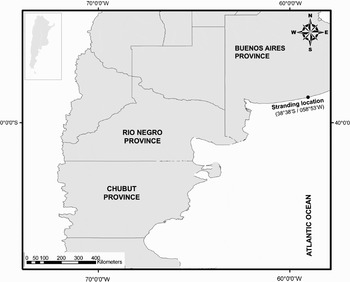
On 11 May 2006, a female specimen of Commerson's dolphin, Cephalorhynchus commersonii, was found stranded and dead 15 km north of the city of Necochea (38°38′S 058°53′W), Buenos Aires Province, Argentina (Figure 1).
Stranding location.

It was determined that it presented Stage 2 of decomposition, indicating recent death, following Geraci & Lounsbury's (Reference Geraci and Lounsbury2005) classification. Morphometric measurements were taken following Norris, Reference Norris1961 (Table 1), as well as the corresponding photographs. The animal was recorded in the Fundación Cethus stranding network database as FCNECC130506. However, this individual is held in the Museo Municipal de Ciencias Naturales ‘Dr José Squadrone’ of Necochea (collection number pending).
Samples of fat tissue, skin, muscle, lung, liver, reproductive system and teeth were collected for later analysis. Bacteriological, virological or toxicological analysis was not carried out nor was any brain taken.
The total length of the specimen was 113 cm and weighed 17.250 kg. The total length and characteristic colour pattern (white, black and grey), the presence of three clear light grey foetal folds, as well as immature aspect of the ovary suggested it was a juvenile of one year old or less. Lockyer et al. (Reference Lockyer, Smellie, Goodall and Cameron1981, Reference Lockyer, Goodall and Galeazzi1988) found that animals one year old were 103–117 cm long and Goodall et al. (Reference Goodall, Galeazzi, Leatherwood, Miller, Cameron, Kastelein and Sobral1988) recorded that the largest C. commersonii off Tierra del Fuego, Argentina, in which light grey still replaced white on dorsal and lateral surfaces, were all less than 117 cm long and one year old or less.
No net marks were found on the carcass. Behind the blowhole and on the dorsal surface of the body, it had a mild depression. The absence of net marks on its body in addition to the depression found on the dorsal region behind the blowhole, are suggestive of death due to starvation, possibly as a consequence of disease or parasite infestation. On the lung surface, rib impressions were observed and within the lungs, nine hard nodules were found in the left lobe and 15 in the right lobe (the largest measuring 15×5 mm).
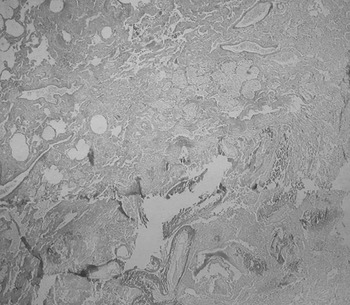
Macroscopically the lung nodules presented well delimited yellow-whitish areas, firm and extruding from the surrounding parenchyma. Sections of formalin-fixed, paraffin embedded lung samples were stained with haematoxylin and eosin. Histologically lung tissues showed areas of granulomatous reaction with an elongated and slightly curved giant cell almost in the centre of the lesion adjacent to suspected fragments of a parasite (Figure 2). It was not possible to determine if this pathology was directly associated with the cause of death. Parasites within the lungs do not necessarily cause death in dolphins, but the debilitating effects of disease and parasites have been linked to stranding and death in a number of dolphin species (e.g. Gibson et al., Reference Gibson, Harris, Bray, Jepson, Kuiken, Baker and Simpson1998; Birkun, Reference Birkun and Notarbartolo di Sciara2002).
Commerson's dolphin. Lung section. Granulomatous reaction with an elongated and slightly curved giant cell almost in the centre of the lesion and suspected fragments of the parasite present. Haematoxylin and eosin 200×.

Total DNA was extracted from frozen skin tissue using a QIAamp® DNA Mini Kit (Qiagen, Valencia, California). The 5′ half of the control region (~600 bp) was PCR amplified in a 25 µl reaction mix following standard protocols, using primers dlp1.5 and dlp5′ (Baker et al., Reference Baker, Cipriano and Palumbi1996). The PCR products were cycle-sequenced using BigDye® Terminator v. 3.1 (Applied Biosystems, Foster City, CA), resulting in approximately 515 bp of sequence. All cycle-sequencing reactions were run using 94°C/30 seconds initial denaturation, followed by 25 cycles of 94°C/20 seconds, 58°C/20 seconds, 60°C/4 minutes, then isopropanol-precipitated, resuspended in deionized formamide and run on an ABI Prism® 3100 Genetic Analyzer (Applied Biosystems, Foster City, CA). The specimen was also determined to be a female using a genetic protocol for amplification of the SRY region (Baker et al., Reference Baker, Cipriano and Palumbi1996); SRY products were size-separated on an agarose mini-gel and ethidium bromide-stained for visualization under ultraviolet light for the presence or absence of the male-specific SRY product. The control region sequence generated from the specimen was compared with sequences collected from samples originating from Ría Gallegos to the Strait of Magellan in an ongoing study (Cipriano et al., Reference Cipriano, Iñíguez and Hevia2007). The sequence of the Necochea stranding matched the most common haplotype found in Ría Gallegos, which is also the second most common haplotype found in Ría Deseado and off San Julián (all of them in the Santa Cruz Province, southern Argentina) and which has also been found in samples collected in the Strait of Magellan. Given the widespread nature of this haplotype, the individual could have been a vagrant from any of the populations studied south of the stranding location.
The Necochea specimen stranded approximately 470 km north of the usual distribution range for this species (41°31′S) (Goodall et al., Reference Goodall, Galeazzi, Leatherwood, Miller, Cameron, Kastelein and Sobral1988). Previously a skull belonging to this species was from the Quilmes area (34°48′S) in Buenos Aires Province (Brownell & Praderi, Reference Brownell and Praderi1985). Later a decomposed specimen was found at Los Patos lagoon's mouth (32°01′S 51°57′W), Brazil (Pinedo et al., Reference Pinedo, Barreto, Lammardo, Andrade and Geracitano2002). These three specimens are the northermost records for the species in South America.
ACKNOWLEDGMENTS
We wish to thank the Museo Municipal de Ciencias Naturales ‘Dr José Squadrone’, Necochea, Pcia, Buenos Aires, Argentina; the Whale and Dolphin Conservation Society (WDCS) for providing financial support for this study; Cecilia Gasparrou, Pablo Moy, Vanesa Tossenberger and Omar Palazzo for suggestions; and two anonymous referees who provided helpful reviews of the manuscript.