INTRODUCTION
Anemonefish (family Pomacentridae) have an obligate symbiotic relationship with sea anemones. Globally, anemonefish inhabit ten different species of anemones, however each species of anemonefish only associates with certain anemone species (Fautin & Allen, Reference Fautin and Allen1997). Amphiprion tricinctus (Schultz & Welander, Reference Schultz, Herald, Lachner, Welander and Woods1953 in Schultz et al., Reference Schultz, Herald, Lachner, Welander and Woods1953) is a species of anemonefish endemic to the Marshall Islands and reportedly inhabits four species of sea anemones: Entacmaea quadricolor; Heteractis aurora; H. crispa; and Stichodactyla mertensi (Fautin & Allen, Reference Fautin and Allen1997). Stichodactyla haddoni (Saville-Kent, Reference Saville-Kent1893) is an anemone that is distributed from the Red Sea and Indian Ocean to New Caledonia and Japan in the Pacific Ocean (Fautin & Allen, Reference Fautin and Allen1997). In various parts of its geographical range, S. haddoni is inhabited by six species of anemonefish (A. akindynos, A. chrysogaster, A. chrysopterus, A. clarkii, A. polymnus and A. sebae). In this study we report the first record of S. haddoni in the Marshall Islands, and in addition, that it is inhabited by the endemic anemonefish A. tricinctus, which represents a newly-described symbiotic relationship.
MATERIALS AND METHODS
Underwater visual censuses of anemonefish and their host anemones were conducted on SCUBA at 25 sites across three atolls (Majuro, Rongerik and Rongelap) in the Republic of the Marshall Islands (Central Pacific Ocean). Anemones and anemonefish were identified following the descriptions in Fautin & Allen (Reference Fautin and Allen1997), and included observations of diagnostic characteristics on the column and underside of the oral disc of anemones. Sites were situated in a range of habitats including lagoons, reef passes and outer reef slopes. At each site, three replicate 250 × 5 m transects were conducted at two depths (3 and 10 m where possible). After completing the surveys, observations of anemonefish were also made during roving swims adjacent to the transect area. The size of any host anemones encountered in, or adjacent to, transects was measured using a ruler (tentacle crown long diameter: Huebner et al., Reference Huebner, Dailey, Titus, Khalaf and Chadwick2012). To determine the sex and maturity of the anemonefish (Amphiprion tricintus) residing on the focal anemone (Stichodactyla haddoni), the two largest individuals were caught (by spearfishing) and their gonads dissected and macroscopically examined. The status of the gonads was classified following the criteria described in Mackie et al. (Reference Mackie, Lewis, Gaughan and Newman2005), with F4 and M3 representing mature females and males, respectively.
RESULTS
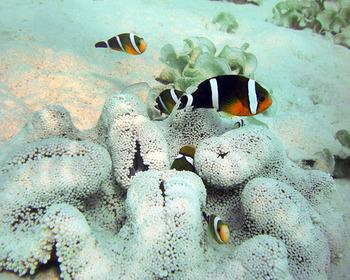
Four species of anemonefish (Amphiprion chrysopterus, A. melanopus, A. perideraion and A. tricinctus) and six species of host anemones (Entacmaea quadricolor, Heteractis aurora, H. crispa, H. magnifica, Stichodactyla haddoni and S. mertensi) were recorded during the underwater surveys. The most notable observation was the new record of S. haddoni in the Marshall Islands and its occupation by the anemonefish A. tricinctus (Figure 1). Stichodactyla haddoni is now the fifth species of anemone inhabited by A. tricinctus and represents a new case of symbiosis between these two species. Five separate S. haddoni anemones were observed between 1 and 8 m depth adjacent to the shoreline (and city of Majuro) at a site in the eastern lagoon of Majuro Atoll (N7.106155 E171.37187). The diameter of the anemones was approximately 30 to 50 cm. Each of the anemones was inhabited by A. tricinctus (orange-brown morph) and the number of individuals per anemone was 2,2,4,6 and 9. Each anemone contained two large A. tricinctus individuals (>7 cm total length), which likely represent adult breeding pairs as the gonads from one A. tricinctus pair revealed a mature female (F4) and mature male (M3).
A large social group of the endemic anemonefish Amphiprion tricinctus occupying the sea anemone Stichodactyla haddoni in the lagoon of Majuro Atoll at the Marshall Islands.

DISCUSSION
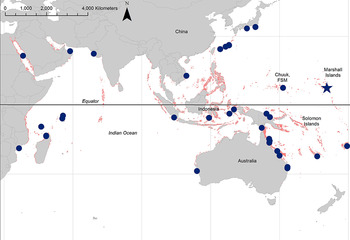
The new record of Stichodactyla haddoni at the Marshall Islands is a significant north-eastern extension of its range (Fautin & Allen, Reference Fautin and Allen1997) that is more than 2200 km from the nearest Ocean Biogeography Information System record (OBIS, 2014) (Figure 2). It therefore represents a significant range extension. Based on reports of longevity and size of sea anemones (Fautin & Allen, Reference Fautin and Allen1997) it would appear that S. haddoni has probably been in the Marshall Islands for at least ten years prior to our observations. Given the size and number of atolls in the Marshall Islands, and the vast extent of shallow water habitats that have not yet been surveyed, it is possible that S. haddoni has been present in the Marshall Islands for much longer (and is more widespread). Based on its current geographical distribution, S. haddoni probably colonized the Marshall Islands from the nearest known extant populations to the west (e.g. Chuuk, Japan, Papua New Guinea and New Caledonia), or from closer locations where populations remain undetected or have gone extinct. The region between the extant populations to the west and where we observed the anemones at Majuro in the Marshall Islands contains many coral reef lagoons that may provide favourable habitat for S. haddoni. We did not observe S. haddoni during surveys in the lagoons of some locations in this region (Pohnpei, Kosrae, Rongelap Atoll, Bikini Atoll and Mili Atoll, 2007–2012: authors' unpublished data). However, there are many other locations that remain un-surveyed in this region and therefore S. haddoni may be present, but undetected.
Map of occurrence records for Stichodactyla haddoni (indicated by dots) (from OBIS, 2014) and the location of the new record in the Marshall Islands indicated by a star.

The presence of juveniles and adult breeding pairs indicates that S. haddoni provides suitable recruitment and breeding habitat for Amphiprion tricinctus. Flexibility in host preferences enables the endemic A. tricinctus to use five of the six host anemone species that occur at the Marshall Islands. While endemic species may have an elevated risk of global extinction, the ability to use a greater diversity of hosts reduces the risk of extinction associated with specialization (Munday, Reference Munday2004). Being able to inhabit a wide range of anemone species may become increasingly important given that rising sea temperatures associated with climate change are causing bleaching and mortality of anemones relied upon by anemonefish (Hobbs et al., Reference Hobbs, Frisch, Ford, Thums, Saenz-Agudelo, Furby and Berumen2013).
ACKNOWLEDGEMENTS
For excellent fieldwork support we thank Don Hess from the Marshall Islands College and Florence Edwards, Emma Kabua, Melba White and Benedict Yamamura from the Marshall Islands Marine Resource Authority. Thanks also to Albon Ishoda and Henry Muller from the Marshall Island Marine Conservation Society for their support. We thank the US National Oceanic and Atmospheric Administration Coral Reef Conservation funding programme for financial support.