Introduction
The persistence of socioeconomic inequalities in health, even in the highly developed welfare states of Western Europe, is one of the greatest failures of public health (Mackenbach, Reference Mackenbach2012). A growing body of evidence provides a clear indication of the adverse effects of socioeconomic inequality on individuals’ morbidity and mortality (Brandt et al., Reference Brandt, Deindl and Hank2012). It has been suggested that high levels of social inequality have a direct and negative causal effect on the health of populations (Wagstaff & van Doorslaer, Reference Wagstaff and van Doorslaer2000; Lynch et al., Reference Lynch, Davey Smith, Harper, Hillemeier, Ross, Kaplan and Wolfson2004). Although this is highly supported by the literature, it has been argued that some other factors, such as the time of exposure to those inequalities, may play a key role, particularly among older adults (Vries et al., Reference Vries, Blane and Netuveli2014).
A recent review suggested that wide income differences play a causal role leading to worse health, especially among individuals of lower socioeconomic status (Pickett & Wilkinson, Reference Pickett and Wilkinson2015). Nevertheless, high levels of inequality negatively affect not only the health of the most disadvantaged groups but also the health of the affluent. This is so, mainly because inequality reduces social cohesion or social capital, which leads to more stress, fear and insecurity for everyone (Kawachi & Kennedy, Reference Kawachi and Kennedy1999). Therefore, health at the individual level may not respond simply to, for example, absolute income, but also to relativities in society (Wagstaff & van Doorslaer, Reference Wagstaff and van Doorslaer2000). Thus, it has been shown that in states with high levels of income inequality, low-income women are 80% more likely to report fair or poor health than low-income women in low-income-inequality states (Kahn et al., Reference Kahn, Wise, Kennedy and Kawachi2000).
As in high-income Western Europe countries, the wide socioeconomic inequalities in Latin American middle-income countries may represent a determinant social factor of health (Reygadas, Reference Reygadas2006; Cardona et al., Reference Cardona, Acosta and Bertone2013). Actually, socioeconomic inequalities are more prominent in most middle- and low-income countries, and life expectancy has increased much faster in these countries than in richer ones (Palloni et al., Reference Palloni, Pinto-Aguirre and Pelaez2002; Lima-Costa et al., Reference Lima-Costa, De Oliveira, Macinko and Marmot2012). In particular, Argentina has had one of the most disappointing social performances in Latin America in the last three decades (Gasparini, Reference Gasparini2007). The year 2001, which was characterized by serious economic and social crisis in the country, displayed the highest educational inequalities in mortality in comparison to either 1991 or 2010 (Manzelli, Reference Manzelli2014). However, the high economic growth experienced by the region during the past decade has had a positive impact on Argentinian social indicators (Maurizio, Reference Maurizio2014). Thus, and in spite of the fact that the magnitude of educational differences has been much higher in Argentina than in other Latin American countries (Manzelli, Reference Manzelli2014), educational inequalities have declined in almost all metropolitan areas in the past years (Morales & Paz Terán, Reference Morales and Paz Terán2010). In a recent ecological study, Argentina showed the second most favourable health status in the region (Cardona et al., Reference Cardona, Acosta and Bertone2013). Therefore, while the social situation has substantially improved in recent years, poverty and inequality are still important (Gasparini, Reference Gasparini2007). Furthermore, the prevalence of different cardiovascular risk factors has increased, mainly in individuals of lower socioeconomic status (Ferrante et al., Reference Ferrante, Linetzky, Konfino, King, Virgolini and Laspiur2011).
In this situation, addressing current differences in health among individuals of different socioeconomic status has become especially important. Health inequalities have been estimated in Argentina in terms of both education and income (De Maio, Reference De Maio2007, Reference De Maio2008; Alazraqui et al., Reference Alazraqui, Diez Roux, Fleischer and Spinelli2009; Manzelli, Reference Manzelli2014). These studies have shown patterns of socioeconomic inequalities in morbidity favouring socially advantaged groups (Hoffman & Centeno, Reference Hoffman and Centeno2003; Cardona et al., Reference Cardona, Acosta and Bertone2013). Nevertheless, the demographic transition in most Latin American countries is generating populations with unprecedented numbers of older adults exposed to significant social inequalities (Lima-Costa et al., Reference Lima-Costa, De Oliveira, Macinko and Marmot2012). However, few studies have addressed health inequalities among Argentinian older adults, considering their social and biological vulnerability.
A gender perspective is important when studying socioeconomic inequalities in health. It has been argued that i) gender is an influential factor that contributes to the prevalence of poor self-reported health during the ageing process (WHO, 2002), ii) differences in health status and perception are linked to gender inequalities in the workplace and in economic and personal autonomy (Montero López et al., Reference Montero López, Fernández-Ballesteros, Zamarrón and Rodríguez López2011). Gender differences in subjective health have been reported previously for Argentina (Alazraqui 2005), and it has been suggested that multi-morbidity explains part of these disparities (Assari & Moghani Lankarani, Reference Assari and Moghani Lankarani2015). Additionally, ways in which social determinants contribute to a poorer health status in women compared with men vary among countries (Hosseinpoor et al., Reference Hosseinpoor, Stewart Williams, Amin, Araujo de Carvalho, Beard and Boerma2012). Thus, it is relevant to examine whether the patterns of association between education/income and subjective health indicators vary for older men and women in Argentina.
Within this context, the present study aimed to analyse educational and income inequalities – by means of an inequality index – in three subjective health indicators based on a representative sample of Argentinian older adults. Addressing health inequalities in Argentina is important due to the high proportion of older, particularly socially disadvantaged adults. These are, largely, more likely to benefit from both social policies leading to improvements in the welfare state (Qin & Liu, Reference Qin and Liu2013) and reduction in socioeconomic inequalities (Stuckler et al., Reference Stuckler, Basu, Suhrcke and McKee2009).
Methods
Sample
Data were obtained from the Argentinian National Survey on Quality of Life of Older Adults 2012 (Encuesta Nacional sobre Calidad de Vida de Adultos Mayores, ENCaViAM) (INDEC, 2014). ENCaViAM is the first cross-sectional national survey on adults’ quality of life to include a representative subsample of older adults living in households located in urban areas of Argentina. Data collection was carried out during 2012 by the National Institute of Statistics and Census (INDEC) together with the Regional Directions of Statistics from Argentina.
ENCaViAM was mainly developed to evaluate the most urgent needs of public policy application among Argentinian older adults. The survey gathered valuable information on access to health services and medicines, self-reported health, life satisfaction and limitations in physical activities of daily living, among other things (INDEC, 2014). The studied sample included 4654 60-year-old and older individuals (mean age 70.5 years; 57.4% women) with complete data. Since ENCaViAM is a probabilistic sample, every primary sampling unit (household) has an expansion factor (calibrated weight), which is the inverse of the selection probability. Consequently, all analyses were performed using calibrated weights. Finally, the non-response rate was relatively low (13.4% of selected individuals). Further methodological aspects of ENCaViAM are described elsewhere (INDEC, 2014).
Variables
Socioeconomic status
Two individual indicators of socioeconomic status were considered to summarize adults’ socioeconomic status: educational level and family per capita income.
Educational level was categorized as: no formal education, primary school, high school and university/higher education. These categories were equivalent and comparable with the ones proposed by the International Standard Classification of Education (ISCED) (UNESCO, 2006) as follows: 1=no formal education; 2=primary school (Level 1 ISCED); 3=high school (Level 2 and 3 ISCED); and 4=university/higher education (Levels 5 and 6 ISCED).
For family per capita income decile groups were created and transformed into quintiles for analytical purposes: 1st (poorest), 2nd, 3rd, 4th and 5th (richest).
Health indicators
Subjective health predicts mortality and a variety of other health outcomes beyond objective health (Franz et al., Reference Franz, Finkel, Panizzon, Spoon, Christensen and Gatz2016). Two different subjective health indicators were evaluated: general self-reported health status (SRH) and self-assessments of physical functioning. Both are valid and useful indicators for measuring general physical well-being and population health (Lundberg & Manderbacka, Reference Lundberg and Manderbacka1996; Miilunpalo et al., Reference Miilunpalo, Vuori, Oja, Pasanen and Urponen1997; Lantz et al., Reference Lantz, Lynch, House, Lepkowski, Mero, Musick and Williams2001). While SRH is a static indicator capturing deviations from a norm perceived as healthy (Ziebarth, Reference Ziebarth2010), limitations in physical activities of daily living is a functional one, capturing the inability to perform certain tasks. Overall, the use of dichotomized self-reported health measures is a standard approach in the literature on health inequalities (Ziebarth & Frick, Reference Ziebarth and Frick2010) given its simplicity and wide use of logistic regression, particularly in epidemiology (Manor et al., Reference Manor, Matthews and Power2000). Additionally, the use of self-reports can provide information about individuals’ own perceptions regarding their health that cannot be measured using an objective assessment tool (CEPAL, 2008).
Self-reported health (SRH) is a subjective indicator that has proved to be highly correlated with objective measures of physical health, as well as a good predictor of functional decline (Lee, Reference Lee2000) and mortality (Idler & Benyamini, Reference Idler and Benyamini1997; Gasparini, Reference Gasparini2007; Haas, Reference Haas2007). Originally, it was assessed using a 5-point scale: excellent, very good, good, fair and poor. However, for analytical purposes and following conventional practice, it was recoded as a binary outcome with 1=fair/poor, and 0=excellent/very good/good (De Maio et al., Reference De Maio, Linetzky, Ferrante and Fleischer2012). Although dichotomization of the self-rated health variable involves a loss of information and has other drawbacks (Ziebarth, Reference Ziebarth2010), only small reductions in power and statistical efficiency have been reported (Manor et al., Reference Manor, Matthews and Power2000).
Physical functioning
Activities of Daily Living (ADL) are defined as those activities essential for independent living, while Instrumental Activities of Daily Living (IADL) are more complex and require a higher level of personal autonomy. IADL refer to tasks implying greater interaction with the environment and enough capacity to make decisions (WHO, 2001). Based on these differences, deficits in IADL normally precede deficits in ADL (Judge et al., Reference Judge, Schechtman and Cress1996). Limitations in ADL (or IADL) are defined as having difficulty with and/or receiving help from another person or being unable to do one or more of the following tasks: dressing, walking across the home, bathing or showering, combing oneself/brushing teeth, eating/cutting up food, getting in or out of bed, using the toilet (including getting up/down) and climbing/climbing down one flight of stairs. Similarly, IADL include seven activities: difficulties in using public transport, preparing a hot meal, shopping for groceries, making telephone calls, taking medications, doing work around the house/garden and managing money/paying bills/keeping track of expenses. Consequently, disabilities in ADL and in IADL were defined as: 1=one or more limitations in ADL/IADL, and 0=without any limitations.
Other variables
In addition to age, other factors such as marital status, the manifestation of depression within the past year (Lorant et al., Reference Lorant, Deliège, Eaton, Robert, Philippot and Ansseau2003), the occurrence of falls within the past two years, level of physical activity (Vagetti et al., Reference Vagetti, Barbosa Filho, Moreira, Oliveira, Mazzardo and Campos2014) and the use of eight or more medications per day might be influencing socioeconomic inequalities in health. Including these variables in the analysis is important in order to evaluate the robustness of the associations of interest.
Statistical analysis
The prevalence of adults with fair/poor SRH and ADL and IADL limitations was analysed by gender. The Relative Index of Inequality (RII) was estimated in order to measure the magnitude of educational and income inequalities in the three health outcomes (SRH, ADL, IADL). The RII is a regression-based measure that takes the complete socioeconomic distribution into account, rather than comparing only the two extreme groups (Mackenbach & Kunst, Reference Mackenbach and Kunst1997). The RII resembles relative risk in that it compares the health of the extremes of the social distribution, but it is estimated using data from all social categories (Singh-Manoux et al., Reference Singh-Manoux, Ferrie, Lynch and Marmot2005). To estimate RII, first both indicators of socioeconomic status were transformed into summary measures (ridit scores). Then educational level and family per capita income were scaled from 0 (highest level of education/income) to 1 (lowest level of education/income) and weighted to reflect the share of the sample at each educational level/income category (Ernstsen et al., Reference Ernstsen, Heine Strand, Nilsen, Arild Espnes and Krokstad2012). Then, the population in each education/income category was assigned a modified ridit score based on the mid-point of the range in the cumulative distribution of the population of participants in the given categories (Khang et al., Reference Khang, Yun and Lynch2008; Ernstsen et al., Reference Ernstsen, Heine Strand, Nilsen, Arild Espnes and Krokstad2012; Kroll, Reference Kroll2013). For example, if the most educated women comprised 10% of the population, the range of women in this category was assigned a value of 0.05 (0.1/2), and if the second category comprised 40% of the population, then every individual in this category was assigned a value of 0.3 (0.1+[0.4/2]), and so forth. Then, gender-specific generalized linear models for the binomial family were used to calculate age-adjusted RII as follows (Kiadaliri et al., Reference Kiadaliri, Asadi-Lari, Kalantari, Jafari, Mahdavi and Faghihzadeh2015):
 $$g{\rm (}Y{\rm )\,{\equals\,}}\beta _{{\rm 0}} {\rm {\,\plus\,}}\beta _{{\rm 1}} {\rm ridit{\,\plus\,}}\beta _{{\rm 2}} {\rm age{\,\plus\,}error}$$
where the error term has a binomial distribution, Y=1 for exposure to the risk factor under study (e.g. fair/poor SRH, 1+ADL/1+IADL limitations) and Y=0 for no exposure. The coefficient β 1 is the coefficient of interest and expresses RII when the link function is log, and ridit is the ridit score (replaces educational level/family per capita income). Thus, RII can be interpreted as the rate ratio between the least and the most educated people/the lowest and highest income quintile (i.e. an RII>1 implies a negative relationship between fair/poor SRH, ADL and IADL limitations and education/income, and an RII<1 implies a positive relationship between these variables). In other words, the RII represents the predicted value of the health outcome in the least advantaged divided by the predicted value in the most advantaged (Kunst et al., Reference Kunst, Geurts and van den Berg1995). Finally, gender-specific RII for education and income were calculated adjusted by i) age and ii) other variables potentially associated with both exposures and outcomes (marital status, depression, falls, physical activity and use of medications).
Data analysis was conducted with the STATA 13 statistical software package (StataCorp 2013).
Results
The sample was characterized by a high proportion of younger men and very old women (Table 1). More than half of the participants had primary level education, and most were in the middle-income distribution with the lowest income quintile being least represented. Compared with men, women showed a higher prevalence of both limitations in ADL and IADL, while the percentage of individuals with fair/poor SRH was relatively high and similar in both genders.
Unadjusted sociodemographic characteristics and prevalence of subjective health indicators in Argentinian men and women aged 60+ years

SRH, self-reported health status; ADL, activities of daily living; IADL, instrumental activities of daily living.
Data source: Argentinian National Survey on Quality of Life of Older Adults 2012 (ENCaViAM).
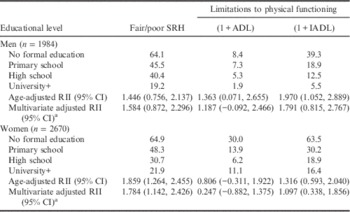
Table 2 shows the prevalence of fair/poor SRH and ADL and IADL limitations by level of education and RII for each outcome. The frequency of fair/poor SRH decreased from the lowest to the highest level of education in both men and women (Table 2). Moreover, there were educational inequalities (age-adjusted RII) in fair/poor SRH for both genders: e.g. women without formal education had 86% (RII 1.859, 95% CI 1.264, 2.455) increased odds of experiencing fair/poor SRH than those with university education.
Prevalence of fair/poor SRH and ADL and IADL limitations by level of education and RII among Argentinian men and women aged 60+ years

a Multivariate adjusted RII includes: age, marital status, occurrence of falls within the past two years, depression within the past year, physical activity and the use of several medications.
RII, Relative Index of Inequality; CI, confidence interval; 1 + ADL, one or more limitations in activities of daily living; 1 + IADL, one or more limitations in instrumental activities of daily living.
Data source: Argentinian National Survey on Quality of Life of Older Adults 2012 (ENCaViAM).
Additionally, the prevalence of ADL and IADL limitations was markedly higher in women compared with men, with the highest frequency among individuals with no formal education. However, educational inequalities in ADL and IADL were higher in men compared with women (Table 2): e.g. men with no formal education had 36% (age-adjusted RII 1.363, 95% CI 0.071, 2.655) and 97% (age-adjusted RII 1.970, 95% CI 1.052, 2.889) higher odds of having limitations in ADL and IADL, respectively, than those with higher education.
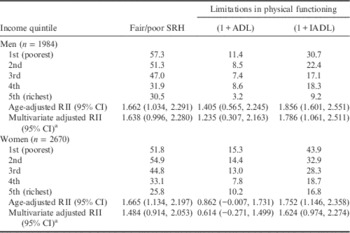
After adjusting for other variables such as age, marital status, occurrence of falls within the past two years, depression within the past year, physical activity and the use of several medications (Table 2, multivariate adjusted RII), educational inequalities decreased slightly although they remained statistically significant for most of the outcomes except for inequalities in ADL in men. Similarly, Table 3 shows the prevalence of fair/poor SRH, and limitations in ADL and IADL by income quintiles and RII for each outcome. The frequency of fair/poor SRH, and limitations in one or more ADL/IADL, decreased from the first (poorest) to the fifth (richest) income quintiles in both men and women (Table 3). Compared with men, the prevalence of ADL and IADL limitations was higher in women throughout the income distribution. Participants within the lowest/poorest income quintile had 66% higher odds of experiencing fair/poor SRH than those within the highest/richest quintile (statistically significant age-adjusted RII was around 1.66 in both genders). Similar income inequalities in IADL limitations existed in both genders while inequalities in ADL limitations were observed only in men. Similarly to what was observed for education in the multivariate adjusted analysis (Table 3), while income inequalities decreased marginally, they remained statistically significant for most of the outcomes.
Prevalence of fair/poor SRH and ADL and IADL limitations by income quintiles and RII among Argentinian men and women aged 60+ years

a Multivariate adjusted RII includes: age, marital status, occurrence of falls within the past two years, depression within the past year, physical activity, and the use of several medications.
RII, Relative Index of Inequality; CI, confidence interval; 1+ADL, one or more limitations in activities of daily living; 1+IADL, one or more limitations in instrumental activities of daily living.
Data source: from the Argentinian National Survey on Quality of Life of Older Adults 2012 (ENCaViAM).
Discussion
This study evaluated, using the relative index of inequality (RII), educational and income inequalities in SRH and ADL and IADL limitations, among 60-year-old and older Argentinians. Overall, the results showed education- and income-related inequalities in the studied subjective health indicators favouring socially advantaged groups. The results remained largely significant after controlling for other associated variables suggesting that education- and income-related inequalities in health indicators – mainly in SRH and IADL – were robust and somehow independent of marital status, physical activity, the use of several medications, depression and the occurrence of falls.
By and large the study findings were in the expected direction for the effects of educational and income inequalities on the studied indicators, to the detriment of socially disadvantaged groups. Nevertheless, it has previously been shown that education and income did not have a similar effect in relation to self-reported health in Argentina (De Maio, Reference De Maio2007, Reference De Maio2008); that is, while poorer income quintiles were associated with higher probabilities of poor health, lower level of education displayed lower probabilities of poor health. The present findings agreed with the described income-related inequalities against disadvantaged groups. After full adjustment, the results on educational inequalities suggested that men and women without formal education had, respectively, 58% and 78% increased odds of experiencing fair/poor SRH than those with university education. Additionally, the prevalence of fair/poor SRH was similar in men and women. This contrasted with evidence from most other countries (Bardage et al., Reference Bardage, Pluijm, Pedersen, Deeg, Jylhä and Noale2005; Hosseinpoor et al., Reference Hosseinpoor, Stewart Williams, Amin, Araujo de Carvalho, Beard and Boerma2012), in which the incidence of poor SRH was higher among adult women.
This study reported a higher prevalence of limitations in physical activities – both ADL and IADL – in women compared with men. This might be due to i) inequalities in the physical and psychological burden associated with activities mainly conducted by women, such as care of elderly/disabled people or family members (Verbrugge, Reference Verbrugge1985), and/or ii) a greater awareness of health issues in relation to men, which might lead to a higher consciousness of health problems. Additionally, income inequalities in ADL were present in men but not in women after full adjustment. This might be explained by i) the above described tasks being mainly carried out by women, somehow independently of their socioeconomic status; and/or ii) the differences for men and women possibly being a consequence of the gender-stratified analysis: insufficient sample sizes in some subgroups, or the confounding effect of other variables in the regressions; and/or iii) RII might not be sensitive enough to detect inequalities in ADL limitations, which are smaller than, for example, limitations in IADL. In this sense, the lack of correlations between SRH and activity limitations with different inequality indexes has been previously highlighted (De Maio, Reference De Maio2008).
Finally, gender differences in educational and income inequalities in IADL limitations were not observed in the present study. Compared with participants with university education, men and women in the lowest educational group showed increased odds (97% and 32%, respectively) of experiencing limitations in IADL. The results for income inequalities in IALD showed a similar pattern, favouring higher-income groups. The evidence is inconsistent as to whether socioeconomic inequalities in health are different in women compared with men, across various health measures and life stages (Moss, Reference Moss2002). The findings of the present study suggest that the patterns of the associations between education/income and subjective health indicators – at least for SRH and IADL – do not vary substantially for older men and women in Argentina.
The study has several limitations that need to be highlighted. Probably the most important one is the use of subjective health indicators. Most studies on social inequalities have been especially focused on subjective health indicators. This is so since national health interviews and level of living surveys usually cover various aspects of subjective health such as perceived general health, physical complaints and quality of life, among others (Kunst et al., Reference Kunst, Geurts and van den Berg1995). Although there is a large amount of longitudinal evidence showing that perceived or subjective health is a significant predictor of both mortality and morbidity (Idler & Benyamini, Reference Idler and Benyamini1997; Menec et al., Reference Menec, Chipperfield and Perry1999; Maurizio, Reference Maurizio2014), some studies have reported a lack of agreement between objective and subjective indicators (De Maio, Reference De Maio2007; Cramm et al., Reference Cramm, Bornscheuer, Selivanova and Lee2015). This calls for the inclusion of both subjective and objective health indicators since they seem to catch ‘different parts’ of a person’s overall health. As such, reliance solely on self-reported health measures seems to provide information that may not reflect actual health performance (Cramm et al., Reference Cramm, Bornscheuer, Selivanova and Lee2015).
Furthermore, it has been shown that the magnitude of health inequality measures depends on the underlying health measure (De Maio, Reference De Maio2008). Some studies reported the highest degree of inequality when subjective health measures like self-assessed health are dichotomized (Ziebarth, Reference Ziebarth2010). Additionally, it has been suggested that the choice of the welfare indicator determines the size of welfare-related health inequality (Ziebarth & Frick, Reference Ziebarth and Frick2010): welfare measures have a particularly large impact when dichotomized subjective health measures are used to calculate welfare-related health inequalities. The effect is much less pronounced when using quasi-objective generic health measures or objective health measures (Ziebarth & Frick, Reference Ziebarth and Frick2010).
Another limitation is that ENCaViAM does not provide within-country comparisons, which somewhat limits the scope of the present study. Previous evidence from social inequities in Argentina has shown that respondents from deprived regions were most likely to report being in good health, despite living in areas with low life expectancy and high infant mortality (De Maio, Reference De Maio2007); in other words, respondents from areas of poor population health reported good individual health. Thereby, it was suggested that under-reporting of poor health in deprived regions might be because people living in these areas are usually less aware of treatable conditions (Sen, Reference Sen2002). If true, this will ultimately lead to an underestimate of the social gradient in health (De Maio et al., Reference De Maio, Linetzky, Ferrante and Fleischer2012) and needs to be taken into account when interpreting the findings of the present study. Additionally, the survey only covered urban populations (close to 85% of the total population of the country; Dachs et al., Reference Dachs, Ferrer, Florez, Barros, Narváez and Valdivia2002), avoiding comparisons between urban and rural adults. Finally, the cross-sectional design of ENCaViAM did not allow for making any assumptions on causality.
Despite these limitations, one interesting aspect of the study is that more than half of the studied population had primary school or lower level of education (near 10% had never received any formal education) and around 30% of the sample was represented in the two lowest income quintiles. Thus, the high prevalence of individuals in the lower social strata has strong implications, since the results showed that both low education and income were associated to an increased likelihood of poor health and more physical impairments.
Argentina is undergoing an advanced demographic transition process, being one of the most aged countries in Latin America (CEPAL, 2008). The population aged 60 years and older represents 14.3% of the whole population of the country (INDEC, 2010). Considering the process of population ageing is set to continue, information is needed to successfully face the social challenge of living longer with the best possible quality of life. Efforts to tackle health inequality will contribute to decreasing the inequalities between men and women and different socioeconomic subgroups. Despite the recent implementation of diverse mechanisms of universal access to health care aimed at decreasing the inequitable socioeconomic pattern in older Argentinian older adults, much work still needs to be done (Minoldo et al., Reference Minoldo, Zavattiero, Peláez and Féliz2015).
Acknowledgments
The authors are grateful for comments made on the draft version of this paper by Estela López and the anonymous reviewers.