Introduction
In the past decade gender inequality in pensions has been increasingly recognised as unacceptable. Women's lower average pension income makes them more likely than men to depend on means-tested benefits or on family members in later life, but neither of these is an attractive option. About a third of individuals eligible for means-tested pension credit do not claim (Department for Work and Pensions, 2012), suggesting some pensioners may be unaware of eligibility or how to claim, or that they find the process too complex or intrusive. Our main focus is therefore on pensions, these being the primary independent source of income security in retirement. Although some women may have other independent sources of income after state pension age, such as earnings, only 9 per cent were employed over age sixty, nearly 70 per cent of these part time (Smeaton and McKay, Reference Sefton, Evandrou and Falkingham2003). Women's employment rate over state pension age increased only slightly between 2002 and 2008. Interest on savings is another source of extra personal income for some older women, but for those with savings the median amount was just over half of men's (Westaway and McKay, Reference Waine2007), which at 3 per cent per annum would generate a trivial amount, under £4 per week.
The review by the UK Pensions Commission (2004) confirmed that women's pension disadvantage is mainly due to their domestic roles, while their (2005) recommendations led to the Pensions Act 2007 which made state pensions more inclusive for those with periods out of the labour market for caring responsibilities. To tackle the decline of occupational pensions in the private sector among lower paid employees, the Pensions Act 2008 provided for employer-supported private pensions in which most employees would be automatically enrolled. But how far will these reforms, and the plans in the 2011 Pensions Act, reduce gender inequality in UK pensions? And for which women? We first review the interaction of the gendered division of labour with pension schemes oriented to a continuous full time career, and assess how far this has changed for later cohorts of women. We then analyse state pension reforms and plans made since 2007 from a gender perspective. We go on to suggest alternative policies that would give women a fairer deal in pensions, and finally set out our conclusions.
Gendered roles and women's employment: legacy for pensioner women
Older women's employment histories have been substantially shorter than men's since the early twentieth century, with less full time work. This is due to the dominant ‘male breadwinner’ society expecting women (especially wives) to prioritise domestic and caring roles, freeing men (especially husbands) to focus on earning (Land, Reference Itzin and Phillipson1994). The resulting discrimination adversely affected career advancement for most women (Thane, Reference Smeaton and McKay2006). University expansion in the 1960s, sex equality legislation and women-friendly state pension reforms in the 1970s were too late to benefit the current generation of retirees.
Research on employment histories has quantified older women's past employment and pension building (Ginn and Arber, Reference Ginn and Arber1996; Sefton et al., Reference Rys2011). Not only was their employment shorter than men's but the proportion of years in full time employment was much lower, a difference found to be crucial for accumulation of private pension entitlements. The gender differences were strongly associated with marriage and motherhood for women. Not surprisingly, the personal income of women aged over sixty-five was much lower than men's; their median amount was only 57 per cent of men's. For the 43 per cent of women with any private (occupational or personal) pension, the amount was only 53 per cent of men's, even including widows’ pensions (Arber and Ginn, Reference Arber and Ginn2004). Consistent with their lower pension income, previously married women were twice as likely as similar men to receive a means-tested top-up (ibid.).
UK pensioner poverty, as measured by the Organisation for Economic Co-operation and Development, is relatively high, with 28 per cent of men and 33 per cent of women over sixty-five at risk (Zaidi, Reference Woods, Makepeace, Joshi, Dolton, Ferri, Bynner and Wadsworth2010) reflecting that UK state pensions are ‘among the least generous in the developed world’ (Pensions Commission, 2004) and found to be the least adequate among twenty-five European countries (Aon, 2007). The UK basic state pension (BSP) in 2012 is less than half the National Minimum Wage for a 35 hour week (£107 versus £217). Comparisons with other EU countries indicate that the UK's high pensioner poverty rate and gender inequality in later life income are avoidable, mainly through better childcare provision and/or more women-friendly and generous state pensions (Ginn, Reference Ginn2003). The gender gap in UK pensioners’ incomes, a legacy of past employment norms and pension policies, remains largely ignored by policymakers; their focus has been on the future pensions of working age individuals.
Gendered roles and pension accumulation: working age women
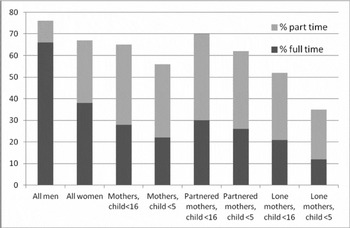
Women now have better educational opportunities and higher levels of achievement than their mothers did, with more access to childcare. The gender gap in hourly pay is narrowing, but rather slowly. As a proportion of men's median full-time hourly pay, women full-timers receive 81 per cent and part-timers only 52 per cent (Pike, 2011). Legislative changes, often due to EU law, have helped diminish barriers to women's employment. However, women still perform the bulk of caring and their full time employment remains much lower than men's. Among mothers with a child aged under sixteen at home, two thirds are employed but less than a third full time (Office for National Statistics, 2012; see Figure 1). The impact of motherhood on employment, hours, earnings and pension scheme acquisition is especially severe for the growing group of lone mothers (Ginn and Price, Reference Ginn and Price2002; Price, Reference Pike2005, Reference Price, Miles and Probert2008).
Percentage of British mothers employed full and part time, by partnership status and age of youngest child at home
Note: Mothers age 16–64. Child living at home.
Source: ONS (2012) for data on mothers’ employment.

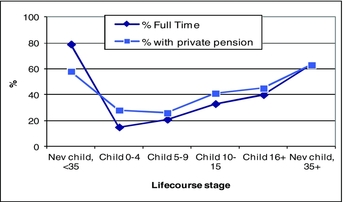
Longitudinal research confirms the low full time-employment rate for mothers of school-age children (Woods et al., Reference Warren2003); women's pattern of employment has been relatively stable (Price, Reference Price2007). The impact of motherhood on their full time employment and private pension scheme membership is illustrated in Figure 2 for mid-skilled British women. A similar effect is seen for graduate and unskilled women, at higher and lower levels respectively (Ginn and Arber, Reference Ginn and Arber2002).
Percentage of British mid-skilled women aged 20–59,
(a) employed full time
(b) contributing to a private pension.
Source: Ginn and Arber (Reference Ginn and Arber2002).

Persistent gender differences in full time employment are reflected in the capacity to accumulate private pension wealth. Among adults of working age, 43 per cent of men and 37 per cent of women contribute to a private pension. Among full time employees, 54 per cent of men and 58 per cent of women were members of an occupational pension scheme; but among women employed part time, only 39 per cent were members (Office for National Statistics, 2010). Even where women do contribute to a private pension, their lower pay builds smaller entitlements. Thus working age men's estimated median pension wealth was £20,000, compared with women's £10,000, and among women aged over thirty-five nearly half have accumulated no pension wealth at all (Office for National Statistics, 2009). At age fifty-six, men's median pension wealth in 2006−08 was £52,800, women's £9,100 (Hansard, 2011).
It is important to recognise diversity among women in terms of educational attainment, occupational class and type of employer, since these all influence their employment pattern, earnings and pensions. For example, women employed part-time in the private sector tend to work for an employer with no pension scheme (Ginn and Arber, Reference Ginn and Arber1993). Highly qualified women in professional and managerial jobs are advantaged relative to other women, with higher pay and a greater likelihood of contributing to a good occupational pension scheme. But even this ‘privileged pole’ of women had lower earnings, shorter full time employment and less accumulated pension wealth than their male equivalents; their pension wealth was also less than that of male manual workers (Warren, Reference Westaway and McKay2003).
Progress made in the 1970s towards more women-friendly state pensions was reversed after 1980 by the adoption of neoliberal policies, with retrenchment of state pensions and tax-subsidised promotion of private pensions (Ginn, Reference Ginn2003: Chapter 1). Under New Labour's 1997 plans, spending on state pension transfers was projected to fall from 4.4 per cent to 3.4 per cent of GDP by 2050; it was hoped that the state's share of all pension provision would fall from 60 per cent to 40 per cent, while that from private (i.e. occupational and personal) pensions would rise from 40 per cent to 60 per cent (Department of Social Security, 1998). For a number of reasons, that expected rise did not occur. Diminishing state pensions and women's continuing disadvantage in private pensions made for a bleak outlook; ‘Women's pension disadvantage and risk of personal poverty in later life is unlikely to diminish in the foreseeable future’ (Department for Work and Pensions, 2002). Reforms since 2005, however, have lessened the impact of women's caring roles on their state pensions.
State pension reforms 2005–09
In 2005, women's state pensions were about three quarters of men's and a Labour minister acknowledged the need for ‘radical reform to tackle the scandal of women's pensions’ (Guardian, 2005). Following the Pension Commission's (2005) recommendations, the 2007 Pensions Act shortened the qualifying period for a full basic state pension (BSP) from forty-four years (men) and thirty-nine years (women) to thirty years for both, but only for those reaching state pension age after 6 April 2010, thus creating a ‘cliff edge’, or sharp difference according to birth date. Credits for caring in lieu of contributions to National Insurance (NI) were aligned in BSP and the earnings-related state second pension (S2P) to apply to anyone caring for a child aged up to twelve and to informal carers for a disabled adult (under specified conditions). However, for S2P, maximum entitlement would still require contributions or credits from age sixteen to the rising state pension age (SPA). The 1995 provisions for equalising men's and women's SPA at sixty-five by 2020 were extended, raising the age to sixty-six by 2026, sixty-seven by 2036 and sixty-eight by 2046. This, alongside the increased NI contributions (to 12 per cent of band earnings from 2011) was to pay for the reforms.
A gender impact assessment estimated women's receipt of the full BSP at SPA would rise from 35 per cent in 2006 to 95 per cent by 2025. Extension of care credits in S2P until the youngest child reached twelve would entitle an extra 780,000 women. The report concluded that, for women with a full work history, the reforms would bring gender equality in state pensions nearer, although a gender gap of about 20 per cent would remain in private pensions (Department for Work and Pensions, 2007). While the greater inclusiveness of state pensions is of great benefit to women (or men) with caring responsibilities, the low level of state pensions still limits their power to reduce women's pension disadvantage. After the 2010 election of a Coalition government, changes were legislated to reduce the cost of state pensions.
Pension reforms from 2010
State pension age
The Coalition's 2011 Pensions Act provided for further rises in SPA, to reach sixty-six by October 2020, nearly six years earlier than planned in 2007, so that 4.4 million men and women will wait up to a year longer for their pension. But some women face a longer wait: about 500,000 must wait between a year and eighteen months extra, with little time to adjust (Pensions Policy Institute, 2011). The SPA will rise to sixty-seven by 2028, affecting around 8 million workers, and further increases may be auto-linked to increasing average life expectancy. Rises in SPA will affect eligibility for the winter fuel allowance, concessionary travel and other age-related benefits.
The steep rise in pensionable age for women amounts to a cut in their state pensions. It allows inadequate time to adjust retirement plans, ignoring the gendered constraints on women's longer employment. Women aged fifty to sixty-nine bear the brunt of caring for elderly relatives, being twice as likely as men (14 per cent versus 7 per cent at a given time) to be informal carers (Arber and Ginn, Reference Arber and Ginn1991, Reference Arber and Ginn1995) and they are more likely than men to care for grandchildren (Gray, Reference Gray2005). Cuts in social care services will enlarge the ‘caring gap’ that women are expected to fill. A further constraint is rising disability rates with age. Disability affects about 40 per cent of men and women aged sixty to sixty-four, rising to 46 per cent in the age group sixty-five to sixty-nine. But the prevalence of disability is about 10 percentage points higher for women than men (Banks et al., Reference Banks, Lessof, Nazroo, Rogers, Stafford and Steptoe2010: 263). Cuts in the public sector will disproportionately affect the availability of jobs for women while gendered age discrimination among some employers further reduces their opportunities (Itzin and Phillipson, 1993; Loretto and Vickerstaff, Reference Long2010; McKay, Reference Loretto, Vickerstaff, Parry and Tyson2010). Employment among women aged over sixty has been rising slowly but is mainly part time; between 2002 and 2008 their employment rose from 29.5 per cent to 30 per cent (age sixty to sixty-four) and from 12.9 per cent to 13.8 per cent (age sixty-five to sixty-nine) (Banks et al., Reference Banks, Lessof, Nazroo, Rogers, Stafford and Steptoe2010: 19).
Changed indexation of pensions
Removing the earnings link from the BSP in 1980 and substituting a price link has seriously eroded its purchasing power. Its value fell from 26 per cent to 16 per cent of average earnings between 1979 and 2010 and is projected to be 14 per cent by 2012 (Department for Work and Pensions, 2010). To avoid further decline, ‘triple lock’ indexation (uprating annually by the rise in average earnings, the RPI or 2.5 per cent, whichever was the highest) was introduced. Soon after, the inflation measure was switched to the Consumer Price Index (CPI) which excludes housing costs and is on average about 1.5 per cent lower than RPI. While the BSP will keep pace with rising prices and living standards in years when earnings rise faster than CPI, this is not the case for S2P. The latter, like most private pensions, will be indexed only to CPI. CPI indexation means pensioners will have less purchasing power from second tier pensions. Although apparently gender-neutral, inadequate indexation affects women more than men because of their lower pensions, greater average longevity and higher risk of living alone. Even RPI failed to reflect rising costs for pensioners (Banks et al., Reference Banks, Lessof, Nazroo, Rogers, Stafford and Steptoe2010: 95).
Planned state pension reforms – the single tier pension (STP)
In 2011, the government announced its intention to combine the BSP and S2P into a flat rate single-tier pension of £140 per week (at 2010 prices). When introduced, after 2015, this will include the self-employed and be indexed in payment through the triple lock. The full amount will be paid at SPA to those with thirty years contributions or credits, pro rata for those with fewer years, and a minimum requirement of seven years. A great advantage of STP is that it is simpler to understand and to operate than the two-tier structure. After a long transition in which individuals will retire with a mix of existing state pensions and the new STP, the need for means-tested guarantee credit should be reduced and spousal benefits may be deemed unnecessary. However, over 40 per cent of pensioner households are still projected to be eligible for other means-tested benefits in 2050 (savings credit, housing benefit and council tax benefit) unless the rules for these are changed (Carrera et al., Reference Carrera, Redwood and Adams2012). It is not clear whether survivor pensions will be accrued in STP, nor whether a divorcee will have rights derived from her ex-husband's STP record. For defined contribution private pensions, contracting out of part of NI contributions will no longer be allowed; this will save the Treasury an estimated £8 billion per annum.
Women with low lifetime earnings will be the major beneficiaries of the STP. It will ensure that most working age women will receive a state pension slightly above the level of means-tested guarantee credit, irrespective of their lifetime earnings or marital status. However, women who would otherwise have been able to accrue state pension entitlements above £140 per week through S2P will be worse off than under the existing two-tier state pensions. The vital protection provided for carers in the state earnings-related schemes (SERPs and S2P) will be lost and the only means of obtaining a wage replacement will be private pensions, where women's time out for caring costs them dear. The STP perpetuates UK pension policy of keeping state pensions very low in international terms. With the exception of Ireland, UK state pensions provide the lowest wage replacement rate across twenty-seven OECD countries, only 35 per cent compared with the average 61 per cent, for a full career on average earnings (Quiesser and Whitehouse, Reference Queisser and Whitehouse2006). Because the STP will be barely above the level of eligibility for guarantee credit, women with less than thirty qualifying years will still be at risk of falling below that threshold and may therefore gain little or nothing financially from any extra saving. This risk is more acute for women than men, since life-course events such as unexpected caring responsibilities and changes in marital or partnership status can dramatically alter their ability to accrue pensions.
For policymakers and private pension providers, the main purpose of STP is to remove, for low to moderate earners, the disincentive to extra voluntary saving that is posed by the risk of interaction with means testing. Yet STP's low level, combined with only partial receipt among a proportion of women, could undermine that aim.
New auto-enrolled defined contribution pensions
Auto-enrolment into workplace pensions, including the state-sponsored National Employee Savings Trust (NEST), starts in October 2012. Employers with over 50,000 employees will be required to auto-enrol all those aged over twenty-two and earning at least £7,475 per annum in a workplace pension scheme. Employees may opt in if earning between £5,035 and £7,475 per annum. Minimum contributions from employer and employee (in addition to NI) will start at 1 per cent of qualifying earnings from each (total 2 per cent plus tax relief) but will rise over several years to 4 per cent from employee, 3 per cent from employer and 1 per cent tax relief (total 8 per cent). For smaller organisations the start date will be delayed for several years depending on size. Employees will be allowed to opt out of their workplace pension scheme. Those with earnings below the lower earnings limit (£5,035 per annum in 2012) will be excluded from membership (Department for Work and Pensions, 2012). These will be mainly women part-timers, who will have no choice but to lose the employer contribution for some years.
The NEST pension account will be portable across jobs, but transfers in and out will not be allowed. Charges will initially be 0.3 per cent per annum of each employee's accumulated fund, but could rise, since there is no legal cap. For a limited period, employees will also be charged 2 per cent of their annual contribution, to help repay a government loan for the start-up costs of the scheme. Policymakers hope that around 7 million individuals will contribute to NEST, providing a combined pension fund for investment of over £6 billion per annum. But concerns have been raised that since employers may choose the scheme and investment, many will shun NEST; auto-enrolled workers could find their savings eroded in badly run or fraudulent funds, with annual charges over 0.5 per cent of the fund further reducing its value. There is also the risk of small pension pots being lost, as workers have an average of eleven jobs in their working life; some offering NEST, others not. For women, the risk of losing track of small pension funds accumulated with different providers over the 40-year working life is exacerbated by periods out of the labour market for childcare and eldercare.
Like other private pensions, NEST cannot remove the gender gap in retirement income. Part-timers, mainly women, who are excluded will lose the employer's contribution. Employers thus have an incentive to keep wages below the auto-enrolment threshold, to avoid paying their contribution. Some may illegally persuade employees to opt out of any auto-enrolled scheme for the same reason. Among full-timers, low paid employees may opt out due to the cost; a survey by B&CE Benefits Schemes found 28 per cent of workers thought they would be unable to afford the 4 per cent contribution in addition to paying 12 per cent of qualifying earnings as NI (The Independent, 2008). Where employers previously paid no contributions other than NI, they are likely to recoup their compulsory contribution by holding down wages of all employees, a double blow for the lowest paid who are excluded.
For a proportion of the modestly paid at whom NEST is targeted, voluntary extra saving may not be advisable. There is no guarantee that the fund at retirement will exceed the value of contributions paid. Repaying debts or saving in other ways may be more worthwhile than contributing to a personal pension, despite the attraction of the employer contribution. The potential interaction with means testing, when additional voluntary saving would bring little or no financial gain, will remain as long as even the full state pension is barely above the level of guarantee credit. The problem applies especially to those who are likely to receive less than the full amount, as well as those aged over forty-five in 2012, or tenants who would otherwise receive housing benefit. It has been estimated that a median earner saving from age thirty until SPA would receive a wage replacement rate of 45 per cent, 30 per cent from state pensions and 15 per cent from a state-sponsored auto-enrolled personal pension (Pensions Commission, 2005: 274). But for those with gaps in employment, the overall replacement rate will be lower (Price, Reference Price2007) and even 70 per cent replacement would leave the low paid (earning under £10,000 per annum) in the unattractive position of relying on means-tested benefits in retirement. Annuity rates are likely to decline further in future and to be especially poor for those with a number of small pension pots, adding to the risk of no financial gain from extra saving. Given the uncertainties of future financial markets, charges and annuity rates, any estimates of future personal pensions can only be speculative; arguably auto-enrolment in personal pensions is inappropriate for low paid workers, even if they can afford the contributions in some years; one expert claims it is ‘irresponsible, in the light of recent experience, to entrust [social insurance] to private arrangements’ (Rys, Reference Queisser and Whitehouse2010: 2). As Waine (Reference Thane, Pemberton, Thane and Whiteside2007) points out, most contributions to personal pensions have been minimal and fund values low, with a high proportion of memberships lapsing after one year. This experience suggests that widespread withdrawal from the new voluntary workplace pension schemes could negate the effect of auto-enrolment, leaving many workers with gaps in contributions and poor replacement rates.
For women, the risks are magnified by the unpredictability of their caring commitments and future relationship status, which make it difficult to calculate whether it is worthwhile to spend money on voluntary pension saving. The only free advice will be generic; individual advice will be costly. A major drawback of NEST and other auto-enrolled workplace pension schemes for mothers is that, unlike state pensions, these schemes provide no credits for periods of family caring. For this reason and because of lower average earnings, women will tend to benefit less than men from the policy of auto-enrolment.
Policy alternatives
Policy levers to reduce the gender pap in pensions are clear:
• comprehensive support for full time employment of mothers and other carers, with sufficient public services, childcare and eldercare, to free women from the requirement to provide informal care;
• higher state pensions, at least as much as the average in the EU;
• retention of an earnings-related component, with care credits, in state pensions so that women can achieve an adequate wage replacement rate despite career breaks.
If it is considered desirable to include an additional voluntary tier of pensions, to enhance the opportunity for wage replacement, auto-enrolment into a VESPA (Voluntary Earnings-related State Pension Addition) would be better-adapted to women's needs than NEST-type schemes. Contributions would be as in NEST and carer credits as in state pensions, thus avoiding the penalty for caring years incurred in private pensions. A VESPA would be a fully portable pay-as-you-go scheme, allowing workers to save for their retirement without the investment and annuity risks inherent in defined contribution schemes. No derived benefits based on marriage would be payable, since these are anachronistic and poorly targeted (Ginn, Reference Ginn2003). Carer credits would require either an intra-VESPA cross-subsidy, as in NI and in occupational pensions’ provision for ill-health and survivor benefits, or a grant from the Exchequer in lieu of tax relief. Tax relief on private pensions is extremely regressive, mainly helping the highest earners; it is also costly, net subsidies to private pension saving being equivalent to 2.2 per cent of GDP (Pensions Policy Institute, 2010). The VESPA fund could be ring-fenced and at arm's length from government, like social insurance funds in other European countries, to minimise political risk.
The reasons for governments’ preference for private pensions are nebulous. One official answer is that they encourage ‘personal responsibility, autonomy and active participation’, but as pension analysts have argued, this is unconvincing (for example, Mann, Reference McKay2007). It is precisely women's sense of personal responsibility and their active participation in social reproduction, as mothers, grandmothers, daughters and wives, that restricts their employment and pension-building. Alternatively, it is argued that private pensions are more sustainable in the context of an ageing population. But numerous economists have pointed out that private pensions are equally affected by increasing longevity and, like state pensions, must be paid out of current production; the chief difference is in whether to reinforce structural income inequalities through private pensions or to redistribute to those who do the vital unpaid work of raising the next generation and caring for the previous one. Some have suggested that the lucrative profits from managing pension fund investment, as well as the tax advantages for the most well-off, have influenced the pension policy preferences of governments, despite other ways to save for retirement providing similar returns while being much more predictable and secure (Long, Reference Land, Baldwin and Falkingham2010; Minns et al., Reference Mann2010).
Conclusions
For existing pensioner men and women, the only improvement from recent reforms is the triple lock indexation of the basic state pension (BSP), which will at least moderate its decline in value relative to average earnings, currently about half what it was in 1979. Since pensioner women's basic state pension is on average much lower than men's, their benefit from the new indexation formula will be less. Moreover, in a prolonged recession, the link to average earnings will be trumped by CPI, which does not fully reflect the rising costs of food and fuel that pensioners must buy to survive. The internationally high UK pensioner poverty rate, the gender gap in personal income from pensions and the high proportion of women pensioners eligible for means-tested benefits looks set to remain.
The thrust of reforms since 2007 has been towards a de facto citizens pension for those of working age, albeit funded by National Insurance (NI) and set at a lower level than the tax-funded citizens pensions in other EU countries. The credits for childcare and eldercare, the requirement of only 30 years of NI contributions or credits since 2010 and the future plan for a single flat rate pension with triple lock indexation will all accelerate gender equality in state pensions. The single tier pension (STP) will be of particular benefit to those (mainly women) who would otherwise have a low personal income and be ineligible for means-tested support due to their partner's income or assets. But it will be too low to ensure a decent standard of living without additional sources of income such as private pensions, where women will, on average, remain at a disadvantage. Maternal roles and entrenched assumptions about gender continue to restrict women's employment and earnings, within each educational level, with lasting consequences for their private pension accumulation. NEST as designed cannot prevent this, although it may benefit those women with long full time employment who otherwise would have lacked access to an employer's contribution. Since the planned state pension reforms abolish any state earnings-related component, private pensions will be the only means of obtaining a decent wage replacement. Yet the risk of poor investment returns and low annuity rates makes defined contribution pensions problematic. Only a minority of women, those who have a ‘masculine‘ lifecourse of forty-plus years of full time employment with a defined benefit occupational pension, are likely to obtain a good wage replacement rate.
Raising the state pension age gradually may seem logical and necessary in the light of rising life expectancy. However, the latter is no guarantee of individuals’ health permitting continued employment nor of the availability of jobs. Many older workers in the future will be left in limbo, too old, sick or occupied with caring to undertake paid work and too young to receive a state pension. The accelerated rise for women is unfair, leaving them without sufficient time to adjust and taking no account of their family caring roles in their fifties and sixties. Further rises, and automatic linking of SPA to average life expectancy need to be thought through carefully, taking account of age-related disabilities, caring commitments, lack of suitable jobs, gendered age discrimination and class-related differentials in life expectancy. Some form of income support for those who are unable to work in a paid job, for whatever reason, will be required and some provision for receiving an early state pension may be the best way to bridge the gap between forced labour market exit and state pension age.
In sum, the reforms that will make state pensions more gender-equal in future are welcome, but the level remains too low and existing pensioners are excluded. Private pensions will continue to disadvantage women, and also men in low paid and insecure employment. We concur with this judgement, ‘If we get it right for women, we'll get it right for everyone’ (Equal Opportunities Commission, 2005).