


Introduction
Across geographical regions and political cultures, several democracies have increasingly experienced two concurrent phenomena: the erosion of their regime’s liberal principles and a greater integration of anti-system actors within their party systems (Kneuer, Reference Kneuer2021; Pereira, Reference Pereira2023). This pattern has become particularly evident with the rise of populist radical-right parties in the Western world. Initially shunned by established actors, their consistent electoral successes have rendered them unavoidable participants in electoral competition, legislative bargaining, and government formation (Harteveld et al., Reference Harteveld, Kokkonen and Linde2021). Due to the timing of these two developments, erosion and inclusion, scholars tended to identify the latter as the cause of the former (Vachudova, Reference Vachudova2021). Yet, such a connection would run contrary to a long-standing conventional argument in political science, that of the inclusion–moderation thesis.
At the risk of overlooking some of the thesis’s more nuanced aspects, its core claim can be summarised as follows. Through their integration into the democratic institutions, anti-system actors are expected to moderate their platforms. They are expected to do so due to several reasons: to appeal to broader and more moderate constituencies in order to maximise their votes, to negotiate legislation or government appointments with other political actors, and to comply with the checks and balances regulating such democratic institutions (Morlino, Reference Morlino1998; Tepe, Reference Tepe2019). At the beginning of the century, the Italian political scientist Leonardo Morlino provided an even more optimistic outlook on the self-regulating power of democratic norms through his theory of the anchors of democratic consolidation. According to this framework, democratic elites may ‘anchor’ those citizens harbouring anti-regime sentiments through top-down institutions such as parties and clientelist networks, and gradually foster their acceptance of democracy as the only legitimate regime (Morlino, Reference Morlino1998; Reference Morlino2005). The party’s repeated participation in electoral competition and its integration into parliamentary dynamics are identified as factors that would moderate the anti-regime attitudes of its leaders and, through anchoring, of its sympathisers (Morlino, Reference Morlino1998: 35, 42, 97). While the anchoring mechanism largely mirrors the logic of the inclusion–moderation thesis, the focus shifts from ideological radicalism to anti-regime attitudes as the primary target of moderation.
This study aims to assess whether Morlino’s argument remains valid when democracy is defined in its narrower electoral conceptualisation, despite mounting evidence that the inclusion of radical and populist parties undermines the liberal dimension of a democratic regime. In addition, the study seeks to determine whether empirical evidence of anchoring can be identified beyond the limited set of cases examined in Morlino’s seminal work.
To evaluate the generalisability of such an argument, the empirical focus is shifted to a time and place often overlooked by the current literature on the subject, but which had nonetheless experienced the rise of dominant populist parties even earlier than Europe or North America (Roberts, Reference Roberts2015; Pereira, Reference Pereira2023): Latin America. Specifically, the analysis focuses on the possible anchoring effects exerted by the Ecuadorian party Movimiento Alianza PAIS (PAIS) between 2006 and 2016. As will be shown, the inclusion of the anti-system PAIS party coincided with an institutionalisation of the country’s parties and was followed by increased support for democracy across society, thereby presenting all the signs of a possible instance of consolidation through anchoring.
The study is structured as follows. The next two sections present, respectively, Morlino’s theoretical framework and a review of the current state of the literature on the integration–moderation thesis. The study then illustrates the selected case study in greater depth, highlighting its appropriateness for evaluating Morlino’s arguments. Once the theoretical framework and the case study are established, the specific hypotheses are developed. The ‘Methodology’ section outlines the data and research methods used to test them, and finally, the findings are presented and discussed in the ‘Results’ section.
Morlino’s anchoring theory and the inclusion–moderation thesis
The theory of anchoring was first introduced in Leonardo Morlino’s (Reference Morlino1998) book Democracy Between Consolidation and Crisis: Parties, Groups, and Citizens in Southern Europe. Morlino posited that the consolidation of a democracy can be achieved even in contexts of limited legitimacy through a specific mechanism: institutional anchoring. Through this process, a democratically committed elite can link itself to society from the top down. When anchoring involves anti-democratic citizens, it enables the encapsulation of conflicts, protests, and other processes of delegitimation (Morlino, Reference Morlino2005). The elite can anchor themselves through a plethora of informal institutions. In his study of the democratisation of Southern European countries, Morlino identified political parties, clientelist networks, and neo-corporatist arrangements as the region’s main anchors of consolidation.
The framework has received a positive reception, as evidenced by its inclusion in national and international handbooks of political science (Cotta et al. Reference Cotta, Della Porta and Morlino2008; Berg-Schlosser et al., Reference Berg-Schlosser, Badie and Morlino2020). Nevertheless, a criticism was raised at the time against this type of framework, with regard to its inability to establish robust causal relationships between the institutions under consideration and the process of consolidation (Munck, Reference Munck2001). Morlino’s work is not exempt from this criticism; the role of clientelism and neo-corporatism remained underdeveloped in his work. However, regarding political parties, Morlino proposed a causal mechanism in the form of the inclusion–moderation thesis (Morlino, Reference Morlino1998: 35, 42, 97).
Morlino’s argument was primarily elaborated by drawing from the experience of the Italian Communist Party (PCI). Following the democratisation of Italy after the Second World War, Palmiro Togliatti, the leader of the PCI, was committed to achieving socialism through the ballot box and to implementing the economic transition in accordance with the spirit of the 1948 republican constitution. The PCI elite’s demobilisation of the 1948 protests could be seen as an example of party anchoring at work. However, the PCI’s potentially anti-regime line remained evident in its alignment with the Soviet Communist Party (Drake, Reference Drake2004). Surveys of the time also showed PCI rank-and-file members holding ambivalent, if not antagonistic, sentiments towards liberal democracy (Morlino, Reference Morlino1998). Still, even without the party’s inclusion in government coalitions, two decades of electoral competition and participation in the democratic process led to visible moderation of both the leadership and, through the party organisation, of its members and supporters.
Before reviewing how the literature on the moderation thesis developed since Morlino’s book, it is important to clarify the conceptualisation of ‘democratic consolidation’. The term has in fact been used interchangeably with regime stabilisation but at other times also with democratic deepening (Schedler, Reference Schedler1998). To remain faithful to Morlino’s original framework, the adopted definition aligns with a strand of the literature, including Rustow (Reference Rustow1970), Diamond (Reference Diamond1994), and Morlino (Reference Morlino1998), that associates consolidation with ‘habituation’. In other words, democracy is consolidated when elections are regular and democratic norms are broadly accepted in society. The more people or social categories do not accept democracy as the only game in town, the weaker the regime’s legitimacy (Morlino, Reference Morlino1998; Reference Morlino2005). From this perspective, a party can be considered an anchor of democratic consolidation if it is capable of moderating the anti-democratic sentiments of its supporters.
State of the literature
The inclusion–moderation thesis has received renewed scholarly attention in recent years, largely due to the aforementioned global rise of radical-right parties and the impact it had on their countries’ democratic politics. Prior research has found evidence of voters’ anti-system attitudes being moderated by such populist actors’ integration into their respective political systems. For instance, supporters of the Norwegian Progress Party increased their trust in democratic institutions once the party entered a governing coalition (Haugsgjerd, Reference Haugsgjerd2019). Yet an examination of the Swedish case presents a contrasting pattern. Despite the Sweden Democrats entering a cooperation agreement with the conservative government in 2022, at the elite level, they have exhibited no substantial signs of ideological moderation (Nicolaisen, Reference Nicolaisen and Bourne2024). Beyond Europe, the Bharatiya Janata Party’s time in power, in India, likewise did not lead to its ideological moderation (Flåten, Reference Flåten2019).
These divergent outcomes have been attributed to differences in political cultures and institutional arrangements (Haugsgjerd, Reference Haugsgjerd2019), as well as to party-specific characteristics and experiences accumulated during their time in opposition (Bernhard, Reference Bernhard2020). In Switzerland, for instance, the Geneva Citizens’ Movement, a radical-right regional party, did undergo ideological moderation after entering government. However, this shift seems to have been driven more significantly by a change in leadership style than by integration (Bernhard, Reference Bernhard2020). A similar conclusion emerges from analyses of the Prosperous Justice Party in Indonesia: Although some moderation occurred following its inclusion in the governing coalition, a more substantial transformation took place only after the party underwent internal institutionalisation (Buehler, Reference Buehler2012).
Another factor complicating assessments of the inclusion–moderation thesis is the varying conceptualisation of ‘moderation’ across studies. Some works focus on anti-democratic attitudes, others on populist appeals, and still others on ideological elements such as nativism (Al-Anani, Reference Al-Anani2019). These differing operationalisations may help explain the inconsistency across cases. It is plausible that parliamentary and electoral inclusion may improve party supporters’ democratic attitudes without necessarily altering the party’s core ideological positions. This appears to be the conclusion reached by Harteveld et al. (Reference Harteveld, Kokkonen and Linde2021), who found that, in the Netherlands, the inclusion of radical parties in government coalitions or negotiations improves only their supporters’ perception of democracy.
Unfortunately, the literature does not suffer solely from a lack of conceptual clarity regarding the meaning of ‘moderation’; the degree of ‘inclusion’ required for integration to occur remains equally contested. In prior research, ‘inclusion’ has often been operationalised as formal participation in a governing coalition. Yet cases such as the PCI or Islamic parties in Tunisia (Al-Anani, Reference Al-Anani2019) demonstrate that moderation can also emerge when a cordon sanitaire is in place. Exclusion from government may compel these actors to temper their positions, broaden their electoral appeal, and ultimately render themselves too politically significant to ignore, a process defined as negative integration (Morlino, Reference Morlino1998: 153–154). From this perspective, long-term participation in the party system can thus be considered a sufficient condition for moderation.
Amidst this lack of consensus on how to engage with the fundamental concepts of the inclusion–moderation thesis, the present study investigates inclusion as party-in-government and moderation as the moderation of anti-regime sentiments. Regarding the latter conceptualisation, as mentioned in the introduction, this remains coherent with Morlino’s framework. As for the former, it prevents attributing a lack of observed moderation to insufficient degrees of the party’s inclusion in the country’s political system.
Case study: Ecuador and the Citizens’ Revolution
The period from 1997 to 2006 in Ecuador was marked by pronounced instability, with seven different presidents successively assuming office. This time of permanent political crisis was characterised by frequent street mobilisation that successfully removed two presidents from office. The 1999 financial crisis, in conjunction with declining oil prices, failed to materialise the promised rewards of the country’s shock transition to neoliberalism in 1992; further austerity measures were instead implemented (Muñoz López, Reference Muñoz López2006; Basabe-Serrano, Reference Basabe-Serrano2009). This contributed to the rise of anti-political sentiment and enabled personalistic vehicles such as the Patriotic Society Party (PSP) and Institutional Renewal Party of National Action (PRIAN) to displace most of the traditional parties (Puertas and Carlos, Reference Puertas and Carlos2007). Finally, the election of Rafael Correa as president in 2006 and the triumph of his party, PAIS, at the 2007 constitutional assembly elections drastically changed the country’s trajectory. Embracing the political vision of 21st-century socialism, spearheaded in the region by Hugo Chavez, Correa would embark on a project of institutional reform so significant that he and his supporters framed it as a peaceful revolution, under the name of Revolucion Ciudadana, the Citizens’ Revolution.
Many scholars who assessed the legacy of such ‘revolution’ highlighted that a weakening of core liberal democratic principles accompanied the strengthening of socio-economic rights and social provisions promised by Correa (de la Torre and Ortiz Lemos, Reference de la Torre and Ortiz Lemos2016; Balderacchi, Reference Balderacchi2017; Holgado and Urribarri, Reference Holgado and Urribarri2024). At the same time, the ideological character of the Revolución Ciudadana contributed to a clearer programmatic structuring of the party system, establishing a configuration that has largely endured to this day (Selçuk and Valdivieso, Reference Selçuk and Valdivieso2025). Moreover, the 2007 elections marked the end of Ecuador’s long period of fragmented legislatures and unstable presidential coalitions, representing a historic shift in the country’s democratic trajectory. Throughout Correa’s presidency, PAIS held either outright majorities or was sustained by solid coalitions. Still, the Citizens’ Revolution came to an abrupt end little more than 10 years after its inception. Correa’s handpicked successor, Lenín Moreno, began reversing many of his predecessor’s reforms after being elected in 2017. Eventually, Correa left Ecuador to avoid a conviction on corruption charges, starting a self-imposed exile in Belgium in 2018. Since then, Correist parties have remained in opposition.
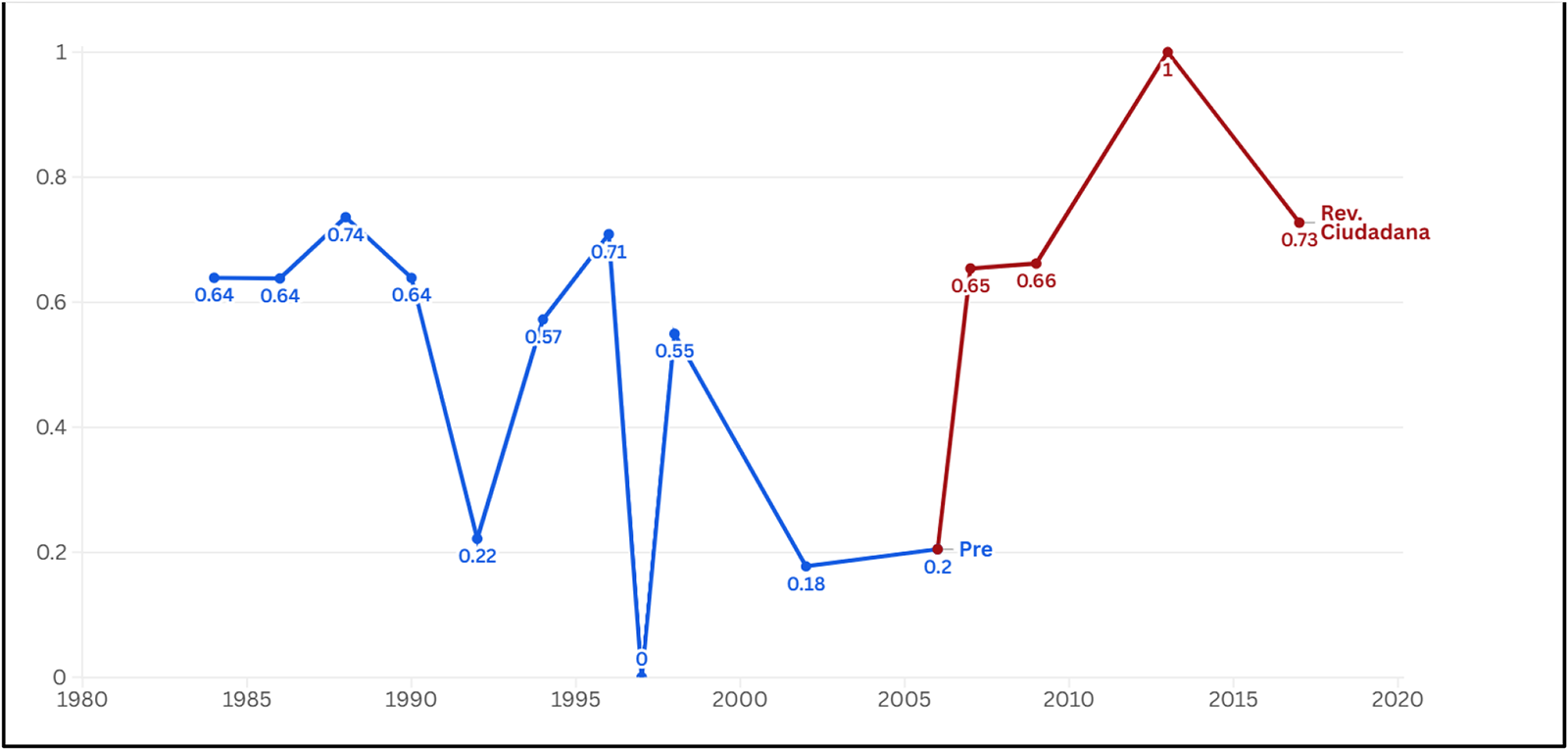
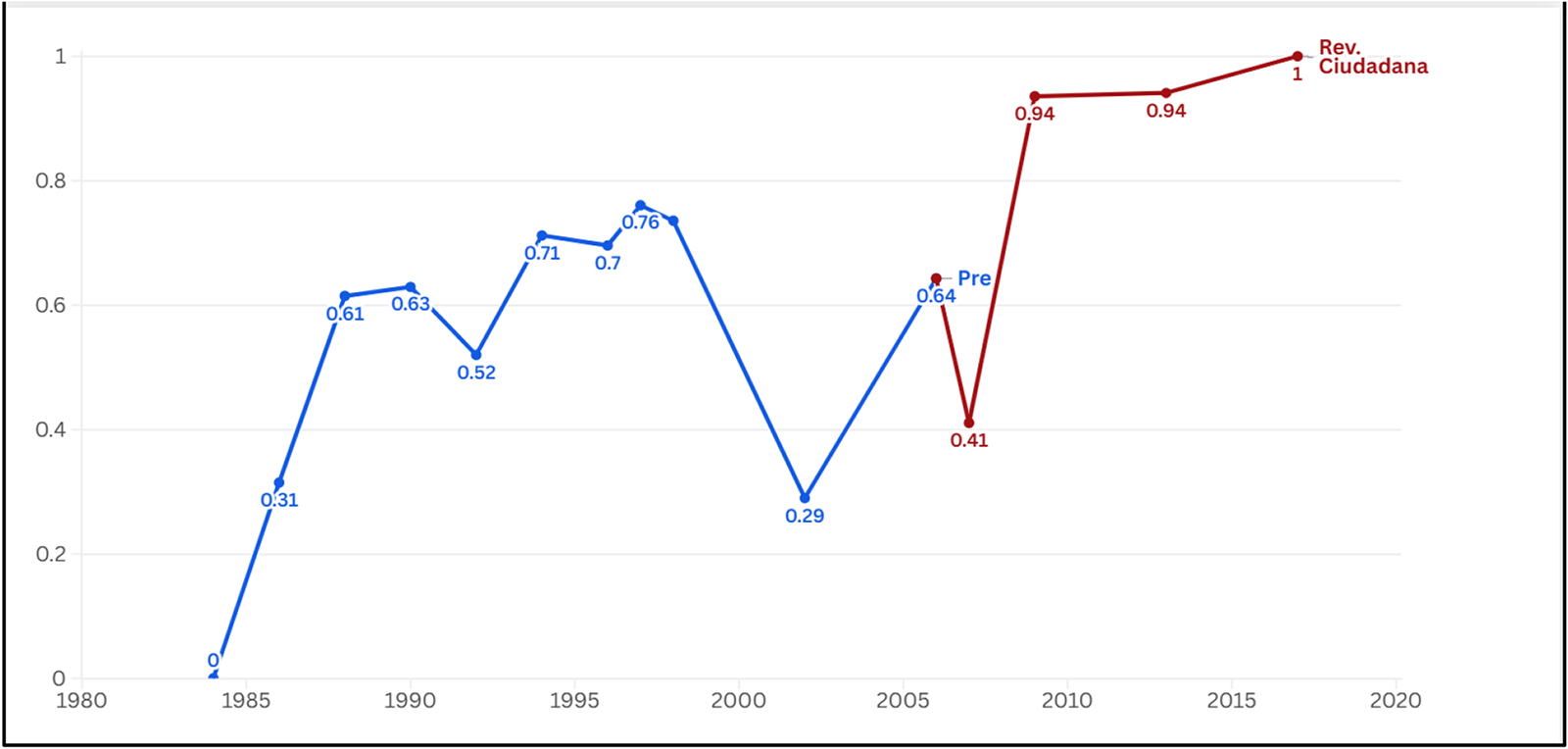
Figures 1 and 2, which plot indices of Party Institutionalisation (PI) and Party System Institutionalisation (PSI), illustrate the Citizens’ Revolution coinciding with a strengthening of both dimensions, with PI primarily driven by PAIS’s high levels of routinisation and electoral support.
In other words, these figures indicate a strengthening of one of the institutions identified by Morlino as a likely anchor: the political party. The widespread anti-political sentiment in Ecuador during the early 2000s, combined with the anti-system platform on which PAIS campaigned in 2006, suggests that PAIS supporters were more likely to harbour anti-democratic attitudes. It is therefore plausible to posit that, if PAIS indeed exercised an anchoring effect within Ecuadorian society, such effects would be clearly observable among its sympathisers. Moreover, in light of the reviewed literature, Ecuador as a case study is particularly compelling because it differs from the actors studied in relation to the moderation thesis. PAIS, far from being a religious or radical-right actor, had embraced a radical-left ideology (Roberts, Reference Roberts2015).
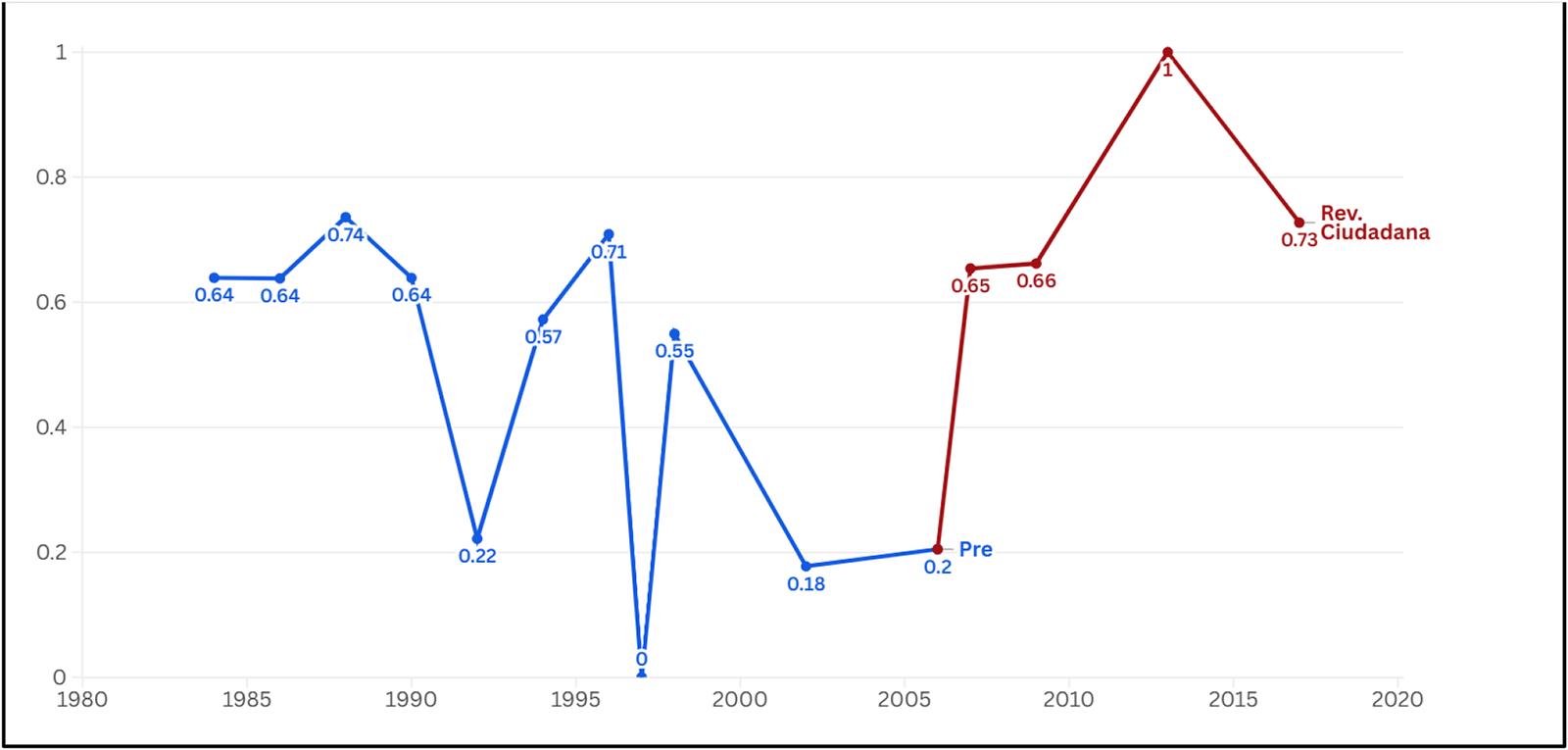
Index of PSI in Ecuador.Footnote 2
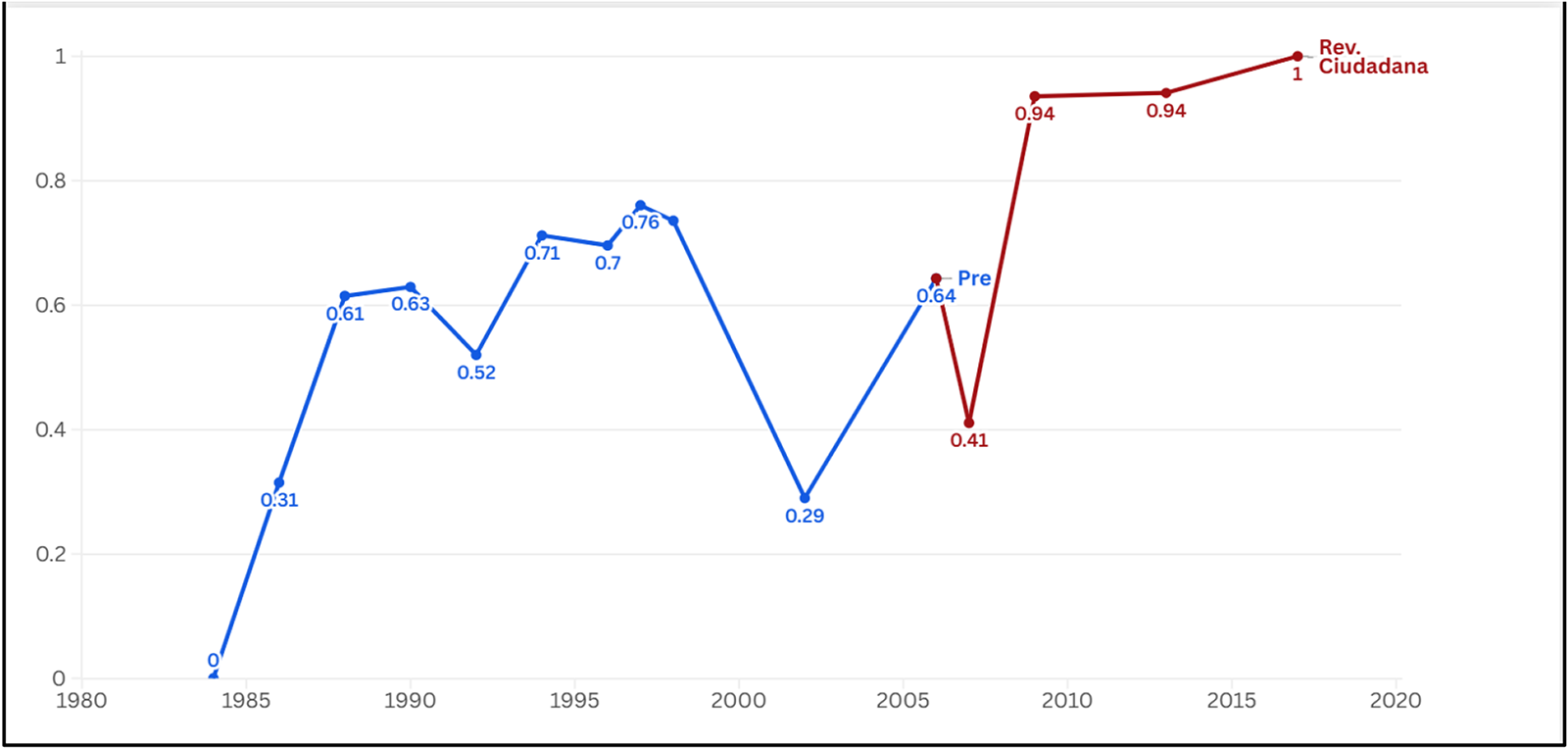
At the same time, some other factors prevent the Citizens’ Revolution from being a ‘perfect’ case to study moderation. Unlike many instances in which anti-system parties spend considerable time in opposition, PAIS entered office immediately, forming a governing coalition involving limited participation by minor partners. Consequently, any eventual moderation could not have been the by-product of opposition dynamics, identified by some authors as impactful. In particular, given the strongly personalised leadership of the party and the absence of a cordon sanitaire, ideological moderation is not expected (Bernhard, Reference Bernhard2020). Nevertheless, moderation as a progressive embrace of democratic attitudes (anchoring) remains possible (Harteveld et al., Reference Harteveld, Kokkonen and Linde2021). These and other expectations are formalised more explicitly in the following section.
Hypotheses
As noted before, anchoring refers to the process by which anti-democratic sentiments are channelled by top-down institutions and gradually moderated (Morlino, Reference Morlino2005). Yet in the early 2000s, Ecuador’s democratic stability appeared to be primarily threatened by periodic mass mobilisation driven by widespread anti-establishment sentiments, rather than by an outright rejection of democratic principles. In this context, PSP, PRIAN, and PAIS emerged and expanded their influence by seeking to capitalise on these dynamics. From this perspective, two questions arise with regard to the adopted framework: were these parties able to integrate the more anti-system sectors of the population into the democratic game? And was this anti-political sentiment evolving into outright anti-democratic sentiment? Their underlying logic was that these new parties were more likely to gain the support of anti-establishment voters, rather than anti-democrats, yet in doing so they could still have performed a democratic anchoring function.
The first and preliminary step thus involves identifying those parties that in Ecuador might have functioned as the primary anchors of the anti-system vote:
H1: Supporters of PAIS, PSP, or PRIAN show higher anti-establishment attitudes than supporters of Democratic Left (ID), Christian Social Party (PSC), or Popular Democracy (PD).Footnote 3
However, regarding the answer to the second question, the literature on political attitudes suggests that abstract support for democracy, anti-establishment sentiments, and support for one country’s democracy are only contingently correlated (Schedler and Sarsfield, Reference Schedler and Sarsfield2007; Bryan, Reference Bryan2023). Morlino (Reference Morlino1998: 125–128), after comparing Italian citizens’ attitudes towards democracy and their country’s politics, for instance, found no connection between the two dimensions. Still, given the duration and intensity of the political crisis in Ecuador, we can expect that:
H2: Ecuadorians expressing stronger anti-establishment attitudes in 2006 were more likely to exhibit both lower specific support and diffuse support for democracy.
After testing the previous hypotheses, we would know whether PAIS stabilised Ecuador’s regime by channelling anti-establishment sentiment and, indirectly, by anchoring citizens with anti-regime attitudes. Even if this were the case, however, it would still not be sufficient for accepting PAIS as a proper anchor of democratic consolidation. Anchoring is a diachronic process unfolding across multiple electoral cycles. If the moderation-through-inclusion mechanism posited by Morlino occurred in Ecuador, we would expect citizens who identified with PAIS to gradually reduce their rejection of the political system and/or the democratic regime.
H3: The longer PAIS participates in the democratic game, the lower the levels of anti-establishment and anti-democratic attitudes among its supporters.
The literature also highlights that individuals’ satisfaction with democracy in their country tends to increase when their preferred party is in government (Ridge, Reference Ridge2023). This process may also extend to the level of abstract support for democracy. If, following the testing of Hypothesis 3, we find that individuals sympathizing with PAIS increase their support for the regime while the party is in power, it will be necessary to distinguish between a partisan incumbency bias and a genuine process of moderation.
H4: This moderation is observable net of partisan-incumbency effects and should persist, to a degree, even after PAIS moves to opposition.
This can be evaluated by analysing the attitudes of PAIS supporters before and after the party held power, and by comparing these trends with those of non-PAIS supporters. The following section illustrates how this and the other hypotheses are tested.
Methodology
The time frame of our study, 2006–2017, is considerably more limited than that examined by Morlino (1950–1998). Yet it should be noted that the PCI’s moderation process, from the death of the Stalinist leader Palmiro Togliatti in 1964 to the reaching of the ‘historic compromise’ between Enrico Berlinguer’s PCI and Christian Democracy (DC) in 1973, unfolded over roughly 10 years. This period is comparable to the time needed for Correísmo to establish itself as the hegemonic force of the Ecuadorian left.
The study’s first hypothesis does not address democratic consolidation as ‘habituation’ directly, but rather seeks to establish the role that the new generation of Ecuadorian parties played in stabilizing the regime by channelling anti-establishment sentiment into the political arena. To test this, we rely on public opinion data collected by the Latinobarómetro survey. Their questionnaires are the only ones that include PAIS in items related to political party support in 2006. Specifically, we estimate a series of binary logistic regression models examining whether intentions to vote for PAIS, PSP, or PRIAN are significantly associated with indicators of anti-establishment sentiment. These are measured using three items: P22ST.B (‘The government seeks the welfare of the people’), P20STM (‘The country is governed for the benefit of the powerful’), and P32ST.A (Confidence in government, reverse-coded). Socio-demographic characteristics and context-relevant political values serve as control variables. Examples of political values and attitudes included as control variables are: attitudes toward the United States (measured from high to low; “US attitudes”), left–right ideological self-placement (“Right-wing”), perceptions of the country’s economic trajectory (“Positive economic trajectory”), and perceptions of the household economic situation (“Subjective economic fragility”).
As in Morlino’s seminal work (Morlino, Reference Morlino1998), the next step assesses the relationship between anti-political/system sentiments and anti-regime attitudes. The aim is to determine whether the linkages identified in testing H1 between new parties and anti-system citizens also implied the anchoring of individuals more likely to hold anti-democratic attitudes. To examine this dimension, a series of linear regressions was conducted to assess whether anti-establishment attitudes are correlated with democratic attitudes. The dependent variables capture three dimensions of democratic legitimacy, all of which were used in Morlino’s study for the same operationalisation purpose: (1) abstract regime support (the Churchill-quote item: democracy has flaws but remains the best system) (Schedler and Sarsfield, Reference Schedler and Sarsfield2007), (2) specific support (satisfaction with Ecuadorian democracy) (Hobolt, Reference Hobolt2012), and (3) preference for democracy over authoritarian alternatives (Morlino, Reference Morlino1998). Dependent and independent variables are again adopted from the Latinobarómetro 2006 survey.
Once the relationship between anti-establishment and anti-democratic attitudes has been established, it is examined whether anti-democratic attitudes significantly predict support for the newly established Ecuadorian parties, thereby testing a more direct form of anchoring. To do so, a series of binary logistic regressions is estimated, with voting intention as the dependent variable, following the specification of the models employed to test Hypothesis 1. However, this time, the three dimensions of democratic legitimacy are included as independent variables as well.
As mentioned earlier, PAIS may have anchored some citizens holding anti-democratic attitudesFootnote 4; the previous analysis assesses this possibility. However, to determine whether this relationship was followed by a genuine process of moderation (as hypothesised in H3), it is necessary to adopt a diachronic perspective. To conduct this analysis, an OLS model including survey-wave fixed effects is estimated for each of the three dimensions of democratic support. The model specification is as follows:
 \begin{equation*}{Y_{is}}\, = \,{\beta _0}\, + \,{\beta _1}\,\cdot{\text{PAI}}{{\text{S}}_{is}}\, + \,{\Sigma _j}\,{\delta _j}\,\cdot{\text{wav}}{{\text{e}}_{js}}\, + \,{\Sigma _j}\,{\theta _j}\,\cdot({\text{PAI}}{{\text{S}}_{is}}\,\, \times \,{\text{wav}}{{\text{e}}_{js}})\, + \,\gamma '{X_{is\,}} + \,{\varepsilon _{is}}\end{equation*}
β₁ captures the association between PAIS identification and the dependent variable in the baseline survey wave (2008), net of wave and controls, while the wavejs dummies and their coefficients δj account for shifts in democratic attitudes common to all respondents in a given wave relative to the 2008 baseline, independent of party identification. Xᵢs denotes the vector of individual-level controls. The key parameters are the interaction coefficients θj, which indicate whether the PAIS–attitude association itself grows stronger, weaker, or reverses in later waves compared to 2008. Dependent and independent variables were drawn from LAPOP surveys from 2008 to 2016, which include measures of party identification. Despite being drawn from a different survey project, the items of democratic support match those of Latinobarómetro, although the control variables differ slightly. The changes in item selection were necessary to ensure consistency across survey waves, as the questionnaire underwent several modifications over the two decades covered by our timeframe.
Finally, the last part of the study assesses the extent to which the moderation identified in the previous step may stem from a partisan bias (H4). To do so, we employ a difference-in-differences (DiD) design. The DiD model examines whether the change in democratic attitudes among PAIS/RC sympathisers before and after 2018 differed significantly from that of non-supporters, net of individual-level control variables such as age, education, gender, town size, and economic perceptions. The DiD specification was:
 \begin{equation*}{Y_{is\,}} = \,{\beta _0}\, + \,{\beta _1}\,\cdot{\text{PAI}}{{\text{S}}_{i\,}} + \,{\beta _2}\,\cdot{\text{Post}}{2017_{s\,}} + \,{\beta _3}\,\cdot({\text{PAI}}{{\text{S}}_i}\, \times \,{\text{Post}}{2017_s})\, + \,\gamma '{X_{is\,}} + \,{\varepsilon _{is}}\end{equation*}
In this analysis, PAIS sympathisers are treated as the treatment group, as they are the respondents most directly exposed to the political shock represented by the party’s loss of power. Respondents who do not identify with the electoral vehicle of correísmo serve as the control group. The treatment is Correa’s removal from government in 2017, assumed to bring Correístas’ partisan bias to the forefront. This design follows Liu et al. (Reference Liu, Su and Wu2023), who examine changes in liberal values in China before and after 2012, positing that media consumers were more affected by the rise in propaganda following Xi Jinping’s election. For the DiD analysis, all LAPOP survey waves from 2008 to 2023 are used, with two exceptions. The 2021 wave is excluded because key items were dropped due to COVID-19-related questionnaire shortening, and the 2019 wave is omitted due to the near disappearance of PAIS sympathisers following the party’s co-optation by anti-Correísta forces.Footnote 5
Results
Anti-system sentiment and party anchoring
In the development of the study’s arguments, we painted the Ecuadorian electorate at the dawn of the Revolucion Ciudadana as largely anti-establishment, given the preceding period of instability. Latinobarómetro data largely supports this interpretation. When Ecuadorians were asked in 2006 about their level of confidence in the country’s main political institutions, respondents with some or high confidence were between 30% and 10% below the regional average. Ecuadorians were also less likely to believe that their country was ruled in the citizens’ interests (Table 1). A decade later, this pattern had reversed. Ecuadorians expressed higher levels of institutional confidence than the regional mean, defying the broader trend of increasing disillusionment across Latin America. The remaining question, then, is whether the concurrent trajectory of PI contributed meaningfully to this shift by increasing the pro-regime and systemic sentiments of previously disenfranchised voters.
Anti-system sentiment in Ecuador and Latin AmericaFootnote 6

Table 1 Long description
Survey percentages compare Ecuador and the Latin America regional average in 2006 and 2016 on perceptions of whom government serves and confidence in government, parties, and parliament. In Ecuador, the share saying government rules for the powerful drops from 86.4% in 2006 to 63.3% in 2016. Over the same period, confidence rises in Ecuador: government from 10.6% to 39.5%, parties from 15.0% to 27.2%, and parliament from 8.7% to 34.4%. Regionally, the belief that government rules for the powerful increases from 73.1% in 2006 to 77.3% in 2016, while confidence declines: government from 44.4% to 28.5%, parties from 22.8% to 17.2%, and parliament from 30.5% to 25.6%. For government ruling for people’s welfare, values are provided only for 2006: Ecuador 43.7% and Latin America 61.3%. Ecuador’s 2016 confidence levels exceed the regional averages despite still high perceptions that government serves the powerful. Ecuador estimates have a larger sampling error than the regional averages, so small differences should be interpreted cautiously.
Source: Latinobarómtero (2006; 2016).
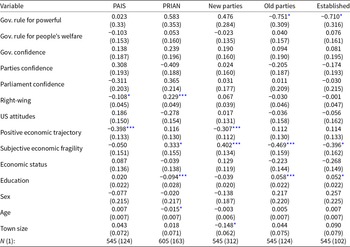
To address this question and therefore test H1, five binary logistic regression models were estimated. Respondents were asked which party they would vote for if elections were held within a week. In Models 1 and 2, the dependent variable was coded 1 if the respondent intended to vote for PAIS or PRIAN, respectively, and 0 otherwise. Model 3 aggregated support for PAIS, PRIAN, and PSP as a single category of ‘new’ parties. Model 4 coded a vote for parties that existed before the political crisis as 1,Footnote 7 and all others as 0. Because some of these older parties, such as the Democratic People’s Movement (MPD) and Pachakutik, had long campaigned on anti-establishment platforms, Model 5 restricted the dependent variable to clearly pro-systemic parties (ID, Partido Roldosista Ecuatoriano [PRE], and PSC).
Independent variables include some of the anti-system items listed in Table 1, supplemented with additional value indicators, ideological self-placement, and distrust of the United States, given that PAIS and PRIAN both campaigned as anti-establishment forces but differed on these two dimensions. Standard socio-demographic predictors of vote choice (age, education, sex, among others) were included as controls.
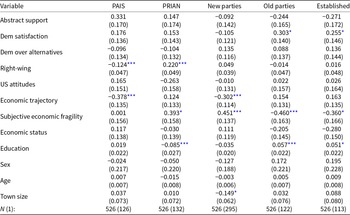
Consistent with expectations, left-leaning respondents are significantly more likely to vote for PAIS. At the same time, we observe a positive correlation between right-wing orientations and voting for PRIAN, suggesting some degree of programmatic identification.
What does not emerge from Table 2 is a clear link between low levels of trust in the traditional institutions of liberal representation, namely political parties and parliament, and support for the new parties. The only partial exception is the perception that political elites act primarily in their own corporatist interests. This variable appears, in fact, to be borderline significant and negatively associated with voting for traditional parties. Subjective economic considerations emerge as the factor truly structuring the divide between pro- and anti-establishment camps.
Pro-/anti-system vote in the 2006 elections
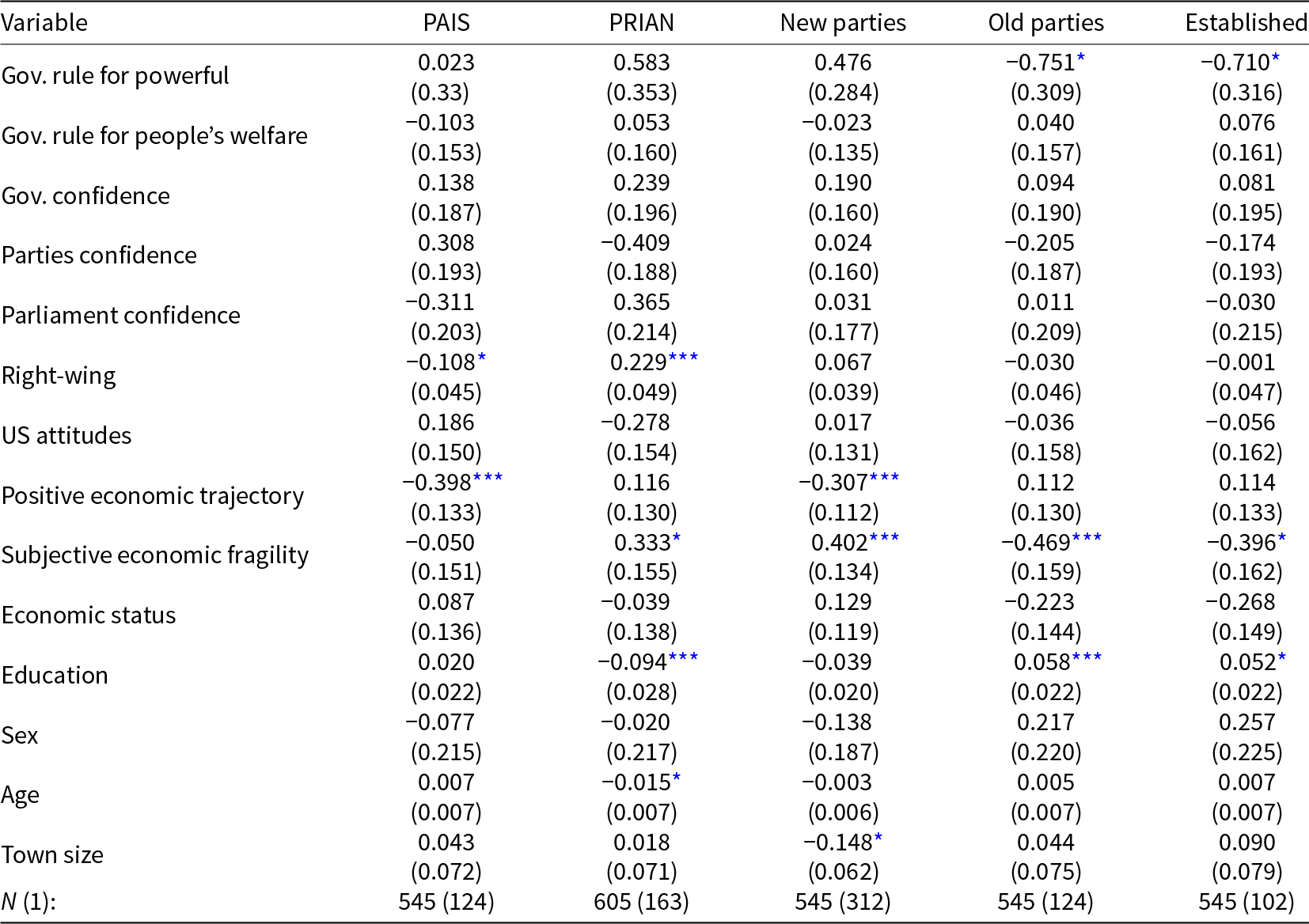
Table 2 Long description
Regression coefficients (with standard errors in parentheses and significance marked by stars) compare predictors of voting across PAIS, PRIAN, New Parties, Old Parties, and Established. “Government rules for the powerful” is strongly negative for Old Parties (about minus 0.75, significant) and Established (about minus 0.71, significant), but positive for PRIAN (about 0.58) and New Parties (about 0.48). Ideology differs most for PRIAN, where right-wing identification is positive and highly significant (about 0.23), while PAIS shows a small negative significant association (about minus 0.11). Economic perceptions also separate groups: a positive economic trajectory is negative and highly significant for PAIS (about minus 0.40) and New Parties (about minus 0.31), while subjective economic fragility is positive for PRIAN (about 0.33, significant) and New Parties (about 0.40, highly significant) but negative for Old Parties (about minus 0.47, highly significant) and Established (about minus 0.40, significant). Education is negative and highly significant for PRIAN (about minus 0.09) but positive and significant for Old Parties (about 0.06) and Established (about 0.05). Confidence measures (government, parties, parliament) and US attitudes show mixed, mostly non-significant patterns across groups. Sample sizes are roughly mid-500s per model, with subgroup counts shown in parentheses.
Note: * p<0.05; ** p<0.01; *** p<0.001.
Source: Author from Latinobarómetro (2006).
Anti-regime sentiment and party democratic anchoring
Table 3 sheds light on levels of democratic regime legitimacy. Similar to the anti-system sentiments, both specific support for democracy and preference for democracy over alternatives were below the regional average at the outset of the Citizens’ Revolution. By 2016, however, these indicators had not only converged with the average but, in some cases, surpassed it. The Citizens’ Revolution thus appears to have shielded the Ecuadorian population from broader regional declines in democratic support. The key question, once again, is the extent to which this outcome can be attributed to the potential anchoring role of PAIS.
Regime sentiment in Ecuador and Latin Americaa

Table 3 Long description
Survey percentages compare Ecuador and the Latin America regional average in 2006 and 2016 on three attitudes: viewing democracy as the best regime, satisfaction with democracy, and preferring democracy over alternatives. In Ecuador, “democracy best regime” increases from 70.9 percent in 2006 to 80 percent in 2016. Ecuador’s satisfaction with democracy rises from 23 percent to 42 percent, and preference for democracy over alternatives rises from 59 percent to 69.8 percent. For Latin America overall, “democracy best regime” is essentially unchanged, moving from 79.2 percent in 2006 to 79.1 percent in 2016. Regional satisfaction declines from 41.4 percent to 35.3 percent, and preference for democracy declines from 68.1 percent to 58.1 percent. By 2016, Ecuador reports higher satisfaction and higher preference for democracy than the regional average, but slightly lower agreement that democracy is the best regime. Results are descriptive percentages and may be influenced by survey sampling and question wording across years and countries.
a Sample sizes are virtually the same as those in Table 1.
Source: Latinobarómetro (2006; 2016).
Before examining the role of PAIS in democratic anchoring (H3) and the interconnectedness between democracy-related and systemic attitudes (H2), Table 3 presents another notable pattern: the high abstract support for democracy in 2006, despite the country’s political crisis. The deteriorating political conditions and austerity measures thus seemed to have impacted how people perceived democracy in their country, but not their view of democracy as a regime. In this sense, Correa’s framing of his illiberal political project as a deepening of democracy rather than an alternative to it might have resonated with the broader public sentiment.
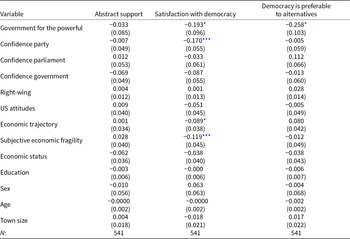
As shown in the previous table, individuals expressing stronger anti-system attitudes were not more likely to vote for the new parties in general, nor for PAIS specifically (Table 2). This would constitute only a minor issue for our thesis if low institutional trust and negative attitudes towards political elites were not clearly associated with explicitly anti-democratic attitudes, and if PAIS had nevertheless been able to attract voters holding stronger anti-democratic views. To assess the first proposition, and thereby test H3, three linear regression models were estimated and their outcome presented in Table 4. The dependent variables correspond to Table 3 items, while the independent variables are from the binary logistic models whose outcomes are reported in Table 2
Link between anti-system and pro-democracy sentiments in 2006
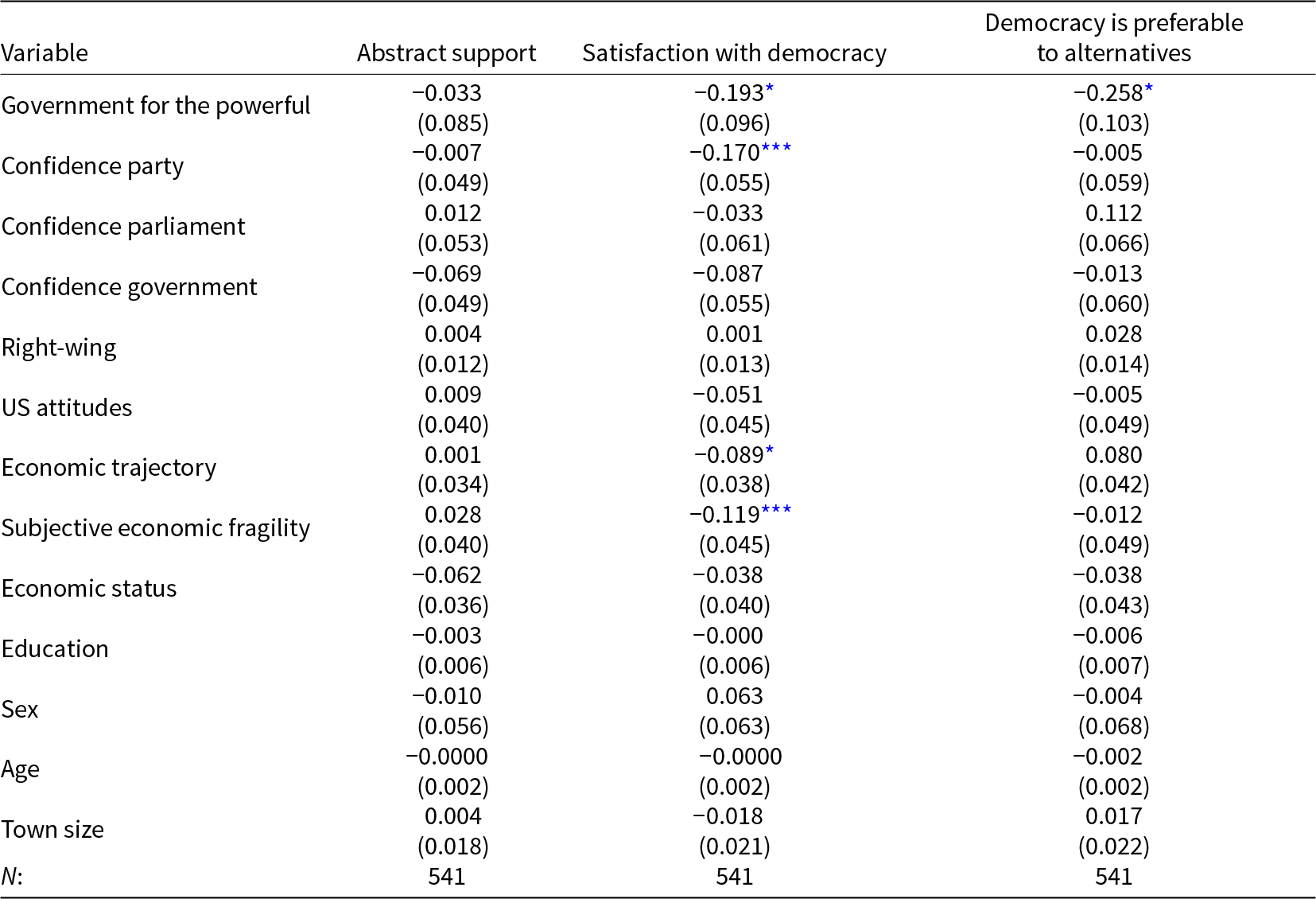
Table 4 Long description
Regression results for 2006 relate several anti-system attitudes and demographics to three outcomes: abstract support for democracy, satisfaction with democracy, and believing democracy is preferable to alternatives. Significant negative links with satisfaction appear for believing government serves the powerful (about minus 0.19), low confidence in parties (about minus 0.17), worse economic trajectory (about minus 0.09), and subjective economic fragility (about minus 0.12). For the belief that democracy is preferable, only the “government for the powerful” measure shows a significant negative association (about minus 0.26). Abstract support shows no statistically significant associations across the listed predictors. Most other variables, including confidence in parliament or government, ideology, education, sex, age, and town size, have small and non-significant coefficients in these models. Standard errors are reported in parentheses and significance is indicated by asterisks, so results describe associations rather than causal effects. Sample size is 541 for each outcome.
Note: *p<0.05; **p<0.01; *** p<0.001.
Source: Author from Latinobarómetro (2006).
.
Supporting our interpretation of Table 3, while abstract support for democracy does not appear to be systematically associated with economic perceptions or political values, satisfaction with democracy does. Moreover, a series of significant correlations that were not present in Morlino’s original research have been found, namely the correlation between seeing the government as ruling for the powerful and being less satisfied with how democracy functions, and between the latter and commitment to democracy over alternatives. In line with previous findings from the literature, it can thus be argued that the country’s economic and political context tended to influence levels of specific support for democracy, but not abstract support (Christmann, Reference Christmann2018).
Anti-political sentiments, rather than low trust in democratic institutions, appear from the previous results to be associated with anti-democratic attitudes, while abstract support for democracy remains largely independent from the other dimensions. The next step is to examine whether the emergence of PAIS and PRIAN allowed for the integration of citizens holding such attitudes. To assess it, the binary logistic models in Table 2 are re-estimated, replacing anti-establishment indicators with measures of regime legitimacy.
Even when the main independent variables are changed, those retained remain significant across Tables 2 and 5, supporting our previous findings and interpretations. The democratic dimensions included in our models are not associated with the likelihood of (non)supporting PAIS or other new parties, although satisfaction with democracy is linked to voting for establishment parties. These results align with recent studies suggesting that anti-democratic views are only weakly related to support for radical and populist parties (Trüdinger and Bächtiger, Reference Trüdinger and Bächtiger2023; Zaslove and Meijers, Reference Zaslove and Meijers2024). However, they also run counter to the idea of PAIS acting as an effective anchor of democratic consolidation, as the party does not appear to have incorporated into the democratic arena either citizens most prone to disloyal attitudes towards the regime or those more likely to hold anti-establishment views.
Pro-/anti-regime vote in the 2006 elections
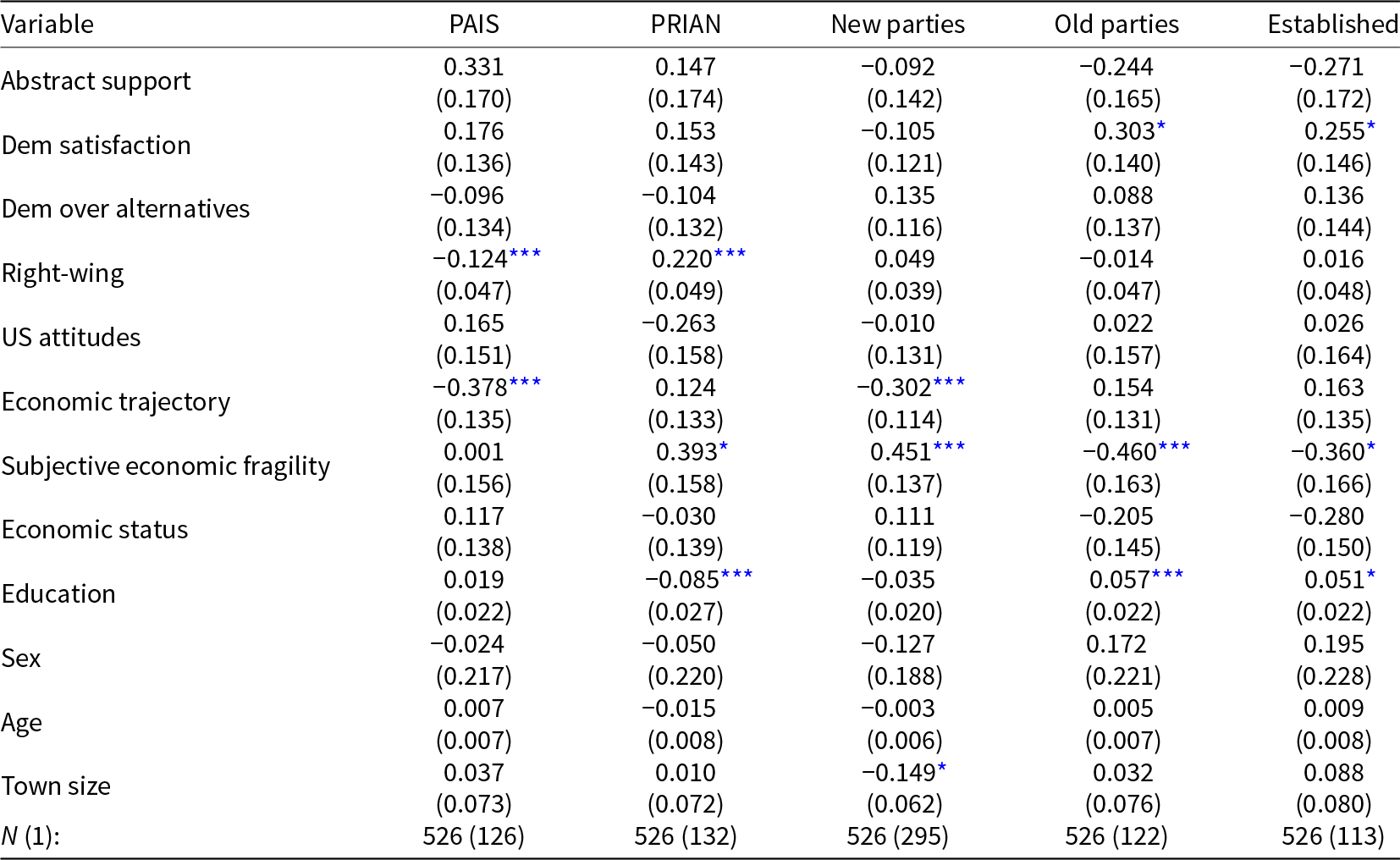
Table 5 Long description
Regression coefficients compare how attitudes and demographics relate to voting for five party groupings: PAIS, PRIAN, New Parties, Old Parties, and Established. Economic trajectory shows the clearest pattern: it is strongly negative for PAIS and New Parties, but positive for Old Parties and Established. Subjective economic fragility moves in opposite directions across blocs, with a strong positive association for New Parties and a strong negative association for Old Parties and Established; PRIAN is also positive. Ideology is sharply split: identifying as right-wing is strongly negative for PAIS and strongly positive for PRIAN, while effects for the other party groups are small. Democratic satisfaction is positive for Old Parties and Established but slightly negative for New Parties; preference for democracy over alternatives shows small effects across all groups. Education is negatively associated with PRIAN but positively associated with Old Parties and Established; town size is modestly negative for New Parties. Several variables, including abstract support, US attitudes, sex, and age, show small or inconsistent associations, and only starred coefficients should be treated as statistically reliable; sample size is 526 with different subgroup counts by party.
Note: *p<0.05; **p<0.01; ***p<0.001.
Source: Author from Latinobarómetro (2006).
Processes of moderation and the role of partisan bias
The introduction showed that PI increased during the Citizens’ Revolution, and so did the support for democracy. However, there is no evidence that individuals with lower democratic support were more likely to vote for PAIS. Still, it remains possible that PAIS contributed indirectly by reinforcing the democratic attitudes of citizens already supportive of democracy or by shielding its supporters from rising anti-democratic attitudes. To examine this possibility, the final set of linear regressions (Table 6) introduces a temporal dimension.
PAIS support and anchoring
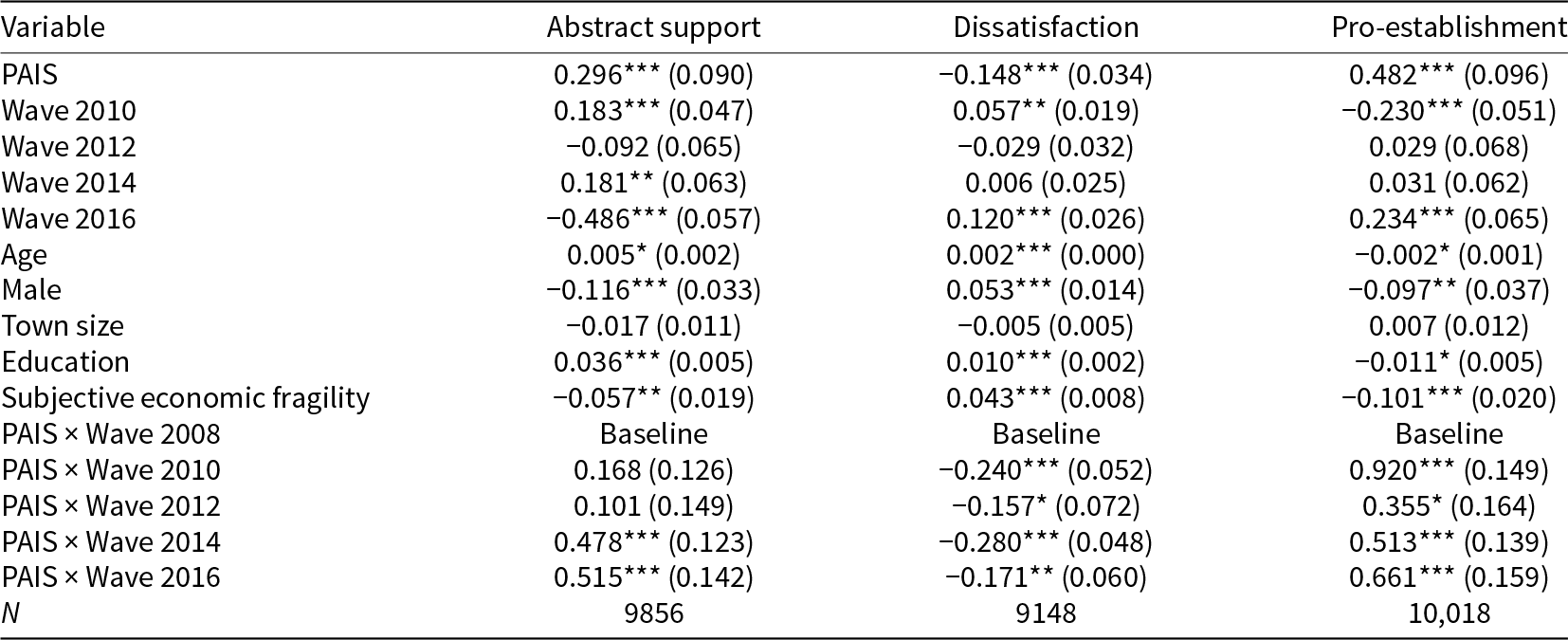
Table 6 Long description
Regression coefficients with standard errors are reported for three outcomes: abstract support, dissatisfaction, and pro-establishment attitudes, using PAIS, survey wave indicators, demographics, and PAIS-by-wave interactions. PAIS shows positive associations with abstract support (0.296, statistically significant) and pro-establishment attitudes (0.482, statistically significant), and a negative association with dissatisfaction (minus 0.148, statistically significant). Compared with the 2008 reference wave, wave 2016 is linked to much lower abstract support (minus 0.486, statistically significant) and higher dissatisfaction (0.120, statistically significant), while also higher pro-establishment attitudes (0.234, statistically significant). Interaction terms indicate PAIS effects vary by wave: for pro-establishment attitudes, PAIS is especially strong in 2010 (0.920, statistically significant) and remains positive and significant in 2014 (0.513) and 2016 (0.661). For dissatisfaction, PAIS-by-wave interactions are consistently negative and significant from 2010 through 2016, suggesting PAIS is associated with lower dissatisfaction in those years relative to 2008. Control variables show small but significant patterns: age slightly increases abstract support and dissatisfaction while slightly decreasing pro-establishment; men report lower abstract support and pro-establishment but higher dissatisfaction; education increases abstract support and dissatisfaction and slightly lowers pro-establishment; subjective economic fragility reduces abstract support and pro-establishment and increases dissatisfaction. Sample sizes differ by model, with about 9,148 to 10,018 observations.
Note:*p<0.05; **p<0.01; ***p<0.001.
Source: Author from LAPOP (2008; 2010; 2012; 2014; 2016).
Although PAIS voters in 2006 were not more anti-democratic or anti-establishment than the average Ecuadorian, individuals who later identified with the party reported higher satisfaction with democracy, stronger abstract support for democracy, and greater belief in elite responsiveness (Table 6), suggesting a potential democratizing effect of party identification. Because the data are not longitudinal, it is unclear whether early supporters became more democratic over time or whether PAIS increasingly attracted individuals with stronger democratic commitments. Most plausibly, both dynamics were at play.
The pattern just observed regarding specific support for democracy and pro-establishment sentiments (Table 6) can, however, also be explained by a standard partisan bias. Significant attachment to the governing party may lead its supporters to downplay negative government performance and increase their support for democracy (Bryan, Reference Bryan2023). To disaggregate the potential partisan bias from the results presented in Table 6, we conducted the aforementioned DiD analysis. The results are reported in Table 7, and the trends are plotted in Figure 4.
Beforehand, Figure 3 visually assesses the parallel trends assumption underlying the DiD model by comparing the trajectories of the outcomes across the two groups, ‘party sympathizers’ and ‘others’. This assumption is necessary to ensure the internal validity of DiD estimates, as it requires that, in the absence of treatment, the difference between the treatment and control groups would be parallel over time. Admittedly, only one of the three dimensions considered, citizens’ abstract support for democracy, appears to satisfy the condition. Indeed, with respect to this dimension, the treated and control groups display broadly similar trajectories before the treatment period.Footnote 8
Pre-treatment parallel trends assumption.
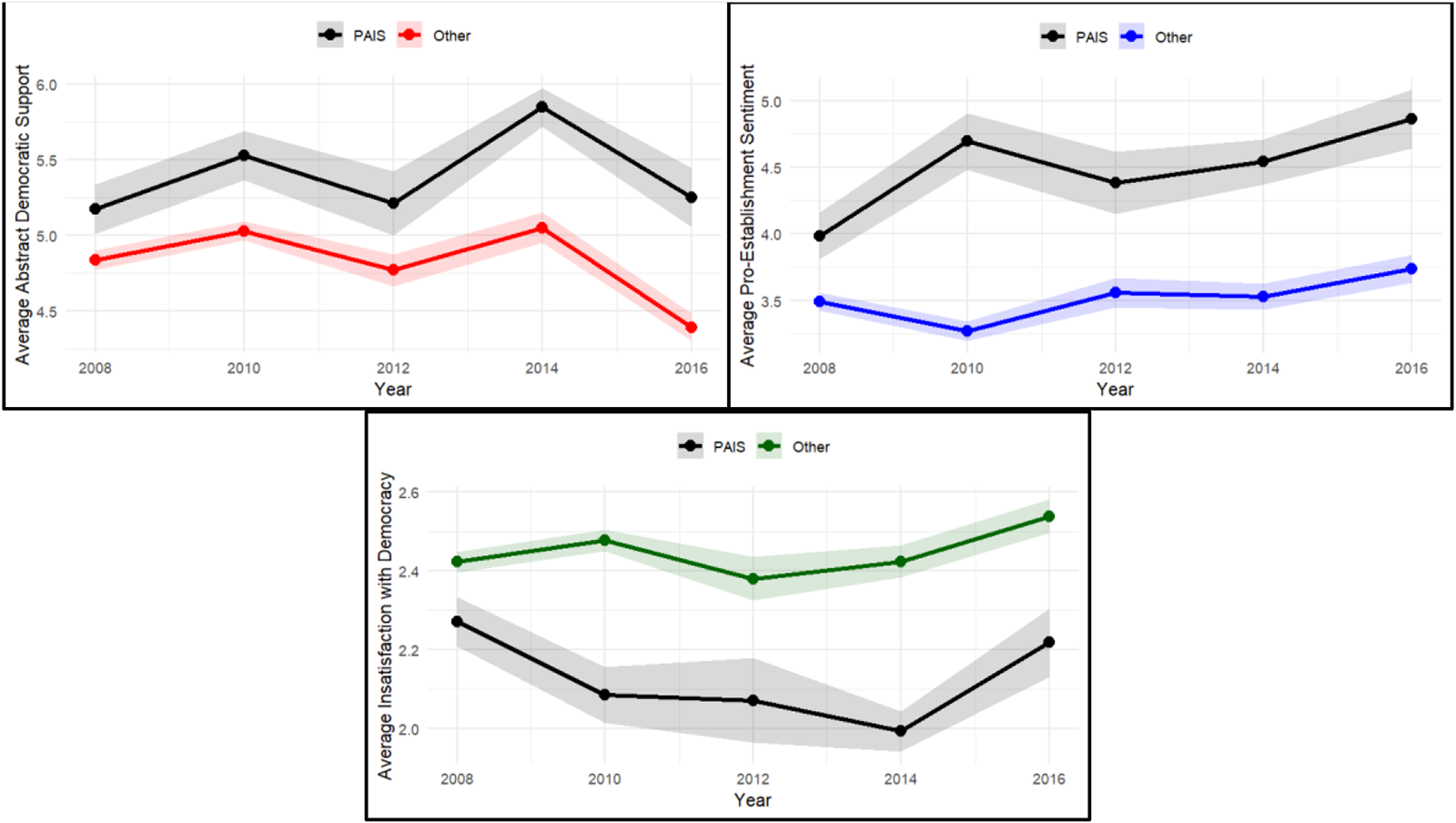
Figure 3 Long description
Panel 1: Average abstract support for democracy. X-axis: Year (2008, 2010, 2012, 2014, 2016). Y-axis: Average abstract support score. Pub group shows a decline from 2008 to 2010, then a rise to 2016. Other group follows a similar trend but remains higher throughout. Major peak for Pub in 2016, major low in 2010. Panel 2: Average political system support. X-axis: Year (2008, 2010, 2012, 2014, 2016). Y-axis: Average political system support score. Pub group shows a steady increase from 2008 to 2016. Other group remains lower but follows a similar upward trend. Major peak for Pub in 2016. Panel 3: Average satisfaction with democracy. X-axis: Year (2008, 2010, 2012, 2014, 2016). Y-axis: Average satisfaction score. Pub group shows fluctuations with a peak in 2010 and a low in 2012. Other group remains higher with less variation. Lines are visually distinguished by color: Pub in black, Other in gray. The graphs illustrate differences in support and satisfaction metrics over time between the two groups.
The DiD analysis was nonetheless conducted for all trends (Table 7). However, given the considerations discussed above, only the model concerning abstract democratic support can be interpreted as a statistically valid DiD estimate.
Difference-in-differences (DiD) results

Table 7 Long description
Difference-in-differences estimates are reported for three political attitude outcomes, alongside their p values. Pro-establishment attitudes show the largest shift, decreasing by about 0.96, with a p value below 0.001. Absolute democratic support also decreases, by about 0.56, with a p value of 0.004. Dissatisfaction with democracy moves in the opposite direction, increasing by about 0.55, with a p value below 0.001. All three results are statistically significant at conventional thresholds, with the strongest evidence for the pro-establishment and dissatisfaction outcomes. The direction of change suggests reduced support for democracy and establishment alignment, alongside higher dissatisfaction, but the table does not provide confidence intervals, sample sizes, or model controls needed to judge precision and robustness.
Source: Author from LAPOP (2008; 2010; 2012; 2014; 2016; 2023).
DiD results aside, the plot in Figure 4 still largely supports the interpretation that a partisan effect is at work. Following the ousting of Correa, PAIS and RC sympathisers exhibited declining satisfaction with the regime, mirroring trends in the general population, to the point that by 2023, they were significantly more anti-democratic than non-RC supporters.
Democratic attitudes: group differences post-treatment.
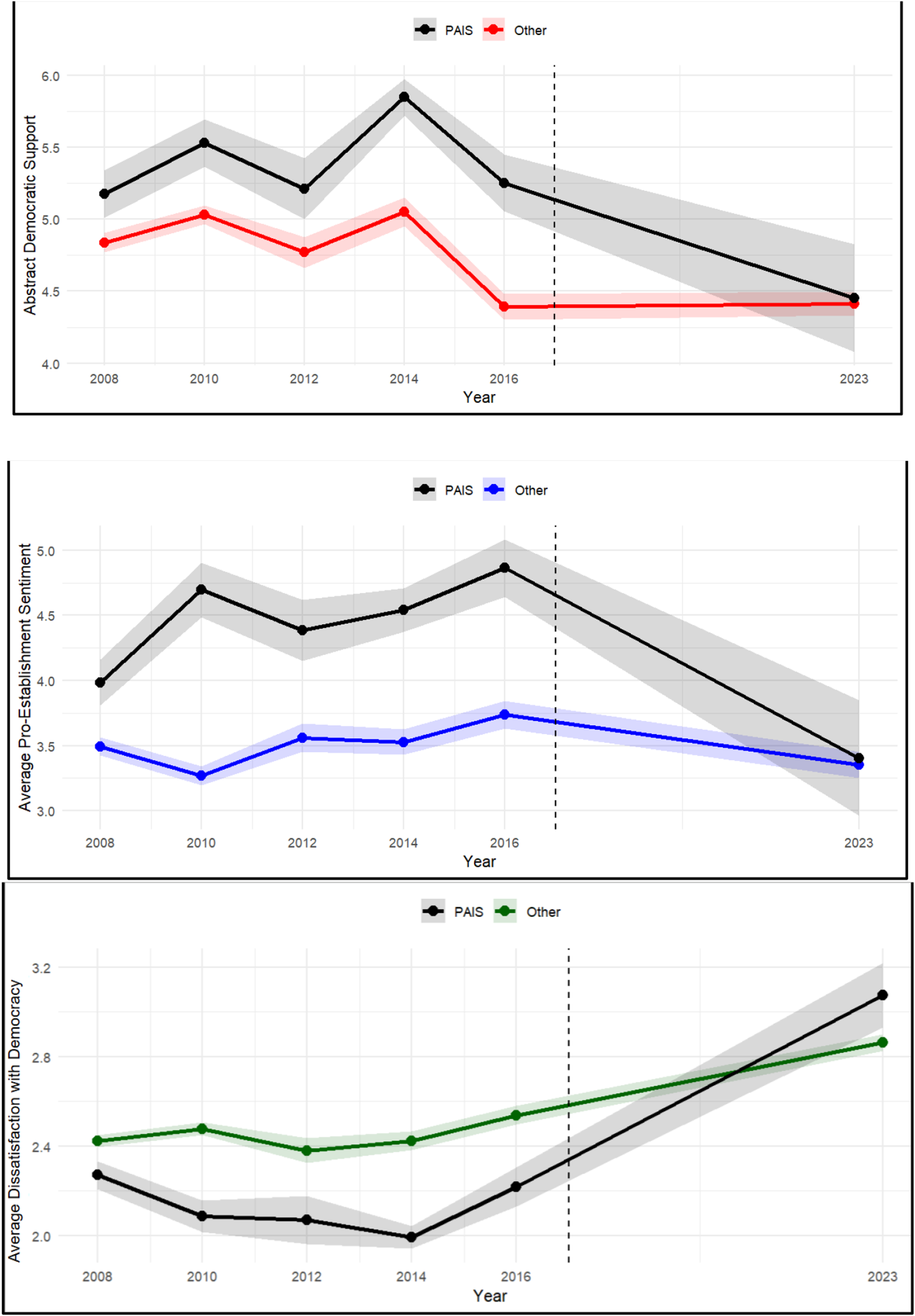
Figure 4 Long description
Three vertically stacked line graphs. Top graph: Vertical axis label: Average Absolute Democratic Support. Horizontal axis label: Year. Horizontal axis tick labels: 2008, 2010, 2012, 2014, 2016, 2023. Two lines with a legend labeled: PAS and Other. A vertical dashed line is drawn between 2016 and 2023. The PAS line rises from 2008 to 2010, dips at 2012, peaks at 2014, then declines through 2016 and continues downward to 2023. The Other line rises from 2008 to 2010, dips at 2012, rises at 2014, drops at 2016, then stays nearly flat from 2016 to 2023. Middle graph: Vertical axis label: Average Pro-Establishment Sentiment. Horizontal axis label: Year. Horizontal axis tick labels: 2008, 2010, 2012, 2014, 2016, 2023. Two lines with a legend labeled: PAS and Other. A vertical dashed line is drawn between 2016 and 2023. The PAS line increases from 2008 to 2010, decreases at 2012, increases through 2014 to 2016, then declines to 2023. The Other line decreases from 2008 to 2010, increases at 2012, stays near the same level at 2014, increases at 2016, then declines to 2023. Bottom graph: Vertical axis label: Average Dissatisfaction with Democracy. Horizontal axis label: Year. Horizontal axis tick labels: 2008, 2010, 2012, 2014, 2016, 2023. Two lines with a legend labeled: PAS and Other. A vertical dashed line is drawn between 2016 and 2023. The PAS line decreases from 2008 to 2010, stays near the same level at 2012, reaches a low point at 2014, then increases at 2016 and continues increasing to 2023. The Other line increases from 2008 to 2010, decreases at 2012, then increases through 2014 and 2016 to 2023
Interestingly, the anti-Correísta opposition did not display a comparable increase in democratic attitudes after 2018, suggesting that the reactions of PAIS supporters reflect features distinctive to the party itself (Figure 4). This pattern echoes findings from European studies on populist radical right parties, particularly Harteveld et al. (Reference Harteveld, Kokkonen and Linde2021) observation of an ‘asymmetrical impact of populist radical right inclusion on satisfaction with democracy’.Footnote 9 Specifically, inclusion tends to generate a substantially larger increase in satisfaction with the functioning of democracy among radical populist voters than among average citizens following the inclusion of liberal parties (Harteveld et al., Reference Harteveld, Kokkonen and Linde2021). Although PAIS was not a right-wing party, it can reasonably be classified as populist according to widely accepted definitions, and its inclusion in the system appears to have produced effects similar to those identified in the broader literature on populist parties.
Concluding remarks
Our analysis suggests that during the Revolución Ciudadana, PAIS and other anti-establishment parties did not function as effective anchors for citizens with stronger anti-democratic or anti-system attitudes. On the other hand, evidence indicates that PAIS might have strengthened the democratic attitudes of its supporters. However, this phenomenon is more plausibly driven by a partisan effect rather than by anchoring.
The absence of strong evidence that PAIS functioned as an anchor of democratic consolidation does not warrant dismissing the anchoring theory altogether. Morlino never conceived the framework as universally generalisable; rather, it was designed to explain specific regional trajectories of consolidation. Furthermore, PAIS represents an unusual type of anti-establishment party, one that was entrusted with governing responsibilities from its inception and faced limited incentives for coalition-building or compromise. If moderation is intended as ideological moderation, rather than a pro-establishment or pro-democratic orientation, it is still possible that PAIS had been affected by it.
During the study’s timeframe, PI and PSI strengthened and pro-democratic views expanded. Thus, although the inclusion–moderation thesis found no supporting evidence, future research may seek to test alternative causal links between the phenomena of anchoring and consolidation, perhaps prioritising the moderating role played by PSI rather than PI, as this study has done. Although these findings run counter to our original expectations and guiding theory, the results consistently show that the democratic attitudes of supporters of Ecuador’s most successful populist party mirror patterns identified in studies of European right-wing populist parties. The present study thus extends the conclusions of this literature across both ideological orientations and regional contexts.
Funding
This publication was written at Masaryk University with the support of the Specific University Research Grant provided by the Ministry of Education, Youth and Sports of the Czech Republic.
Data
The replication dataset is available at https://dataverse.harvard.edu/dataverse/ipsr-risp.
Supplementary material
The supplementary material for this article can be found at https://doi.org/10.1017/ipo.2026.10097.
Competing interests
The author declares none.







 Open access

