During the past decade, hospitals have made significant progress in preventing catheter-related bloodstream infections (CRBSIs). Basic strategies during the insertion and maintenance of catheters have successfully reduced CRBSIs and have been incorporated into clinical practice.Reference Pronovost, Needham and Berenholtz1,Reference Ista, van der Hoven and Kornelisse2 Despite these advances, however, CRBSIs remain a problem. Recent data from the United States showed that CRBSI rates have been steady between 0.56 and 0.67 cases per 1,000 catheter daysReference Magill, Edwards and Bamberg3 and, in European intensive care units (ICUs), rates have oscillated between 1.7 and 4.7 cases per 1,000 catheter days.4 A substantial number of patients experience CRBSIs, a preventable healthcare-associated infection linked to increased mortality, length of hospital stay, and healthcare costs.Reference Ziegler, Pellegrini and Safdar5 Thus, attention has moved to other preventive measures, including the use of chlorhexidine-impregnated dressings at the catheter insertion site.
Chlorhexidine (CHG) is an antiseptic with broad-spectrum antimicrobial activity.Reference Karpanen, Casey, Conway, Lambert and Elliott6 When incorporated into catheter dressings, the burden of microorganisms on the skin decreases and CRBSIs caused by an extraluminal route might be reduced.Reference Karpanen, Casey, Whitehouse, Nightingale, Das and Elliott7 Previous meta-analyses have suggested that CHG dressings can prevent CRBSIs.Reference Ullman, Cooke and Mitchell8-Reference Wei, Li, Li, Bian, Wen and Li10 However, numerous gaps in knowledge remain and tailored recommendations are lacking. It is unclear which patients benefit the most from CHG dressings, to what extent the catheter type impacts CHG effectiveness, or whether the main types of CHG dressings available (CHG-impregnated discs or transparent dressings with an integrated CHG gel pad) are equally effective.
Numerous clinical trials have been published in recent years regarding CHG dressings, and it is time to re-evaluate the evidence for their use. This meta-analysis aims to determine CHG dressing effectiveness in different populations (eg, adults/pediatric populations, onco-hematological patients), settings (eg, ICU and non-ICUs), and types of catheters. Also, it will address barriers for successful implementation, such as the risk of adverse events or CHG-acquired resistance.
Methods
Search strategy
This meta-analysis followed the Preferred Reporting Items for Systematic and Meta-Analysis (PRISMA) statement,Reference Moher, Liberati, Tetzlaff, Altman and Group11 and it was registered on PROSPERO (no. CRD42019125329). A librarian performed a search, without language or publication restrictions, in PubMed, Cumulative Index to Nursing and Allied Health Literature (CINAHL), EMBASE, and ClinicalTrials.gov. We searched for studies from database inception through March 2019 (Appendix 1 online). We reviewed the reference lists of retrieved articles to identify additional studies. Articles written in Chinese were reviewed using Google translate (https:/translate.google.com). Other non-English articles were translated by native speakers. Of the 7 authors who we contacted for clarifications, 2 provided the information.
Eligibility criteria
Studies were included if they met the following criteria: (1) The study population consisted of patients requiring short-term central venous catheters [CVCs] (nontunneled catheters) or long-term CVCs (tunneled catheters and ports). Peripherally inserted central catheters (PICCs), arterial catheters, and antimicrobial-impregnated catheters were also included. (2) CHG-impregnated dressings were used in the intervention group and nonantimicrobial dressings were used in the control group. (3) The study reported incident CRBSIs as counts (%). And (4) the study was a randomized controlled trial (RCT) or a quasi-experimental (nonrandomized) trial. Nonrandomized trials were included to improve generalizability. Crossover RCTs in which analyses could not be adjusted for within-patient correlation were not included.Reference Elbourne, Altman, Higgins, Curtin, Worthington and Vail12 We excluded the following studies: (1) Studies comparing CHG dressings with other antimicrobial dressings. (2) Studies in which blood cultures were drawn through the catheter and there was no confirmed peripheral bloodstream infection (BSI). (3) Studies in which CHG dressings were implemented along with other preventive measures that precluded determining the independent effectiveness of CHG dressings. And (4) studies with zero outcomes in both study arms.Reference Higgins and Green13
Outcomes
The primary outcome was CRBSI, as defined by the authors. This definition must have included bacteremia and/or fungemia in patients with an intravascular catheter. When multiple definitions of CRBSI were given (definite, probable, possible), only definite CRBSIs were considered. This definition has a high likelihood of causal relation between the catheter and the BSI and minimizes the risk of underestimating CHG dressing effectiveness. Secondary outcomes included exit-site and tunnel infections, adverse events, and CHG resistance.
Data extraction
Titles and abstracts were screened for eligibility. Reasons for exclusion are detailed in Appendix 2 (online). Two reviewers independently extracted the following data from each full-text article included in the meta-analysis: study design and population, catheter characteristics, study groups, type of dressing, frequency of dressing change, and outcomes. For studies involving multiple study groups with minor variations between them (eg, different standard-of-care dressings), we combined the data to create a single pairwise comparison between the intervention and control groups.Reference Higgins and Green14 Disagreements between reviewers were resolved by consensus.
The risk of bias for the association between CHG dressing and CRBSI was assessed using the Cochrane tool for RCTsReference Higgins, Thomas and Chandler15 and the Robins-I tool for nonrandomized trials.Reference Sterne, Hernan and Reeves16
Statistical analysis
We used random-effects models with inverse variance weighting to estimate pooled risk ratios (pRR).Reference DerSimonian and Laird17 The unit of analysis was the catheter. Among studies in which patients received >1 catheter during the study period, analyses were adjusted for within-patient correlation by multiplying the variance of the risk ratio by the average number of catheters per patient.Reference Chaiyakunapruk, Veenstra, Lipsky and Saint18 We assessed heterogeneity using the Cochrane Q statistic and the I 2 test. Funnel plots were visually inspected to assess potential publication bias.
For the primary outcome, we performed subgroup analyses based on a priori selected variables: population and setting, catheter type, and frequency of dressing change. Sensitivity analyses accounted for methodological differences between studies. Statistical analyses were performed using Excel 2007 software (Microsoft, Redmond, WA) and the Cochrane Review Manager (RevMan, version 5.3).
Results
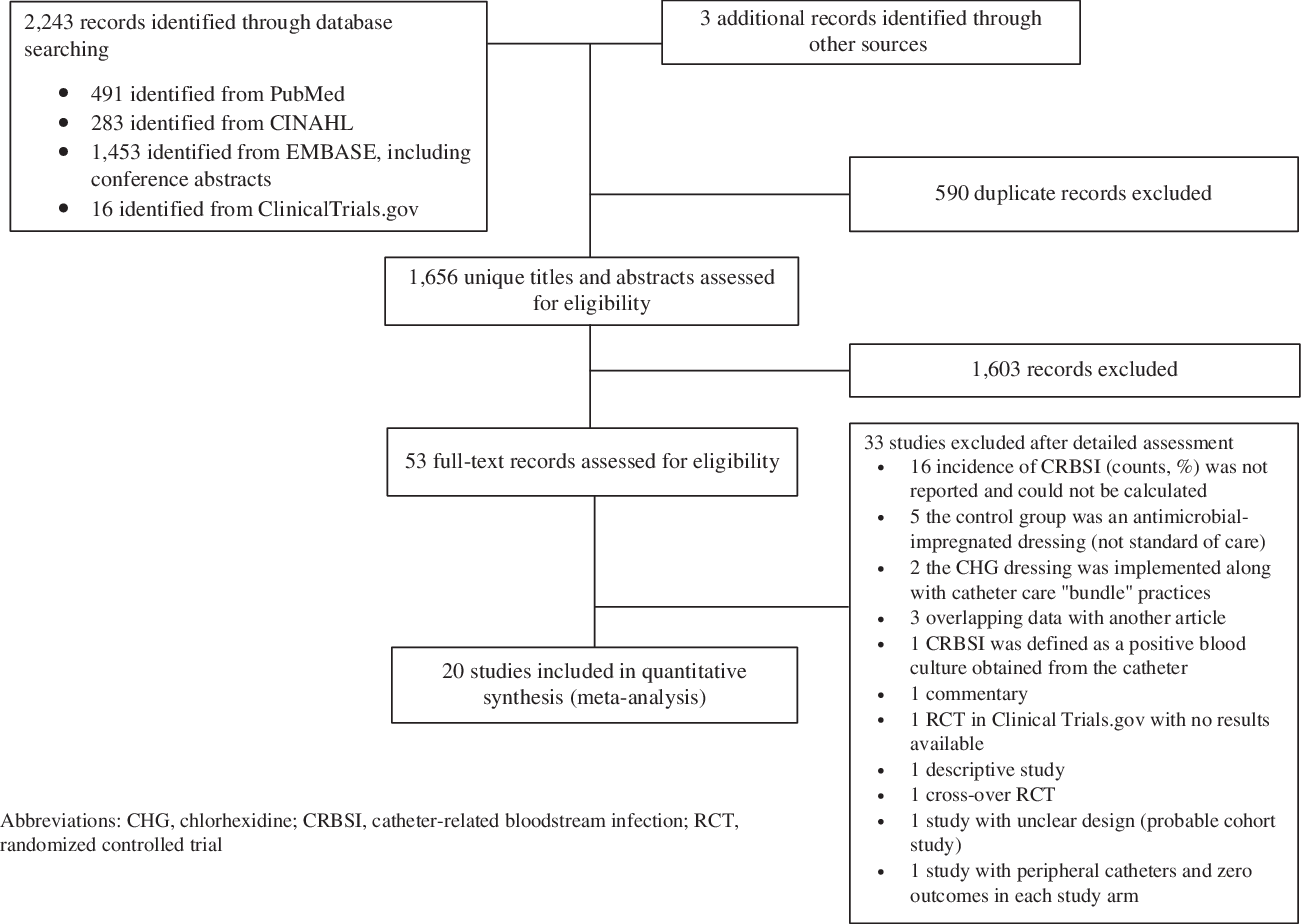
We screened 1,656 unique articles and included 20 studies (published between 1998 and 2019) that comprised the combined study of 15,590 catheters (Fig. 1).
Flow diagram of search strategy.

Study characteristics
Table 1 and Appendix 3 (online) present the characteristics of included studies. The selected studies included 18 RCTsReference Garland, Alex and Mueller19-Reference Arpa and Aygün36 and 2 quasi-experimental studies,Reference Ergul, Gokcek, Ozcan, Cetin, Gultekin and Torun37,Reference O’Horo, Corson and Baum38 and all of them were performed in hospital settings. Furthermore, 6 studies were multicentric (≥ 2 hospitals),Reference Garland, Alex and Mueller19-Reference Timsit, Mimoz and Mourvillier23,Reference Biehl, Huth and Panse27 14 studies were performed on adults,Reference Maki, Mermel, Kluger, Narans, Knasinski, Parenteau and Covington20-Reference Pivkina, Gusarov, Blot, Zhivotneva, Pasko and Zamyatin25,Reference Biehl, Huth and Panse27-Reference Pedrolo, Danski and Vayego29,Reference Chambers, Sanders and Patton31,Reference Ruschulte, Franke and Gastmeier33-Reference Yu, Lu, Meng, Zhao and Li35,Reference O’Horo, Corson and Baum38 and 6 studies examined neonates or pediatric populations.Reference Garland, Alex and Mueller19,Reference Duzkaya, Sahiner, Uysal, Yakut and Citak26,Reference Gerceker, Yardimci and Aydinok30,Reference Levy, Katz and Solter32,Reference Arpa and Aygün36,Reference Ergul, Gokcek, Ozcan, Cetin, Gultekin and Torun37 Of the studies with this information, 13 included ICU patients,Reference Garland, Alex and Mueller19,Reference Arvaniti, Lathyris and Clouva-Molyvdas21-Reference Duzkaya, Sahiner, Uysal, Yakut and Citak26,Reference Pedrolo, Danski and Vayego29,Reference Levy, Katz and Solter32,Reference Roberts and Cheung34-Reference Ergul, Gokcek, Ozcan, Cetin, Gultekin and Torun37 4 included onco-hematological patients,Reference Biehl, Huth and Panse27,Reference Gerceker, Yardimci and Aydinok30,Reference Chambers, Sanders and Patton31,Reference Ruschulte, Franke and Gastmeier33 and 1 included non-ICU patients.Reference Chan, Northfield and Larsen28 The definition of CRBSI, exit-site and tunnel infections, and adverse events varied across the studies (Appendix 4 online). Also, 5 studies reported CRBSI rates ≥ 2.0 per 1,000 catheter daysReference Arvaniti, Lathyris and Clouva-Molyvdas21,Reference Pivkina, Gusarov, Blot, Zhivotneva, Pasko and Zamyatin25,Reference Biehl, Huth and Panse27,Reference Gerceker, Yardimci and Aydinok30,Reference Yu, Lu, Meng, Zhao and Li35 in at least one study group and 2 studies reported CRBSI rates <1.5 per 1,000 catheter days in both groups.Reference Timsit, Schwebel and Bouadma22,Reference Timsit, Mimoz and Mourvillier23
Types of catheters and insertion practices
Among studies with available data, 11 included short-term CVCs,Reference Arvaniti, Lathyris and Clouva-Molyvdas21,Reference Margatho, Ciol and Hoffman24-Reference Biehl, Huth and Panse27,Reference Pedrolo, Danski and Vayego29,Reference Levy, Katz and Solter32,Reference Ruschulte, Franke and Gastmeier33,Reference Yu, Lu, Meng, Zhao and Li35-Reference Ergul, Gokcek, Ozcan, Cetin, Gultekin and Torun37 3 included long-term CVCs,Reference Gerceker, Yardimci and Aydinok30,Reference Chambers, Sanders and Patton31,Reference O’Horo, Corson and Baum38 3 included CVCs and arterial catheters,Reference Maki, Mermel, Kluger, Narans, Knasinski, Parenteau and Covington20,Reference Timsit, Schwebel and Bouadma22,Reference Timsit, Mimoz and Mourvillier23 1 included long and short-term CVCs,Reference Garland, Alex and Mueller19 and 1 included PICC lines.Reference Chan, Northfield and Larsen28 In addition, 2 studies used antimicrobial-impregnated catheters.Reference Biehl, Huth and Panse27,Reference Ruschulte, Franke and Gastmeier33 The duration of catheterization and catheter insertion sites between CHG and control groups were similar in studies that reported these data. Femoral insertions represented ≥44% of catheters in 3 studies.Reference Arvaniti, Lathyris and Clouva-Molyvdas21,Reference Duzkaya, Sahiner, Uysal, Yakut and Citak26,Reference Yu, Lu, Meng, Zhao and Li35 One study used different skin antiseptics (alcohol versus povidone-iodine) in each study arm,Reference Garland, Alex and Mueller19 and another study applied daily CHG bathing in all patients.Reference Margatho, Ciol and Hoffman24 Also, 3 studies used >0.5% of CHG skin preparation before catheter insertion.Reference Chan, Northfield and Larsen28,Reference Yu, Lu, Meng, Zhao and Li35,Reference Ergul, Gokcek, Ozcan, Cetin, Gultekin and Torun37 Maximal sterile barrier precautions were cited in 14 studies.Reference Garland, Alex and Mueller19,Reference Arvaniti, Lathyris and Clouva-Molyvdas21-Reference Duzkaya, Sahiner, Uysal, Yakut and Citak26,Reference Pedrolo, Danski and Vayego29,Reference Gerceker, Yardimci and Aydinok30,Reference Levy, Katz and Solter32-Reference Arpa and Aygün36
Interventions
In the intervention group, 10 studies used CHG discs (Biopatch)Reference Garland, Alex and Mueller19-Reference Timsit, Schwebel and Bouadma22,Reference Chan, Northfield and Larsen28,Reference Chambers, Sanders and Patton31-Reference Roberts and Cheung34,Reference O’Horo, Corson and Baum38 , 8 used CHG transparent dressings (Tegaderm or unspecified),Reference Timsit, Mimoz and Mourvillier23-Reference Pivkina, Gusarov, Blot, Zhivotneva, Pasko and Zamyatin25,Reference Biehl, Huth and Panse27,Reference Gerceker, Yardimci and Aydinok30,Reference Yu, Lu, Meng, Zhao and Li35-Reference Ergul, Gokcek, Ozcan, Cetin, Gultekin and Torun37 and 2 used “CHG-impregnated dressings” without further detail.Reference Duzkaya, Sahiner, Uysal, Yakut and Citak26,Reference Pedrolo, Danski and Vayego29 In the control group, 16 studies used transparent dressings,Reference Garland, Alex and Mueller19-Reference Pivkina, Gusarov, Blot, Zhivotneva, Pasko and Zamyatin25,Reference Biehl, Huth and Panse27,Reference Chan, Northfield and Larsen28,Reference Gerceker, Yardimci and Aydinok30,Reference Levy, Katz and Solter32-Reference Ergul, Gokcek, Ozcan, Cetin, Gultekin and Torun37 2 used gauzes,Reference Duzkaya, Sahiner, Uysal, Yakut and Citak26,Reference Pedrolo, Danski and Vayego29 1 used standard-of-care dressings,Reference O’Horo, Corson and Baum38 and 1 did not use dressings.Reference Chambers, Sanders and Patton31
Most studies planned a 7-day dressing change for the CHG group (n = 13).Reference Garland, Alex and Mueller19,Reference Maki, Mermel, Kluger, Narans, Knasinski, Parenteau and Covington20,Reference Margatho, Ciol and Hoffman24-Reference Duzkaya, Sahiner, Uysal, Yakut and Citak26,Reference Chan, Northfield and Larsen28-Reference Chambers, Sanders and Patton31,Reference Ruschulte, Franke and Gastmeier33,Reference Yu, Lu, Meng, Zhao and Li35-Reference Ergul, Gokcek, Ozcan, Cetin, Gultekin and Torun37 When the scheduled dressing change was different between the CHG and control groups,Reference Maki, Mermel, Kluger, Narans, Knasinski, Parenteau and Covington20,Reference Duzkaya, Sahiner, Uysal, Yakut and Citak26,Reference Pedrolo, Danski and Vayego29,Reference Yu, Lu, Meng, Zhao and Li35,Reference Ergul, Gokcek, Ozcan, Cetin, Gultekin and Torun37 dressings in the control group were expected to be changed more often (ie, every 24 hours to 3 days).
Risk of bias assessment
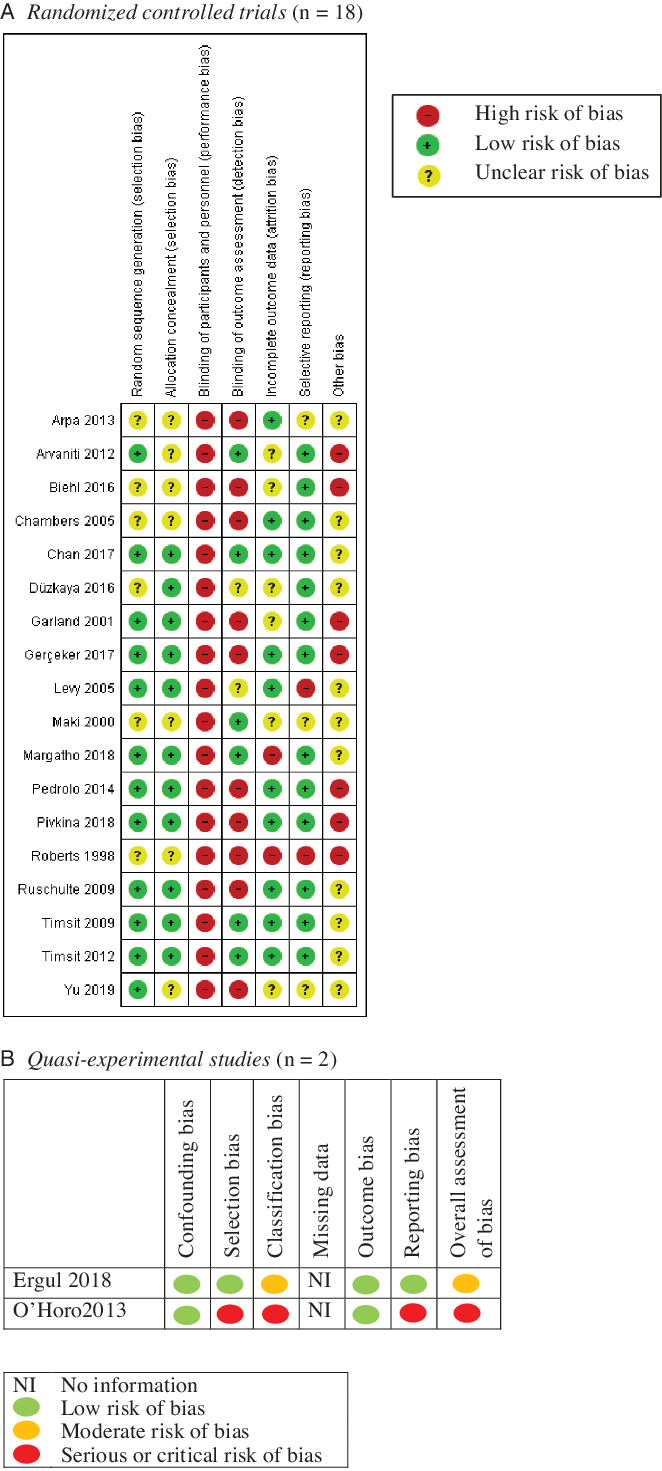
The risk of bias for each study is reported in Figure 2. None of the studies blinded participants or healthcare personnel to the type of dressing used, and 6 RCTs blinded the outcome assessors.Reference Maki, Mermel, Kluger, Narans, Knasinski, Parenteau and Covington20-Reference Margatho, Ciol and Hoffman24,Reference Chan, Northfield and Larsen28 Furthermore, 6 RCTs were stopped before reaching the planned sample size or had insufficient power to detect differences between study groups.Reference Garland, Alex and Mueller19,Reference Arvaniti, Lathyris and Clouva-Molyvdas21,Reference Pivkina, Gusarov, Blot, Zhivotneva, Pasko and Zamyatin25,Reference Biehl, Huth and Panse27,Reference Gerceker, Yardimci and Aydinok30,Reference Roberts and Cheung34
Risk of bias for the CRBSI outcome assessment in the included studies. (A) Randomized controlled trials (n = 18). (B) Quasi-experimental studies (n = 2).

Catheter-related bloodstream infections
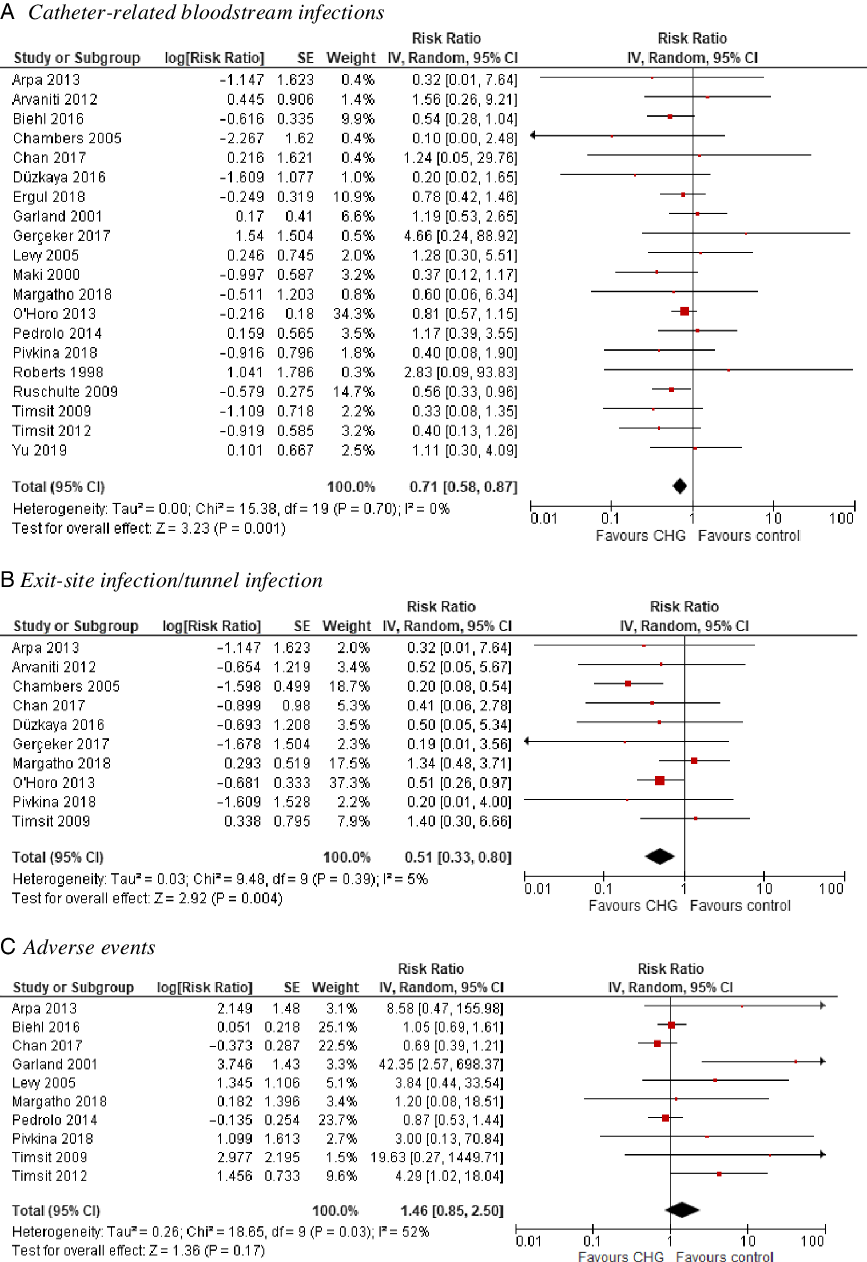
After pooling the 20 studies, the CRBSI rate was 2.0% (160 of 7,826) in the CHG group and 3.2% (252 of 7,764) in the control group. The risk of CRBSI was significantly lower in the CHG group than in the control group (pRR, 0.71; 95% CI, 0.58–0.87). The test for heterogeneity was not statistically significant (P = .70; I 2 = 0%) (Fig. 3). The funnel plot was symmetric, and there was no evidence of publication bias (Appendix 5 online). CHG dressings remained associated with a significant reduction of CRBSIs regardless of the type of dressing used: CHG-impregnated disc (10 studies; pRR, 0.74; 95% CI, 0.57–0.95)Reference Garland, Alex and Mueller19-Reference Timsit, Schwebel and Bouadma22,Reference Chan, Northfield and Larsen28,Reference Chambers, Sanders and Patton31-Reference Roberts and Cheung34,Reference O’Horo, Corson and Baum38 or CHG transparent dressing (8 studies; pRR, 0.64; 95% CI, 0.44–0.94).Reference Timsit, Mimoz and Mourvillier23-Reference Pivkina, Gusarov, Blot, Zhivotneva, Pasko and Zamyatin25,Reference Biehl, Huth and Panse27,Reference Gerceker, Yardimci and Aydinok30,Reference Yu, Lu, Meng, Zhao and Li35-Reference Ergul, Gokcek, Ozcan, Cetin, Gultekin and Torun37
Forest plots of the comparison of CHG dressings versus standard of care for the main study outcomes. (A) Catheter-related bloodstream infections. (B) exit-site infection/tunnel infection. (C) Adverse events.

Sensitivity analyses accounting for study differences (eg, CRBSI definition) and subgroup analyses are shown in Appendix 6 (online). The risk of CRBSI in RCTs versus nonrandomized trials showed differing results: pRR, 0.65 (95% CI, 0.49–0.85) versus pRR, 0.80 (95% CI, 0.59–1.09), respectively.
Effectiveness by study population and setting
In adults, CHG dressings significantly reduced CRBSIs (14 studies; pRR 0.63; 95% CI, 0.51–0.77), including onco-hematological patients (3 studies; pRR, 0.54; 95% CI, 0.36–0.81).Reference Biehl, Huth and Panse27,Reference Chambers, Sanders and Patton31,Reference Ruschulte, Franke and Gastmeier33 Although CHG dressings did not significantly decrease CRBSIs in ICUs (8 studies; pRR, 0.70; 95% CI, 0.41–1.18),Reference Arvaniti, Lathyris and Clouva-Molyvdas21-Reference Pivkina, Gusarov, Blot, Zhivotneva, Pasko and Zamyatin25,Reference Pedrolo, Danski and Vayego29,Reference Roberts and Cheung34,Reference Yu, Lu, Meng, Zhao and Li35 2 high-quality studies suggested that CHG dressings were effective in ICUs with CRBSI rates <1.5 per 1,000 catheter days (pRR, 0.37; 95% CI, 0.15–0.90).Reference Timsit, Schwebel and Bouadma22,Reference Timsit, Mimoz and Mourvillier23 One single study was performed in non-ICU patients (RR, 1.24; 95% CI, 0.05–29.76).Reference Chan, Northfield and Larsen28 Analyses considering other settings and populations (eg, hemodialysis patients) were not possible.
In neonates and pediatric populations, CHG dressings did not significantly reduce CRBSIs (6 studies; pRR, 0.90; 95% CI, 0.57–1.40).Reference Garland, Alex and Mueller19,Reference Duzkaya, Sahiner, Uysal, Yakut and Citak26,Reference Gerceker, Yardimci and Aydinok30,Reference Levy, Katz and Solter32,Reference Arpa and Aygün36,Reference Ergul, Gokcek, Ozcan, Cetin, Gultekin and Torun37 These results were consistent when neonates were excluded from the analysis (4 studies; pRR, 0.71; 95% CI, 0.33–1.50)Reference Duzkaya, Sahiner, Uysal, Yakut and Citak26,Reference Gerceker, Yardimci and Aydinok30,Reference Arpa and Aygün36,Reference Ergul, Gokcek, Ozcan, Cetin, Gultekin and Torun37 and when only neonates or pediatric patients admitted to the ICU were considered (5 studies; pRR, 0.86; 95% CI, 0.55–1.35).Reference Garland, Alex and Mueller19,Reference Duzkaya, Sahiner, Uysal, Yakut and Citak26,Reference Levy, Katz and Solter32,Reference Arpa and Aygün36,Reference Ergul, Gokcek, Ozcan, Cetin, Gultekin and Torun37
Effectiveness by catheter type and insertion site
For short-term CVCs, CHG dressings decreased CRBSIs (11 studies; pRR, 0.67; 95% CI, 0.50–0.90).Reference Arvaniti, Lathyris and Clouva-Molyvdas21,Reference Margatho, Ciol and Hoffman24-Reference Biehl, Huth and Panse27,Reference Pedrolo, Danski and Vayego29,Reference Levy, Katz and Solter32,Reference Ruschulte, Franke and Gastmeier33,Reference Yu, Lu, Meng, Zhao and Li35-Reference Ergul, Gokcek, Ozcan, Cetin, Gultekin and Torun37 This benefit was evident for studies with a mean length of catheterization >7 days (7 studies; pRR, 0.58; 95% CI, 0.42–0.81),Reference Margatho, Ciol and Hoffman24-Reference Biehl, Huth and Panse27,Reference Ruschulte, Franke and Gastmeier33,Reference Arpa and Aygün36,Reference Ergul, Gokcek, Ozcan, Cetin, Gultekin and Torun37 but not for catheterizations ≤7 days (3 studies; pRR, 1.34; 95% CI, 0.54–3.32).Reference Arvaniti, Lathyris and Clouva-Molyvdas21,Reference Pedrolo, Danski and Vayego29,Reference Roberts and Cheung34
For long-term CVCs, CHG dressings did not significantly decrease CRBSIs (3 studies; pRR, 0.80; 95% CI, 0.22–2.95).Reference Gerceker, Yardimci and Aydinok30,Reference Chambers, Sanders and Patton31,Reference O’Horo, Corson and Baum38 However, only 2 studies were RCTs, and they had small sample sizes. Another small RCT evaluated PICC lines and did not find a protective effect of CHG dressing use (RR, 1.24; 95% CI, 0.05–29.76).Reference Chan, Northfield and Larsen28
None of these studies reported the incidence of CRBSI stratified by insertion site. When we pooled studies with jugular/subclavian insertions or those with frequent femoral insertions, the small sample size precluded definitive conclusions (Appendix 6 online). Additionally, Timsit 2012 showed a significant reduction in CRBSI rates among patients with venous catheters but not with arterial catheters.Reference Timsit, Mimoz and Mourvillier23
Effectiveness by the frequency of dressing change
Among studies with a similar frequency of dressing change in both groups, CHG dressings significantly reduced CRBSIs (12 studies; pRR, 0.58; 95% CI, 0.42–0.82).Reference Arvaniti, Lathyris and Clouva-Molyvdas21-Reference Pivkina, Gusarov, Blot, Zhivotneva, Pasko and Zamyatin25,Reference Biehl, Huth and Panse27,Reference Chan, Northfield and Larsen28,Reference Gerceker, Yardimci and Aydinok30,Reference Levy, Katz and Solter32-Reference Roberts and Cheung34,Reference Arpa and Aygün36 When the planned frequency was 7 days for the CHG group and ≤3 days for the control group, the benefit of CHG dressings was lost (5 studies; pRR, 0.73; 95% CI, 0.46–1.14).Reference Maki, Mermel, Kluger, Narans, Knasinski, Parenteau and Covington20,Reference Duzkaya, Sahiner, Uysal, Yakut and Citak26,Reference Pedrolo, Danski and Vayego29,Reference Yu, Lu, Meng, Zhao and Li35,Reference Ergul, Gokcek, Ozcan, Cetin, Gultekin and Torun37
Exit-site and tunnel infections
Ten studies reported exit-site and/or tunnel infections,Reference Arvaniti, Lathyris and Clouva-Molyvdas21,Reference Timsit, Schwebel and Bouadma22,Reference Margatho, Ciol and Hoffman24-Reference Duzkaya, Sahiner, Uysal, Yakut and Citak26,Reference Chan, Northfield and Larsen28,Reference Gerceker, Yardimci and Aydinok30,Reference Chambers, Sanders and Patton31,Reference Arpa and Aygün36,Reference O’Horo, Corson and Baum38 with an incidence of 1% (38 of 3,688) in the CHG group and 2% (74 of 3,625) in the control group. When these studies were pooled, CHG dressings decreased incident exit-site and tunnel infections (pRR, 0.51; 95% CI, 0.33–0.80) (Fig. 3). The test for heterogeneity was not statistically significant (P = .39, I 2 = 5%), but there was evidence of publication bias (Appendix 5 online). When stratified by catheter type, CHG dressings remained protective against exit-site and tunnel infections in long-term CVCs (3 studies; pRR, 0.37; 95% CI, 0.22–0.64)Reference Gerceker, Yardimci and Aydinok30,Reference Chambers, Sanders and Patton31,Reference O’Horo, Corson and Baum38 but not in short-term CVCs (5 studies; pRR, 0.85; 95% CI, 0.38–1.91).Reference Arvaniti, Lathyris and Clouva-Molyvdas21,Reference Margatho, Ciol and Hoffman24-Reference Duzkaya, Sahiner, Uysal, Yakut and Citak26,Reference Arpa and Aygün36 The single RCT that assessed PICC lines did not show an association between CHG dressings and exit-site and tunnel infections (RR, 0.41; 95% CI, 0.06–2.78).Reference Chan, Northfield and Larsen28
Adverse events
Ten articles evaluated the risk of adverse events,Reference Garland, Alex and Mueller19,Reference Timsit, Schwebel and Bouadma22-Reference Pivkina, Gusarov, Blot, Zhivotneva, Pasko and Zamyatin25,Reference Biehl, Huth and Panse27-Reference Pedrolo, Danski and Vayego29,Reference Levy, Katz and Solter32,Reference Arpa and Aygün36 with a pooled frequency of 2.8% (138 of 5,013) in the CHG group and 1.7% (75 of 4,807) in the control group. Premature neonates with weights <1,000 g had an increased incidence of 15% and a risk of severe reactions such as pressure necrosis.Reference Garland, Alex and Mueller19 Definitions of adverse events were varied, but all included reactions at the catheter insertion site (Appendix 4 online).
In the pooled analysis, CHG dressings were not significantly associated with adverse events (10 studies; pRR, 1.46; 95% CI, 0.85–2.50) (Fig. 3). However, there was evidence of publication bias (Appendix 5 online), and the heterogeneity was high (P = .03; I 2 = 52%). When the 3 studies that combined contact dermatitis with unspecific events (eg, bruise at device removal) were excluded,Reference Biehl, Huth and Panse27-Reference Pedrolo, Danski and Vayego29 there was an independent association between CHG dressing and contact dermatitis (pRR, 5.16; 95% CI, 2.09–12.70; heterogeneity: P = .68; I 2 = 0%). This finding was evident for both neonates and pediatric populations (3 studies; pRR, 9.20; 95% CI, 2.10–40.26)Reference Garland, Alex and Mueller19,Reference Levy, Katz and Solter32,Reference Arpa and Aygün36 and adults (4 studies; pRR, 3.65; 95% CI, 1.17–11.40).Reference Timsit, Schwebel and Bouadma22-Reference Pivkina, Gusarov, Blot, Zhivotneva, Pasko and Zamyatin25 Contact dermatitis occurred with transparent CHG dressings (4 studies; pRR, 3.70; 95% CI, 1.24–11.04)Reference Timsit, Mimoz and Mourvillier23-Reference Pivkina, Gusarov, Blot, Zhivotneva, Pasko and Zamyatin25,Reference Arpa and Aygün36 and CHG-impregnated discs (3 studies; pRR, 10.42; 95% CI, 2.12–51.27).Reference Garland, Alex and Mueller19,Reference Timsit, Schwebel and Bouadma22,Reference Levy, Katz and Solter32
CHG resistance
Two studies evaluated and did not find an association between CHG dressings and CHG resistance.Reference Timsit, Schwebel and Bouadma22,Reference Chambers, Sanders and Patton31 However, the median follow-up in these studies was either short (7 days)Reference Timsit, Schwebel and Bouadma22 or bacterial isolates causing exit-site infections were not investigated.Reference Chambers, Sanders and Patton31
Discussion
Principal findings
This meta-analysis shows that CHG dressings are effective in reducing the risk of CRBSIs by 33%. However, the evidence is strongest for adults with short-term CVCs, particularly those at high risk for CRBSI such as onco-hematological patients. Our findings do not support CHG dressing use among neonates and pediatric populations. There is a risk of serious adverse events and lack of proven effectiveness for these age groups.
In line with current guidelines, our results suggest that CHG dressings should only be recommended for short-term CVCs.Reference O’Grady, Alexander and Burns39,Reference Talbot, Stone, Irwin, Overholt, Dasti and Kallen40 This can be explained because the source of BSIs in short-term catheters is the skin colonization at the insertion site, which is specifically targeted by CHG dressings. In long-term CVCs, however, the catheter hub contamination increases in relevance and the exit site, where CHG dressing are effective, contribute less to the incidence of CRBSIs.Reference Mermel41 With that said, we did not find a benefit of CHG dressings for catheterizations <7 days. Indeed, sterile barrier precautions during catheter insertion, along with early catheter removal, can reduce CRBSIs that might occur soon after catheterization. However, the 7-day threshold should be interpreted with caution and needs to be confirmed with further individual catheter-level analyses capable of adjusting for confounding factors. Also, although we found that CHG dressings might reduce exit-site and tunneled infections in long-term CVCs, further high-quality studies are warranted.
Generalizability of the study
This meta-analysis involved a comprehensive search with no publication bias. However, one limitation is that the characteristics of the published studies challenge the generalizability of these results. First, the lack of evidence beyond adults hospitalized in ICUs or onco-hematological units precludes extending the recommendations to other populations. Second, the inadequate statistical power might have limited our capacity to assess the effectiveness in pediatric populations. Third, numerous factors influence the risk of CRBSI, but some of them are difficult to address in a meta-analysis. We could not determine which insertion site would benefit the most from CHG dressings. Subgroup analyses had small sample sizes and studies compiled data from different insertion sites. Additionally, insertion sites were not randomized, and unmeasured confounding factors (eg, duration of catheterization) probably persisted in pooled estimates.
Another concern is that studies differed in the preventive measures used for catheter insertion, and multiple definitions for CRBSI and exit-site infections were used. However, pooled studies were homogeneous, and subgroup analyses confirmed primary conclusions. To improve the quality of future research, studies should follow the best infection control practices (eg, >0.5% CHG skin antisepsis),Reference O’Grady, Alexander and Burns39 should minimize the detection bias by blinding outcome assessors (double-blind trials might be impracticable because of the visual differences between CHG and non-CHG dressings), and should use a standardized form to assess adverse events.
Findings into clinical context
Recently published data allows us to provide new guidance for CHG dressing use. Our results suggest that both CHG discs and CHG transparent dressings reduce CRBSIs. Still, in clinical practice, CHG transparent dressings might be preferred over discs because they are easy to applyReference Pfaff, Heithaus and Emanuelsen42 and do not block the visualization of the catheter insertion site.Reference Safdar, O’Horo and Ghufran9,Reference Banton and Banning43 Also, guidelines recommend CHG dressing use when CRBSI rates remain high despite the adherence to basic preventive strategies.Reference O’Grady, Alexander and Burns39 However, 2 RCTs have shown that CHG dressings can decrease CRBSI rates <1.5 per 1,000 catheter days,Reference Timsit, Schwebel and Bouadma22,Reference Timsit, Mimoz and Mourvillier23 and an 11-year quasi-experimental study supported the use of CHG dressings to achieve CRBSI rates <0.5 per 1,000 catheter days.Reference Eggimann, Pagani and Dupuis-Lozeron44 Although the goal of zero CRBSIs might be unrealistic,Reference Edmond45 CHG dressings might help achieve the lowest rates, even when the best practices are already in place.
The decision to use CHG dressings should weight the effectiveness against the risk of adverse events, the risk of CHG resistance, and the cost of this strategy. Although CHG adverse events are rare (2.8% in this meta-analysis), severe contact dermatitis can occur,Reference Timsit, Schwebel and Bouadma22 and the risk of skin necrosis in premature neonatesReference Garland, Alex and Mueller19 and adults with skin disorders (eg, graft-versus-host disease)Reference Wall, Divito and Talbot46 contraindicate CHG dressing use in these populations. Furthermore, the risk of CHG resistance has been only addressed by 2 of the included studies. However, most pathogens can adapt to CHG exposure with increased minimum inhibitory concentrations,Reference Kampf47 and CHG dressing effectiveness might decrease over time.Reference Kampf48 As such, the association between CHG resistance and the widespread use of CHG products in healthcare (eg, skin antisepsis, bathing, dressings) merits further attention. Finally, a cost-effectiveness analysis was beyond the scope of this meta-analysis. However, studies performed in different healthcare systemsReference Heimann, Biehl, Vehreschild, Franke, Cornely and Vehreschild49-Reference Pedrolo, Danski, Wiens and Boostel52 have estimated that the higher expenses incurred from CHG dressings are overcome by lower CRBSI rates and associated costs.
In conclusion, this meta-analysis supports CHG dressing use to reduce CRBSIs in adults with short-term CVCs, including those with an onco-hematological disease. However, the benefit of CHG dressings in other settings and populations have yet to be proven (eg., non-ICU wards, children) or is contraindicated because of safety concerns (ie, premature neonates). CHG dressings may decrease exit-site and tunneled infections in long-term CVCs, but more RCTs are warranted. Expanding the evidence to different settings and catheters (eg, PICC lines) and clarifying whether the catheter insertion site impacts CHG effectiveness should be addressed in future studies.
Supplementary material
To view supplementary material for this article, please visit https://doi.org/10.1017/ice.2020.356
Acknowledgments
We thank Dilek Ince for her help in evaluating an article written in Turkish.
Financial support
No financial support was provided relevant to this article.
Conflicts of interest
All authors report no conflicts of interest relevant to this article.