1. INTRODUCTION
The development of short-pulse high-intensity lasers allowed accelerating electrons, protons, and heavier ions to multi-MeV energies in the interaction of these lasers with different targets. Laser-triggered protons or ions and γ-rays from laser-accelerated electrons can trigger nuclear reactions. A technique suggested for nuclear reactions with laser-accelerated ions (Bychenkov et al., Reference Bychenkov, Tikhonchuk and Tolokonnikov1999) or γ-rays (Ledingham & Norreys, Reference Ledingham and Norreys1999) with a powerful ultrashort laser pulse in a plasma is now widely adopted for studying the most effective ways to generate neutrons (Pretzler et al., Reference Pretzler, Saemann, Eidmann, Habs, Meyer-ter-Vehn, Pukhov, Rudolph, Schatz, Schramm, Thirolf, Tsakiris and Witte1998; Roth et al., Reference Roth, Jung, Falk, Guler, Deppert, Devlin, Favalli, Fernandez, Gautier, Geissel, Haight, Hamilton, Hegelich, Johnson, Merrill, Schaumann, Schoenberg, Schollmeier, Shimada, Taddeucci, Tybo, Wagner, Wender, Wilde and Wurden2013) and produce isotopes (Nemoto et al., Reference Nemoto, Maksimchuk, Banerjee, Flippo, Mourou, Umstadter and Bychenkov2001; Ledingham et al., Reference Ledingham, McKenna, McCanny, Shimizu, Yang, Robson, Zweit, Gillies, Bailey, Chimon, Clarke, Neely, Norreys, Collier, Singhal, Wei, Mangles, Nilson, Krushelnick and Zepf2004). Such a technique offers a unique opportunity both for fundamental research in nuclear physics on ultrashort time scales and for medical applications.
We report an interesting example of isotope production using protons accelerated to multi-MeV energies by a powerful short laser pulse. This technique permits producing Tc-99m from the Mo-100(p,2n)Tc-99m reaction (Clarke et al., Reference Clarke, Dorkings, Neely and Musgrave2014). This isotope has traditionally been created by fission of weapons-grade uranium, which produces the Mo-99 radionuclide via the U-235(n,f)Mo-99 process. It has a half-life of 66 hours and decays into Tc-99m. This radionuclide is now produced largely at two nuclear reactors, one at Chalk River in Canada (NRU) and the other in the Netherlands (Petten). Both facilities are in the process of shutting-down production and could be closed by 2016 and 2022, correspondingly (Van Noorden, Reference Van Noorden2013). For example, the Canadian government has several times committed to stop production of medical isotopes at the NRU reactor by 2016, including most recently in its National Progress Report to the 2014 Nuclear Security Summit (Report, 2014). This may lead to a shortage in Tc-99m, while about 80% of diagnostic nuclear imaging procedures require Tc-99m according to the European Nuclear Society (Nunan, Reference Nunan2010; Crowley et al., Reference Crowley, Ruth, Allen and Vandegrift2013; Pillai et al., Reference Pillai, Dash and Knapp2013; Van Noorden, Reference Van Noorden2013). By using new laser technology, such as lasers with high peak and average power, ICAN (Mourou et al., Reference Mourou, Brocklesby, Tajima and Limpert2013), metropolitan areas could combat an increasing shortage of Tc-99m. It is important that although much progress in radiochemistry and radiopharmacology has occurred, Tc-99m has held its position as the most widely used radioisotope in diagnostic nuclear medicine for 40 years. Technetium-99m is mainly used to image the skeleton and heart muscle, but also for brain, thyroid, lungs (perfusion and ventilation), bone marrow, liver, spleen, kidney (structure and filtration rate), gall bladder, salivary and lacrimal glands, heart blood pool, infection and numerous specialized medical investigations. It is likely that Tc-99m will maintain its pre-eminence (Peykov & Cameron, Reference Peykov and Cameron2014) because of its availability, convenient chemical properties, reasonable cost, convenient half-life (6 hours), the best gamma's energy for the gamma camera (ideal for efficient detection and limited absorption in tissues), and relatively low radiation dose to patients and manipulators resulting from its short physical half-life.
Cyclotron isotope production facilities are now being considered as a replacement for nuclear reactors, although cyclotron-produced Tc-99m would probably be more expensive. Significant progress has been made on adapting current cyclotrons to create the Tc-99m radioisotope for nuclear imaging and research, for example, by a TRIUMF-led team of Canadian scientists (Gagnon et al., Reference Gagnon, Benardb, Kovacs, Ruth, Schaffer, Wilson and McQuarrie2011; Benard et al., Reference Benard, Buckley, Ruth, Zeisler, Klug, Hanemaayer, Vuckovic, Hou, Celler, Appiah, Valliant, Kovacs and Schaffer2014). They announced production of 10 Ci Tc-99m in a 6-hour overnight shift, which is enough to use in treating 250 patients during the day. It has been shown that a decentralized cyclotron-based production of Tc-99m is possible in the long term and may be a feasible alternative to the reactor-based production strategy. A similar study of laser-based Tc-99m production is very timely. Our analysis in this paper opens up a rich research agenda, including an investigation of optimized laser-target parameters for Tc-99m production.
We report the results of an optimization study of proton generation from ultrathin CH2 foils for producing Tc-99m through the Mo-100(p,2n)Tc-99m reaction. Here, a laser-triggered proton beam bombards highly enriched Mo-100 as the target material. The laser interacts with the entire foil volume, continuously resupplying energy to electrons to accelerate the entire target volume ions to tens of MeV/amu. It is known that the target thickness should be properly matched to the laser intensity (Esirkepov et al., Reference Esirkepov, Yamagiwa and Tajima2006) to achieve both volumetric electron heating and volumetric proton acceleration and to obtain maximum ion (proton) energy. Although the optimal target thickness can be estimated in order of magnitude (Esirkepov et al., Reference Esirkepov, Yamagiwa and Tajima2006), 3D PIC simulations are needed to correctly quantify it for different laser intensities. Our aim here is to optimize the target thickness for a given laser energy that can be accessible in the near future for high repetition rate lasers. Our optimization includes the production of protons with a characteristic energy that maximizes the Tc-99m yield. Such an optimization should be based on a systematic study of laser light absorption (i.e., laser to electron energy conversion efficiency) in semi-transparent targets that is still lacking. We perform this study and quantify how the parameters of the laser pulse affect the conversion of laser energy to hot electrons and finally define the effectiveness of high-energy proton production. We present the results of a 3D optimization study with the PIC code Mandor (Romanov et al., Reference Romanov, Bychenkov, Rozmus, Capjack and Fedosejevs2004) for the acceleration of protons from semi-transparent targets. Unlike monochromatic protons from cyclotron, laser-triggered protons have wide spectra that complicates the detailed calculations of Tc-99m yield.
The cross section of the reaction Mo-100(p,2n)Tc-99g is about four times higher than that of the Mo-100(p,2n)Tc-99m reaction. Both these reactions are effective for proton energies of 15 to 20 MeV. Similar, the Tc-98 impurity from the reaction Mo-100(p,3n)Tc-98, as the main side effect may also exceed the number of Tc-99m atoms for higher proton energies. The ratio of long-lived Tc-99g plus Tc-98 atoms to Tc-99m atoms is a critical parameter for the formation of Tc-chelates for human application. We estimate this ratio for different laser intensities because the question still remains open whether the Tc-99m atoms produced by higher energy protons up to 30 MeV, with a much higher ratio of Tc-99g + Tc-98 to Tc-99m, could also be used.
2. PROTON ACCELERATION FROM THIN FOIL
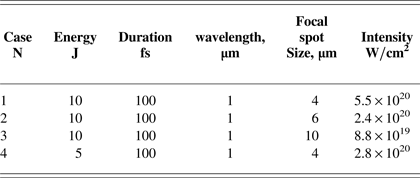
The proton beam parameters have been deduced from 3D simulations performed using the PIC code MANDOR (Romanov et al., Reference Romanov, Bychenkov, Rozmus, Capjack and Fedosejevs2004). We consider the interaction of a 10 J linearly polarized 100 fs laser pulse with an ultrathin plain hydric target (foil) assuming a repetition rate of 10 kHz. These laser parameters are consistent with what is expected from ICAN “dream laser” (Mourou et al. Reference Mourou, Brocklesby, Tajima and Limpert2013). By changing focal spot size and target thickness, we aim to maximize both the energy and the number of accelerated protons to maximize Tc-99m yield for a single shot when the protons from the foil are directed into a Mo-100 target. In order to boost acceleration of protons with highest current and energy, the bulk concentration of protons in the foil needs to be maximal (Robinson et al., Reference Robinson, Bell and Kingham2006). The highest proton content can be achieved with a pure hydrogen target. However, such a target requires cryogenic setup and precise thickness control and currently does not exist. Instead, ultra-thin CH2 foils can be used. They are known as PMP (poly(4-methyl-1-pentene): (CH3)2 CHCH2CH = CH2), targets. The CH2 foils have to be free-standing over the holes with radius of at least several hundred micrometers in a base plate (cf., Henig et al., (Reference Henig, Steinke, Schnurer, Sokollik, Horlein, Kiefer, Jung, Schreiber, Hegelich, Yan, Meyer-ter-Vehn, Tajima, Nickles, Sandner and Habs2009)) because with smaller radii, ionization of the target holder could affect the laser-plasma interaction. Such design could allow the base plate to be mounted inside the vacuum chamber on a motorized stage and fast rotated to ensure that each laser shot interacts with a fresh foil similar to what was used in the experiment (Liao et al., Reference Liao, Mordovanakis, Hou, Chang, Rever, Mourou, Nees and Galvanauskas2007), where the target was shot at a repletion rate of 1 kHz. As a case in point, we consider laser interaction with ultrathin CH2 foil and, as a reference, we set the laser wavelength at λ = 1 µm. The hot spot size was varied from 4 µm up to 10 μm, which corresponds to laser pulse intensity decrease from 5.5 × 10²⁰ W/cm2 to 8.8 × 10¹⁹ W/cm2. To study the possibility of Tc-99m production with a smaller scale laser, we also considered a laser pulse with an energy of 5 J and the same 100 fs pulse duration (the intensity is 2.8 × 10²⁰ W/cm2 for a 4 µm focal hot spot). The full set of the laser parameters are collected in Table 1.
Laser parameters under considereation

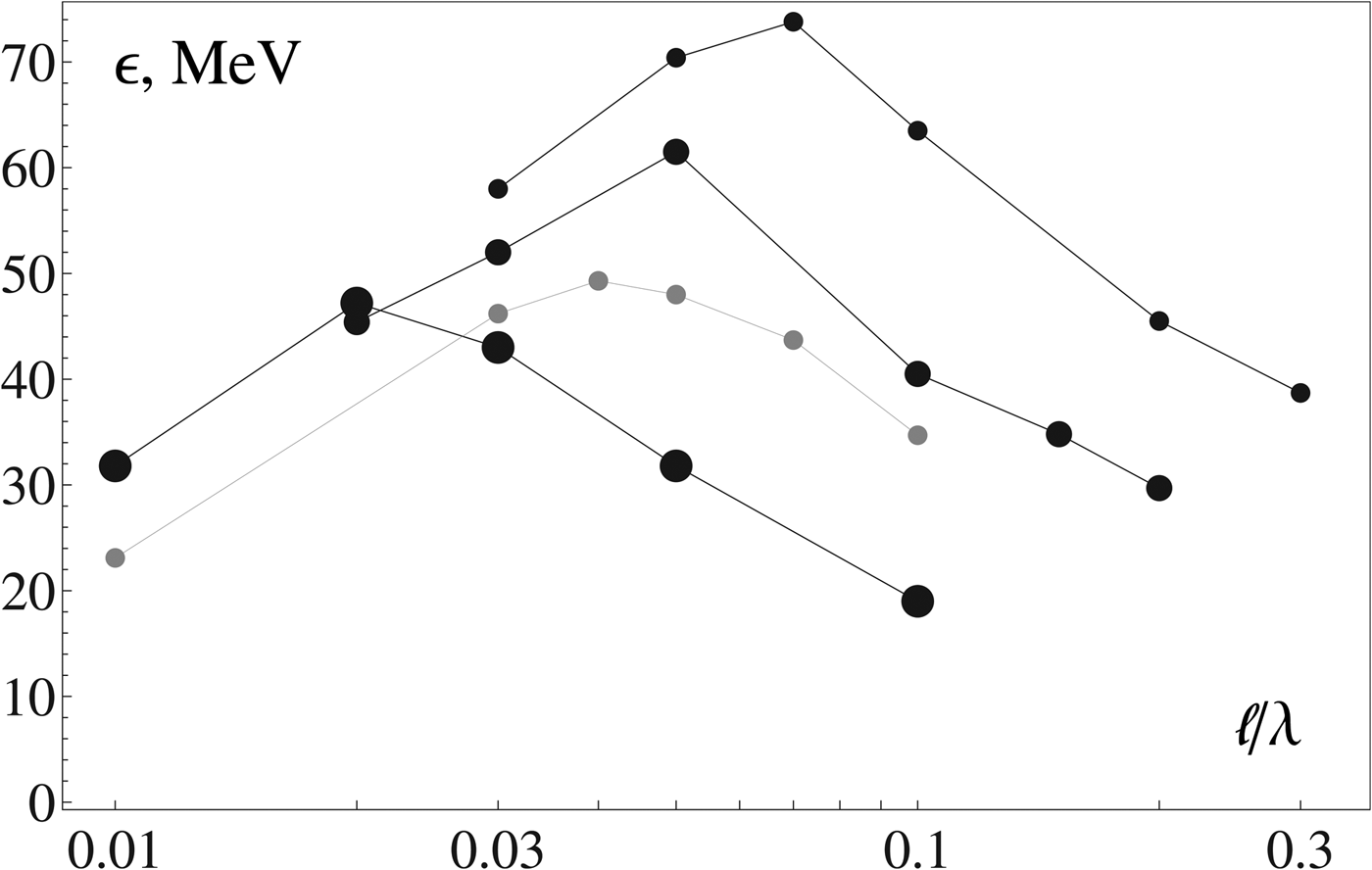
The laser pulse is focused at the front side of the plasma target composed from electrons and fully ionized carbon and hydrogen. The target has an electron density of 200n c, which corresponds to a real mass density of CH2 (1.1 g/cm3). Varying the target thickness (l) from 20 nm to 0.5 µm, we find the optimal thickness to maximize the maximum proton energy. The optimum target thickness (l 0) corresponds to the partially transparent regime of laser–plasma interaction (Brantov & Bychenkov, Reference Brantov and Bychenkov2013). This thickness is proportional to the square root of the laser pulse intensity and therefore decreases as the focal spot size increases (see Fig. 1).
Maximum proton energy vs. target thickness for different laser pulse focal spots: d = 4 µm (small black dots, case 1), d = 6 µm (medium black dots, case 2), and d = 10 µm (large black dots, case 3); grey dots correspond to a 5 J laser pulse focused into a 4 µm hot spot (case 4).
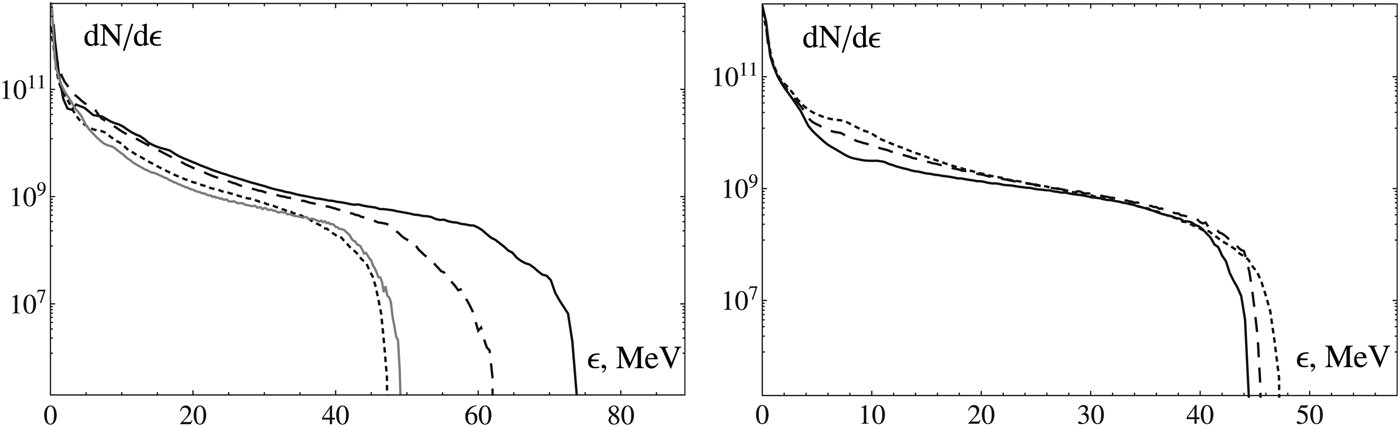
We also compare the number of energetic protons accelerated from thin foils. In this study, the number of protons with energy exceeding 8 MeV (the threshold for the Mo-100(p,2n)Tc-99m reaction) is of interest. In general, the number of accelerated particles increases with the focal spot size and laser intensity. For a given laser pulse energy, maximizing the number of accelerated particles would correspond to some trade-off between them. But our simulations demonstrate that increased intensity dominates. By analyzing the spectra of protons accelerated from a target of optimum thickness (see the left panel in Fig. 2), we conclude that a tight laser pulse focus gives not only the maximum proton energy but also the maximum number of energetic particles. Moreover, even a less energetic pulse but with a tighter focus can be used to achieve approximately the same number of energetic protons (cf., gray and dotted curves in the left panel in Fig. 2). In fact, proton acceleration from a very thin foil is a Coulomb explosion (Fig. 2, right panel). Although this regime is less effective for proton acceleration, because of significant electron exhaustion of the entire irradiated target volume, it shows some increase of the maximum proton energy and number of energetic protons as the focal spot size increases (see the right panel in Fig. 2).
Spectra of protons accelerated from the target with optimum thickness (left panel) and from a target with the thickness l = 0.02λ (right panel): d = 4 µm (solid curves), d = 6 µm (dashed curves), and d = 10 µm (dotted curves). The corresponding optimum thicknesses are l 0 = 0.07λ, l 0 = 0.05λ, and l = 0.02λ. The grey line shows the proton spectra for a 5 J laser pulse focused into a 4 μm hot spot (l 0 = 0.04λ).
To summarize, when the laser interacts with a thin foil whose thickness is properly adjusted to the pulse energy and focusing optics, both maximum proton energy and maximum number of particles can be achieved. The generated proton beam is characterized by an angular spreading of ≲10° and a wide energy distribution with a sharp cut-off at the maximum energy E max, which is of the order of 50 to 70 MeV for about 10 J laser pulse. The number of protons with energy higher than 8 MeV is of the order of 1011 particles per shot.
3. TC-99M YIELD CALCULATION
We now estimate the Tc-99m yield for the Mo-100(p,2n) Tc-99g reaction in a thick target (catcher) bombarded by laser-produced protons from a thin CH2 foil (pitcher). A pitcher-catcher set up is typical for laser initiation of nuclear reactions (Nemoto et al., Reference Nemoto, Maksimchuk, Banerjee, Flippo, Mourou, Umstadter and Bychenkov2001; Clarke et al., 2013; Storm et al., Reference Storm, Jiang, Wertepny, Orban, Morrison, Willis, McCary, Belancourt, Snyder, Chowdhury, Bang, Gaul, Dyer, Ditmire, Freeman and Akli2013; Roth et al., Reference Roth, Jung, Falk, Guler, Deppert, Devlin, Favalli, Fernandez, Gautier, Geissel, Haight, Hamilton, Hegelich, Johnson, Merrill, Schaumann, Schoenberg, Schollmeier, Shimada, Taddeucci, Tybo, Wagner, Wender, Wilde and Wurden2013). Actually, since laser produces highly collimated protons (Cowan et al., Reference Cowan, Fuchs, Ruh, Kemp, Audebert, Roth, Stephens, Barton, Blazevic, Brambrink, Cobble, Fernandez, Gauthier, Geissel, Hegelich, Kaae, Karsch, LeSage, Letzring, Manclossi, Meyroneinc, Newkirk, Pepin and Renard-LeGalloudec2004), in the laser nuclear experiments there are a wide variety of desired distances between pitcher and catcher, 5–200 mm, in a vacuum chamber (Nemoto et al., Reference Nemoto, Maksimchuk, Banerjee, Flippo, Mourou, Umstadter and Bychenkov2001; Storm et al., Reference Storm, Jiang, Wertepny, Orban, Morrison, Willis, McCary, Belancourt, Snyder, Chowdhury, Bang, Gaul, Dyer, Ditmire, Freeman and Akli2013; Roth et al., Reference Roth, Jung, Falk, Guler, Deppert, Devlin, Favalli, Fernandez, Gautier, Geissel, Haight, Hamilton, Hegelich, Johnson, Merrill, Schaumann, Schoenberg, Schollmeier, Shimada, Taddeucci, Tybo, Wagner, Wender, Wilde and Wurden2013). For example, if an angular spreading of the accelerated multi-MeV protons is 10°, that is the case of our simulations, almost all accelerated energetic protons will interact with the 15–30 µm radius catcher which is placed at the distance of 100–200 mm. Due to such distant positioning the catcher almost surely will be safe in regards to being disrupted by laser-produced plasma. If necessary (when the distance between the pitcher and catcher is small), additional thin metal or/and plastic films with thickness less than 50 µm can be placed behind laser target (Roth et al., Reference Roth, Jung, Falk, Guler, Deppert, Devlin, Favalli, Fernandez, Gautier, Geissel, Haight, Hamilton, Hegelich, Johnson, Merrill, Schaumann, Schoenberg, Schollmeier, Shimada, Taddeucci, Tybo, Wagner, Wender, Wilde and Wurden2013). In our calculations, we neglect small proton energy losses in possible protective screen foils. As a catcher, we assume metallic target of enriched Mo-100 of 99.54% (Isoflex). To stop protons with energy of 30–40 MeV a thickness of the Mo-100 layer should be 1.6–2.6 µm. To increase an effective thickness of the catcher it can be placed at the angle of several degrees to the proton beam axis that has been recently proposed by Benard et al. (Reference Benard, Buckley, Ruth, Zeisler, Klug, Hanemaayer, Vuckovic, Hou, Celler, Appiah, Valliant, Kovacs and Schaffer2014).
Note, that the proton beam contains protons with wide energy spread. They are moving with different velocities and therefore reach a catcher target at different instants. For example, if the catcher is at 100 mm behind the pitcher, the protons with energy of 40 MeV hit Mo-100 after 340 ps and the protons with energy of 10 MeV do it after 680 ps. Therefore, effective beam duration is about 340 ps, more than 3000 times longer than the laser pulse duration that significantly reduces proton beam power compared to monoenergetic beam. Moreover, due to greater proton spot size at the catcher, the power flux density at the catcher is also dramatically decreased. Given the laser-proton conversion efficiency 1%, that is typical for our simulations, the power flux density of the proton bunch bombarding an enriched Mo-100 target is about 108 W/cm2. It is very likely that such power flux density is too low to cause any damage and heating of the catcher (see, for example, the experiment by Patel et al., (Reference Patel, Mackinnon, Key, Cowan, Foord, Allen, Price, Ruhl, Springer and Stephens2003) in which proton energy flux at the target was many orders of magnitude larger). Because low-energy protons (with energy < 8 MeV) considerably contribute to the total power flux density but are useless for technetium production these protons can be excluded with magnetic selection (Busold et al., Reference Busold, Schumacher, Deppert, Brabetz, Frydrych, Kroll, Joost, Al-Omari, Blazevic, Zielbauer, Hofmann, Bagnoud, Cowan and Roth2013) before they reach the catcher. This could even stronger decrease power deposited into Mo-100, thus more preventing it from destructive effects.
The yield (number of reactions) for one proton of energy E is given by Krasnov (1974) and Celler et al. (Reference Celler, Hou, Benard and Ruth2011)
 $$Y_1 \lpar E\rpar ={{N_A } \over {Mm_u }} \int_0^E \, {\rm \sigma} \lpar E^{\prime}\rpar \left({dE^{\prime} \over {d{\rm \rho} x}}\right)^{-1} dE^\prime\comma \;$$
where σ (E) is the cross section (Qaim et al., 2014) in cm2, dE/dρ x is the stopping power in the units MeV cm2/g, M is the target atomic mass, N A is the Avogadro number, and m u = 1 g/mol is the molar mass constant. For the proton spectrum derived from the simulation, the total yield Y Σ per one laser shot can be calculated from
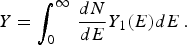 $$Y=\int_0^\infty \, \displaystyle{{dN} \over {dE}}Y_1 \lpar E\rpar dE\, .$$
The corresponding number of radioactive nuclei at the given instant t d after the production of Tc-99m terminates is
 $$Y_\Sigma=Yf\left(1 - \exp\left( - {\lambda} t_r \right) \right)\exp\left( - \lambda t_d \right)/ \lambda\, \comma \;$$
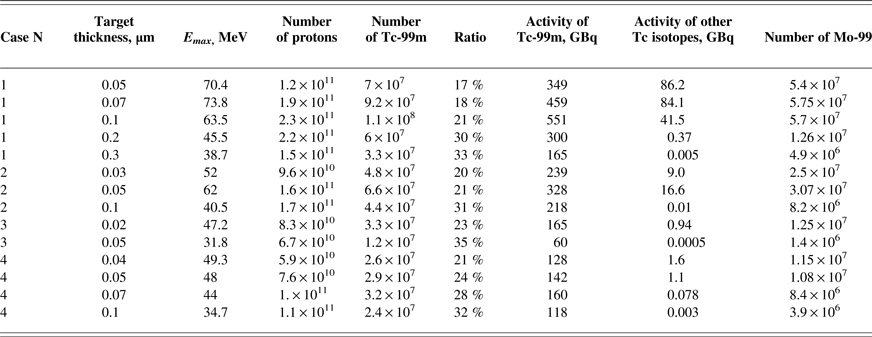
where t r is the duration of radiation exposure, f is the laser pulse repetition rate, and the decay constant λ is inversely proportional to the half-life τ1/2, λ = log(2)/τ1/2. The maximum yield is (Yf/λ)[1 - exp(- λ t r )] and is shown in Table 2. The stopping power and reaction cross-sections data have been taken from SRIM code (Ziegler, Reference Ziegler2010; Berger et al., Reference Berger, Coursey, Zucker and Chan2014; and Qaim et al., Reference Qaim, Sudar, Scholten, Koning and Coenen2014).
The Tc-99m production versus irradiation condition and target thickness
The full set of data for the four cases discussed (see Table 1) is presented in Table 2. We calculated the number of Tc-99m atoms produced from Mo-100(p,2n) reaction per one laser shot and compared it with the other Tc isotopes: Tc-99g, Tc-98, Tc-97g, Tc-97m, and Tc-96g produced from Mo-100(p,2n), Mo-100(p,3n), Mo-100(p,4n), and Mo-100(p,5n) reactions. The table shows the ratio of Tc-99m to these impurities (see “Ratio” column).
The main issue of Tc-99m sample quality is radionuclide purities in terms of other Tc isotopes which could not be removed by chemical purification. These Tc radioisotopes are generated from nuclear interactions of the accelerated protons ether with other stable Mo isotopes presented in the nuclear target (Hou et al., Reference Hou, Celler, Grimes, Benard and Ruth2012; Lebeda et al., Reference Lebeda, van Lier, Stursa, Ralis and Zyuzin2012) or from (p,4n) and (p,5n) reaction in interaction with Mo-100. By using isoflex target with 99.54% of Mo-100 and 0.41% of Mo-98 one may greatly reduce amount of radioactive technetium isotopes other than Tc-99m which can be produced from the most dangerous Mo-(95-97) impurities (Hou et al., Reference Hou, Celler, Grimes, Benard and Ruth2012). However, the unstable Tc-97m, Tc-96m, and Tc-96g isotopes appear because protons have a rather high maximum energy E max up to 70 MeV. Their production may result in unacceptable increase of the activities (see column 8 in Table 2). In spite of the fact that Tc-96m decays to Tc-96g in approximately 50 minutes, the activities of parasitic Tc isotopes may still be high enough for medical application. For example, the ratio of parasitic Tc isotope activities to the Tc-99m activity which reaches 7.5% for protons with E max = 63.5 MeV (see third row in a Table 2) decreases up to 1.6% during three hours after the end-of-bombardment. The isotopes Tc-97m and Tc-96g may comprise 20% to 40% of the entire Tc-99m isotope. The percentage of these isotopes can be significantly reduced when the maximum proton energy decreases, for example, up to 2% for a proton beam with the energy cutoff at 46 MeV (see the fourth row in Table 2). In latter case, the relative activities of parasitic Tc isotopes which is just 0.12% at the end-of-bombardment drops to the 0.03% after three hours. Therefore, using of proton beam with maximum energy up to 40 Mev is more favorable for Tc-99m production. We assume that unstable Tc-100 (τ1/2 = 15.8 s) which is produced during Mo-100(p,n) reaction decays to stable Ru and does not contribute to the final radioactivity. The Tc-99m activity after six hours irradiation is calculated for laser repetition rate of 10 kHz.
We also calculated the number of Mo-99 due to Mo-100(p,d + pn)Mo-99 reaction. It may increase Tc-99m production somewhat (Qaim et al., Reference Qaim, Sudar, Scholten, Koning and Coenen2014). Because Mo-99 has a long decay time (τ1/2 = 66.0 h), it contributes noticeably to the Tc-99m yield only for a relatively long irradiation time (more than 12 h) and a large proton energy (in excess of 30 MeV) (Qaim et al., Reference Qaim, Sudar, Scholten, Koning and Coenen2014).
4. CONCLUSIONS
Whereas a study of the direct production of Tc-99m on cyclotrons has begun quite long ago since pioneering work by Beaver and Hupf (Reference Beaver and Hupf1971), the works on a laser approach to Tc-99m production are just beginning (Clarke et al., Reference Clarke, Dorkings, Neely and Musgrave2014). We believe that Tc-99m production with ultrashort intense laser pulses is potential alternative moving forward to create new source of supply of Tc-99m for decades to come.
We have performed optimization of thin target as a source of high-energy protons to analyze the prospects for laser-based production of Tc-99m with ICAN laser with energy of 10J and repetition rate of 10 kHz . Our results show that short-pulse laser-generated proton beam may have a wide energy spectrum up to 74 MeV that is enough for production of Tc-99m with activity up to 550 GBq after 6-hours irradiation. However, the additional patient dose from the co-produced other Tc isotopes is too large for the case of maximum proton energy, 74 MeV, and dose, 550 GBq. With properly adjusted laser target thickness and irradiation condition we have demonstrated significant reduction in activities of co-produced isotopes which could be acceptable for medical needs. Corresponding Tc-99m activity is 300 Gbq after six-hours irradiation with radionuclidic purities less than 0.12 %.
Since our work does not consider manipulation of laser-generated proton beam (Busold et al., Reference Busold, Schumacher, Deppert, Brabetz, Frydrych, Kroll, Joost, Al-Omari, Blazevic, Zielbauer, Hofmann, Bagnoud, Cowan and Roth2013) and Mo-100 target thickness (Esposito et al., Reference Esposito, Vecchi, Pupillo, Taibi, Uccelli, Boschi and Gambaccini2013) we conclude that further improvement of the radionuclidic purity of laser-produced Tc-99m is possible. Future investigation is also required to suggest reliable engineering design of laser-target system which allows one to work at high repetition rate. One more interesting and novel approach could be a study to use laser irradiation of a single hydric bulk Mo-100 target instead of use of two (laser and nuclear) targets if technology advances to allow it. In this case front side accelerated protons will produce Tc-99m in the same target (Cf. (Willingale et al., Reference Willingale, Petrov, Maksimchuk, Davis, Freeman, Joglekar, Matsuoka, Murphy, Ovchinnikov, Thomas, Van Woerkom and Krushelnick2011)). The efficiency of such a target could be a matter of study in future work.
ACKNOWLEDGEMENT
This work was supported by the Russian Foundation for Basic Research (Grant Nos. 13-02-00426-a, 12-02-00231-a).