Smen is a traditional fermented butter, generally produced from cows’ milk, although goats’ milk, ewes’ milk or a mixture are sometimes used. Smen was traditionally prepared at home from raw milk subjected to spontaneous fermentation for 1 to 3 d. The curdled milk is then churned to separate the liquid phase, traditionally called Lben, from the fat called Zebda, corresponding to some sort of farm butter. The latter is then washed with warm water, salted to remove excess water and then packed in closed earthen jars for several months. Smen production is considered to be a means of preserving butter from spoilage and loss during high milk production seasons, corresponding to spring and early summer in Morocco (Tantaoui-Elaraki & El Marrakchi, Reference Tantaoui-Elaraki and El Marrakchi1987). This final highly fragrant fermented product is mostly used as an aromatising additive to many traditional food dishes.
During the period of ripening, various biochemical processes occur and lead to the transformation of the farm butter into smen and thus define the characteristics of smen as a final product. Earlier scientific investigations have defined some important characteristics of smen. The average values of fat, non-fat dry matter, water, salt and proteins are 81·34, 4·96, 13·7, 1·5 and 3·25%, respectively (El Marrakchi et al. Reference El Marrakchi, Berrada, Chahboun and Benbouhou1986). Lipolysis has been described as the main mechanism responsible of physicochemical changes and flavour in smen (Faid et al. Reference Faid, Chabard, Larpent and Berger1989). The described lipolysis can result either from microbial lipases or indigenous lipases (Benkerroum & Tamime, Reference Benkerroum and Tamime2004), but the latter are considered of minor importance, as it is suggested that they can be inhibited by acidic conditions and salt concentration (Faid et al. Reference Faid, Chabard, Larpent and Berger1989). The reported average value of acid index ranged from 12 to 107 mg KOH/g of smen by El Marrakchi et al. (Reference El Marrakchi, Berrada, Chahboun and Benbouhou1986) and from 14 to 28 mg KOH/g of smen by Faid et al. (Reference Faid, Larpent, Larpent, Chabard and Berger1990). These values give evidence of a strong lipolysis in smen. The wide range of the above reported chemical characteristics reflect the heterogeneity in the smen products that results from differences in raw material origin, additives and processing parameters. Smen is still produced mostly in homes without any standardisation like most traditional fermented foods such as lben and raib (Benkerroum & Tamime, Reference Benkerroum and Tamime2004).
Smen aroma has been essentially attributed to the four C4 to C10 free fatty acids, i.e., butanoic, hexanoic, octanoic, and decanoic acids, which are directly released from butter through lipolysis (Faid et al. Reference Faid, Larpent, Larpent, Chabard and Berger1990). Triqui & Guth (Reference Triqui and Guth2001) have reported that butanoic and hexanoic acids were the most potent volatiles in smen.
However, because this product is fermented for months if not years in some cases and is highly aromatic, we think that other processes beyond simple lipolysis contribute to the development of the complex aroma of this product. Thus, we explored the volatile profile using SPME GS/MS to identify the frequency and the abundance of different compounds in a diverse set of smen samples. Then, we analysed the major volatile products and their relation to certain processing factors as well as consumer preferences using univariate and multivariate statistical analysis.
Material & methods
Sampling
To enable a large variety in product characteristics, a range of 10 samples were obtained and used for analysis. Prior to physicochemical and aroma analyses, an amount of each sample was kept at −20 °C to avoid further fermentation and changes in the physicochemical characteristics of the samples. The values reported were average of three repetitions for each sample.
Chemical characterisation
Acid value was determined according to AOAC (1999). In a screw-capped tube, approximately 0·5 g of sample were dissolved in 5 ml of freshly neutralised ethyl-ether, then 2–3 drops of phenolphthalein were added to the mixture. The acidity was titrated by a 0·5 or 0·1 N methanolic KOH solution until a persistent roseate colour was observed.
To determine moisture content, 0·5–1 g of each sample was weighed and dried to a constant weight at 60 °C in oven. Fat content was determined according to Folch et al. (Reference Folch, Lees and Sloane Stanley1957). Approximately 0·5 g of sample were weighed in a test tube, 10 ml of chloroform:methanol (2 : 1, v/v) were added and the tube was then stirred. After phase's separation, the upper phase was removed and the remaining phase was washed with 0·2 its volume of 0·58% NaCl. Phases were enabled to separate again and then the lower phase was filtered in a weighed test tube and evaporated. The obtained extract was dried at 101 °C for 1 h in oven and then weighed.
To determine Na content, samples were subjected to acidic digestion according to Masotti et al. (Reference Masotti, Erba, De Noni and Pellegrino2012) with slight modifications. Approximately 5 g of each sample was subjected to ashing for 5 h at 560 °C in oven. Obtained ashes were taken up in 7 ml of HNO3. Mixing was performed to ensure a complete mineralisation. The mixture was then filtered and completed to 50 ml with distilled water. Na determination was performed on the obtained solution by Inductively Coupled Plasma Atomic Emission Spectrometry (ICP-AES). The analysis included blank and different concentration standards of the elements analysed.
Volatiles analysis
Extraction of volatile aroma compounds from sample matrix was performed by solid phase micro-extraction (SPME). Samples were pretreated at 55 °C for 10 min and aroma volatiles compounds were extracted by exposing a 75 µm carboxen/polydimethylsiloxane (CAR/PDMS) SPME fibre to the headspace for 20 min at 55 °C. Following extraction, the gas chromatography mass spectrometry (GC/MS) analysis was performed on an Agilent 7890A gas chromatograph, directly coupled to the mass spectrometer system of an Agilent 5975C inert MSD with triple-axis detector. On GC, volatile compounds were separated using a DB-5MS UI column (length: 30 m, diameter: 0·25 mm, thickness: 0·25 µm, Agilent Technologies). Helium was used as carrier gas in splitless mode with a total flow of 52·3 ml/min. The temperature program was maintained at 50 °C for 3 min then raised at 6 °C/min to 250 °C and held for 5 min. The GC-MS transfer line was at 280 °C. The MS operated in scan mode over a range of m/z 40–600. Source and quadrupole temperatures held at 230 and 150 °C.
The MSD Chemstation was used to find all the peaks in the raw GC chromatogram. A library search was carried out for all the peaks using the NIST/EPA/NIH Mass Spectral library version 2·0, and the results were combined in a single peak table.
Sensory analysis
Consumer preference was evaluated with 31 untrained personnel (18 females and 13 males aged 19 to 56) from the Faculty of Sciences and Technology Marrakech that were familiar with smen. Sample preference was assessed using a 9-point hedonic scale method. Samples were put in 1 ml Eppendorf tubes to the half of their content, covered with aluminium foil to hide the colour and then allowed to reach room temperature prior to their presentation to consumers. Samples were presented monadically and assessors were allowed to retest them as many times as they wished. Consumers were then asked to grade them according to their appreciation by filling a nine-point form with the following scale: 9: like extremely, 8: like very much, 7: like moderately, 6: like slightly, 5: neither like nor dislike, 4: dislike slightly, 3: dislike moderately, 2: dislike very much, 1: dislike extremely. In the absence of a reference product, sample SI1 that showed the highest grading value record was used as the reference sample.
Statistical analysis
The hedonic method results were analysed using a two-way ANOVA followed with post-hoc comparisons by Tukey's HSD test using IBM SPSS V23. The R-index values were also calculated using as reference sample the most liked sample (SI1) as reported by Seong Lee & Van Hout (Reference Seong Lee and Van Hout2009). The volatile profiles of samples were compared by applying a multidimensional scaling analysis of a matrix of Euclidian distance between peak areas of each chemical compound in the aromas using IBM SPSS V23.
Results & discussion
Volatile profile characterisation
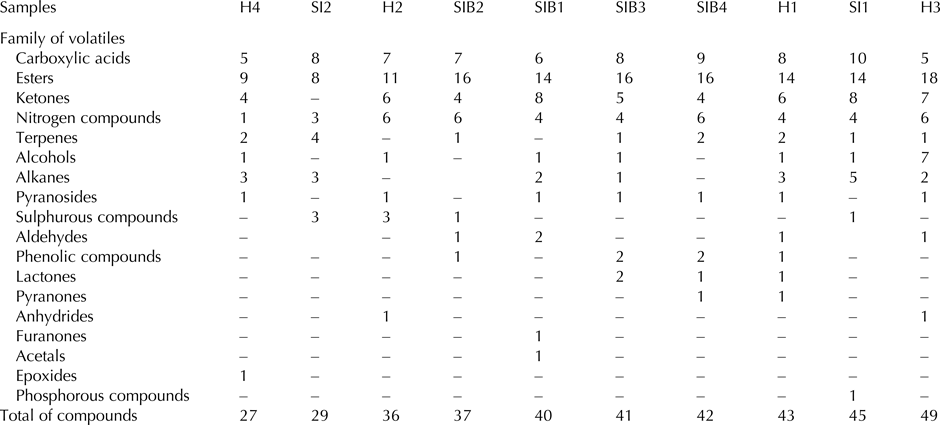
As expected the fatty acids were present in all the samples but along with other volatiles with an average of 39 (range from 27 to 49) different volatiles in each smen sample (Table 1). The other volatile compounds belonged to ketones especially methylketones, esters, nitrogen, sulphurous and phosphorous compounds, alcohols, alkanes, terpenes, pyranones, furanones, pyranosides, lactones, phenols, aldehydes, acetals, anhydrides and epoxide. These compounds are typical volatiles of dairy products (McSweeney & Sousa, Reference McSweeney and Sousa2000; Curioni & Bosset, Reference Curioni and Bosset2002; Delgado et al. Reference Delgado, González-Crespo, Cava and Ramírez2011).
The number of compounds and their occurrence for each family of volatiles detected in 10 commercial and homemade smen samples by SPME-GC-MS

Carboxylic acids are the first to be produced mainly through lipolysis of triglycerides (El Marrakchi et al. Reference El Marrakchi, Berrada, Chahboun and Benbouhou1986). Further, they are precursor of other volatile compounds through different biochemical pathways. Esters are formed through chemical equilibrium or enzymatic reaction when acids react with alcohols from lactose fermentation or from amino acids catabolism (Gallois & Langlois, Reference Gallois and Langlois1990). Carboxyl esterase, an esterifying enzyme, is commonly found in most of microorganisms involved in cheese ripening (Qian et al. Reference Qian, Cara and Bloomer2002). Esters were the most frequent family detected in smen samples. They have been detected as important odour compounds in several different cheeses (Delgado et al. Reference Delgado, González-Crespo, Cava and Ramírez2011). Most detected ketones were methylketones that are produced through β-oxidation of fatty acids by microbial activity (McSweeney & Sousa, Reference McSweeney and Sousa2000). Methylketones have been described as abundant and positive constituents of volatile fraction of several dairy products namely cheeses (Delgado et al. Reference Delgado, González-Crespo, Cava and Ramírez2011). Detected alcohols were primary alcohols, straight-chain and branched-chain secondary alcohols, glycerol, cyclic alcohols and a polyol. Alcohols may be produced under different pathways such as lactose metabolism, methylketones reduction, amino acid metabolism and degradation of unsaturated fatty acids (Molimard & Spinnler, Reference Molimard and Spinnler1996). Sulphurous and nitrogen compounds, alkanes, lactones , aldehydes, furanes, pyrazines, pyranones, phenols and terpenes have been also described in the volatile fraction of some cheeses even if they are encountered less frequently than the families described above (McSweeney & Sousa, Reference McSweeney and Sousa2000; Curioni & Bosset, Reference Curioni and Bosset2002; Delgado et al. Reference Delgado, González-Crespo, Cava and Ramírez2011).
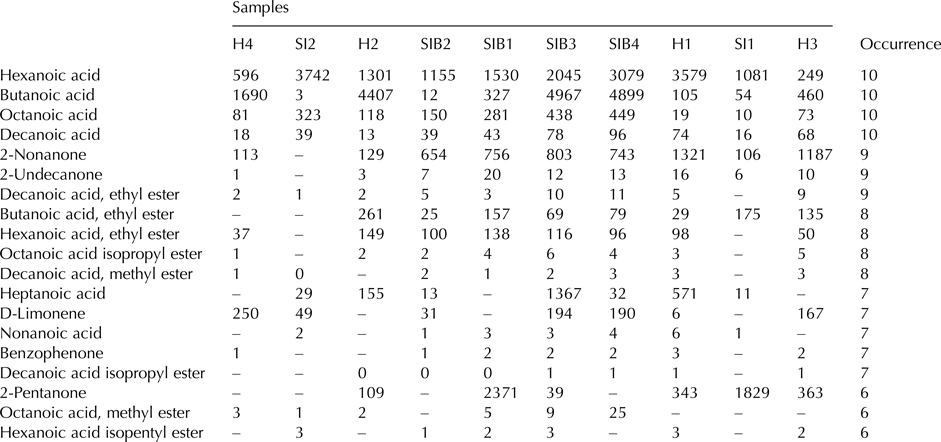
Those last families were less detected in smen samples as well. Of the total 183 different volatile compounds identified in all samples, 119 individual compounds were detected only in one single smen sample. Only 19 compounds were common to more than 50% of the samples (Table 2). These volatiles were the four even numbered short chain fatty acids (butanoic, hexanoic, octanoic and decanoic acids), two odd numbered short chain fatty acids (hepatanoic and nonanoic acids), four ketones (2-nonanone, 2-undecanone, benzophenone and 2-pentanone), eight esters (decanoic acid ethyl ester, butanoic acid ethyl ester and hexanoic acid ethyl ester, octanoic acid isopropyl ester, decanoic acid methyl ester, caproic acid isopropyl ester, octanoic acid methyl ester and hexanoic acid isopentyl ester) and a terpene compound (d-limonene).
SPME-GCMS peak area (area/106) of 19 most common volatile compounds in 10 commercial and homemade smen samples

Except for D-limonene that is a known lipophilic plant terpene (Fernandez et al. Reference Fernandez, Astier, Rock, Coulon and Berdagué2003) certainly transferred to milk via the forage mixture of animals (Revello Chion et al. Reference Revello Chion, Tabacco, Giaccone, Peiretti, Battelli and Borreani2010), the other 18 compounds are known volatiles of dairy products. These 18 compounds are all intermediates in fat metabolism that are well known contributors to the aromas of other dairy products such as cheeses. They also present low sensory perception thresholds and they bring special flavour notes (Curioni & Bosset, Reference Curioni and Bosset2002; Qian & Reineccius, Reference Qian and Reineccius2002; Delgado et al. Reference Delgado, González-Crespo, Cava and Ramírez2011)
The 4 fatty acids hexanoic, butanoic, octanoic and decanoic acids were among the most abundant and the only compounds detected in all smen samples in this study. These compounds released from butter triglycerides have been detected as important aromas in other dairy products especially cheeses. Hexanoic acid has been reported as a key odorant in aged Cheddar (Christensen & Reineccius, Reference Christensen and Reineccius1995) and Grana Padano (Moio & Addeo, Reference Moio and Addeo1998). Butanoic acid also plays a major role in the aroma of many cheeses such as Gruyère, Camembert and Cheddar. Almost all past investigations of smen (El Marrakchi et al. Reference El Marrakchi, Berrada, Chahboun and Benbouhou1986; Tantaoui-Elaraki & El Marrakchi, Reference Tantaoui-Elaraki and El Marrakchi1987; Benkerroum & Tamime, Reference Benkerroum and Tamime2004) considered these 4 fatty acids as the main if not the only odorants in smen released by simple lipolysis of butter triglycerides.
However, the presence, in most samples, of odd numbered fatty acids, methylketones and the other compounds in Table 4 that are not found in bovine milk fat indicate that other processes of fat transformation beyond simple hydrolysis or lipolysis of butter triglycerides may be important in developing aromas in this product.
Indeed, odd numbered fatty acids can be produced through lactate metabolism or amino acids catabolism by Lactic Acid Bacteria (McSweeney & Sousa, Reference McSweeney and Sousa2000; Marilley & Casey, Reference Marilley and Casey2004; Delgado et al. Reference Delgado, González-Crespo, Cava and Ramírez2011). Methylketones with odd numbered chain are produced by P.roqueforti, P.camemberti and G.candidum from free fatty acids (FFA) catabolism (Collins et al. Reference Collins, McSweeney and Wilkinson2003). Strains of Penicillium sp. and Geotrichum candidum identified in Moroccan smen (Faid et al. Reference Faid, Touraibi, Tantaoui-Elaraki and Breton1992) may produce methylketones. Furthermore, methylketone 2-nonanone detected in smen is the most potent compound in aroma of blue and in Camembert cheeses (Qian et al. Reference Qian, Cara and Bloomer2002). Butanoic acid ethyl ester has been reported to be an important odorant in Emmental and Cheddar cheeses while hexanoic acid ethyl ester plays an important role in aged Cheddar, natural Gorgonzola and Grana Padano cheeses (Curioni & Bosset, Reference Curioni and Bosset2002).
Multifactorial analysis of volatile amounts
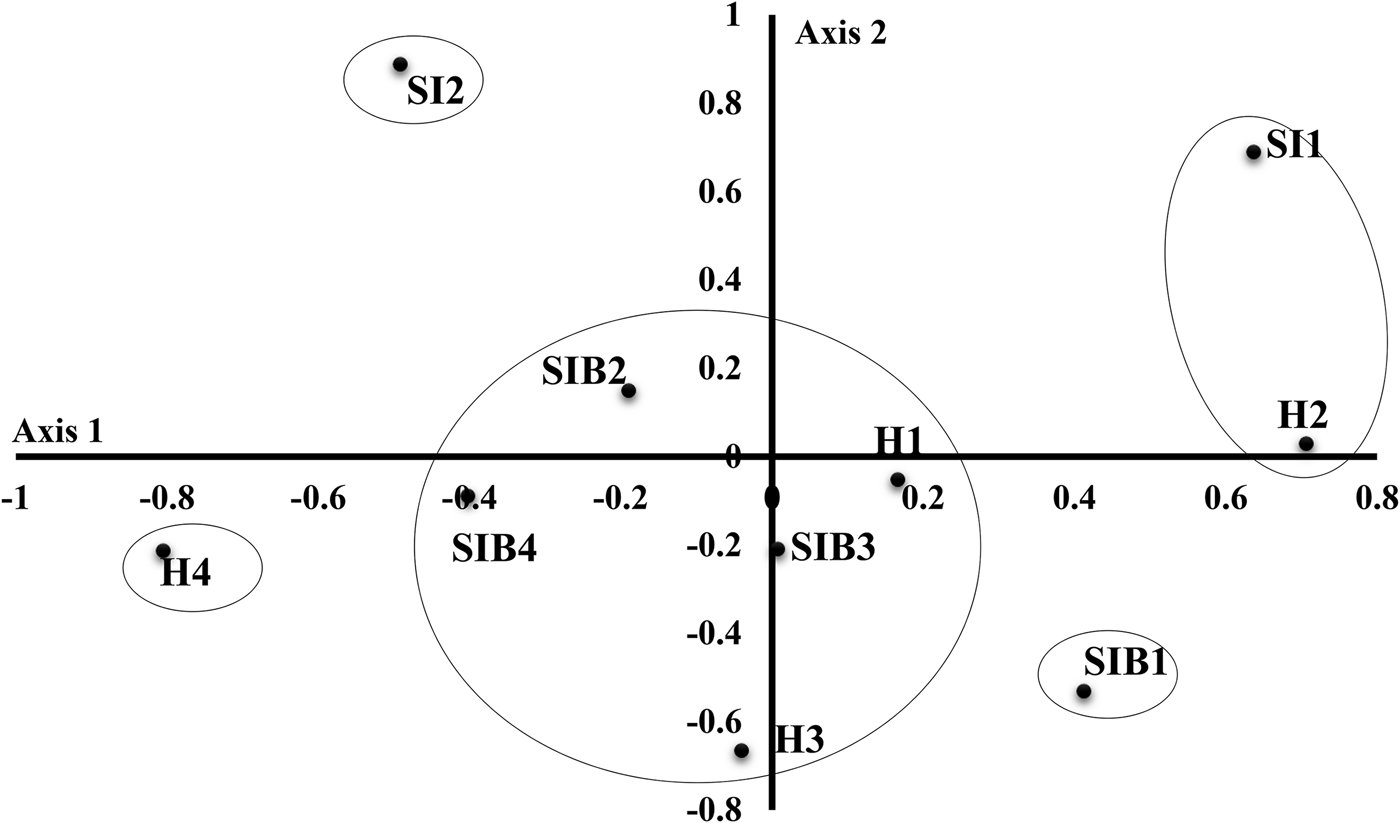
In addition to being the most frequent compounds in smen, the carboxylic acids were also the most abundant especially the even C4–C10 acids (Table 2). They were followed by certain ketones, then the uneven carboxylic acids. Finally, the levels of esters were the lowest despite being more frequent with 8 out of the 18 common compounds (Table 2). To analyse these differences we used the peak area of volatiles as variables to compute Euclidian distances between smen samples and presented the results in 2 dimensional plot using multidimensional scaling analysis (Fig. 1). About half of the smen samples form a seemingly homogeneous central group in the scatterplot defined by the axes 1 and 2 (Fig. 1). The five remaining samples were clearly distinguished from this central group namely samples H4 and SI2 on one side and SIB1, H2 and SI2 from the opposite side of the first axis.
Multidimensional scaling scatterplot of peak area from SPME-GCMS of the most common aroma compounds in 10 commercial and homemade smen samples.

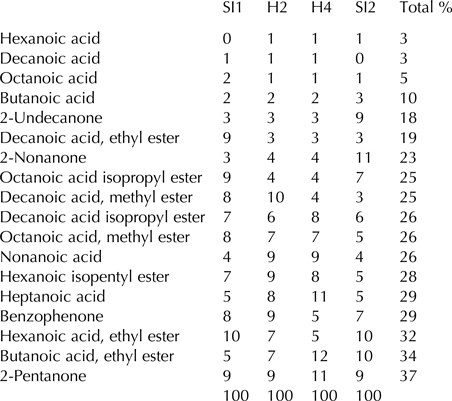
Analysis of the contribution of each volatile to the Euclidian distance (Table 3) for the samples (SI1, H2, IS2 and H4) that led to the greatest distance from the central group showed that the four acids contributed the least with a percentage rarely exceeding 1%. In contrast, the esters and certain ketones had a significantly higher contribution. In particular, the presence of 2-pentanone and butanoic and hexanoic acid ethyl esters are worth noting.
Percentage contribution of the 19 aroma compounds to the Euclidian distances for samples SI1, H2, SI2 and H4

Although the four carboxylic acids seem to contribute less in the differentiation of smen samples, these short chain fatty acids have relatively low perception thresholds allowing the release of their associated flavour notes to contribute to the aromas of dairy products. Butanoic acid is associated to rancid and cheesy flavour, hexanoic acid has pungent and blue cheese note while octanoic acid is associated to goaty, waxy and soapy notes (Molimard & Spinnler, Reference Molimard and Spinnler1996; Qian & Reineccius, Reference Qian and Reineccius2002). However, some methylketones and esters, detected in smen volatile fraction, such as 2-pentanone, 2-nonanone and butanoic acid ethyl ester and hexanoic acid ethyl ester are also dairy products aromas that additionally present lower perception thresholds than the four free fatty acids (Molimard & Spinnler, Reference Molimard and Spinnler1996). They also present fruity, floral and musty notes (Delgado et al. Reference Delgado, González-Crespo, Cava and Ramírez2011) that minimise the rancid, waxy, goaty sharp odour notes due to free fatty acids and other compounds (Gallois & Langlois, Reference Gallois and Langlois1990).
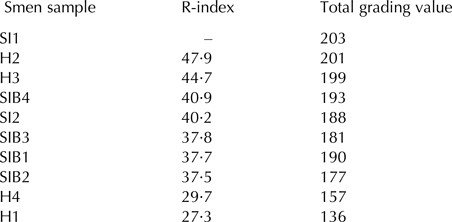
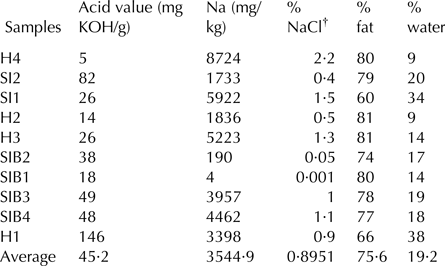
These properties may have affected the differences observed for consumer preference evaluation (Table 4). Indeed, the group of samples that contained the highest amounts of butanoic acid ethyl ester (H2 and SI1) were ranked the highest in our consumer preference analysis based on the R-index (Table 4). They were significantly different (P < 0·05) only from samples H1 and H4 (ANOVA followed by Tukey's test of hedonic scale scores). In these last two samples that presented different volatile profiles (Fig. 1), butanoic acid ethyl ester was not detected. They were the samples with the highest acidity values of 146 mgKOH/g smen H1 and the lowest acidity value with only 5 mgKOH/g smen H4 (Table 5). A more in depth analysis of the sensory attributes and flavours is needed to confirm these results because of the use of basic hedonic methodology in this work.
Comparison of 9 point hedonic scale scores for 10 commercial and homemade smen samples

Nature and chemical characteristics of 10 commercial and homemade smen samples

† %NaCl (1 g of NaCl/100 g of smen) estimated from Na concentration.
Nevertheless, the multivariate volatile profile analysis (Fig. 1) seem to reflect some of the samples properties especially for the 5 samples not included in the central group ST1, H2, H4, SIB1 and SI2. Indeed, as stated above SI1 and H2 were the samples with the highest consumer scores while samples H4 and SIB1 were the smen samples with the highest (2·2%) and the lowest (0001%) concentration of salt (Table 5). Sample H4 also showed very limited fatty acid hydrolysis as reflected by the lowest acidity value (5 mg KOH/g) and led to the lowest number of different volatiles par sample along with sample SI2 (Table 1). Despite its average salt content, SI2 was the only sample containing thyme extract as indicated on the product package. As reported by Davidson (Reference Davidson, Doyle, Beauchat and Montville2001) and Shelef & Seiter (Reference Shelef, Seiter, Davidson, Sofos and Branem2005), a high salt content will potentially affect the flora size and composition and hence may affect the production of volatiles in the smen samples. Thyme is also known for its anti-microbial activity (Çetin et al. Reference Çetin, Çakmakçi and Çakmakçi2011) that also may influence the amount and composition of volatiles produced in smen. However, thyme is not traditionally added to smen but reserved to aromatise and preserve another melted butter product, like Indian Ghee, that is not fermented. Thyme containing products are highly appreciated by the local population which may explain why SI1 was still rather appreciated by the consumers despite its volatile profile.
Conclusions
Volatile composition showed that butyric, hexanoic, octanoic and decanoic acids are the most recurrent and abundant aroma compounds in most smen samples. These acids that can result from direct lipolysis of butter fat have been considered by past investigators as the main if not the only aromas of smen, However, this work showed that short chain odd numbered fatty acids, methylketones and fatty acid esters that result from more elaborate microbial transformation of butter fat were also present in most samples (at least 6 out of 10) at high levels in some cases. Furthermore, the difference in concentration of the four C4 to C10 free fatty acids did not seem to explain the results of the effect of salt concentration, thyme presence or consumer preference. In contrast, the other volatiles, in particular 2-pentanone and butanoic and hexanoic acid ethyl esters, in addition to the other methylketones and esters seem to better explain the effect these factors. Additionally, these compounds, plus the four C4 to C10 free fatty acids, are among the most potent compounds in many dairy products especially due to their low perception thresholds and pleasant flavour notes. Hence, they should be considered as important fragrant compounds and may be used to define typical aroma profile for smen.
The highest (2·2%) and lowest (0·5%) levels of salt seem to significantly affect the profile and amounts of volatile compounds in smen. The presence of thyme and some high acidity values along with salt seem to also be important factors in volatile composition and consumer preference.
GCMS Instrument used in aroma analysis has been supported by Molecular Structure Characterization Laboratory (MPSM), Center for Research and instrumentation Management (CRIM), Universiti Kebangsaan Malaysia (UKM). This research did not receive any specific grant from funding agencies in the public, commercial, or not-for-profit sectors.