Introduction
Travertine formed during the Tertiary to Quaternary periods is widely distributed in northwestern (NW) Iran and Turkey and serves as a valuable sample for paleoenvironmental reconstructions in semi-arid areas, such as paleoprecipitation and paleohydrology. As groundwater gushes out, dissolved carbon dioxide (CO2) is degassed and dissolved calcium (Ca2+) precipitates as calcium carbonate (CaCO3), forming travertine, which is expected to provide information on the chemical composition of the groundwater, the water temperature, and the rainfall at the time of carbonate precipitation. Previous studies (e.g., Mohammadi et al. Reference Mohammadi, Capezzuoli, Claes, Alipoor, Muchez and Swennen2019, Reference Mohammadi, Vaselli, Muchez, Claes, Capezzuoli and Swennen2020; Roshanak et al. Reference Roshanak, Moore, Zarasvandi, Keshavarzi and Gratzer2018; Zarasvandi et al. Reference Zarasvandi, Roshanak, Gratzer, Pourkaseb and Moore2019) have analyzed the chemical compositions, carbon and oxygen isotopes of travertines in NW Iran for paleoenvironmental reconstructions, but they did not include dating.
Common dating methods for travertine (Pentecost Reference Pentecost2005) are U/Th dating (234U–230Th, < 5 × 10⁵ yr), U–Pb dating (> 1 × 10⁶ yr) (e.g., Quade et al. Reference Quade, Rasbury, Huntington, Hudson, Vonhof, Anchukaitis, Betancourt, Latorre and Pepper2017), thermoluminescence (TL, 103–106 yr) (e.g., Engin and Güven Reference Engin and Güven1997), and 14C (< 5 × 10⁴ yr) (e.g., Srdoč et al. Reference Srdoč, Osmond, Horvatinčić, Dabous and Obelić1994), and the U/Th method has been widely used to date the deposits up to 500 ka (e.g., Priestley et al. Reference Priestley, Karlstrom, Love, Crossey, Polyak, Asmerom, Meredith, Crow, Keppel and Habermehl2018; Sierralta et al. Reference Sierralta, Kele, Melcher, Hambach, Reinders, van Geldern and Frechen2010; Uysal et al. Reference Uysal, Feng, Zhao, Altunel, Weatherley, Karabacak, Cengiz, Golding, Lawrence and Collerson2007). Radiocarbon (14C) dating is also available for travertine deposits with less than 50 ka in age. Because travertine is composed of calcium carbonate, 14C dating is straightforward when the source of the dissolved inorganic carbon (DIC) is atmospheric. However, carbon in travertine has been found to originate from various sources, including 14C-dead carbon derived from bedrock and volcanic gas, making its dating rarely straightforward (e.g., Genty et al. Reference Genty, Massault, Gilmour, Baker, Verheyden and Kepens1999; Srdoč et al. Reference Srdoč, Osmond, Horvatinčić, Dabous and Obelić1994). Therefore, the 14C dating of terrestrial plant organic matter deposited in travertines has also been used (e.g., Nishikawa et al. Reference Nishikawa, Furuhashi, Masuyama, Ogata, Shiraishi and Shen2012; Wang et al. Reference Wang, Yin, Cheng, Ning and Meyer2022).
The objective of this study is to determine the formation age of a travertine mound in NW Iran by directly comparing 14C and δ13C of travertine and its related spring water DIC.
Samples and method
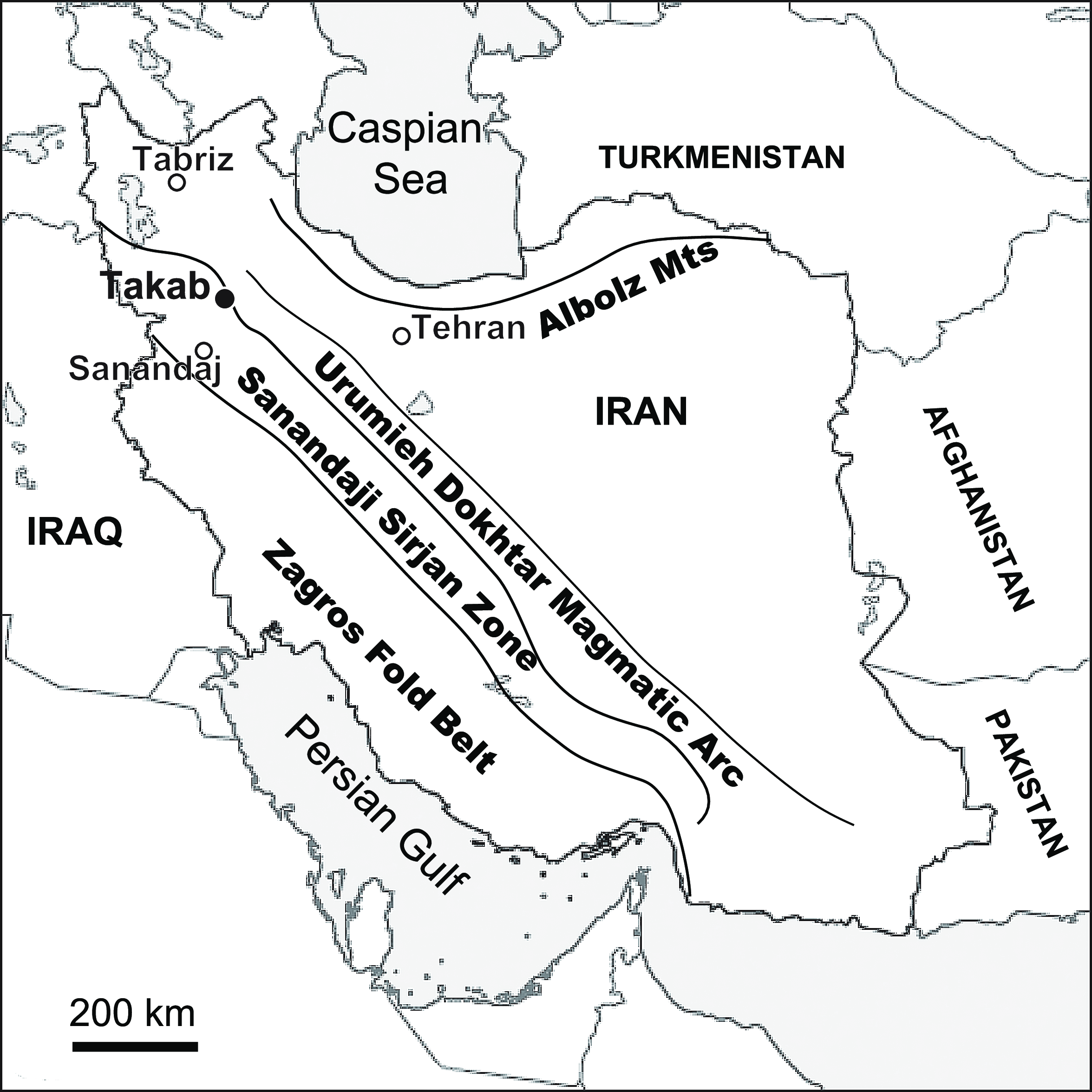
The Jurassic to Cretaceous limestones are widely distributed in the Zagros Orogenic Belt of NW Iran, while travertines are produced during the Tertiary to Quaternary periods. The Quaternary travertines and spring water resources are widely distributed in the Takab region of NW Iran, which is surrounded by Neogene red marls and sandstones (Figure 1). Zendan-e Soleyman is a large, massive travertine mound in this region (GSI 1999). The Takab region is located in the Hamadan-Tabriz volcanic zone (Azizi and Moinevaziri Reference Azizi and Moinevaziri2009), which is a Tertiary-Quaternary igneous zone within the Zagros orogenic belt.
Simplified geological map of Iran modified from Azizi and Moinevaziri (Reference Azizi and Moinevaziri2009).

Twenty-four travertine samples, a few centimeters in size, were collected from the base to the top of a conical travertine mound, Zendan-e Soleyman, with an elevation of approximately 100 m above the surrounding plain. The relative elevation between the sampling position at the lowest level and that at the top of the mound is 101 m, and small fractures (faults) are found at the elevation 35 m above the lowest level. In the center of the mound, there is a cylindrical cavity, approximately 65 m in diameter, which no longer contains spring water.
Powdered travertine samples of approximately 30 mg were put into reaction tubes. After evacuating the gases inside the tubes, the samples were dissolved in ∼3 mL of H3PO4 (Merck Suprapur® 85%) overnight at 80°C to extract CO2. The CO2 was purified cryogenically in the vacuum line. Stable isotope analyses of δ13C for the travertine samples were conducted using a stable isotope ratio mass spectrometer (DELTA V Plus, Thermo Fisher Scientific) equipped with a gas bench at Shoko Science Co., Ltd., Japan.
To compare the carbon isotope compositions between the travertine carbonate and the spring water DIC, spring surface water samples were collected in October 2018 and May 2019 from four springs of varying sizes, ranging from 20 cm to 100 m in diameter and tens of cm to 100 m in depth, near the mound. One of them is clearly hot spring water (36°C). The largest spring is a crater-like spring on a flat-top travertine mound, Takht-e Soleyman, which is a circular spring-fed pond approximately 100 m in diameter and 100 m deep. This spring is located 3 km east of Zendan-e Soleyman. Water samples were collected in 100 mL PAN (polyacrylonitrile) bottles without filtration. Sample preparation of the spring water DIC for 14C and δ13C analysis followed the method of Minami et al. (Reference Minami, Kato, Horikawa and Nakamura2015). The δ13C value of the DIC samples was measured via isotope ratio mass spectrometry (Delta-V Advantage, Thermo Fisher Scientific, Inc., USA) using a dual inlet system at the Geological Survey of Japan, AIST.
The CO2 gases of the travertine and spring water were reduced to graphite with an iron catalyst and hydrogen at 620ºC for 6 hr. Finally, the iron/carbon mixture was pressed as a pellet into an aluminum target holder for 14C measurement. The 14C concentration was measured using a 3 MV AMS (model 4130-AMS, HVEE, Netherlands) at the Institute for Space–Earth Environmental Research, Nagoya University (Nakamura et al. Reference Nakamura, Niu, Oda, Ikeda, Minami, Takahashi, Adachi, Pals, Gottdang and Suya2000). Isotopic fractionation was corrected using the 13C/12C ratio measured using the AMS system.
Results and discussion
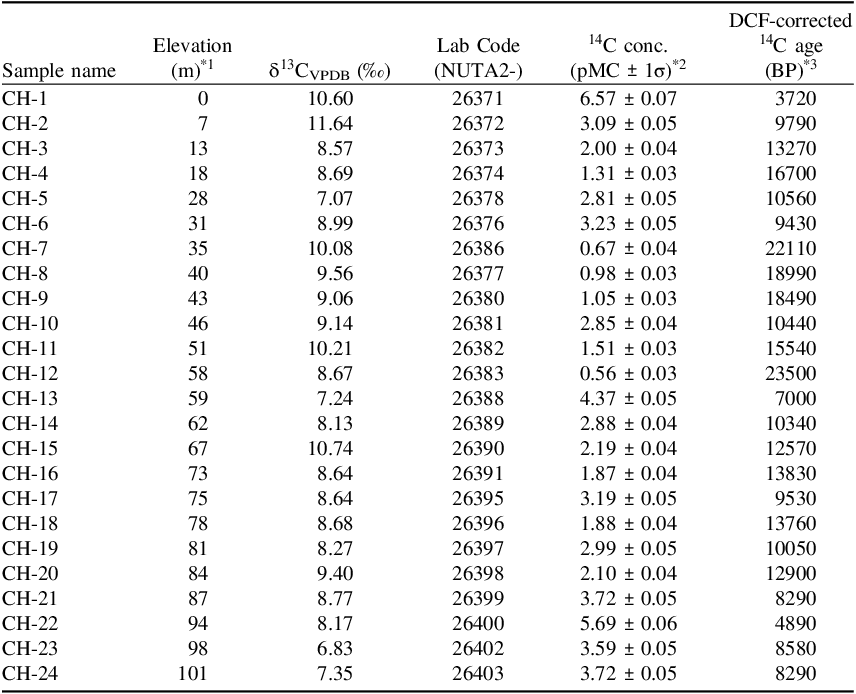
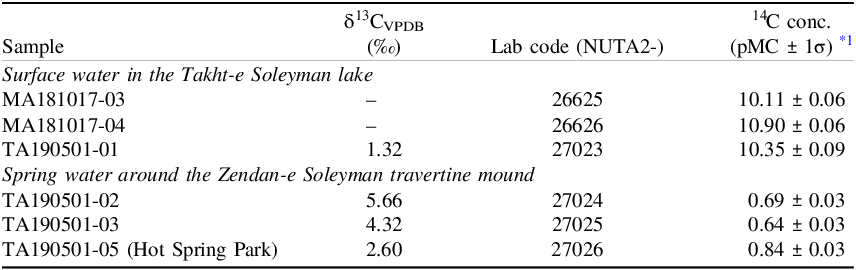
The analytical results of 14C concentrations and δ13C values of the travertines and nearby spring water DIC are presented in Tables 1 and 2.
Results of 14C and δ13C of the Zendan-e Soleyman travertine mound in NW Iran

Table 1 Long description
A table with 24 rows and 7 columns presenting analytical results of 14C concentrations and 13C values of travertines and nearby spring water DIC. The columns are labeled Sample name, Elevation (m), δ13C VPDB (permil), Lab Code (NUTA2-), 14C conc. (pMC ± 1σ), and DCF-corrected 14C age (BP). The table lists sample names from CH-1 to CH-24, their respective elevations in meters, δ13C values in permil, lab codes, 14C concentrations in pMC with standard deviations, and DCF-corrected 14C ages in years before present (BP). Each row provides specific data for each sample, detailing the elevation, δ13C value, lab code, 14C concentration, and DCF-corrected 14C age.
*1 Elevation from the level of the CH-1 sampling point, which is the base of the travertine mound.
*2 The error is at the 1σ level.
*3 DCF-corrected 14C ages are calculated using an average 14C age of the three Takht-e Soleyman lake waters. See data for the lake waters in Table 2.
Results of 14C and δ13C of the spring water DIC around the Zendan-e Soleyman travertine mound in NW Iran

Table 2 Long description
A table comparing carbon isotope data from water samples around a travertine mound in Iran. The table has 8 rows and 4 columns. The columns are labeled Sample, δ13C VPDB (per mil), Lab code (NUTA2-), and 14C conc. (pMC ± 1σ). The rows are grouped into two categories: Surface water in the Takht-e Soleyman lake and Spring water around the Zendan-e Soleyman travertine mound. Each row lists specific samples with their corresponding δ13C values, lab codes, and 14C concentrations. Notable data points include varying δ13C values and 14C concentrations across different samples.
*1 The error is at the 1 σ level.
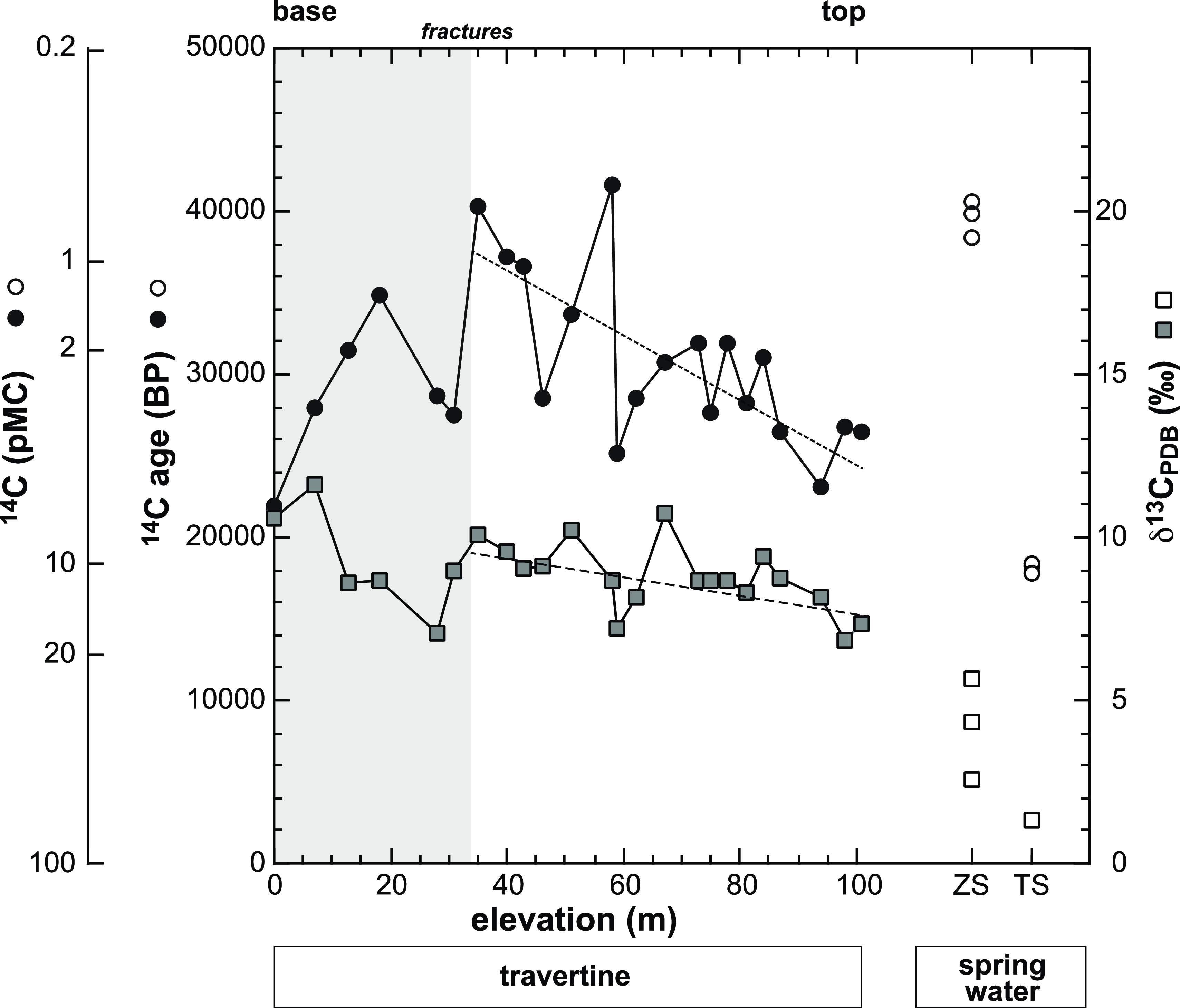
The 14C concentrations of the travertines ranged from 0.67 to 3.72 pMC above the fractures (elevation > 35 m), with values fluctuating considerably and higher 14C being observed at higher elevations (Figure 2). The 14C concentrations of the travertines below the 35 m level, where the fractures are located, are higher than those of the travertines around the 40 m level, with the highest 14C concentrations at 0 m (CH-1) (Table 1, Figure 2). This suggests that the travertines below the 35 m level may be mixed with travertines formed later by spring water from the fractures and surrounding areas. The following discussion deals with the travertines above the 35 m level. The δ13Ctrav values of the travertines ranged from +10.1 to +7.4‰ with fluctuations, showing lower values at higher elevations. The values were relatively high, suggesting that the travertines were of hydrothermal origin (typically δ13C > –1‰ for thermogene, and typically δ13C < –3‰ for meteogene: Pentecost Reference Pentecost2005; Quezada et al. Reference Quezada, Cury, Calderón, Henríquez, Mancini, Micheletto, Athayde and Rumbelsperger2024; Roshanak et al. Reference Roshanak, Moore, Zarasvandi, Keshavarzi and Gratzer2018) and formed by decarbonation of limestone and rapid CO2 degassing (Becker et al. Reference Becker, Bickle, Galy and Holland2008; Pentecost Reference Pentecost2005; Uysal et al. Reference Uysal, Feng, Zhao, Altunel, Weatherley, Karabacak, Cengiz, Golding, Lawrence and Collerson2007).
14C age and δ13C variation of the Zendan-e Soleyman travertine mound in NW Iran versus elevation, compared with those of nearby spring water DIC. ZS: DIC of small springs around Zendan-e Soleyman travertine mound, TS: DIC of the Takht-e Soleyman lake (spring), which is located 3 km east of Zendan-e Soleyman.

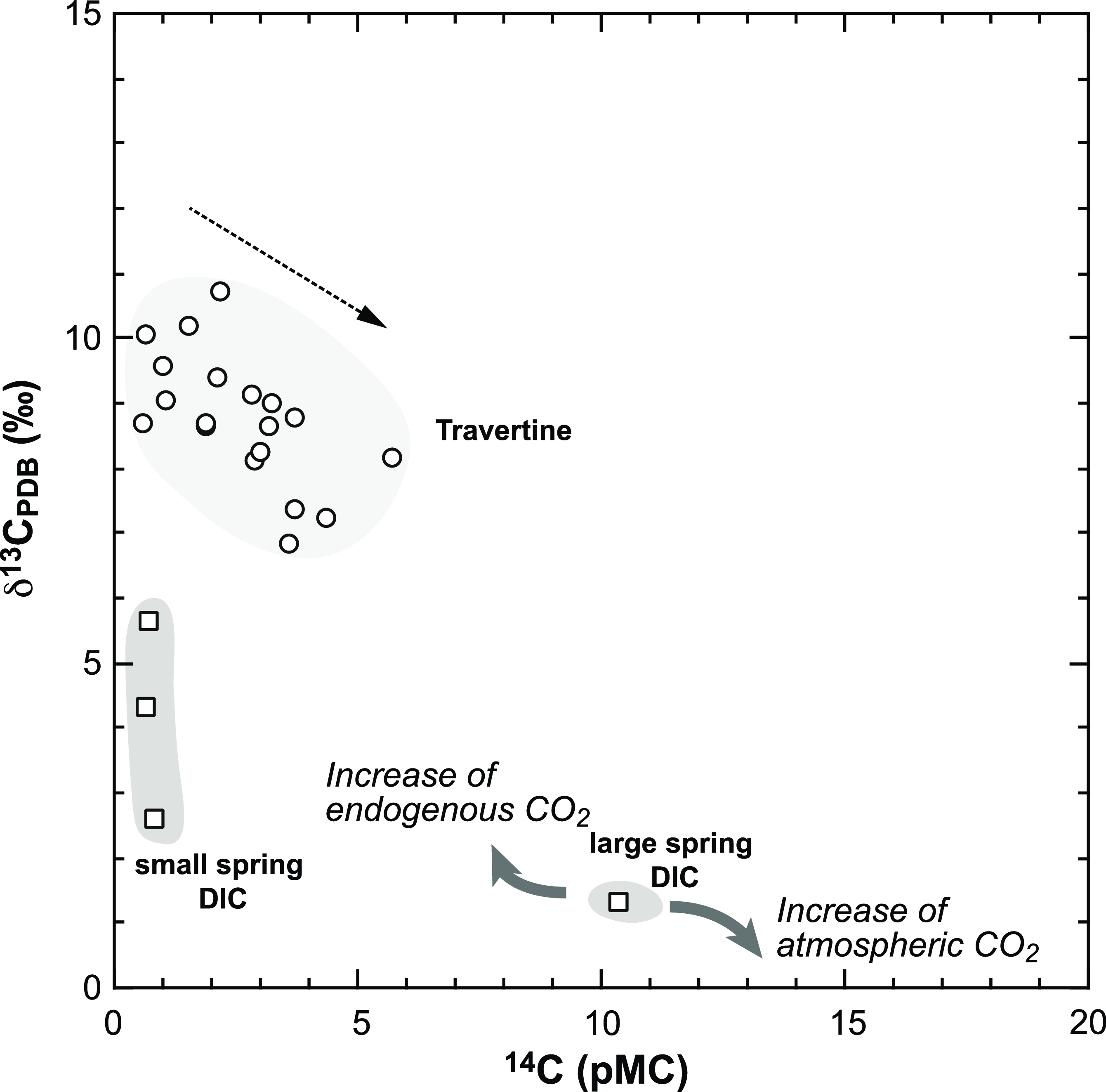
The water samples showed different 14C concentrations and δ13C values depending on the spring size. Three smaller springs, with diameters ranging from 20 cm to 5 m, had low 14C concentrations of 0.64–2.1 pMC and δ13CDIC values of +2.6 – +5.7‰. Meanwhile, the water samples from the largest spring of Takht-e Soleyman exhibited higher 14C concentrations of 10.1–10.9 pMC. The δ13CDIC value of the large spring is +1.3‰, slightly lower than those of the three small springs. Because the small springs are shallow and have low water pressure, the amount of endogenous CO2 that can be dissolved is small and is actively degassed, making atmospheric CO2 dissolution less likely. In contrast, the large spring is deep and has high water pressure, allowing a larger amount of endogenous CO2 to be dissolved and slowly degassed. These indicate that the atmospheric CO2 dissolution in the surface water of the large spring and/or CO2 exchange between the atmospheric CO2 and the surface water DIC increases the 14C concentration and decreases the δ13CDIC value compared to the small springs.
The 14C concentrations of the travertines near the top (3.6–5.7 pMC) are higher than those of the small springs (0.64–2.1 pMC) and are lower than those of the Takht-e Soleyman spring water (10.1–10.9 pMC). The 14C concentrations at the top of the travertine mound cannot be explained by the 14C concentrations of the small spring water but can be explained by the 14C concentration of the Takht-e Soleyman spring water. Given that the DIC source for the travertine mound had a carbon composition similar to the Takht-e Soleyman surface water DIC (10.4 pMC, 89.6% DCF. TA190501-01), rather than atmospheric CO2, we can estimate the formation age of the travertine mound. The DCF-corrected 14C ages for the travertine mound using the 14C of Takht-e Soleyman surface water DIC are shown in Table 1. The formation age near the base of the travertine, i.e., the beginning of the formation of the travertine mound, is estimated to be 18–22 kyr BP or earlier, and the growth of the mound ended at 4.9–8.6 kyr BP. The average growth rate of the travertine mound is estimated at 5 mm/year.
The similarity of the travertine-depositing spring DIC to the Takht-e Soleyman surface water DIC is supported by δ13C. Considering the carbon isotope fractionation during CaCO3 precipitation (δ13CCO2 = 1.2 δ13Ctrav –10.5: Minissale et al. Reference Minissale, Kerrick, Magro, Murrell, Paladini, Rihs, Sturchio, Tassi and Vaselli2002; Panichi and Tongiorgi Reference Panichi and Tongiorgi1976), the δ13CDIC values of the spring water that formed the travertine mound (δ13C = +6.8 – +10.7‰) are estimated to be –2 to +2‰. These are consistent with the δ13CDIC value of +1.3‰ for the Takht-e Soleyman spring water.
The δ13Ctrav values of the travertines decreased slightly from 10 to 7‰ at higher elevations (Figure 2), with some fluctuations, and the δ13C– 14C plot (Figure 3) shows some correlation. This is probably due to reduced CO2 degassing, i.e. an increase in CO2 solubility, as the travertine mound grew. As the depth of the travertine mound spring increased, leading to high water pressure, the amount of endogenous CO2 that can be dissolved also increased, resulting in an increase in the travertine spring δ13CDIC. The fluctuations observed for the 14C concentrations and δ13C values of the travertine mound (Figure 2) could be due to several factors: changes in the groundwater supply due to changes in rainfall and endogenous CO2 supply, disturbance of the spring lake stratification (change in ventilation of the spring water depending on climate conditions), and other causes. These factors would alter the mixing rate of endogenous gas (100% DCF) and atmospheric CO2 (0% DCF), resulting in sometimes abrupt, sometimes gradual, fluctuations in both 14C and δ13C values. The causes are unclear at this time, but detailed analysis of 14C concentrations and δ13C values of the spring water DIC as a depth profile will probably contribute to more reliable travertine 14C dating.
Plot of δ13C versus 14C concentration of the Zendan-e Soleyman travertines and nearby spring waters.

Conclusions
We determined the formation age of a travertine mound in northwestern Iran using 14C and δ13C from the travertine and its related spring water DIC.
• The 14C concentrations of the travertine mound ranged from 0.67 to 3.72 pMC and tend to be higher from the base to the top.
• The δ13Ctrav values of the travertine mound, ranging from +10.1 to +7.4‰, are lower at higher elevations with fluctuations, and these high values suggest that the travertines are of hydrothermal origin and were formed by decarbonation of marine limestone and rapid CO2 degassing.
• The 14C concentrations of the surface spring water DIC of Takht-e Soleyman (about 10.4 pMC) are higher than those of the travertines near the top of the travertine mound.
• Considering the carbon isotope fractionation during CaCO3 precipitation, the δ13CDIC values of the spring water that formed the travertine mound are estimated to be –2 to +2‰ and are consistent with the δ13CDIC value of +1.3‰ for the Takht-e Soleyman spring water.
• Given that the DIC source for the travertine mound had a carbon composition similar to the Takht-e Soleyman surface water DIC, 89.6% DCF (10.4 pMC), we can estimate the formation age of the travertine mound. Based on the DCF of the spring water DIC, the travertine mound formation began at about 20 kyr BP, and the mound growth ended at about 7 kyr BP.
Acknowledgments
The authors thank Professor Dr. Toshio Nakamura, Nagoya University, for his help with the AMS measurements. We are also grateful to Prof. H. Azizi of University of Kurdistan and Dr. H.A. Takahashi of the Geological Survey of Japan, AIST, for field work and support of δ13CDIC analysis, respectively. This study was supported by JSPS KAKENHI Grant No. 17H01671 and 19H05035 and the Joint Research Program of the Institute for Space–Earth Environmental Research, Nagoya University (No. 300907, 201909004).