INTRODUCTION
The governance of inter-organizational relationships has been a critical research issue (Poppo & Zenger, Reference Poppo and Zenger2002; Zollo, Reuer, & Singh, Reference Zollo, Reuer and Singh2002; Dyer & Chu, Reference Dyer and Chu2003; Rowley & Baum, Reference Rowley and Baum2004; Goerzen, Reference Goerzen2007; Liu, Luo, & Liu, Reference Liu, Luo and Liu2009; Coombs, Bierly, & Gallagher, Reference Coombs, Bierly and Gallagher2012; Lumineau & Quélin, Reference Lumineau and Quélin2012; Schilke & Cook, Reference Schilke and Cook2013). While some research on the governance of inter-organizational relationships argues that firms could employ either transactional or relational mechanisms for governing inter-organizational relationships (Gulati, Reference Gulati1995a; Gulati & Singh, Reference Gulati and Singh1998; Williamson, Reference Williamson2002; Cousins & Lawson, Reference Cousins and Lawson2007), other research has opposed views on whether both mechanisms act as complementary (Poppo & Zenger, Reference Poppo and Zenger2002) or substitutive forces (Wuyts & Geyskens, Reference Wuyts and Geyskens2005). Whereas transactional mechanisms emphasize how to mitigate opportunism through competition and relational mechanisms address how to facilitate trustworthiness through cooperation (Goerzen, Reference Goerzen2007; Liu, Luo, & Liu, Reference Liu, Luo and Liu2009), these mechanisms are exposed to several liabilities such as adverse selection and relational inertia when a firm exclusively persists in either a transactional mechanism or a relational mechanism (Lumineau & Quélin, Reference Lumineau and Quélin2012). Thus, an intriguing question is whether the joint use of transactional and relational mechanisms is altogether more effective in mitigating opportunism and fostering performance than individual use (Arranz & Fdez de Arroyabe, Reference Arranz and Fdez de Arroyabe2012).
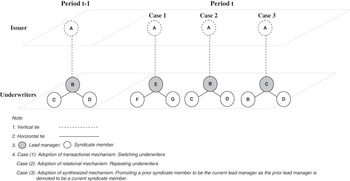
Since the governance effectiveness of transactional and relational mechanisms is contingent on contexts (Liu, Luo, & Liu, Reference Liu, Luo and Liu2009; Arranz & Fdez. de Arroyabe, Reference Arranz and Fdez de Arroyabe2012; Galvin, Reference Galvin2014), we intend to investigate such a question in a specific context–issuer–underwriter relationships in the US equity underwriting market, a leading capital market in the investment banking industry of the world. The majority of research on underwriting markets has taken place in finance, and increasingly recognizes that the horizontal inter-organizational relationships between underwriters can affect the underwriters’ performance (Li & Rowley, Reference Li and Rowley2002; Song, Reference Song2004; Burch, Nanda, & Warther, Reference Burch, Nanda and Warther2005; Corwin & Schultz, Reference Corwin and Schultz2005; Ang & Zhang, Reference Ang and Zhang2006; Jenkinson & Jones, Reference Jenkinson and Jones2009; Huang & Zhang, Reference Huang and Zhang2011). For instance, Li and Rowley (Reference Li and Rowley2002) suggest that the past horizontal relationships between investment banks are the key drivers for their future relationships, such that a lead underwriter selects subordinate banks to join its syndicate. More recently, Huang and Zhang (Reference Huang and Zhang2011) argue that the number of managing underwriters and the marketing efforts of investment banks could influence the price discount of underwriting offerings. However, there is limited research that we are aware of which explicitly considers how the vertical issuer–underwriter relationships affect issuers’ performance, although recent work on strategic management and organizations has begun to explore the relevant issue about the vertical ties between issuers and underwriters (Shipilov & Li, Reference Shipilov and Li2012). Just like investment banks who collaborate with each other in the underwriting markets, they are also linked to the issuers of securities. Figure 1 illustrates such relationships by depicting vertical ties (illustrated by dashed lines) arising as a result of underwriters providing services to issuers and charging fees for such services, and horizontal ties (illustrated by solid lines) among investment banks co-working on underwriting services and sharing fees in the underwriting syndicate. At Period t−1, specifically, issuer A had a vertical tie to bank B because it chose that bank to lead its offering. At Period t, there are three cases in which the issuer could have an option to select and choose its lead manager bank for the next issuing offer. The issuer could choose another bank E to lead its next offering (Case 1), repeat bank B to lead the offering (Case 2) or designate bank C as the lead manager but request bank B to be included in the syndicate (Case 3). Consequently, a vertical tie at Period t−1 could evolve into a different, same, or similar formation of a vertical tie at Period t. This study extends both the literature of finance and strategic organizations to explore these three cases of vertical relationships by integrating inter-organizational governance theory with existing underwriting research in finance to enhance better understanding of the value of inter-organizational relationships in underwriting markets.
Vertical ties and horizontal ties

In the underwriting markets, empirically, the debate on how issuers manage the inter-organizational relationships with underwriters is ongoing. While the proponents of transactional mechanisms basically embrace the principle of transaction cost, asserting that an issuer has power to opportunistically switch and to actively choose certain banks to be underwriters who offer better deals, the students of relational mechanisms emphasize that the close cooperation between issuers and underwriters helps enhance issuing performance. Unlike the transactional and relational mechanisms that offer mutually polarizing explanations, nonetheless, a joint exploitation of both mechanisms (for simplicity, a joint exploitation of transactional and relational governance of inter-organizational relationships is referred to as a synthesized mechanism hereafter) may provide another way to untangle the complicated relations between issuers and underwriters from our point of view. However, it is not clear whether the best mechanism for an issuer to work with underwriters should be transactional, relational, or a synthesis of the two. Based on a theoretical logic, this study compares the three above-mentioned mechanisms and proposes three competing hypotheses to explore the differences in issuing performance as an issuer takes one of three mechanisms to maintain its inter-organizational relationships with certain underwriters.
We extend prior related research on the governance of inter-organizational relationships in which transactional mechanisms are viewed as substitutes for relational mechanisms by testing the argument that transactional and relational mechanisms function as complements (Poppo & Zenger, Reference Poppo and Zenger2002; Liu, Luo, & Liu, Reference Liu, Luo and Liu2009; Arranz & Fdez. de Arroyabe, Reference Arranz and Fdez de Arroyabe2012). In addition, we use two types of performance indicators, price performance and cost performance, to test the question whether there is a distinct effect of three mechanisms on performance. By using two different performance indicators, we complement the research on inter-organizational relationships in which the different characteristics of vertical inter-organizational relationships facilitate different performance outcomes (Cousins & Lawson, Reference Cousins and Lawson2007). Furthermore, the vast majority of inter-organizational governance research has been conducted in the manufacturing industries, despite the fact that alliances are popular and ubiquitous in service-based industries (Judge & Dooley, Reference Judge and Dooley2006). We aim to examine the effects of different forms of governance on inter-organizational relationships for explaining performance outcomes within a major service industry. The remainder of the paper proceeds as follows. The next section considers the theoretical background, empirical context–issuer–underwriter relationships, and the development of hypotheses of this study. Following is the methodology for the study. Then, the paper presents the results of the empirical study in achieving the goals as those set out previously. Discussions and conclusions are provided in the last section.
THEORETICAL BACKGROUND
Prior research and theory has addressed both the cooperative and competitive sides of inter-organizational relationships. On the one hand, studies examining the cooperative side of inter-organization relationships focus on joint value creation or value maximizing choices. For example, scholars in economics and strategy have emphasized resource complementarity, cost defrayment, risk sharing, and value creation between firms (Eisenhardt & Schoonhoven, Reference Eisenhardt and Schoonhoven1996; Walter, Ritter, & Gemünden, Reference Walter, Ritter and Gemünden2001; Dussauge, Garrette, & Mitchell, Reference Dussauge, Garrette and Mitchell2004; Lin, Yang, & Arya, Reference Lin, Yang and Arya2009; Rice, Liao, Martin, & Galvin, Reference Rice, Liao, Martin and Galvin2012) and scholars in social network have emphasized social endorsements, creation of legitimacy, and learning in inter-organizational relationships (Stuart, Hoang, & Hybels, Reference Stuart, Hoang and Hybels1999; Chung, Singh, & Lee, Reference Chung, Singh and Lee2000; Baum, Rowley, Shipilov, & Chuang, Reference Baum, Rowley, Shipilov and Chuang2005; Suseno & Ratten, Reference Suseno and Ratten2007; Ahuja, Polidoro, & Mitchell, Reference Ahuja, Polidoro and Mitchell2009; Kim & Choi, Reference Kim and Choi2014). On the other hand, research on the competitive side of inter-organization relationships concerns the impact of opportunism such as potential resource misappropriation and value appropriation between firms on inter-organizational relationships (Li, Eden, Hitt, & Ireland, Reference Li, Eden, Hitt and Ireland2008; Sánchez, Vélez, & Álvarez-Dardet, Reference Sánchez, Vélez and Álvarez-Dardet2013). For example, an inter-organizational relationship is almost always partly competitive, the larger firm often attempting to capture the technology of the smaller one, to transfer it to its own operations, and, ultimately, to appropriate it (Doz, Reference Doz1988: 32). Similarly, Oxley (Reference Oxley1997) posits that partners might appropriate value opportunistically. While relationships between firms can create value, moreover, in some circumstances firms may suffer from collaborating with large partners because the latter tend to outlearn or exploit the focal firms and take away the lion’s share of the value created in alliances (Alvarez & Barney, Reference Alvarez and Barney2001). Although the tension between cooperative side and competitive side can occur throughout relationships (Brandenburger & Nalebuff, Reference Brandenburger and Nalebuff1996), firms employ multiple mechanisms in the governance of inter-organizational relationships to either enhance the positive effect of cooperative side or mitigate the negative effect of competitive side on the relationships.
The principal theoretical approach for understanding when inter-organizational relationships form and how to manage such relationships is transaction cost economics. Transaction costs are economized by assigning transactions to governance structures, such as firms, in a discriminating way (Coase, Reference Coase1937; Williamson, Reference Williamson1975, Reference Williamson1979, Reference Williamson1985). A central notion of the transaction cost theory is that firms can manage their activities so as to minimize their transaction costs (Coase, Reference Coase1937). Expounding Coase’s main arguments, Williamson (Reference Williamson1975, Reference Williamson1979, Reference Williamson1985) asserts that transactions involving uncertainty about their outcome, recurring frequently, and requiring substantial transaction-specific investment – money, time, or energy that cannot be easily transferred – are more likely to take place in hierarchical organizations and vertical integration. In contrast, straightforward, non-repetitive exchanges requiring no transaction-specific investment are more likely to take place across a market interface. In this way, the transactions are moved out of markets in hierarchies as knowledge that is specific to the transactions or asset specificity builds up. When this occurs, the bureaucratic organization will be preferred to the market transactions. In short, this theory emphasizes that the core motivation for bringing transactions in hierarchies or forming inter-organizational relationships is to solve market failure problems caused by asset specificity (Williamson, Reference Williamson1985). Inspired by Williamson, scholars have thus argued that anticipated transaction costs and concerns of opportunistic behavior of partners determine the governance structure of an inter-organizational collaboration (Kogut, Reference Kogut1988; Hamel, Doz, & Prahalad, Reference Hamel, Doz and Prahalad1989), and that the main governance mechanism aims to reduce transaction costs and opportunism (Poppo & Zenger, Reference Poppo and Zenger2002). Specifically, transaction costs within partners include the costs of negotiating and writing contingent contracts, enforcing contractual promises, monitoring performance, and addressing contractual breaches (Goerzen, Reference Goerzen2007; Coombs, Bierly, & Gallagher, Reference Coombs, Bierly and Gallagher2012). Additionally, opportunistic behavior can arise from several sources, even in the absence of specific assets (Saleh & Ali, Reference Saleh and Ali2009; Arranz & Fdez. de Arroyabe, Reference Arranz and Fdez de Arroyabe2012). For instance, a firm can misrepresent its capabilities or resources during the partner selection process, can fail to contribute what it promised during the inter-organizational relationship, or can misappropriate the resources that it gains from the relationship (Sánchez, Vélez, & Álvarez-Dardet, Reference Sánchez, Vélez and Álvarez-Dardet2013). Therefore, the conventional view held by students of transaction cost economics is that a firm adopts transactional governance mechanisms such as intensive contracts and/or a number of partners to reduce transaction costs and to prevent from its partners behaving opportunistically in an inter-organizational relationship.
In contrast, social network theory has emerged to consider the various sociological factors that have impacts on choice of inter-organizational governance structure in which relational norms and trust are viewed as substitutes for explicit contracts or vertical integration (Granovetter, Reference Granovetter1985; Gulati, Reference Gulati1995a; Uzzi, Reference Uzzi1997; Dyer & Singh, Reference Dyer and Singh1998). From the social perspective, relational governance mechanisms focus on the role of social interactions and network embeddedness of firms (Granovetter, Reference Granovetter1985). Culling the literature in a number of social science and management fields, Powell (Reference Powell1990) argues that a relational or network form of organization is an identifiable and viable form of economic exchange under certain specifiable circumstances, insofar as firms are blurring their established boundaries and engaging in forms of collaboration that resemble neither the familiar alternative of arms’ length market transaction nor the former ideal of vertical integration. It is often the case that certain exchange relations are more social, more dependent on relationships, more reliant on mutual interests, and more based on reputation as well as less guided by a formal governance structure (Powell, Reference Powell1990). Exchange relations can be long term and continuous, and thus with scant need for their formalization. Aligning with Granovetter and Powell, scholars argue that long-term, repeat relationships create a history of exchange that promotes social attachments, social norms, and familiarity-based trust (Ring & Van de Ven, Reference Ring and Van de Ven1994; Gulati, Reference Gulati1995b; Walker, Kogut, & Shan, Reference Walker, Kogut and Shan1997; Dyer & Singh, Reference Dyer and Singh1998; Suseno & Ratten, Reference Suseno and Ratten2007). More recently, scholars have also shown that some sociological factors, including higher levels of mutual understanding, help firms form inter-organizational collaboration, make existing collaborative relationships extend to future cooperation, curb the opportunism of the partners through shared norms, and increase the partners’ collective ability to generate value in the relationship (Liu, Luo, & Liu, Reference Liu, Luo and Liu2009; Shipilov & Li, Reference Shipilov and Li2012; Guinot, Chiva, & Mallén, Reference Guinot, Chiva and Mallén2013). In addition, familiarity, trust, and mutual understanding between partners can in fact facilitate the increase in transaction efficiency as well as the decrease in transaction cost within the inter-organizational relations (Suseno & Ratten, Reference Suseno and Ratten2007; Saleh & Ali, Reference Saleh and Ali2009). Some examples include the lowering of search costs as well as a reduction in the perceived need for detailed contracts (Rice et al., Reference Rice, Liao, Martin and Galvin2012). Such sociological factors also drive the solid but flexible inter-organizational relationships that can adapt to shifting environments (Rice et al., Reference Rice, Liao, Martin and Galvin2012). Aside from the sociological factors that underpin the formation of highly connected inter-organizational relationships, the economic logic of repeat relationships is based on the key benefit of trust, which is cost saving.
However, increasing evidence reveals that repeat relationships do not necessarily give rise to trust or the presumed benefits of preferential relationships (Anderson & Jap, Reference Anderson and Jap2005; Goerzen, Reference Goerzen2007; Lazzarini, Miller, & Zenger, Reference Lazzarini, Miller and Zenger2008; Poppo, Zhou, & Ryu, Reference Poppo, Zhou and Ryu2008; Ryall & Sampson, Reference Ryall and Sampson2009; Lee, Reference Lee2013). Such a potential dark side of repeat relationships includes relational inertia stemming from limited search and perceived high switching cost (Anderson & Jap, Reference Anderson and Jap2005) and the constraint for the actors in seeking alternative exchange opportunities (Lazzarini, Miller, & Zenger, Reference Lazzarini, Miller and Zenger2008). Under certain conditions, furthermore, repeat relationships might bring adverse consequences to actors. For example, Goerzen (Reference Goerzen2007) demonstrates that firms entering repeat relationships more frequently experience inferior economic performances. Moreover, Poppo, Zhou, and Ryu (Reference Poppo, Zhou and Ryu2008) indicate that repeat ties could weaken the benefit associated with relational governance. Research has also suggested that several contingencies, such as exchange uncertainty (Goerzen, Reference Goerzen2007), social uncertainty (Lazzarini, Miller, & Zenger, Reference Lazzarini, Miller and Zenger2008), asset specificity (Poppo, Zhou, & Ryu, Reference Poppo, Zhou and Ryu2008), risk of appropriation (Li et al., Reference Li, Eden, Hitt and Ireland2008), and the expectation of continuity (Ryall & Sampson, Reference Ryall and Sampson2009), may be facilitating or restraining the benefits of repeat relationships. All these together render the sanctions of deviant behavior increasingly less likely, thereby increasing the relational hazards (Lee, Reference Lee2013). Despite the dark side of repeat relationships, recent research in management and economics has suggested that inter-organizational relationships could be governed by a combination of relational and transactional mechanisms. For example, Liu, Luo, and Liu (Reference Liu, Luo and Liu2009) show that contracts and relational mechanisms are complementary in relationship governance. Moreover, Arranz and Fdez. de Arroyabe (Reference Arranz and Fdez de Arroyabe2012) find that transactional mechanisms such as formal contracts entail an ex ante way to make explicit both payoff and task coordination in the operative stage of the project, while relational mechanisms such as relational norms complement the contract in the face of conflicts and unforeseen situations. Empirically, managers combine different mechanisms to govern inter-organizational relationships (Sánchez, Vélez, & Álvarez-Dardet, Reference Sánchez, Vélez and Álvarez-Dardet2013); thus, research could prevent studying only a specific mechanism in isolation from other parts of the inter-organizational governance in order to reveal complete results.
ISSUER-UNDERWRITER RELATIONSHIPS
As depicted in Figure 1, this study focuses on equity underwriting that refers to the process by which underwriters (banks) raise investment capital from investors on behalf of issuers such as corporations or governments that are issuing securities for first time and/or subsequent to the initial public offerings (IPOs) in the primary security markets (Pollock, Reference Pollock2004; Baum, McEvily, & Rowley, Reference Baum, McEvily and Rowley2012). Formally, issuers (firms) select lead managers to form an underwriting syndicate either on the basis of an existing relationship or after a bid in which several investment banks compete. To win the position of lead manager, investment banks typically set a lower bound on the portion of underwriting fees on which they must agree with issuers. The fee for underwriting an offering is called gross spread – the difference between the dollar amount at which the syndicate buys the securities and the dollar amount at which the syndicate sells the securities (Podolny, Reference Podolny1993, Reference Podolny1994). Equity underwriting can be conducted by a single investment bank or several banks. To facilitate the placement of each offering and to reduce its own risk, however, a lead manager very often forms and leads a syndicate of as few as three banks to as many as a 100 in placing each offering (Rowley, Baum, Shipilov, Greve, & Rao, Reference Rowley, Baum, Shipilov, Greve and Rao2004). In addition to sharing risk, a lead manager also structures a syndicate to gain other investment banks’ resources such as complementary capabilities (Song, Reference Song2004; Baum et al., Reference Baum, Rowley, Shipilov and Chuang2005).
A lead manager could recruit certain co-lead managers to be included in a syndicate on the grounds of whether the issuer designates them or not (Baum et al., Reference Baum, Rowley, Shipilov and Chuang2005). Sometimes, lead managers may recommend issuers the best co-lead managers to include in a syndicate (Corwin & Schultz, Reference Corwin and Schultz2005). It might be an indication that such an invitation is a practice of exchanging favors in underwriting businesses for the good of lead managers (Lee, Jeon, & Kim, Reference Lee, Jeon and Kim2011; Shipilov & Li, Reference Shipilov and Li2012). Each member of a syndicate takes responsibility for distributing a particular allotment of the offering, with the quantity of shares received by each member being determined primarily by lead managers (Jenkinson & Jones, Reference Jenkinson and Jones2009), while they enlist the help of other syndicate members to sell new issues (Jeon & Ligon, Reference Jeon and Ligon2011). Lead managers carry out many tasks for equities underwriting service, including advising their issuers on the design, size and timing of the offering. Lead managers also schedule the appointments for issuers to meet with other syndicate members. Moreover, lead managers organize road shows to promote the offering when the issuer’s management visits investors in large groups such as institutional conferences or in small meetings like one-on-one interviews. Further, lead managers collect bids from investors either directly or via other syndicate members and form a book of demand after the meetings.
The issuer’s goal is to raise as much capital as possible for the portion of the company securities being sold to the investors while paying as little underwriting fees as possible to a syndicate (Williamson, Reference Williamson1988). For an issuer, the issuing performance is defined by minimizing the money left on the table for investors and by maximizing the expected net proceeds of public offerings (Loughran & Ritter, Reference Loughran and Ritter2004). This is an indicator of price performance that depends on the higher offer price at a given amount of proceeds provided by a syndicate. Another indicator of performance is the cost of the underwriter’s service (Jeon & Ligon, Reference Jeon and Ligon2011). Because the cost of the underwriter’s service is a major burden to issuers who want to maximize the expected net proceeds of public offerings (Lee, Jeon, & Kim, Reference Lee, Jeon and Kim2011), the lower underwritings cost the better issuing performance. A decision whether an issuer will change its underwriters to work with equities underwriting at different periods depends on the motivation to enhance its issuing performance. Since lead managers, co-lead managers, and other syndicate members in a syndicate have an impact on issuing performance (Song, Reference Song2004), an issuer will be concerned about its underwriters and their qualities, competition, and cooperation when considering forming a syndicate. Thus, the selection of underwriters becomes more sophisticated (Fernando, Gatchev, & Spindt, Reference Fernando, Gatchev and Spindt2005), yet existing literature provides only partial explanations to this selection and the governance of this selection (Jeon & Ligon, Reference Jeon and Ligon2011; Lee, Jeon, & Kim, Reference Lee, Jeon and Kim2011).
THE DEVELOPMENT OF HYPOTHESES
Based on the transaction cost theory, scholars have proposed the transactional mechanism to govern the inter-organizational relationships between issuers (firms) and underwriters (investment banks) in the investment banking industry (James, Reference James1992; Krigman, Shaw, & Womack, Reference Krigman, Shaw and Womack2001; Corwin & Schultz, Reference Corwin and Schultz2005; Fernando, Gatchev, & Spindt, Reference Fernando, Gatchev and Spindt2005). To establish underwriting relationships with investment banks, issuers invest the transaction-specific asset such as time, money, and manpower. If transactions with the same investment banks are expected to recur in such a situation, the issuer realizes that repeatedly choosing a certain bank to be the lead manager creates bilateral monopoly power (James, Reference James1992). Even if the market provides for ex ante perfect competition, once the repeat relationship is established there is ex post bilateral monopoly power (James, Reference James1992). In general, the negotiation cost increases as bilateral monopoly power increases. In particular, the repeat relationship creates a lock-in effect and makes it more costly for the issuer to switch the underwriters. For example, Hayward (Reference Hayward2003) indicates that a bank can increase switching costs in order to persuade its client to hire it for future business and to reap the benefits of its influence. Thus, the size of the investment in relationship-specific assets and the cost of switching determine the degree of bilateral monopoly power.
According to the nature of underwriting services, we argue that issuers do not invest durable transaction-specific assets in order to work with a certain underwriter. Especially in the process of evaluating the subsequent offerings, the issuer could encourage the competition among investment banks so that it could prevent bilateral monopoly power and benefit from the competition. Issuers would be expected to adopt a transactional mechanism for selecting and changing their lead underwriters for every offering so that issuing performance can be improved. Specifically, an issuer could switch its underwriters to obtain a better offering with a lower cost and to receive a better priced offering. For example, Krigman, Shaw, and Womack (Reference Krigman, Shaw and Womack2001) point out that 30% of firms completing a sequent offering – a seasoned equity offering (SEO) within 3 years of their IPO switched lead underwriters. In addition, the switchers’ SEOs were significantly less underpriced than non-switchers’ SEOs (Krigman, Shaw, & Womack, Reference Krigman, Shaw and Womack2001). Fernando, Gatchev, and Spindt (Reference Fernando, Gatchev and Spindt2005) also find that issuers switch to select the privileged investment banks and choose the capable underwriters to maintain the issue quality leading to raise more capital. Moreover, a cost-related argument to switch underwriter might uncover the increasing competition in investment banking industry and greater bargaining power of issuers (Karpavicius & Suchard, Reference Karpavicius and Suchard2009). Ellis, Michaely, and O’Hara (Reference Ellis, Michaely and O’Hara2011) further show that firms that switch to similar-quality underwriters for follow-on offerings enjoy more intense competition among investment banks, which manifests in lower fees and more optimistic recommendations. Therefore, this study proposes the following hypothesis:
Hypothesis 1: Issuers adopting a transactional mechanism achieve better issuing performance.
On the basis of social network theory, however, scholars argue that issuers can have a better investment banking service through the repeat and long-term relationships with the same underwriters (Baum, McEvily, & Rowley, Reference Baum, McEvily and Rowley2012). The key insight of such a perspective is that trust between an issuer and an underwriter is generated from their repeat relationships, which then benefits both parties. By implication, the creation of trust in cooperative relationships increases transaction efficiency and decreases transaction cost. Prior research has observed that organizations often enter into alliances repeatedly with partners from previous cooperative relationships since trust that develops between them may reduce transaction costs (Gulati, Reference Gulati1995a; Zollo, Reuer, & Singh, Reference Zollo, Reuer and Singh2002; Dyer & Chu, Reference Dyer and Chu2003; Gulati, Lavie, & Singh, Reference Gulati, Lavie and Singh2009). The repeat and long-term relationships engender rising degrees of trust, which appear to reduce the need for contractual safeguards in subsequent collaboration between issuers and underwriters. Trust, for example, counteracts fear of opportunistic behavior and is, as a result, likely to limit the transaction costs associated with an exchange (Gulati, Reference Gulati1995a). Once a repeat relationship is established, the emerging organizational routines would result in relatively low monitoring costs given the partners’ trust and familiarity with each others’ processes, systems, and routines (Zollo, Reuer, & Singh, Reference Zollo, Reuer and Singh2002). In addition to reducing transaction costs, trust within repeat relationships may encourage information sharing, provide important information on reliability and suitability, and decrease the problem of adverse selection (Uzzi & Lancaster, Reference Uzzi and Lancaster2003; Baum et al., Reference Baum, Rowley, Shipilov and Chuang2005; Gulati, Lavie, & Singh, Reference Gulati, Lavie and Singh2009).
Accordingly, we argue that issuers would be expected to adopt a relational mechanism that maintains repeating and hiring the same underwriters to lead an SEO and to improve issuing performance for a variety of reasons. First, an issuer could repeat its underwriters to obtain a better SEO with less underwriting cost and managing fees charged by the same underwriters than charged by the new ones because the repeat underwriters spend less time and resource knowing and auditing the issuer’s business then do the new ones. For example, Burch, Nanda, and Warther, (Reference Burch, Nanda and Warther2005) find that SEO firms pay lower underwriting fees if they remain with their IPO underwriters. In the same vein, Karpavicius and Suchard (Reference Karpavicius and Suchard2009) indicate that loyal firms face lower fees as the current underwriter is familiar with the firm and conducts less due diligence investigation. Second, an issuer can obtain a better priced offering since the repeat relation encourages trust and limits the scope of information asymmetries. For instance, a repeat, embedded relationship reduces information asymmetry and discourages opportunism by fostering trust between the exchange partners (Uzzi & Lancaster, Reference Uzzi and Lancaster2003). Moreover, offer prices are more likely to be adjusted up in response to positive information, which issuers send to the trusted underwriters (Corwin & Schultz, Reference Corwin and Schultz2005). The information is more likely to be reliable as a result of its being gathered over a longer relationship and from underwriting prior offers (Baum, McEvily, & Rowley, Reference Baum, McEvily and Rowley2012). In the specific context of the market for public offerings, third, the information transfer and joint problem-solving arrangements developed as a result of a bank’s prior interactions with the issuer will make it easier for that bank to understand and to meet the specific issuer’s needs (Shipilov & Li, Reference Shipilov and Li2012: 478). Therefore, this study proposes the following hypothesis:
Hypothesis 2: Issuers adopting a relational mechanism achieve better issuing performance.
Whereas transactional mechanisms highlight the advantages of how an issuer avoids an underwriter’s bilateral monopoly power and/or opportunism through competition and relational mechanisms emphasize the advantages of how an issuer encourages an underwriter’s trustworthiness through cooperation, these mechanisms manifest shortcomings when an issuer exclusively sticks to either a transactional mechanism or a relational mechanism. In other words, the transactional mechanism may result in a low level of information sharing between issuers and underwriters, while the relational mechanism may incur some level of lock-in effect that can constrain the issuers’ bargaining power, increasing the issuers’ cost. For one thing, Karpavicius and Suchard (Reference Karpavicius and Suchard2009) indicate that a switching firm pays higher fees as an underwriter does not know the firm and needs to perform more thorough due diligence investigation. For another thing, Lee, Jeon, and Kim (Reference Lee, Jeon and Kim2011) find that reciprocal syndicates tend to have substantially less analyst coverage by the lead manager and charge more underwriting spreads to issuers. By the same token, Lee (Reference Lee2013) shows that firms that repeatedly hire the same investment banks tend to overpay for the financial service. To combine the advantages while offsetting the disadvantages of these two types of governance, a synthesized mechanism could be another form of governance, which issuers could adopt to manage the inter-organizational relationships with underwriters (Madhavan, Gnyawali, & He, Reference Madhavan, Gnyawali and He2004; Jenkinson & Jones, Reference Jenkinson and Jones2009; Arranz and Fdez. de Arroyabe, Reference Arranz and Fdez de Arroyabe2012; Sánchez, Vélez, & Álvarez-Dardet, Reference Sánchez, Vélez and Álvarez-Dardet2013).
We argue that an issuer adopting the synthesized mechanism can benefit by exploiting the coopetitive nature of banking industry since it has the right to decide who participates in a syndicate (Ljungqvist, Marston, & Wilhelm, Reference Ljungqvist, Marston and Wilhelm2009; Baum, McEvily, & Rowley, Reference Baum, McEvily and Rowley2012; Shipilov & Li, Reference Shipilov and Li2012). One example is that issuers became increasingly involved in co-lead manager choice, forcing lead managers to accept co-lead managers that they would not traditionally have chosen (Ljungqvist, Marston, & Wilhelm, Reference Ljungqvist, Marston and Wilhelm2009). Another example of this can be seen when a lead manager has to be given a mandate to do so by the issuer who might have had existing relationships with other underwriters that may have been competitors before assembling a syndicate (Shipilov & Li, Reference Shipilov and Li2012). Several benefits are produced under the context of coopetition (Brandenburger & Nalebuff, Reference Brandenburger and Nalebuff1996). First of all, even though the investment banks work in the same syndicate, they compete with each other to earn future business opportunities. Co-lead managers, for example, provide a significant source of competition for the lead manager because they have a high likelihood of being selected to lead future offerings (Ljungqvist, Marston, & Wilhelm, Reference Ljungqvist, Marston and Wilhelm2009). In addition, both the lead manager and the co-lead manager have a type of veto power to specify the fee and share structure (Corwin & Schultz, Reference Corwin and Schultz2005). The co-lead managers can also keep competitive pressure on the lead manager because they can directly report to the issuer. The appropriate increase in competition between lead and co-lead managers may result in lower underwriting costs for the issuer. From an issuer’s point of view, then, the number of close underwriting relationships to establish and maintain is the result of balancing the benefits of increased competition among underwriters and the costs of maintaining relationships (Ang & Zhang, Reference Ang and Zhang2006). It has been found that an issuer can have greater control on lead managers and facilitate more contingent fee structures by hiring several co-lead managers (Jenkinson & Jones, Reference Jenkinson and Jones2009). Moreover, the temptation to succumb to conflicts of interest may be reduced if there is more than one lead manager (Jenkinson & Jones, Reference Jenkinson and Jones2009). Evidence has shown that issuers can force lead banks into relationships with those partners that are in the best interest of the issuers, but not in the best interest of the lead banks (Shipilov & Li, Reference Shipilov and Li2012). These relationships may even serve to mitigate agency problems within the syndicate. For instance, Fung, Gul, and Radhakrishnan (Reference Fung, Gul and Radhakrishnan2014) also find that agency problems between investment banks and IPO firms are indeed mitigated by competition and that the persistence of IPO underpricing in developed markets is likely due to competitive forces. Furthermore, the ongoing relationships among underwriters play a critical role in syndicate formation. On the one hand, the lead managers tend to recruit several underwriters with whom they have worked in the past and to enhance the transaction efficiency and service quality with same experiences (Song, Reference Song2004). On the other hand, the increase in cooperation with co-lead managers may result in more positive analyst coverage, and lead to a situation in which the offer price is more likely to increase in response to the increase in information (Corwin & Schultz, Reference Corwin and Schultz2005; Francis, Hasan, & Sun, Reference Francis, Hasan and Sun2014). To sum up, an issuer could construct the syndicate structure under which lead managers become interconnected to other fellow underwriters in a way that not only helps them to increase the transactional efficiency, but also exposes them to competitive pressures (Jenkinson & Jones, Reference Jenkinson and Jones2009; Shipilov & Li, Reference Shipilov and Li2012). Issuers could then adopt a synthesized mechanism for retaining the same lead underwriters and promoting the co-lead managers to lead the SEO. Therefore, this paper proposes the following hypothesis:
Hypothesis 3: Issuers adopting a synthesized mechanism achieve better issuing performance.
METHODOLOGY
Sample and data
The subjects for empirical analysis of this study are the companies issuing common shares subsequent to the IPOs (SEOs) in the primary stock markets of United States from 2001 to 2009. The data are collected from Thompson Financial Securities Data Company Platinum (SDC) – a collection of databases with information on financial transactions. For each offering, SDC includes data on offer characteristics, lead manager and syndicate member identity, underwriter roles within the syndicate, and share allocations across underwriters. The pooled data consists of the issuer’s name, the issuer’s founding date, the issuing date, the lead manager’s name, the issuing size, the issuing fee, the offering price, and so on. From the 9-year observation period, 1,202 issuers from nine major industries, 2,327 SEOs, and 95 investment banks in charge of lead managers are collected and tested.
Estimation model
The underlying idea for managing issuer–underwriter relationships in the investment banking industry is dynamic. The basic methodology used for this study is the longitudinal application of regression analysis through the explicit pooled data, which includes 1,202 issuers differing in the number of issuing events from 2001 to 2009. For the analysis, we construct the estimation model by pooling the yearly data, and estimate the model on the pooled cross-sections by using time series regression methods. Each investment bank is represented in the sample for the years in which it participated in issuing events. Pooling repeat observations on the same banks that offer underwriting services to different issuers is likely against the assumption of independence from observation to observation, resulting in the residuals of model being autocorrelated as well as a clustered structure. In addition, first-order autocorrelation occurs when the disturbances in one time period are correlated with those in the previous time period, resulting in incorrect variance estimates. This makes traditional OLS estimates inefficient. To obtain unbiased and efficient estimates for the pooled data, thus, we estimate random effects GLS models with robust standard errors, which correct for autocorrelation of disturbances and the clustered structure (Greene, Reference Greene1993; King & Zeng, Reference King and Zeng2001).
Dependent variables
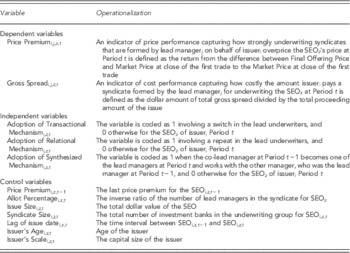
Issuing performance is primarily based on the underwriting price as well as the gross spread (James, Reference James1992; Podolny, Reference Podolny1993, Reference Podolny1994; Pollock, Reference Pollock2004; Corwin & Schultz, Reference Corwin and Schultz2005; Ang & Zhang, Reference Ang and Zhang2006). For this reason, in measuring the issuing performance, this study adopts two dependent variables: Price Premium and Gross Spread. Price Premium is an indicator of price performance that captures how strongly underwriting syndicates formed by lead manager j on behalf of issuer i overprice SEO z at Period t (Krigman, Shaw, & Womack, Reference Krigman, Shaw and Womack2001; Loughran & Ritter, Reference Loughran and Ritter2004; Pollock, Reference Pollock2004). To compute this variable, for SEO z that lead manager j oversaw for issuer i at Period t, this study compares the offering’s final price with the market price at the close of the first trade, using the following formula:
 $${\rm Price \ Preimum}_{{i,j, z,t}} {\rm \ = \ }{{\left( {{\rm Final \ Offering \ Price}_{{i,j,z,t}} \ {\minus}\ {\rm Market \ Price \ at \ close \ of \ the \ first \ trade}_{{i,j,z, t}} } \right)} \over {{\rm Market \ Price \ at \ close \ of \ the \ first \ trade}_{{i,j,z, t}} }}{\times}100{\rm \,\%\,}{\rm .}$$
A large difference in the values between final offering price and market price trading in the market suggests that issuer i feels that the offering is overpriced, leaving little of the money on the table (Shipilove & Li, Reference Shipilov and Li2012). As such, the higher the price premium, the higher the offering price for an issue and the better the performance in terms of capital increase for the issuer.
Gross Spread is an indicator of cost performance that captures how costly the amount issuer i pays a syndicate formed by lead manager j for underwriting SEO z at Period t. The gross spread is the difference between the dollar value that an issuer pays underwriters for the underwriting and the dollar value at which underwriters resell the offering to the market (Podolny, Reference Podolny1993). Additionally, the gross spread is the total of the manager’s fees, which is shared among lead managers, co-lead managers, and the syndicate group (Ang & Zhang, Reference Ang and Zhang2006). The higher the gross spread, the higher the underwriting cost for an issue and the worse the performance in terms of cost increase for the issuer (Jeon & Ligon, Reference Jeon and Ligon2011). For SEO z that lead manager j oversaw for issuer i at Period t, this study adopts gross spread, which is disclosed on the SDC database and computed by dividing the dollar amount of total gross spread by the total proceeding amount of the issue as the following formula:
 $${\rm Gross \ Spread}_{{i,j, z,t}} {\rm = }{{{\rm Total \ amount \ of \ Gross \ Spread}_{{i,j,z,t}} } \over {{\rm Total \ proceeding \ amount}_{{i,j,z, t}} }}{\times}100{\rm \,\%\,}{\rm .}$$
Independent variables
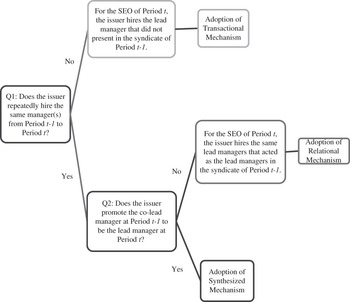
This study measures three independent variables, adoptions of Transactional Mechanism, Relational Mechanism, and Synthesized Mechanism, by using dummy variables. As mentioned earlier in Figure 1, an issuer could adopt transactional mechanisms, relational mechanisms, or synthesized mechanisms to manage the relationships with its underwriters after the initial or the last offering at Period t−1 for its sequent offering at Period t. Figure 2 further illustrates the operationalization of these three mechanisms. To measure the mode of governance mechanism that an issuer adopts, this study compares the lead manager in the offering of Period t–1 to the lead manager in the subsequent offering of Period t. Specifically, this study begins with the operationalization by examining the first question ‘Does the issuer repeatedly hire the same manager(s) from Period t−1 to Period t?’. If the answer is no, which means that the lead manager underwriting the subsequent offering at Period t differs from the one who managed the offering at Period t−1, the variable – Adoption of Transactional Mechanism is coded as 1 involving a switch in the lead manager, and 0 otherwise. By contrast, if the answer is yes, this study asks the second question ‘Does the issuer promote the co-lead manager at Period t−1 to be the lead manager at Period t?’. If the answer to this question is no, which means the lead manager underwriting the subsequent offering at Period t is same as the one who managed the offering at Period t−1, the variable – Adoption of Relational Mechanism is coded as 1 involving a repeat in the lead manager, and 0 otherwise. On the other hand, if the answer to the second question is yes, the variable – Adoption of Synthesized Mechanism is coded as 1 when the co-lead manager at Period t−1 becomes the lead manager at Period t and works with the other manager, who was the lead manager at Period t−1, and 0 otherwise.
Adoption of transactional mechanism, relational mechanism, or synthesized mechanism

Control variables
This study controls for the testing models including a range of additional industry-specific factors and a firm’s characteristics (Pollock, Reference Pollock2004; Rowley & Baum, Reference Rowley and Baum2004; Rowley et al., Reference Rowley, Baum, Shipilov, Greve and Rao2004; Baum et al., Reference Baum, Rowley, Shipilov and Chuang2005; Corwin & Schultz, Reference Corwin and Schultz2005; Baum, McEvily, & Rowley, Reference Baum, McEvily and Rowley2012; Fung, Gul, & Radhakrishnan, Reference Fung, Gul and Radhakrishnan2014). The industry-specific factors include five variables such as Price Premium i,z,t−1, Allot Percentage i,z,t , Issue Size i,z,t , Syndicate Size i,z,t , and Lag of issue date i,z,t . The firm’s characteristics consist of two variables – Issuer’s Age i,z,t and Issuer’s Scale i,z,t . This study computes such variables indicating both the decisions of an issuer to select a specific underwriter as a lead manager for the SEO and the offering decisions of lead managers for the SEO. The details of each control variable are elaborated as follows:
Price premium i,z,t−1
The last price premium for SEO i,z,t−1 that shows the path-dependent, lag, and signal effects can influence the underwriter’s behavior to price SEO i,z,t (Huang & Zhang, Reference Huang and Zhang2011; Fung, Gul, & Radhakrishnan, Reference Fung, Gul and Radhakrishnan2014; Francis, Hasan, & Sun, Reference Francis, Hasan and Sun2014). A high value of price premium on the previous offering signals how popular the common shares of issuer i were trading in the market. For a new underwriter, it is an important signal and path to assign a price to a stock. Under the condition, it may influence the pricing behavior of lead manager j for SEO i,z,t .
Allot percentage i,z,t
This study computes the inverse ratio of the number of lead managers in the syndicate for SEO i,z,t . The number of lead managers can potentially affect both the pricing strategy for SEO i,z,t and the competition within the lead managers (Rowley & Baum, Reference Rowley and Baum2004; Corwin & Schultz, Reference Corwin and Schultz2005). When the number of managers goes up, it presents the increase in the underwriting cost such as fees to share within the syndicate and the rivalry in the syndicate. Thus, it influences the issuing performance and the underwriting process.
Issue size i,z,t
The total dollar value of SEO i,z,t is included because size of the offering may be related to the difficulty that the underwriters sell lager amount of shares to the investors, affecting the issuing price as well as costs (Pollock, Reference Pollock2004; Baum et al., Reference Baum, Rowley, Shipilov and Chuang2005; Corwin & Schultz, Reference Corwin and Schultz2005; Huang & Zhang, Reference Huang and Zhang2011).
Syndicate size i,z,t
The size of the syndicate is the total number of investment banks in the underwriting group for SEO i,z,t . This is the variable for handling common actor effects in analysis of inter-organizational relationships (Pollock, Reference Pollock2004; Baum et al., Reference Baum, Rowley, Shipilov and Chuang2005; Baum, McEvily, & Rowley, Reference Baum, McEvily and Rowley2012). This control variable likely influences the cost of underwriting event.
Lag of issue date i,z,t
To the extent that the transaction-specific asset depreciates and that path-dependent and signal effect decreases over time, the longer the expected interval between transactions the less costly an issuer will be to switch underwriters. Therefore, the less likely a firm is to make a subsequent offer and the longer the expected time until a subsequent issue, the less important will be the inter-temporal linkage in the pricing of investment banking services (Baum et al., Reference Baum, Rowley, Shipilov and Chuang2005; Huang & Zhang, Reference Huang and Zhang2011). Hence, this study controls for the time interval between SEO i,z,t−1 and SEO i,z,t .
Issuer’s age i,z,t
The age of issuer i is included because firms with longer operating histories are more likely to survive and issue in the future (Pollock, Reference Pollock2004; Lee, Jeon, & Kim, Reference Lee, Jeon and Kim2011). Alternatively, the older the firm at the time of SEO i,z,t , the less frequent it needs for external financing and the less likely it will issue securities.
Issuer’s scale i,z,t
This study also controls for the capital size of issuer i because large firms may be more resourceful and better able to raise capital (Pollock, Reference Pollock2004). Large firms possess abundant resources, allowing them to attract the underwriters. The size of issuer i is controlled by its total asset before the time of SEO i,z,t is issued.
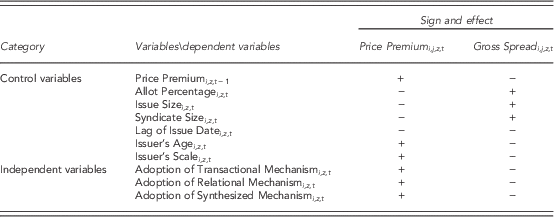
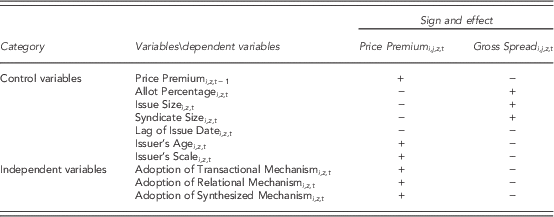
In short, this study presents Table 1 to summarize the operationalization of each variable and Table 2 to provide the prediction signs and effects of all control variables and independent variables on the dependent variables.
Variable description

Prediction sign and effect on dependent variables
RESULTS
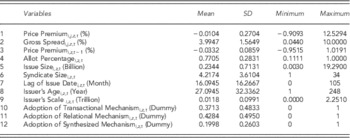
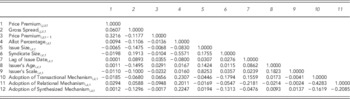
Table 3 shows the descriptive statistics of the variables and Table 4 shows the pair-wise correlation coefficients for all of the variables. This study applies the regression analysis to explore the effects of three different governance mechanisms for managing issuer–underwriter relationships on issuing performance – increase in price premium and decrease in gross spread.
Descriptive statistics

Correlation coefficients

Note: Correlations >|0.11| are significant at p<.01.
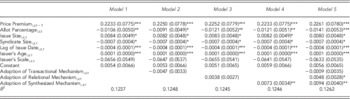
Table 5 shows the regression models for the regression analysis of predicting price performance – the offering’s price premium, whereas Table 6 depicts the regression models predicting cost performance – gross spread. Model 1 is the baseline model used to explore the effects of the control variables on the dependent variable of Price Premium i,j,z,t . The results of this model indicate that Price Premium i,z,t−1 has a positive effect (coefficient: 0.2233; p-value: .004) on the subsequent offering’s Price Premium i,j,z,t due to the path-dependent and signal effects. In addition, Allot Percentage i,z,t has a negative effect (coefficient: −0.0106; p-value: .034) on Price Premium i,j,z,t , meaning that when there are more lead and co-lead managers in a syndicate, the offering’s price would be enhanced. Lag of Issue Date i,z,t , which is the time interval between SEO i,z,t−1and SEO i,z,t has a significant negative effect (coefficient: −0.0004; p-value: .000) on Price Premium i,j,z,t . Such a result may suggest that a shorter interval between transactions makes the price less likely to change. Issuer’s Age i,z,t has a significant positive effect (coefficient: 0.0001; p-value: .000) on the dependent variable, indicating that an older firm is better able to receive an offering with a higher price premium.
Regression models predicting price performance

Notes:
Robust standard errors (in parentheses) are clustered by the issuer. N=2,223; Cluster=1,092. In the full model (Model 5), the multicollinearity is relatively mild since none of the Variance Inflation Factors (VIFs) is excessively greater than 10 (O’Brien, Reference O’brien2007). R 2 difference between Model 5 and Model 1 is 0.003 and significant as F-value is 2.771 and p-value is .008. Considering the year effects (not reported here), the main effects of independent variables on the dependent variable are the same.
∗<0.10, ∗∗<0.05, ∗∗∗<0.01 (two-tailed).
Regression models predicting cost performance

Notes:
Robust standard errors (in parentheses) are clustered by the issuer. N=2,031; Cluster=1,048. In the full model (Model 10), the multicollinearity is relatively mild since none of the VIFs is excessively greater than 10 (O’brien, Reference O’brien2007). R 2 difference between Model 10 and Model 6 is 0.014 and significant as F-value is 11.291 and p-value is .000. Considering the year effects (not reported here), the effects of independent variables on the dependent variable are the same.
∗<0.10, ∗∗<0.05, ∗∗∗<0.01 (two-tailed).
This study adds three independent variables – Adoptions of Transactional Mechanism i,z,t , Relational Mechanism i,z,t , and Synthesized Mechanism i,z,t in Models 2, 3, and 4, respectively, and all variables are then included in Model 5. First, the results show that Transactional Mechanism i,z,t might not have a significant effect on the offering’s price premium (coefficient: −0.0047, p-value: .156 in Model 2; coefficient: −0.0009, p-value: .794 in Model 5). Second, the results show that Relational Mechanism i,z,t might impose a marginally significant effect on the offering’s price premium (coefficient: 0.0038, p-value: .157 in Model 3; coefficient: 0.0048, p-value: .080 in Model 5). Third, the results show that Synthesized Mechanism i,z,t would significantly enhance the offering’s price premium (coefficient: 0.0073, p-value: .033 in Model 4; coefficient: 0.0094, p-value: .018 in Model 5).
Model 6 is the null model for examining the effects of control variables on the second dependent variable of Gross Spread i,j,z,t . Model 6 shows that Price Premium i,z,t−1 has a significant negative effect on the offering’s Gross Spread i,j,z,t (coefficient: −2.6204; p-value: .000). Since the price premium of the offering could be seen as a sign of popularity of the offering issued by certain issuers, the underwriters would charge fewer fees to underwrite a possible popular offering. Issue Size i,z,t has a negative effect on Gross Spread i,j,z,t (coefficient: −0.7622; p-value: .000) probably because it is the denominator in the formula of gross spread. Syndicate Size i,z,t has a significant positive effect on Gross Spread i,j,z,t (coefficient: 0.1074; p-value: .000), meaning that more underwriters in a syndicate would raise the underwriting fees as well as costs. Lag of Issue Date i,z,t has a significant positive effect on Gross Spread i,j,z,t (coefficient: 0.2393; p-value: .000). Although a longer interval between issue offerings would most likely make an issuer switch its underwriters and reduce its cost by increasing bargaining power, a shorter interval between offerings may help underwriters reduce the cost by avoiding the repeat underwriting tasks or by having timely access to information from issuers. In other words, given that underwriters have to run the whole process, underwriting costs may increase if the SEO is issued after a very long interval. Issuer’s Age i,z,t has significant negative effects on the dependent variable of cost performance (coefficient: −0.0069; p-value: .000), and the results indicate that an older firm possesses a greater bargaining power to obtain a better deal. Issuer’s Scale i,z,t has significant positive effects on the dependent variable (coefficient: 3.6085; p-value: .028). Even though issuer’s scale may represent its bargaining power, it may also represent the complexity or scope of the issuer’s business, which costs the underwriters more time to run the underwriting process such as due diligence investigation.
Three independent variables are individually and respectively added in Models 7, 8, and 9. All variables are then included in Model 10. Model 7 shows that Transactional Mechanism i,z,t has a negative effect on Gross Spread i,j,z,t (coefficient: −0.1844; p-value: .041). This suggests that an issuer chooses a new lead manager on the basis that it can provide a relatively low cost offering and beat other bankers’ offering. Model 8 indicates that Relational Mechanism i,z,t has a positive effect on Gross Spread i,j,z,t (coefficient: 0.2982; p-value: .000). The reason for this could be that a lock-in effect happens to the issuer who possesses less bargaining power. Model 9 and Model 10 demonstrate that Synthesized Mechanism i,z,t has a negative effect on Gross Spread i,j,z,t and would significantly decrease the underwriting cost (coefficient: −0.6033; p-value: .000 in Model 9; coefficient: −0.5990; p-value: .001 in Model 10). In order to verify the robustness of our findings, we conduct a further robustness check by considering the temporal effect. We include year dummies for the calendar years from 2002 to 2009 in the models. The results indicate that all previously reported effects occur when the temporal effect are taken into consideration. Overall, the results corroborate the expectations formulated in the previous hypotheses.
DISCUSSIONS AND CONCLUSIONS
This study explores the vertical ties between issuers and underwriters, focusing on the governance of inter-organizational relationships that underlies the issuing performance of a firm. The analysis of the survey consisting 1,202 issuers and 95 lead manager banks in the US equity underwriting market validates our central premise: the joint use of transactional and relational mechanisms is altogether more effective in mitigating opportunism and fostering performance than individual use. Specifically, this study has three major findings. First, the results reveal that an issuer adopting a transactional mechanism to manage its inter-organizational relationships with underwriters could obtain a lower cost offering, which may not present a price premium. Two reasons help explain such results. From the lead manager’s view, investment banks (potential underwriters) often compete with each other by initiating a price competition. The winner to underwrite a new issue may ask for a lower underwriting fee from an issuer. Nonetheless, new underwriters who are newly selected by issuers are faced with the difficult task of assigning a price to a stock with no prior trading history (Corwin & Schultz, Reference Corwin and Schultz2005). A new lead manager favors the reduction of the underwriting risk by offering an underpriced offering since it is more likely to face the information asymmetry between itself and the issuer. From the issuer’s view, issuers especially having a large scale and long history possess greater bargaining power to request a lower cost offering from investment banks since they have absolute power to select underwriters and to construct the syndicate’s structure (Ang & Zhang, Reference Ang and Zhang2006). Based on these results, Hypothesis 1 is partially supported. The results echo the recent research on the basis of the transaction cost theory (e.g., Ellis, Michaely, & O’Hara, Reference Ellis, Michaely and O’Hara2011).
Second, the results reveal that an issuer taking a relational mechanism to manage its relationships with underwriters could obtain a price premium offering for which more fees may be charged. The major reason to explain this is that a lead manger could build up the trust with its issuer and receive more detailed and reliable information from the issuer through the repeat relationships (Uzzi & Lancaster, Reference Uzzi and Lancaster2003). In particular, in the process of evaluating the offer, the investment banker obtains information concerning the firm’s operations and management that would be useful in underwriting subsequent offerings. Hence, reliable information about the issuer can not only decrease the asymmetry between the issuer and the lead manager, but also increase the detailed analysis coverage that can attract more investors who would invest in the new offering (Fernando, Gatchev, & Spindt, Reference Fernando, Gatchev and Spindt2005). However, continuing cooperation and building trust with an issuer is time-consuming and costly for underwriters. To recover these costs from the firm’s frequent business and to compensate for such investments, lead managers may ask for more underwriting fees (Ang & Zhang, Reference Ang and Zhang2006). Thus, the findings not only provide partial supports to Hypothesis 2, but also shed some light on the recent literature suggesting that a repeat relationship could exert a greater impact of the relational hazards on firm performance (e.g., Lee, Reference Lee2013).
Third, the results suggest that an issuer adopting a synthesized mechanism to govern its inter-organizational relationships with underwriters could obtain a price premium offering with a lower underwriting cost. On the one hand, the synthesized mechanism leverages the advantages such as cost efficiency from the transactional mechanism and trust from the relational mechanism (Lazzarini, Miller, & Zenger, Reference Lazzarini, Miller and Zenger2008). On the other hand, the synthesized mechanism fixes the disadvantages such as adverse selection and information asymmetry inherent in the transactional mechanism as well as the lock-in effect and opportunism associated with the relational mechanism (Jenkinson & Jones, Reference Jenkinson and Jones2009). Based on such results, Hypothesis 3 is fully supported. These results also support prior research emphasizing that different governance mechanisms of vertical inter-organizational relationships facilitate different performance outcomes (Cousins & Lawson, Reference Cousins and Lawson2007). Moreover, these results are consistent with the findings of previous studies showing that transactional and relational mechanisms are complementary in relationship governance (Liu, Luo, & Liu, Reference Liu, Luo and Liu2009). More than that, this study extends the work on inter-organizational relationships in which relational mechanisms are viewed as substitutes for transactional mechanisms and vice versa (Gulati & Singh, Reference Gulati and Singh1998; Williamson, Reference Williamson2002; Wuyts & Geyskens, Reference Wuyts and Geyskens2005; Cousins & Lawson, Reference Cousins and Lawson2007).
This study has attempted to provide a theoretical and empirical justification for comparing transaction cost theory with social network theory and to synthesize and integrate these influential theories. In doing so, this study has tried to provide a basis for the convergence of the transactional and relational governance mechanism on inter-organizational relationships. As scholars from the transaction cost perspective look increasingly to processes of retrospection in decision making, they can potentially gain from how social factors enter into the decision-making process. As this examination of the investment banking industry has intended to show that a concern with cooperation is not incompatible with recognition of the importance of competition, cooperation exists among the underwriters, but it could be handled by issuers. Only by taking this dual-faceted context into account can we understand the industrial dynamics when an issuer taking the synthesized mechanism can obtain a price premium offering at a lower cost than can an issuer taking either the uniquely transactional mechanism or the uniquely relational mechanism (Galvin, Reference Galvin2014). The synthesized mechanism can thus exert a strong influence on performance by providing firms with different incentives to invest in inter-organizational relationships (Arranz & Fdez. de Arroyabe, Reference Arranz and Fdez de Arroyabe2012). This study has also shown how coopetition can contribute to a better understanding of the US equity underwriting market as well as one of the investment banking services in the financial industry. This study sketching out an inter-organizational relationship, where the competition and cooperation within underwriters are simultaneously maintained by an issuer, provides a valuable practice for firms to raise their capital in the capital market.
Beyond providing a mediating insight into the debate between transaction cost theory and social network theory, this study represents a point of departure for further inter-organizational research on the financial industry, especially the investment banking industry. One interesting research question concerns the number of lead managers in a syndicate. Anticipating that the issuer is likely to switch in future, the underwriter is eager to recover the costs as early as possible (Ang & Zhang, Reference Ang and Zhang2006), and as such, the first few deals between the underwriter and the issuer should have higher underwriting fees than the later deals. To minimize the expenses on issuing, the issuer must refrain from too many underwriters; and yet doing business with only one underwriter is subject to the underwriter’s rent-extracting behavior. As a result of balancing the tradeoff between the costs and benefits of having one underwriting relationship, the issuer may likely maintain a fixed number of relationships (Huang & Zhang, Reference Huang and Zhang2011). It is intriguing to speculate on how many underwriters an issuer would like to work with. Therefore, this framework, far from being in tension with a concern for the number of lead managers in a syndicate, helps make such an examination possible.
Another poignant question is whether different industries would support the results of this study. The investment banking industry might be peculiar in how banks are able to occupy different positions and roles as lead managers and co-lead managers, insofar as the same bank might be a subordinate syndicate member in one deal, and then it might seek to become a lead on a subsequent syndicate (Shipilov & Li, Reference Shipilov and Li2012). Such a change in positions creates high levels of competition between syndicate members, thus possibly providing a partial explanation for the tensions that this study has identified within their relations. Even though in industries such as IT service and software, organizations have more rigid positions, the conflicting interests between them might be pronounced as they serve the same customer in an alliance, and accordingly, the competition within partners might be intensified. It would be interesting and worthwhile to examine our central premise in other IT industries. For instance, two IT companies such as Samsung and HTC might have an R&D alliance such as the Open Handset Alliance with each other as well as be suppliers to a customer such as Google. In this case, the customers might seek to influence dynamics of relationships between their suppliers, enabling only those relationships that are in its interests. For instance, Google might prompt two companies to collaborate with each other on an Andriod-specific project, even if these two companies have no prior experience of working together and even if they compete directly in the market. Conversely, when two companies contemplate a future relationship, they would have to consider not only their current competitive interactions, but also the vertical ties, which they have and cooperate with the common customer.
This study has some limitations. First, we did not account for alternative sources of direct experience when dealing with investment banks, which issuers may face. In the context of public offerings, such experience could be obtained through the members of the issuer’s management if its members have been active in listing other companies’ shares on the stock markets in the past (Francis, Hasan, & Sun, Reference Francis, Hasan and Sun2014). By observing pricing decisions of investment banks, such members can recommend which bank should be selected as a lead underwriter for the public offerings. Consequently, although issuers with an experienced staff may exert influence on the formation of the underwriting syndicates, these dynamics were not explored in this research. Second, investment banks could have multiple relations that we did not observe in the data. One example is that inter-locks between issuers and investment bankers because the investment bankers making relationship-specific investments in certain issuers can easily approach their clients again with a possible underwriting opportunity. Another example is that investment bankers often move from one bank to another. The mobility of those bankers would affect the likelihood of those banks, for which those bankers had worked, to form repeat relationships on the subsequent public offering deals. Starting with the boundary spanner as the key individual at the beginning of a new collaboration, Schilke and Cook (Reference Schilke and Cook2013) have noted the importance of individual mobility and have specified how trust embedded in a repeat relationship gradually becomes part of the fabric of organizational action. Nonetheless, the impact of mobility on the future collaboration of investment banks is not captured in this study. Clearly, whereas personnel mobility may influence inter-organizational relationships, it may nonetheless prove to be a useful source of variation for the relationships between issuers and investment banks. Third, we stood on the issuer’s angle to see how the vertical issuer–underwriter relationships affect firm performance with modest concerns about the underwriter’s angle. Since the vertical relationship between issuers and underwriters is a bilateral, not only the issuers but also the underwriters can influence the value creation of the relationship. Both parties can employ such relationship to generate their own interest. For instance, Walter, Ritter, and Gemünden (Reference Walter, Ritter and Gemünden2001) take the supplier’s perspective and conceptualize value creation as a set of direct and indirect functions of customer relationship because the supplier not only offers value to the customer but also needs to gain benefits from the customer at the same time. For future study, likewise, scholars may take the underwriter’s angle to examine how the vertical issuer–underwriter relationships influence the underwriter’s performance.
Despite these limitations, this study contributes to a growing body of research on inter-organizational relationships and the governance of inter-organizational relationships. The main conclusion of this study is that the horizontal competitive relationships among underwriters takes into account the vertical cooperative relationships between issuers and underwriters given that issuers do in fact play an important role in the formation of syndicate structure. Such a triad of relationships contains players with divergent interests, ultimately making a synthesized governance mechanism an automatic occurrence. In highlighting these points, this study hopes to have achieved a more nuanced understanding of governance mechanisms for managing inter-organizational relationships.
Acknowledgment
The authors would like to acknowledge the Ministry of Science and Technology in Taiwan and its funding for this research, and also the editor – Dr. Galvin as well as three anonymous reviewers of the paper.