Introduction
Drilling fluid is a general term for all kinds of circulating fluids that meet the needs of drilling work with their multiple functions in the process of oil and gas drilling. It has the functions of carrying drill cuttings, transferring hydraulic power, stabilizing the wellbore, etc. (Caenn and Chillingar, Reference Caenn and Chillingar1996; Huskić et al., Reference Huskić, Žigon and Ivanković2013; Mahmoud et al., Reference Mahmoud, Gajbhiye and Elkatatny2023). Depending on the continuous phase, drilling fluids in general can be categorized into three main groups, namely water-based drilling fluids, oil-based drilling fluids, and gas-based drilling fluids, of which the first two types are the most commonly used (Caenn and Chillingar, Reference Caenn and Chillingar1996; Liu et al., Reference Liu, Zhang, Sun, Lin, Feng and Wang2022; Liu et al., Reference Liu, Li, Liao, Liu, Lu, Lv, Sun, Liu, Mei and Wu2023). Water-based drilling fluids were the first to be developed and applied because of their low cost and relatively low pollution to the environment (Meng et al., Reference Meng, Zhang, Zhou and Chu2012). However, water-based drilling fluids suffer from poor inhibition, salt resistance, and temperature resistance, and cannot meet the operational requirements of some special process wells (Khodja et al., Reference Khodja, Canselier, Bergaya, Fourar, Khodja, Cohaut and Benmounah2010). Oil-based drilling fluids (OBFs) offer a range of benefits over water-based fluids, including superior resistance to high temperatures and salinity, greater wellbore stability, better lubrication, and minimal impact on reservoir integrity (Davoodi et al., Reference Davoodi, Al-Shargabi, Wood, Rukavishnikov and Minaev2024; Hermoso et al., Reference Hermoso, Martinez-Boza and Gallegos2014). These advantages contribute to more effective and efficient drilling operations. Oil-based drilling fluids have mitigated some unfavorable effects of water-based systems and have become the preferred choice for high-temperature, high-pressure, and other complex wells (Mahto and Sharma, Reference Mahto and Sharma2004; Khodja et al., Reference Khodja, Canselier, Bergaya, Fourar, Khodja, Cohaut and Benmounah2010). Rheology is one of the most important characteristics of drilling fluids, especially viscosity and shear stress, which directly affect the ability of the system to carry drill cuttings, maintain wall stability, achieve optimal drilling speed, and ensure other properties. Therefore, the drilling fluid should have the appropriate viscosity and shear stress (Abdo and Haneef, Reference Abdo and Haneef2013). As the core treatment agent in OBFs, organoclay (OC) can regulate the rheological behavior of the system effectively. Its mechanism of action includes two main aspects. Firstly, the incorporation of OC can augment the solids content, leading to elevated internal friction and a consequent increase in the viscosity of the system, which increases proportionally with the OC concentration (Yang et al., Reference Yang, Grulke, Zhang and Wu2007; Hermoso et al., Reference Hermoso, Martinez-Boza and Gallegos2014; Mahmoud et al., Reference Mahmoud, Gajbhiye and Elkatatny2023). Secondly, the uniform distribution of OC in OBF is facilitated by its layered structure and the long-chain part of surfactant molecules, which act as ‘bridges’ to connect solid particles in OBF, thereby forming a three-dimensional spatial network structure. The structure enhances the viscosity and improves the shear performance of the drilling fluid (Van Olphen, Reference Van Olphen1964a; Van Olphen, Reference Van Olphen1964b). In the field of OBF, OC is prepared mostly by quaternary ammonium salt intercalation, in which the quaternary ammonium salt cationic surfactant improves the lipophilicity and basal spacing of montmorillonite (Mnt) by replacing the hydrated inorganic cations between the layers (Ghalambor et al., Reference Ghalambor, Ashrafizadeh and Nasiri2008). However, the traditional method of intercalating quaternary ammonium salts faces significant challenges in terms of thermal stability, particularly in high-temperature environments. At elevated temperatures, modifiers within OC can detach readily from Mnt layers, resulting in the collapse of the layers and accumulation of particles (Zhuang et al., Reference Zhuang, Jiang and Zhang2019b), which can affect the performance of the drilling fluid adversely. Furthermore, during drilling operations, clays in the formation may permeate the drilling fluid and interact with desorbed modifier molecules. This leads to an increase in the OC content, resulting in greater system viscosity. Under these conditions, pump pressure may increase sharply, risking the cessation of drilling fluid circulation and posing a significant safety threat. Extensive research has been conducted by scientists on quaternary OCs, delving into the intricate effects of variables such as carbon chain length, the number of modifiers, and the quantity added during the modification process (Lagaly et al., Reference Lagaly, Ogawa and Dékány2006). Jordan (Reference Jordan1949) first proposed that modifiers with different alkyl chain lengths affect the modification effect of Mnt (Jordan, Reference Jordan1949); Heinz et al. (Reference Heinz, Vaia, Krishnamoorti and Farmer2007) investigated the effects of cation exchange capacity (CEC), chain length of alkyl groups, and type of headgroups of Mnt on the interlayer self-assembly, and found that the basal spacing increased with increasing chain length, low CEC showed a stepwise growth, high CEC showed a continuous growth, and NMe3 head groups had no hydrogen-bonding constraints and had better surface diffusion capacity than NH3 head groups (Heinz et al., Reference Heinz, Vaia, Krishnamoorti and Farmer2007). He et al. (Reference He, Ma, Zhu, Yuan and Qing2010) found that the basal spacing of OMt increased with chain length and content, and that double-chain surfactants expanded the interlayer spacing more than single-chain ones, and that CEC had a limited effect on the maximum spacing, but that lower-CEC Mnts required less surfactant to reach the maximum spacing (He et al., Reference He, Ma, Zhu, Yuan and Qing2010). Zhuang et al. (Reference Zhuang, Jiang and Zhang2019b) investigated the thermal degradation or desorption mechanism of OMt interlayer surfactants at high temperatures, and the results showed that the long-chain and double-chain surfactants improved significantly the colloidal stability and high-temperature resistance by enhancing intermolecular interactions. The quaternary surfactants were degraded at high temperatures (>200°C), and the short-chain surfactants were desorbed at low temperatures, while the degradation products of the long-chain surfactants were able to maintain part of the dispersing ability due to the polar head and long-chain structure. Thermal degradation and desorption together lead to the reduction of OMt layer spacing and rheological properties, but the long-chain modifiers with double-chains can still maintain relatively good thermal stability at 250°C because the degradation products still have surface activity (Zhuang et al., Reference Zhuang, Jiang and Zhang2019b). Usually, longer alkyl chains and more organic modifiers lead to better rheological properties of OMt in oil, and as the temperature increases, the structure of OMt in oil changes from swelling to exfoliation and finally collapsing, and the swelling and exfoliation of OMt facilitates the formation of a ‘house of cards’ network structure, which contributes to the excellent rheological properties of OMt (Zhuang et al., Reference Zhuang, Zhang, Wu, Zhang and Liao2017; Zhuang et al., Reference Zhuang, Gao, Peng and Zhang2019a). Mnt was modified with stearyl dimethyl benzyl ammonium chloride (1827) and dioctadecyl dimethyl ammonium chloride (1821), respectively, to prepare OMt for OBF, and the OMt modified with 1821 was found to maintain better rheological properties at high temperatures (Zhuang et al., Reference Zhuang, Zhang, Wu, Zhang and Liao2017). However, the OMt modified with 1827 covered the Mnt active sites effectively, and improved the adsorption density (Luo et al., Reference Luo, Sasaki and Hirajima2015). Additionally, OMt prepared using quaternary ammonium salt was adsorbed physically, resulting in poor performance and poor rheology at 150°C (Xie et al., Reference Xie, Gao, Pan, Hunter, Singh and Vaia2001; Zhuang et al., Reference Zhuang, Zhang, Sun and Liao2016). Claytone-IMG 400 is an OC with a small particle size and large specific surface area, which improved the dispersion and rheological properties of OBF. Experimental results showed that Claytone-IMG 400 was superior to conventional OC in terms of electrical stability, rheological properties, sedimentation control, and filtration efficiency (Mahmoud et al., Reference Mahmoud, Gajbhiye and Elkatatny2024b). Mahmoud et al. (Reference Mahmoud, Gajbhiye and Elkatatny2024a, Reference Mahmoud, Gajbhiye and Elkatatny2024b) evaluated the effect of a new OC, Claytone-EM, as a rheological additive on the performance of oil-based drilling fluids. This was also tested at high pressure, high temperature (HPHT) conditions (275°F, 500 psi) and compared with an existing organoclay, MC-TONE, which showed that Claytone-EM did not affect the drilling fluid density (which remained at 15 ppg), the electrical stability increased slightly by 1%, Claytone-EM reduced effectively the problem of sedimentation, plastic viscosity (PV) increased by 11%, yield point (YP) increased by 85%, apparent viscosity (AV) increased by 28%, and the YP/PV ratio increased from 1.12 to 1.86 (a 66% increase). Claytone-EM improved significantly emulsion stability, rheological properties and filtration performance of drilling fluids under HPHT conditions; it helps to reduce settling problems and well wall instability during drilling (Mahmoud et al., Reference Mahmoud, Gajbhiye and Elkatatny2024a). These researchers modified sepiolite with surfactants and investigated the effects of the amount and chain length of surfactants and the ratio of cationic to anionic surfactants on the performance of modified sepiolite, and they found that long-chain cationic surfactants had greater adhesion to the sepiolite surface than short-chain surfactants (Weng et al., Reference Weng, Gong, Liao, Lv and Tan2018). Moreover, the study on how Tunisian clay modified with various concentrations of cationic surfactants affects the rheology of oil-based drilling fluids found that increasing surfactant concentration improves the yield point and consistency coefficient, with the best results achieved at a surfactant concentration of 3.0× the Mnt’s CEC (Msadok et al., Reference Msadok, Hamdi, Rodríguez, Ferrari and Srasra2020).
However, even though many research studies have focused on quaternary ammonium OC, they tend to have limited thermal stability at elevated temperatures, which is an obvious drawback. This limitation highlights the need to develop high-temperature-resistant OCs. To address the limitations of traditional quaternary ammonium salt intercalation methods, silane graft modification of layered silicate clays (e.g. Mnt) has emerged as a promising alternative. Specifically, silane coupling agents form covalent bonds with reactive hydroxyl groups on the Mnt surface or lamellar edges. This covalent grafting creates a stable organic coating layer, which enhances interfacial compatibility and reduces particle aggregation in composite materials (Waddell et al., Reference Waddell, Leyden and DeBello1981; Bee et al., Reference Bee, Abdullah, Bee, Sin and Rahmat2018). Souza et al. (Reference Souza, Larocca and Pessan2016) used alkyl ammonium salts, alkyl and aryl phosphonium salts, and a silane to modify two types of commercial clay minerals. Thermogravimetric (TG) analysis confirmed that the phosphonium and silane OCs were more thermally stable than conventional alkyl ammonium OCs (Souza et al., Reference Souza, Larocca and Pessan2016). Mnt was modified with octadecyltrimethoxysilane (Song and Sandí, Reference Song and Sandí2001); however, the silane coupling agent was grafted primarily onto the edges of the Mnt platelets, leaving the interlayer spacing unchanged. Due to the limited number of reactive hydroxyl groups on the surface of clay particles, the hydrophobicity and basal spacing of the particles could not be improved significantly by covalent grafting alone. As a result, Mnt has been modified using a combination of long-chain quaternary ammonium salts and long-chain silanes, finding enhanced thermal properties, better dispersion of the OC, and increased temperature resistance with larger amounts of grafted silane (Qian et al., Reference Qian, Zhou, Xu, Ding, Zhang and Yang2009; Guo et al., Reference Guo, Yang, Zhang, Zhang, Gao, Zhang and Zhang2020a).
Few studies have reported on the preparation of high-temperature-resistant OC for OBF by the composite modification of quaternary ammonium salt and silane. Thus, it is necessary to study the method and reveal the influence of temperature resistance of OC prepared by the method. In the present study, the objective was to employ dioctadecyl dimethyl ammonium chloride (1821) and stearyl dimethyl benzyl ammonium chloride (1827) as intercalating agents, with dodecyl trimethoxy silane (DTMS) grafted to the edge of Mnt to co-prepare the OMt. A further objective was to compare the mechanism for the enhancement of thermal stability by the co-modification of silane and quaternary ammonium salts with that of the OMt without the addition of silane.
Materials and methods
Materials
Mnt was obtained from Kazuo Shuanglong Mining Co., Ltd (Liaoning Province, China); the CEC is 70 mmol 100 g–1. It was dried in a drying oven at 60°C for 24 h, then ground and sieved through a 200-mesh sieve. Dioctadecyl dimethyl ammonium chloride (1821, 97%) was purchased from Shanghai Macklin Biochemical Technology Co., Ltd (China). Stearyl dimethyl benzyl ammonium chloride (1827, 98%) was purchased from Beijing MREDA Technology Co., Ltd (China). Dodecyl trimethoxy silane (DTMS, 97%) was purchased from Guangzhou City Building Double Chemical Technology Co., Ltd (China). The base oil (i.e. No. 0 diesel oil) was bought from Sinopec Group Co., Ltd (Beijing, China). The main emulsifier for resistance to 260°C was developed by the research group which includes the present authors.
Preparation of OMts
Two types of OCs were prepared in aqueous solution using the following steps: (1) Na-Mnt was poured into deionized water and stirred at room temperature to make it fully hydrated in order to make the 6 wt.% suspension (the mass ratio of Mnt to deionized water was 3:47); this was recorded as suspension A. (2) Suspension B was obtained by adding 2.0× the Mnt CEC of 1821 to suspension A, adjusting the pH to 8 with Na2CO3, reacted at 70°C for 1.5 h, then adding 1.0 CEC of 1827 dissolved in deionized water and continuing to stir for 1.5 h. After the reaction was completed, half of suspension B was removed, left to stand, separated, dried, and passed through a 200-mesh sieve to produce 1821+1827-OMt. (3) DTMS (1 g Mnt corresponding to 0.33 g DTMS) was dissolved in ethanol and deionized water (the volume ratio of ethanol to deionized water was 7:3), stirred slowly for 1 h and then added to the remaining suspension B and stirred for 5 h at 90°C. After the reaction was completed, it was allowed to stand, separated, dried, and passed through a 200-mesh sieve to obtain 1821+1827+DTMS-OMt.
Preparation of OBF and oil-based gels
Preparation of OMt/oil systems and gels
Six grams of OMt was added into 300 mL of diesel fuel and blended for 10 min at the rate of 11,000 rpm. Two groups of OMt samples were prepared in eight suspensions according to the method above, and one of the suspensions of each group of OMt samples was allowed to stand at room temperature for 90 min, and the remaining seven samples were aged, and the aging temperatures were set at 120, 150, 180, 200, 220, 240, and 260°C. After aging for 16 h, the OMt dispersion system at various aging temperatures was ultimately obtained, in which 100 mL of each suspension was taken to test the gel volume, and the remaining 200 mL was centrifuged to obtain the OMt/oil gel samples, which were then prepared for the X-ray diffraction analysis (XRD), nitrogen elemental analysis, and optical microscopy test.
Preparation of oil-based drilling fluids
Twelve grams of the main emulsifier were added to a high-speed mixing cup containing 340 mL of diesel fuel and mixed at high speed for 5 min; 60 mL of water was then added and mixed for 20 min, followed by the addition of 16 g of OMt and mixed at high speed for 20 min. For each OMt sample, four basal suspensions were prepared as described above and stored for subsequent aging experiments, with the temperatures set at 200, 220, 240, and 260°C, respectively.
Characterization
X-ray diffraction (XRD) analysis was carried out using a D8 Advance X-ray powder diffractometer (Bruker, Karlsruhe, Germany), using CuKα radiation, 40 kV, 40 mA. The experiments were carried out in step scanning mode, with a scan speed of 0.05 s per step (step size: 0.02°2θ). The XRD patterns were collected over the range 1.5 to 10°2θ. The samples were powders sieved through a 200-mesh screen and tested after compaction. Scanning electron microscopy experiments were performed using a Hitachi SU8020 SEM instrument with an operating voltage of 5 kV, and the samples were coated with Au before testing. Contact angle tests were conducted using a JC2000D1 instrument with distilled water as the probe liquid. OMt samples for the contact angle test were pressed into pellets at 15 MPa for 1 min. Infrared analysis was performed using an IS10 FT-IR spectrometer (Nicolet, USA) in the range 400–4000 cm–1 and 32 scans. The sample was prepared as a KBr pellet (sample to KBr ratio is 1:100, pressed at 20 MPa). Background correction was performed prior to sample analysis using pure KBr. TG and derivative thermogravimetric (DTG) analyses were carried out on the TGA/DSC3+ simultaneous thermal analyzer (Mettler Toledo, Switzerland). The samples were heated from 25 to 900°C under air at a rate of 10°C min–1. The DTG curves were derived directly from the corresponding TG curves. Optical microscopy images were obtained using an Axio Imager M1m (Zeiss, Germany). The organic element analyzer UNICUBE (Elementar, Germany) was used to measure the N content of the OMts after the high-temperature treatments. Gel volume results were obtained by adding 100 mL of aged fluid to a stoppered graduated cylinder and allowing it to stand for 90 min. The AV, PV, and YP were measured at various temperatures using the ZNN-D63 viscometer. All experiments were repeated two to three times to ensure the accuracy of the data or images.
Results and Discussion
Structure and morphology of OMts
XRD analysis
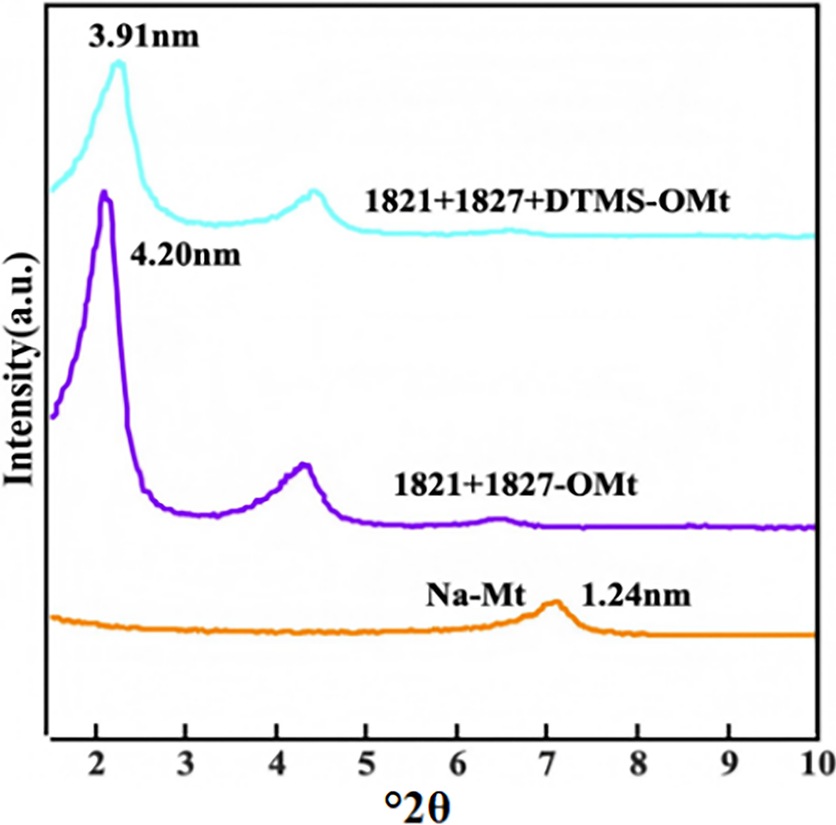
The XRD patterns of Mnt and OMts (Fig. 1) revealed that the basal spacing of Na-Mnt was 1.24 nm, and after organic modification, the 1821+1827-OMt basal spacing reached 4.20 nm and the 1821+1827+DTMS-OMt basal spacing reached 3.91 nm. The slightly smaller basal spacing of 1821+1827+DTMS-OMt relative to that of the 1821+1827-OMt was thought to be due to the condensation reaction of silanes occurring in the interlayers and at the edges of the Mnt (Asgari et al., Reference Asgari, Abouelmagd and Sundararaj2017).
XRD patterns of Mnt and OMts.

SEM morphology
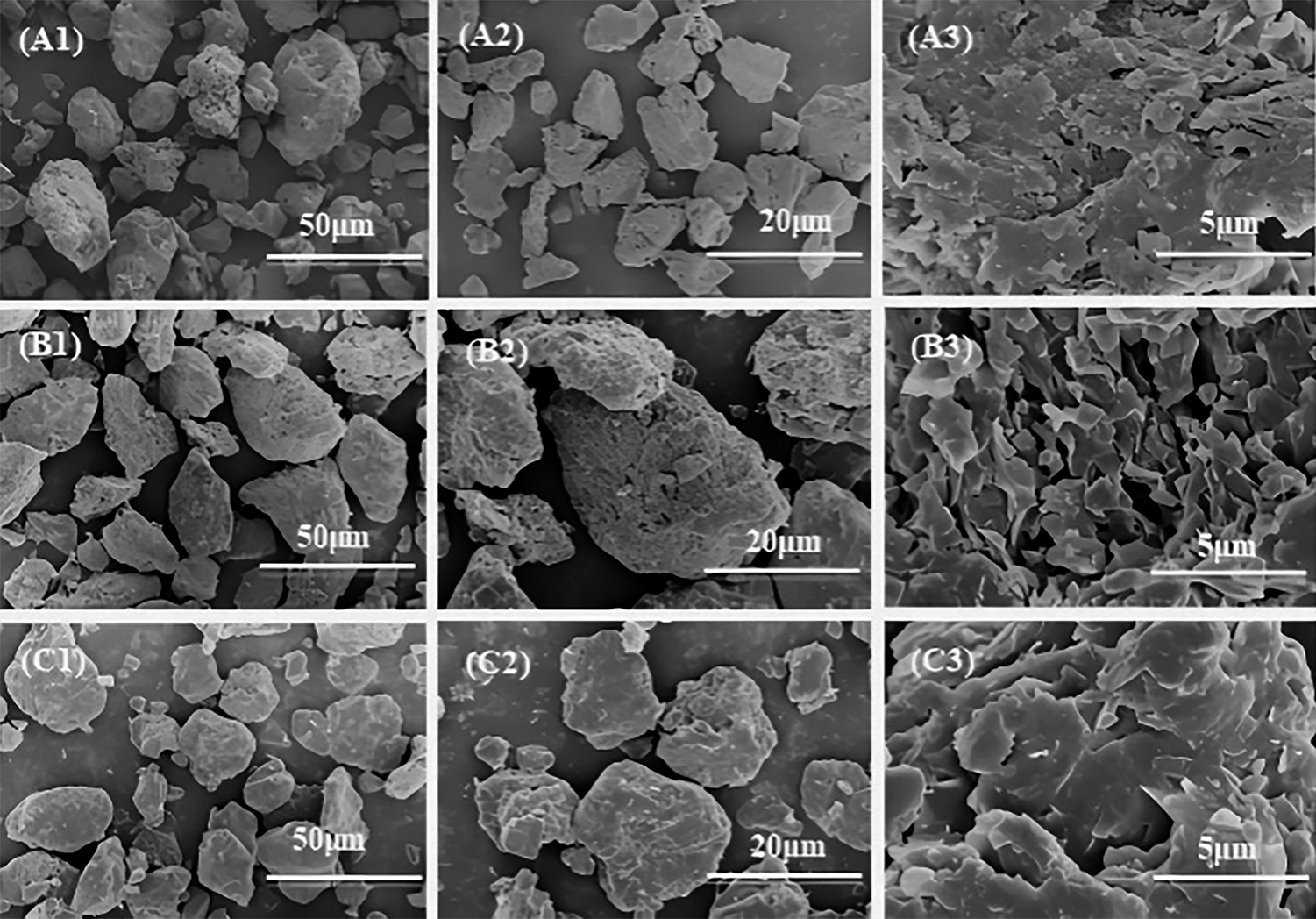
SEM images labeled (A1–A3) are of Na-Mnt; (B1–B3), of 1821+1827-OMt; and (C1–C3), of 1821+1827+DTMS-OMt (Fig. 2). The Na-Mnt exhibited a layered structure composed of scaly aggregates; it was not exfoliated or dispersed, and displayed an irregular arrangement and a large lamellar size. Comparative analysis between Na-Mnt and OMts revealed that the latter exhibited a more pronounced lamellar structure, had more curly lamellae, looser interlayer stacking, greater interlayer spacing, and superior dispersion compared with the unmodified Na-Mnt. These structural changes indicated that the Mnt was modified successfully. Furthermore, the edges of the lamellae of 1821+1827+DTMS-OMt exhibited a coarser surface with the presence of some agglomerates in comparison with those of Na-Mnt and 1821+1827-OMt. These differences were attributed to the silane coating.
SEM images of Na-Mnt (A1–A3), 1821+1827-OMt (B1–B3), and 1821+1827+DTMS-OMt (C1–C3).

Contact-angle measurements
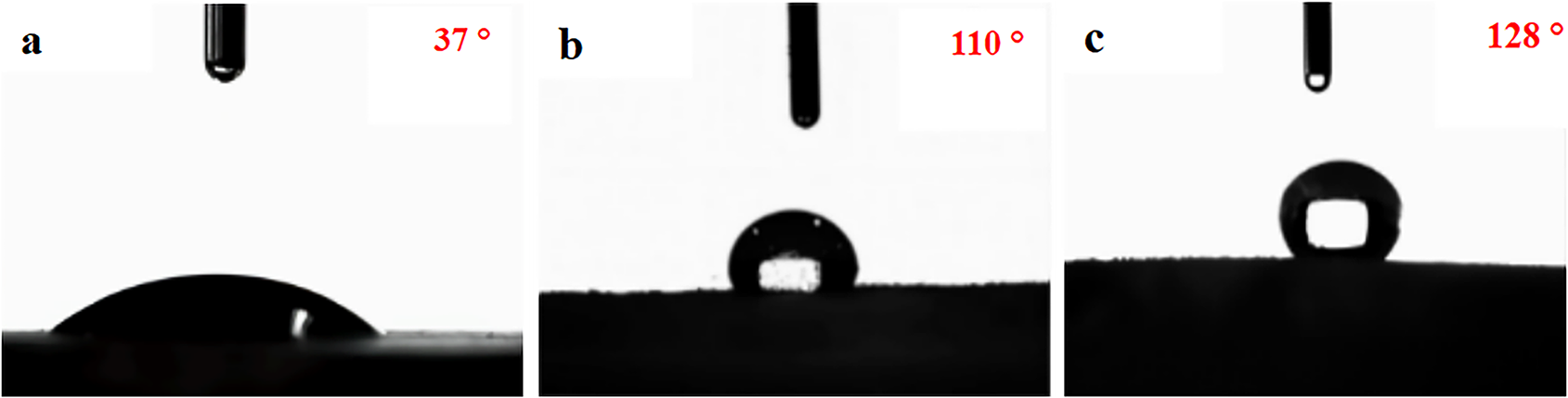
Large contact angles indicate hydrophobicity, while small contact angles indicate hydrophilicity. Na-Mnt exhibited hydrophilicity with a contact angle of 33° (Fig. 3a). The contact angle of 1821+1827-OMt reached 110° and that of 1821+1827+DTMS-OMt reached 128°, indicating that the two samples of OMt were hydrophobic, suggesting that the modification was successful (Fig. 3b,c). Because 1821+1827+DTMS-OMt was modified by adding silane as a coupling agent to 1821+1827-OMt, the lipophilicity was improved further and the contact angle of 1821+1827+DTMS-OMt was larger than that of 1821+1827-OMt.
Contact angles of (a) Na-Mnt, (b) 1821+1827-OMt, and (c) 1821+1827+DTMS-OMt.

FT-IR spectra
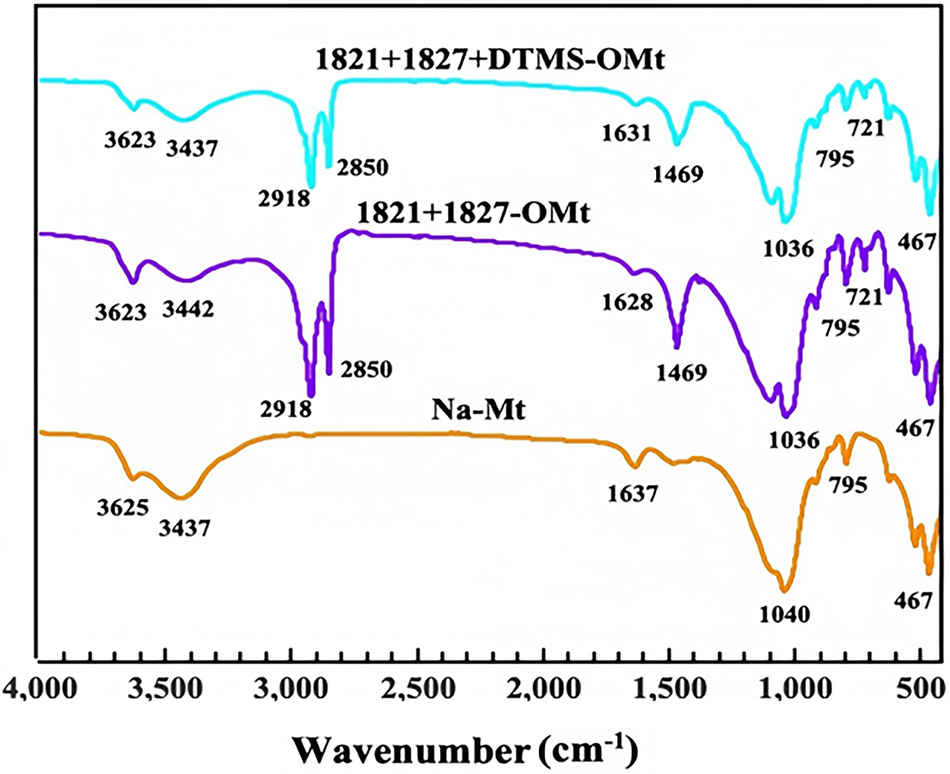
The infrared spectra of Na-Mnt and OMts (Fig. 4) were similar, indicating that the original structural framework of Na-Mnt was unchanged during the intercalation modification process. Both showed the characteristic O-H stretching peaks of Mnt at 3000–3750 cm–1. The band at 3625 cm–1 was due to Mg-OH with Al-OH. The 3437 cm–1 peak was due to adsorbed water. The other bands observed were H-O-H bending of water at 1637 cm–1, Si-O-Si stretching at 1040 cm–1, two small bands at 915 cm–1 and 795 cm–1 corresponding to OH-bending of hydrated water (Zawrah et al., Reference Zawrah, Khattab, Saad and Gado2014), and flexural peaks of Si-O-Al and Si-O-Si appeared near 520 and 467 cm–1, respectively (Madejová, Reference Madejová2003). Comparison of the FT-IR spectra of Na-Mnt and OMts revealed that there was no significant change in the structural OH absorption peaks (near 3625 cm–1), and the intensity of the absorption peaks near 3437 cm–1 and 1637 cm–1 was reduced significantly after the organic modification, which indicated that the organic modifiers entered the interlayer space of Na-Mnt and removed a large number of adsorbed water molecules by means of a strong hydrophobic effect. 1821+1827-OMt showed asymmetric stretching peaks of –CH3 and symmetric stretching peaks of –CH2– at 2919 cm–1 and 2850 cm–1, and peaks of the benzene ring skeleton also appeared at 1469 cm–1, while a bending peak of –CH2– appeared at 721 cm–1. The overall FT-IR spectral profile of 1821+1827+DTMS-OMt was similar to that of 1821+1827-OMt, especially for the characteristic bands of the 1821 and 1827 organic modifiers, indicating the initial organic structure was largely preserved during subsequent silane grafting; this grafting process is understood to occur primarily via reaction of the silane with the surface Si-OH groups of the montmorillonite component, rather than with the less reactive Al-OH and Mg-OH sites (He et al., Reference He, Duchet, Galy and Gerard2005). Therefore, the intensity of the Si-O-Si absorption peak of 1821+1827+DTMS-OMt at 467 cm–1 also increased, inferring that the silane coupling agent underwent dehydration condensation with Na-Mnt to form a grafted Si-O-Si covalent bond structure.
FT-IR spectra of Na-Mnt and OMts.

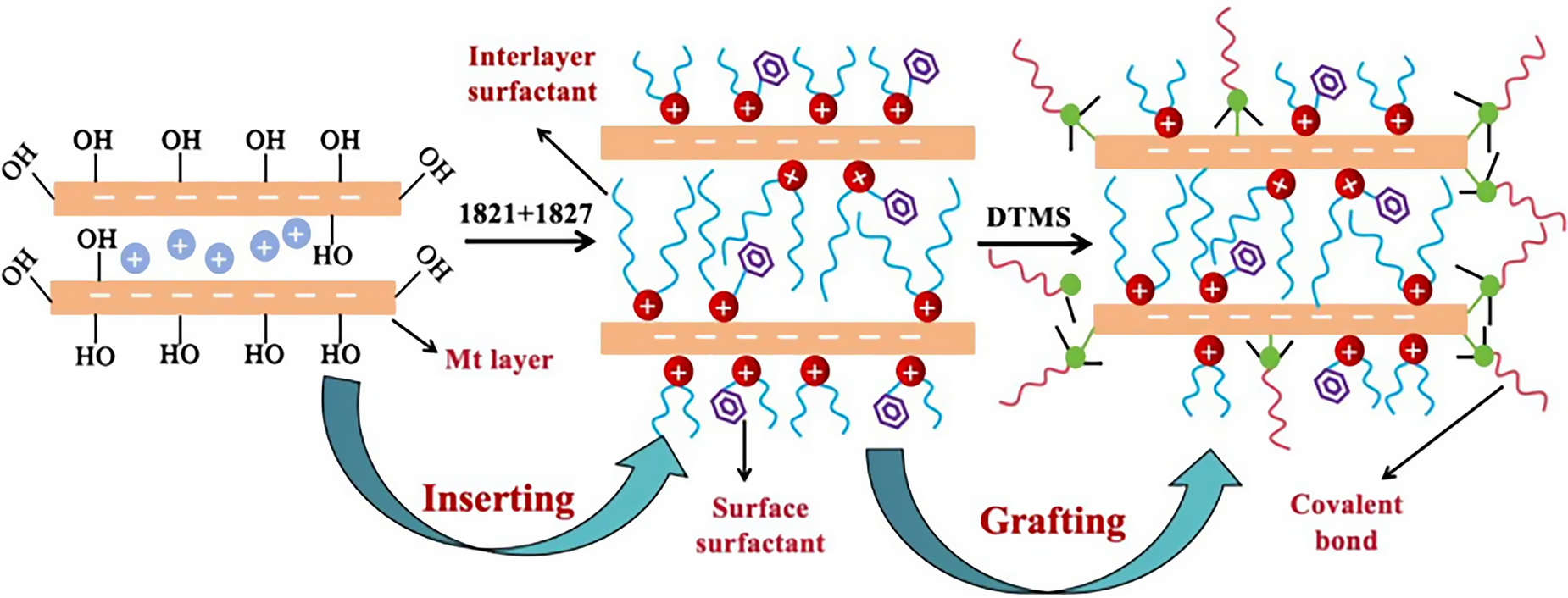
Based on the experimental data and analysis above, a reaction mechanism model between Mnt layers and modifiers was proposed (Fig. 5). In the modification process, Na-Mnt was first intercalated with modifiers 1821 and 1827. This led to the majority of the modifiers entering the interlayer space of Na-Mnt by ion exchange, while a few modifiers were adsorbed on the outer surface of Na-Mnt. In 1821 and 1827, there are two large groups: one benzyl and one octadecyl for 1827, and two octadecyls for 1821. For 1821 and 1827, all C–C bonds were in trans-conformations, and the carbon chains were V-shaped. The conformation of the surfactants changed upon intercalation into the interlayer space. An almost parallel orientation of the chains was achieved through the formation of gauche bonds near the ammonium group. This conformation allowed a denser packing of these surfactants (Zhuang et al., Reference Zhuang, Zhang, Wu, Zhang and Liao2017). During the addition of silane DTMS, DTMS interacted with -OH mainly at the Na-Mnt edges of the layer. This interaction led to the formation of covalent bonds between DTMS and Na-Mnt, and the condensation reduced the distance between the Mnt layers (Asgari et al., Reference Asgari, Abouelmagd and Sundararaj2017). This mechanism used ion exchange for interlayer modification and the formation of covalent bonds on the Na-Mnt surface or layer edges, which enhanced the interlayer and surface bonding through covalent bonding, and formed a dense protective layer on the OMt’s surface to delay the escape of quaternary ammonium salts, thereby preventing reduction of the layer spacing due to the desorption of quaternary ammonium salts (Bertuoli et al., Reference Bertuoli, Piazza, Scienza and Zattera2014; Guo et al., Reference Guo, Liu, Gates and Zhou2020b).
Schematic diagram of the reaction mechanism between Na-Mnt and modifiers.

Comparative analysis of temperature resistance of OMts
Thermal analysis
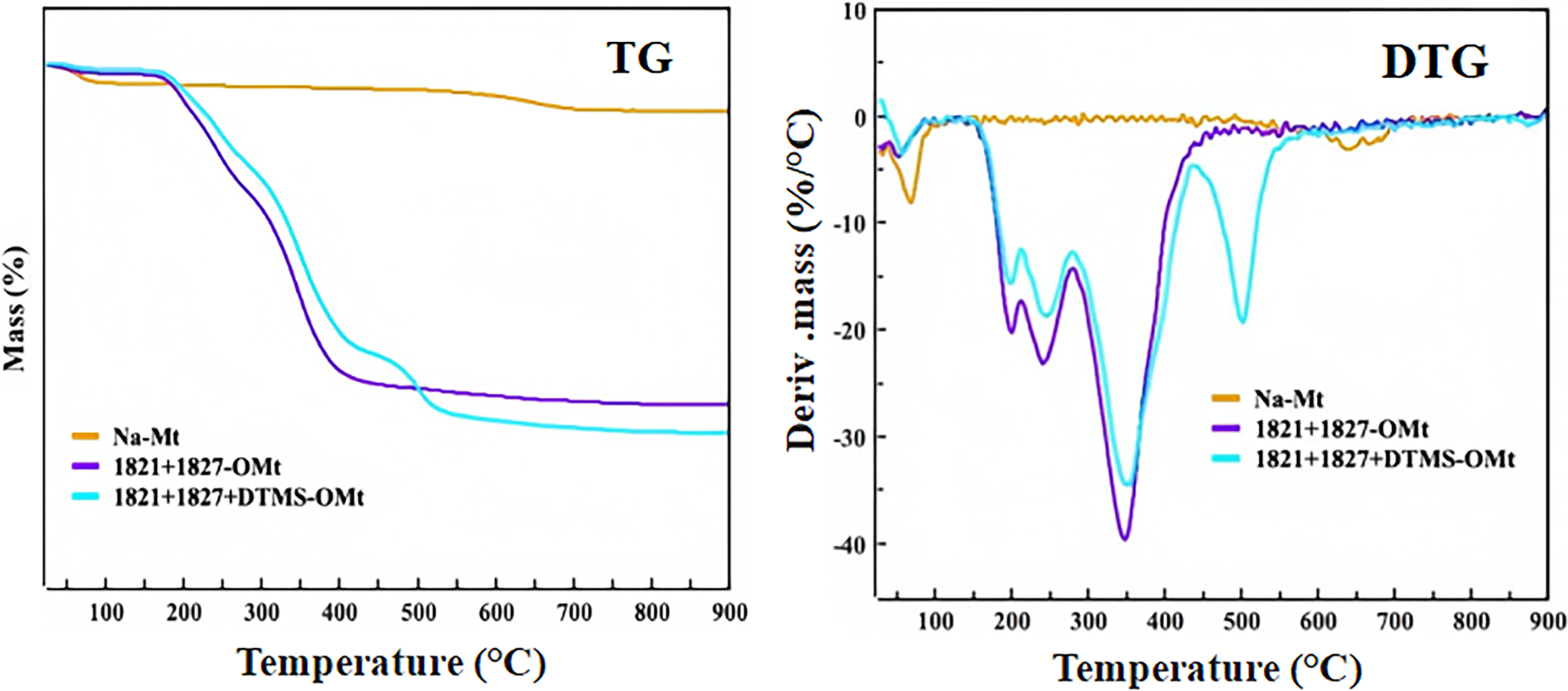
Na-Mnt and OMts exhibited different thermal decomposition behaviors (Fig. 6). The thermal mass loss of Na-Mnt can be categorized into two stages. The initial stage occurred before reaching 200°C, characterized by the loss of adsorbed and interlayer water (Shanmugharaj et al., Reference Shanmugharaj, Rhee and Ryu2006; Piscitelli et al., Reference Piscitelli, Posocco, Toth, Fermeglia, Pricl, Mensitieri and Lavorgna2010). In the 600–700°C stage, the removal of structural hydroxyl groups from the layers was the main concern (Pavlidou and Papaspyrides, Reference Pavlidou and Papaspyrides2008; Asgari and Sundararaj, Reference Asgari and Sundararaj2018b). Both OMts exhibited the shedding of adsorbed water at ~55°C. At ~60–150°C, the weight loss from OMts was less than from Na-Mnt, indicating that the organic modifier entered the Na-Mnt interlayer, displacing the interlayer cations along with the associated interlayer water.
Thermal analysis of Na-Mnt and OMts.

According to the TG-DTG curves, almost no weight loss from Na-Mnt was observed in the intervals of ~150–400°C and ~400–550°C. Therefore, the weight loss from the two groups of OMt from these same intervals was mainly from the modifier. There were two significant weight losses of 1821+1827-OMt after 150°C, ~150–285°C, and ~285–440°C, in which the weight loss of 19.95% in the interval from ~150 to 285°C belonged to the degradation of 1821 and 1827, with the products being hydrocarbons and amines, and the weight loss of 36.98% in the interval from ~285 to 440°C belonged to the oxidative decomposition of the quaternary ammonium salt (Zhuang et al., Reference Zhuang, Gao, Peng and Zhang2019a; Zhuang et al., Reference Zhuang, Zhang, Peng, Gao, Pereira and Jaber2019c). The correspondence between the thermogravimetric weight loss and the quantity of modifier incorporated was notably consistent. Three weight-loss events were observed from 1821+1827+DTMS-OMt at temperatures >150°C, namely, ~150–285°C (16.52%), ~285–440°C (32.59%), and ~440–550°C (13.67%), of which the weight loss of 1821 and 1827 was consistent with that of 1821+1827-OMt. In addition, the weight loss of 1821+1827+DTMS-OMt in the interval of ~150–285°C also included the weight loss of silane physically adsorbed on the surface of Na-Mnt (Asgari and Sundararaj, Reference Asgari and Sundararaj2018b; Guo et al., Reference Guo, Yang, Zhang, Zhang, Gao, Zhang and Zhang2020a). The thermal weight loss in the range ~440–550°C represented the mass of silane covalently grafted onto Na-Mnt (Asgari et al., Reference Asgari, Abouelmagd and Sundararaj2017; Asgari and Sundararaj, Reference Asgari and Sundararaj2018a), indicating successful grafting of DTMS on the Na-Mnt layer edges and an enhanced thermal decomposition temperature compared with the quaternary ammonium salt.
XRD analysis
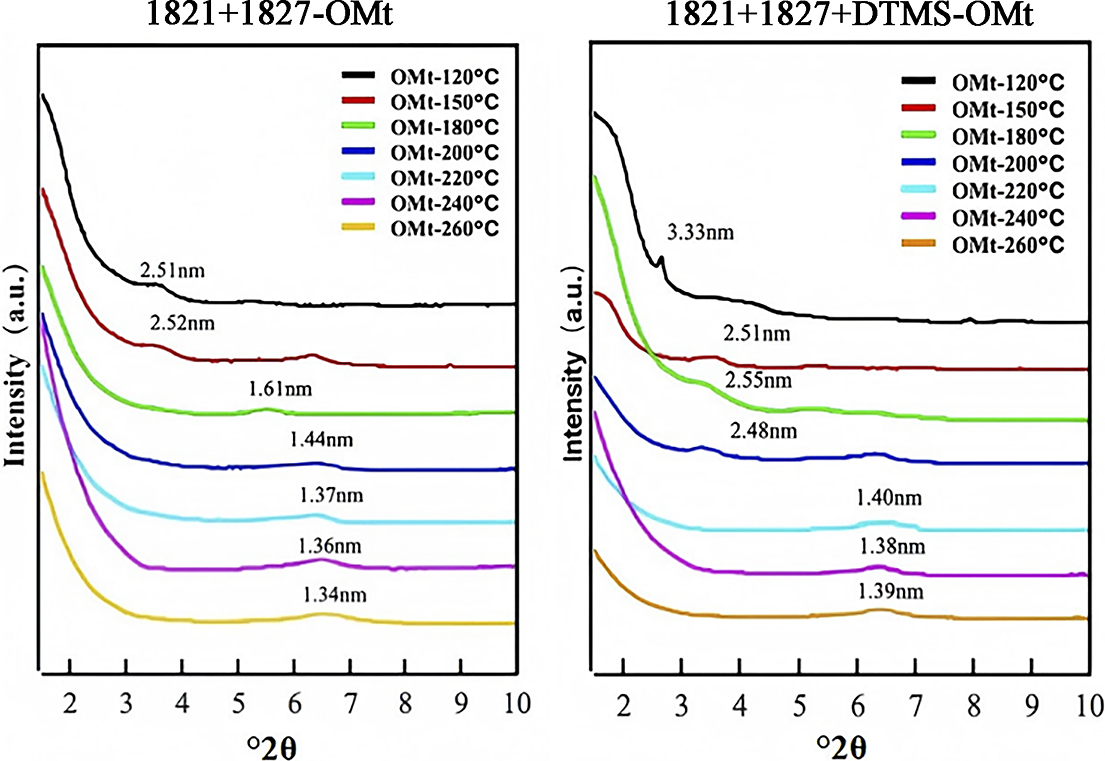
XRD analysis of the OMts treated at high-temperature (Fig. 7) revealed that the basal spacing was reduced due to the combined effect of mechanical forces and the infiltration of diesel fuel compared with untreated OMt powders. This resulted in the transformation of originally more defined reflections into numerous broad reflections, signaling a reduced crystallinity in the heat-treated OMt relative to its powdered form. Specifically, the basal spacing of the 1821+1827-OMt powders decreased from 4.20 to 2.51 nm and 2.52 nm after aging at 120°C and 150°C, respectively, and further to 1.61 nm after aging at 180°C, at which temperature the quaternary ammonium compound began to decompose and the modifier started to desorb from the interlayers. This is consistent also with the TG-DTG analysis. As the aging temperature increased to 260°C, the basal spacing decreased progressively, indicating the decomposition or dissolution of organic modifiers in the oil, leading to the reaccumulation of Mnt layers closer to the Na-Mnt configuration. The basal spacing of 1821+1827+DTMS-OMt powders decreased from 3.91 to 3.33 nm after aging at 120°C, and the peak shape became sharper, indicating that the crystallinity was improved at this temperature. After further aging at 150 and 180°C, the basal spacing decreased to 2.51 and 2.55 nm, respectively, along with weakening of the reflection and reduction of the crystallinity. Sample 1821+1827+DTMS-OMt was still in the stage of dispersion and swelling compared with 1821+1827-OMt. As also observed in the TG-DTG analysis, the quaternary ammonium started to decompose at 180°C, but the degree of desorption was smaller than that of sample 1821+1827-OMt at the same temperature. Remarkably, at 200°C and above, the basal spacing of 1821+1827+DTMS-OMt remained relatively stable, indicating the protective effect of DTMS against high-temperature conditions by hindering the detachment of the interlayer modifier, thereby enhancing the thermal stability of the OMt.
XRD spectra of OMts after high-temperature treatments.

The analysis confirmed the following: (1) negative correlation between aging temperature and basal spacing; the desorption of surfactant from the Mnt interlayer space was enhanced with increasing temperature; and (2) 1821+1827+DTMS-OMt maintained a greater basal spacing at elevated temperatures compared with 1821+1827-OMt, and exhibited superior thermal stability and effective dispersion compared with 1821+1827-OMt, even at temperatures of 220°C or greater. This stability was attributed to the stabilization with DTMS modification, which limited the desorption of organics and thus maintained the structural integrity of 1821+1827+DTMS-OMt at high temperatures.
Optical microscopy
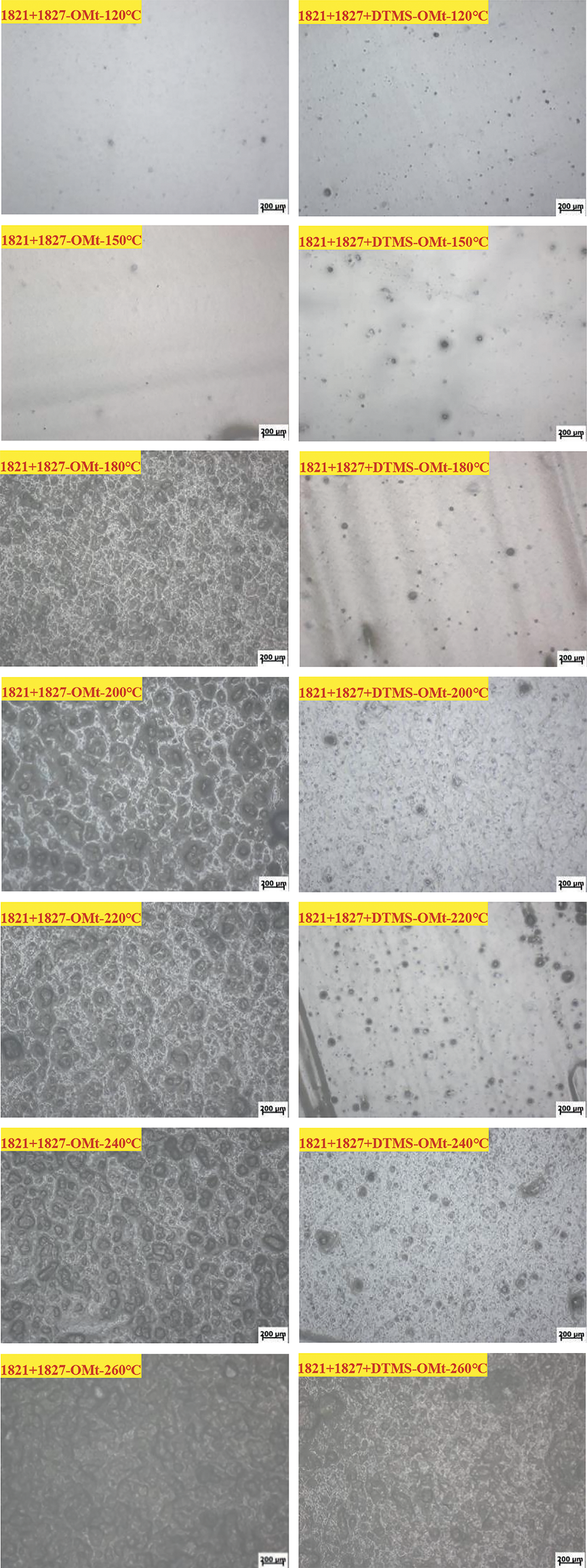
The optical microscope image (200 μm) (Fig. 8) illustrated the evolution of the morphology of the OMt/oil gels across a range of aging temperatures. The 1821+1827-OMt/oil gels aged at 120 and 150°C showed small, uniformly dispersed particles attributed to the synergistic effect of the high-temperature treatments and mechanical forces during aging. This process led to further dispersion of some of the undispersed OMts that were connected to each other through agglomerates, resulting in better dispersion of the particles. When the aging temperature was 180°C and above, the gel appeared in blocky form, indicating that 1821+1827-OMt appeared to be dispersed inhomogeneously within the OBF system along with the formation of large particles with a reduced dispersing ability. This is because, at high temperatures, interlayer organics desorbed into the oil phase, causing the Na-Mnt layers to reaccumulate, and the particles were visible as agglomerates under the microscope.
Micrographs of OMts after treatment at different temperatures.

Conversely, the 1821+1827+DTMS-OMt/oil gels maintained a more uniform structure across a wider range of temperatures (120–220°C), despite the presence of some large particles. The improved stability and dispersion were due primarily to two factors: (1) the spatial network structure formed between the modifier molecules was more stable due to the larger amount of modifier, which weakened the agglomeration tendency; (2) the silane association and adsorption on the surface or edge of the Na-Mnt layer prevented desorption of the quaternary ammonium salt of the 1821+1827+DTMS-OMt layer, making the particles less prone to agglomeration at these temperatures. However, at 240°C and 260°C, even the 1821+1827+DTMS-OMt began to exhibit a noticeable block structure, indicating an increase in particle agglomeration and a consequent decrease in dispersing efficiency at these greater temperatures.
N content analysis
The results of the N analysis are displayed in Table 1. The wet modification and the effect of high-temperature aging led to the degradation of some of the modifiers. As a consequence, a reduction in the nitrogen content occurred. The overall N content in the OMt/oil gel decreased gradually as the temperature increased. Regardless of the type of OMt, desorption occurred to varying extents, with greater temperatures leading to smaller N contents and more significant desorption. The N content of 1821+1827-OMt did not change significantly after aging at 120 and 150°C; the decrease was obvious at 180°C and above, suggesting a gradual desorption of the modifier. At the same temperature, 1821+1827+DTMS-OMt as a whole had a larger N content than 1821+1827-OMt, which was the covalent bonding acting as a site barrier.
N content of OMts after aging

Gel volume
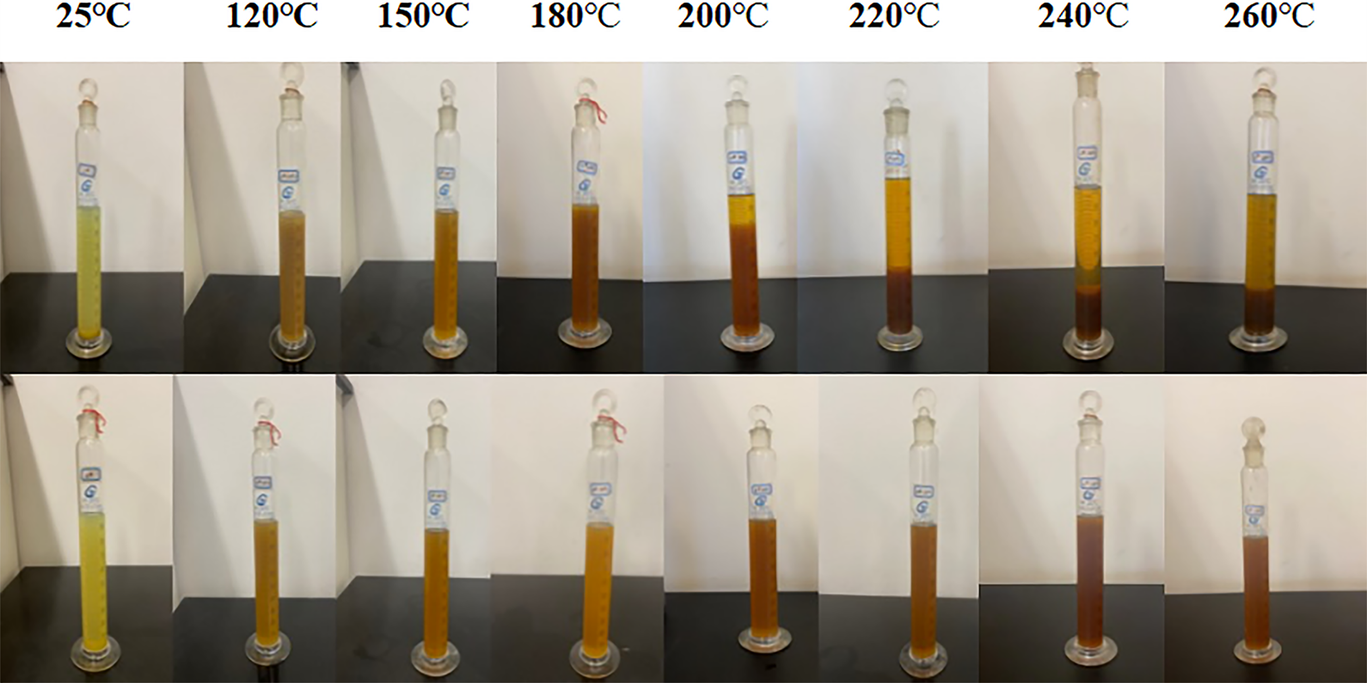
The gel volume variations in the OMt dispersed system with different temperatures are shown in Table 2 and Fig. 9. Initially, at room temperature (25°C), the suspension containing 1821+1827-OMt exhibited a smaller gel volume, whereas that with 1821+1827+DTMS-OMt displayed the gel volume of 100 mL. This superior colloidal stability was attributed to the secondary modification of the OMt with silane, which had enhanced the hydrophobicity of the clay edges, thereby improving dispersion in the base oil. However, at 180°C and above, the gel volume of 1821+1827-OMt started to decrease, and the stability and dispersibility decreased. In contrast, 1821+1827+DTMS-OMt maintained the gel volume of 100 mL even at 260°C. This remarkable stability was attributed to the covalent bonds that had formed between the Mnt layers and the silane (Guo et al., Reference Guo, Yang, Zhang, Zhang, Gao, Zhang and Zhang2020a). The formation of a spatial network structure, which was attributed to silane cross-linking and adsorption, enhanced the anti-coalescence properties of the OMt, thus improving its suspension qualities and resistance to high temperatures. These findings demonstrated that modification with silanes had improved the dispersion properties of the OMt under various thermal conditions. The combined results from XRD and TG-DTG analyses revealed that the modification of DTMS can improve the thermal stability of OMt significantly, and reduce the effect of high temperature on its structure and properties. Although XRD showed that the structural stability of 1821+1827+DTMS-OMt decreased significantly above 220°C, the gel volume remained unchanged at 260°C, which indicated that the retention of the gel volume was not only determined by the changes in the crystal structure, but was also closely related to factors such as dispersibility, solubility, and surface modification.
Gel volume of OMts at various aging temperatures

Gel volume of Na-Mnt and OMts aged at various temperatures (upper row: 1821+1827-OMt; lower row: 1821+1827+DTMS-OMt).

Rheological properties
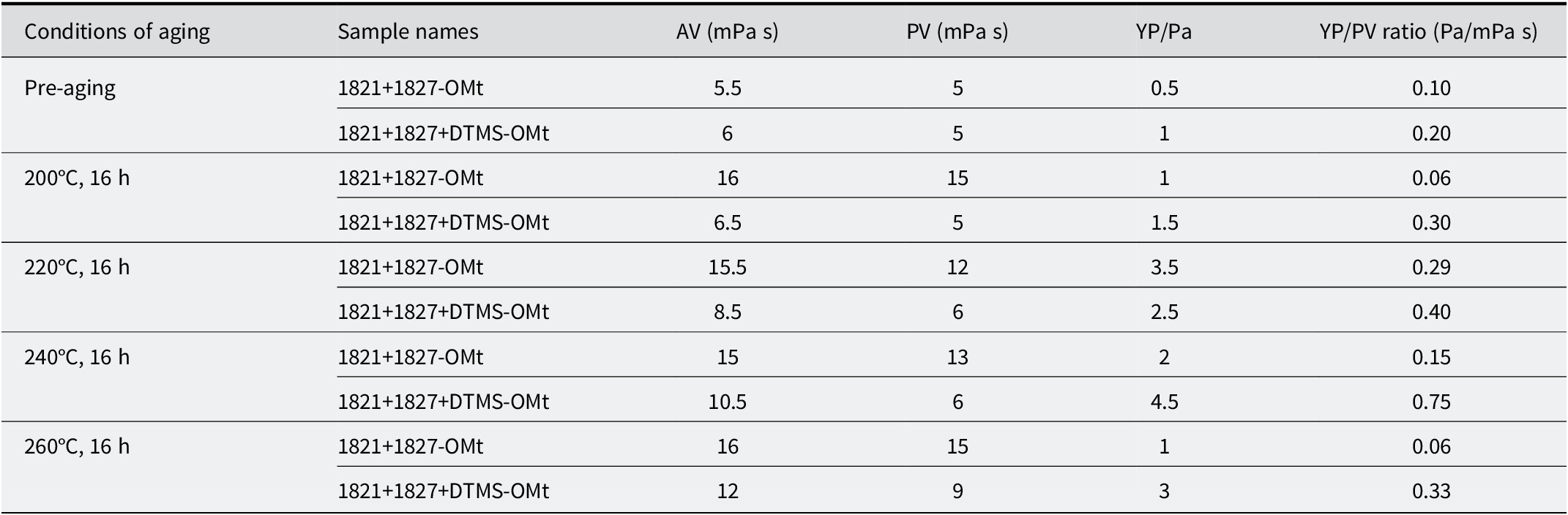
The AV and YP of drilling fluids are important factors that indicate their rheological properties. OMt increases both the viscosity and shear stress of the system (Okamoto et al., Reference Okamoto, Taguchi, Sato, Kotaka and Tateyama2000; Zhong and Wang, Reference Zhong and Wang2003). Furthermore, the rheology of drilling fluids depends not only on the properties of OMt but also on temperature. The rheological parameters of the system are shown in Table 3. The AV and YP of the 1821+1827+DTMS-OMt system increased after aging at 200, 220, 240, and 260°C because the Brownian motion was enhanced at high temperatures, which led to an increase in the frequency of molecular collisions and entanglement. The silane of 1821+1827+DTMS-OMt produced spatial site resistance at the edge of the layers, which prevented some of the oil molecules from entering the interlayer space. In addition, the interactions between the silane molecules and other molecules in the system overlapped and stacked to form a stable spatial network structure. Consequently, at the same temperature, the AV of 1821+1827+DTMS-OMt was lower than that of 1821+1827-OMt, and the YP was greater than that of 1821+1827-OMt. This conferred upon 1821+1827+DTMS-OMt the rheological property of ‘low viscosity and high yield point’. Meanwhile, the YP/PV ratio of 1821+1827+DTMS-OMt at various temperatures was reasonable, and the YP/PV ratio of 1821+1827-OMt was obviously insufficient in terms of rock-carrying capacity, and in general, the rheological parameters of 1821+1827+DTMS-OMt were better.
Rheological properties of OMts after high-temperature treatments

Conclusions
The present study revealed the thermal stability and properties of modified OCs, leading to four notable conclusions. These conclusions emphasize that OCs have enhanced heat resistance. (1) The onset of weight loss associated with Si-O-Si bonding in 1821+1827+DTMS-OMt was higher, at ~440°C, compared with 1821 and 1827. This indicates that the presence of the silane coupling agent enhanced the thermal stability. (2) After high-temperature aging, the decreasing trend point of the basal spacing of 1821+1827+DTMS-OMt (220°C) was significantly greater than that of 1821+1827-OMt (180°C), and the overall N residue was greater than that of 1821+1827-OMt, indicating that its structure was better preserved under the same thermal conditions. (3) In comparison with 1821+1827-OMt after aging at 260°C, the gel volume of 1821+1827+DTMS-OMt was still 100 mL, fewer large particles were observed under the microscope, and the resistance to agglomeration was better. (4) The 1821+1827+DTMS-OMt maintained more stable rheological properties at higher temperatures, the YP/PV ratio was more stable, and this further highlights the improved thermal stability.
These findings illustrated that 1821+1827+DTMS-OMt offered significant thermal stability advantages, primarily due to two factors: (1) silane maintained its structural stability effectively by forming strong covalent bonds with the oxygen atoms of Mnt, making it less prone to desorption or desorption at high temperatures; and (2) the steric hindrance of silane played a crucial role in inhibiting the desorption of quaternary ammonium between layers. Quaternary ammonium molecules were usually intercalated between the layers of Mnt by van der Waals forces or electrostatic interaction. When the temperature increases, these weak interactions may lead to the desorption of the quaternary ammonium, thus affecting the stability of Mnt. However, silane molecules formed a stereoscopic barrier on the surface of Mnt through its steric hindrance effect, which reduced the desorption of quaternary ammonium, and thus maintained the physical structure and hydrophobicity between layers effectively. The method was demonstrated to enhance the thermal stability and rheology of OBF, thereby improving wellbore stability. This method provided a novel solution for the application of OBF in high-temperature and high-pressure environments and has broad potential applications. The present study acknowledges certain limitations, including its temperature range, which could benefit from exploration at more extreme temperatures. In addition, future studies could be conducted in conjunction with actual oilfield applications to verify the practical application effect of this modified OC in oilfield drilling fluids and to improve further its application prospects.
Author contribution
Dongyue Zhang: Conceptualization, Methodology, Investigation, Formal Analysis, Visualization, Writing – Original Draft. Jianhua Wang: Methodology, Investigation, Writing – Review & Editing, Funding Acquisition. Xiaoxiao Ni: Methodology, Investigation, Writing – Review & Editing, Data Curation. He Shi: Conceptualization, Validation, Writing – Review & Editing. Jiaqi Zhang: Conceptualization, Supervision, Writing – Review & Editing.
Acknowledgments
The authors acknowledge the financial support provided by the Major Technology Field Trial Project of China National Petroleum Corporation (No. 2024ZS49) and the Scientific Research and Technology Development Project of China National Petroleum Corporation (No. 2020E-2803(JT)).
Financial support
This work was supported financially by the Major Technology Field Trial Project of China National Petroleum Corporation (No. 2024ZS49) and the Scientific Research and Technology Development Project of China National Petroleum Corporation (No. 2020E-2803(JT)).
Competing interests
The authors declare none.
Data availability statement
The data that support the findings of this study are available on request from the corresponding author.