INTRODUCTION
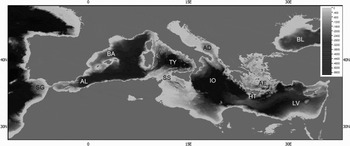
The Mediterranean Sea is a semi-enclosed body of water with limited connection to the world's oceans via the Strait of Gibraltar and the Suez Canal (Figure 1). Almost entirely surrounded by the landmass of 14 nations, human density in the region is high. The potential impact of human activities on the health and conservation status of Mediterranean species is of subsequent concern (EAA, 1999). The waters of the Mediterranean are exposed to the deleterious effects of chemical and acoustic pollution, marine debris, high levels of shipping and tourist traffic, climate change, coastal construction and depletion of marine resources through activities such as fishing. These factors may all contribute to the degradation and loss of cetacean habitat in the Mediterranean Sea (Notarbartolo di Sciara, Reference Notarbartolo di Sciara2002). As a result, populations of common bottlenose dolphins Tursiops truncatus (Montagu, 1821) in the Mediterranean basin have become increasingly fragmented (Notarbartolo di Sciara, Reference Notarbartolo di Sciara2002). The short-beaked common dolphin Delphinus delphis (Linnaeus, 1758) has declined in the northern part of the Mediterranean Sea (Bearzi et al., Reference Bearzi, Reeves, Notarbartolo Di Sciara, Politi, Cañadas, Frantzis and Mussi2003). Heavy metals and other persistent toxic compounds are known to accumulate in the blubber of local cetaceans (Aguilar et al., Reference Aguilar, Borrell and Reijnders2002). The conservation status of Black Sea cetaceans appears even worse than that of Mediterranean populations as local subspecies including the harbour porpoise Phocoena phocoena relicta (Abel, 1905), the common dolphin Delphinus delphis ponticus (Barabash-Nikiforov, 1935) and the bottlenose dolphin Tursiops truncatus ponticus (Barabasch, 1940) were subject to commercial catches until the 1980s (Birkun, Reference Birkun and Notarbartolo di Sciara2002).
Bathymetry and key locations within the Mediterranean Sea and contiguous Atlantic Ocean (constructed using Hydro-Plot, National Geophysical Data Center). AD, Adriatic Sea; AE, Aegean Sea; AL, Alborán Sea; BA, Balearic Sea; BL, Black Sea; HT, Hellenic Trench; IO, Ionian Sea; LV, Levantine Basin; SG, Strait of Gibraltar; SS, Strait of Sicily; TY, Tyrrhenian Sea.

Although the apparent decline of some Mediterranean cetacean species may have been caused by a combination of factors, it seems that the primary cause for species such as the sperm whale Physeter macrocephalus (Linnaeus, 1758) is entanglement in high-seas swordfish driftnets (Northridge, Reference Northridge1991; Tudela et al., Reference Tudela, Kai Kai, Mohamed El Andalossi and Guglielmi2005). Despite international and national regulations banning driftnets from the Mediterranean, Illegal, Unregulated and Unreported (IUU) fisheries are of great concern and continue in both the western and eastern Mediterranean (ACCOBAMS, 2006). Although information on the magnitude of this problem is lacking, there are numerous records of the bycatch of all notable species in most types of gear; striped dolphin Stenella coeruleoalba (Meyen, 1833), common dolphin and bottlenose dolphin are the species most often recorded (Bearzi, Reference Bearzi and Notarbartolo di Sciara2002). Scientists working in the region have long recognized the need for detailed population assessments in response to threats such as net entanglement. Of the 21 species of cetaceans known to occur in the Mediterranean and Black Seas (Notarbartolo di Sciara, Reference Notarbartolo di Sciara2002), 12 populations have recently been assessed under IUCN Red List Criteria at Regional Levels (Reeves & Notarbartolo di Sciara, Reference Reeves and Notarbartolo di Sciara2006). Of the nine Mediterranean species assessed, killer whales Orcinus orca (Linnaeus, 1758) from the Strait of Gibraltar were listed as Critically Endangered, the sperm whale and common dolphin as Endangered, striped and bottlenose dolphin as Vulnerable, and Risso's dolphin Grampus griseus (Cuvier, 1812), long-finned pilot whale Globicephala melas (Traill, 1809), fin whale Balaenoptera physalus (Linnaeus, 1758) and Cuvier's beaked whale Ziphius cavirostris (Cuvier, 1823) as Data Deficient (Reeves & Notarbartolo di Sciara, Reference Reeves and Notarbartolo di Sciara2006).
The Agreement for the Conservation of Cetaceans of the Black and Mediterranean Seas (ACCOBAMS), acting under the auspices of the Convention for Migratory Species, has identified a number of research actions required for the establishment of efficient management measures in the region. It is envisaged that a basin-wide systematic survey will be carried out across the whole Mediterranean Sea and the Black Sea, collecting data on at least nine species of cetacean. The general objectives of this survey will be to estimate abundance of cetaceans in the Mediterranean and Black Seas, to identify high density areas and thus investigate habitat preferences, and to identify areas of high biodiversity of groups of top predators. To provide preliminary baseline data, a series of surveys were conducted by the International Fund for Animal Welfare's (IFAW) RV ‘Song of the Whale’ between 2003 and 2007 in the Mediterranean Sea and contiguous regions under invitation from the ACCOBAMS Secretariat. The primary aim was to investigate a method for surveying sperm whales acoustically and to carry out trial acoustic surveys (Lewis et al., Reference Lewis, Gillespie, Lacey, Matthews, Danbolt, Leaper, McLanaghan and Moscrop2007; additional analysis ongoing). A secondary aim was to obtain information on encounter rates and relative densities for all cetacean species encountered. Four separate surveys were conducted using joint visual–acoustic techniques and this paper provides a brief description of the results of these studies relevant to the planning of a basin-wide survey.
MATERIALS AND METHODS
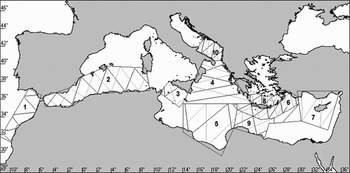
The Mediterranean regions selected for investigation were typically those areas with the most limited prior survey information, the eastern basin being particularly lacking in data. The first survey took place in 2003 from IFAW's 14 m auxiliary-powered sailing RV ‘Song of the Whale’. The core study areas were the Ionian Sea and the Sicilian and Malta Channels, but data were also collected on passage through the western Mediterranean. Following the commissioning of a new custom-designed 21 m ‘Song of the Whale’, a second survey took place in 2004 incorporating the western basin, followed by a third survey in 2007 in the eastern reaches of the Mediterranean. Survey data from the Atlantic coast of Morocco were also collected in 2005. The survey blocks and planned transects are shown in Figure 2.
Survey blocks and tracklines followed in the four surveys. From west to east: in 2005 north-west Morocco (1); in 2004 the western basin (2); in 2003 the Sicilian Channel (3) and Ionian Sea (4); in 2007 five blocks in the eastern basin (5–9) and a final block in the Adriatic (10).

Predetermined tracklines with randomly generated start points were laid out following the standard principles for line-transect survey design; surveys were based on the equal-spaced zigzag design, which gives a more nearly even coverage probability than the equal-angle zigzag design (Buckland et al., Reference Buckland, Anderson, Burnham, Laake, Borchers and Thomas2001). During daylight hours in clear weather with Beaufort sea states of three or less, two observers were stationed on an observation platform with an eye height of approximately 5.3 m above sea level. The port side observer scanned from 270° to 15° and the starboard observer from 345° to 90° relative to the vessel's direction of travel. Observers scanned with the naked eye and estimated ranges to sightings visually. Sightings were recorded directly to an on-deck computer terminal by a third person. Environmental and GPS data were logged to a database, including vessel position, sea surface temperature, depth and sea state. Visual surveys were conducted at speeds of 7 knots; when off track, the survey vessel typically maintained speeds of approximately 6 knots. During 2003, independence of the visual and acoustic surveys was maintained. However, from 2004 onwards, in order to increase the number of acoustic recordings of positively identified species, observers could be cued by acoustic events and non-observers. Acoustic events were identified using a two-element hydrophone array towed 200 m behind the vessel (appropriate for most cetacean species; 10 Hz–40 kHz bandwidth) and a two-element array (specifically for porpoises; 30–150 kHz bandwidth) towed 100 m behind the vessel. Incoming signals were automatically scanned for candidate odontocete clicks and whistles in the field using IFAW's suite of passive detection software (www.ifaw.org/sotw). Time of arrival differences of vocalizations on both hydrophone arrays were used to determine bearings to animals.
As the accuracy of group size estimation may vary with environmental conditions, encounter rates were calculated as the number of encounters with distinct groups per 100 nautical miles. Depth information for each on-track encounter was derived from the Geophysical Data System (National Geophysical Data Center) to a resolution of one minute. Distances to shore were measured using the software package Logger (www.ifaw.org). Comparisons of water depth and distance to shore between species were provided using a one-way ANOVA (data square-root transformed to approach normality; Tamahane's post-hoc test used as the variance across groups was not equal).
RESULTS
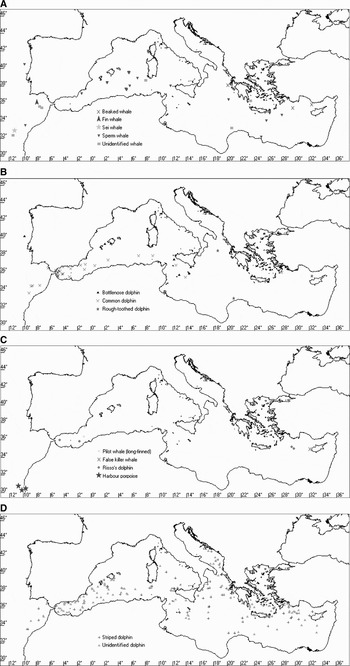
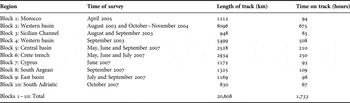
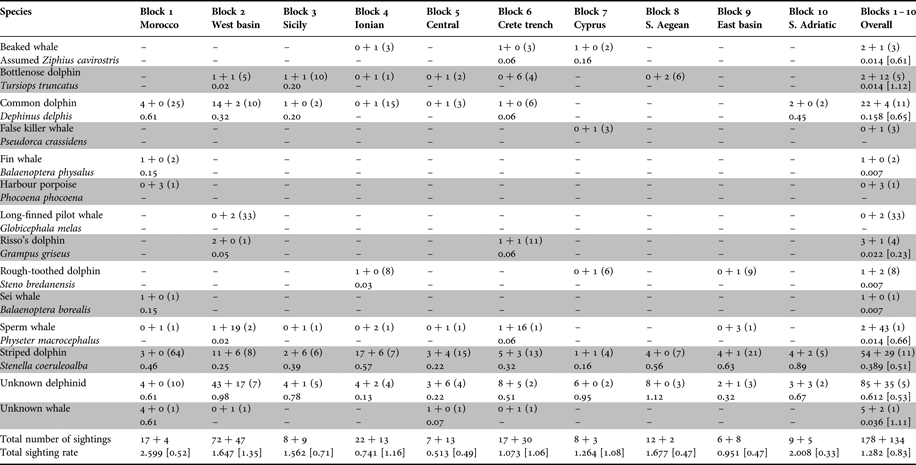
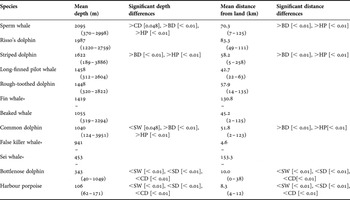
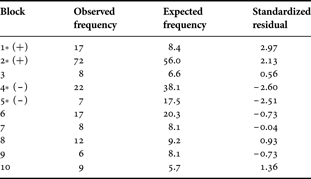
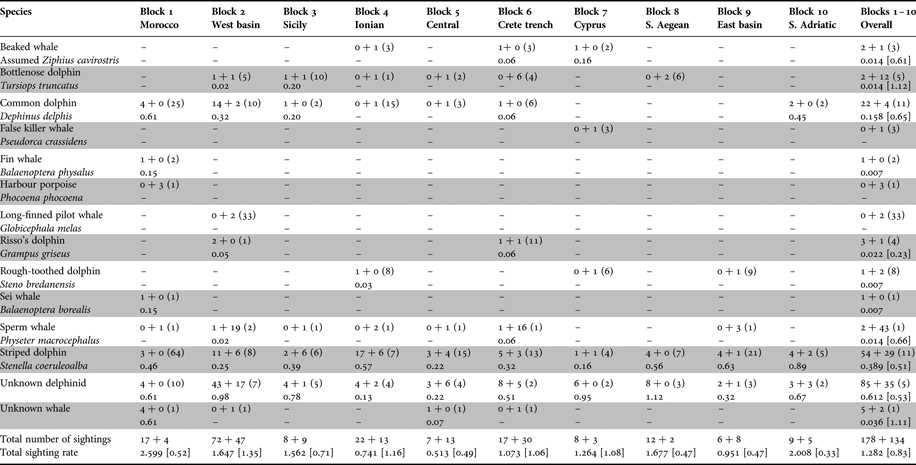
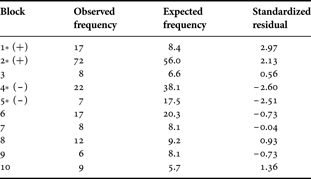
A total of ten blocks were surveyed by the ‘Song of the Whale’ team, representing a total of 21,000 km of trackline (Table 1). During these surveys, 11 cetacean species were seen in the Mediterranean and contiguous waters, namely bottlenose dolphin, Cuvier's beaked whale, fin whale, false killer whale Psuedorca crassidens (Owen, 1846), long-finned pilot whale, Risso's dolphin, rough-toothed dolphin Steno bredanensis (Cuvier, 1828), sei whale Balaenoptera borealis (Lesson, 1828), short-beaked common dolphin, sperm whale and striped dolphin (Figure 3). By far the most commonly encountered species in all areas surveyed was striped dolphin (Table 2). Baleen whales were only encountered in the contiguous region outside the main body of the Mediterranean Sea. An additional species, the harbour porpoise, was encountered just outside the contiguous region along Morocco's Atlantic seaboard (Boisseau et al., Reference Boisseau, Matthews, Gillespie, Lacey, Moscrop and El Ouamari2007). Certain species, notably the sperm whale, were more readily detected using acoustic techniques than visual; subsequent off-effort tracking of sperm whales resulted in higher encounter rates off the trackline. Some species such as the sperm whale and Risso's dolphin tended to be found in deeper, offshore waters, while others such as harbour porpoise and bottlenose dolphins were found in shallower water close to land (Table 3). Encounter rates (weighted for length of trackline) were not even between blocks (χ2 = 30.6, P < 0.01); comparison of standardized residuals suggests there were more encounters than expected in the western blocks 1 and 2 but fewer in the central blocks 4 and 5 (Table 4).
Sightings (on and off track) made from 2003 to 2007; (a) beaked, sperm, baleen (and unidentified) whales, (b) bottlenose, common and rough-toothed dolphins, (c) pilot whales, false killer whales, Risso's dolphins and harbour porpoises; (d) striped (and unidentified) dolphins.

Effort for blocks surveyed in the Mediterranean and contiguous region, 2003–2007.

Summary of sightings and on-track detection rates for each survey block. The upper values represent the number of encounters on the trackline plus the number of off-track encounters (mean group size in parentheses); the lower value represents the sighting rate (encounters per 100 nautical miles of trackline). Values in square brackets represent coefficients of variance.
Mean depth of water and distance from land at which all sightings were made (range of values in parentheses). Those species with only one encounter are marked with an asterisk. Significant differences were derived using a one-way ANOVA on square-root transformed values test (Tamahane's post-hoc test used as the variance across groups was not equal). Numbers in square brackets are P values at the 95% level. BD, bottlenose dolphin; CD, common dolphin; HP, harbour porpoise; SD, striped dolphin; SW, sperm whale.

Comparison of the number of encounters in each block (weighted by amount of trackline); asterisks indicate blocks with standardized residuals above the 95% critical value of 1.96 (χ2 = 30.6, P < 0.01, + represents values higher than expected, – represents lower values).
2003: Ionian Sea and Strait of Sicily
Six cetacean species were sighted in the Ionian Sea and Strait of Sicily in 2003 (summarized in Lacey et al., Reference Lacey, Lewis, Moscrop and Evans2005). Striped dolphins were widespread throughout the region while common and bottlenose dolphins were encountered primarily to the south of Sicily. A group of rough-toothed dolphins was seen in the Ionian Sea. During the survey, sperm whales were only sighted after first being detected acoustically and subsequently located by taking the vessel off-track; consequently there are no sperm whale sightings in Table 2. An off-track sighting of three Cuvier's beaked whales was also made off Kefallonia, Greece.
2004: south-west Mediterranean
The southern part of the western Mediterranean was surveyed between October and November in 2004. During the survey, six cetacean species were seen, namely bottlenose, common, Risso's and striped dolphins, sperm and pilot whales. Sperm whales were only observed when off-track. Bottlenose and common dolphins were observed to have contrasting distributions, with the former more likely in shallower northern waters and the latter more likely in the deeper southern basin. Sightings of pilot whales and Risso's dolphins were confined to the western Alborán Sea; striped dolphins were widespread.
2005: West Africa
The Atlantic waters contiguous to the Mediterranean were surveyed in spring 2005 between the latitudes of 20°N and 37°N. During this survey six cetacean species were identified. Although sperm whales were routinely encountered near the Canary Islands, only one sighting was made in the contiguous region (latitude 33°N) in the deeper waters off the continental slope. The northernmost sighting of porpoises was of four individuals in Agadir Bay, which to the authors' knowledge are the first sightings in Moroccan waters (Boisseau et al., Reference Boisseau, Matthews, Gillespie, Lacey, Moscrop and El Ouamari2007). The other whales identified (fin and sei) were encountered intermittently while common and striped dolphin encounters tended to be close to the Strait of Gibraltar.
2007: the eastern basin
In order to survey different habitats and geographical areas, this large basin was sub-divided into six separate blocks. A research permit was not granted for Egypt thus prohibiting surveys up to 200 nautical miles off its coastline. A total of eight cetacean species were encountered. As with other areas in the Mediterranean, striped dolphins appeared to be uniformly dispersed. Sperm whale and Cuvier's beaked whale sightings typically occurred in the deepest waters apart from an encounter with a lone sperm whale in the relatively shallow waters (370 m deep) off the coast of Libya. Bottlenose dolphins were only encountered in the north, towards the Aegean Sea; similarly the only sighting of common dolphins occurred to the north, off the east coast of the Greek island of Rhodes. Occasional sightings were also made of false killer whales, Risso's dolphins and rough-toothed dolphins.
DISCUSSION
Previous cetacean research effort in much of the area covered by these surveys has been limited, particularly to the east of the Mediterranean basin and along the Mediterranean and Atlantic coasts of Africa. The data presented here are therefore intrinsically valuable, especially as there are concerns over the conservation status of several cetacean species in the Mediterranean Sea (Bearzi et al., Reference Bearzi, Reeves, Notarbartolo Di Sciara, Politi, Cañadas, Frantzis and Mussi2003). Many of the species encountered are identified by ACCOBAMS as regular Mediterranean species (short-beaked common dolphin, striped dolphin, common bottlenose dolphin, Risso's dolphin, long-finned pilot whale, fin whale, sperm whale and Cuvier's beaked whale) or regular contiguous Atlantic species (harbour porpoise). The remaining two species encountered in this study (rough-toothed dolphin and false killer whale) are described as visitors to the Mediterranean. These studies have expanded and clarified some of the known distributions of cetaceans within the Mediterranean Sea. New species documented from Libyan waters include sperm whale, striped dolphin and rough-toothed dolphin. False killer whales and rough-toothed dolphins were documented for the first time off Cyprus. Live harbour porpoises were seen for the first time in Atlantic Moroccan waters.
The Mediterranean Sea is an enclosed basin connected to the Atlantic Ocean by a 290 m deep sill at the Strait of Gibraltar. There is also a connection to the Red Sea and on into the Indian Ocean via the Suez Canal. In contrast to the flat 2700 m deep basin of the western Mediterranean, the Ionian, Levantine and Aegean Seas in the eastern basin are characterized by alternating deep depressions and morphological highs, submarine valleys and steep slopes (EEA, 1999). River catchments are generally small in the Mediterranean and excessive evaporation is partially compensated by an inflow of Atlantic surface water through the Strait of Gibraltar. Although the Mediterranean is an oligotrophic sea, this influx of Atlantic water creates cyclonic circuits (EEA, 1999) and thus areas such as the Alborán Sea and the Ligurian Sea are noted for being highly productive. The eastern basin tends to have warmer, more saline waters and correspondingly lower rates of productivity (Bosc et al., Reference Bosc, Bricaud and Antoine2004), although the Rhodes gyre in the northern Levantine Sea stimulates increased primary production. In general, the Mediterranean is characterized by a relatively low biomass and a high diversity, which is twice as great in the western as in the eastern basin. This is reflected in higher than expected cetacean encounter rates in blocks 1 and 2 (the contiguous Atlantic region and the Alborán Sea respectively); these blocks represent the transition zone between the Mediterranean Sea and the Atlantic Ocean.
Perhaps more surprising is that encounter rates are not significantly lower than expected in the eastern basin. In this area, it is possible local populations are bolstered in the summer months by an influx of individuals or groups. Oceanographic systems and bathymetric features may act as ecological barriers for within the Mediterranean Sea (Patarnello et al., Reference Patarnello, Volckaert and Castilho2007). For example, the Strait of Sicily provides a 160 km wide interface between the western and eastern basins. As the maximum depth of this region is 316 m, it is likely that the Strait may restrict the movements of deeper water cetaceans such as sperm whales, beaked whales, pilot whales and Risso's dolphin. Indeed, in this study the Ionian block and central basin block were found to have fewer encounters than expected by chance alone. Although an unsuitable habitat for many cetacean species, it seems unlikely that the Straits of Sicily and Messina act as a migratory barrier; deep water species are found in the eastern basin and are unlikely to have entered through the Suez Canal. However, the Suez Canal cannot be ruled out as a corridor for shallower water species. This 190 km canal is 60 m wide at is narrowest point and reaches a maximum depth of 22 m, presumably restricting the transit of deep water species. However, since the canal was created in 1869 there has been a steady influx of biota from the subtropical Red Sea (Patarnello et al., Reference Patarnello, Volckaert and Castilho2007). Indeed, recent rare occurrences of cetacea along the Israeli coast are thought to represent animals entering the region from the Suez Canal via lessepsian migration (Kerem et al., Reference Kerem, Goffman and Spanier2001; Scheinin et al., Reference Scheinin, Kerem, Goffman and Spanier2004). Currently about 300 species of flora and fauna from the Red Sea have been identified in the Mediterranean Sea (Belmaker et al., Reference Belmaker, Brokovich, China, Golani and Kiflawi2009) and of the cetaceans encountered in the studies presented here, these may include the rough-toothed dolphin and false-killer whale. Comprehensive surveys of the Egyptian coast may be able to quantify the degree of lessepsian migration.
Common bottlenose dolphin
Although the distribution of common bottlenose dolphins in the Mediterranean may have historically been continuous in coastal regions, it is now marked by gaps with low densities. In the survey data presented here, bottlenose dolphin distribution was patchy, with most sightings occurring within 10 km of islands. In keeping with other coastal sightings, group sizes were small, ranging from 1 to 25 individuals. No sightings were made in African waters although the southern basin is noted for its intermittent occurrence of bottlenose dolphins; indeed occurrence has only previously been reported for Morocco, Algeria and Tunisia (Bearzi et al., Reference Bearzi, Fortuna and Reeves2009). Individuals were encountered along Turkey's coastline as far as the Gulf of Antalya; however no sightings were made near Cyprus. Indeed no bottlenose dolphins were encountered further east than 30°E although the survey tracklines did not penetrate the extreme eastern Levantine basin.
Cuvier's beaked whale
Beaked whales were observed on only three occasions during the surveys; off the Greek island of Kefalonia and twice off Turkey's Antalya coastline. These encounters fall well within the known range for this species within the Mediterranean. A lack of sightings in the southern basin is in keeping with previous reports for the region where Cuvier's beaked whales have not been recorded from sightings and even the stranding record exhibits a pronounced absence (Podestà et al., Reference Podestà, D'Amico, Pavan, Drougas, Komnenou and Portunato2006). The inconspicuous nature of beaked whales suggests acoustic techniques may provide a more appropriate detection tool.
False killer whale
Another species known largely from stranded and bycaught individuals, false killer whales are classified as ‘visitor’ species to the Mediterranean (Reeves & Notarbartolo di Sciara, Reference Reeves and Notarbartolo di Sciara2006). In this study, false killer whales were encountered only once and the two individuals recorded off Cyprus add to several other sightings made in recent years in the eastern Mediterranean near Israel (Scheinin et al., Reference Scheinin, Kerem, Goffman and Spanier2004). Indeed, until the 1990s, no records of false killer whales had been noted in the eastern basin of the Mediterranean (east of 18°E). Although typically found in deep water habitats Pseudorca have been known to utilize shallower waters around oceanic islands (Baird, Reference Baird, Perrin, Würsig and Thewissen2002) and as such their occurrence off Cyprus is not unprecedented. The presence of false killer whales in the eastern basin may represent an eastwards extension of the species range in the Mediterranean or a more recent influx of individuals through the Suez Canal.
Fin whale
Although the fin whale is the most commonly sighted baleen whale in the Mediterranean, no individuals were encountered during these surveys. A possible individual fin whale was observed off the south-west tip of Sardinia although the species was not definitively identified. However, the low encounter rate is to be expected as the vessel did not survey near the Ligurian–Corsican–Provençal basin, one of the principal feeding grounds for fin whales in the Mediterranean Sea. Indeed a recent review of fin whale sightings and strandings suggested 90% of all live encounters have occurred in the Ligurian–Corsican–Provençal and Tyrrhenian basins (Notarbartolo di Sciara et al., Reference Notarbartolo di Sciara, Zanardelli, Jahoda, Panigada and Airoldi2003), neither of which were surveyed in the trips reported here.
Harbour porpoise
Full results for porpoises over the entire survey are reported fully in Boisseau et al. (Reference Boisseau, Matthews, Gillespie, Lacey, Moscrop and El Ouamari2007). The northernmost sighting of porpoises in the contiguous Atlantic area was of four individuals in Agadir Bay, which to the authors' knowledge are the first sightings in Moroccan waters (see Bayed & Beaubrun, Reference Bayed and Beaubrun1987 for a review of strandings in Morocco). As might be expected, no sightings were made within the Mediterranean; the few previously confirmed sightings of porpoises seem to be of ‘fringe’ individuals in the waters neighbouring the Atlantic and/or Black Sea (Frantzis et al., Reference Frantzis, Gordon, Hassidis and Komnenou2001, Reference Frantzis, Alexiadou, Paximadis, Politi, Gannier and Corsini-Foka2003).
Killer whale
Killer whales were not encountered in these surveys. Although a known population of three pods is described as a regular species for the Strait of Gibraltar (Cañadas & de Stephanis, Reference Cañadas, de Stephanis, Reeves and Notarbartolo di Sciara2006), relatively little time was spent in this area during our surveys. It would appear killer whale distribution is largely limited to the extreme west of the Mediterranean with only occasional incidents of ‘visitors’ in the western basin. The killer whale seems to be largely absent from the eastern basin with little evidence of ingress from the Suez Canal.
Long-finned pilot whale
Long-finned pilot whales were notable by their absence from all regions surveyed except the Alborán Sea, an area of known importance for this species (McBrearty et al., Reference McBrearty, Message, King, Bryden and Harrison1986). Another region of high encounter density, the north-western Mediterranean Sea (Praca & Gannier, Reference Praca and Gannier2007), was not surveyed in the course of these cruises. Our surveys support the notion that long-finned pilot whales are absent from the eastern Mediterranean basin (Frantzis et al., Reference Frantzis, Alexiadou, Paximadis, Politi, Gannier and Corsini-Foka2003). The water depths of our encounters, between 300 and 2600 m, were at the very extremes of those previously reported for the Alborán Sea (over 80% between 500 and 1200 m; Cañadas & Sagarminaga, Reference Cañadas and Sagarminaga2000).
Risso's dolphin
Although Risso's dolphins have been considered scarce in the eastern Mediterranean, this species was encountered twice in the eastern basin, including a long encounter with a group of approximately 12 individuals plus calves. It is possible these individuals represent the eastern frontier of a relatively high density population noted for the Aegean Sea (Frantzis et al., Reference Frantzis, Alexiadou, Paximadis, Politi, Gannier and Corsini-Foka2003). Risso's dolphins were also encountered twice in the Alborán Sea, and although previous records suggest this species is more prevalent in the western basin, this may in part be due to a relative lack of survey effort. The sightings reported here were consistent with the previously reported preference of this species for outer-slope habitats, presumably due to the distribution of their cephalopod prey (Cañadas et al., Reference Cañadas, Sagarminaga and Garcìa-Tiscar2002; Azzellino et al., Reference Azzellino, Gaspari, Airoldi and Nani2008). However, the distance from shore and mean depth of the encounters presented here are notably greater than in comparable surveys (Notarbartolo di Sciara et al., Reference Notarbartolo di Sciara, Venturino, Zanardelli, Bearzi, Borsani and Cavalloni1993; Gannier & West, Reference Gannier and West2005). These surveys also confirmed the noted lack of sightings in the southern Mediterranean Sea.
Rough-toothed dolphin
The biology of this species is poorly studied and little is known about global population structure. The known distribution includes tropical and warm temperate oceanic waters from approximately 32°S to 53°N (Rice, Reference Rice1998). Despite this they are rarely sighted in the Mediterranean Sea (Notarbartolo di Sciara, Reference Notarbartolo di Sciara2002) and are classified as ‘visitor’ species to the Mediterranean and ‘possibly visitor’ to the contiguous Atlantic by Reeves & Notarbartolo di Sciara (Reference Reeves and Notarbartolo di Sciara2006). Although bones and stranded individuals have been discovered on several beaches in the Mediterranean, free-ranging animals appear to have been reported on only two previous occasions, in the Ionian Sea and off Israel. During the former encounter, a large group of 160 individuals was observed in the Sicilian Channel (Watkins et al., Reference Watkins, Tyack, Moore and Notarbartolo di Sciara1987) while during the latter encounter, a large group of approximately 30 dolphins entered the Port of Haifa, Israel, and stayed throughout the day feeding on mullet (Kerem, Reference Kerem2005). In this study, three sightings were made of rough-toothed dolphins, all east of 18°E longitude. A group of eight animals (including one calf) was sighted during the survey in the Ionian Sea in September 2003. Another group of approximately nine animals was encountered in June 2007 and appears to be the first occurrence of this species noted off Cyprus. A final encounter in July 2007 of 10 individuals (including calves) off Libya is the first record of this species in North African waters. An unconfirmed sighting of this species was also made to the south of Malta in October, an unusual encounter for the region (A. Vella, personal communication).
Internationally, rough-toothed dolphins are more likely to be sighted in deep offshore waters although they have been observed in relatively shallow coastal waters (Jefferson, Reference Jefferson, Perrin, Würsig and Thewissen2002). It seems the distribution of rough-toothed dolphins in the Mediterranean is fluid with some sightings made close to land and others made in offshore waters. Encounters in this study occurred both inshore and offshore (15, 25 and 135 km from land) and in both mid and deep water habitats (320, 1202 and 2822 m deep respectively). However, the 2005 encounter reported from the port of Haifa (Kerem, Reference Kerem2005) suggests this species can range in to very shallow water regions. Within the Mediterranean, regional peaks in abundance have been observed, as suggested by beaching events off Israel that have typically occurred in the spring (Kerem, Reference Kerem2005). Although there is only weak evidence of seasonality, it is striking that all sightings and cases of live-caught animals have occurred in the Mediterranean between March and September (Reeves & Notarbartolo di Sciara, Reference Reeves and Notarbartolo di Sciara2006; this study). It is not clear if this summer bias reflects a lack of survey effort in winter months or a genuine influx of animals in the summer months, either via the Red Sea or Atlantic Ocean. In other areas, Steno has exhibited year-round site-fidelity in limited geographical regions, such as off La Gomera (Ritter, Reference Ritter2002) and Tahiti (Gannier & West, Reference Gannier and West2005). As this species has been encountered throughout the Mediterranean and groups have often included young calves, it is possible there is a stable population of Steno in the Mediterranean that are not transient visitors. As such, it may be appropriate to revise the status of rough-toothed dolphin in the Mediterranean from visitor to regular species. It is possible that the application of acoustic classification techniques to survey recordings of the ‘Song of the Whale’ may identify further encounters with Steno in the Mediterranean (analysis ongoing).
Short-beaked common dolphin
The short-beaked common dolphin is currently listed as an endangered sub-population within the Mediterranean under the IUCN Red List Categories (Reeves & Notarbartolo di Sciara, Reference Reeves and Notarbartolo di Sciara2006). Sightings between the Aegean and Alborán sectors of the Mediterranean appear to be of isolated remnant groups and the once large aggregate subpopulation is now a small fraction of what it once was as recently as the middle of the 20th Century (Bearzi et al., Reference Bearzi, Reeves, Notarbartolo Di Sciara, Politi, Cañadas, Frantzis and Mussi2003). Large groups of common dolphins are routinely encountered in the Alborán Sea in contrast with the smaller groups recorded elsewhere in the Mediterranean. Apart from the eastern Ionian Sea and the Aegean Sea, no reliable data exist for most of the eastern Mediterranean basin except for a rare encounter off the Israeli coastline (see Bearzi et al., Reference Bearzi, Reeves, Notarbartolo Di Sciara, Politi, Cañadas, Frantzis and Mussi2003; Stockin et al., Reference Stockin, Vella and Evans2005 for reviews).
During the surveys described here, the encounter rates of common dolphins were highest in western blocks and gradually decreased to the east, an outcome in keeping with the prevailing knowledge of common dolphin distribution in the Mediterranean. One of the sightings in 2007 was near Malta, an area noted for several encounters with large groups of common dolphins (Vella, Reference Vella, Stockin, Vella and Evans2004). The most eastern sighting was off Rhodes, an area thought to represent the species' eastern boundary, the occasional rare occurrence off the Israeli coastline notwithstanding (Goffman et al., Reference Goffman, Roditi, Shariv, Spanier and Kerem2000). This sighting was of interest as it occurred to the south of Rhodes; this species is rarely seen south of the latitudinal line connecting the island of Rhodes with the island of Kythira to the west (Frantzis et al., Reference Frantzis, Alexiadou, Paximadis, Politi, Gannier and Corsini-Foka2003). Most sightings however were made west of 14°E. Survey data from North Africa are particularly valuable and although common dolphins were encountered off Morocco, Algeria and Tunisia, it is notable that none were observed off the Libyan coast. Common dolphins were encountered in a range of water depths but were mostly associated with shallow slope regions; only occasional sightings were made in deeper waters (mean depth of encounters = 1040 m). This aggregation near shallower slope and shelf regions is in keeping with a complementary survey in the northern reaches of the Mediterranean (Gannier, Reference Gannier2005), although our sightings of common dolphins tended to be in deeper waters further from land.
Sperm whale
Sperm whales are thought to roam across the Mediterranean as part of a single genetically discrete subpopulation. The population status in the Mediterranean Sea is presently ‘endangered’ (Reeves & Notarbartolo di Sciara, Reference Reeves and Notarbartolo di Sciara2006) and encounter rates have been unexpectedly low during recent years. Our surveys suggest on-track sightings rates for sperm whales are extremely low; indeed only two sperm whale groups were encountered visually on the trackline throughout the surveys presented here. Both on-track and off-track sightings in the western basin occurred primarily in waters deeper than 2000 m although no sightings were made in the Tyrrhenian Sea; sightings in the eastern basin were typically closely associated with slope regions and were rare in open waters. However, as sperm whales are much more readily detected using acoustic techniques, there were a correspondingly high number of acoustic detections particularly in the western basin. The acoustic results for 2003 have already been presented (Lewis et al., Reference Lewis, Gillespie, Lacey, Matthews, Danbolt, Leaper, McLanaghan and Moscrop2007) and analysis of subsequent years is ongoing.
Striped dolphin
The striped dolphin is believed to be the most abundant cetacean in the Mediterranean (Forcada et al., Reference Forcada, Aguilar, Hammond, Pastor and Aguilar1994; Forcada & Hammond, Reference Forcada and Hammond1998). By far the most commonly encountered cetacean during theses surveys, striped dolphins were found to be fairly uniformly distributed. The lowest encounter rates occurred in the most southern and eastern blocks (namely the central basin, south Crete and around Cyprus). Perhaps surprisingly, relatively few sightings were made in the Alborán Sea, an area characterized by high encounter rates for other species. The water depth of encounters in these surveys had a bimodal distribution with 48% of sightings taking place in water depths between 400 and 1400 m and 32% between 2400 and 3200 m. As most sightings were made at least 50 km from land, these encounters support the notion of the striped dolphin in the Mediterranean as a ‘wide ranging oceanic and slope species’ as described by Gannier (Reference Gannier2005). Sightings within the Adriatic were confined to relatively deep southern waters, supporting the theory that this pelagic species is relatively abundant towards the southern portion of the Adriatic Sea but less numerous in the shallower northern region (Bearzi et al., Reference Bearzi, Holcer and Di Sciara2004). Although large schools were encountered in the contiguous Atlantic region (approximately 150 individuals on one occasion), group sizes were typically smaller within the Mediterranean, with 88% of groups being composed of fewer than 15 individuals.
Summary
Although visual encounter rates are to some extent dependent on the survey vessel, particularly the height of the viewing platform, relative rates from similar vessels such as in this study provide valid information. As the primary goal of these surveys was to survey for sperm whales, an emphasis on acoustic detection was considered appropriate as sperm whales are detected far more readily by acoustic than by visual techniques. To reduce potential biases to the acoustic survey, field protocol reduced the opportunities to break track to explore sightings of lower priority species. Thus there were a relatively high number of encounters with unidentified dolphin and whale species that may have been identified by closer approaches. As other deep diving species, such as Cuvier's beaked whale, may be detected more readily by hydrophone than eye, future efforts to survey basin-wide may benefit from a greater division between acoustic and visual techniques with perhaps a separate vessel or time-period for dedicated acoustic work. Despite their shortcomings, these surveys may represent the best available data for extensive areas not covered in previous surveys (e.g. Notarbartolo di Sciara et al., Reference Notarbartolo di Sciara, Zanardelli, Jahoda, Panigada and Airoldi2003; Gannier, Reference Gannier2005; Cañadas & Hammond, Reference Cañadas and Hammond2006; Gómez de Segura et al., Reference Gómez de Segura, Crespo, Pedraza, Hammond and Raga2006). These data will be useful for ACCOBAMS' proposed basin-wide cetacean survey. For the purposes of planning line transect surveys, Buckland et al. (Reference Buckland, Anderson, Burnham, Laake, Borchers and Thomas2001) recommend that pilot surveys such as those presented here be carried out to determine the expected encounter rate in the survey region. The survey effort needed to provide a required precision in the abundance estimate can then be predicted. The information presented here may also assist in partitioning survey areas to ensure survey vessels can collect sufficient numbers of detections for the purposes of estimating their individual detection functions.
ACKNOWLEDGEMENTS
A special thanks to Marie-Christine Grillo-Compulsione, the staff of the ACCOBAMS Secretariat, and the ACCOBAMS Scientific Committee, for supporting the survey. Thanks also to all those who have helped us gain the necessary permissions to conduct the research and for assisting in the planning of the surveys. We would like to thank the following participants from 17 countries: Sabina Airoldi, Marta Azzolin, Myriam Ben Abid, Federico Bendinoni, Duncan Borg, Stefan Bräger, Valérie Burgener, Susannah Calderan, Simone Canese, Ayhan Dede, Carlo Della Libera, Paul Dolder, Najib El Ouamari, Faid El Madani, Ruth Esteban, Mahmoud Fouad, Christina Francia, Veronica Frank, Alexandros Frantzis, Mohamed Ghani, Popi Gikopoulou, Harun Guclusoy, Guðjón Andri Gylfason, Mark Hadley, Hildur Harðar, Andrew Howard, Volkan Hürsever, Aliki Kaltsidou, Cem Kıraç, Zafer Kizilkaya, Mohamed Makloufi, Pilar Marcos, Carmen Mifsud, Géraldine Montpelier, Hanna Nuutilla, Makis Pagidas, Ana Peña, Evelyn Philpott, Anna Särnblad, Alicia Sánchez Cabanes, Alessia Scuderi, Joh Sidey, Arda Tonay, Eda Topçu, Denik Ulqini, Joseph Vella, Masha Vorontsova and Ursula Woodburn.